Urolithiasis
BY
Prof Dr; Ahmed ragab
Epidemiology
Ten per cent of the population may expect to have an
episode of stone disease during their lifetime.
The upper urinary tract is affected in most cases. Bladder
stones are found in a small proportion of men with bladder
outflow obstruction.
The incidence in children remains high in some developing
countries. Age: peak age 20-40 years.
The prevalence of stones changes with age and is lower in
women. Sex: male : female = 3-1
Intrinsic causes ;play the major role like metabolic causes
,genetic,obstraction,infection
Extrinsic causes has arole like climate daitery and water
intake
Metabolic
Ca Stones: Hypercalcemia, Hypercalccuria. Hyperoxaluria
Uric Acid: Gout, Hyperuricosuria
Cystine: Autosomal recessive Disorder
Xanthine Stones: Heriditary xanthinuria
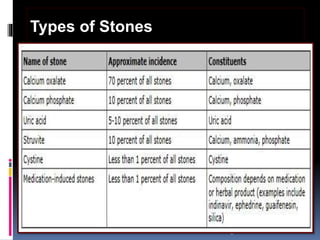
Etiology and Pathogenesis
Risk Factors
Excess Calcium in urine
Idiopathic hypercalcuria
Hyperparathyroidism
Losing Calcium because of recumbency.
Excess Oxalate in urine
Congenital Hyperoxaluria (rare disease)
Surgical removal of last feets of ileum
Hyperuricosuria (uric acid stone)
Congenital error of tubular function
Gout (Hyperuricemia)
Tissue break down e.g. tumors and Chemotherapy
Infection
Changes the PH of Urine (Urea Splitting Organisms →
alkalinization of Urine) leads to alkaline urine which result in
Magnesium-Ammonium- Phosphate (MAP) Struvite stones
insoluble in alkaline urine. It grows at high rate (Stag-Horn
stone)
Obstruction:
Stasis & infection; Anatomical obstructing conditions
associated with higher incidence of stones leads to (2ry
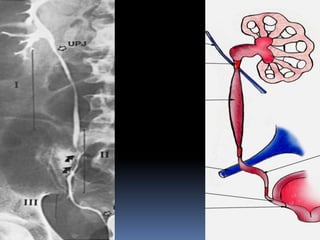
stones) like: PUJ, BPH, ureteric stricture, urethral stricture,
horseshoe kidney,
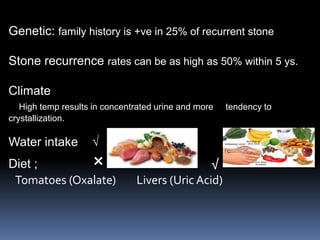
Genetic: family history is +ve in 25% of recurrent stone
Stone recurrence rates can be as high as 50% within 5 ys.
Climate
High temp results in concentrated urine and more tendency to
crystallization.
Water intake √
Diet ; × √
Tomatoes (Oxalate) Livers (Uric Acid)
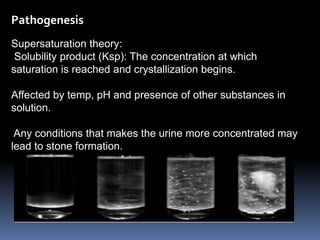
Pathogenesis
Supersaturation theory:
Solubility product (Ksp): The concentration at which
saturation is reached and crystallization begins.
Affected by temp, pH and presence of other substances in
solution.
Any conditions that makes the urine more concentrated may
lead to stone formation.
Lack of inhibitors : disturbed colloid-crystalloid ratio such as
mucin and nucleic acid, and Citrate.
Nucleation: to form a lattice upon witch crystals aggregate eg:
cell debris, RBCs, bacteria, casts or other nuclei.
Growth and Aggregation: to form a stone, crystals grow in size
to be large enough to occlude collecting duct.
Retention (Rhandal,s theories) : Fixed nucleation in interstitial
and intracellular crystallization and leads to formation of
Rhandal,s plaque which later rupture into the urinary stream.
NANOBACTERIA: It is claimed that Calcifying NanoParticles
(CNPs) is responsible for formation of apatite stone (calcium
phosphate)
©
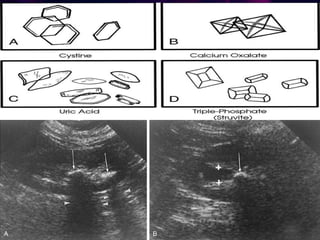
Types of Stones
©
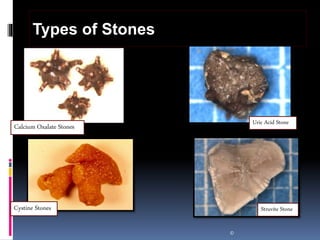
Types of Stones
Calcium Oxalate Stones
Uric Acid Stone
Cystine Stones Struvite Stone
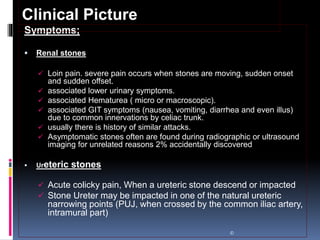
Symptoms;
 Renal stones
 Loin pain. severe pain occurs when stones are moving, sudden onset
and sudden offset.
 associated lower urinary symptoms.
 associated Hematurea ( micro or macroscopic).
 associated GIT symptoms (nausea, vomiting, diarrhea and even illus)
due to common innervations by celiac trunk.
 usually there is history of similar attacks.
 Asymptomatic stones often are found during radiographic or ultrasound
imaging for unrelated reasons 2% accidentally discovered
 Ureteric stones
 Acute colicky pain, When a ureteric stone descend or impacted
 Stone Ureter may be impacted in one of the natural ureteric
narrowing points (PUJ, when crossed by the common iliac artery,
intramural part)
©
Clinical Picture
 Bladder Stones:
 Either formed in the bladder (Due to Obstruction) or
descending from the upper tract.
 Presenting with Frequency, Interruption of urine
stream & Maybe terminal hematuria
 Urethral Stones
 Mostly Migrating from above, or rarely formed in a
urethral diverticulum
 Causes interruption of stream then acute retention
©
Clinical Picture
Signs: according to its site maks tenderness at area over
its unless complicated.
 Infection
 Obstruction
 Migration
 Hematuria
 Retention (if impacted in the urethra or the bladder neck)
 Malignancy: Rarely squamous cell carcinoma of the
renal pelvis due to chronic irritation by long standing
stone.
 Calculus anuria: Post renal acute renal failure due to
complete obstruction in a single functioning kidney.
©
Complications
 Laboratory:
 Urinalysis
 Serum Calcium & Uric Acid
 Renal Function Tests
 Radiological
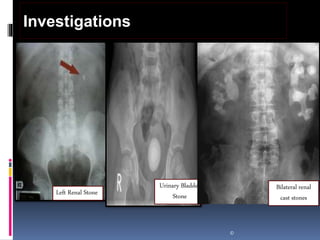
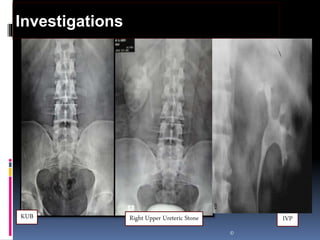
 KUB – 90% of Stones are Radio-opaque
 IVU: Stone appear as filling defect , obstruction & Back pressure Not useful if the
kidney is not functioning or during pain. Nephrotoxic Contraindicated if serum
creatinine >2.5mg/dl. Allergic reactions to contrast is common.Takes longer time than
CT
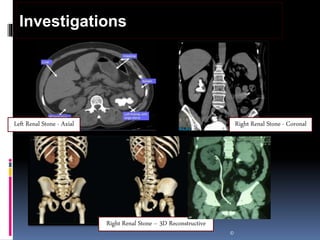
 CT Scan : Helpful to diagnose Radiolucent Stones & determining stone densityThe
imaging of choice in patients with renal colic No contrast complications No need to
asses kidney function before use May show other causes of acute abdominal pain It
can predict stone fragility.
 Ultrasound & Radio-Isotopic Scan
 MRU: magnetic resonant urography. Suitable in bad function kidney. Show the
level of obstruction and may show the stone.
 Instrumental
 Endoscopy
©
Investigations
©
Investigations
Left Renal Stone
Urinary Bladder
Stone
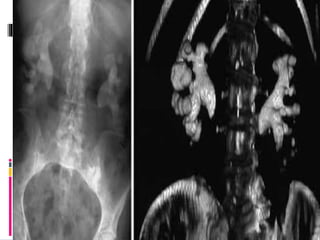
Bilateral renal
cast stones
©
Investigations
Right Upper Ureteric StoneKUB IVP
©
Investigations
Left Renal Stone - Axial Right Renal Stone - Coronal
Right Renal Stone – 3D Reconstructive
Differential diagnosis
1. DD of renal colic from other causes of acute
abdomen eg: appendicitis, diverticulitis,
colicystitis, intestinal obstruction.
2. DD of stone in KUB from other radio opaque
shadows in the abdomen ( gall bladder stone,
philipolithes, calcified lymph nodes or dermoid
cyst).
3. DD of filling defect in IVU: stone, tumor, blood
clot.
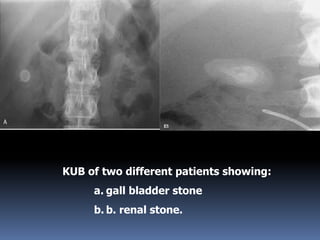
KUB of two different patients showing:
a. gall bladder stone
b. b. renal stone.
 Renal Stones:
 Conservative management of small renal stones
 MET ;in the form of excessive fluid analgesic when needed α
blocker. May expand to one month unless uncontrollable pain, fever
increase backpressure or anuria
 Extracorporeal shockwave lithotripsy
 Effective for treating kidney stones 2 cm in maximum diameter, as
long as no obstruction to the passage of stone fragments is present.
 Retrograde Renoscopy
A laser fibre can be introduced through a flexible fibre optic
reterorenoscope, which is introduced through the urethra and bladder,
and up the ureter to the renal collecting system. Stones 1 cm in
diameter can be disintegrated.
©
Treatment
 Renal Stones:
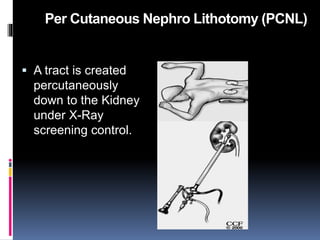
 Percutaneous nephrolithotomy
 Stones 2 cm in diameter or more may be treated by
percutaneous nephrolithotomy. Under fluoroscopic control
 Open surgery
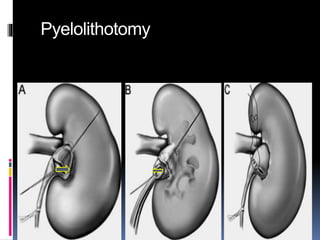
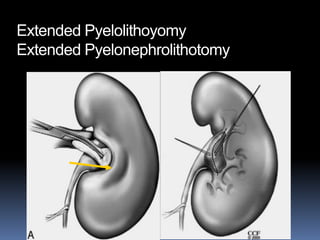
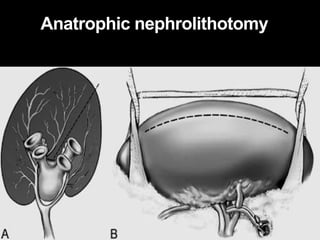
 Staghorn stones Kidneys that contribute pyelolithotomy or
extended pyelolithotomy ,nephrolithotomy anatrophic.
 Laparscopic and Robotics
 NEPHRECTOMY: may be resorted to in late cases
(complicated non functioning kidney).
©
Treatment
Bilateral Renal Stones
Operate on the better functioning Kidney first.
Two exceptions:
1. Severe pain
2. Presence of infection
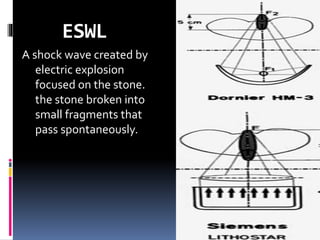
ESWL
A shock wave created by
electric explosion
focused on the stone.
the stone broken into
small fragments that
pass spontaneously.
Contraindications of ESWL
1. Gross skeletal abnormalities
2. excessive weight
3. Pregnant women
4. Large abdominal aortic aneurysms or
5. uncorrectable bleeding disorders
6. Unsuitable for large stone
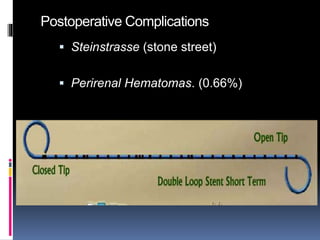
Postoperative Complications
 Steinstrasse (stone street)
 Perirenal Hematomas. (0.66%)
Per Cutaneous Nephro Lithotomy (PCNL)
 A tract is created
percutaneously
down to the Kidney
under X-Ray
screening control.
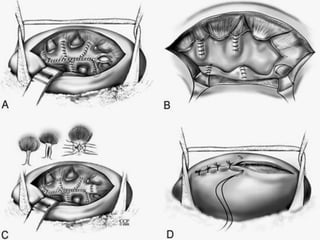
Pyelolithotomy
Extended Pyelolithoyomy
Extended Pyelonephrolithotomy
Anatrophic nephrolithotomy
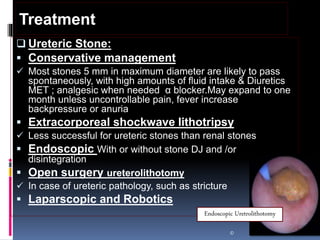
 Ureteric Stone:
 Conservative management
 Most stones 5 mm in maximum diameter are likely to pass
spontaneously, with high amounts of fluid intake & Diuretics
MET ; analgesic when needed α blocker.May expand to one
month unless uncontrollable pain, fever increase
backpressure or anuria
 Extracorporeal shockwave lithotripsy
 Less successful for ureteric stones than renal stones
 Endoscopic With or without stone DJ and /or
disintegration
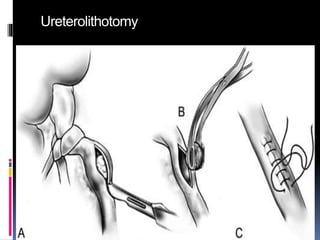
 Open surgery ureterolithotomy
 In case of ureteric pathology, such as stricture
 Laparscopic and Robotics
©
Treatment
Endoscopic Uretrolithotomy
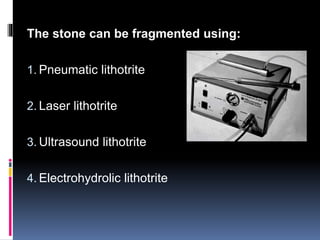
The stone can be fragmented using:
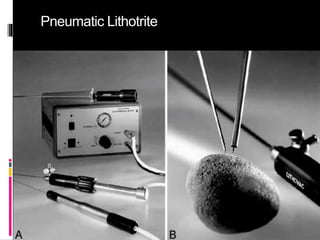
1. Pneumatic lithotrite
2. Laser lithotrite
3. Ultrasound lithotrite
4. Electrohydrolic lithotrite
Pneumatic Lithotrite
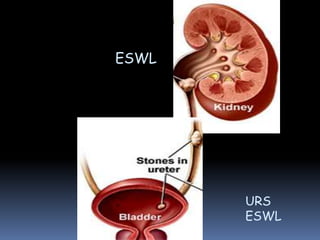
ESWL
URS
ESWL
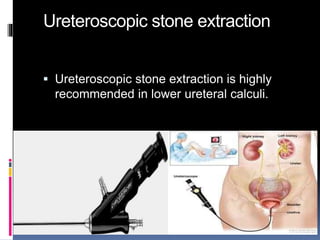
Ureteroscopic stone extraction
 Ureteroscopic stone extraction is highly
recommended in lower ureteral calculi.
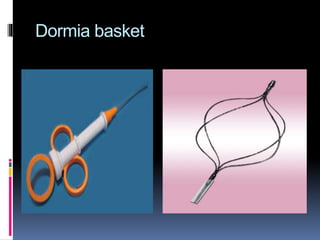
Dormia basket
Ureterolithotomy
Bladder Stones
 Endoscopic (Cystolitholapaxy)
 In stones less than 2cm
 Surgical (Cystolithotomy):
 Larger than 2cm,
 Hard stones (Resistent for Crushing)
 Stones associated with diverticulum or Bladder neck
obstruction (BPH)
Laparscopic and Robotics
©
Treatment
Uretheral stone
 Conservative; small ,smooth,priviousely
passer
 Endoscopy pouch Bach into the bladder
and mange unless impacted to prevent
Uretheral stricture
 Meatotomy and extracted if large and
impacted in navicular fossa
 Stone analysis
 Serum Ca & Phosphorus to exclude
Hyperparathyroidism
 24 hour collection of urine for: Ca, Oxalate, Citrate,
Uric Acid
 Diet modification (Avoid diet containing the
causative crystals) plus high fluid intake
 Modifivation of Urine PH (Alkalinization in uric acid
stones by oral NaHCO3 or Acidification in
phosphate stones by Vitamin C)
 Prevention & Treatment of UTI
©
Prevention & Metabolic Work-up
►RIRS;
http://www.youtube.com/watch?v=YNRSv
PR8azE
►Robotics;
http://www.youtube.com/watch?v=N2vjO2
lzpHo
Thanks for Allah
then Thank you

Urolithiasis by prof dr ahmed ragab

  • 2.
  • 3.
    Epidemiology Ten per centof the population may expect to have an episode of stone disease during their lifetime. The upper urinary tract is affected in most cases. Bladder stones are found in a small proportion of men with bladder outflow obstruction. The incidence in children remains high in some developing countries. Age: peak age 20-40 years. The prevalence of stones changes with age and is lower in women. Sex: male : female = 3-1
  • 4.
    Intrinsic causes ;playthe major role like metabolic causes ,genetic,obstraction,infection Extrinsic causes has arole like climate daitery and water intake Metabolic Ca Stones: Hypercalcemia, Hypercalccuria. Hyperoxaluria Uric Acid: Gout, Hyperuricosuria Cystine: Autosomal recessive Disorder Xanthine Stones: Heriditary xanthinuria Etiology and Pathogenesis
  • 5.
    Risk Factors Excess Calciumin urine Idiopathic hypercalcuria Hyperparathyroidism Losing Calcium because of recumbency. Excess Oxalate in urine Congenital Hyperoxaluria (rare disease) Surgical removal of last feets of ileum Hyperuricosuria (uric acid stone) Congenital error of tubular function Gout (Hyperuricemia) Tissue break down e.g. tumors and Chemotherapy
  • 6.
    Infection Changes the PHof Urine (Urea Splitting Organisms → alkalinization of Urine) leads to alkaline urine which result in Magnesium-Ammonium- Phosphate (MAP) Struvite stones insoluble in alkaline urine. It grows at high rate (Stag-Horn stone) Obstruction: Stasis & infection; Anatomical obstructing conditions associated with higher incidence of stones leads to (2ry stones) like: PUJ, BPH, ureteric stricture, urethral stricture, horseshoe kidney,
  • 7.
    Genetic: family historyis +ve in 25% of recurrent stone Stone recurrence rates can be as high as 50% within 5 ys. Climate High temp results in concentrated urine and more tendency to crystallization. Water intake √ Diet ; × √ Tomatoes (Oxalate) Livers (Uric Acid)
  • 8.
    Pathogenesis Supersaturation theory: Solubility product(Ksp): The concentration at which saturation is reached and crystallization begins. Affected by temp, pH and presence of other substances in solution. Any conditions that makes the urine more concentrated may lead to stone formation.
  • 9.
    Lack of inhibitors: disturbed colloid-crystalloid ratio such as mucin and nucleic acid, and Citrate. Nucleation: to form a lattice upon witch crystals aggregate eg: cell debris, RBCs, bacteria, casts or other nuclei. Growth and Aggregation: to form a stone, crystals grow in size to be large enough to occlude collecting duct. Retention (Rhandal,s theories) : Fixed nucleation in interstitial and intracellular crystallization and leads to formation of Rhandal,s plaque which later rupture into the urinary stream. NANOBACTERIA: It is claimed that Calcifying NanoParticles (CNPs) is responsible for formation of apatite stone (calcium phosphate)
  • 10.
  • 11.
    © Types of Stones CalciumOxalate Stones Uric Acid Stone Cystine Stones Struvite Stone
  • 13.
    Symptoms;  Renal stones Loin pain. severe pain occurs when stones are moving, sudden onset and sudden offset.  associated lower urinary symptoms.  associated Hematurea ( micro or macroscopic).  associated GIT symptoms (nausea, vomiting, diarrhea and even illus) due to common innervations by celiac trunk.  usually there is history of similar attacks.  Asymptomatic stones often are found during radiographic or ultrasound imaging for unrelated reasons 2% accidentally discovered  Ureteric stones  Acute colicky pain, When a ureteric stone descend or impacted  Stone Ureter may be impacted in one of the natural ureteric narrowing points (PUJ, when crossed by the common iliac artery, intramural part) © Clinical Picture
  • 14.
     Bladder Stones: Either formed in the bladder (Due to Obstruction) or descending from the upper tract.  Presenting with Frequency, Interruption of urine stream & Maybe terminal hematuria  Urethral Stones  Mostly Migrating from above, or rarely formed in a urethral diverticulum  Causes interruption of stream then acute retention © Clinical Picture Signs: according to its site maks tenderness at area over its unless complicated.
  • 15.
     Infection  Obstruction Migration  Hematuria  Retention (if impacted in the urethra or the bladder neck)  Malignancy: Rarely squamous cell carcinoma of the renal pelvis due to chronic irritation by long standing stone.  Calculus anuria: Post renal acute renal failure due to complete obstruction in a single functioning kidney. © Complications
  • 16.
     Laboratory:  Urinalysis Serum Calcium & Uric Acid  Renal Function Tests  Radiological  KUB – 90% of Stones are Radio-opaque  IVU: Stone appear as filling defect , obstruction & Back pressure Not useful if the kidney is not functioning or during pain. Nephrotoxic Contraindicated if serum creatinine >2.5mg/dl. Allergic reactions to contrast is common.Takes longer time than CT  CT Scan : Helpful to diagnose Radiolucent Stones & determining stone densityThe imaging of choice in patients with renal colic No contrast complications No need to asses kidney function before use May show other causes of acute abdominal pain It can predict stone fragility.  Ultrasound & Radio-Isotopic Scan  MRU: magnetic resonant urography. Suitable in bad function kidney. Show the level of obstruction and may show the stone.  Instrumental  Endoscopy © Investigations
  • 18.
    © Investigations Left Renal Stone UrinaryBladder Stone Bilateral renal cast stones
  • 19.
  • 20.
    © Investigations Left Renal Stone- Axial Right Renal Stone - Coronal Right Renal Stone – 3D Reconstructive
  • 21.
    Differential diagnosis 1. DDof renal colic from other causes of acute abdomen eg: appendicitis, diverticulitis, colicystitis, intestinal obstruction. 2. DD of stone in KUB from other radio opaque shadows in the abdomen ( gall bladder stone, philipolithes, calcified lymph nodes or dermoid cyst). 3. DD of filling defect in IVU: stone, tumor, blood clot.
  • 22.
    KUB of twodifferent patients showing: a. gall bladder stone b. b. renal stone.
  • 24.
     Renal Stones: Conservative management of small renal stones  MET ;in the form of excessive fluid analgesic when needed α blocker. May expand to one month unless uncontrollable pain, fever increase backpressure or anuria  Extracorporeal shockwave lithotripsy  Effective for treating kidney stones 2 cm in maximum diameter, as long as no obstruction to the passage of stone fragments is present.  Retrograde Renoscopy A laser fibre can be introduced through a flexible fibre optic reterorenoscope, which is introduced through the urethra and bladder, and up the ureter to the renal collecting system. Stones 1 cm in diameter can be disintegrated. © Treatment
  • 25.
     Renal Stones: Percutaneous nephrolithotomy  Stones 2 cm in diameter or more may be treated by percutaneous nephrolithotomy. Under fluoroscopic control  Open surgery  Staghorn stones Kidneys that contribute pyelolithotomy or extended pyelolithotomy ,nephrolithotomy anatrophic.  Laparscopic and Robotics  NEPHRECTOMY: may be resorted to in late cases (complicated non functioning kidney). © Treatment
  • 26.
    Bilateral Renal Stones Operateon the better functioning Kidney first. Two exceptions: 1. Severe pain 2. Presence of infection
  • 27.
    ESWL A shock wavecreated by electric explosion focused on the stone. the stone broken into small fragments that pass spontaneously.
  • 28.
    Contraindications of ESWL 1.Gross skeletal abnormalities 2. excessive weight 3. Pregnant women 4. Large abdominal aortic aneurysms or 5. uncorrectable bleeding disorders 6. Unsuitable for large stone
  • 29.
    Postoperative Complications  Steinstrasse(stone street)  Perirenal Hematomas. (0.66%)
  • 30.
    Per Cutaneous NephroLithotomy (PCNL)  A tract is created percutaneously down to the Kidney under X-Ray screening control.
  • 31.
  • 32.
  • 34.
  • 36.
     Ureteric Stone: Conservative management  Most stones 5 mm in maximum diameter are likely to pass spontaneously, with high amounts of fluid intake & Diuretics MET ; analgesic when needed α blocker.May expand to one month unless uncontrollable pain, fever increase backpressure or anuria  Extracorporeal shockwave lithotripsy  Less successful for ureteric stones than renal stones  Endoscopic With or without stone DJ and /or disintegration  Open surgery ureterolithotomy  In case of ureteric pathology, such as stricture  Laparscopic and Robotics © Treatment Endoscopic Uretrolithotomy
  • 37.
    The stone canbe fragmented using: 1. Pneumatic lithotrite 2. Laser lithotrite 3. Ultrasound lithotrite 4. Electrohydrolic lithotrite
  • 38.
  • 40.
  • 41.
    Ureteroscopic stone extraction Ureteroscopic stone extraction is highly recommended in lower ureteral calculi.
  • 42.
  • 43.
  • 44.
    Bladder Stones  Endoscopic(Cystolitholapaxy)  In stones less than 2cm  Surgical (Cystolithotomy):  Larger than 2cm,  Hard stones (Resistent for Crushing)  Stones associated with diverticulum or Bladder neck obstruction (BPH) Laparscopic and Robotics © Treatment
  • 45.
    Uretheral stone  Conservative;small ,smooth,priviousely passer  Endoscopy pouch Bach into the bladder and mange unless impacted to prevent Uretheral stricture  Meatotomy and extracted if large and impacted in navicular fossa
  • 46.
     Stone analysis Serum Ca & Phosphorus to exclude Hyperparathyroidism  24 hour collection of urine for: Ca, Oxalate, Citrate, Uric Acid  Diet modification (Avoid diet containing the causative crystals) plus high fluid intake  Modifivation of Urine PH (Alkalinization in uric acid stones by oral NaHCO3 or Acidification in phosphate stones by Vitamin C)  Prevention & Treatment of UTI © Prevention & Metabolic Work-up
  • 47.
  • 49.