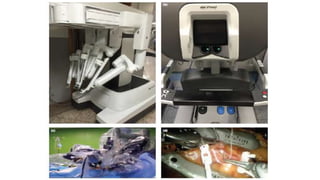
Minimal Invasive Surgery
(M.I.S.)
UG 4th Semester Batch
17/10/22
Dr. Ankita Singh
Assistant Professor
Department of Surgery
Learning Objectives
• What is M.I.S. ?
• History
• What are the indications?
• What are the advantages & disadvantages?
• Prerequisites & Principles
• Complications
Terminologies
• Minimal Access Surgery(MAS)
– surgical innovation that aims to accomplish surgical therapeutic goals with
minimal somatic and psychological trauma.
– reduced wound access trauma, as well
– less disfiguring than conventional techniques
• Minimal Invasive Surgery(MIS)
– Laparoscopic
– Endoscopic
Laparoscopy: History
• First laparoscopic cholecystectomy –
– done by Muhe of Germany in 1985 & by Mouret in Lyon in 1987
– in USA in 1988, by McKeran and Saye
– In India, by Professor TE Udwadia
• First laparoscopic appendicectomy –
– done by Semm as prophylaxis
– by Schreiber in 1987 for acute appendicitis
Laparoscopy: Advantages
• Relatively less painful
– Trauma of access is very less
• Shorter hospital stay and early return to work
• Faster postoperative recovery
• Better visualization of the anatomy,
– better approach for dissection and visualization of other parts of abdomen for
any other pathology
• Instrumental access to different locations is many times better
• Minimal scar
Laparoscopy: Limitations
• Relative contraindications:
– Compromised cardiac status
– Peritonitis
– Previous abdominal surgeries.
– Bleeding disorders.
– Morbid obesity.
– Third trimester pregnancy.
– Portal hypertension.
Laparoscopy: Limitations..
• Limitations of MIS:
– Reliance on remote vision and operating
– Loss of tactile feedback
– Dependence on hand–eye coordination
– Difficulty with hemostasis
– Reliance on new techniques
– Extraction of large specimens
Laparoscopy: Prerequisites
• Overall fitness: cardiac arrhythmia, emphysema, medications,
allergies
• Previous surgery: scars, adhesions
• Body habitus: obesity, skeletal deformity
• Normal coagulation
• Thromboprophylaxis
• Informed consent
• Instruments used
Laparoscopy: Prerequisites..
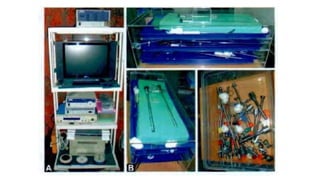
• Instruments used:
– Laparoscope
– Camera
– Cold light source
– Video monitor
– C02 insufflator
– Surgical instruments:
• Long fine dissectors
• Hooks & spatulas
• Clip applicators
• Needle holders
• Endostaplers
• Veress needle
• Suction-irrigation apparatus
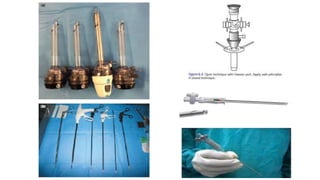
• Trocars
• Reducers
Laparoscopy: Prerequisites..
• Preparation:
– General anesthesia
– Prevention of inadvertent injuries
– Pressure bandages/ cuffs
– Position of patient
• Strapping
• According to surgery
• Reverse Trendelenburg position
Laparoscopy: Technique
• Access:
– Open vs. closed method
• Creation of pneumoperitonium
• Visualization
• Additional ports
– Triangulation
– Ergonomics
• Sometimes additional incision required
Laparoscopy: Physiologic changes
• CO2 causes
– hypercarbia, acidosis and hypoxia.
• Pneumoperitoneum
– decreases the venous return
– increases the arterial pressure
• It compromises the respiratory function
– by compressing over the diaphragm
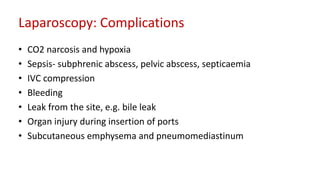
Laparoscopy: Complications
• CO2 narcosis and hypoxia
• Sepsis- subphrenic abscess, pelvic abscess, septicaemia
• IVC compression
• Bleeding
• Leak from the site, e.g. bile leak
• Organ injury during insertion of ports
• Subcutaneous emphysema and pneumomediastinum
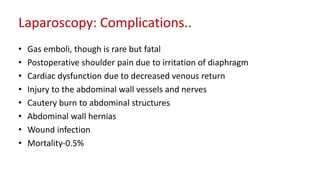
Laparoscopy: Complications..
• Gas emboli, though is rare but fatal
• Postoperative shoulder pain due to irritation of diaphragm
• Cardiac dysfunction due to decreased venous return
• Injury to the abdominal wall vessels and nerves
• Cautery burn to abdominal structures
• Abdominal wall hernias
• Wound infection
• Mortality-0.5%
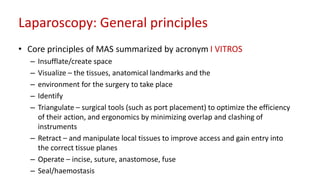
Laparoscopy: General principles
• Core principles of MAS summarized by acronym I VITROS
– Insufflate/create space
– Visualize – the tissues, anatomical landmarks and the
– environment for the surgery to take place
– Identify
– Triangulate – surgical tools (such as port placement) to optimize the efficiency
of their action, and ergonomics by minimizing overlap and clashing of
instruments
– Retract – and manipulate local tissues to improve access and gain entry into
the correct tissue planes
– Operate – incise, suture, anastomose, fuse
– Seal/haemostasis
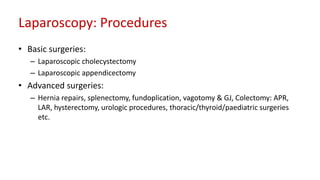
Laparoscopy: Procedures
• Basic surgeries:
– Laparoscopic cholecystectomy
– Laparoscopic appendicectomy
• Advanced surgeries:
– Hernia repairs, splenectomy, fundoplication, vagotomy & GJ, Colectomy: APR,
LAR, hysterectomy, urologic procedures, thoracic/thyroid/paediatric surgeries
etc.
Thank you
Any questions?

Minimal access surgery basics.pptx

  • 1.
    Minimal Invasive Surgery (M.I.S.) UG4th Semester Batch 17/10/22 Dr. Ankita Singh Assistant Professor Department of Surgery
  • 2.
    Learning Objectives • Whatis M.I.S. ? • History • What are the indications? • What are the advantages & disadvantages? • Prerequisites & Principles • Complications
  • 3.
    Terminologies • Minimal AccessSurgery(MAS) – surgical innovation that aims to accomplish surgical therapeutic goals with minimal somatic and psychological trauma. – reduced wound access trauma, as well – less disfiguring than conventional techniques • Minimal Invasive Surgery(MIS) – Laparoscopic – Endoscopic
  • 4.
    Laparoscopy: History • Firstlaparoscopic cholecystectomy – – done by Muhe of Germany in 1985 & by Mouret in Lyon in 1987 – in USA in 1988, by McKeran and Saye – In India, by Professor TE Udwadia • First laparoscopic appendicectomy – – done by Semm as prophylaxis – by Schreiber in 1987 for acute appendicitis
  • 5.
    Laparoscopy: Advantages • Relativelyless painful – Trauma of access is very less • Shorter hospital stay and early return to work • Faster postoperative recovery • Better visualization of the anatomy, – better approach for dissection and visualization of other parts of abdomen for any other pathology • Instrumental access to different locations is many times better • Minimal scar
  • 6.
    Laparoscopy: Limitations • Relativecontraindications: – Compromised cardiac status – Peritonitis – Previous abdominal surgeries. – Bleeding disorders. – Morbid obesity. – Third trimester pregnancy. – Portal hypertension.
  • 7.
    Laparoscopy: Limitations.. • Limitationsof MIS: – Reliance on remote vision and operating – Loss of tactile feedback – Dependence on hand–eye coordination – Difficulty with hemostasis – Reliance on new techniques – Extraction of large specimens
  • 8.
    Laparoscopy: Prerequisites • Overallfitness: cardiac arrhythmia, emphysema, medications, allergies • Previous surgery: scars, adhesions • Body habitus: obesity, skeletal deformity • Normal coagulation • Thromboprophylaxis • Informed consent • Instruments used
  • 9.
    Laparoscopy: Prerequisites.. • Instrumentsused: – Laparoscope – Camera – Cold light source – Video monitor – C02 insufflator – Surgical instruments: • Long fine dissectors • Hooks & spatulas • Clip applicators • Needle holders • Endostaplers • Veress needle • Suction-irrigation apparatus • Trocars • Reducers
  • 13.
    Laparoscopy: Prerequisites.. • Preparation: –General anesthesia – Prevention of inadvertent injuries – Pressure bandages/ cuffs – Position of patient • Strapping • According to surgery • Reverse Trendelenburg position
  • 14.
    Laparoscopy: Technique • Access: –Open vs. closed method • Creation of pneumoperitonium • Visualization • Additional ports – Triangulation – Ergonomics • Sometimes additional incision required
  • 15.
    Laparoscopy: Physiologic changes •CO2 causes – hypercarbia, acidosis and hypoxia. • Pneumoperitoneum – decreases the venous return – increases the arterial pressure • It compromises the respiratory function – by compressing over the diaphragm
  • 16.
    Laparoscopy: Complications • CO2narcosis and hypoxia • Sepsis- subphrenic abscess, pelvic abscess, septicaemia • IVC compression • Bleeding • Leak from the site, e.g. bile leak • Organ injury during insertion of ports • Subcutaneous emphysema and pneumomediastinum
  • 17.
    Laparoscopy: Complications.. • Gasemboli, though is rare but fatal • Postoperative shoulder pain due to irritation of diaphragm • Cardiac dysfunction due to decreased venous return • Injury to the abdominal wall vessels and nerves • Cautery burn to abdominal structures • Abdominal wall hernias • Wound infection • Mortality-0.5%
  • 18.
    Laparoscopy: General principles •Core principles of MAS summarized by acronym I VITROS – Insufflate/create space – Visualize – the tissues, anatomical landmarks and the – environment for the surgery to take place – Identify – Triangulate – surgical tools (such as port placement) to optimize the efficiency of their action, and ergonomics by minimizing overlap and clashing of instruments – Retract – and manipulate local tissues to improve access and gain entry into the correct tissue planes – Operate – incise, suture, anastomose, fuse – Seal/haemostasis
  • 19.
    Laparoscopy: Procedures • Basicsurgeries: – Laparoscopic cholecystectomy – Laparoscopic appendicectomy • Advanced surgeries: – Hernia repairs, splenectomy, fundoplication, vagotomy & GJ, Colectomy: APR, LAR, hysterectomy, urologic procedures, thoracic/thyroid/paediatric surgeries etc.
  • 21.