COMPLEMENTARY
THERAPIES
INTRODUCTION
• Complementary therapies can be defined as medical interventions that
are currently not an integral part of conventional medicine.
• Since 1990 documentation by several surveys of the widespread and
increasing use by consumers of CAM therapies has brought the
attention of the health care community, employers and insures to the
importance of this form of therapy.
CLASSIFICATION
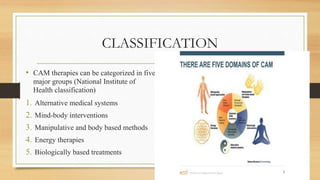
• CAM therapies can be categorized in five
major groups (National Institute of
Health classification)
1. Alternative medical systems
2. Mind-body interventions
3. Manipulative and body based methods
4. Energy therapies
5. Biologically based treatments
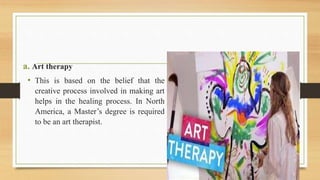
a. Art therapy
• This is based on the belief that the
creative process involved in making art
helps in the healing process. In North
America, a Master’s degree is required
to be an art therapist.
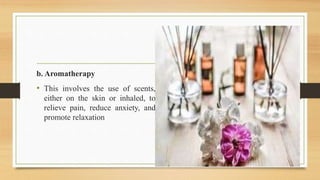
b. Aromatherapy
• This involves the use of scents,
either on the skin or inhaled, to
relieve pain, reduce anxiety, and
promote relaxation
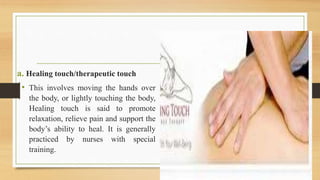
a. Healing touch/therapeutic touch
• This involves moving the hands over
the body, or lightly touching the body,
Healing touch is said to promote
relaxation, relieve pain and support the
body’s ability to heal. It is generally
practiced by nurses with special
training.
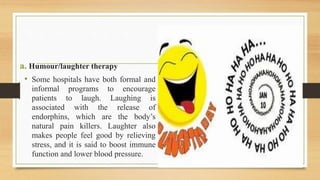
a. Humour/laughter therapy
• Some hospitals have both formal and
informal programs to encourage
patients to laugh. Laughing is
associated with the release of
endorphins, which are the body’s
natural pain killers. Laughter also
makes people feel good by relieving
stress, and it is said to boost immune
function and lower blood pressure.
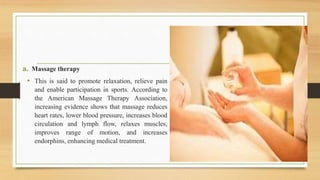
a. Massage therapy
• This is said to promote relaxation, relieve pain
and enable participation in sports. According to
the American Massage Therapy Association,
increasing evidence shows that massage reduces
heart rates, lower blood pressure, increases blood
circulation and lymph flow, relaxes muscles,
improves range of motion, and increases
endorphins, enhancing medical treatment.
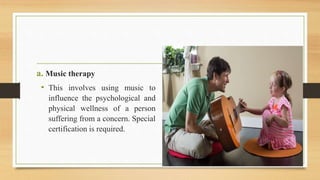
a. Music therapy
• This involves using music to
influence the psychological and
physical wellness of a person
suffering from a concern. Special
certification is required.
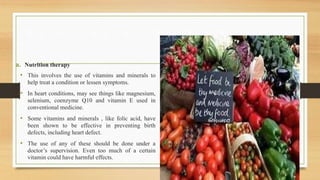
a. Nutrition therapy
• This involves the use of vitamins and minerals to
help treat a condition or lessen symptoms.
• In heart conditions, may see things like magnesium,
selenium, coenzyme Q10 and vitamin E used in
conventional medicine.
• Some vitamins and minerals , like folic acid, have
been shown to be effective in preventing birth
defects, including heart defect.
• The use of any of these should be done under a
doctor’s supervision. Even too much of a certain
vitamin could have harmful effects.
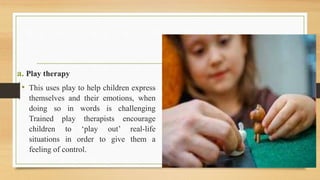
a. Play therapy
• This uses play to help children express
themselves and their emotions, when
doing so in words is challenging
Trained play therapists encourage
children to ‘play out’ real-life
situations in order to give them a
feeling of control.
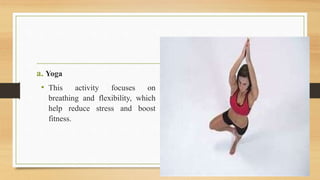
a. Yoga
• This activity focuses on
breathing and flexibility, which
help reduce stress and boost
fitness.
MIND-BODY INTERVENTIONS
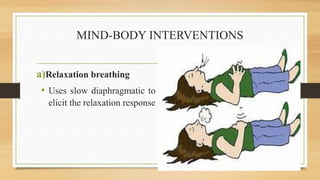
a)Relaxation breathing
• Uses slow diaphragmatic to
elicit the relaxation response
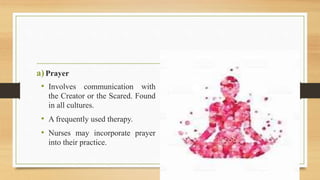
a)Prayer
• Involves communication with
the Creator or the Scared. Found
in all cultures.
• A frequently used therapy.
• Nurses may incorporate prayer
into their practice.
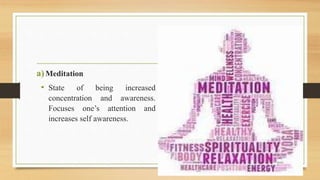
a)Meditation
• State of being increased
concentration and awareness.
Focuses one’s attention and
increases self awareness.
• Two branches exist:
 Inclusive , mindfulness
 Exclusive, concentrative
• Mindfulness meditation focuses on
“living in the moment” without
judgement. Concentrative meditation
involves “moving inward”- often
initiated by concentrating on the breath,
a mantra, or an object. Outcomes may
include relaxation, spiritual growth, and
personal healing.
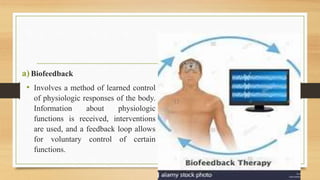
a)Biofeedback
• Involves a method of learned control
of physiologic responses of the body.
Information about physiologic
functions is received, interventions
are used, and a feedback loop allows
for voluntary control of certain
functions.
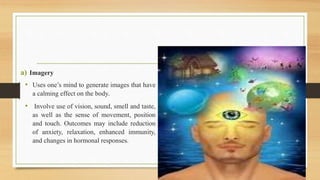
a) Imagery
• Uses one’s mind to generate images that have
a calming effect on the body.
• Involve use of vision, sound, smell and taste,
as well as the sense of movement, position
and touch. Outcomes may include reduction
of anxiety, relaxation, enhanced immunity,
and changes in hormonal responses.
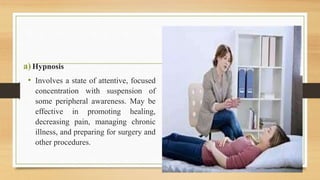
a)Hypnosis
• Involves a state of attentive, focused
concentration with suspension of
some peripheral awareness. May be
effective in promoting healing,
decreasing pain, managing chronic
illness, and preparing for surgery and
other procedures.
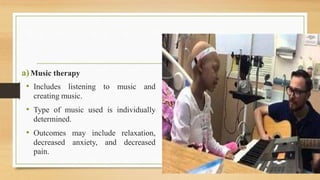
a)Music therapy
• Includes listening to music and
creating music.
• Type of music used is individually
determined.
• Outcomes may include relaxation,
decreased anxiety, and decreased
pain.
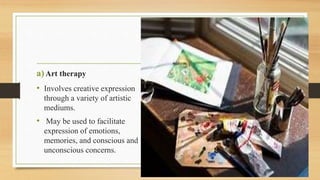
a)Art therapy
• Involves creative expression
through a variety of artistic
mediums.
• May be used to facilitate
expression of emotions,
memories, and conscious and
unconscious concerns.
a)Journaling
• Involves writing down one’s
feelings, thoughts, perceptions,
personal events or memories.
• Outcomes may include stress
reduction, as well as personal
development through self-
reflection
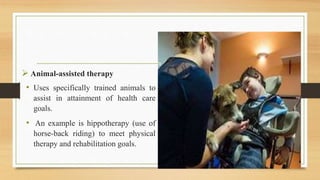
 Animal-assisted therapy
• Uses specifically trained animals to
assist in attainment of health care
goals.
• An example is hippotherapy (use of
horse-back riding) to meet physical
therapy and rehabilitation goals.
MANIPULATIVE AND BODY BASED
METHODS
• These therapies are based on
manipulation of the body and
movements and include
chiropractic, massage therapy and
osteopathic medicine
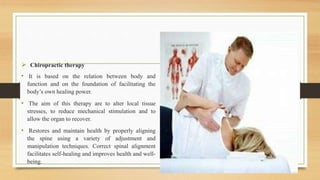
 Chiropractic therapy
• It is based on the relation between body and
function and on the foundation of facilitating the
body’s own healing power.
• The aim of this therapy are to alter local tissue
stresses, to reduce mechanical stimulation and to
allow the organ to recover.
• Restores and maintain health by properly aligning
the spine using a variety of adjustment and
manipulation techniques. Correct spinal alignment
facilitates self-healing and improves health and well-
being.
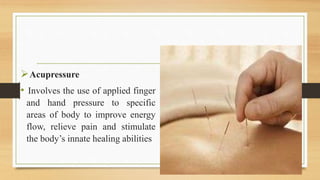
Acupressure
• Involves the use of applied finger
and hand pressure to specific
areas of body to improve energy
flow, relieve pain and stimulate
the body’s innate healing abilities
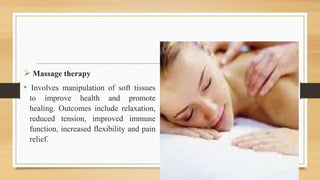
 Massage therapy
• Involves manipulation of soft tissues
to improve health and promote
healing. Outcomes include relaxation,
reduced tension, improved immune
function, increased flexibility and pain
relief.
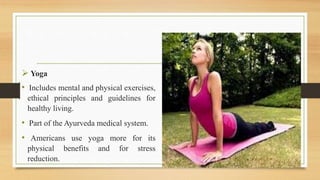
 Yoga
• Includes mental and physical exercises,
ethical principles and guidelines for
healthy living.
• Part of the Ayurveda medical system.
• Americans use yoga more for its
physical benefits and for stress
reduction.
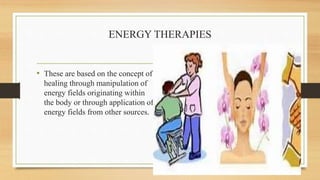
ENERGY THERAPIES
• These are based on the concept of
healing through manipulation of
energy fields originating within
the body or through application of
energy fields from other sources.
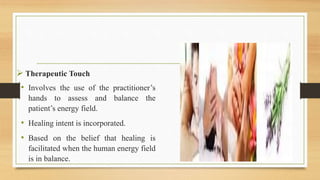
 Therapeutic Touch
• Involves the use of the practitioner’s
hands to assess and balance the
patient’s energy field.
• Healing intent is incorporated.
• Based on the belief that healing is
facilitated when the human energy field
is in balance.
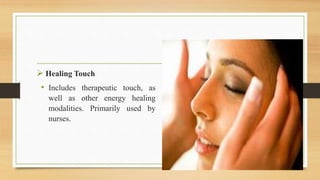
 Healing Touch
• Includes therapeutic touch, as
well as other energy healing
modalities. Primarily used by
nurses.
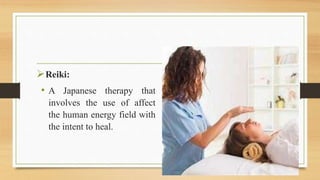
Reiki:
• A Japanese therapy that
involves the use of affect
the human energy field with
the intent to heal.
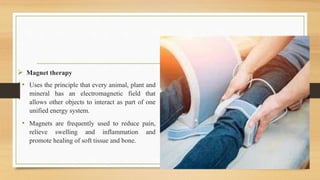
 Magnet therapy
• Uses the principle that every animal, plant and
mineral has an electromagnetic field that
allows other objects to interact as part of one
unified energy system.
• Magnets are frequently used to reduce pain,
relieve swelling and inflammation and
promote healing of soft tissue and bone.
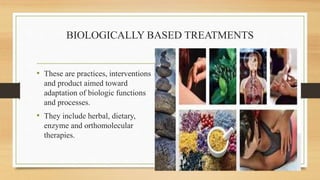
BIOLOGICALLY BASED TREATMENTS
• These are practices, interventions
and product aimed toward
adaptation of biologic functions
and processes.
• They include herbal, dietary,
enzyme and orthomolecular
therapies.
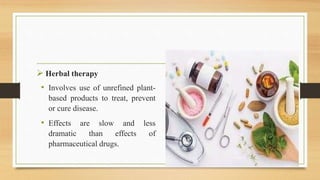
 Herbal therapy
• Involves use of unrefined plant-
based products to treat, prevent
or cure disease.
• Effects are slow and less
dramatic than effects of
pharmaceutical drugs.
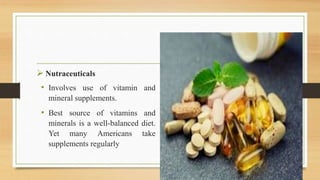
 Nutraceuticals
• Involves use of vitamin and
mineral supplements.
• Best source of vitamins and
minerals is a well-balanced diet.
Yet many Americans take
supplements regularly
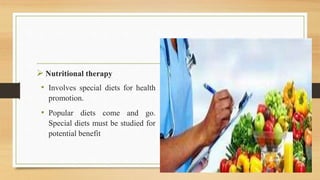
 Nutritional therapy
• Involves special diets for health
promotion.
• Popular diets come and go.
Special diets must be studied for
potential benefit
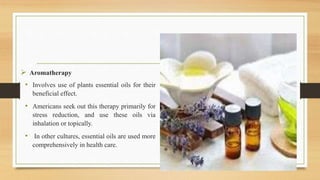
 Aromatherapy
• Involves use of plants essential oils for their
beneficial effect.
• Americans seek out this therapy primarily for
stress reduction, and use these oils via
inhalation or topically.
• In other cultures, essential oils are used more
comprehensively in health care.
PATIENT AND FAMILY TEACHING
GUIDE: HERBAL THERPIES
 Ask the patient about use of herbal therapies. Take a complete history of herbal use,
including amounts, brand names and frequency of use. Ask the patient about
allergies.
 Investigate whether herbs are used instead of or in addition to traditional medical
treatments. Find out whether herbal therapies are used to prevent disease or to treat
an existing problem.
 Instruct the patient to inform health care provider before taking any herbal
treatments
 Make the patient aware of the risks and benefits associated with herbal
use, including drug reactions when taken in combination with other drugs
 Advise the patient using herbal therapies to be aware of any side effects
while taking herbal treatments and to immediately report them to health
care provider.
 Make the patient aware that moisture, sunlight and heat may alter the
components of herbal treatments.
NURSING MANAGEMENT
The role of the nurse with respect to complementary and alternative therapies is evolving. Roles of the
nurse may include
 Assessing a patient’s use of complementary and alternative therapies and the
possible risk of complications or adverse interactions with conventional therapies.
 Promoting safety and serving as a resource
 Providing holistic self-care and holistic nursing care
 Serving as a provider
 Participating in research
CONCLUSION
• CAM therapies are commonly used by patients with cardiovascular diseases treated
by conventionally trained physicians.
• It is therefore important for the practitioners to be familiar with CAM therapies,
with their proposed mechanism of action and effectiveness, and with the potential
risks of adverse effects and drug interactions.
• It is likely that the increasing interest of the medical community and of regulatory
and funding agencies in CAM therapies will soon lead to better understanding of
their role in cardiovascular care.
BIBLIOGRAPHY
 Black Joyce m. et al. Medical Surgical nursing. 1st edition. Singapore.
W.B.Sunder 1997: pp780-5.
 Perry and potter. Fundamentals of nursing. 6th ed. Mosby an imprint of
Elsevier New Delhi: pp 915-26.
 http://explorewingworldquest.org
 http://www.stopgettinglik.com

Complementary therapies ppt

  • 2.
  • 3.
    INTRODUCTION • Complementary therapiescan be defined as medical interventions that are currently not an integral part of conventional medicine. • Since 1990 documentation by several surveys of the widespread and increasing use by consumers of CAM therapies has brought the attention of the health care community, employers and insures to the importance of this form of therapy.
  • 4.
    CLASSIFICATION • CAM therapiescan be categorized in five major groups (National Institute of Health classification) 1. Alternative medical systems 2. Mind-body interventions 3. Manipulative and body based methods 4. Energy therapies 5. Biologically based treatments
  • 5.
    a. Art therapy •This is based on the belief that the creative process involved in making art helps in the healing process. In North America, a Master’s degree is required to be an art therapist.
  • 6.
    b. Aromatherapy • Thisinvolves the use of scents, either on the skin or inhaled, to relieve pain, reduce anxiety, and promote relaxation
  • 7.
    a. Healing touch/therapeutictouch • This involves moving the hands over the body, or lightly touching the body, Healing touch is said to promote relaxation, relieve pain and support the body’s ability to heal. It is generally practiced by nurses with special training.
  • 8.
    a. Humour/laughter therapy •Some hospitals have both formal and informal programs to encourage patients to laugh. Laughing is associated with the release of endorphins, which are the body’s natural pain killers. Laughter also makes people feel good by relieving stress, and it is said to boost immune function and lower blood pressure.
  • 9.
    a. Massage therapy •This is said to promote relaxation, relieve pain and enable participation in sports. According to the American Massage Therapy Association, increasing evidence shows that massage reduces heart rates, lower blood pressure, increases blood circulation and lymph flow, relaxes muscles, improves range of motion, and increases endorphins, enhancing medical treatment.
  • 10.
    a. Music therapy •This involves using music to influence the psychological and physical wellness of a person suffering from a concern. Special certification is required.
  • 11.
    a. Nutrition therapy •This involves the use of vitamins and minerals to help treat a condition or lessen symptoms. • In heart conditions, may see things like magnesium, selenium, coenzyme Q10 and vitamin E used in conventional medicine. • Some vitamins and minerals , like folic acid, have been shown to be effective in preventing birth defects, including heart defect. • The use of any of these should be done under a doctor’s supervision. Even too much of a certain vitamin could have harmful effects.
  • 12.
    a. Play therapy •This uses play to help children express themselves and their emotions, when doing so in words is challenging Trained play therapists encourage children to ‘play out’ real-life situations in order to give them a feeling of control.
  • 13.
    a. Yoga • Thisactivity focuses on breathing and flexibility, which help reduce stress and boost fitness.
  • 14.
    MIND-BODY INTERVENTIONS a)Relaxation breathing •Uses slow diaphragmatic to elicit the relaxation response
  • 15.
    a)Prayer • Involves communicationwith the Creator or the Scared. Found in all cultures. • A frequently used therapy. • Nurses may incorporate prayer into their practice.
  • 16.
    a)Meditation • State ofbeing increased concentration and awareness. Focuses one’s attention and increases self awareness.
  • 17.
    • Two branchesexist:  Inclusive , mindfulness  Exclusive, concentrative • Mindfulness meditation focuses on “living in the moment” without judgement. Concentrative meditation involves “moving inward”- often initiated by concentrating on the breath, a mantra, or an object. Outcomes may include relaxation, spiritual growth, and personal healing.
  • 18.
    a)Biofeedback • Involves amethod of learned control of physiologic responses of the body. Information about physiologic functions is received, interventions are used, and a feedback loop allows for voluntary control of certain functions.
  • 19.
    a) Imagery • Usesone’s mind to generate images that have a calming effect on the body. • Involve use of vision, sound, smell and taste, as well as the sense of movement, position and touch. Outcomes may include reduction of anxiety, relaxation, enhanced immunity, and changes in hormonal responses.
  • 20.
    a)Hypnosis • Involves astate of attentive, focused concentration with suspension of some peripheral awareness. May be effective in promoting healing, decreasing pain, managing chronic illness, and preparing for surgery and other procedures.
  • 21.
    a)Music therapy • Includeslistening to music and creating music. • Type of music used is individually determined. • Outcomes may include relaxation, decreased anxiety, and decreased pain.
  • 22.
    a)Art therapy • Involvescreative expression through a variety of artistic mediums. • May be used to facilitate expression of emotions, memories, and conscious and unconscious concerns.
  • 23.
    a)Journaling • Involves writingdown one’s feelings, thoughts, perceptions, personal events or memories. • Outcomes may include stress reduction, as well as personal development through self- reflection
  • 24.
     Animal-assisted therapy •Uses specifically trained animals to assist in attainment of health care goals. • An example is hippotherapy (use of horse-back riding) to meet physical therapy and rehabilitation goals.
  • 25.
    MANIPULATIVE AND BODYBASED METHODS • These therapies are based on manipulation of the body and movements and include chiropractic, massage therapy and osteopathic medicine
  • 26.
     Chiropractic therapy •It is based on the relation between body and function and on the foundation of facilitating the body’s own healing power. • The aim of this therapy are to alter local tissue stresses, to reduce mechanical stimulation and to allow the organ to recover. • Restores and maintain health by properly aligning the spine using a variety of adjustment and manipulation techniques. Correct spinal alignment facilitates self-healing and improves health and well- being.
  • 27.
    Acupressure • Involves theuse of applied finger and hand pressure to specific areas of body to improve energy flow, relieve pain and stimulate the body’s innate healing abilities
  • 28.
     Massage therapy •Involves manipulation of soft tissues to improve health and promote healing. Outcomes include relaxation, reduced tension, improved immune function, increased flexibility and pain relief.
  • 29.
     Yoga • Includesmental and physical exercises, ethical principles and guidelines for healthy living. • Part of the Ayurveda medical system. • Americans use yoga more for its physical benefits and for stress reduction.
  • 30.
    ENERGY THERAPIES • Theseare based on the concept of healing through manipulation of energy fields originating within the body or through application of energy fields from other sources.
  • 31.
     Therapeutic Touch •Involves the use of the practitioner’s hands to assess and balance the patient’s energy field. • Healing intent is incorporated. • Based on the belief that healing is facilitated when the human energy field is in balance.
  • 32.
     Healing Touch •Includes therapeutic touch, as well as other energy healing modalities. Primarily used by nurses.
  • 33.
    Reiki: • A Japanesetherapy that involves the use of affect the human energy field with the intent to heal.
  • 34.
     Magnet therapy •Uses the principle that every animal, plant and mineral has an electromagnetic field that allows other objects to interact as part of one unified energy system. • Magnets are frequently used to reduce pain, relieve swelling and inflammation and promote healing of soft tissue and bone.
  • 35.
    BIOLOGICALLY BASED TREATMENTS •These are practices, interventions and product aimed toward adaptation of biologic functions and processes. • They include herbal, dietary, enzyme and orthomolecular therapies.
  • 36.
     Herbal therapy •Involves use of unrefined plant- based products to treat, prevent or cure disease. • Effects are slow and less dramatic than effects of pharmaceutical drugs.
  • 37.
     Nutraceuticals • Involvesuse of vitamin and mineral supplements. • Best source of vitamins and minerals is a well-balanced diet. Yet many Americans take supplements regularly
  • 38.
     Nutritional therapy •Involves special diets for health promotion. • Popular diets come and go. Special diets must be studied for potential benefit
  • 39.
     Aromatherapy • Involvesuse of plants essential oils for their beneficial effect. • Americans seek out this therapy primarily for stress reduction, and use these oils via inhalation or topically. • In other cultures, essential oils are used more comprehensively in health care.
  • 40.
    PATIENT AND FAMILYTEACHING GUIDE: HERBAL THERPIES  Ask the patient about use of herbal therapies. Take a complete history of herbal use, including amounts, brand names and frequency of use. Ask the patient about allergies.  Investigate whether herbs are used instead of or in addition to traditional medical treatments. Find out whether herbal therapies are used to prevent disease or to treat an existing problem.  Instruct the patient to inform health care provider before taking any herbal treatments
  • 41.
     Make thepatient aware of the risks and benefits associated with herbal use, including drug reactions when taken in combination with other drugs  Advise the patient using herbal therapies to be aware of any side effects while taking herbal treatments and to immediately report them to health care provider.  Make the patient aware that moisture, sunlight and heat may alter the components of herbal treatments.
  • 42.
    NURSING MANAGEMENT The roleof the nurse with respect to complementary and alternative therapies is evolving. Roles of the nurse may include  Assessing a patient’s use of complementary and alternative therapies and the possible risk of complications or adverse interactions with conventional therapies.  Promoting safety and serving as a resource  Providing holistic self-care and holistic nursing care  Serving as a provider  Participating in research
  • 43.
    CONCLUSION • CAM therapiesare commonly used by patients with cardiovascular diseases treated by conventionally trained physicians. • It is therefore important for the practitioners to be familiar with CAM therapies, with their proposed mechanism of action and effectiveness, and with the potential risks of adverse effects and drug interactions. • It is likely that the increasing interest of the medical community and of regulatory and funding agencies in CAM therapies will soon lead to better understanding of their role in cardiovascular care.
  • 44.
    BIBLIOGRAPHY  Black Joycem. et al. Medical Surgical nursing. 1st edition. Singapore. W.B.Sunder 1997: pp780-5.  Perry and potter. Fundamentals of nursing. 6th ed. Mosby an imprint of Elsevier New Delhi: pp 915-26.  http://explorewingworldquest.org  http://www.stopgettinglik.com