NURSING CARE OF CHILD
UNDERGOING LUMBAR PUNCTURE
PRESENTED BY:
SIVASAKTHI.K
M.SC NURSING
II ND YEAR
CON-PIMS
Introduction
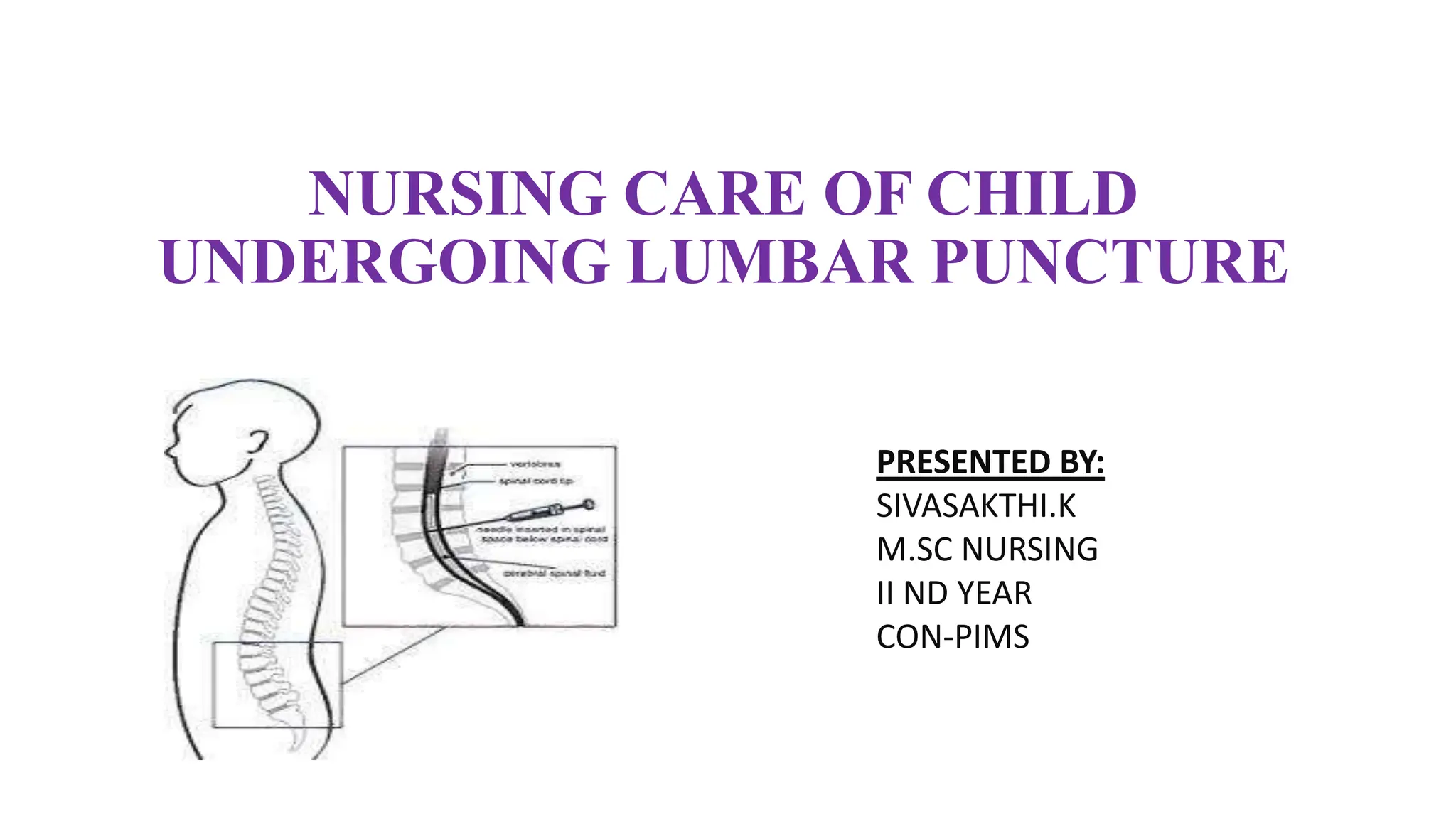
Lumbar puncture, also known as a spinal
tap, is a medical procedure in which a
needle is inserted into the spinal canal,
most commonly to collect cerebrospinal
fluid for diagnostic testing.
DEFINITION
A lumbar puncture often called a spinal tap, is a
common medical test that involves taking a small
sample of cerebrospinal fluid (CSF) for examination.
CSF is a clear, colorless liquid that delivers nutrients
and "cushions" the brain and spinal cord, or central
nervous system
Indication
• Measure cerebrospinal fluid (CSF) pressure
• Diagnosis of suspected CNS infections
• Infuse medications which include spinal anesthesia before
surgery.
• Treat normal pressure hydrocephalus, cerebrospinal fistulas,
and idiopathic intracranial hypertension (IIH).
• Placement of a lumbar CSF drainage catheter
Contraindication
•Increased intracranial pressure.
•Skin infection near the puncture site..
•Severe degenerative vertebral joint disease.
•Severe coagulopathy
Articles needed
• The lumbar puncture kit contains:
• Sterile gloves
• Sterile drapes and procedure tray
• Sterile gauze pads
• Aseptic solution: povidone-iodine solution (Betadine)
• Local anesthetic: Lidocaine 1% solution
• 22 or 25G needle
• 10ml syringe (1)
• Spinal needle with stylet (size 22G or 25G)
• CSF tube (2 to 4)
• Stopcock
• Manometer tubing
Procedure
The step-by-step procedure for a lumbar puncture (spinal tap) is as follows:
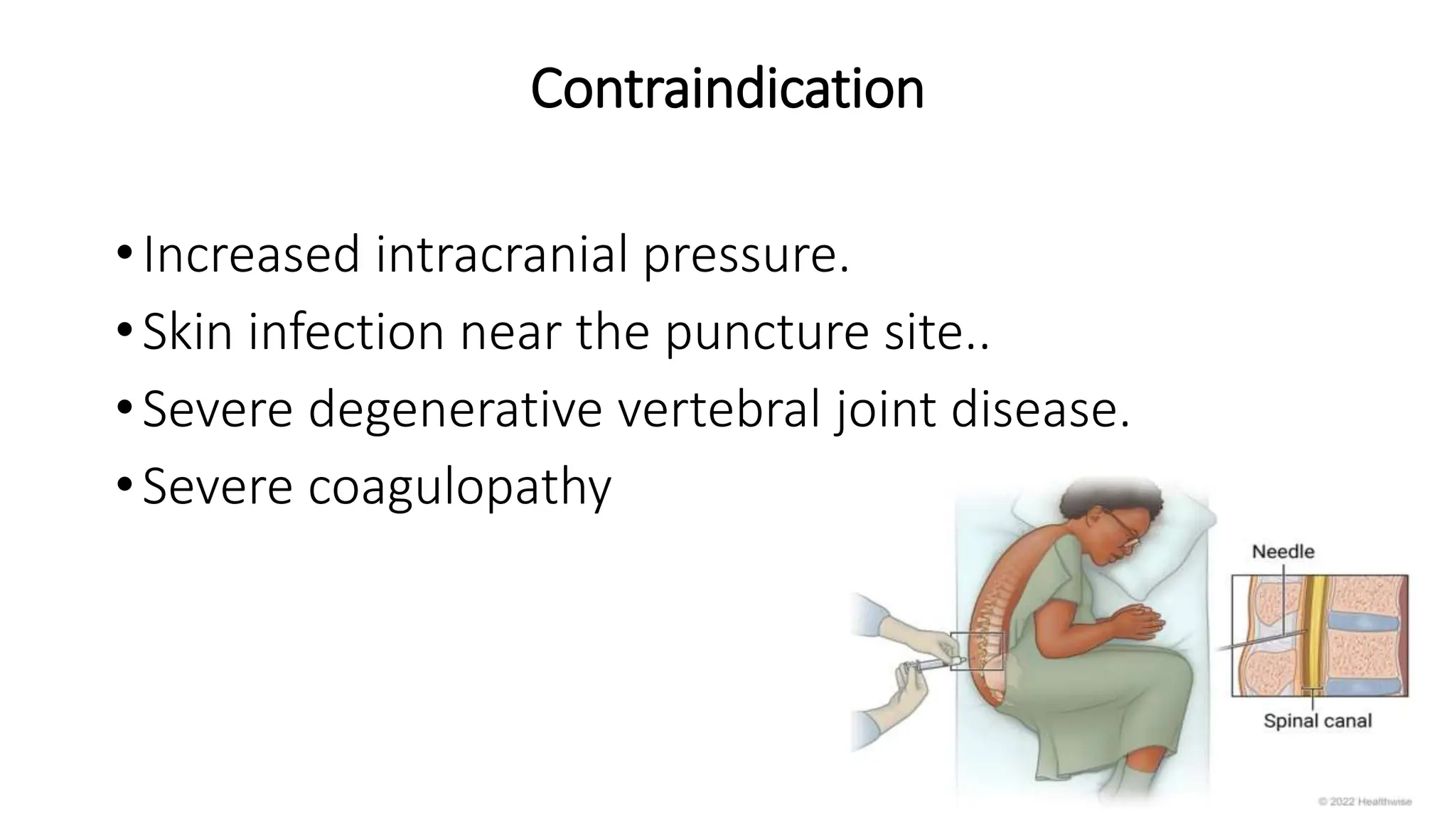
1. Position the child in a fetal position
The child is positioned on his side at the edge of the bed with his knees
drawn up to his abdomen and chin tucked against his chest (fetal position)
or sitting while leaning over a bedside table. When the child is positioned
supine, pillows are provided to support the spine on a horizontal plane.
Cont.,
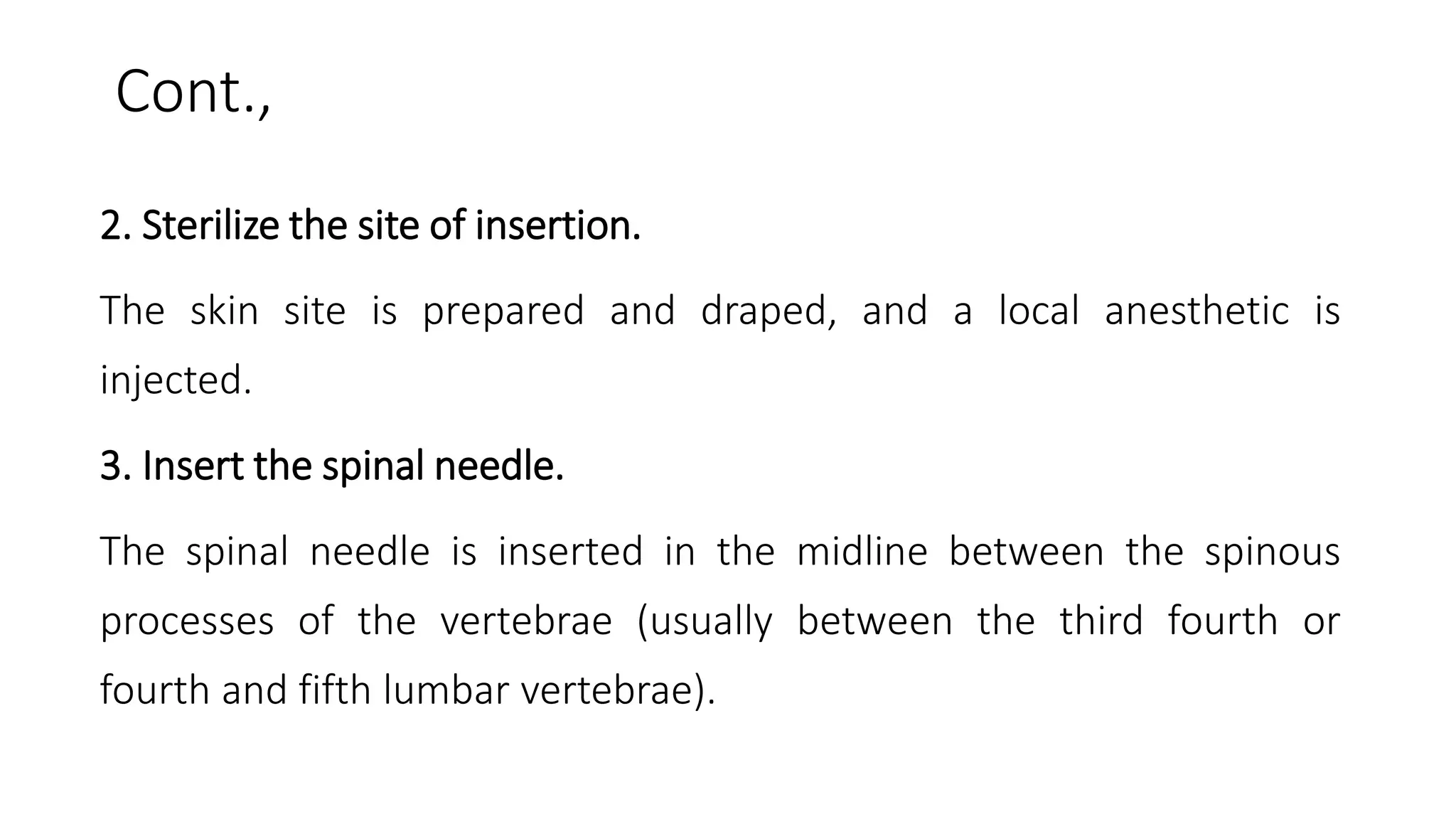
2. Sterilize the site of insertion.
The skin site is prepared and draped, and a local anesthetic is
injected.
3. Insert the spinal needle.
The spinal needle is inserted in the midline between the spinous
processes of the vertebrae (usually between the third fourth or
fourth and fifth lumbar vertebrae).
Cont.,
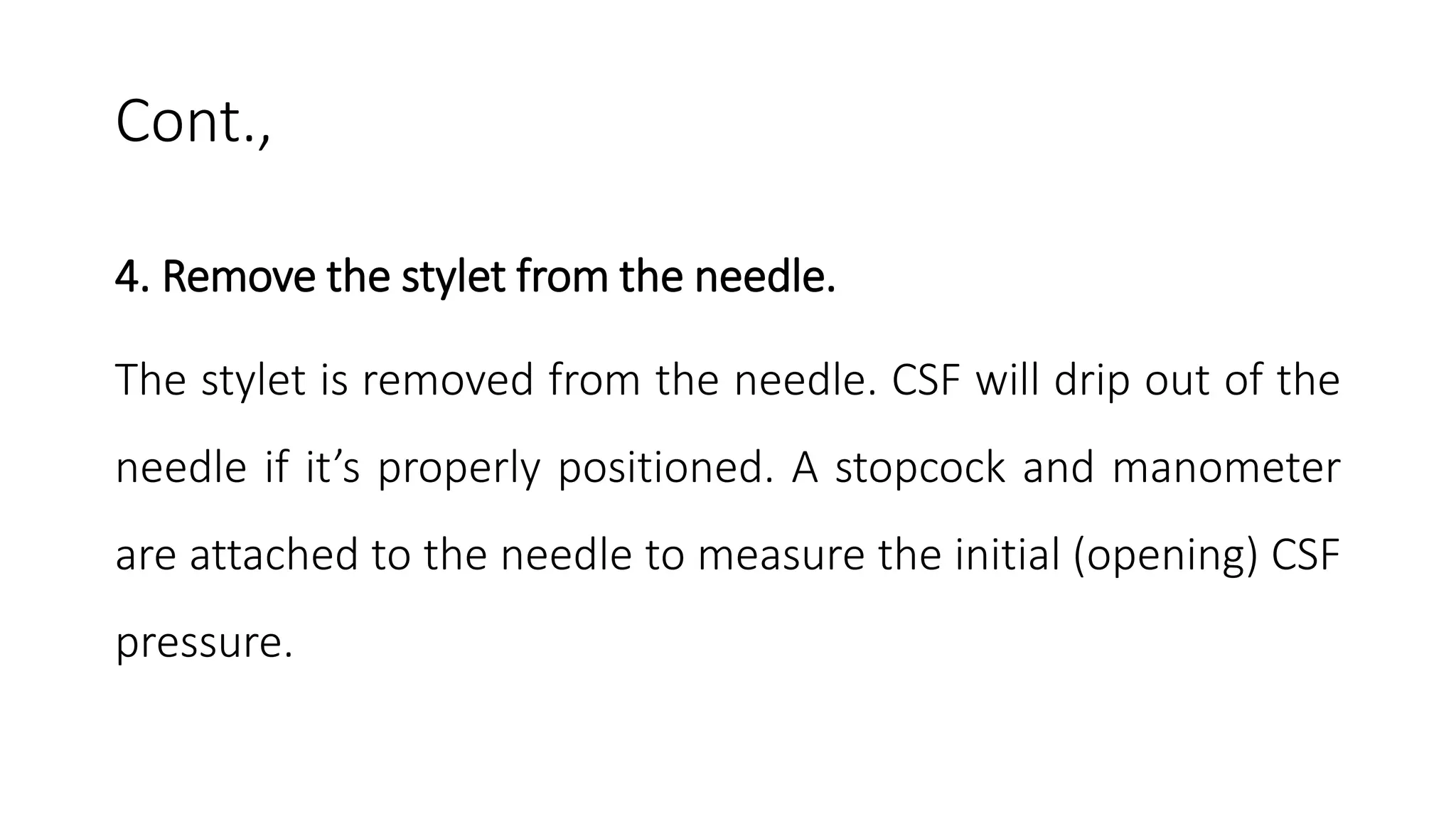
4. Remove the stylet from the needle.
The stylet is removed from the needle. CSF will drip out of the
needle if it’s properly positioned. A stopcock and manometer
are attached to the needle to measure the initial (opening) CSF
pressure.
Cont.,
5. Collect specimen.
• Specimens are collected and placed in the appropriate containers.
Collect 1 ml of CSF in each of vial
a) Tube 1: gram stain, culture and sensitivity
b) Tube 2: Glucose, protein
c) Tube 3: Cell count and differential count
d) Tube 4: Any special studies(viral, bacterial or chemical studies)
6. Remove the needle.
The needle is removed, and a small sterile dressing is applied.
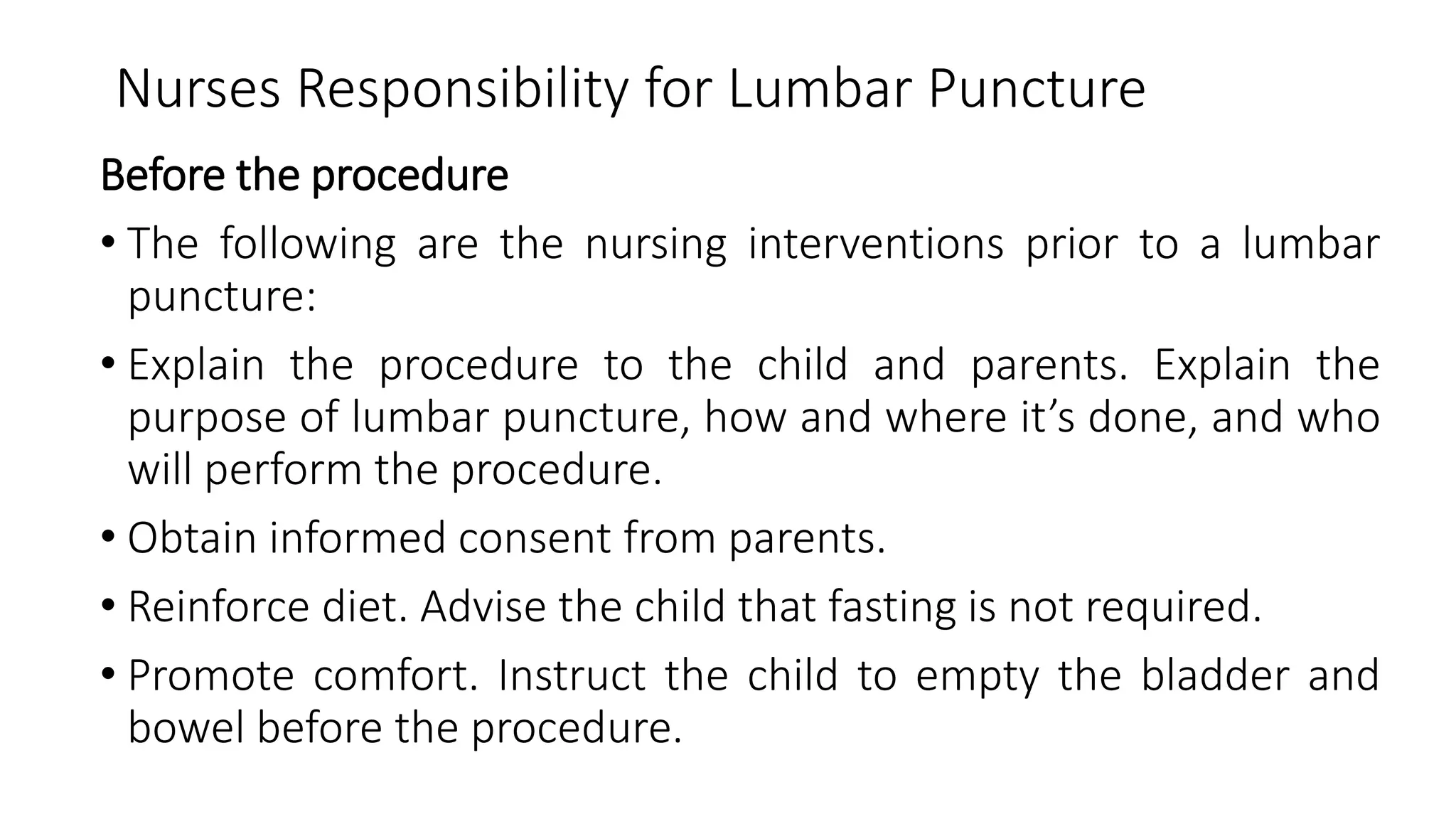
Nurses Responsibility for Lumbar Puncture
Before the procedure
• The following are the nursing interventions prior to a lumbar
puncture:
• Explain the procedure to the child and parents. Explain the
purpose of lumbar puncture, how and where it’s done, and who
will perform the procedure.
• Obtain informed consent from parents.
• Reinforce diet. Advise the child that fasting is not required.
• Promote comfort. Instruct the child to empty the bladder and
bowel before the procedure.
Cont.,
• Establish baseline assessment data. Do vital signs monitoring and
neurologic assessment of the legs by assessing the child’s movement,
strength, and sensation.
• Place the child in a lateral decubitus position. Assist the client to assume a
lateral decubitus (fetal) position, near the side of the bed with the neck,
hips, and knees drawn up to the chest. An alternative position is to have
the child sit on the edge of the bed while leaning over a bedside table.
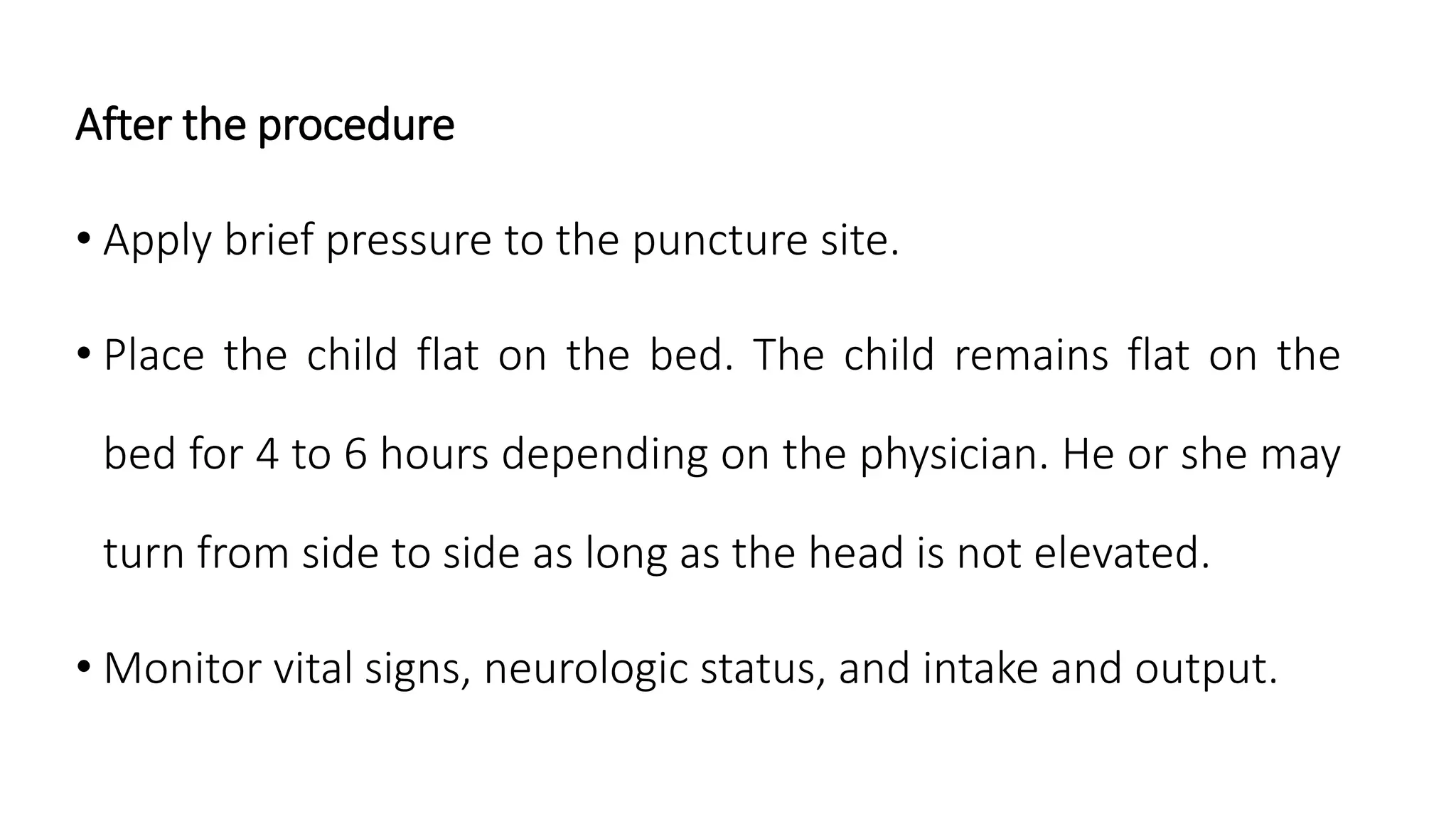
After the procedure
• Apply brief pressure to the puncture site.
• Place the child flat on the bed. The child remains flat on the
bed for 4 to 6 hours depending on the physician. He or she may
turn from side to side as long as the head is not elevated.
• Monitor vital signs, neurologic status, and intake and output.
Cont.,
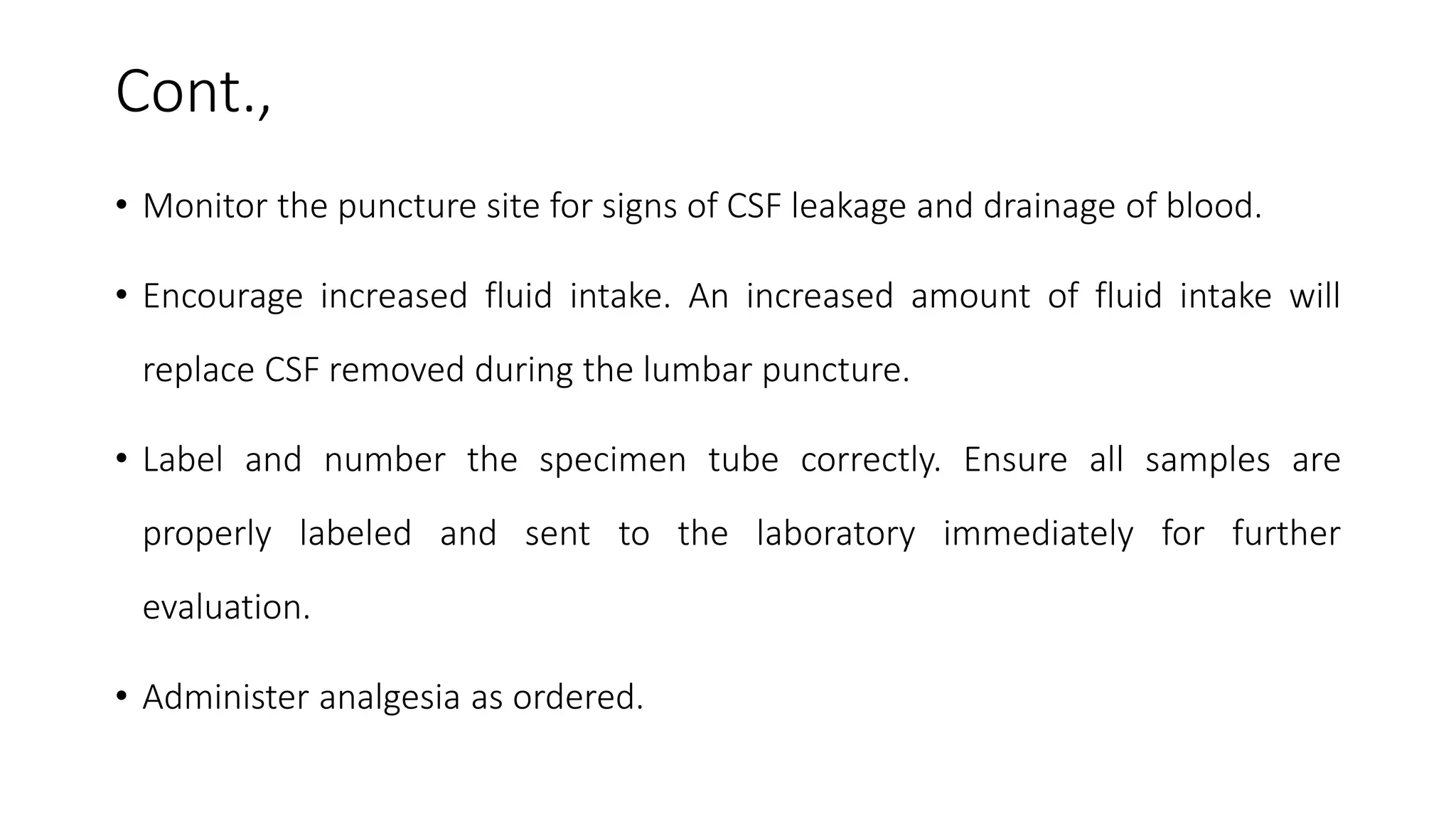
• Monitor the puncture site for signs of CSF leakage and drainage of blood.
• Encourage increased fluid intake. An increased amount of fluid intake will
replace CSF removed during the lumbar puncture.
• Label and number the specimen tube correctly. Ensure all samples are
properly labeled and sent to the laboratory immediately for further
evaluation.
• Administer analgesia as ordered.
Normal Results
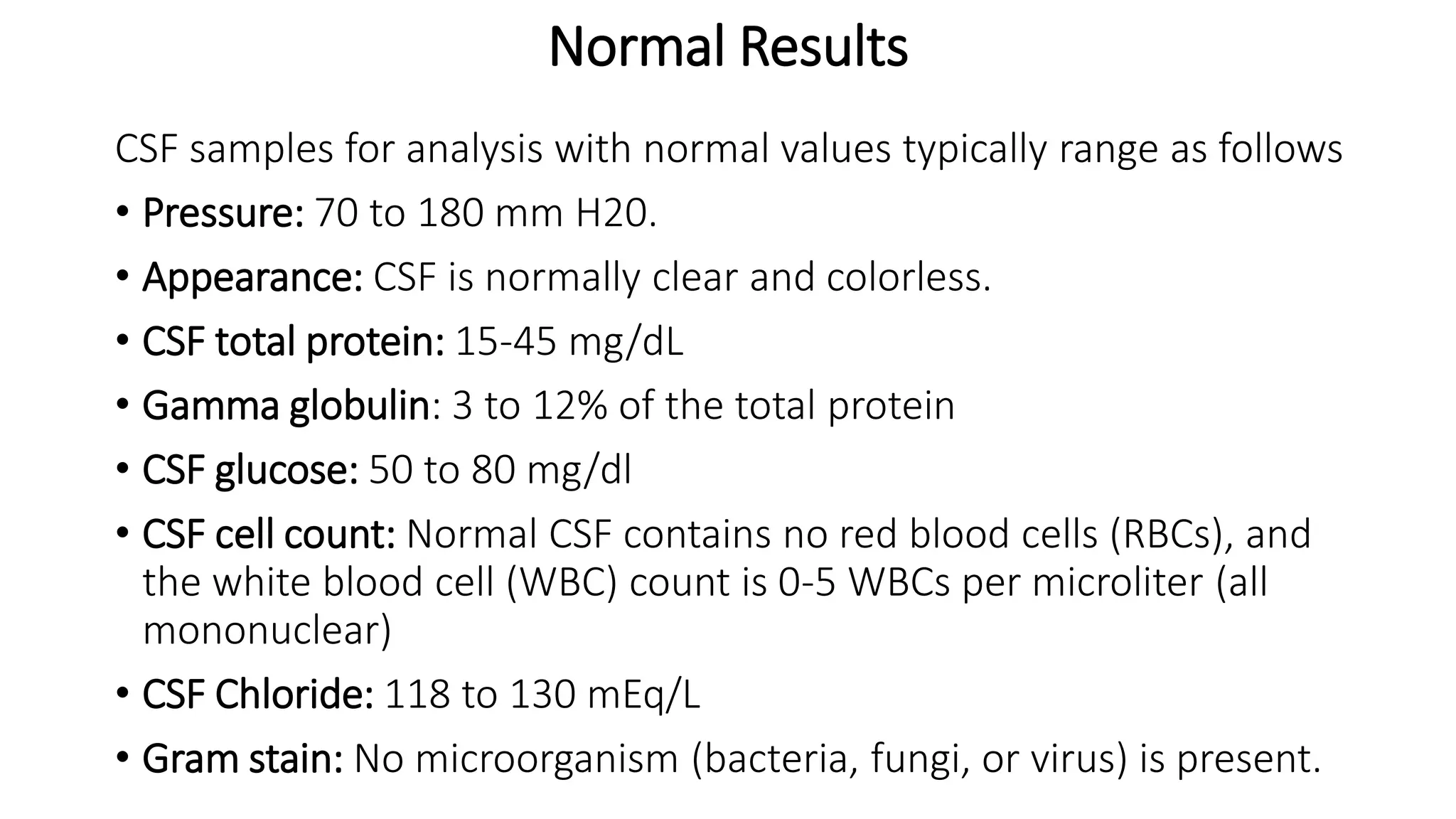
CSF samples for analysis with normal values typically range as follows
• Pressure: 70 to 180 mm H20.
• Appearance: CSF is normally clear and colorless.
• CSF total protein: 15-45 mg/dL
• Gamma globulin: 3 to 12% of the total protein
• CSF glucose: 50 to 80 mg/dl
• CSF cell count: Normal CSF contains no red blood cells (RBCs), and
the white blood cell (WBC) count is 0-5 WBCs per microliter (all
mononuclear)
• CSF Chloride: 118 to 130 mEq/L
• Gram stain: No microorganism (bacteria, fungi, or virus) is present.
Complications
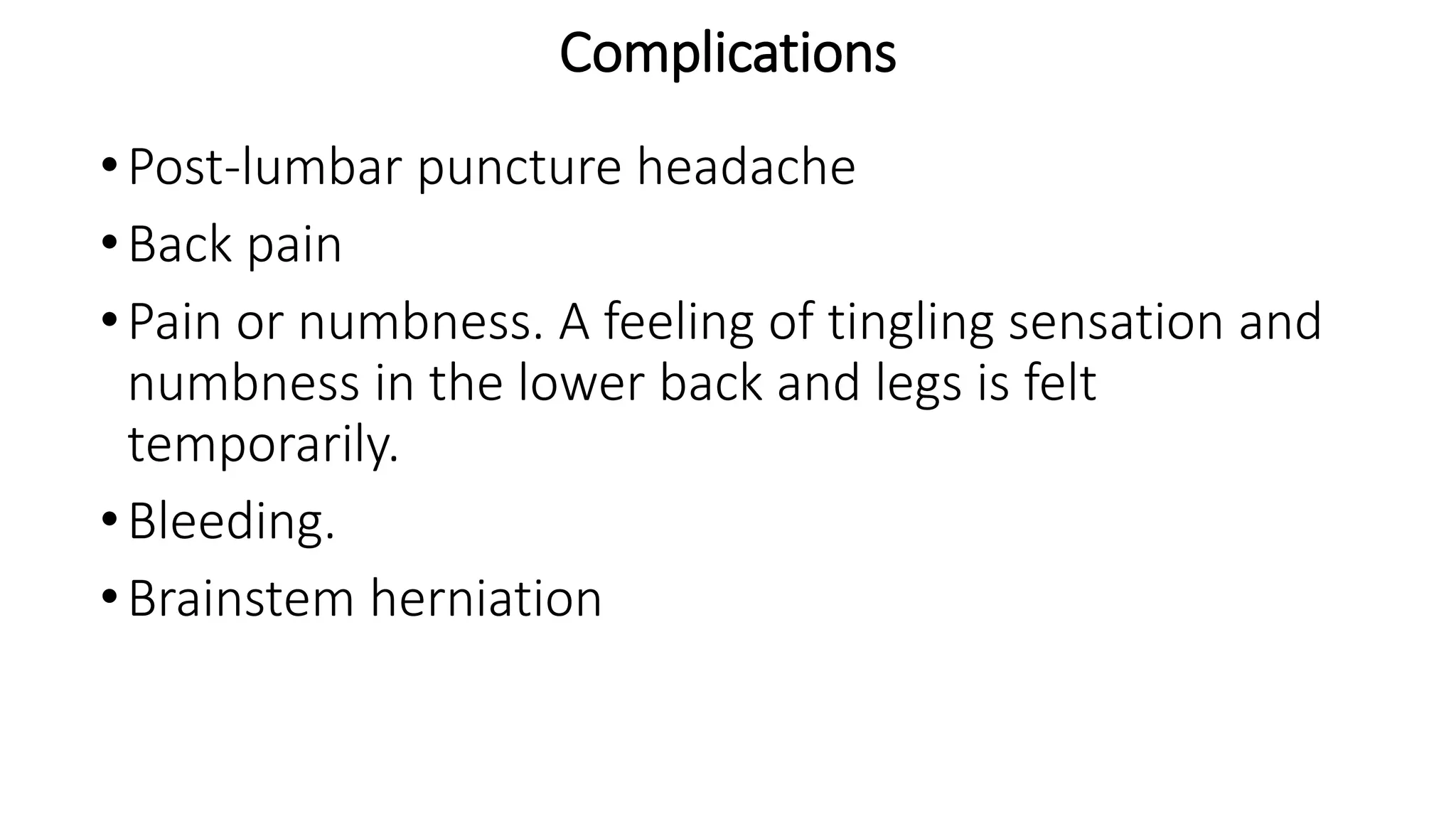
•Post-lumbar puncture headache
•Back pain
•Pain or numbness. A feeling of tingling sensation and
numbness in the lower back and legs is felt
temporarily.
•Bleeding.
•Brainstem herniation
Conclusion
The lumbar puncture in expert hands is a safe test. The health
professional should be suitably familiar with its
contraindications, the regional anatomy and the technique
used to perform it.
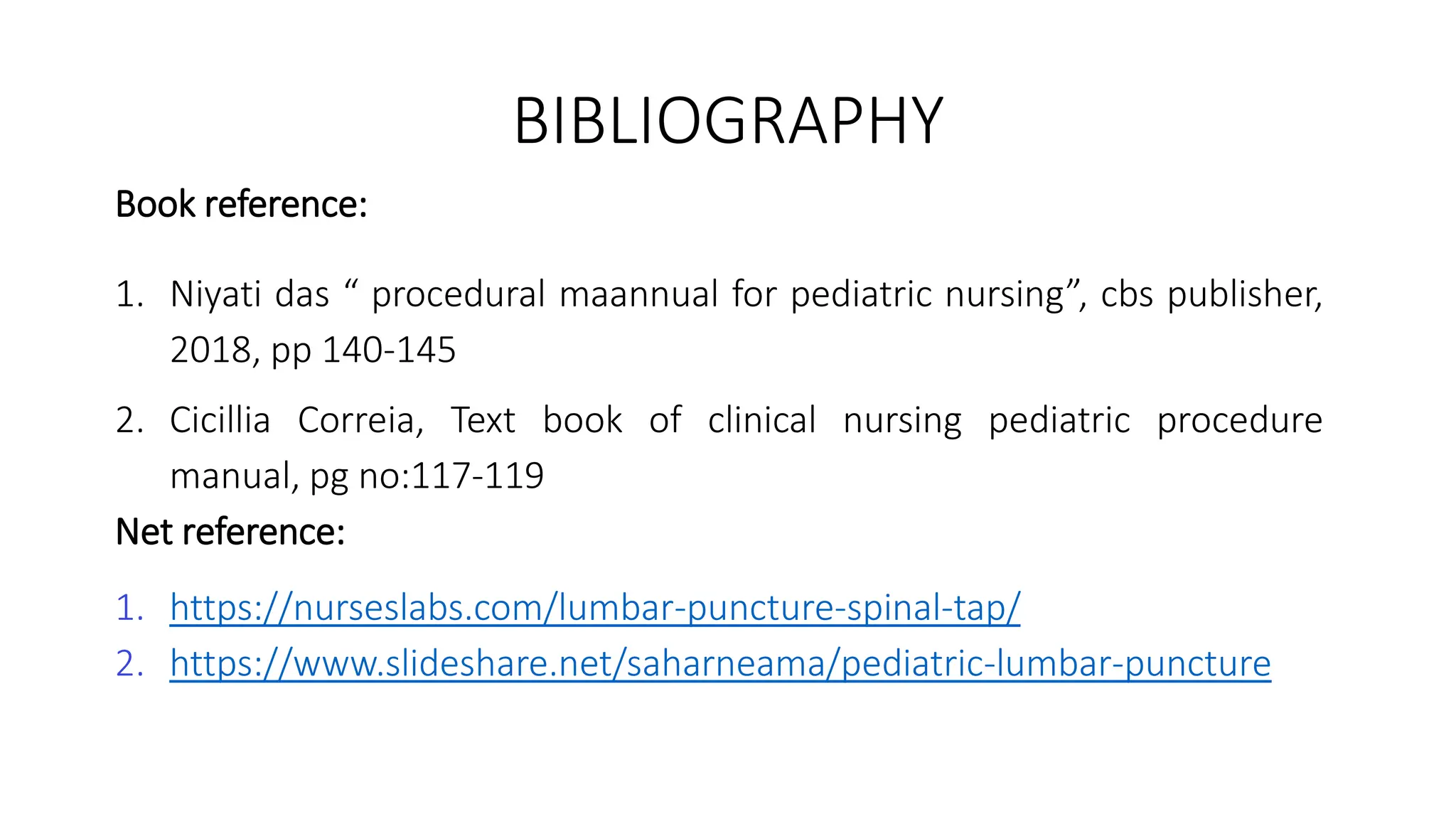
BIBLIOGRAPHY
Book reference:
1. Niyati das “ procedural maannual for pediatric nursing”, cbs publisher,
2018, pp 140-145
2. Cicillia Correia, Text book of clinical nursing pediatric procedure
manual, pg no:117-119
Net reference:
1. https://nurseslabs.com/lumbar-puncture-spinal-tap/
2. https://www.slideshare.net/saharneama/pediatric-lumbar-puncture
lumbar puncture.pptx child health nursing

lumbar puncture.pptx child health nursing

  • 1.
    NURSING CARE OFCHILD UNDERGOING LUMBAR PUNCTURE PRESENTED BY: SIVASAKTHI.K M.SC NURSING II ND YEAR CON-PIMS
  • 2.
    Introduction Lumbar puncture, alsoknown as a spinal tap, is a medical procedure in which a needle is inserted into the spinal canal, most commonly to collect cerebrospinal fluid for diagnostic testing.
  • 3.
    DEFINITION A lumbar punctureoften called a spinal tap, is a common medical test that involves taking a small sample of cerebrospinal fluid (CSF) for examination. CSF is a clear, colorless liquid that delivers nutrients and "cushions" the brain and spinal cord, or central nervous system
  • 4.
    Indication • Measure cerebrospinalfluid (CSF) pressure • Diagnosis of suspected CNS infections • Infuse medications which include spinal anesthesia before surgery. • Treat normal pressure hydrocephalus, cerebrospinal fistulas, and idiopathic intracranial hypertension (IIH). • Placement of a lumbar CSF drainage catheter
  • 5.
    Contraindication •Increased intracranial pressure. •Skininfection near the puncture site.. •Severe degenerative vertebral joint disease. •Severe coagulopathy
  • 6.
    Articles needed • Thelumbar puncture kit contains: • Sterile gloves • Sterile drapes and procedure tray • Sterile gauze pads • Aseptic solution: povidone-iodine solution (Betadine) • Local anesthetic: Lidocaine 1% solution • 22 or 25G needle • 10ml syringe (1) • Spinal needle with stylet (size 22G or 25G) • CSF tube (2 to 4) • Stopcock • Manometer tubing
  • 7.
    Procedure The step-by-step procedurefor a lumbar puncture (spinal tap) is as follows: 1. Position the child in a fetal position The child is positioned on his side at the edge of the bed with his knees drawn up to his abdomen and chin tucked against his chest (fetal position) or sitting while leaning over a bedside table. When the child is positioned supine, pillows are provided to support the spine on a horizontal plane.
  • 8.
    Cont., 2. Sterilize thesite of insertion. The skin site is prepared and draped, and a local anesthetic is injected. 3. Insert the spinal needle. The spinal needle is inserted in the midline between the spinous processes of the vertebrae (usually between the third fourth or fourth and fifth lumbar vertebrae).
  • 9.
    Cont., 4. Remove thestylet from the needle. The stylet is removed from the needle. CSF will drip out of the needle if it’s properly positioned. A stopcock and manometer are attached to the needle to measure the initial (opening) CSF pressure.
  • 10.
    Cont., 5. Collect specimen. •Specimens are collected and placed in the appropriate containers. Collect 1 ml of CSF in each of vial a) Tube 1: gram stain, culture and sensitivity b) Tube 2: Glucose, protein c) Tube 3: Cell count and differential count d) Tube 4: Any special studies(viral, bacterial or chemical studies) 6. Remove the needle. The needle is removed, and a small sterile dressing is applied.
  • 11.
    Nurses Responsibility forLumbar Puncture Before the procedure • The following are the nursing interventions prior to a lumbar puncture: • Explain the procedure to the child and parents. Explain the purpose of lumbar puncture, how and where it’s done, and who will perform the procedure. • Obtain informed consent from parents. • Reinforce diet. Advise the child that fasting is not required. • Promote comfort. Instruct the child to empty the bladder and bowel before the procedure.
  • 12.
    Cont., • Establish baselineassessment data. Do vital signs monitoring and neurologic assessment of the legs by assessing the child’s movement, strength, and sensation. • Place the child in a lateral decubitus position. Assist the client to assume a lateral decubitus (fetal) position, near the side of the bed with the neck, hips, and knees drawn up to the chest. An alternative position is to have the child sit on the edge of the bed while leaning over a bedside table.
  • 13.
    After the procedure •Apply brief pressure to the puncture site. • Place the child flat on the bed. The child remains flat on the bed for 4 to 6 hours depending on the physician. He or she may turn from side to side as long as the head is not elevated. • Monitor vital signs, neurologic status, and intake and output.
  • 14.
    Cont., • Monitor thepuncture site for signs of CSF leakage and drainage of blood. • Encourage increased fluid intake. An increased amount of fluid intake will replace CSF removed during the lumbar puncture. • Label and number the specimen tube correctly. Ensure all samples are properly labeled and sent to the laboratory immediately for further evaluation. • Administer analgesia as ordered.
  • 15.
    Normal Results CSF samplesfor analysis with normal values typically range as follows • Pressure: 70 to 180 mm H20. • Appearance: CSF is normally clear and colorless. • CSF total protein: 15-45 mg/dL • Gamma globulin: 3 to 12% of the total protein • CSF glucose: 50 to 80 mg/dl • CSF cell count: Normal CSF contains no red blood cells (RBCs), and the white blood cell (WBC) count is 0-5 WBCs per microliter (all mononuclear) • CSF Chloride: 118 to 130 mEq/L • Gram stain: No microorganism (bacteria, fungi, or virus) is present.
  • 16.
    Complications •Post-lumbar puncture headache •Backpain •Pain or numbness. A feeling of tingling sensation and numbness in the lower back and legs is felt temporarily. •Bleeding. •Brainstem herniation
  • 17.
    Conclusion The lumbar puncturein expert hands is a safe test. The health professional should be suitably familiar with its contraindications, the regional anatomy and the technique used to perform it.
  • 19.
    BIBLIOGRAPHY Book reference: 1. Niyatidas “ procedural maannual for pediatric nursing”, cbs publisher, 2018, pp 140-145 2. Cicillia Correia, Text book of clinical nursing pediatric procedure manual, pg no:117-119 Net reference: 1. https://nurseslabs.com/lumbar-puncture-spinal-tap/ 2. https://www.slideshare.net/saharneama/pediatric-lumbar-puncture