HISTORY OF ARTS 
Assignment 
on 
Company School of Paintings 
Submitted to: Ms Neha Dhaliwal 
Submitted by: Minnoti Verma 
Roll No.: 3310 
BFA, 3rd Year 
“Painting is just another way of keeping a diary.” 
-Pablo Picasso
Colonial influence on Indian art 
or 
Company style of art 
“Native artists were encouraged to paint 
images of Indian life which reflected the social 
fabric of the period.”
Classification of Indian art 
Indian art can be classified into specific periods each 
reflecting particular religious, political and cultural 
developments. 
• Hinduism and Buddhism of the ancient period (3500 BCE-present) 
• Islamic ascendancy (712-1757 CE) 
• The Colonial period (1757-1947) 
• Independence and the postcolonial period (Post-1947) 
• Modernism 
• Postmodernism 
Each period is unique in its art, literature and architecture. 
Indian art is constantly challenged as it rises to the peak of 
achieving the ideals of one philosophy in a visual form, 
then begins anew for another.
Company Paintings – Introduction 
Europeans arriving in India during the 18th century, 
were fascinated by their new environment. The British 
wanted their visual experiences to be recorded in 
paintings and sketches, and found that the subjects 
that interested them could be depicted far more 
accurately by Indian than British artists. 
During the 18th and 19th centuries, the British 
employed Indian artists to illustrate the manners and 
customs of India and to record scenes of monuments, 
deities, festivals, and occupations. These works later 
became known as 'Company paintings' because they 
were created by Indian artists employed by members 
of the British East India Company.
Company Paintings - Scenes of 
Everyday Life 
The British wanted images of everyday scenes such as 
the vendors at the market selling grain, fruits and 
vegetables. The paintings show that the markets of 
1850 are very similar to the food markets in India 
today. Religious castes and occupations were also very 
popular subjects, especially in South India. People 
were usually depicted in pairs, as with this set of three 
mendicant couples with various instruments used in 
worship and daily life. This painting comes from a book 
of 30 pages depicting castes, occupations, methods of 
cultivation and procession scenes. Groups of images 
were commonly compiled into books, and presented 
as gifts or saved as mementos.
Company Paintings - Paintings for 
European Markets 
Many of these paintings were created by Indian 
artist families in areas of British influence such as 
Tanjore, Trichinopoly, Delhi, Murshidabad, Patna, 
Calcutta, Benares and Lucknow. Sometimes 
paintings of local subjects were produced and 
later peddled at British train stations or sold to 
European travelers. Individual artists were also 
commissioned or employed by European officers 
of the East India company to produce specific 
works, such as the painting of the Rath Jatra 
festival procession of 1822, showing a British 
couple with an Indian nobleman.
Company Paintings - Stylistic 
Crossover 
Indian artists were willing to create new works 
targeted at the taste of the Europeans who favored 
watercolor paintings. Both subject matter and style 
were influenced by the English representational 
watercolor paintings and prints that were brought to 
India. Artists gradually switched from heavy Indian 
opaque paints to light water-colour paints. The result 
is a type of painting with a blend of Indian and British 
styles, and an attempt by Indian artists to meet 
European demands for accurate depictions of subjects. 
The bright colors traditionally used in Indian miniature 
paintings were replaced with soft blue, green and 
brown tones.
Company Paintings - Records from 
the past 
Company paintings can be used as historical 
documentation of origins of the people of India. 
Monuments and their surroundings as they were 
in the past can now only be visualized through 
these paintings. The Taj Mahal complex, as 
depicted in the 1830s, is bursting with trees 
which no longer exist. Through these paintings 
we are able to have a glimpse of India through 
Indian eyes of the 1800s. Company paintings for 
the British continued throughout the 19th 
century until the introduction of photography in 
India in the 1840s, which gradually took over.
Company Paintings - Basic 
Characteristics and Examples 
• The use of watercolors 
• Linear perspective 
• Light and Shade. 
• Fairly simple illustrations of a limited range of Indian 
life of miniature painting - company paintings 
• Company paintings provided what was in some ways a 
restricted vision. 
• Tended to focus on a simple range of representative 
crafts and occupations, castes and ethnic groups, and 
commonly observed events and occasions.
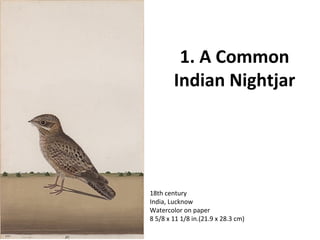
1. A Common 
Indian Nightjar 
18th century 
India, Lucknow 
Watercolor on paper 
8 5/8 x 11 1/8 in.(21.9 x 28.3 cm)
A Common Indian Nightjar 
The classic works of the Company School of painting were 
studies of plant and animal life, of which this depiction of 
the nightjar bird is one. The bird is executed with great 
attention to detail—individual feathers have been outlined 
and painted with subtle gradations of color, and several 
shades of brown and black are used to delineate its body 
markings. The eye has a bright ring around it and the legs 
are textured with parallel line markings. The landscape in 
which the bird stands is only sparingly indicated, and is in a 
smaller scale than the animal. This feature is common in 
Company School paintings of this kind, as the main purpose 
of the painting was to record species new to British 
observers. The painting comes from an album made for 
Claud Martin (1735–1800), the French soldier and patron of 
the arts who settled in Lucknow in the eighteenth century.
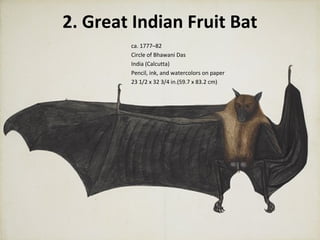
2. Great Indian Fruit Bat 
ca. 1777–82 
Circle of Bhawani Das 
India (Calcutta) 
Pencil, ink, and watercolors on paper 
23 1/2 x 32 3/4 in.(59.7 x 83.2 cm)
Great Indian Fruit Bat 
In 1777, Sir Elijah Impey, chief justice of Bengal between 1774 and 
1782, and his wife, Lady Mary, hired local artists to record the 
specimens of Indian flora and fauna they collected at their estate in 
Calcutta. Over the next five years, at least 326 paintings of plants, 
animals, and birds were made for the Impeys. On most of these 
works, the name of one of three artists—Bhawani Das, Shaykh Zayn 
al-Din, or Ram Das—appears along with the Hindi name of the 
animal and the phrase, in English, "In the collection of Lady Impey 
at Calcutta." Although this painting bears no such inscription, it is 
closely related to another painting of a bat by Bhawani Das, and it 
has always been associated with Impey patronage. One can imagine 
Bhawani Das and the anonymous artist of this painting working side 
by side, observing the animals, but whereas Bhawani Das' painting 
depicts a tawny-colored female bat centered on the page with both 
wings outstretched, his fellow artist has created an asymmetrical 
composition in shades of gray and black of an emphatically male 
bat with one wing dramatically unfurled.
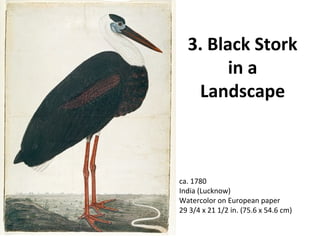
3. Black Stork 
in a 
Landscape 
ca. 1780 
India (Lucknow) 
Watercolor on European paper 
29 3/4 x 21 1/2 in. (75.6 x 54.6 cm)
Black Stork in a Landscape 
By the late eighteenth century, many Mughal-trained painters in 
central and eastern India were looking to the emerging British 
ruling class for patronage. The products of this new Company 
School were often albums of flora and fauna and other exotic sights 
of India, made to be taken back to Britain. Although this tradition 
reached its climax in the late eighteenth century, it continued well 
into the nineteenth. Of the varied subjects, bird studies, such as this 
bold depiction of a sturdy black stork, may be deemed a classic 
type. Paintings of birds, animals, and flowers had been an 
important genre in Indian art since the time of the Mughal emperor 
Jahangir (r. 1605–27), and the continuation of such subjects under 
British patronage was a natural extension of that established 
tradition, although the results were often quite different 
stylistically. In this painting, the stork is standing upright in a 
receding landscape of considerably reduced scale that contains a 
meandering river. The dramatic contrast in size between the bird 
and the vista it dominates gives the composition a distinctively 
idiosyncratic mood.
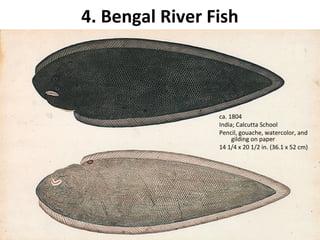
4. Bengal River Fish 
ca. 1804 
India; Calcutta School 
Pencil, gouache, watercolor, and 
gilding on paper 
14 1/4 x 20 1/2 in. (36.1 x 52 cm)
Bengal River Fish 
This painting shows two views of a Bengal river fish, 
executed in pencil and watercolor with traces of 
gilding on paper. The twin images of each side of the 
fish are placed by one another, the upper image in a 
dark gray tone and the lower one in a paler shade of 
the same color. The mottled, scaly surface of the fish's 
body is carefully rendered, as are its mouth and eyes. 
The painting is from the collection of Marquis 
Wellesley, governor-general of India from 1798 until 
1805. Wellesley had large menageries and hired native 
artists to paint each of the birds and animals in them
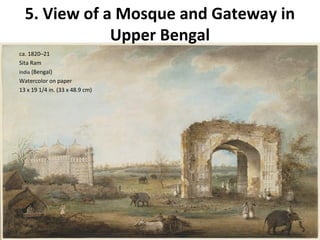
5. View of a Mosque and Gateway in 
Upper Bengal 
ca. 1820–21 
Sita Ram 
India (Bengal) 
Watercolor on paper 
13 x 19 1/4 in. (33 x 48.9 cm)
View of a Mosque and Gateway in 
Upper Bengal 
• Sita Ram, painter of this idyllic scene, was hired to record 
the travels of Francis Rawdon, the governor-general of 
Bengal (1814–21). Sita Ram had trained in Murshidabad 
and was particularly skilled in depicting architecture; he 
prepared a total of ten albums for Rawdon, but no other of 
his works survive. This particular picture was probably 
painted during Rawdon's tour of Bengal in the winter of 
1820–21, and appears to be a composite of monuments 
from the Gaur district. 
• This painting is likely part of a series from two important 
dispersed albums recording views of the Ganges in Bengal 
and of monuments in Agra. It is characterized by a 
Europeanizing style and exhibits a mastery of European 
watercolor techniques, suggesting that Sita Ram had 
contact with distinguished artists such as George Chinnery 
and Charles D'Oyly.
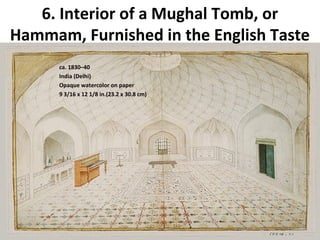
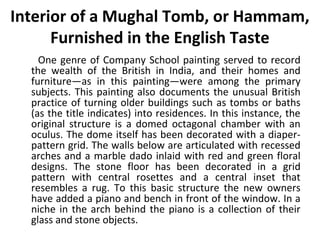
6. Interior of a Mughal Tomb, or 
Hammam, Furnished in the English Taste 
ca. 1830–40 
India (Delhi) 
Opaque watercolor on paper 
9 3/16 x 12 1/8 in.(23.2 x 30.8 cm)
Interior of a Mughal Tomb, or Hammam, 
Furnished in the English Taste 
One genre of Company School painting served to record 
the wealth of the British in India, and their homes and 
furniture—as in this painting—were among the primary 
subjects. This painting also documents the unusual British 
practice of turning older buildings such as tombs or baths 
(as the title indicates) into residences. In this instance, the 
original structure is a domed octagonal chamber with an 
oculus. The dome itself has been decorated with a diaper-pattern 
grid. The walls below are articulated with recessed 
arches and a marble dado inlaid with red and green floral 
designs. The stone floor has been decorated in a grid 
pattern with central rosettes and a central inset that 
resembles a rug. To this basic structure the new owners 
have added a piano and bench in front of the window. In a 
niche in the arch behind the piano is a collection of their 
glass and stone objects.
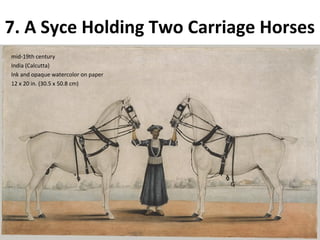
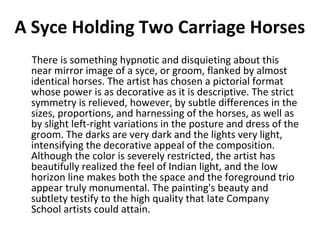
7. A Syce Holding Two Carriage Horses 
mid-19th century 
India (Calcutta) 
Ink and opaque watercolor on paper 
12 x 20 in. (30.5 x 50.8 cm)
A Syce Holding Two Carriage Horses 
There is something hypnotic and disquieting about this 
near mirror image of a syce, or groom, flanked by almost 
identical horses. The artist has chosen a pictorial format 
whose power is as decorative as it is descriptive. The strict 
symmetry is relieved, however, by subtle differences in the 
sizes, proportions, and harnessing of the horses, as well as 
by slight left-right variations in the posture and dress of the 
groom. The darks are very dark and the lights very light, 
intensifying the decorative appeal of the composition. 
Although the color is severely restricted, the artist has 
beautifully realized the feel of Indian light, and the low 
horizon line makes both the space and the foreground trio 
appear truly monumental. The painting's beauty and 
subtlety testify to the high quality that late Company 
School artists could attain.
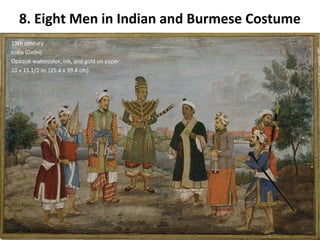
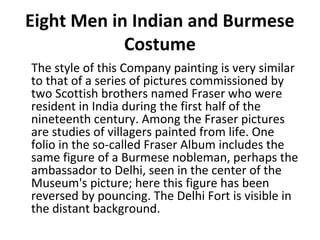
8. Eight Men in Indian and Burmese Costume 
19th century 
India (Delhi) 
Opaque watercolor, ink, and gold on paper 
10 x 15 1/2 in. (25.4 x 39.4 cm)
Eight Men in Indian and Burmese 
Costume 
The style of this Company painting is very similar 
to that of a series of pictures commissioned by 
two Scottish brothers named Fraser who were 
resident in India during the first half of the 
nineteenth century. Among the Fraser pictures 
are studies of villagers painted from life. One 
folio in the so-called Fraser Album includes the 
same figure of a Burmese nobleman, perhaps the 
ambassador to Delhi, seen in the center of the 
Museum's picture; here this figure has been 
reversed by pouncing. The Delhi Fort is visible in 
the distant background.
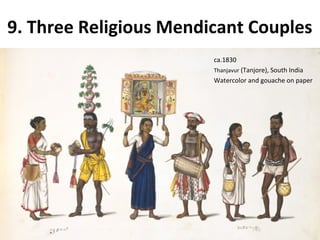
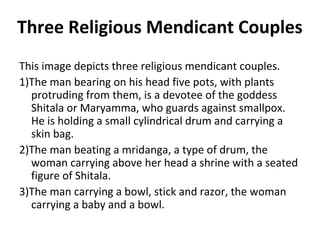
9. Three Religious Mendicant Couples 
ca.1830 
Thanjavur (Tanjore), South India 
Watercolor and gouache on paper
Three Religious Mendicant Couples 
This image depicts three religious mendicant couples. 
1)The man bearing on his head five pots, with plants 
protruding from them, is a devotee of the goddess 
Shitala or Maryamma, who guards against smallpox. 
He is holding a small cylindrical drum and carrying a 
skin bag. 
2)The man beating a mridanga, a type of drum, the 
woman carrying above her head a shrine with a seated 
figure of Shitala. 
3)The man carrying a bowl, stick and razor, the woman 
carrying a baby and a bowl.
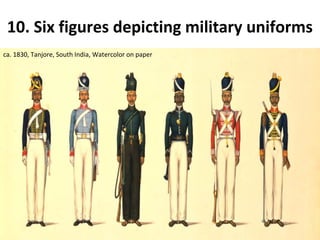
10. Six figures depicting military uniforms 
ca. 1830, Tanjore, South India, Watercolor on paper
Six figures depicting military uniforms 
Painting of six figures depicting military uniforms. 
Indians who worked for the British were also depicted in 
Company paintings. 
From a volume containing thirty folios depicting castes, 
occupations, methods of cultivation and Processions. 
The various uniforms are: 
• Madras Horse Artillery. 
• Madras Light Cavalry. 
• Madras Rifle Corps. 
• Madras Pioneers. 
• Madras Native Infantry. 
• Foot Artillery.
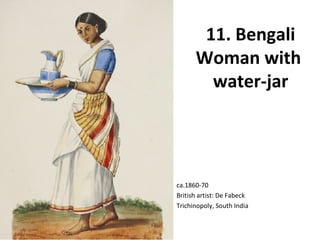
11. Bengali 
Woman with 
water-jar 
ca.1860-70 
British artist: De Fabeck 
Trichinopoly, South India
Bengali Woman with water-jar 
An ayah in a blue choli carrying a china ware 
and basin. Life study of a Bengali women 
carrying a lota, or jar, of water; wearing a 
green skirt; pink sari; along with a red and blue 
choli. These images serve as representations of 
ordinary people in India and show how they 
would have appeared during the 18th and 
19th centuries. They also give a sense of the 
body language, clothing, ornaments, and 
hairstyles that were associated with various 
occupations.
12. Durga Puja 
c.1809 
Sevak Ram 
Watercolour depicting a Durga Puja
Durga Puja 
Durga is a form of the Great Goddess Devi; she is 
considered to be one in a variety of personalities of 
the Hindu goddess. She is most well known as the 
goddess who killed the Buffalo Demon Mahisha. 
The Durga puja is an autumn festival where her 
victory is celebrated and other elements of her 
mythology are remembered. In this drawing, male 
dancers and musicians are performing before an 
image of the goddess Durga installed inside a house. 
The shrine to Durga depicts her in the moment of 
triumph over Mahisha. On the left a group of three 
men are seated on painted stools, one smoking a 
hookah.
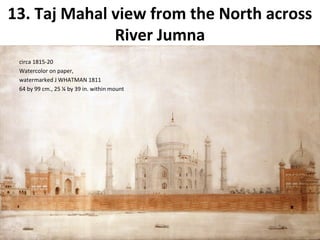
13. Taj Mahal view from the North across 
River Jumna 
circa 1815-20 
Watercolor on paper, 
watermarked J WHATMAN 1811 
64 by 99 cm., 25 ¼ by 39 in. within mount
Taj Mahal view from the North across 
River Jumna 
Earlier views of the Taj Mahal from the river were 
centred on the mausoleum itself. about 1820 moved the 
perspective to centre on the mosque to the west of the 
mausoleum, thereby increasing the beauty and 
complexity of the perspective drawing. By his use of the 
play of light and shadow, the artist has here given the 
hieratic image of the Taj an added dimension, that 
emotional content so often absent from Company 
School painting. To the right on the west side is the 
mosque and opposite on the east side is the Mihman 
Khana or assembly hall used as a guest house. The Taj 
Mahal, Agra from the river Jumna from a series of 60 
drawing of Mughal monuments. The drawings are 
recorded as being by 'native draughtsmen of the Delhi 
School in the Office of the East India Company'.
14. Holi being played in Courtyard 
circa 1795, Medium: Watercolor
Holi being played in Courtyard 
• Watercolour drawing showing the Holi festival, by an anonymous artist 
working in the Patna school, c. 1795-1800. Inscribed on the back of the 
drawing is: 'No.4. The Gift of E.E. Pote Esqr. Elizath Collins. This is a Hindoo 
Festival celebrated, among other sports, by throwing a red powder enclosed 
in globes of Lak which break instantly and cover the party with the Powder - 
this is immediately returned - and thus by partial and promiscuous peltings - 
the whole Party are entirely covered with the red Powder. The Powder is also 
put in Water, and the Assembly attack each other with squirts filled with the 
red water - by the time the Party break up', 'they are so disfigured as scarce to 
be known'; also' The Festival of the Hoolee.' 
• Holi is a very colourful Hindu festival celebrated at the end of the winter 
season on the last full moon day of the lunar month Phalguna 
(February/March). During the celebrations participants jump over bonfires the 
preceding night and on the day itself they throw coloured water and powder 
at each other. The festival has ancient origins and is practiced all over India. In 
this drawing, an Indian gentleman is sitting on a painted stool watching the 
celebrations. Men sing and dance and play on instruments while women 
squirt coloured water.
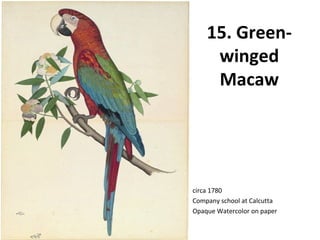
15. Green-winged 
Macaw 
circa 1780 
Company school at Calcutta 
Opaque Watercolor on paper
Green-winged Macaw 
• A Green-Winged Macaw, folio, possibly from the 
'Impey Album,' Attributed by inscription to 
Shaikh Zain al-Din, Company school at Calcutta, 
about 1780, opaque watercolor on paper. 
• The green wing Macaw is primarily a darker red 
in color. It has red, or, red and black, feather 
species on its facial patch and a green band of 
feathers following the red on its wings. The 
Green wing macaw is also known as the Gentle 
Giant as it is larger than most other macaws 
species.
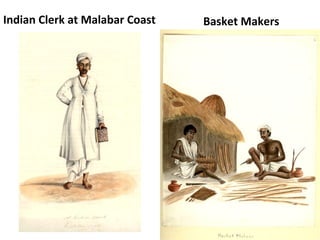
Indian Clerk at Malabar Coast Basket Makers
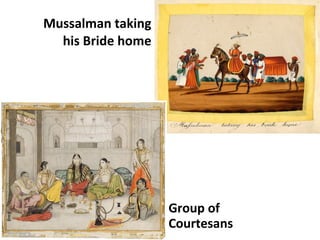
Mussalman taking 
his Bride home 
Group of 
Courtesans
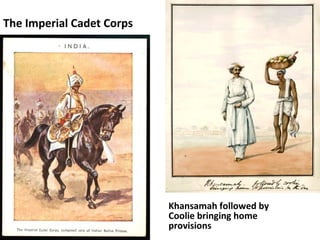
The Imperial Cadet Corps 
Khansamah followed by 
Coolie bringing home 
provisions

Company school painting

  • 1.
    HISTORY OF ARTS Assignment on Company School of Paintings Submitted to: Ms Neha Dhaliwal Submitted by: Minnoti Verma Roll No.: 3310 BFA, 3rd Year “Painting is just another way of keeping a diary.” -Pablo Picasso
  • 2.
    Colonial influence onIndian art or Company style of art “Native artists were encouraged to paint images of Indian life which reflected the social fabric of the period.”
  • 3.
    Classification of Indianart Indian art can be classified into specific periods each reflecting particular religious, political and cultural developments. • Hinduism and Buddhism of the ancient period (3500 BCE-present) • Islamic ascendancy (712-1757 CE) • The Colonial period (1757-1947) • Independence and the postcolonial period (Post-1947) • Modernism • Postmodernism Each period is unique in its art, literature and architecture. Indian art is constantly challenged as it rises to the peak of achieving the ideals of one philosophy in a visual form, then begins anew for another.
  • 4.
    Company Paintings –Introduction Europeans arriving in India during the 18th century, were fascinated by their new environment. The British wanted their visual experiences to be recorded in paintings and sketches, and found that the subjects that interested them could be depicted far more accurately by Indian than British artists. During the 18th and 19th centuries, the British employed Indian artists to illustrate the manners and customs of India and to record scenes of monuments, deities, festivals, and occupations. These works later became known as 'Company paintings' because they were created by Indian artists employed by members of the British East India Company.
  • 5.
    Company Paintings -Scenes of Everyday Life The British wanted images of everyday scenes such as the vendors at the market selling grain, fruits and vegetables. The paintings show that the markets of 1850 are very similar to the food markets in India today. Religious castes and occupations were also very popular subjects, especially in South India. People were usually depicted in pairs, as with this set of three mendicant couples with various instruments used in worship and daily life. This painting comes from a book of 30 pages depicting castes, occupations, methods of cultivation and procession scenes. Groups of images were commonly compiled into books, and presented as gifts or saved as mementos.
  • 6.
    Company Paintings -Paintings for European Markets Many of these paintings were created by Indian artist families in areas of British influence such as Tanjore, Trichinopoly, Delhi, Murshidabad, Patna, Calcutta, Benares and Lucknow. Sometimes paintings of local subjects were produced and later peddled at British train stations or sold to European travelers. Individual artists were also commissioned or employed by European officers of the East India company to produce specific works, such as the painting of the Rath Jatra festival procession of 1822, showing a British couple with an Indian nobleman.
  • 7.
    Company Paintings -Stylistic Crossover Indian artists were willing to create new works targeted at the taste of the Europeans who favored watercolor paintings. Both subject matter and style were influenced by the English representational watercolor paintings and prints that were brought to India. Artists gradually switched from heavy Indian opaque paints to light water-colour paints. The result is a type of painting with a blend of Indian and British styles, and an attempt by Indian artists to meet European demands for accurate depictions of subjects. The bright colors traditionally used in Indian miniature paintings were replaced with soft blue, green and brown tones.
  • 8.
    Company Paintings -Records from the past Company paintings can be used as historical documentation of origins of the people of India. Monuments and their surroundings as they were in the past can now only be visualized through these paintings. The Taj Mahal complex, as depicted in the 1830s, is bursting with trees which no longer exist. Through these paintings we are able to have a glimpse of India through Indian eyes of the 1800s. Company paintings for the British continued throughout the 19th century until the introduction of photography in India in the 1840s, which gradually took over.
  • 9.
    Company Paintings -Basic Characteristics and Examples • The use of watercolors • Linear perspective • Light and Shade. • Fairly simple illustrations of a limited range of Indian life of miniature painting - company paintings • Company paintings provided what was in some ways a restricted vision. • Tended to focus on a simple range of representative crafts and occupations, castes and ethnic groups, and commonly observed events and occasions.
  • 10.
    1. A Common Indian Nightjar 18th century India, Lucknow Watercolor on paper 8 5/8 x 11 1/8 in.(21.9 x 28.3 cm)
  • 11.
    A Common IndianNightjar The classic works of the Company School of painting were studies of plant and animal life, of which this depiction of the nightjar bird is one. The bird is executed with great attention to detail—individual feathers have been outlined and painted with subtle gradations of color, and several shades of brown and black are used to delineate its body markings. The eye has a bright ring around it and the legs are textured with parallel line markings. The landscape in which the bird stands is only sparingly indicated, and is in a smaller scale than the animal. This feature is common in Company School paintings of this kind, as the main purpose of the painting was to record species new to British observers. The painting comes from an album made for Claud Martin (1735–1800), the French soldier and patron of the arts who settled in Lucknow in the eighteenth century.
  • 12.
    2. Great IndianFruit Bat ca. 1777–82 Circle of Bhawani Das India (Calcutta) Pencil, ink, and watercolors on paper 23 1/2 x 32 3/4 in.(59.7 x 83.2 cm)
  • 13.
    Great Indian FruitBat In 1777, Sir Elijah Impey, chief justice of Bengal between 1774 and 1782, and his wife, Lady Mary, hired local artists to record the specimens of Indian flora and fauna they collected at their estate in Calcutta. Over the next five years, at least 326 paintings of plants, animals, and birds were made for the Impeys. On most of these works, the name of one of three artists—Bhawani Das, Shaykh Zayn al-Din, or Ram Das—appears along with the Hindi name of the animal and the phrase, in English, "In the collection of Lady Impey at Calcutta." Although this painting bears no such inscription, it is closely related to another painting of a bat by Bhawani Das, and it has always been associated with Impey patronage. One can imagine Bhawani Das and the anonymous artist of this painting working side by side, observing the animals, but whereas Bhawani Das' painting depicts a tawny-colored female bat centered on the page with both wings outstretched, his fellow artist has created an asymmetrical composition in shades of gray and black of an emphatically male bat with one wing dramatically unfurled.
  • 14.
    3. Black Stork in a Landscape ca. 1780 India (Lucknow) Watercolor on European paper 29 3/4 x 21 1/2 in. (75.6 x 54.6 cm)
  • 15.
    Black Stork ina Landscape By the late eighteenth century, many Mughal-trained painters in central and eastern India were looking to the emerging British ruling class for patronage. The products of this new Company School were often albums of flora and fauna and other exotic sights of India, made to be taken back to Britain. Although this tradition reached its climax in the late eighteenth century, it continued well into the nineteenth. Of the varied subjects, bird studies, such as this bold depiction of a sturdy black stork, may be deemed a classic type. Paintings of birds, animals, and flowers had been an important genre in Indian art since the time of the Mughal emperor Jahangir (r. 1605–27), and the continuation of such subjects under British patronage was a natural extension of that established tradition, although the results were often quite different stylistically. In this painting, the stork is standing upright in a receding landscape of considerably reduced scale that contains a meandering river. The dramatic contrast in size between the bird and the vista it dominates gives the composition a distinctively idiosyncratic mood.
  • 16.
    4. Bengal RiverFish ca. 1804 India; Calcutta School Pencil, gouache, watercolor, and gilding on paper 14 1/4 x 20 1/2 in. (36.1 x 52 cm)
  • 17.
    Bengal River Fish This painting shows two views of a Bengal river fish, executed in pencil and watercolor with traces of gilding on paper. The twin images of each side of the fish are placed by one another, the upper image in a dark gray tone and the lower one in a paler shade of the same color. The mottled, scaly surface of the fish's body is carefully rendered, as are its mouth and eyes. The painting is from the collection of Marquis Wellesley, governor-general of India from 1798 until 1805. Wellesley had large menageries and hired native artists to paint each of the birds and animals in them
  • 18.
    5. View ofa Mosque and Gateway in Upper Bengal ca. 1820–21 Sita Ram India (Bengal) Watercolor on paper 13 x 19 1/4 in. (33 x 48.9 cm)
  • 19.
    View of aMosque and Gateway in Upper Bengal • Sita Ram, painter of this idyllic scene, was hired to record the travels of Francis Rawdon, the governor-general of Bengal (1814–21). Sita Ram had trained in Murshidabad and was particularly skilled in depicting architecture; he prepared a total of ten albums for Rawdon, but no other of his works survive. This particular picture was probably painted during Rawdon's tour of Bengal in the winter of 1820–21, and appears to be a composite of monuments from the Gaur district. • This painting is likely part of a series from two important dispersed albums recording views of the Ganges in Bengal and of monuments in Agra. It is characterized by a Europeanizing style and exhibits a mastery of European watercolor techniques, suggesting that Sita Ram had contact with distinguished artists such as George Chinnery and Charles D'Oyly.
  • 20.
    6. Interior ofa Mughal Tomb, or Hammam, Furnished in the English Taste ca. 1830–40 India (Delhi) Opaque watercolor on paper 9 3/16 x 12 1/8 in.(23.2 x 30.8 cm)
  • 21.
    Interior of aMughal Tomb, or Hammam, Furnished in the English Taste One genre of Company School painting served to record the wealth of the British in India, and their homes and furniture—as in this painting—were among the primary subjects. This painting also documents the unusual British practice of turning older buildings such as tombs or baths (as the title indicates) into residences. In this instance, the original structure is a domed octagonal chamber with an oculus. The dome itself has been decorated with a diaper-pattern grid. The walls below are articulated with recessed arches and a marble dado inlaid with red and green floral designs. The stone floor has been decorated in a grid pattern with central rosettes and a central inset that resembles a rug. To this basic structure the new owners have added a piano and bench in front of the window. In a niche in the arch behind the piano is a collection of their glass and stone objects.
  • 22.
    7. A SyceHolding Two Carriage Horses mid-19th century India (Calcutta) Ink and opaque watercolor on paper 12 x 20 in. (30.5 x 50.8 cm)
  • 23.
    A Syce HoldingTwo Carriage Horses There is something hypnotic and disquieting about this near mirror image of a syce, or groom, flanked by almost identical horses. The artist has chosen a pictorial format whose power is as decorative as it is descriptive. The strict symmetry is relieved, however, by subtle differences in the sizes, proportions, and harnessing of the horses, as well as by slight left-right variations in the posture and dress of the groom. The darks are very dark and the lights very light, intensifying the decorative appeal of the composition. Although the color is severely restricted, the artist has beautifully realized the feel of Indian light, and the low horizon line makes both the space and the foreground trio appear truly monumental. The painting's beauty and subtlety testify to the high quality that late Company School artists could attain.
  • 24.
    8. Eight Menin Indian and Burmese Costume 19th century India (Delhi) Opaque watercolor, ink, and gold on paper 10 x 15 1/2 in. (25.4 x 39.4 cm)
  • 25.
    Eight Men inIndian and Burmese Costume The style of this Company painting is very similar to that of a series of pictures commissioned by two Scottish brothers named Fraser who were resident in India during the first half of the nineteenth century. Among the Fraser pictures are studies of villagers painted from life. One folio in the so-called Fraser Album includes the same figure of a Burmese nobleman, perhaps the ambassador to Delhi, seen in the center of the Museum's picture; here this figure has been reversed by pouncing. The Delhi Fort is visible in the distant background.
  • 26.
    9. Three ReligiousMendicant Couples ca.1830 Thanjavur (Tanjore), South India Watercolor and gouache on paper
  • 27.
    Three Religious MendicantCouples This image depicts three religious mendicant couples. 1)The man bearing on his head five pots, with plants protruding from them, is a devotee of the goddess Shitala or Maryamma, who guards against smallpox. He is holding a small cylindrical drum and carrying a skin bag. 2)The man beating a mridanga, a type of drum, the woman carrying above her head a shrine with a seated figure of Shitala. 3)The man carrying a bowl, stick and razor, the woman carrying a baby and a bowl.
  • 28.
    10. Six figuresdepicting military uniforms ca. 1830, Tanjore, South India, Watercolor on paper
  • 29.
    Six figures depictingmilitary uniforms Painting of six figures depicting military uniforms. Indians who worked for the British were also depicted in Company paintings. From a volume containing thirty folios depicting castes, occupations, methods of cultivation and Processions. The various uniforms are: • Madras Horse Artillery. • Madras Light Cavalry. • Madras Rifle Corps. • Madras Pioneers. • Madras Native Infantry. • Foot Artillery.
  • 30.
    11. Bengali Womanwith water-jar ca.1860-70 British artist: De Fabeck Trichinopoly, South India
  • 31.
    Bengali Woman withwater-jar An ayah in a blue choli carrying a china ware and basin. Life study of a Bengali women carrying a lota, or jar, of water; wearing a green skirt; pink sari; along with a red and blue choli. These images serve as representations of ordinary people in India and show how they would have appeared during the 18th and 19th centuries. They also give a sense of the body language, clothing, ornaments, and hairstyles that were associated with various occupations.
  • 32.
    12. Durga Puja c.1809 Sevak Ram Watercolour depicting a Durga Puja
  • 33.
    Durga Puja Durgais a form of the Great Goddess Devi; she is considered to be one in a variety of personalities of the Hindu goddess. She is most well known as the goddess who killed the Buffalo Demon Mahisha. The Durga puja is an autumn festival where her victory is celebrated and other elements of her mythology are remembered. In this drawing, male dancers and musicians are performing before an image of the goddess Durga installed inside a house. The shrine to Durga depicts her in the moment of triumph over Mahisha. On the left a group of three men are seated on painted stools, one smoking a hookah.
  • 34.
    13. Taj Mahalview from the North across River Jumna circa 1815-20 Watercolor on paper, watermarked J WHATMAN 1811 64 by 99 cm., 25 ¼ by 39 in. within mount
  • 35.
    Taj Mahal viewfrom the North across River Jumna Earlier views of the Taj Mahal from the river were centred on the mausoleum itself. about 1820 moved the perspective to centre on the mosque to the west of the mausoleum, thereby increasing the beauty and complexity of the perspective drawing. By his use of the play of light and shadow, the artist has here given the hieratic image of the Taj an added dimension, that emotional content so often absent from Company School painting. To the right on the west side is the mosque and opposite on the east side is the Mihman Khana or assembly hall used as a guest house. The Taj Mahal, Agra from the river Jumna from a series of 60 drawing of Mughal monuments. The drawings are recorded as being by 'native draughtsmen of the Delhi School in the Office of the East India Company'.
  • 36.
    14. Holi beingplayed in Courtyard circa 1795, Medium: Watercolor
  • 37.
    Holi being playedin Courtyard • Watercolour drawing showing the Holi festival, by an anonymous artist working in the Patna school, c. 1795-1800. Inscribed on the back of the drawing is: 'No.4. The Gift of E.E. Pote Esqr. Elizath Collins. This is a Hindoo Festival celebrated, among other sports, by throwing a red powder enclosed in globes of Lak which break instantly and cover the party with the Powder - this is immediately returned - and thus by partial and promiscuous peltings - the whole Party are entirely covered with the red Powder. The Powder is also put in Water, and the Assembly attack each other with squirts filled with the red water - by the time the Party break up', 'they are so disfigured as scarce to be known'; also' The Festival of the Hoolee.' • Holi is a very colourful Hindu festival celebrated at the end of the winter season on the last full moon day of the lunar month Phalguna (February/March). During the celebrations participants jump over bonfires the preceding night and on the day itself they throw coloured water and powder at each other. The festival has ancient origins and is practiced all over India. In this drawing, an Indian gentleman is sitting on a painted stool watching the celebrations. Men sing and dance and play on instruments while women squirt coloured water.
  • 38.
    15. Green-winged Macaw circa 1780 Company school at Calcutta Opaque Watercolor on paper
  • 39.
    Green-winged Macaw •A Green-Winged Macaw, folio, possibly from the 'Impey Album,' Attributed by inscription to Shaikh Zain al-Din, Company school at Calcutta, about 1780, opaque watercolor on paper. • The green wing Macaw is primarily a darker red in color. It has red, or, red and black, feather species on its facial patch and a green band of feathers following the red on its wings. The Green wing macaw is also known as the Gentle Giant as it is larger than most other macaws species.
  • 40.
    Indian Clerk atMalabar Coast Basket Makers
  • 41.
    Mussalman taking hisBride home Group of Courtesans
  • 42.
    The Imperial CadetCorps Khansamah followed by Coolie bringing home provisions