 NAME: Boon Li Ying
 STUDENT ID: 0323839
 MODULE: Effective Public Communication [COM 30103]
 SESSION: September 2015
 LECTURER: Mohd Ridhwan Abdullah
 SUBMISSION DATE: 20 January 2016
SCHOOL OF ARCHITECTURE, BUILDING AND DESIGN
Foundation in Natural & Built Environment (FNBE)
Individual Assignment
(Oral Presentation)
Religious Building Around The World
Rome, Italy
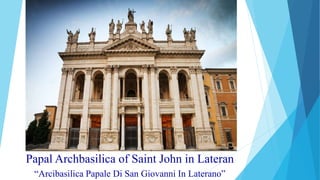
Papal Archbasilica of Saint John in Lateran
“Arcibasilica Papale Di San Giovanni In Laterano”
A. Historical Background
 the first church to be built in Rome
 the cathedral church of Rome
 the cathedral of the bishop of Rome, the Pope (the head of the
Catholic Church)
 the oldest and ranks first among the five Papal Basilicas of the
world
 the first among the four major basilicas of Rome, which are St.
Peter’s Basilica, St. Mary Major and St. Paul’s outside the Walls
 built by Constantine the Great in the 4th century
A. Historical Background
 This site was occupied by the palace belonging to the rich
Laterani family in ancient times
 P. Sextius Lateranus, was the first to attain the rank of consul
 The palace was confiscated because of Plautius Lateranus
accused of conspiracy against the emperor in the time of Nero
 The palace came eventually into the hands of Constantine, the
first Christian emperor but it became Imperial property when
Constantine I married Fausta (the sister of his enemy
Maxentius), and was eventually given to the Bishop of Rome
 So, Lateran Palace become the official residence of the Pope
A. Historical Background
 A first basilica was built, right next to the Lateran
Palace
 It was consecrated ten years later by Pope Sylvester I
 The church was sacked twice in the fifth century but
rebuilt soon
 It was damaged by an earthquake but once again it was
rebuilt
 The Lateran Palace and the church were severely
damaged by fire
 So, the Palace and Basilica were reconstructed to
various degrees several times before the 16th century
B. Structure of The Buildings (Exterior)
 Lateran Palace
 Main entrance is on the north
side
 There are three storeys,
rendered in orange ochre
 The first storey has windows
with floating cornices, while
the other two storeys have
alternate triangular and
segmentally pedimental
windows.
B. Structure of The Buildings (Exterior)
 Basilica
 There are five doors in the
narthex, one for each nave
 Five naves divided by
massive columns that support
large arches
 Occupied by a semi-circular
apse ten metres deep
B. Structure of The Buildings (Exterior)
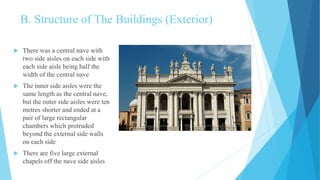
 There was a central nave with
two side aisles on each side with
each side aisle being half the
width of the central nave
 The inner side aisles were the
same length as the central nave,
but the outer side aisles were ten
metres shorter and ended at a
pair of large rectangular
chambers which protruded
beyond the external side walls
on each side
 There are five large external
chapels off the nave side aisles
B. Structure of The Buildings (Exterior)
 The colossal eastern façade of St. John Lateran is probably the most
recognizable part of this basilica
 topped with fifteen large travertine statues, each seven meters tall
 The central is Jesus Christ , flanked by St. John the Baptist and St.
John the Evangelist while the others statues represent Fathers of the
Church
B. Structure of The Buildings (Exterior)
 Loggia of Benedictions
 at the north façade which is the end
of the transept
 the edifice has two structurally
identical storeys, each with five
large arched portals and separated
by pilasters with a painted ceiling
 flanked by two medieval bell towers
B. Structure of The Buildings (Exterior)
 Cloisters
 accessible from the left
transept
 is an intermediate style
between Romanesque
and Gothic
 adorned with unique
spiral columns of inlaid
marble and contain
many early Christian
fragments from the
basilica
B. Structure of The Buildings (Interior)
 The Central Nave
 the main nave, from the main entrance to the throne, towards the end of the apse
 flanked by two aisles on each side and ending in a semi-circular apse to the west
 stands over the Papal Altar and the beautiful gothic style baldachin, which is
located towards the top of the altar
B. Structure of The Buildings (Interior)
 The Apse
 decorated with large
mosaics
 depicting Christ
surrounded by nine
seraphim
B. Structure of The Buildings (Interior)
 The Papal Cathedra
(throne of the Pope)
B. Structure of The Buildings (Interior)
 ceiling of the Loggia of
Benedictions
 decorated with fresco of Saints
and Angels
B. Structure of The Buildings (Interior)
 decorative floor
B. Layout of The Buildings
 Basic plan of the basilica, St John in Lateran
B. Layout of The Buildings (Floor Plan)
B. Layout of The Buildings
 1. Apse
 2. Transept 1
 3. Transept 2
 4. Nave 1
 5. Nave 2
 6. Chapel Column
 7. Lancellotti Chapel
 8. Corsini Chapel
 9. Cloister
 10. Baptistery
 11. Baptistery Chapel
 12. Exterior (North)
 13. Exterior (East)
http://www.vatican.va/various/basiliche/san_giovanni/vr_tour/index-it.html
C. Types of Ornamentation Used
 12 niches in the walls of the nave
 12 sculptures of Apostles, of greater than life-size to be placed in the niches
 selected from among the most prominent late Baroque sculptors in Rome
C. Types of Ornamentation Used
St. Andrew St. James the GreaterSt. Bartholomew St. James the Lesser
C. Types of Ornamentation Used
St. PaulSt. Jude ThaddeausSt. John St. Matthew
C. Types of Ornamentation Used
St. Philip St. Thomas St. SimonSt. Peter
D. Types of Materials Used
 decorated with the
colossal marble
statues of the
Apostles
D. Types of Materials Used
 decorated with gold coffered ceiling
D. Types of Materials Used
 the Lancellotti Chapel
 decorated with the stucco
angels, putti, medallion
and garlands of stucco
roses above the altar niche
D. Types of Materials Used
 most of the Lancellotti
Chapel dome decorate
with stucco work
E. Other relevant information
 Lateran Obelisk
 is the tallest obelisk in
Rome, and the largest
standing Egyptian obelisk
in the world
 located at the north-west
of the basilica
E. Other relevant information
 Lateran Baptistery
 is the oldest baptistery in
Rome
 located next to St. John
Lateran and the Lateran
Palace
E. Other relevant information
Location of St. John in Lateran
References
 1. http://www.vatican.va/various/basiliche/san_giovanni/index_it.htm
 2. http://romanchurches.wikia.com/wiki/San_Giovanni_in_Laterano
 3. http://www.sacred-destinations.com/italy/rome-san-giovanni-laterano
 4. http://www.aviewoncities.com/rome/sangiovanniinlaterano.htm
 5. http://www.digital-images.net/Gallery/Scenic/Rome/Churches/Lateran/lateran.html
 6. http://www.piercedhearts.org/treasures/holy_sites/st_john_lateran.htm
THANK
YOU

Religious building around the world

  • 1.
     NAME: BoonLi Ying  STUDENT ID: 0323839  MODULE: Effective Public Communication [COM 30103]  SESSION: September 2015  LECTURER: Mohd Ridhwan Abdullah  SUBMISSION DATE: 20 January 2016 SCHOOL OF ARCHITECTURE, BUILDING AND DESIGN Foundation in Natural & Built Environment (FNBE) Individual Assignment (Oral Presentation)
  • 2.
    Religious Building AroundThe World Rome, Italy
  • 3.
    Papal Archbasilica ofSaint John in Lateran “Arcibasilica Papale Di San Giovanni In Laterano”
  • 4.
    A. Historical Background the first church to be built in Rome  the cathedral church of Rome  the cathedral of the bishop of Rome, the Pope (the head of the Catholic Church)  the oldest and ranks first among the five Papal Basilicas of the world  the first among the four major basilicas of Rome, which are St. Peter’s Basilica, St. Mary Major and St. Paul’s outside the Walls  built by Constantine the Great in the 4th century
  • 5.
    A. Historical Background This site was occupied by the palace belonging to the rich Laterani family in ancient times  P. Sextius Lateranus, was the first to attain the rank of consul  The palace was confiscated because of Plautius Lateranus accused of conspiracy against the emperor in the time of Nero  The palace came eventually into the hands of Constantine, the first Christian emperor but it became Imperial property when Constantine I married Fausta (the sister of his enemy Maxentius), and was eventually given to the Bishop of Rome  So, Lateran Palace become the official residence of the Pope
  • 6.
    A. Historical Background A first basilica was built, right next to the Lateran Palace  It was consecrated ten years later by Pope Sylvester I  The church was sacked twice in the fifth century but rebuilt soon  It was damaged by an earthquake but once again it was rebuilt  The Lateran Palace and the church were severely damaged by fire  So, the Palace and Basilica were reconstructed to various degrees several times before the 16th century
  • 7.
    B. Structure ofThe Buildings (Exterior)  Lateran Palace  Main entrance is on the north side  There are three storeys, rendered in orange ochre  The first storey has windows with floating cornices, while the other two storeys have alternate triangular and segmentally pedimental windows.
  • 8.
    B. Structure ofThe Buildings (Exterior)  Basilica  There are five doors in the narthex, one for each nave  Five naves divided by massive columns that support large arches  Occupied by a semi-circular apse ten metres deep
  • 9.
    B. Structure ofThe Buildings (Exterior)  There was a central nave with two side aisles on each side with each side aisle being half the width of the central nave  The inner side aisles were the same length as the central nave, but the outer side aisles were ten metres shorter and ended at a pair of large rectangular chambers which protruded beyond the external side walls on each side  There are five large external chapels off the nave side aisles
  • 10.
    B. Structure ofThe Buildings (Exterior)  The colossal eastern façade of St. John Lateran is probably the most recognizable part of this basilica  topped with fifteen large travertine statues, each seven meters tall  The central is Jesus Christ , flanked by St. John the Baptist and St. John the Evangelist while the others statues represent Fathers of the Church
  • 11.
    B. Structure ofThe Buildings (Exterior)  Loggia of Benedictions  at the north façade which is the end of the transept  the edifice has two structurally identical storeys, each with five large arched portals and separated by pilasters with a painted ceiling  flanked by two medieval bell towers
  • 12.
    B. Structure ofThe Buildings (Exterior)  Cloisters  accessible from the left transept  is an intermediate style between Romanesque and Gothic  adorned with unique spiral columns of inlaid marble and contain many early Christian fragments from the basilica
  • 13.
    B. Structure ofThe Buildings (Interior)  The Central Nave  the main nave, from the main entrance to the throne, towards the end of the apse  flanked by two aisles on each side and ending in a semi-circular apse to the west  stands over the Papal Altar and the beautiful gothic style baldachin, which is located towards the top of the altar
  • 14.
    B. Structure ofThe Buildings (Interior)  The Apse  decorated with large mosaics  depicting Christ surrounded by nine seraphim
  • 15.
    B. Structure ofThe Buildings (Interior)  The Papal Cathedra (throne of the Pope)
  • 16.
    B. Structure ofThe Buildings (Interior)  ceiling of the Loggia of Benedictions  decorated with fresco of Saints and Angels
  • 17.
    B. Structure ofThe Buildings (Interior)  decorative floor
  • 18.
    B. Layout ofThe Buildings  Basic plan of the basilica, St John in Lateran
  • 19.
    B. Layout ofThe Buildings (Floor Plan)
  • 20.
    B. Layout ofThe Buildings  1. Apse  2. Transept 1  3. Transept 2  4. Nave 1  5. Nave 2  6. Chapel Column  7. Lancellotti Chapel  8. Corsini Chapel  9. Cloister  10. Baptistery  11. Baptistery Chapel  12. Exterior (North)  13. Exterior (East) http://www.vatican.va/various/basiliche/san_giovanni/vr_tour/index-it.html
  • 21.
    C. Types ofOrnamentation Used  12 niches in the walls of the nave  12 sculptures of Apostles, of greater than life-size to be placed in the niches  selected from among the most prominent late Baroque sculptors in Rome
  • 22.
    C. Types ofOrnamentation Used St. Andrew St. James the GreaterSt. Bartholomew St. James the Lesser
  • 23.
    C. Types ofOrnamentation Used St. PaulSt. Jude ThaddeausSt. John St. Matthew
  • 24.
    C. Types ofOrnamentation Used St. Philip St. Thomas St. SimonSt. Peter
  • 25.
    D. Types ofMaterials Used  decorated with the colossal marble statues of the Apostles
  • 26.
    D. Types ofMaterials Used  decorated with gold coffered ceiling
  • 27.
    D. Types ofMaterials Used  the Lancellotti Chapel  decorated with the stucco angels, putti, medallion and garlands of stucco roses above the altar niche
  • 28.
    D. Types ofMaterials Used  most of the Lancellotti Chapel dome decorate with stucco work
  • 29.
    E. Other relevantinformation  Lateran Obelisk  is the tallest obelisk in Rome, and the largest standing Egyptian obelisk in the world  located at the north-west of the basilica
  • 30.
    E. Other relevantinformation  Lateran Baptistery  is the oldest baptistery in Rome  located next to St. John Lateran and the Lateran Palace
  • 31.
    E. Other relevantinformation Location of St. John in Lateran
  • 32.
    References  1. http://www.vatican.va/various/basiliche/san_giovanni/index_it.htm 2. http://romanchurches.wikia.com/wiki/San_Giovanni_in_Laterano  3. http://www.sacred-destinations.com/italy/rome-san-giovanni-laterano  4. http://www.aviewoncities.com/rome/sangiovanniinlaterano.htm  5. http://www.digital-images.net/Gallery/Scenic/Rome/Churches/Lateran/lateran.html  6. http://www.piercedhearts.org/treasures/holy_sites/st_john_lateran.htm
  • 33.