BAROQUE STYLE
• Submitted by:
Yash Patel-1649
Rathin Shah-1667
Hardik Darji-1610
Apoorv Rayka-1681
Sushant Kumar Singh-1672
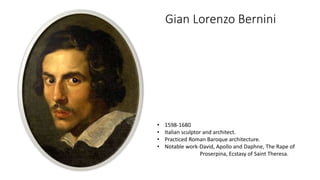
Gian Lorenzo Bernini
• 1598-1680
• Italian sculptor and architect.
• Practiced Roman Baroque architecture.
• Notable work-David, Apollo and Daphne, The Rape of
Proserpina, Ecstasy of Saint Theresa.
St Peter’s Square, Rome
• St. Peter's Square is a large plaza located directly in front of St. Peter's Basilica in the Vatican City.
• Trapezoidal entrance to the basilica and the massive elliptical area.
• The long axis, parallel to the basilica's facade, creates a pause in the sequence of forward
movements that is characteristic of a Baroque monumental approach.
• Surrounded by 284 columns, set out in rows of four, and 88 pilasters, the columns have a height
of 20 m and a width of 1.6 m.
• Bernini’s pupils built 140 statues of saints, 3.20 m high along the balustrade above the columns.
• 320 meters long and 240 meters wide.
• Gian Lorenzo Bernini designed the square which embrace visitors in "the maternal arms of
Mother Church“
• Used Tuscan form of Doric order.
• At the center of the piazza stands an Egyptian obelisk of red granite, 25.5 m tall,
in all 41 m to the cross on its top. The obelisk was originally erected at
Heliopolis, Egypt, by an unknown pharaoh.
Maderno fountain
Bernini fountain
• Maderno’s fountain was built in 1612.
• Maderno fountain could shoot water twenty feet
upwards into the air as the source was above sea level.
• For half a century, the square was decorated with the
Maderno fountain and with the obelisk , but the
southern part of the square remained empty.
• Gian Lorenzo Bernini was commissioned to build a
second fountain, which followed the design of the
Maderno fountain. Bernini fountain was completed in
1677.
Doric order
Egyptian obelisk
Scala Regia
• Scala regia is a flight of steps in the Vatican city and is part of the formal entrance to the Vatican.
• It was built by Antonio da Sangallo the younger.
• Restored by Gian Lorenzo Bernini from 1663 to1666.
• Connects the Apostolic palace to St. Peter’s Basilica.
• The site for the stairs between church and palace, is awkwardly shaped with irregular convering walls.
• The staircase take the form of a barrel-vaulted colonnade that necessarily becomes narrower at the end
exaggerating the distance.
• Total 32 numbers of column are
there.
• Length approx. 130 m.
• Ionic columns are used.
• The statue of Constantine by Gian
Lorenzo Bernini.
• The statue of Constantine shows
the emperor in the traditional
episode of the cross appearing to
him before the battle of Ponte
Milvio.
Columns of Scala Regia
statue of Constantine
Scala regia
• Detail of the decoration is extremely
rich: we can notice that the flowers
are all different.
• Another statue of Charlemagne (who
was crowned in St Peter's in 800).
• Bernini originally constructed six
skylight, two of which still exist (3, 4),
raising the level of illumination on the
last leg of the stairs.
Detail of the decoration
Statue of Charlemagne
Exploded view showing six skylights.
Section of Scala Regia
View from the bottom of the stairs
Forming a barrel-vaulted
Francesco Borromini
• 1599-1667
• Italian baroque architect
• Notable Work-San Carlo alle Quattro Fontane,
Sant'Agnese in Agone, Sant'Ivo alla Sapienza,
Oratorio dei Filippini
San Carlo alle Quattro
(Saint Charles at the Four Fountains)
San Carlo alle Quattro
• It is a Roman Catholic church in Rome, Italy.
• The plan and section show the layout of the cramped and difficult site
the church is on the corner with the cloister next to it.
• It has a concave-convex facade.
• Tall Corinthian columns stand on plinths and bear the main entablatures.
• Length-20 meters Width-12 metres.
• The three principal parts can be identified
vertically as the lower order at ground level , the
transition zone of the pendentives and the oval
coffered dome with its oval lantern.
Geometry and form development of plan.
Triangle form derived from the trinity order.
AXIS
SYMMETRY
REPITITION
Geometry development of the section.
The founders of the Trinitarian order
Smaller columns with their entablature weave behind
the main columns and in turn they frame niches and
windows.
Side chapelMain altar
Entrance view
Saint 'Ivo alla Sapienza
• It is a Roman Catholic church in Rome.
• Built in 1642-1660 by the architect Francesco Borromini, the church is a
masterpiece of Roman Baroque architecture.
• The church rises at the end of a courtyard, known as the courtyard of
Giacomo Della Porta.
• The facade is concave, moulding the church into the courtyard as if
completing it rather than disrupting it.
• A key aspect is the top of the church, the lantern of Sant'Ivo
is topped with a spiral shape, surmounted by a Cross.
• This blending of edges and curves is Borromini’s most distinguishable
signature.
• Windows associated with the round sections of the dome are larger
than those associated with the edges.
• Through the perforations in the lantern, sunlight
illuminates the dome.
• Direction of facade-ENE
• Length-27 metres Width-26 metres.
• He choose a plan resembling a star of David- which would have been recognized at the time as a star of
Solomon, symbolizing wisdom and merged a curved façade of the church with the courtyard of the
palace.
Axis
Symmetry
Repetition
Courtyard
Plan of church
• Another detail is that windows associated with
the round sections of the dome are larger than
those associated with the edges.
• Through the perforations in the lantern the
sunlight illuminates the dome.
The entrance facade. The lantern of Sant'Ivo
Oratory of Saint Phillip Neri
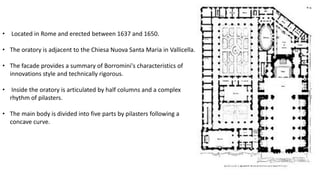
• Located in Rome and erected between 1637 and 1650.
• The oratory is adjacent to the Chiesa Nuova Santa Maria in Vallicella.
• The facade provides a summary of Borromini's characteristics of
innovations style and technically rigorous.
• Inside the oratory is articulated by half columns and a complex
rhythm of pilasters.
• The main body is divided into five parts by pilasters following a
concave curve.
Gian Lorenzo Bernini
• Bernini saw architecture as a staging of an
experience, and used theatricality and drama
in his design to heighten the visitor’s
emotional and spiritual response.
Francesco Borromini
• Borromini, on the other hand, stretched the
limits of classical architecture that had made
a revival during the Renaissance by distorting
pure classical elements to create dynamic,
sculptural spaces.

Boromini bernini(baroque style)

  • 1.
    BAROQUE STYLE • Submittedby: Yash Patel-1649 Rathin Shah-1667 Hardik Darji-1610 Apoorv Rayka-1681 Sushant Kumar Singh-1672
  • 2.
    Gian Lorenzo Bernini •1598-1680 • Italian sculptor and architect. • Practiced Roman Baroque architecture. • Notable work-David, Apollo and Daphne, The Rape of Proserpina, Ecstasy of Saint Theresa.
  • 3.
  • 4.
    • St. Peter'sSquare is a large plaza located directly in front of St. Peter's Basilica in the Vatican City. • Trapezoidal entrance to the basilica and the massive elliptical area. • The long axis, parallel to the basilica's facade, creates a pause in the sequence of forward movements that is characteristic of a Baroque monumental approach. • Surrounded by 284 columns, set out in rows of four, and 88 pilasters, the columns have a height of 20 m and a width of 1.6 m. • Bernini’s pupils built 140 statues of saints, 3.20 m high along the balustrade above the columns. • 320 meters long and 240 meters wide. • Gian Lorenzo Bernini designed the square which embrace visitors in "the maternal arms of Mother Church“
  • 5.
    • Used Tuscanform of Doric order. • At the center of the piazza stands an Egyptian obelisk of red granite, 25.5 m tall, in all 41 m to the cross on its top. The obelisk was originally erected at Heliopolis, Egypt, by an unknown pharaoh. Maderno fountain Bernini fountain • Maderno’s fountain was built in 1612. • Maderno fountain could shoot water twenty feet upwards into the air as the source was above sea level. • For half a century, the square was decorated with the Maderno fountain and with the obelisk , but the southern part of the square remained empty. • Gian Lorenzo Bernini was commissioned to build a second fountain, which followed the design of the Maderno fountain. Bernini fountain was completed in 1677. Doric order Egyptian obelisk
  • 6.
  • 7.
    • Scala regiais a flight of steps in the Vatican city and is part of the formal entrance to the Vatican. • It was built by Antonio da Sangallo the younger. • Restored by Gian Lorenzo Bernini from 1663 to1666. • Connects the Apostolic palace to St. Peter’s Basilica. • The site for the stairs between church and palace, is awkwardly shaped with irregular convering walls. • The staircase take the form of a barrel-vaulted colonnade that necessarily becomes narrower at the end exaggerating the distance.
  • 8.
    • Total 32numbers of column are there. • Length approx. 130 m. • Ionic columns are used. • The statue of Constantine by Gian Lorenzo Bernini. • The statue of Constantine shows the emperor in the traditional episode of the cross appearing to him before the battle of Ponte Milvio. Columns of Scala Regia statue of Constantine Scala regia
  • 9.
    • Detail ofthe decoration is extremely rich: we can notice that the flowers are all different. • Another statue of Charlemagne (who was crowned in St Peter's in 800). • Bernini originally constructed six skylight, two of which still exist (3, 4), raising the level of illumination on the last leg of the stairs. Detail of the decoration Statue of Charlemagne
  • 10.
    Exploded view showingsix skylights.
  • 11.
    Section of ScalaRegia View from the bottom of the stairs Forming a barrel-vaulted
  • 12.
    Francesco Borromini • 1599-1667 •Italian baroque architect • Notable Work-San Carlo alle Quattro Fontane, Sant'Agnese in Agone, Sant'Ivo alla Sapienza, Oratorio dei Filippini
  • 13.
    San Carlo alleQuattro (Saint Charles at the Four Fountains)
  • 14.
  • 15.
    • It isa Roman Catholic church in Rome, Italy. • The plan and section show the layout of the cramped and difficult site the church is on the corner with the cloister next to it. • It has a concave-convex facade. • Tall Corinthian columns stand on plinths and bear the main entablatures. • Length-20 meters Width-12 metres. • The three principal parts can be identified vertically as the lower order at ground level , the transition zone of the pendentives and the oval coffered dome with its oval lantern.
  • 16.
    Geometry and formdevelopment of plan. Triangle form derived from the trinity order.
  • 17.
  • 18.
    The founders ofthe Trinitarian order Smaller columns with their entablature weave behind the main columns and in turn they frame niches and windows. Side chapelMain altar Entrance view
  • 19.
  • 21.
    • It isa Roman Catholic church in Rome. • Built in 1642-1660 by the architect Francesco Borromini, the church is a masterpiece of Roman Baroque architecture. • The church rises at the end of a courtyard, known as the courtyard of Giacomo Della Porta. • The facade is concave, moulding the church into the courtyard as if completing it rather than disrupting it. • A key aspect is the top of the church, the lantern of Sant'Ivo is topped with a spiral shape, surmounted by a Cross. • This blending of edges and curves is Borromini’s most distinguishable signature. • Windows associated with the round sections of the dome are larger than those associated with the edges. • Through the perforations in the lantern, sunlight illuminates the dome. • Direction of facade-ENE • Length-27 metres Width-26 metres.
  • 22.
    • He choosea plan resembling a star of David- which would have been recognized at the time as a star of Solomon, symbolizing wisdom and merged a curved façade of the church with the courtyard of the palace.
  • 23.
  • 24.
    • Another detailis that windows associated with the round sections of the dome are larger than those associated with the edges. • Through the perforations in the lantern the sunlight illuminates the dome.
  • 26.
    The entrance facade.The lantern of Sant'Ivo
  • 27.
    Oratory of SaintPhillip Neri
  • 28.
    • Located inRome and erected between 1637 and 1650. • The oratory is adjacent to the Chiesa Nuova Santa Maria in Vallicella. • The facade provides a summary of Borromini's characteristics of innovations style and technically rigorous. • Inside the oratory is articulated by half columns and a complex rhythm of pilasters. • The main body is divided into five parts by pilasters following a concave curve.
  • 29.
    Gian Lorenzo Bernini •Bernini saw architecture as a staging of an experience, and used theatricality and drama in his design to heighten the visitor’s emotional and spiritual response. Francesco Borromini • Borromini, on the other hand, stretched the limits of classical architecture that had made a revival during the Renaissance by distorting pure classical elements to create dynamic, sculptural spaces.