Presented by :
Ar.Shruti
Indian Temple Architecture
•  A	
  notable	
  feature	
  of	
  these	
  temples	
  is	
  the	
  
wider	
  intercolumnina5on	
  of	
  the	
  pillars	
  in	
  the	
  
middle	
  than	
  on	
  the	
  sides.	
  As	
  suggested	
  by	
  
the	
  flat	
  roof,	
  square	
  or	
  rectangular	
  form	
  the	
  
plain	
  treatment	
  of	
  the	
  walls	
  and	
  modestness	
  
of	
  size,	
  these	
  temples	
  must	
  obviously	
  have	
  
been	
  derived	
  from	
  rock-­‐cut	
  proto-­‐types	
  of	
  
which	
  early	
  Gupta	
  examples	
  occur	
  at	
  Udaigiri	
  
near	
  Sanchi.	
  
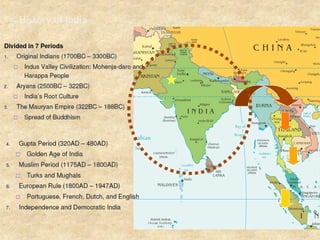
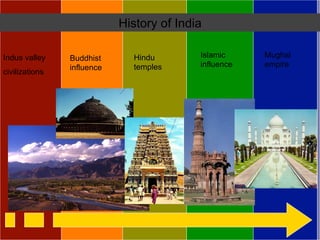
History	
  of	
  India	
  
Indus valley
civilizations
Buddhist
influence
Hindu
temples
Islamic
influence
Mughal
empire
History of India
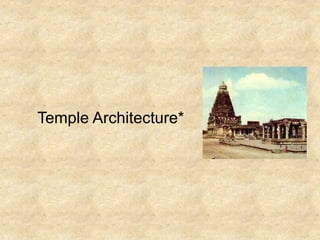
Temple Architecture*
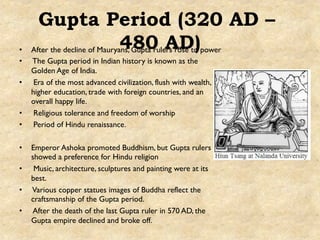
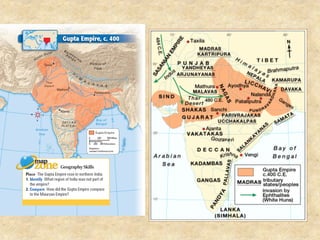
Gupta Period (320 AD –
480 AD)•  After the decline of Mauryans, Gupta rulers rose to power
•  The Gupta period in Indian history is known as the
Golden Age of India.
•  Era of the most advanced civilization, flush with wealth,
higher education, trade with foreign countries, and an
overall happy life.
•  Religious tolerance and freedom of worship
•  Period of Hindu renaissance.
•  Emperor Ashoka promoted Buddhism, but Gupta rulers
showed a preference for Hindu religion
•  Music, architecture, sculptures and painting were at its
best.
•  Various copper statues images of Buddha reflect the
craftsmanship of the Gupta period.
•  After the death of the last Gupta ruler in 570 AD, the
Gupta empire declined and broke off.
Extensive Trade 4c
spices
gold & ivory gold & ivory
rice & wheathorses
cotton goods
cotton goods
Medicine Literature
Mathematics
Astronomy
Printed
medicinal guides
1000 diseases
classified
Plastic
Surgery
C-sections
performed
Inoculations
500 healing
plants identified
Decimal
System
Concept
of Zero
PI = 3.1416
Kalidasa
Solar
Calendar
The earth
is round
Gupta
India
Gupta
Achievements
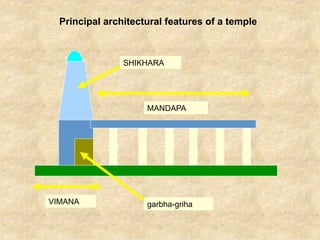
Principal architectural features of a temple
VIMANA
MANDAPA
SHIKHARA
garbha-griha
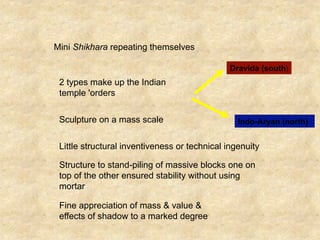
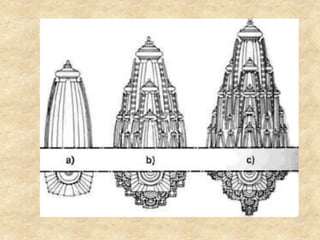
Mini Shikhara repeating themselves
Dravida (south)
2 types make up the Indian
temple 'orders
Indo-Aryan (north)Sculpture on a mass scale
Little structural inventiveness or technical ingenuity
Structure to stand-piling of massive blocks one on
top of the other ensured stability without using
mortar
Fine appreciation of mass & value &
effects of shadow to a marked degree
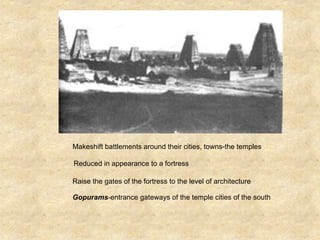
Reduced in appearance to a fortress
Raise the gates of the fortress to the level of architecture
Gopurams-entrance gateways of the temple cities of the south
Makeshift battlements around their cities, towns-the temples
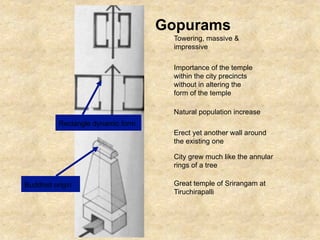
Gopurams
Importance of the temple
within the city precincts
without in altering the
form of the temple
Natural population increase
Erect yet another wall around
the existing one
City grew much like the annular
rings of a tree
Great temple of Srirangam at
Tiruchirapalli
Rectangle dynamic form
Towering, massive &
impressive
Buddhist origin
Gopuram
Buddhist and Hindu Temples during the
Mauryan and Gupta Periods
HinduTemples
•  During the Mauryan period,
temples were small, stone
structures with one or two
rooms and flat roofs.
•  During the Gupta period, the
temples were more complex,
with huge towers and intricate
carvings.
BuddhistTemples
•  Some Buddhists carved entire
temples out of mountainsides.
•  The temples at Ajanta and
Ellora are two of the most
famous of this type of
Buddhist temple.
•  Another type of Buddhist
temple was the stupa.
INDIAN TEMPLE ARCHITECTURE

INDIAN TEMPLE ARCHITECTURE

  • 1.
  • 2.
    •  A  notable  feature  of  these  temples  is  the   wider  intercolumnina5on  of  the  pillars  in  the   middle  than  on  the  sides.  As  suggested  by   the  flat  roof,  square  or  rectangular  form  the   plain  treatment  of  the  walls  and  modestness   of  size,  these  temples  must  obviously  have   been  derived  from  rock-­‐cut  proto-­‐types  of   which  early  Gupta  examples  occur  at  Udaigiri   near  Sanchi.  
  • 3.
  • 4.
  • 5.
  • 6.
    Gupta Period (320AD – 480 AD)•  After the decline of Mauryans, Gupta rulers rose to power •  The Gupta period in Indian history is known as the Golden Age of India. •  Era of the most advanced civilization, flush with wealth, higher education, trade with foreign countries, and an overall happy life. •  Religious tolerance and freedom of worship •  Period of Hindu renaissance. •  Emperor Ashoka promoted Buddhism, but Gupta rulers showed a preference for Hindu religion •  Music, architecture, sculptures and painting were at its best. •  Various copper statues images of Buddha reflect the craftsmanship of the Gupta period. •  After the death of the last Gupta ruler in 570 AD, the Gupta empire declined and broke off.
  • 8.
    Extensive Trade 4c spices gold& ivory gold & ivory rice & wheathorses cotton goods cotton goods
  • 9.
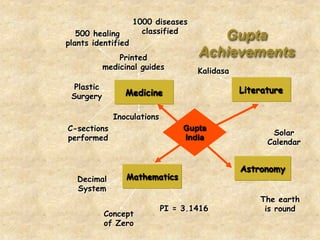
    Medicine Literature Mathematics Astronomy Printed medicinal guides 1000diseases classified Plastic Surgery C-sections performed Inoculations 500 healing plants identified Decimal System Concept of Zero PI = 3.1416 Kalidasa Solar Calendar The earth is round Gupta India Gupta Achievements
  • 10.
    Principal architectural featuresof a temple VIMANA MANDAPA SHIKHARA garbha-griha
  • 11.
    Mini Shikhara repeatingthemselves Dravida (south) 2 types make up the Indian temple 'orders Indo-Aryan (north)Sculpture on a mass scale Little structural inventiveness or technical ingenuity Structure to stand-piling of massive blocks one on top of the other ensured stability without using mortar Fine appreciation of mass & value & effects of shadow to a marked degree
  • 13.
    Reduced in appearanceto a fortress Raise the gates of the fortress to the level of architecture Gopurams-entrance gateways of the temple cities of the south Makeshift battlements around their cities, towns-the temples
  • 14.
    Gopurams Importance of thetemple within the city precincts without in altering the form of the temple Natural population increase Erect yet another wall around the existing one City grew much like the annular rings of a tree Great temple of Srirangam at Tiruchirapalli Rectangle dynamic form Towering, massive & impressive Buddhist origin
  • 15.
  • 16.
    Buddhist and HinduTemples during the Mauryan and Gupta Periods HinduTemples •  During the Mauryan period, temples were small, stone structures with one or two rooms and flat roofs. •  During the Gupta period, the temples were more complex, with huge towers and intricate carvings. BuddhistTemples •  Some Buddhists carved entire temples out of mountainsides. •  The temples at Ajanta and Ellora are two of the most famous of this type of Buddhist temple. •  Another type of Buddhist temple was the stupa.