Lisa Torrey and Jude ShavlikUniversity of WisconsinMadison WI, USAPolicy Transfer viaMarkov Logic Networks
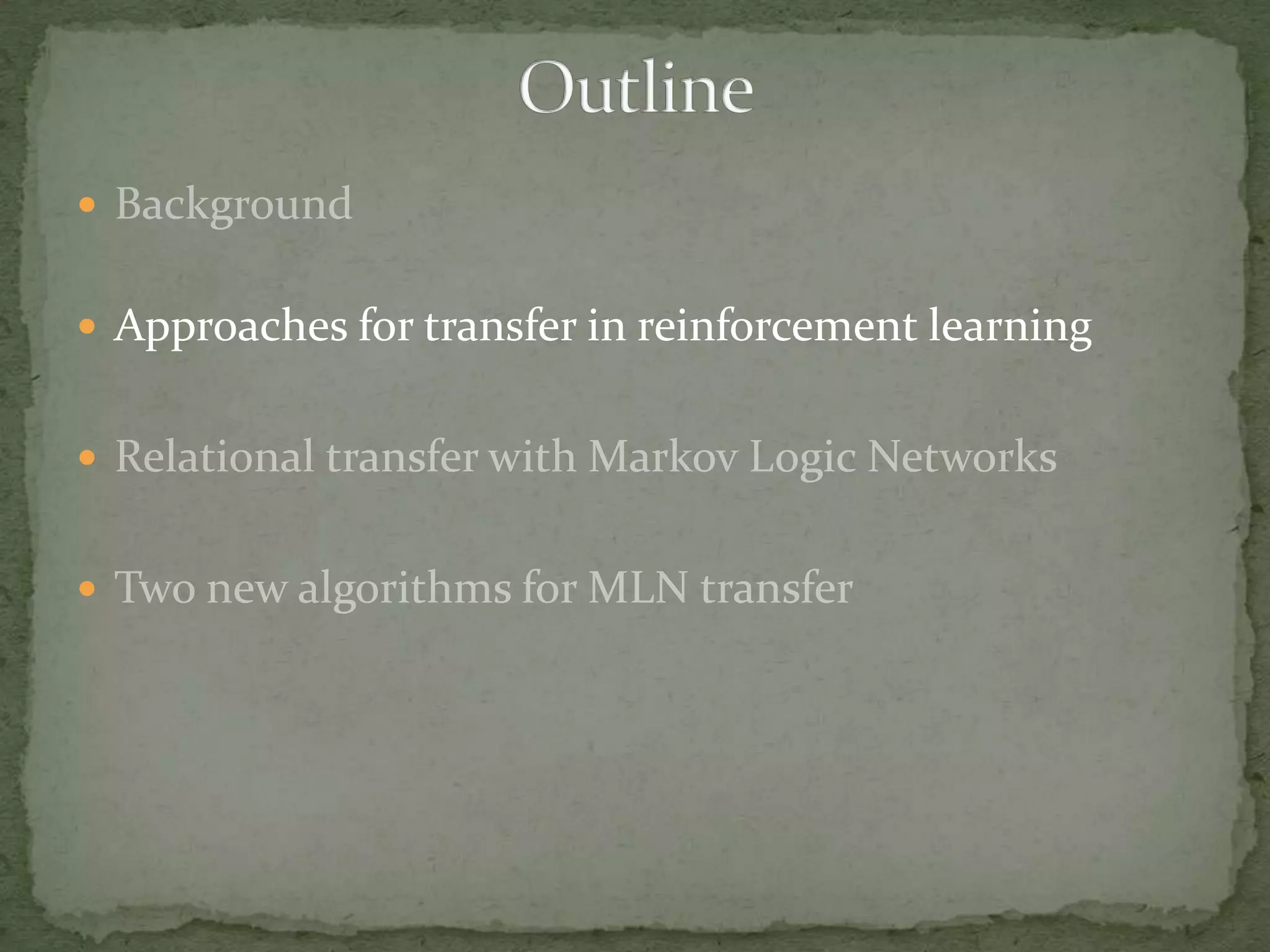
BackgroundApproaches for transfer in reinforcement learningRelational transfer with Markov Logic NetworksTwo new algorithms for MLN transferOutline
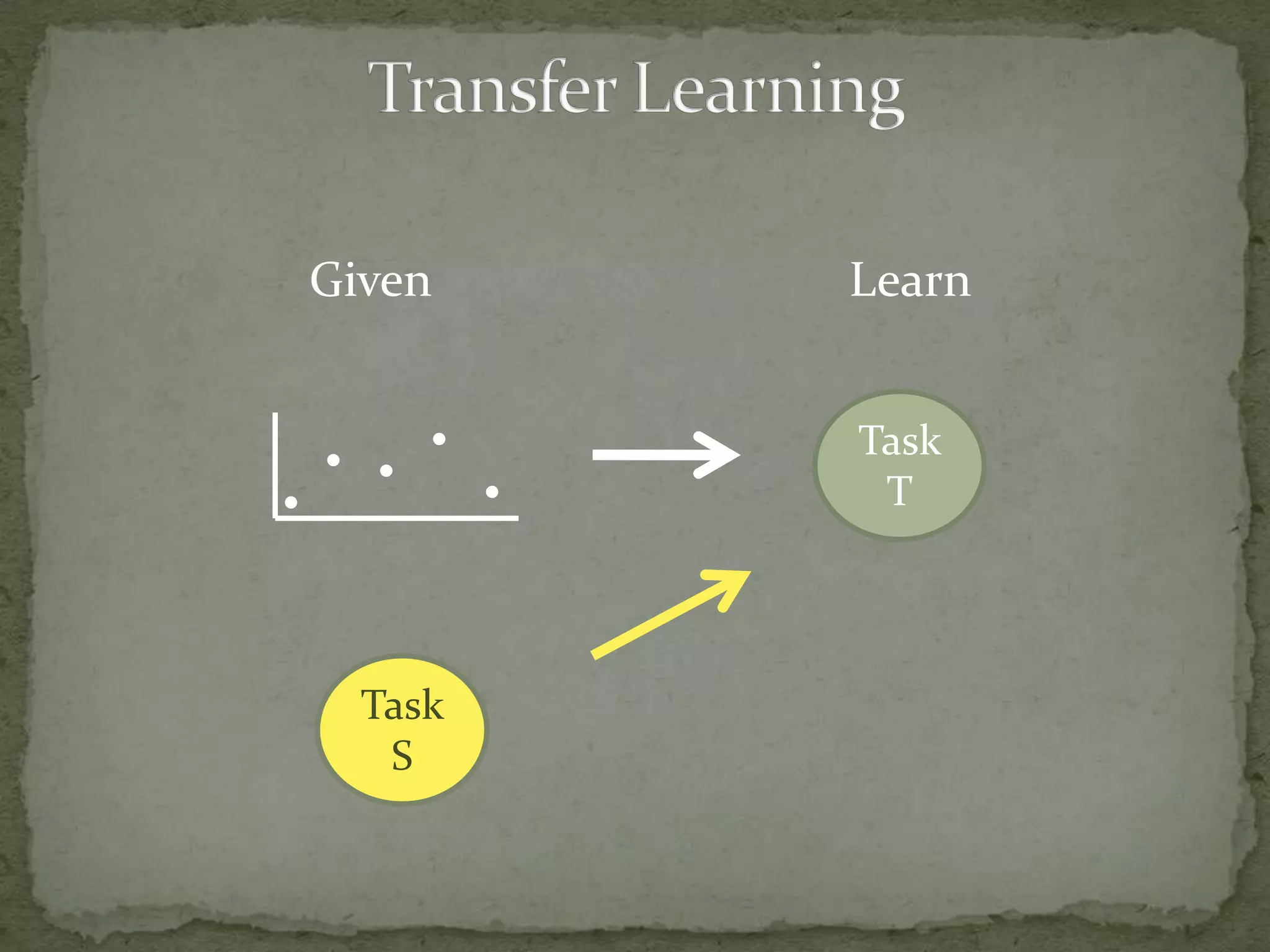
Transfer LearningGivenLearnTask TTask S
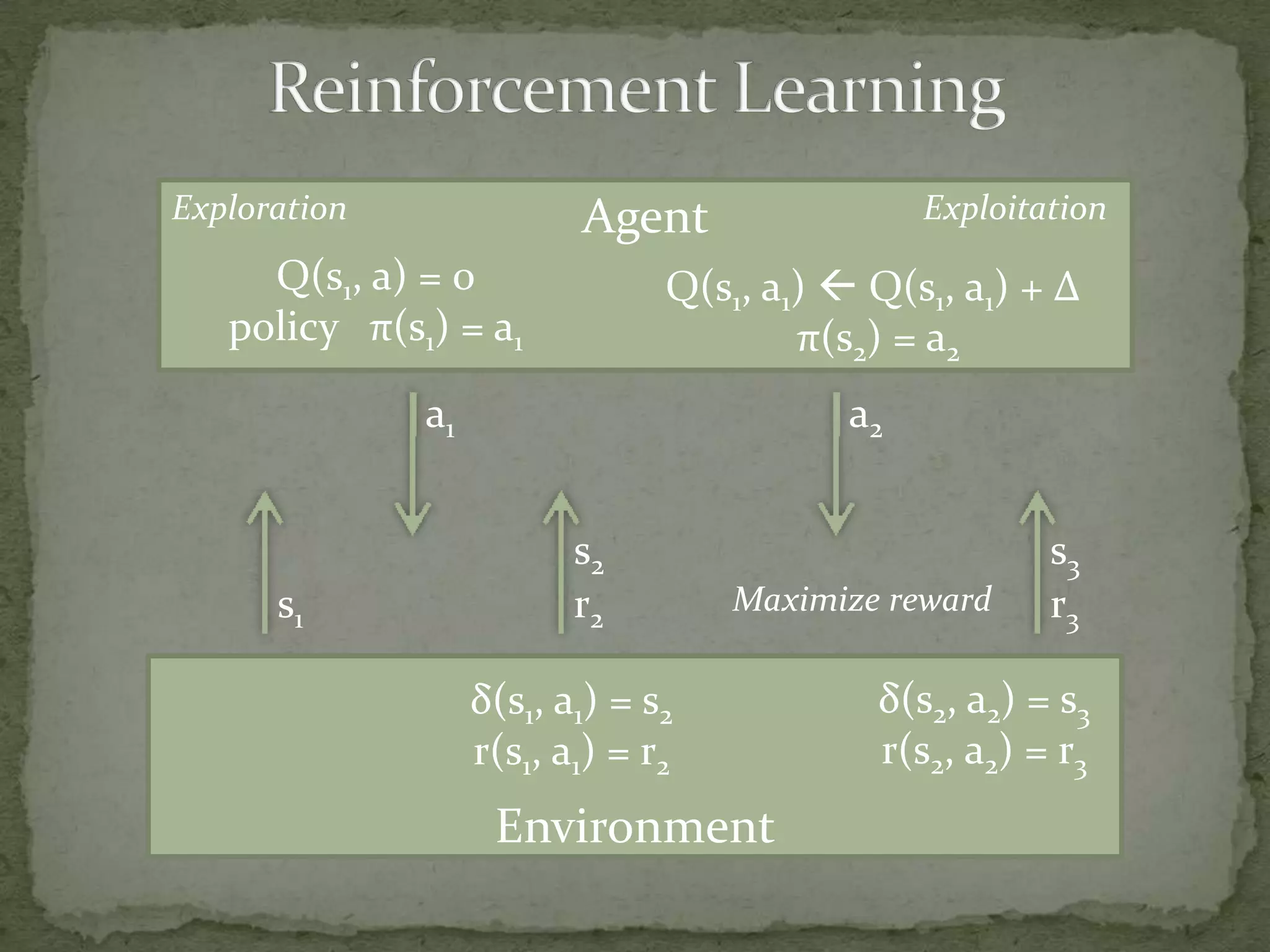
Reinforcement LearningAgentExplorationExploitationQ(s1, a) = 0policy   π(s1) = a1Q(s1, a1)  Q(s1, a1) + Δπ(s2) = a2s2s3a1a2r2r3Maximize rewards1Environmentδ(s2, a2) = s3r(s2, a2) = r3δ(s1, a1) = s2r(s1, a1) = r2
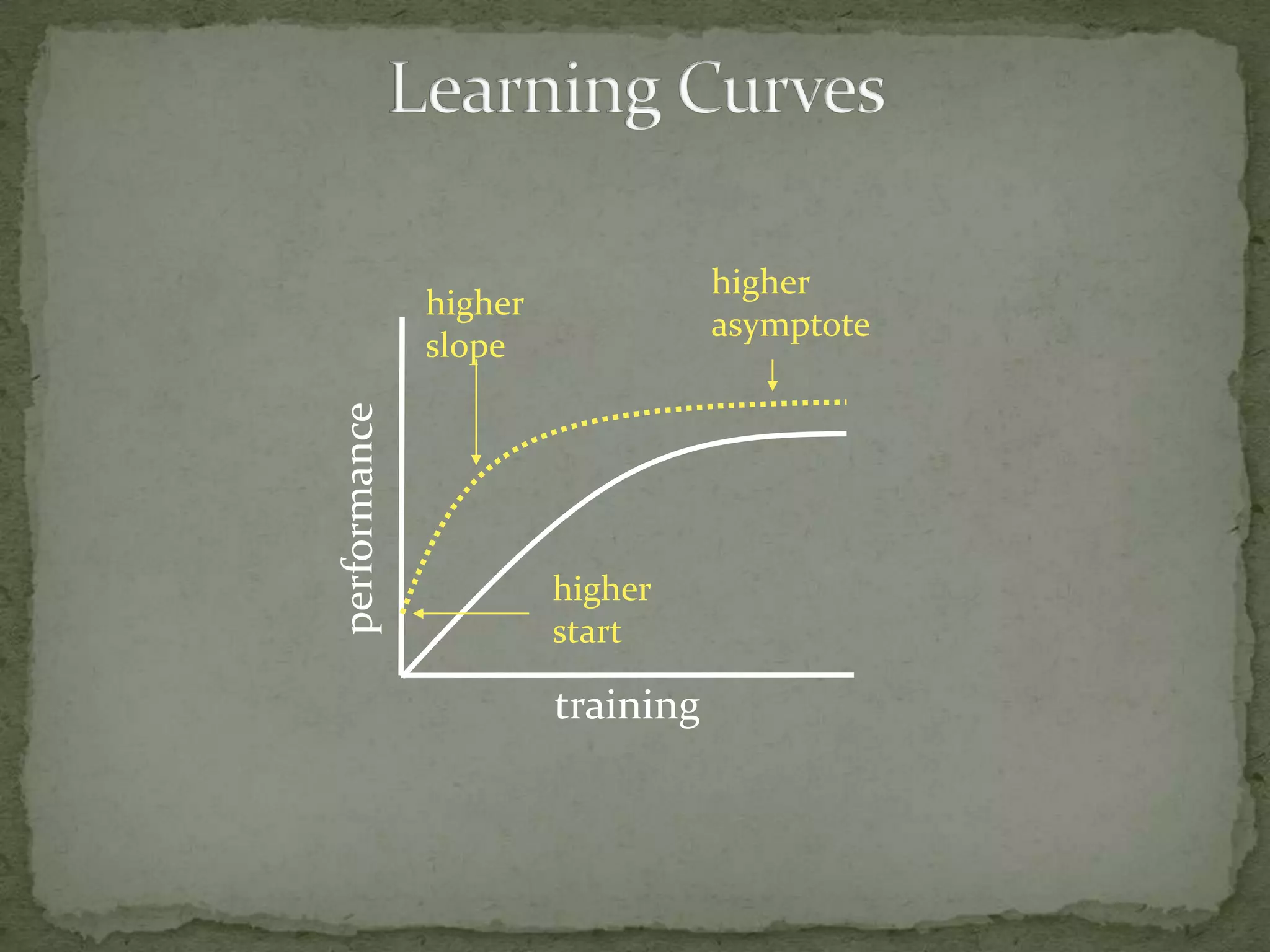
Learning Curveshigher asymptotehigher slopeperformancehigher starttraining
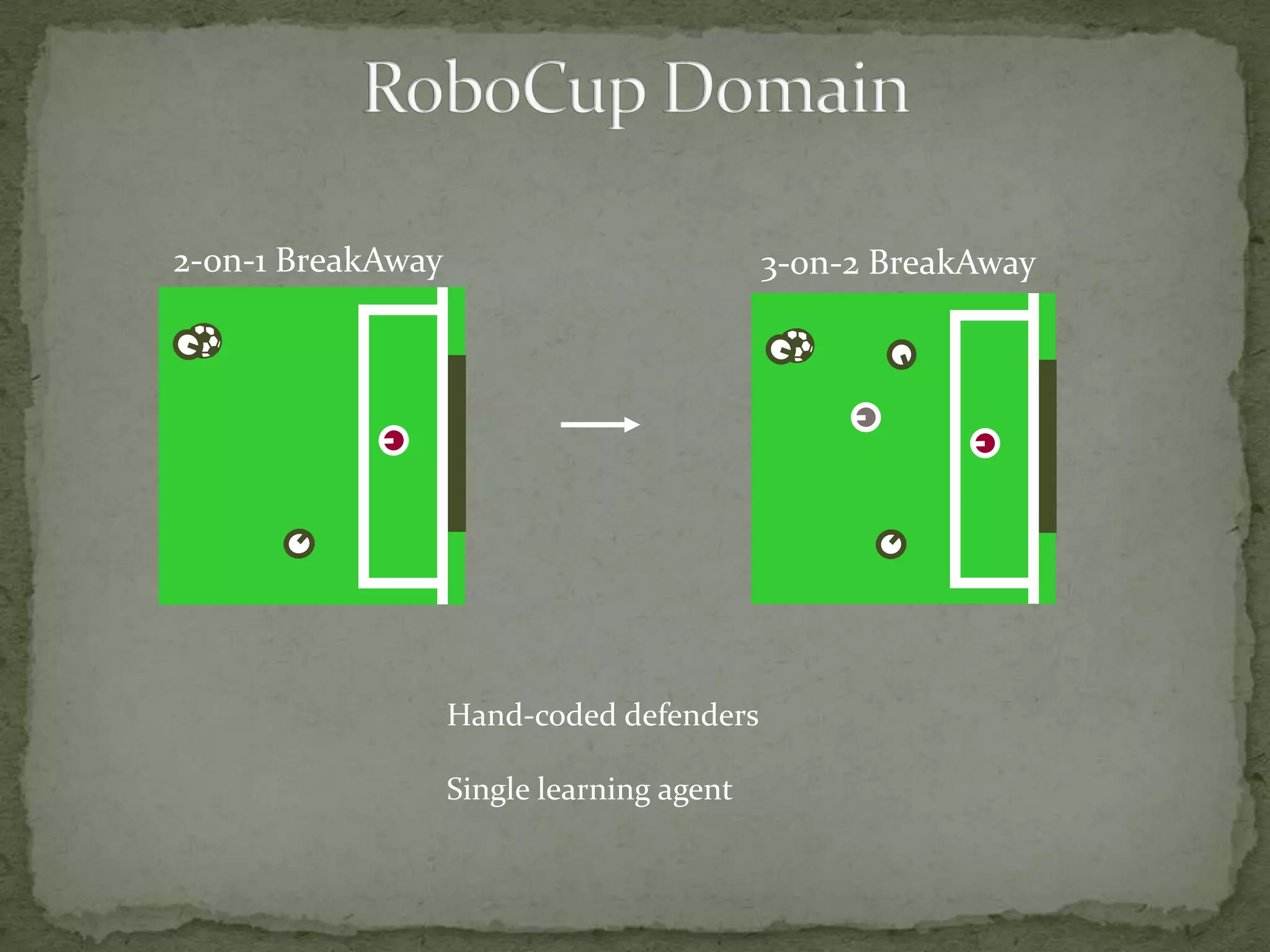
RoboCup Domain2-on-1 BreakAway3-on-2 BreakAwayHand-coded defendersSingle learning agent
BackgroundApproaches for transfer in reinforcement learningRelational transfer with Markov Logic NetworksTwo new algorithms for MLN transferOutline
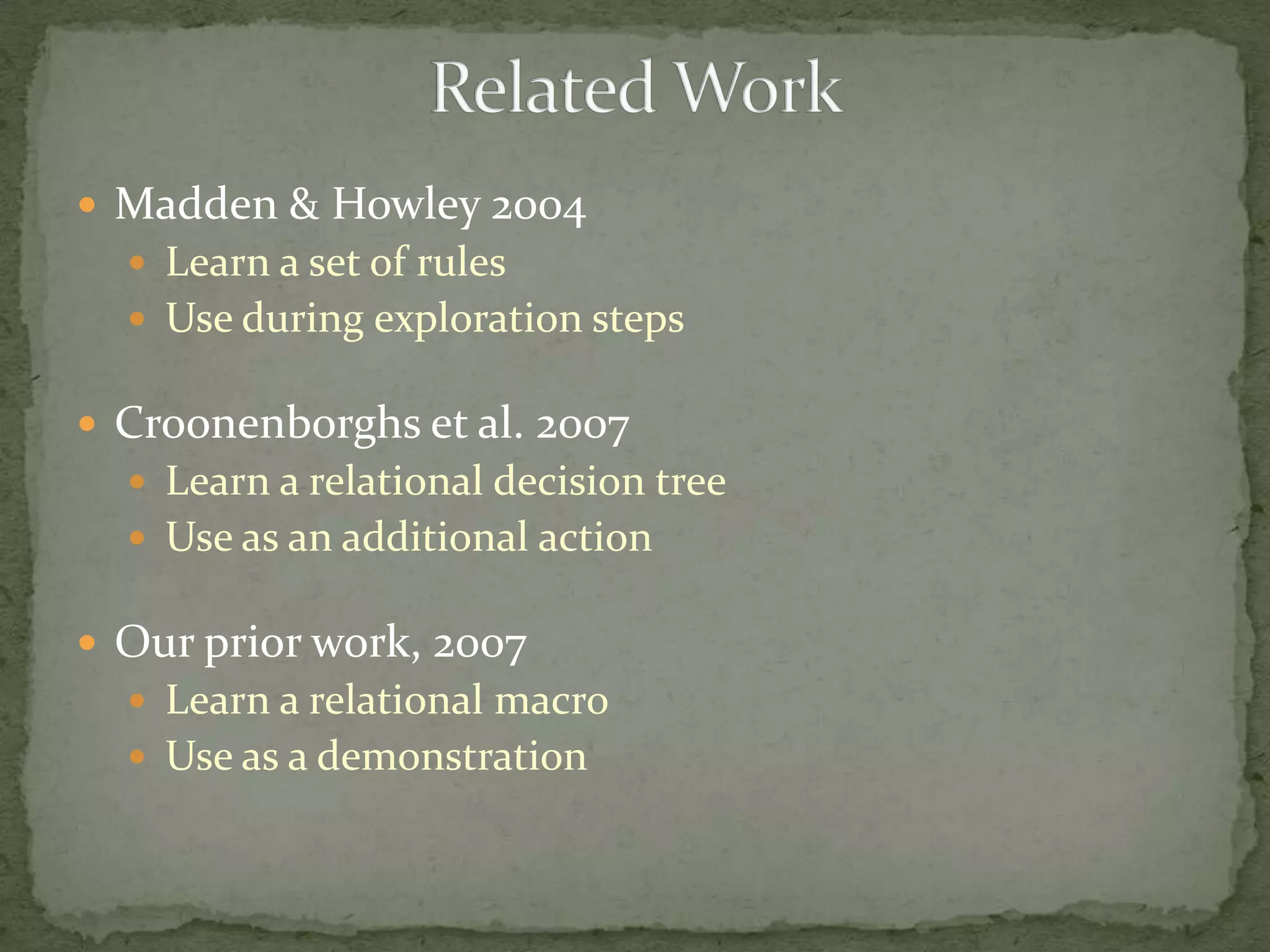
Madden & Howley 2004Learn a set of rulesUse during exploration stepsCroonenborghs et al. 2007Learn a relational decision treeUse as an additional actionOur prior work, 2007Learn a relational macroUse as a demonstrationRelated Work
BackgroundApproaches for transfer in reinforcement learningRelational transfer with Markov Logic NetworksTwo new algorithms for MLN transferOutline
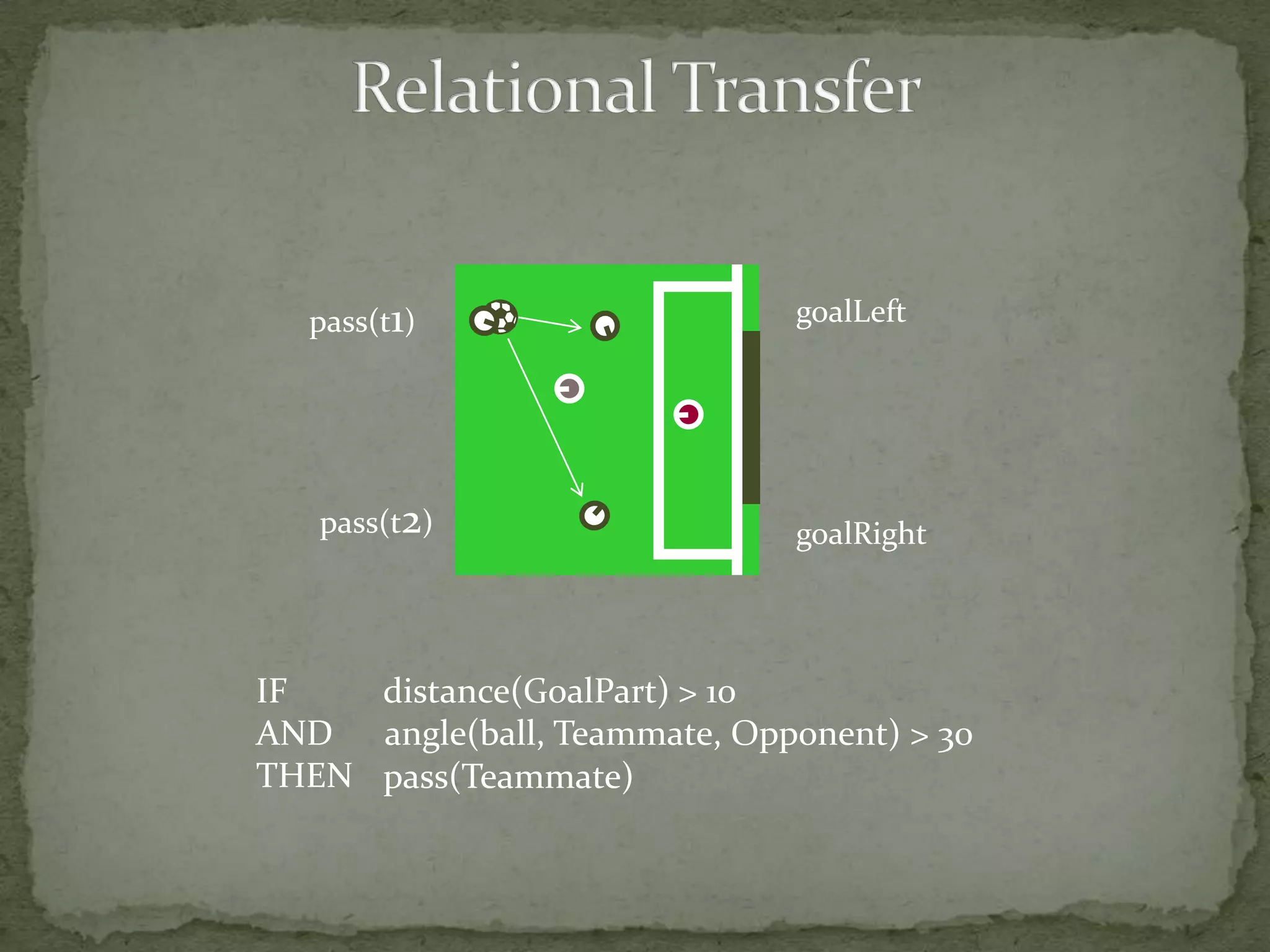
pass(t1)goalLeftpass(t2)goalRightIF           distance(GoalPart) > 10AND      angle(ball, Teammate, Opponent) > 30THENRelational Transferpass(Teammate)
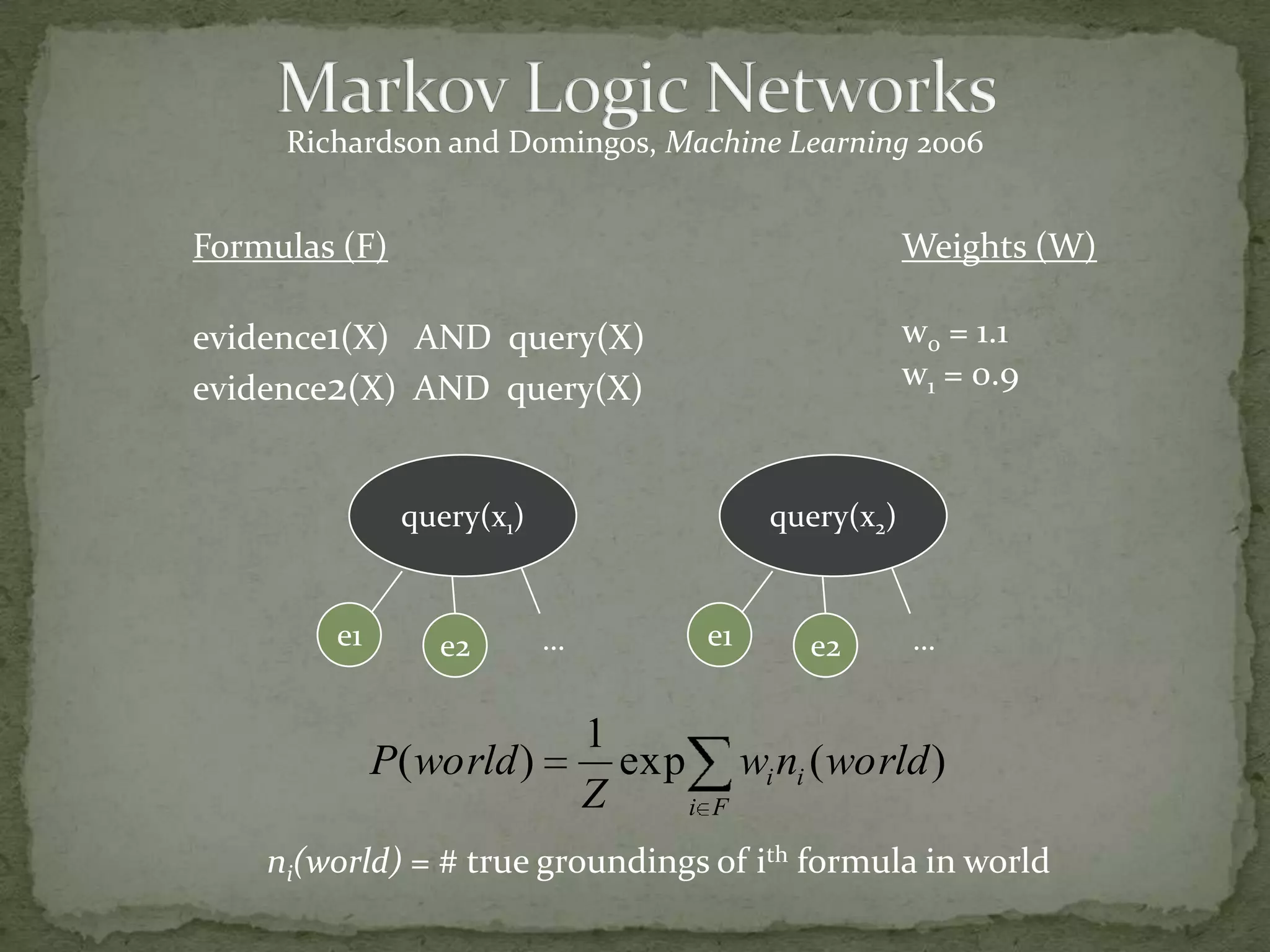
Markov Logic NetworksRichardson and Domingos, Machine Learning 2006Formulas (F)evidence1(X)   AND  query(X)evidence2(X)  AND  query(X)Weights (W)w0 = 1.1w1 = 0.9query(x1)query(x2)e1e1……e2e2ni(world) = # true groundings of ith formula in world
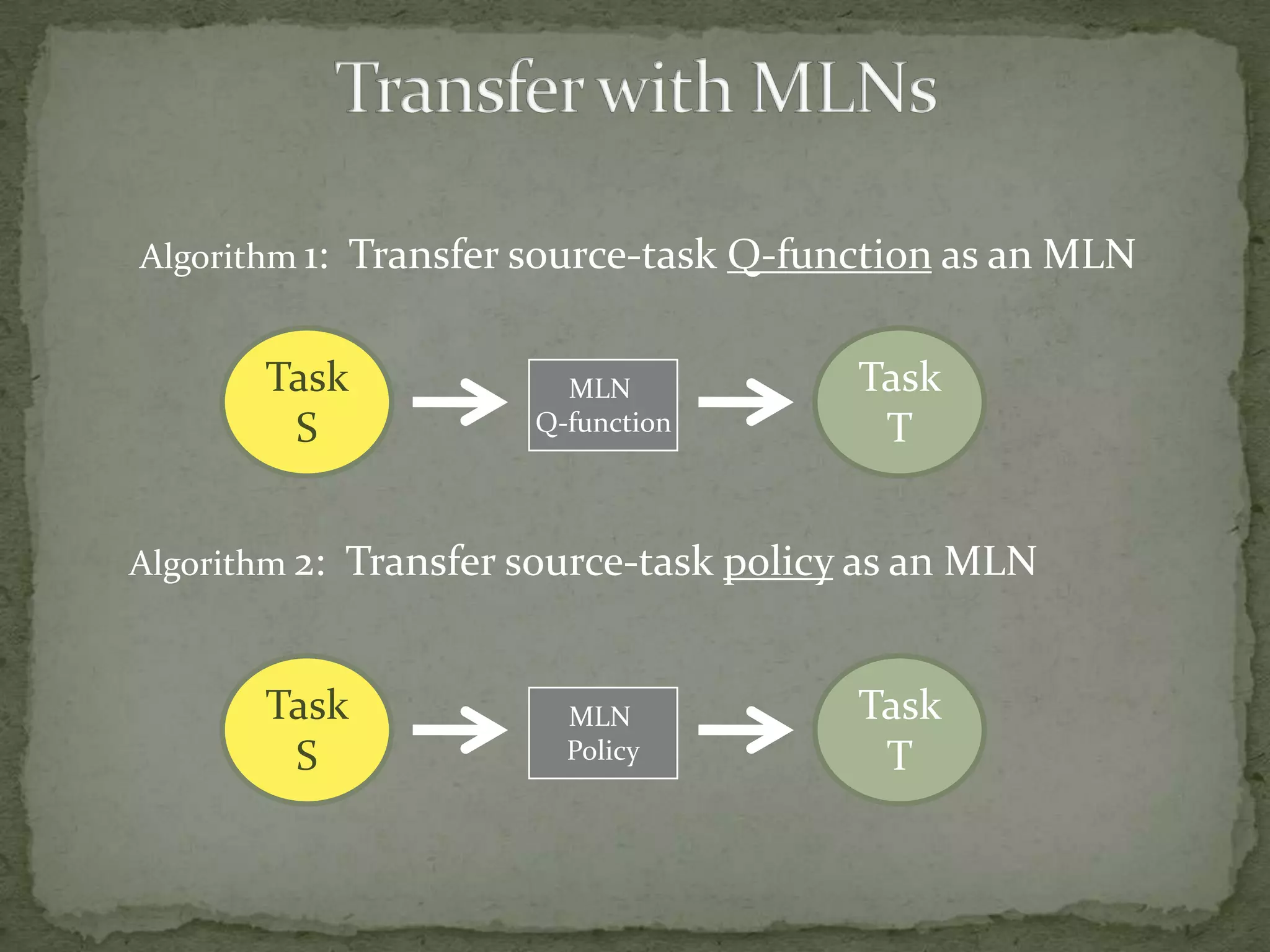
Transfer with MLNsAlgorithm 1:  Transfer source-task Q-function as an MLNTask TTask SMLN Q-functionAlgorithm 2:  Transfer source-task policy as an MLNTask TTask SMLN Policy
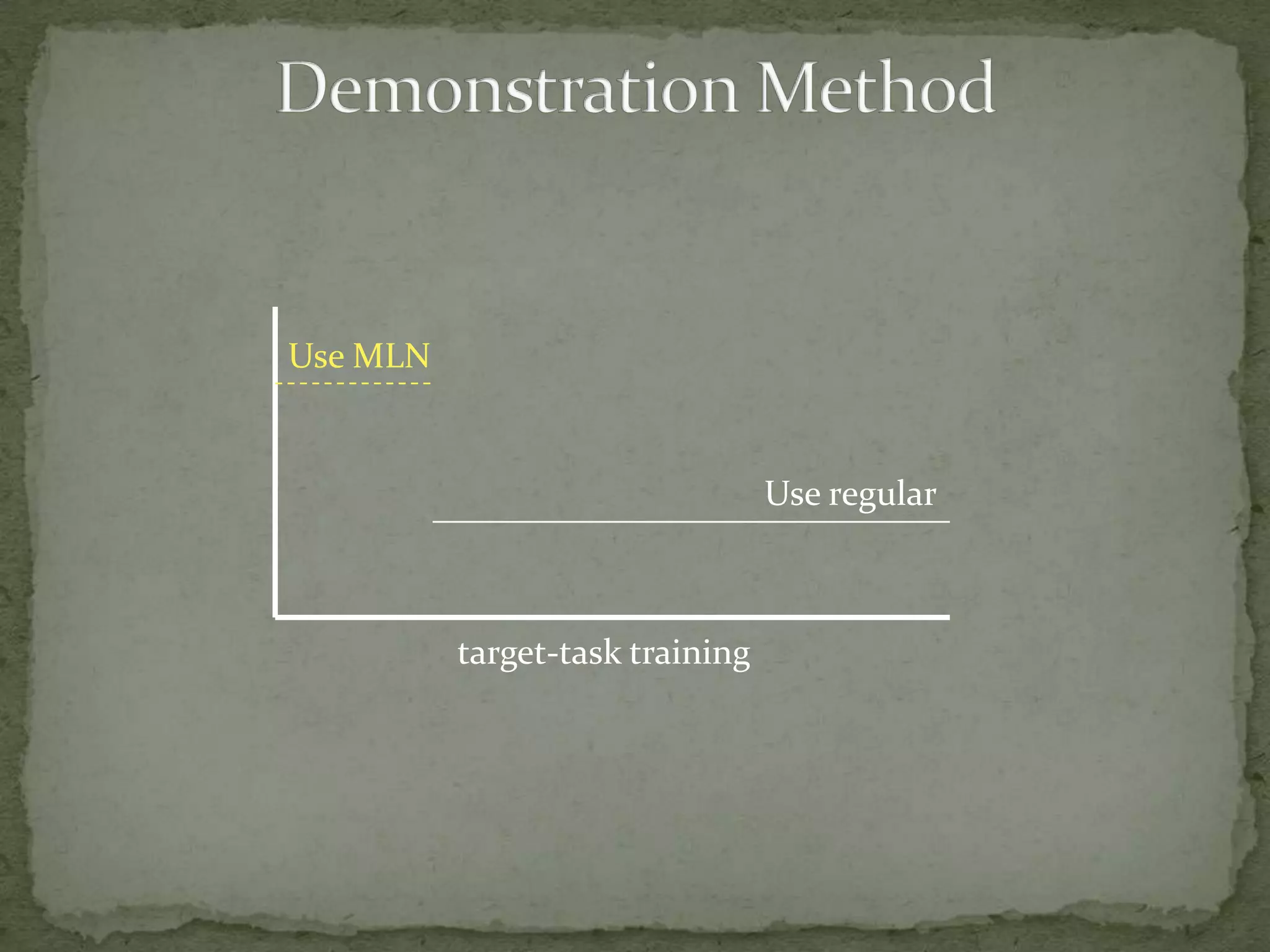
Demonstration MethodUse MLNUse regular target-task training
BackgroundApproaches for transfer in reinforcement learningRelational transfer with Markov Logic NetworksTwo new algorithms for MLN transferOutline
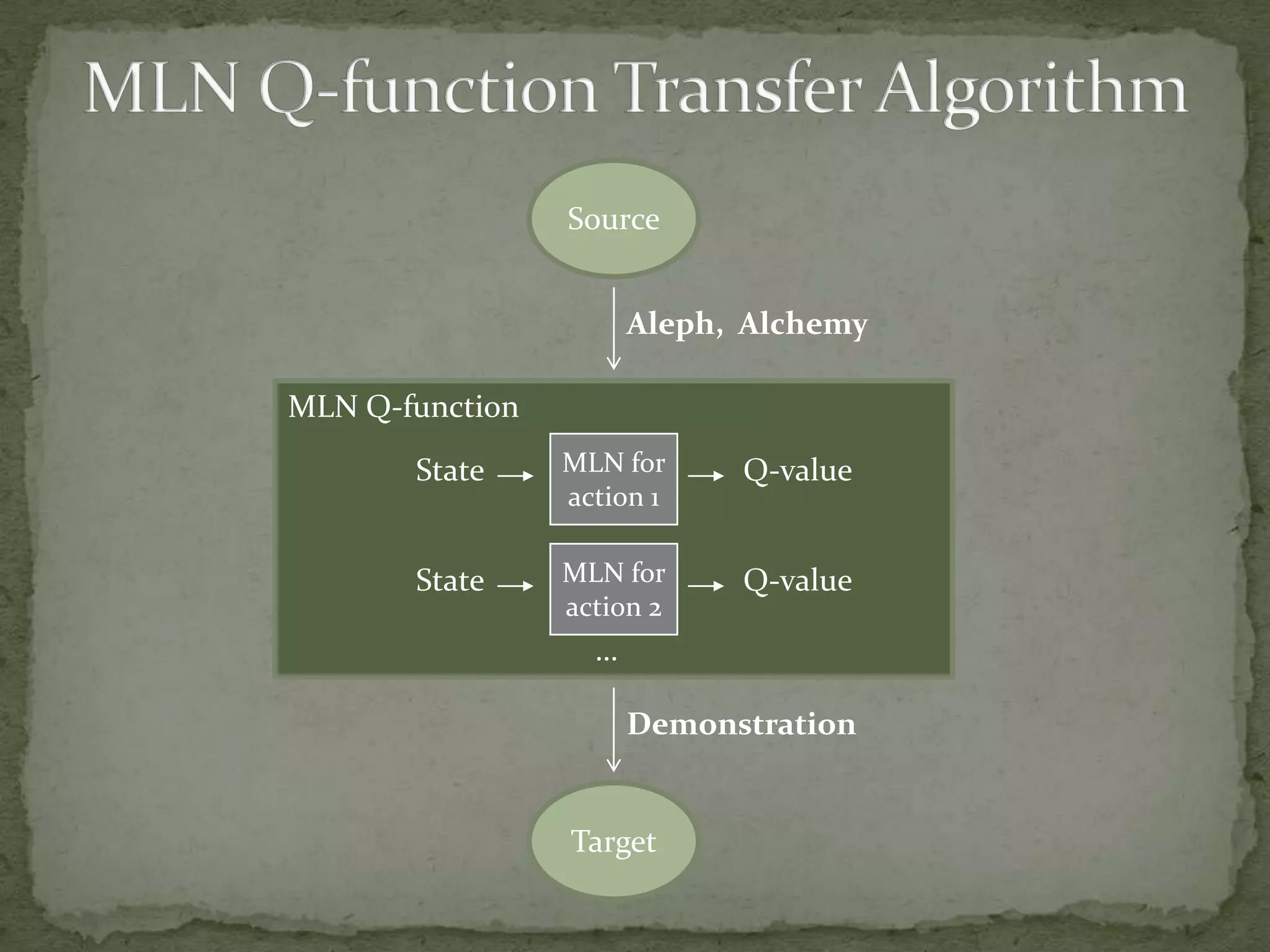
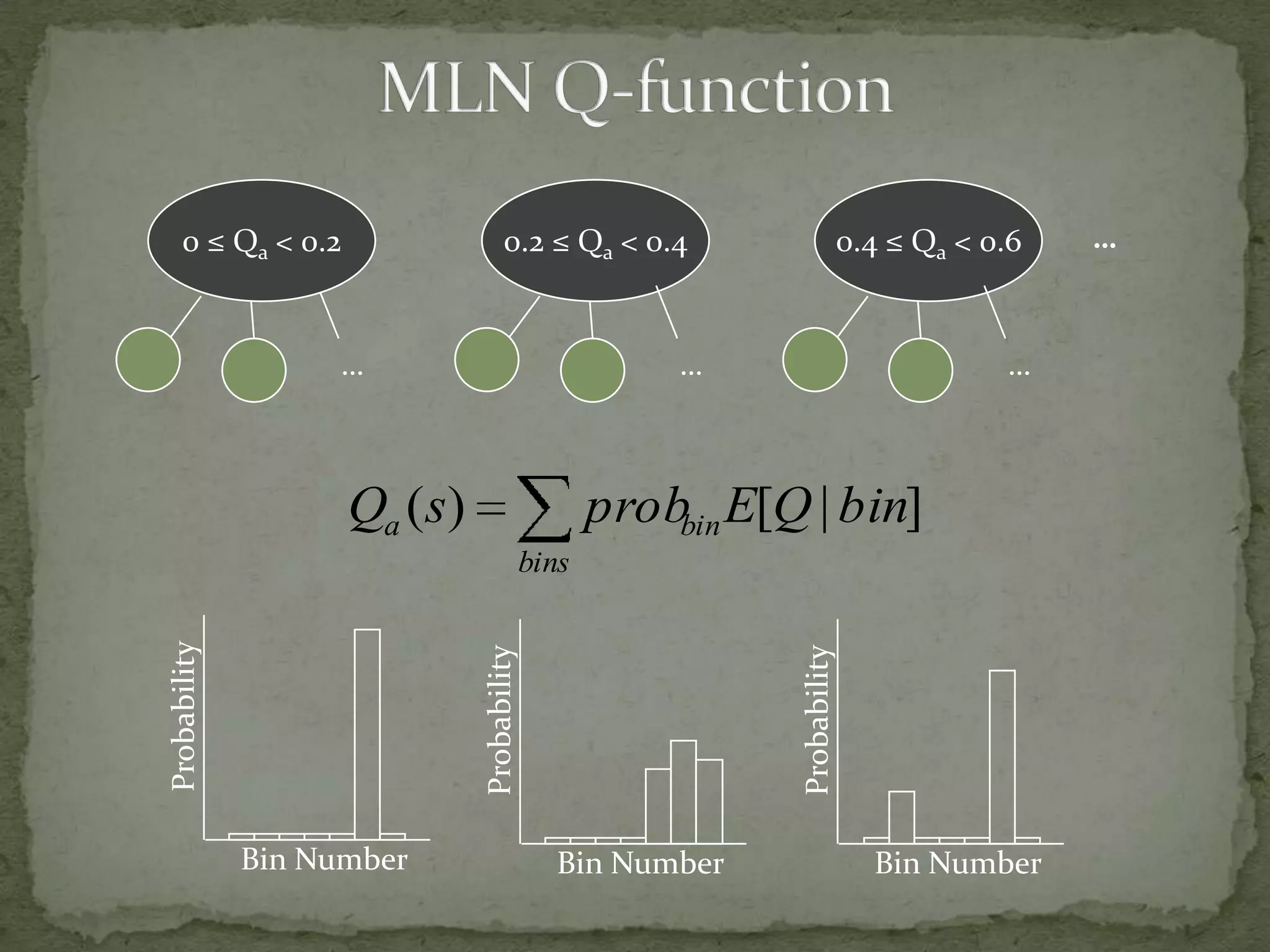
MLN Q-function Transfer AlgorithmSourceAleph,  AlchemyMLN Q-functionMLN foraction 1StateQ-valueMLN foraction 2StateQ-value…DemonstrationTarget
MLN Q-functionProbabilityProbabilityProbabilityBin NumberBin NumberBin Number0 ≤ Qa < 0.20.2 ≤ Qa < 0.40.4 ≤ Qa < 0.6…………
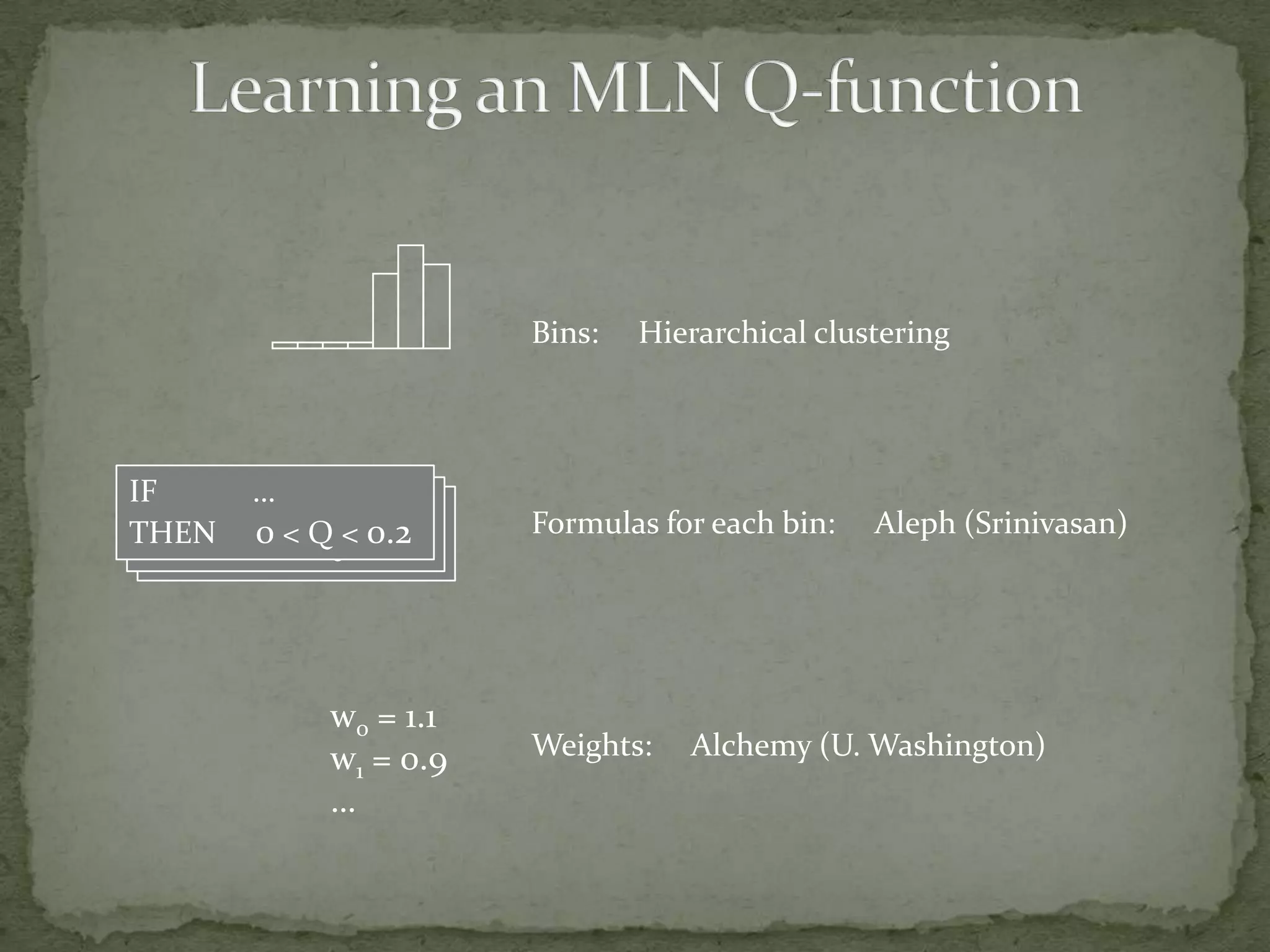
Learning an MLN Q-functionBins:     Hierarchical clusteringIF            … THEN  0 < Q < 0.2IF            … THEN     0 < Q < 0.2IF            … THEN     0 < Q < 0.2Formulas for each bin:     Aleph (Srinivasan)w0= 1.1w1 = 0.9…Weights:     Alchemy (U. Washington)
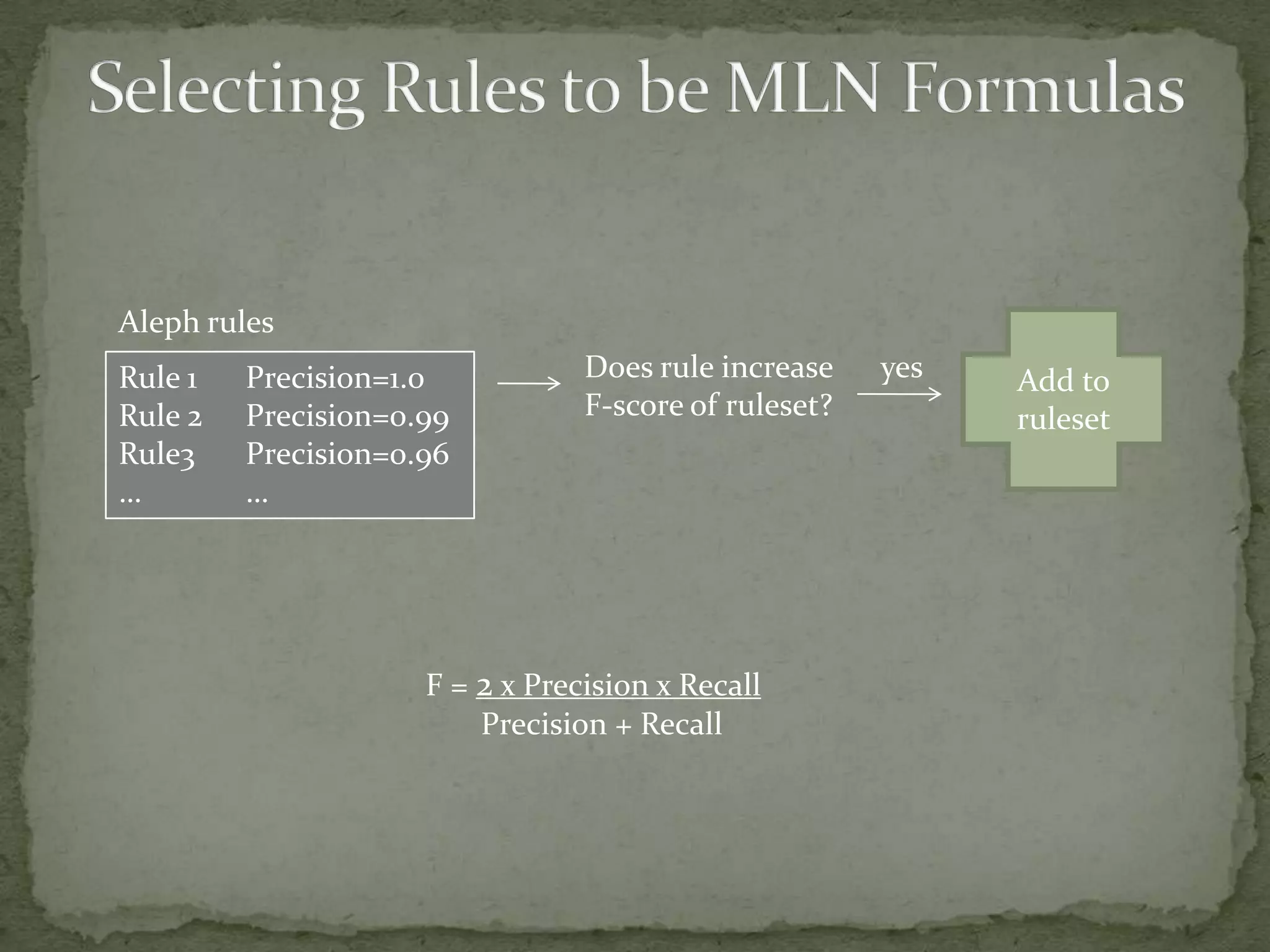
Selecting Rules to be MLN FormulasAdd torulesetAleph rulesDoes rule increase F-score of ruleset?yesRule 1	Precision=1.0Rule 2	Precision=0.99Rule3	Precision=0.96…	…F = 2 x Precision x Recall       Precision + Recall
MLN Q-function RulesExamples for transfer from 2-on-1 BreakAway to 3-on-2 BreakAwayIF	distance(me, GoalPart) ≥ 42	distance(me, Teammate) ≥ 39 THEN 	pass(Teammate) falls into [0, 0.11]IF	angle(topRight, goalCenter, me) ≤ 42	angle(topRight, goalCenter, me) ≥ 55	angle(goalLeft, me, goalie) ≥ 20	angle(goalCenter, me, goalie) ≤ 30THEN 	pass(Teammate) falls into [0.11, 0.27]IF	distance(Teammate, goalCenter) ≤ 9	angle(topRight, goalCenter, me) ≤ 85THEN 	pass(Teammate) falls into [0.27, 0.43]
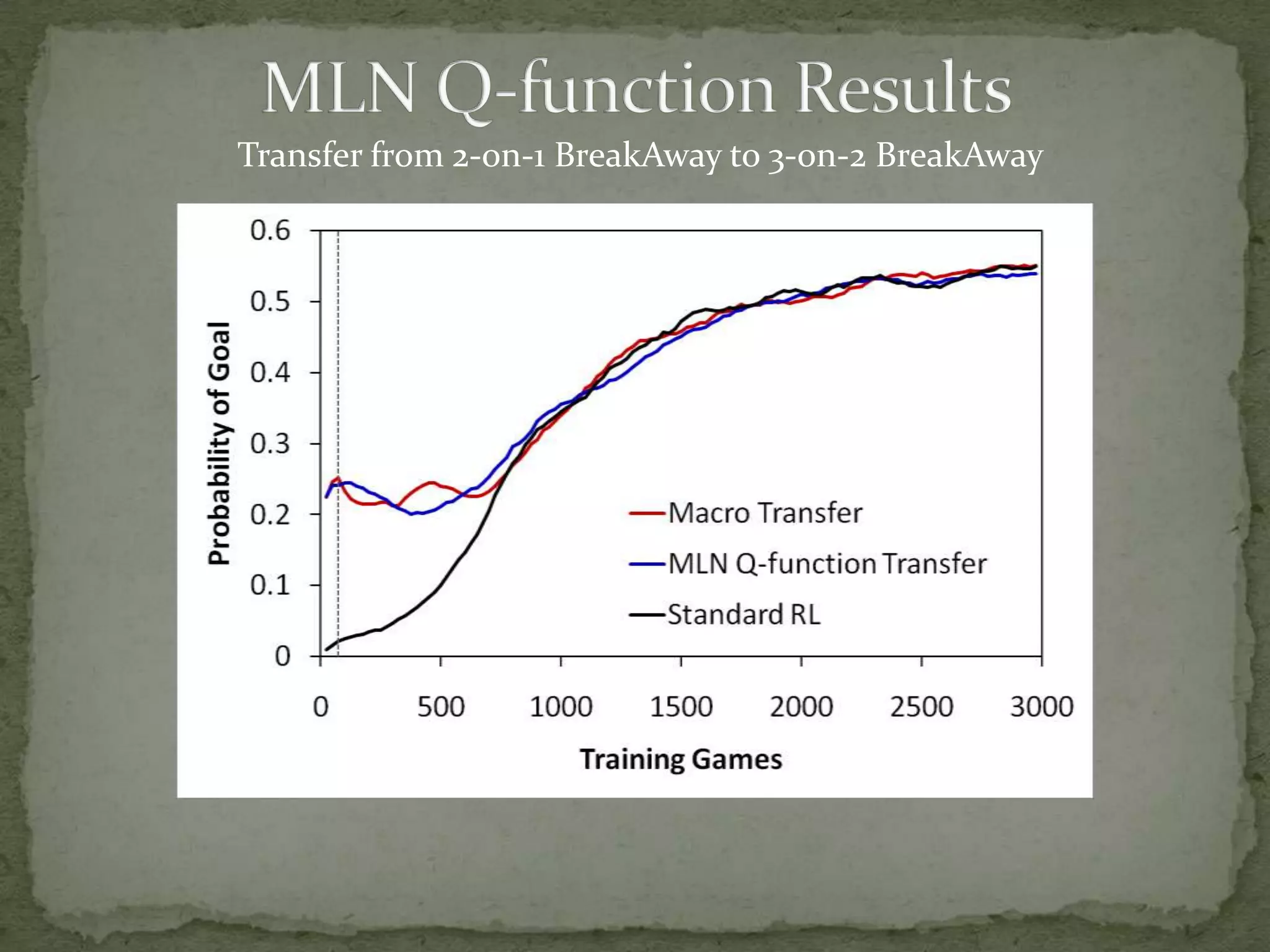
MLN Q-function ResultsTransfer from 2-on-1 BreakAway to 3-on-2 BreakAway
BackgroundApproaches for transfer in reinforcement learningRelational transfer with Markov Logic NetworksTwo new algorithms for MLN transferOutline
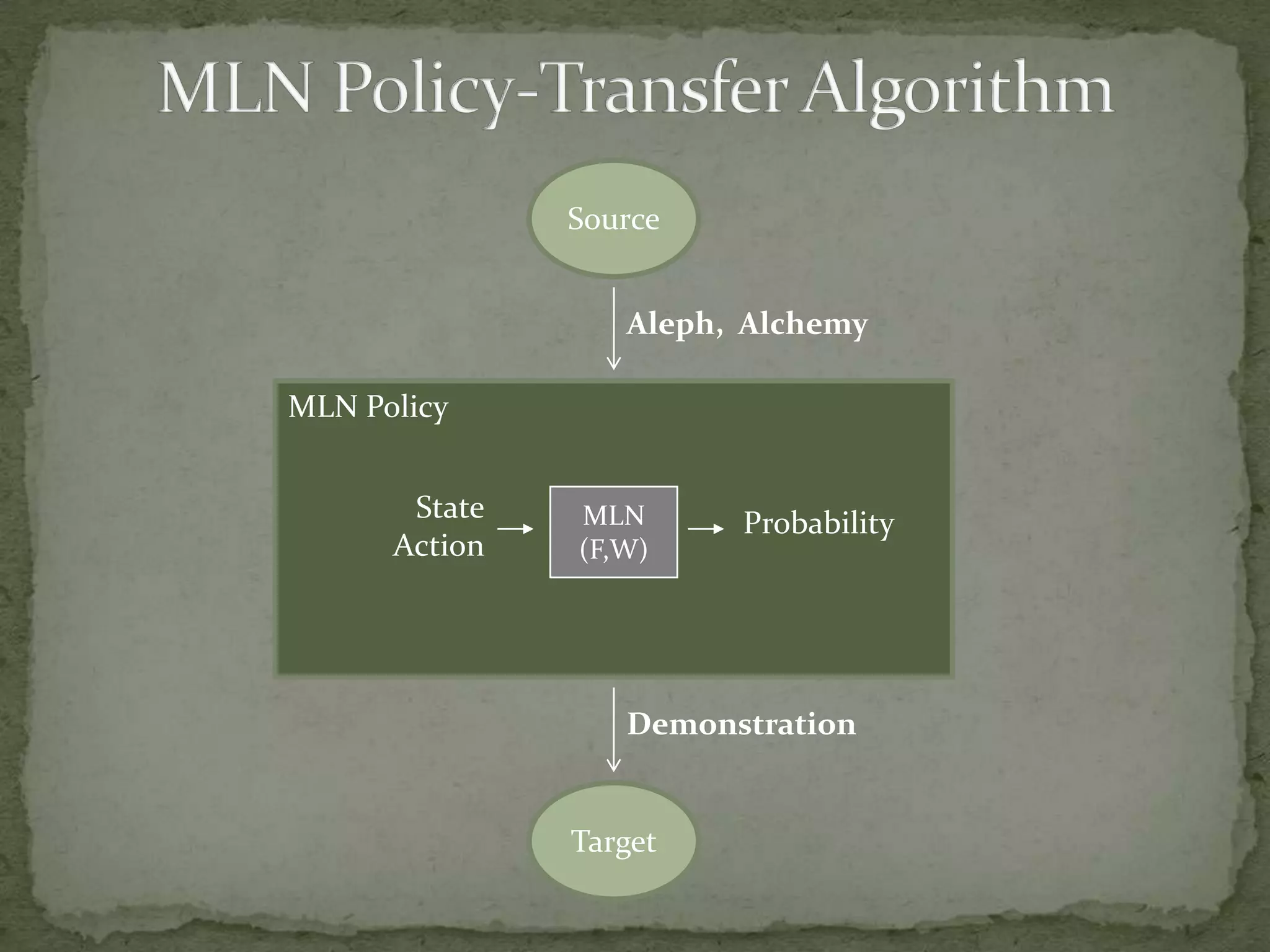
MLN Policy-Transfer AlgorithmSourceAleph,  AlchemyMLN PolicyStateActionMLN(F,W)ProbabilityDemonstrationTarget
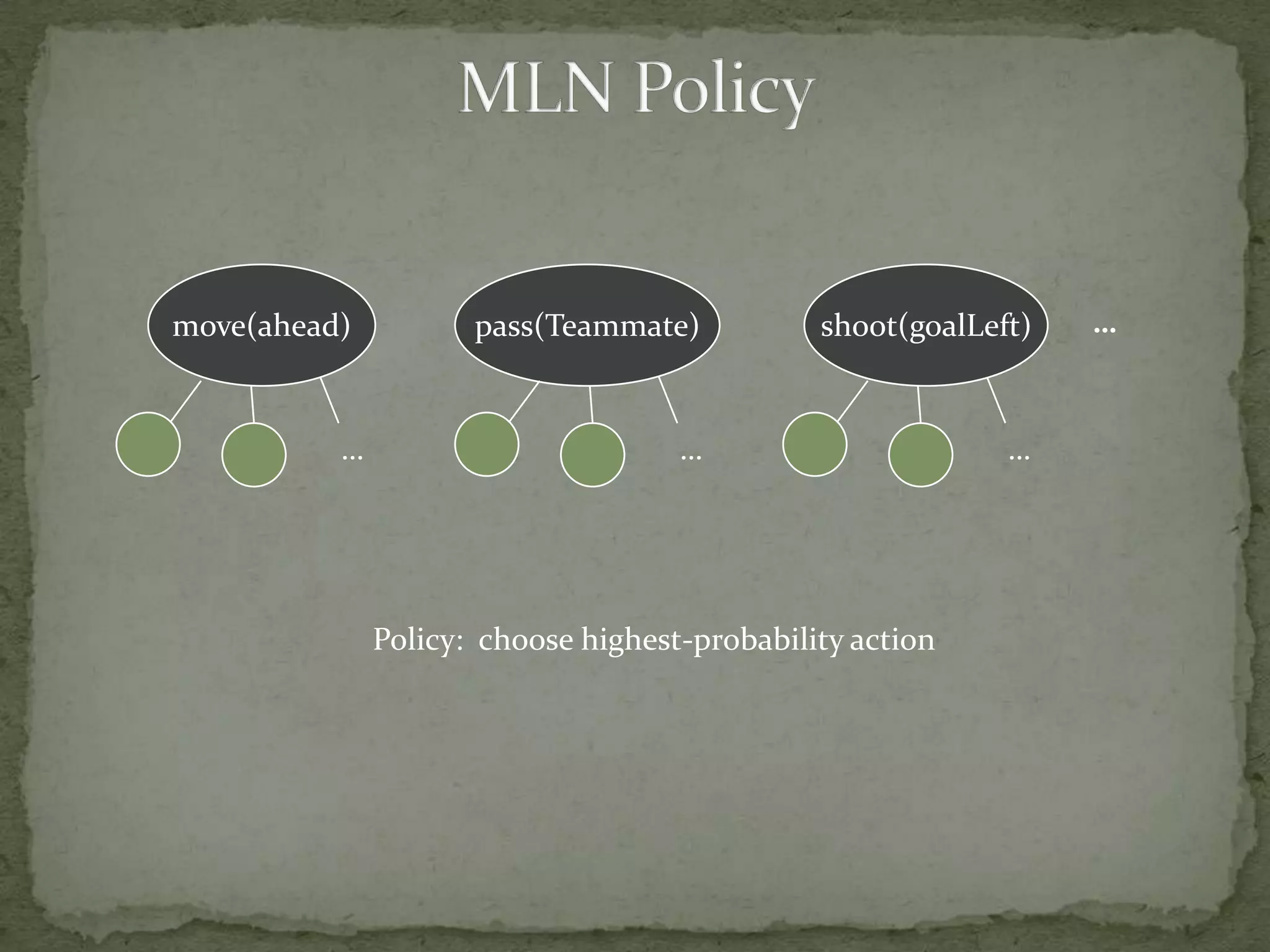
MLN Policymove(ahead)pass(Teammate)shoot(goalLeft)…………Policy:  choose highest-probability action
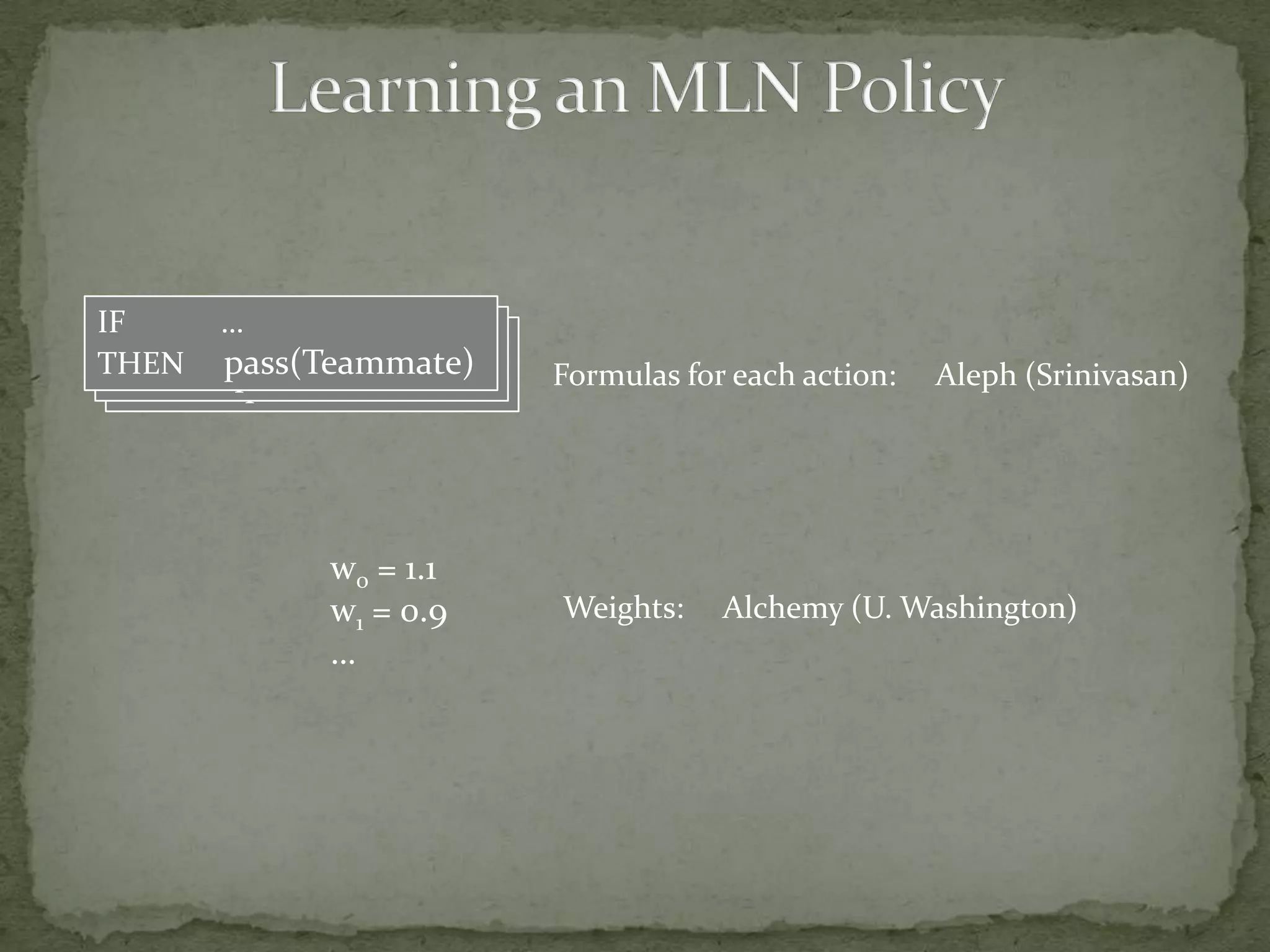
IF            … THEN  pass(Teammate)IF            … THEN  pass(Teammate)IF            … THEN  pass(Teammate)Learning an MLN PolicyFormulas for each action:     Aleph (Srinivasan)w0= 1.1w1 = 0.9…Weights:     Alchemy (U. Washington)
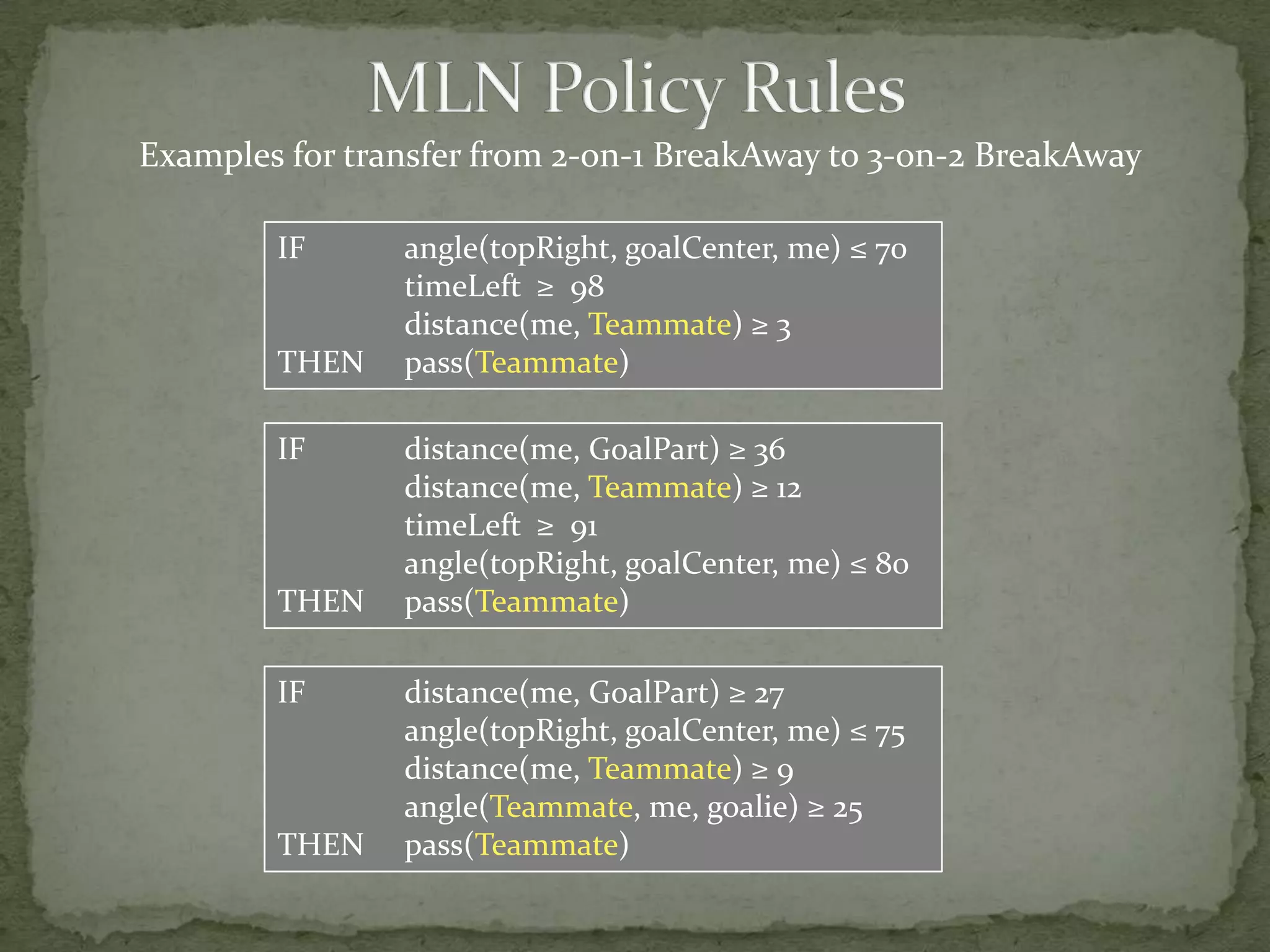
MLN Policy RulesExamples for transfer from 2-on-1 BreakAway to 3-on-2 BreakAwayIF	angle(topRight, goalCenter, me) ≤ 70	timeLeft  ≥  98	distance(me, Teammate) ≥ 3 THEN 	pass(Teammate)IF	distance(me, GoalPart) ≥ 36	distance(me, Teammate) ≥ 12	timeLeft  ≥  91	angle(topRight, goalCenter, me) ≤ 80THEN 	pass(Teammate)IF	distance(me, GoalPart) ≥ 27	angle(topRight, goalCenter, me) ≤ 75	distance(me, Teammate) ≥ 9	angle(Teammate, me, goalie) ≥ 25THEN 	pass(Teammate)
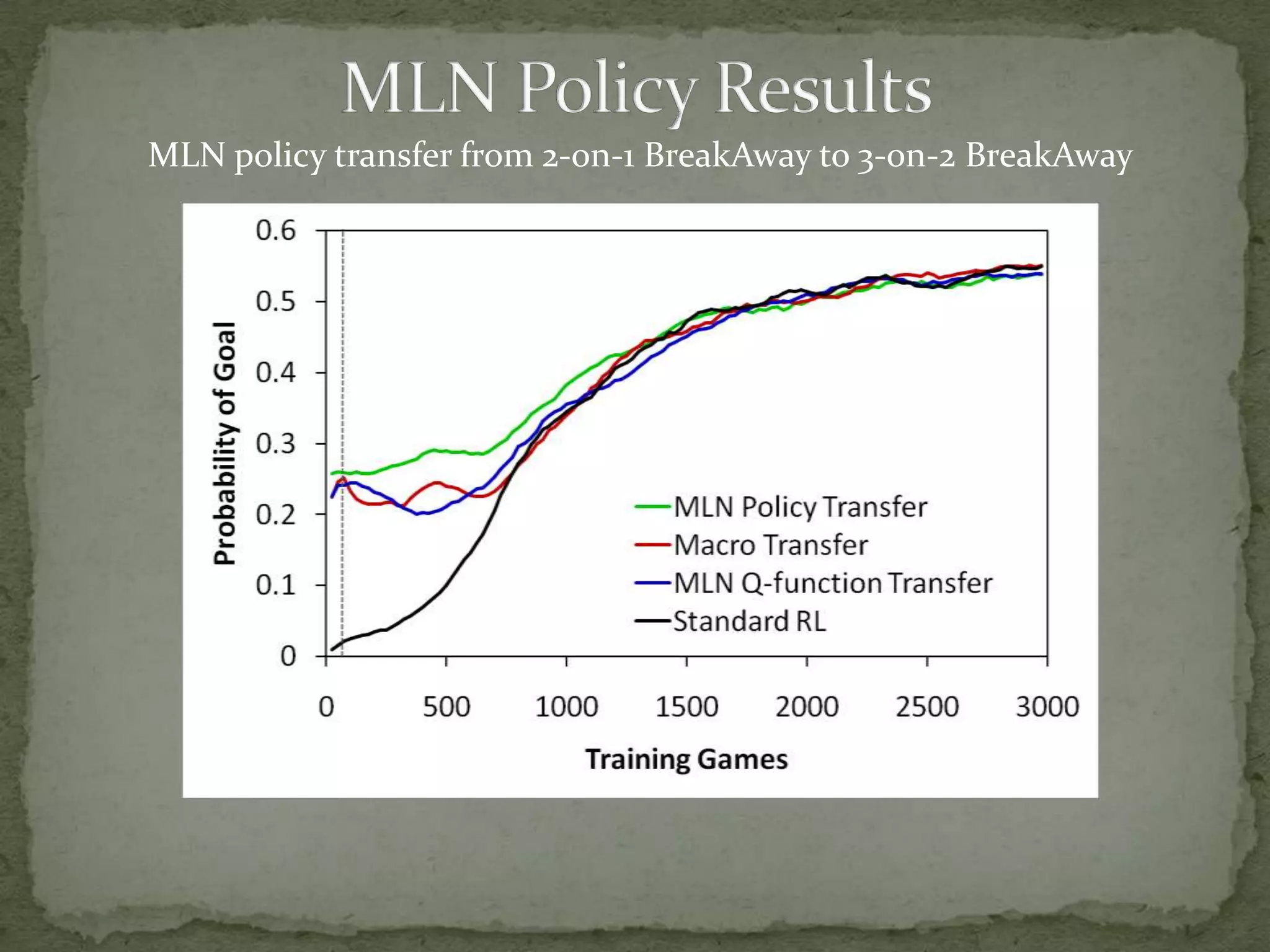
MLN Policy ResultsMLN policy transfer from 2-on-1 BreakAway to 3-on-2 BreakAway
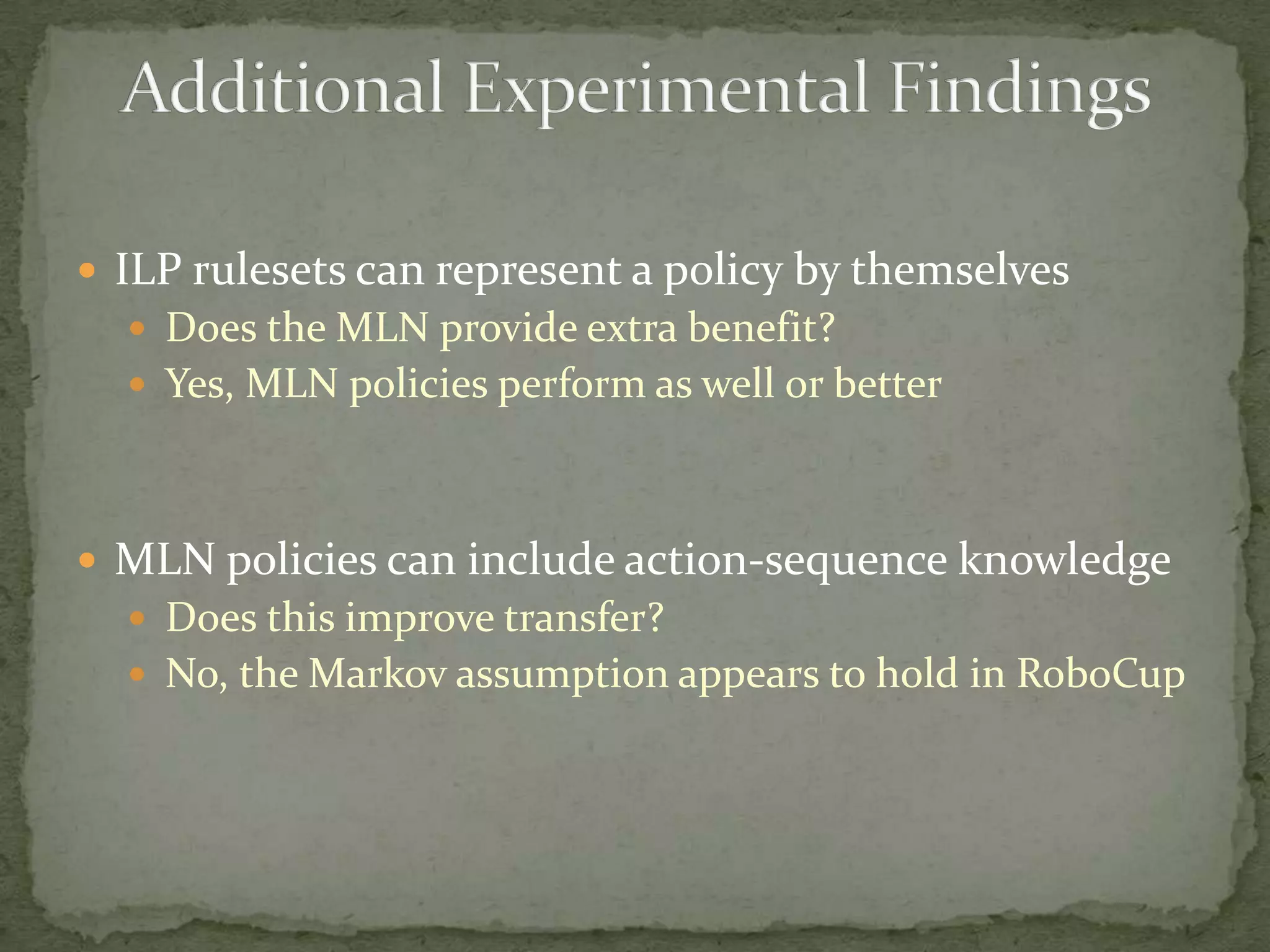
ILP rulesets can represent a policy by themselvesDoes the MLN provide extra benefit?Yes, MLN policies perform as well or betterMLN policies can include action-sequence knowledgeDoes this improve transfer?No, the Markov assumption appears to hold in RoboCupAdditional Experimental Findings
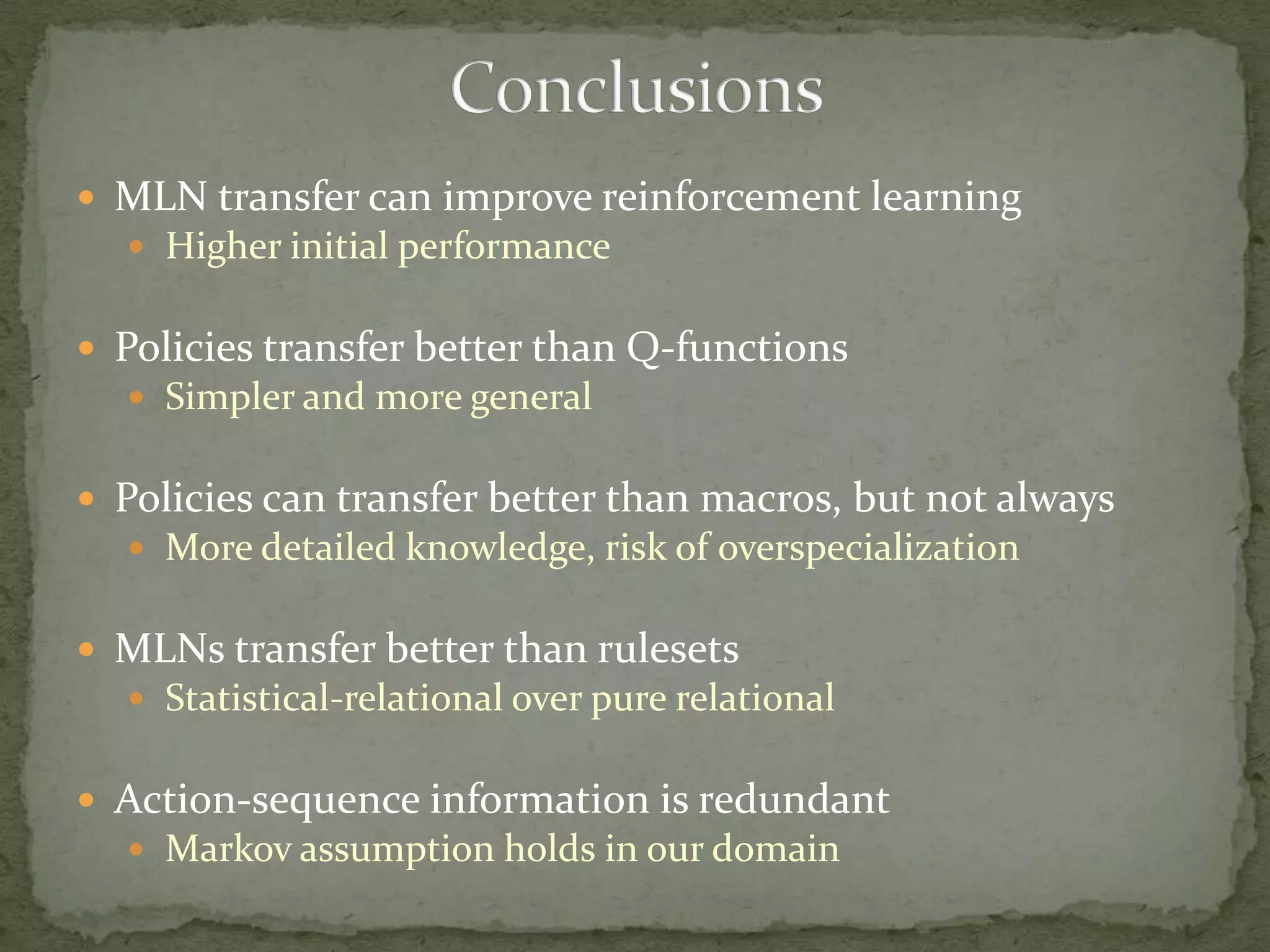
MLN transfer can improve reinforcement learningHigher initial performancePolicies transfer better than Q-functionsSimpler and more generalPolicies can transfer better than macros, but not alwaysMore detailed knowledge, risk of overspecializationMLNs transfer better than rulesetsStatistical-relational over pure relationalAction-sequence information is redundantMarkov assumption holds in our domain	 Conclusions
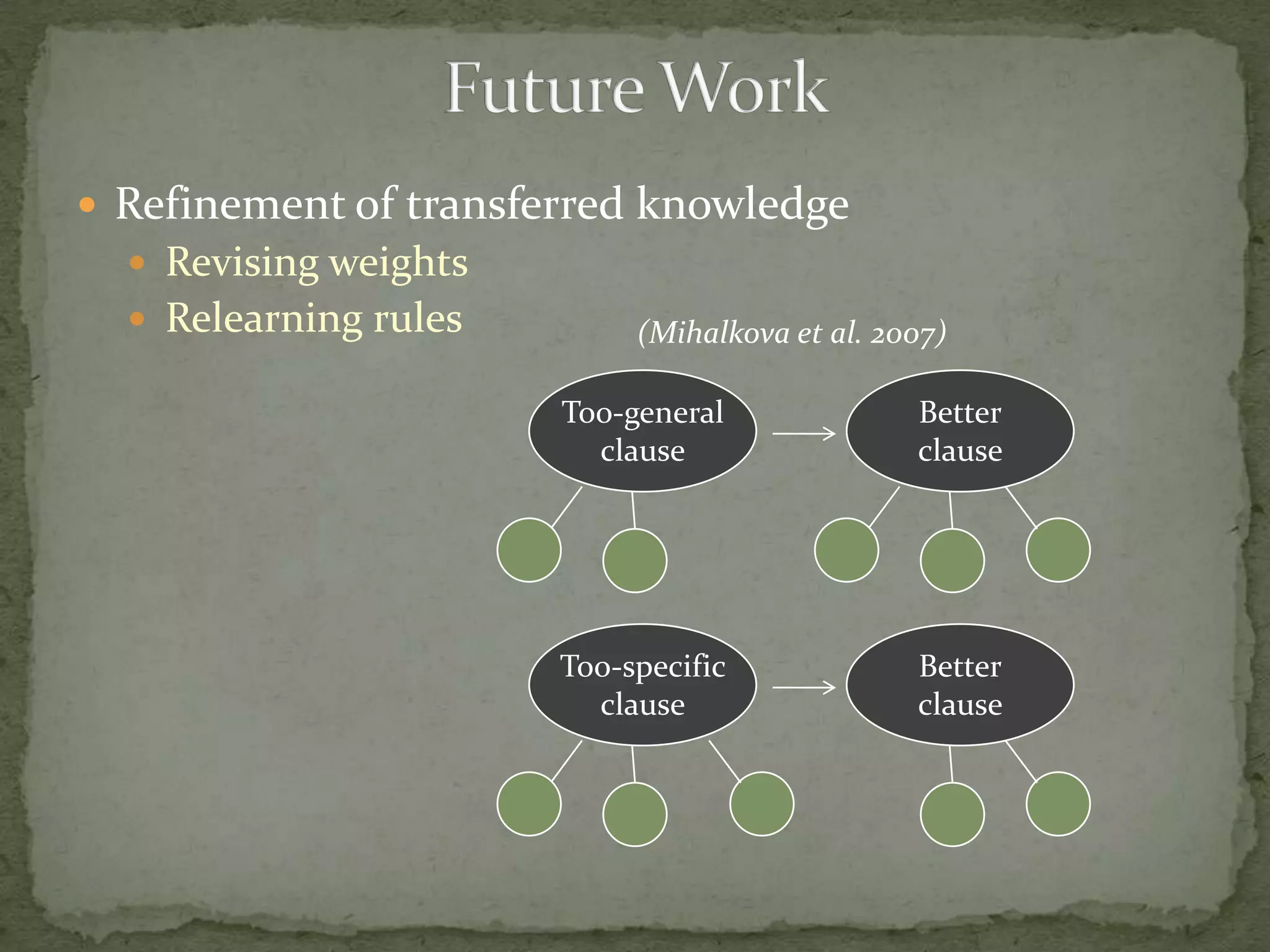
Future WorkRefinement of transferred knowledgeRevising weightsRelearning rules(Mihalkova et al. 2007) Too-specificclauseBetterclauseToo-generalclauseBetterclause
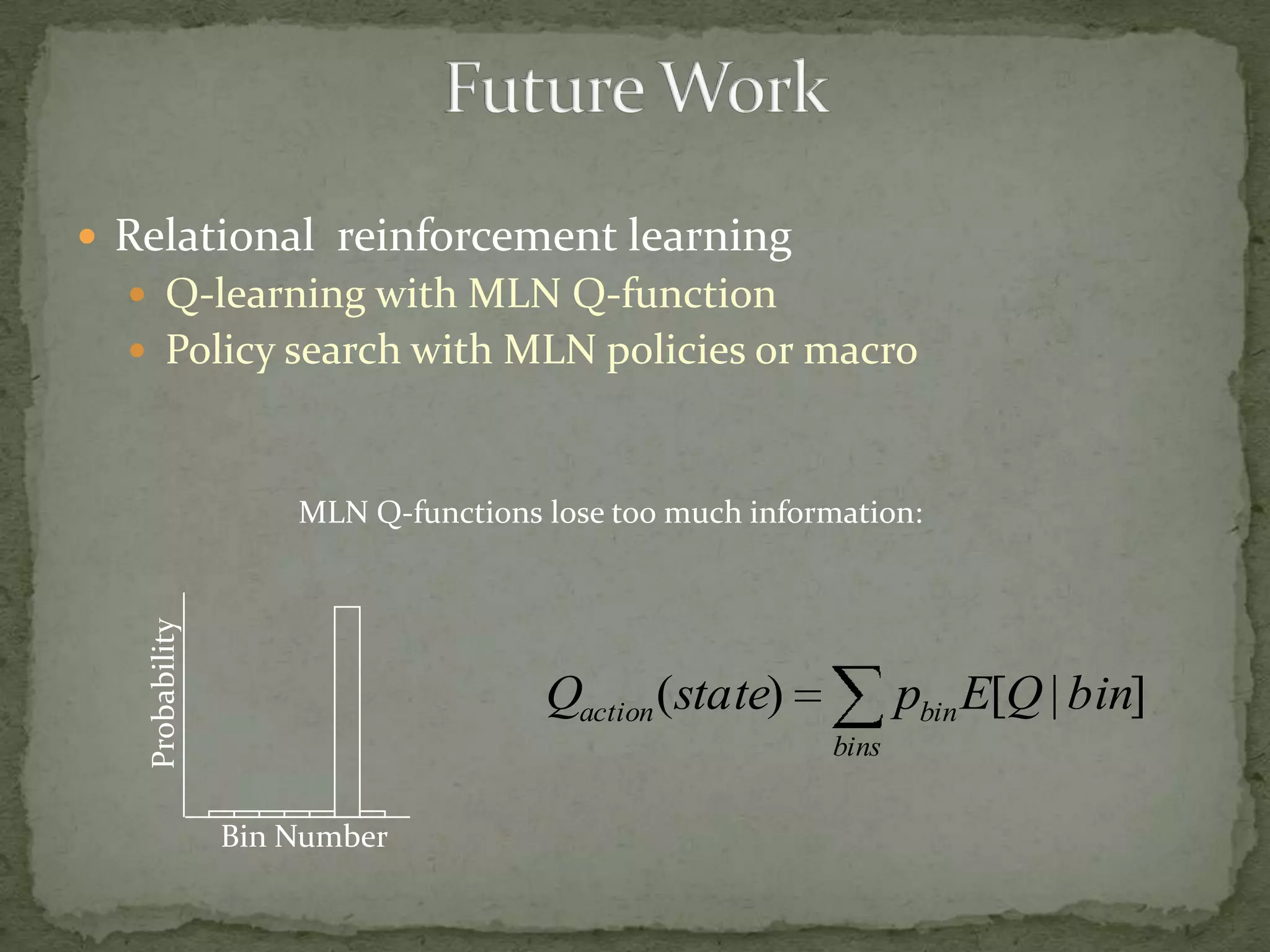
Future WorkProbabilityBin NumberRelational  reinforcement learningQ-learning with MLN Q-functionPolicy search with MLN policies or macroMLN Q-functions lose too much information:
Co-author:  Jude  ShavlikGrantsDARPA HR0011-04-1-0007DARPA FA8650-06-C-7606Thank You

Relational Transfer in Reinforcement Learning

  • 1.
    Lisa Torrey andJude ShavlikUniversity of WisconsinMadison WI, USAPolicy Transfer viaMarkov Logic Networks
  • 2.
    BackgroundApproaches for transferin reinforcement learningRelational transfer with Markov Logic NetworksTwo new algorithms for MLN transferOutline
  • 3.
    BackgroundApproaches for transferin reinforcement learningRelational transfer with Markov Logic NetworksTwo new algorithms for MLN transferOutline
  • 4.
  • 5.
    Reinforcement LearningAgentExplorationExploitationQ(s1, a)= 0policy π(s1) = a1Q(s1, a1)  Q(s1, a1) + Δπ(s2) = a2s2s3a1a2r2r3Maximize rewards1Environmentδ(s2, a2) = s3r(s2, a2) = r3δ(s1, a1) = s2r(s1, a1) = r2
  • 6.
    Learning Curveshigher asymptotehigherslopeperformancehigher starttraining
  • 7.
    RoboCup Domain2-on-1 BreakAway3-on-2BreakAwayHand-coded defendersSingle learning agent
  • 8.
    BackgroundApproaches for transferin reinforcement learningRelational transfer with Markov Logic NetworksTwo new algorithms for MLN transferOutline
  • 9.
    Madden & Howley2004Learn a set of rulesUse during exploration stepsCroonenborghs et al. 2007Learn a relational decision treeUse as an additional actionOur prior work, 2007Learn a relational macroUse as a demonstrationRelated Work
  • 10.
    BackgroundApproaches for transferin reinforcement learningRelational transfer with Markov Logic NetworksTwo new algorithms for MLN transferOutline
  • 11.
    pass(t1)goalLeftpass(t2)goalRightIF distance(GoalPart) > 10AND angle(ball, Teammate, Opponent) > 30THENRelational Transferpass(Teammate)
  • 12.
    Markov Logic NetworksRichardsonand Domingos, Machine Learning 2006Formulas (F)evidence1(X) AND query(X)evidence2(X) AND query(X)Weights (W)w0 = 1.1w1 = 0.9query(x1)query(x2)e1e1……e2e2ni(world) = # true groundings of ith formula in world
  • 13.
    Transfer with MLNsAlgorithm1: Transfer source-task Q-function as an MLNTask TTask SMLN Q-functionAlgorithm 2: Transfer source-task policy as an MLNTask TTask SMLN Policy
  • 14.
    Demonstration MethodUse MLNUseregular target-task training
  • 15.
    BackgroundApproaches for transferin reinforcement learningRelational transfer with Markov Logic NetworksTwo new algorithms for MLN transferOutline
  • 16.
    MLN Q-function TransferAlgorithmSourceAleph, AlchemyMLN Q-functionMLN foraction 1StateQ-valueMLN foraction 2StateQ-value…DemonstrationTarget
  • 17.
    MLN Q-functionProbabilityProbabilityProbabilityBin NumberBinNumberBin Number0 ≤ Qa < 0.20.2 ≤ Qa < 0.40.4 ≤ Qa < 0.6…………
  • 18.
    Learning an MLNQ-functionBins: Hierarchical clusteringIF … THEN 0 < Q < 0.2IF … THEN 0 < Q < 0.2IF … THEN 0 < Q < 0.2Formulas for each bin: Aleph (Srinivasan)w0= 1.1w1 = 0.9…Weights: Alchemy (U. Washington)
  • 19.
    Selecting Rules tobe MLN FormulasAdd torulesetAleph rulesDoes rule increase F-score of ruleset?yesRule 1 Precision=1.0Rule 2 Precision=0.99Rule3 Precision=0.96… …F = 2 x Precision x Recall Precision + Recall
  • 20.
    MLN Q-function RulesExamplesfor transfer from 2-on-1 BreakAway to 3-on-2 BreakAwayIF distance(me, GoalPart) ≥ 42 distance(me, Teammate) ≥ 39 THEN pass(Teammate) falls into [0, 0.11]IF angle(topRight, goalCenter, me) ≤ 42 angle(topRight, goalCenter, me) ≥ 55 angle(goalLeft, me, goalie) ≥ 20 angle(goalCenter, me, goalie) ≤ 30THEN pass(Teammate) falls into [0.11, 0.27]IF distance(Teammate, goalCenter) ≤ 9 angle(topRight, goalCenter, me) ≤ 85THEN pass(Teammate) falls into [0.27, 0.43]
  • 21.
    MLN Q-function ResultsTransferfrom 2-on-1 BreakAway to 3-on-2 BreakAway
  • 22.
    BackgroundApproaches for transferin reinforcement learningRelational transfer with Markov Logic NetworksTwo new algorithms for MLN transferOutline
  • 23.
    MLN Policy-Transfer AlgorithmSourceAleph, AlchemyMLN PolicyStateActionMLN(F,W)ProbabilityDemonstrationTarget
  • 24.
  • 25.
    IF … THEN pass(Teammate)IF … THEN pass(Teammate)IF … THEN pass(Teammate)Learning an MLN PolicyFormulas for each action: Aleph (Srinivasan)w0= 1.1w1 = 0.9…Weights: Alchemy (U. Washington)
  • 26.
    MLN Policy RulesExamplesfor transfer from 2-on-1 BreakAway to 3-on-2 BreakAwayIF angle(topRight, goalCenter, me) ≤ 70 timeLeft ≥ 98 distance(me, Teammate) ≥ 3 THEN pass(Teammate)IF distance(me, GoalPart) ≥ 36 distance(me, Teammate) ≥ 12 timeLeft ≥ 91 angle(topRight, goalCenter, me) ≤ 80THEN pass(Teammate)IF distance(me, GoalPart) ≥ 27 angle(topRight, goalCenter, me) ≤ 75 distance(me, Teammate) ≥ 9 angle(Teammate, me, goalie) ≥ 25THEN pass(Teammate)
  • 27.
    MLN Policy ResultsMLNpolicy transfer from 2-on-1 BreakAway to 3-on-2 BreakAway
  • 28.
    ILP rulesets canrepresent a policy by themselvesDoes the MLN provide extra benefit?Yes, MLN policies perform as well or betterMLN policies can include action-sequence knowledgeDoes this improve transfer?No, the Markov assumption appears to hold in RoboCupAdditional Experimental Findings
  • 29.
    MLN transfer canimprove reinforcement learningHigher initial performancePolicies transfer better than Q-functionsSimpler and more generalPolicies can transfer better than macros, but not alwaysMore detailed knowledge, risk of overspecializationMLNs transfer better than rulesetsStatistical-relational over pure relationalAction-sequence information is redundantMarkov assumption holds in our domain Conclusions
  • 30.
    Future WorkRefinement oftransferred knowledgeRevising weightsRelearning rules(Mihalkova et al. 2007) Too-specificclauseBetterclauseToo-generalclauseBetterclause
  • 31.
    Future WorkProbabilityBin NumberRelational reinforcement learningQ-learning with MLN Q-functionPolicy search with MLN policies or macroMLN Q-functions lose too much information:
  • 32.
    Co-author: Jude ShavlikGrantsDARPA HR0011-04-1-0007DARPA FA8650-06-C-7606Thank You