RELATED UMBILICAL
DISORDERS
Department of surgery
Songhkla hospital
The development of the anterior
abdominal wall
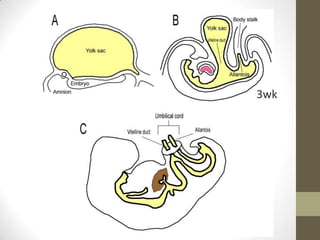
• the yolk sac is divided into an intracoelomic portion and an
extracoelomic portion.
• The intracoelomic portion becomes the primitive alimentary
canal and communicates with the extracoelomic portion
through the vitelline duct, (omphalomesenteric duct).
• This communication is lost at 5-7 wks' gestation. Persistence
of part or all of this connection results in omphalomesenteric
anomalies.
3wk
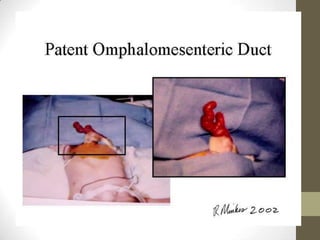
1. Omphalomesenteric duct
• This is extremely rare and may be recognized with fecal
drainage noted from the umbilicus. It is more common in boys
than in girls, and differentiation from urachal anomalies is
important for the surgical approach. Confirmation is done
through a fistulogram.
2. Partially patent
omphalomesenteric duct.
• Omphalomesenteric duct sinus
• Omphalomesenteric duct cyst
• This can be diagnosed with fistulograms and require excision.
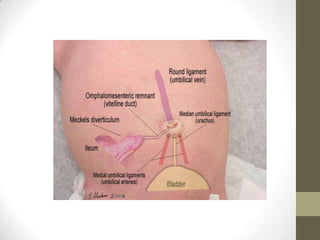
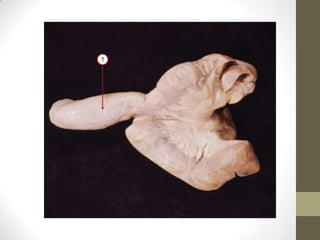
3. Meckel's diverticulum.
• Persistence of the proximal portion of the omphalomesenteric
duct as a diverticulum opening into the ileum is called a
Meckel's diverticulum. It may be associated with an umbilical
polyp.
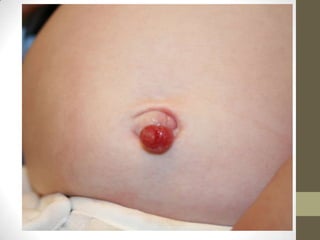
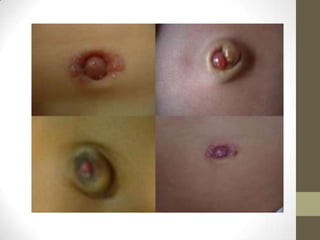
4. Umbilical polyp.
• Persistence of intestinal mucosa at the umbilicus can develop
into an umbilical polyp. Probing and possibly a fistulogram are
important.
• A simple polyp can be treated superficially with silver nitrate
or local excision. It is important, however, to make sure that it
is not associated with a duct remnant.
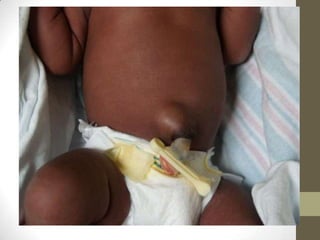
6. Umbilical hernia.
•
This is usually congenital and relates to the incomplete closure
of the anterior abdominal wall fascia after the intestines have
returned to the abdominal cavity.
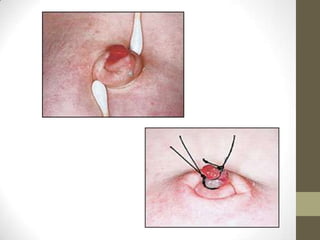
7.Umbilical granuloma
An umbilical granuloma is a piece of tissue that remains on your
baby's belly button after the umbilical cord falls off.
treatment
• silver nitrate
• Liquid nitrogen
• Ligation at the base of granuloma
• excision
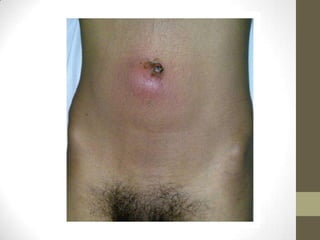
8. Omphalitis
• Inflammation of the umbilicus
• In full-term infants, the mean age at onset is 5-9 days. In
preterm infants, the mean age at onset is 3-5 days.
• Approximately ¾ of omphalitis cases are polymicrobial in
origin. predominated by
• Staphylococcus aureus
• group A Streptococcus
• Escherichia coli
• Klebsiella pneumoniae
• Proteus mirabilis
Related umbilical disorders

Related umbilical disorders

  • 1.
  • 2.
    The development ofthe anterior abdominal wall • the yolk sac is divided into an intracoelomic portion and an extracoelomic portion. • The intracoelomic portion becomes the primitive alimentary canal and communicates with the extracoelomic portion through the vitelline duct, (omphalomesenteric duct). • This communication is lost at 5-7 wks' gestation. Persistence of part or all of this connection results in omphalomesenteric anomalies.
  • 3.
  • 5.
    1. Omphalomesenteric duct •This is extremely rare and may be recognized with fecal drainage noted from the umbilicus. It is more common in boys than in girls, and differentiation from urachal anomalies is important for the surgical approach. Confirmation is done through a fistulogram.
  • 7.
    2. Partially patent omphalomesentericduct. • Omphalomesenteric duct sinus • Omphalomesenteric duct cyst • This can be diagnosed with fistulograms and require excision.
  • 9.
    3. Meckel's diverticulum. •Persistence of the proximal portion of the omphalomesenteric duct as a diverticulum opening into the ileum is called a Meckel's diverticulum. It may be associated with an umbilical polyp.
  • 11.
    4. Umbilical polyp. •Persistence of intestinal mucosa at the umbilicus can develop into an umbilical polyp. Probing and possibly a fistulogram are important. • A simple polyp can be treated superficially with silver nitrate or local excision. It is important, however, to make sure that it is not associated with a duct remnant.
  • 13.
    6. Umbilical hernia. • Thisis usually congenital and relates to the incomplete closure of the anterior abdominal wall fascia after the intestines have returned to the abdominal cavity.
  • 15.
    7.Umbilical granuloma An umbilicalgranuloma is a piece of tissue that remains on your baby's belly button after the umbilical cord falls off. treatment • silver nitrate • Liquid nitrogen • Ligation at the base of granuloma • excision
  • 17.
    8. Omphalitis • Inflammationof the umbilicus • In full-term infants, the mean age at onset is 5-9 days. In preterm infants, the mean age at onset is 3-5 days. • Approximately ¾ of omphalitis cases are polymicrobial in origin. predominated by • Staphylococcus aureus • group A Streptococcus • Escherichia coli • Klebsiella pneumoniae • Proteus mirabilis