Rectal and Umbilical
polyps
Pushpa Lal Bhadel
Department of Pediatric surgery
Kathmandu Model Hospital
Rectal polyp
 Occur in approx. 1 % of preschool children
 Peak incidence between 3-5 years of age
 50% of them has solitary polyps
 Rest has 2-10 polyps
 40% of juvenile polyps are found in rectum or sigmoid colon
 Rest of the 60% are found distributed throughout the colon
Rectal polyp
 Juvenile polyps : retention/inflammatory or cystic polyps
 Grossly these have glistening, smooth, spherical, reddish head and
range from 2mm to several cms in diameter
 Often have ulcerated surface
 Attached by a long, narrow stalk covered by colonic mucosa
Rectal polyp
 Results from a structural arrangement of mucosa secondary to inflammatory
process
 Initially ulceration and subsequent inflammation of mucosa
 Obstruction of regional, small colonic glands of mucosa
 Obstructed glands enlarge with mucous secretion and push up into the lumen
 Fecal stream and peristalsis push the mass down the lumen causing the stalk to
elongate- pedunculated appearance
Rectal polyp
Clinical features
Ulceration of surface or autoamputation leads to bright
red blood on defecation
Prolapse of polyp present as dark, cherry red protrusion at
the anus
Most of the polyps are within reach of digital rectal
examination
Rectal polyp
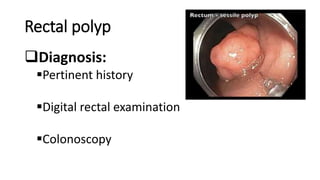
Diagnosis:
Pertinent history
Digital rectal examination
Colonoscopy
Rectal polyp
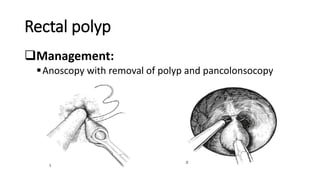
Management:
Anoscopy with removal of polyp and pancolonsocopy
Rectal polyp
Complication:
Perforation
Hemorrhage
Umbilical polyp
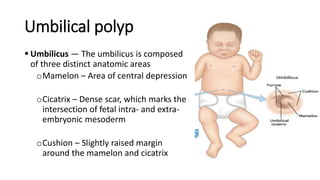
 Umbilicus — The umbilicus is composed
of three distinct anatomic areas
oMamelon – Area of central depression
oCicatrix – Dense scar, which marks the
intersection of fetal intra- and extra-
embryonic mesoderm
oCushion – Slightly raised margin
around the mamelon and cicatrix
Umbilical polyp
Introduction
Firm masses comprised of intestinal epithelium or
uroepithelium, which are omphalomesenteric or urachal
embryologic remnants.
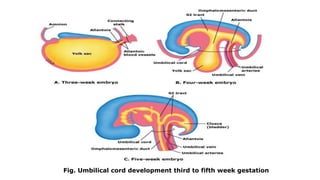
Umbilical cord : paired umbilical arteries, umbilical vein,
allantois (urachus) and omphalomesenteric duct (OMD) or
vitelline duct (VD).
Connects the yolk sac to the midgut.
Umbilical polyp
The OMD/VD obliterates by the 5–9th week of gestation
while the urachus obliterates by the 4–5th months of
gestation.
In the newborn, the umbilical cord typically separates
within 3 weeks, leaving a dry, star-like central abdominal
scar that forms the umbilicus.
Fig. Umbilical cord development third to fifth week gestation
Umbilical polyp
 Persistent or failure of involution of OMD result in spectrum of
congenital anomalies ranging from umbilical polyp, Meckel's
diverticulum
 Seen in 2%–3% of the population
 Umbilical polyp may be difficult to distinguish from an umbilical
granuloma
Umbilical polyp
 Clinical presentation of umbilical lesions depends on the age of the patient.
 In the newborn, delayed umbilical separation and omphalitis are common.
 In childhood and among adults, umbilical mass and umbilical discharge or
wet umbilicus take precedence.
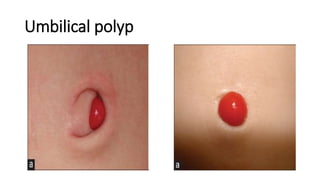
 Characterized by the presence of a firm, reddish and discharging polypoid
lesion
Umbilical polyp
Umbilical polyp
Histopathology
Shows remnants of enteric mucosa which is usually of
small intestine or colonic type, but occasionally of
gastric type in direct continuity with the adjacent
epidermis.
Other variant, fibrous umbilical polyp; is a distinctive
umbilical polyp devoid of any epithelial component.
Umbilical polyp
Management:
 Show unresponsiveness to conservative management with
repeated tropical silver nitrate ablation, ligation or use of alcoholic
wipes.
 Simple surgical excision is adequate.
 A study by Pacilli et al. also show that surgical excision is adequate
and that inspection and probing of the base of the polyp after its
excision is not necessary.
 Exploration of the peritoneal cavity in children with an umbilical
polyp does not seem to be necessary.
THANK YOU

Rectal and Umbilical polyps.pptx

  • 1.
    Rectal and Umbilical polyps PushpaLal Bhadel Department of Pediatric surgery Kathmandu Model Hospital
  • 2.
    Rectal polyp  Occurin approx. 1 % of preschool children  Peak incidence between 3-5 years of age  50% of them has solitary polyps  Rest has 2-10 polyps  40% of juvenile polyps are found in rectum or sigmoid colon  Rest of the 60% are found distributed throughout the colon
  • 3.
    Rectal polyp  Juvenilepolyps : retention/inflammatory or cystic polyps  Grossly these have glistening, smooth, spherical, reddish head and range from 2mm to several cms in diameter  Often have ulcerated surface  Attached by a long, narrow stalk covered by colonic mucosa
  • 4.
    Rectal polyp  Resultsfrom a structural arrangement of mucosa secondary to inflammatory process  Initially ulceration and subsequent inflammation of mucosa  Obstruction of regional, small colonic glands of mucosa  Obstructed glands enlarge with mucous secretion and push up into the lumen  Fecal stream and peristalsis push the mass down the lumen causing the stalk to elongate- pedunculated appearance
  • 5.
    Rectal polyp Clinical features Ulcerationof surface or autoamputation leads to bright red blood on defecation Prolapse of polyp present as dark, cherry red protrusion at the anus Most of the polyps are within reach of digital rectal examination
  • 6.
  • 7.
    Rectal polyp Management: Anoscopy withremoval of polyp and pancolonsocopy
  • 8.
  • 9.
    Umbilical polyp  Umbilicus— The umbilicus is composed of three distinct anatomic areas oMamelon – Area of central depression oCicatrix – Dense scar, which marks the intersection of fetal intra- and extra- embryonic mesoderm oCushion – Slightly raised margin around the mamelon and cicatrix
  • 10.
    Umbilical polyp Introduction Firm massescomprised of intestinal epithelium or uroepithelium, which are omphalomesenteric or urachal embryologic remnants. Umbilical cord : paired umbilical arteries, umbilical vein, allantois (urachus) and omphalomesenteric duct (OMD) or vitelline duct (VD). Connects the yolk sac to the midgut.
  • 11.
    Umbilical polyp The OMD/VDobliterates by the 5–9th week of gestation while the urachus obliterates by the 4–5th months of gestation. In the newborn, the umbilical cord typically separates within 3 weeks, leaving a dry, star-like central abdominal scar that forms the umbilicus.
  • 12.
    Fig. Umbilical corddevelopment third to fifth week gestation
  • 13.
    Umbilical polyp  Persistentor failure of involution of OMD result in spectrum of congenital anomalies ranging from umbilical polyp, Meckel's diverticulum  Seen in 2%–3% of the population  Umbilical polyp may be difficult to distinguish from an umbilical granuloma
  • 14.
    Umbilical polyp  Clinicalpresentation of umbilical lesions depends on the age of the patient.  In the newborn, delayed umbilical separation and omphalitis are common.  In childhood and among adults, umbilical mass and umbilical discharge or wet umbilicus take precedence.  Characterized by the presence of a firm, reddish and discharging polypoid lesion
  • 15.
  • 16.
    Umbilical polyp Histopathology Shows remnantsof enteric mucosa which is usually of small intestine or colonic type, but occasionally of gastric type in direct continuity with the adjacent epidermis. Other variant, fibrous umbilical polyp; is a distinctive umbilical polyp devoid of any epithelial component.
  • 17.
    Umbilical polyp Management:  Showunresponsiveness to conservative management with repeated tropical silver nitrate ablation, ligation or use of alcoholic wipes.  Simple surgical excision is adequate.  A study by Pacilli et al. also show that surgical excision is adequate and that inspection and probing of the base of the polyp after its excision is not necessary.  Exploration of the peritoneal cavity in children with an umbilical polyp does not seem to be necessary.
  • 18.

Editor's Notes

  • #4 Stalk: torsion-venous congestion, surface ulceration, bleeding and autoamputation.
  • #7 Increased risk of malignancy for >5 juvenile polyps
  • #11 to become the median umbilical ligament.
  • #12 to become the median umbilical ligament.
  • #14 but unlike granuloma, umbilical polyp is usually brighter red, usually slightly larger with diameter of 0.5–2 cm as oppose to 0.1–1 cm of granuloma and it does not respond to conservative treatment with topical silver nitrate.