Dr. Md. Jakir Hossain Bhuiyan
(Sohel)Resident Phase–A
Dr MD AB QUIYUM
Resident,HBS,BSMMU
ABDOMINAL WALL DEFECTS
Welcome
OBJECTIVES
 Anatomy of abdominal wall in short
 What are the types of abdominal wall defects
 Embryology of different abdominal wall defects
 Diagnosis and management of different abdominal
wall defects
Borders of the Abdomen
• Superior:
Costal cartilages 7-12.
Xiphoid process:
Level of 10th cartilage = L3
• Inferior:
Pubic bone and iliac crest =Level of L4.
• Umbilicus:
Level of IV disc L3-4
Abdominal Quadrants
Formed by two intersecting lines:
Intersect at umbilicus.
Quadrants:
Upper left.
Upper right.
Lower left.
Lower right.
ABDOMINAL REGIONS
Divided into 9 regions by two pairs of planes:
●Vertical Planes:
Left and right lateral planes
= midclavicular planes
●Horizontal Planes:
Transpyloric plane: tip 9 th CC
Intertubercular plane:Through tubercles of iliac
crests.
Fascia
• Superficial:Camper’s fascia Continuous with
fascia over thorax and thigh Fatty layer.
• Deep Superficial:Scarpa’s fascia
-Membranous layer:Continues into perineum
as:Superficial perineal fascia = Colle’s fascia.
• Deep: Thin layer covering abdominal muscles.
Muscle LayersMuscle Layers
General Characteristics:
-Three large flat sheets connecting rib cage to
hip bone.
-Muscular posteriorly and laterally.
-Aponeurotic anteriorly and medially.
Muscle Layers
• Include:
External oblique.
Internal oblique.
Transversus abdominus.
Rectus abdominus.
Arterial Supply
Above the Umbilicus:
●PIA 10-11.●Subcostal artery●LA 1-4.
●MA●Superior epigastric arteries.
●Inferior epigastric arteries.
Below the Umbilicus:
●3s
Venous Drainage
• Superficial veins are paired with arteries.
• Above the umbilicus:
Drain into the azygos venous system.
• Below the umbilicus:
Drain into the femoral system (via great
saphenous).
OMPHALOCOELE
●Anterior abdominal wall defect at the base of
the umbilical cord with herniation of the
umbilical contents
Small omphalocoele 1:5000
Large omphalocoele 1:10000
Male to female ratio 1:1
Pacific Islanders have low risk for omphalocoele
Embryology of Omphalocele
• Failure of the midgut to return to abdomen by
the 10th
week of gestation
(Somatic layers of cephalic, caudal, and lateral
folds join to close abdominal wall)
Embryology of Omphalocele
Clinical Findings
• Covered clinical defect
of the umbilical ring
• Defect may vary from 2-
10 cm
• Sac is composed of
amnion, Wharton’s jelly
and peritoneum
• Associate ẽ
BA,IA,TTF,SD,VIF,CL
Clinical Findings
• 50% have
accompanying liver,
spleen, testes/ovary
• >50% have associated
defects
• Location:
– Epigastric
– Central
– Hypogastric
• Cord attachment is on
the sac
Clinical Findings
GASTROSCHISISGASTROSCHISIS
Defect of the anterior abdominal wall just
lateral to the umbilicus
1:20,000-30,000
Sex ratio 1:1
10-15% have associated anomalies
40% are premature/SGA
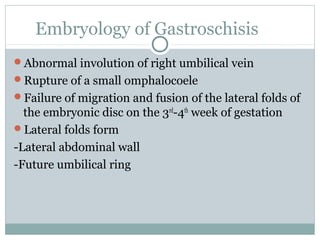
Embryology of Gastroschisis
Abnormal involution of right umbilical vein
Rupture of a small omphalocoele
Failure of migration and fusion of the lateral folds of
the embryonic disc on the 3rd
-4th
week of gestation
Lateral folds form
-Lateral abdominal wall
-Future umbilical ring
Clinical Findings
• Defect to the right of an
intact UC allowing extrusion
of abdominal content
• Opening ≅ 5 cm
• No covering sac
Clinical Findings
• Bowels often
thickened, matted and
edematous
• 10-15% with intestinal
atresia
MANAGEMENT
 ABC
 Heat Management
 Sterile wrap or sterile bowel bag
 Radiant warmer
 Fluid Management
 IV bolus 20 ml/kg LR/NS
 D10¼NS 2-3 maintenance rate
MANAGEMENT
Nutrition
 NPO and TPN
Gastric Distention
 OG/NG tube
Infection Control
 Ampicillin and Gentamicin
Associated Defects
MANAGEMENT
 Conservative treatment
 Reduction by squeezing the sac
 Painting sac with escharotic agent
0.25% Silver nitrate
0.25% Merbromin (Mercurochrome)
MANAGEMENT
 Surgical Management
 Skin Flaps
 Primary Closure
 Staged Closure
Staged repair using silo pouch
Skin Flaps
Primary Closure
Staged Closure
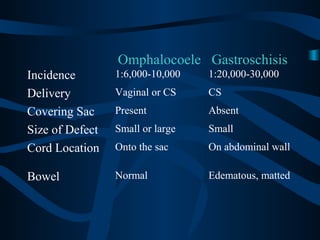
Omphalocoele Gastroschisis
Incidence 1:6,000-10,000 1:20,000-30,000
Delivery Vaginal or CS CS
Covering Sac Present Absent
Size of Defect Small or large Small
Cord Location Onto the sac On abdominal wall
Bowel Normal Edematous, matted
Omphalocoele Gastroschisis
Other Organs Liver often out Rare
Prematurity 10-20% 50-60%
IUGR Less common Common
NEC If sac is ruptured 18%
Associated
Anomalies
>50% 10-15%
Treatment Often primary Often staged
Prognosis 20%-70% 70-90%
UMBILICAL HERNIA
• Defect in linea alba,
subcutaneous tissue
and skin covering the
protruding bowel
• Frequent in premature
infants
Pathophysiology
● In intrauterine life, there is a small opening
in the abdominal muscles that allows the UC
to pass through, connecting mother to baby.
● After birth, this opening in the abdominal
muscles closes.
●Sometimes, these muscles do not meet and
grow together completely,
Clinical findings
• Bulge or swelling in the belly button area
• May become more noticeable when the baby
cries.
• May become smaller or disappear when the
baby is quiet
• Usually get smaller or go back into the
abdomen when gently pushes on the bulge
• Sometimes incarcerated hernia
MANAGEMENT
●Many umbilical hernias close spontaneously by
ages 3 to 4.
●If closure does not occur by this time, surgical
repair is usually advised
●In younger children, if there is an episode of
incarceration or if the hernia is very large, surgical
repair may be recommended.
PRUNE BELLY SYNDROME
(AMDS,CAAM, EBS,OS,FS & TS)
A group of birth defects that deal with three main
issues-
•Thin, flaccid abdominal wall
•Dilation of bladder, ureter and renal collecting
system
•UDT
•1:30,000-50,000
•95% are male
EMBRYOLOGY
• Myotomal cells from somites form ventral
and dorsal group migrating cells called
hypomeres
• If for some reasons hypomeric group does
not migrate,proliferate or differenciate
within the Abdominal resons
• “Little Buddha” appearance
• Constipation
• Delay in sitting and walking
• Difficulties coughing
• Difficulties in micturation
CLINICAL SYMPTOMS
BLADDER EXTROPHY
• Defective enfolding of
caudal folds
• 3.3 in 100,000 births
• Associated with prolapsed
vagina or rectum,
epispadias, bifid clitoris or
penis
BLADDER EXTROPHY
●Spectrum of severity
-Small defect can result in epispadias
-large defect can result in exposure of
posterior bladder wall
●Exposed bladder mucosa is edematous and
friable
EMBRYOLOGY
• It is partial form of spectrum of failure of
abdominal and pelvic fusions in the 1st
month
of embryogenesis
• It occurs as a result of defective migration of
genital tubercle primodii to the clocal
membrane and so malformation of the genital
tubercle at about 5th
week of gestation
MANAGEMENT
●Moist, fine-mesh gauze or vaseline gauze to cover
exposed bladder
●Antibiotics
●Renal ultrasound
●Transfer infant to surgical center
-Want surgical correction by 48-72 hours of life
-Sacroiliac joints are still pliable and the pelvis can be
“molded” to allow better approximation of the pubic
rami
●IVP of limited utility b/c of poor concentrating ability
of neonatal kidney
MANAGEMENT
●Turn-in of the bladder to preserve bladder
function
●Symphysis pubis is approximated
Iliac osteotomies aren’t necessary if ●repair
is within 48 HOL (bones are still pliable
from circulating maternal estrogens)
●Epispadiac urethra is reconstructed later
Cloacal Exstrophy
●Very rare: 1 in 200,000 births
●Sporadic occurrence
●Complex of GI and GU anomalies:
-Imperforate anus
-Exstrophy of the bladder
-Omphalocele
-Vesicointestinal fistula
-Frequently prolapse of bowel thru the
fistula on bladder mucosa
EMBRYOLOGY
• Abnormal over development of the clocal
membrane which prevents medial
migration of the mesenchymal tissue and
proper lower abdominal wall development
MANAGEMENT
●Cover exposed mucosa (vaseline/saline gauze)
and/or plastic wrap to minimize heat loss
●Gender assignment / diagnosis
-Karyotype / FISH
-Controversial regarding assignment
●NG suction to relieve partial intestinal
obstruction.
-Stool frequently excreted through a vesico-
intestinal fistula that is often partially
obstructed
Cloacal Exstrophy - Operative
●Survival 80% - mortality due to sepsis and
bowel obstruction
●Prompt surgery to separate fecal and urinary
streams
●Bladder can be closed during initial procedure
if baby stable
●Subsequent procedures to reduce the number
of stomas and create genitalia
COMPLICATIONS
Multiple Long term problems:
Psychosocial / Gender Identification
Recurrent UTIs
Bowel/Bladder Incontinence
Sexual function in later life
PENTALOGY OF CANTRELL
• Omphalocoele
• Anterior diaphragmatic hernia
• Sternal cleft
• Ectopia Cordis
• Intracardiac defect
BECKWITH-WIEDEMANN
SYNDROME (MOEAM)
• Macrosomia
• Macroglossia
• Organomegaly
• Abdominal wall
defects
• Embryonal tumors
Thanks to
all

Abdominal wall-defects

  • 1.
    Dr. Md. JakirHossain Bhuiyan (Sohel)Resident Phase–A Dr MD AB QUIYUM Resident,HBS,BSMMU ABDOMINAL WALL DEFECTS Welcome
  • 2.
    OBJECTIVES  Anatomy ofabdominal wall in short  What are the types of abdominal wall defects  Embryology of different abdominal wall defects  Diagnosis and management of different abdominal wall defects
  • 3.
    Borders of theAbdomen • Superior: Costal cartilages 7-12. Xiphoid process: Level of 10th cartilage = L3 • Inferior: Pubic bone and iliac crest =Level of L4. • Umbilicus: Level of IV disc L3-4
  • 4.
    Abdominal Quadrants Formed bytwo intersecting lines: Intersect at umbilicus. Quadrants: Upper left. Upper right. Lower left. Lower right.
  • 5.
    ABDOMINAL REGIONS Divided into9 regions by two pairs of planes: ●Vertical Planes: Left and right lateral planes = midclavicular planes ●Horizontal Planes: Transpyloric plane: tip 9 th CC Intertubercular plane:Through tubercles of iliac crests.
  • 6.
    Fascia • Superficial:Camper’s fasciaContinuous with fascia over thorax and thigh Fatty layer. • Deep Superficial:Scarpa’s fascia -Membranous layer:Continues into perineum as:Superficial perineal fascia = Colle’s fascia. • Deep: Thin layer covering abdominal muscles.
  • 7.
    Muscle LayersMuscle Layers GeneralCharacteristics: -Three large flat sheets connecting rib cage to hip bone. -Muscular posteriorly and laterally. -Aponeurotic anteriorly and medially.
  • 8.
    Muscle Layers • Include: Externaloblique. Internal oblique. Transversus abdominus. Rectus abdominus.
  • 9.
    Arterial Supply Above theUmbilicus: ●PIA 10-11.●Subcostal artery●LA 1-4. ●MA●Superior epigastric arteries. ●Inferior epigastric arteries. Below the Umbilicus: ●3s
  • 10.
    Venous Drainage • Superficialveins are paired with arteries. • Above the umbilicus: Drain into the azygos venous system. • Below the umbilicus: Drain into the femoral system (via great saphenous).
  • 11.
    OMPHALOCOELE ●Anterior abdominal walldefect at the base of the umbilical cord with herniation of the umbilical contents Small omphalocoele 1:5000 Large omphalocoele 1:10000 Male to female ratio 1:1 Pacific Islanders have low risk for omphalocoele
  • 12.
    Embryology of Omphalocele •Failure of the midgut to return to abdomen by the 10th week of gestation (Somatic layers of cephalic, caudal, and lateral folds join to close abdominal wall)
  • 13.
  • 14.
    Clinical Findings • Coveredclinical defect of the umbilical ring • Defect may vary from 2- 10 cm • Sac is composed of amnion, Wharton’s jelly and peritoneum • Associate ẽ BA,IA,TTF,SD,VIF,CL
  • 15.
    Clinical Findings • 50%have accompanying liver, spleen, testes/ovary • >50% have associated defects • Location: – Epigastric – Central – Hypogastric • Cord attachment is on the sac
  • 16.
  • 17.
    GASTROSCHISISGASTROSCHISIS Defect of theanterior abdominal wall just lateral to the umbilicus 1:20,000-30,000 Sex ratio 1:1 10-15% have associated anomalies 40% are premature/SGA
  • 18.
    Embryology of Gastroschisis Abnormalinvolution of right umbilical vein Rupture of a small omphalocoele Failure of migration and fusion of the lateral folds of the embryonic disc on the 3rd -4th week of gestation Lateral folds form -Lateral abdominal wall -Future umbilical ring
  • 19.
    Clinical Findings • Defectto the right of an intact UC allowing extrusion of abdominal content • Opening ≅ 5 cm • No covering sac
  • 20.
    Clinical Findings • Bowelsoften thickened, matted and edematous • 10-15% with intestinal atresia
  • 22.
    MANAGEMENT  ABC  HeatManagement  Sterile wrap or sterile bowel bag  Radiant warmer  Fluid Management  IV bolus 20 ml/kg LR/NS  D10¼NS 2-3 maintenance rate
  • 23.
    MANAGEMENT Nutrition  NPO andTPN Gastric Distention  OG/NG tube Infection Control  Ampicillin and Gentamicin Associated Defects
  • 24.
    MANAGEMENT  Conservative treatment Reduction by squeezing the sac  Painting sac with escharotic agent 0.25% Silver nitrate 0.25% Merbromin (Mercurochrome)
  • 26.
    MANAGEMENT  Surgical Management Skin Flaps  Primary Closure  Staged Closure Staged repair using silo pouch
  • 27.
  • 28.
  • 33.
  • 38.
    Omphalocoele Gastroschisis Incidence 1:6,000-10,0001:20,000-30,000 Delivery Vaginal or CS CS Covering Sac Present Absent Size of Defect Small or large Small Cord Location Onto the sac On abdominal wall Bowel Normal Edematous, matted
  • 39.
    Omphalocoele Gastroschisis Other OrgansLiver often out Rare Prematurity 10-20% 50-60% IUGR Less common Common NEC If sac is ruptured 18% Associated Anomalies >50% 10-15% Treatment Often primary Often staged Prognosis 20%-70% 70-90%
  • 40.
    UMBILICAL HERNIA • Defectin linea alba, subcutaneous tissue and skin covering the protruding bowel • Frequent in premature infants
  • 41.
    Pathophysiology ● In intrauterinelife, there is a small opening in the abdominal muscles that allows the UC to pass through, connecting mother to baby. ● After birth, this opening in the abdominal muscles closes. ●Sometimes, these muscles do not meet and grow together completely,
  • 42.
    Clinical findings • Bulgeor swelling in the belly button area • May become more noticeable when the baby cries. • May become smaller or disappear when the baby is quiet • Usually get smaller or go back into the abdomen when gently pushes on the bulge • Sometimes incarcerated hernia
  • 43.
    MANAGEMENT ●Many umbilical herniasclose spontaneously by ages 3 to 4. ●If closure does not occur by this time, surgical repair is usually advised ●In younger children, if there is an episode of incarceration or if the hernia is very large, surgical repair may be recommended.
  • 44.
    PRUNE BELLY SYNDROME (AMDS,CAAM,EBS,OS,FS & TS) A group of birth defects that deal with three main issues- •Thin, flaccid abdominal wall •Dilation of bladder, ureter and renal collecting system •UDT •1:30,000-50,000 •95% are male
  • 45.
    EMBRYOLOGY • Myotomal cellsfrom somites form ventral and dorsal group migrating cells called hypomeres • If for some reasons hypomeric group does not migrate,proliferate or differenciate within the Abdominal resons
  • 46.
    • “Little Buddha”appearance • Constipation • Delay in sitting and walking • Difficulties coughing • Difficulties in micturation CLINICAL SYMPTOMS
  • 47.
    BLADDER EXTROPHY • Defectiveenfolding of caudal folds • 3.3 in 100,000 births • Associated with prolapsed vagina or rectum, epispadias, bifid clitoris or penis
  • 48.
    BLADDER EXTROPHY ●Spectrum ofseverity -Small defect can result in epispadias -large defect can result in exposure of posterior bladder wall ●Exposed bladder mucosa is edematous and friable
  • 49.
    EMBRYOLOGY • It ispartial form of spectrum of failure of abdominal and pelvic fusions in the 1st month of embryogenesis • It occurs as a result of defective migration of genital tubercle primodii to the clocal membrane and so malformation of the genital tubercle at about 5th week of gestation
  • 50.
    MANAGEMENT ●Moist, fine-mesh gauzeor vaseline gauze to cover exposed bladder ●Antibiotics ●Renal ultrasound ●Transfer infant to surgical center -Want surgical correction by 48-72 hours of life -Sacroiliac joints are still pliable and the pelvis can be “molded” to allow better approximation of the pubic rami ●IVP of limited utility b/c of poor concentrating ability of neonatal kidney
  • 51.
    MANAGEMENT ●Turn-in of thebladder to preserve bladder function ●Symphysis pubis is approximated Iliac osteotomies aren’t necessary if ●repair is within 48 HOL (bones are still pliable from circulating maternal estrogens) ●Epispadiac urethra is reconstructed later
  • 52.
    Cloacal Exstrophy ●Very rare:1 in 200,000 births ●Sporadic occurrence ●Complex of GI and GU anomalies: -Imperforate anus -Exstrophy of the bladder -Omphalocele -Vesicointestinal fistula -Frequently prolapse of bowel thru the fistula on bladder mucosa
  • 53.
    EMBRYOLOGY • Abnormal overdevelopment of the clocal membrane which prevents medial migration of the mesenchymal tissue and proper lower abdominal wall development
  • 54.
    MANAGEMENT ●Cover exposed mucosa(vaseline/saline gauze) and/or plastic wrap to minimize heat loss ●Gender assignment / diagnosis -Karyotype / FISH -Controversial regarding assignment ●NG suction to relieve partial intestinal obstruction. -Stool frequently excreted through a vesico- intestinal fistula that is often partially obstructed
  • 55.
    Cloacal Exstrophy -Operative ●Survival 80% - mortality due to sepsis and bowel obstruction ●Prompt surgery to separate fecal and urinary streams ●Bladder can be closed during initial procedure if baby stable ●Subsequent procedures to reduce the number of stomas and create genitalia
  • 56.
    COMPLICATIONS Multiple Long termproblems: Psychosocial / Gender Identification Recurrent UTIs Bowel/Bladder Incontinence Sexual function in later life
  • 57.
    PENTALOGY OF CANTRELL •Omphalocoele • Anterior diaphragmatic hernia • Sternal cleft • Ectopia Cordis • Intracardiac defect
  • 59.
    BECKWITH-WIEDEMANN SYNDROME (MOEAM) • Macrosomia •Macroglossia • Organomegaly • Abdominal wall defects • Embryonal tumors
  • 60.