Organ systems working together to maintain homeostasis Body’s Mechanisms to maintain homeostasis against the change in environmental factors
Regulation Of Temperature
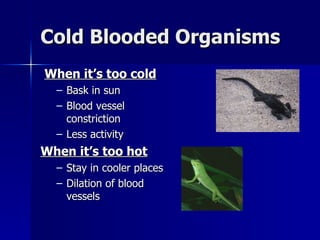
Cold Blooded Organisms When it’s too cold Bask in sun Blood vessel constriction Less activity When it’s too hot Stay in cooler places Dilation of blood vessels
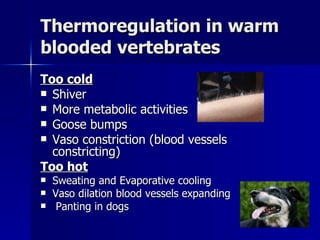
Thermoregulation in warm blooded vertebrates Too cold Shiver More metabolic activities Goose bumps Vaso constriction (blood vessels constricting) Too hot Sweating and Evaporative cooling Vaso dilation blood vessels expanding  Panting in dogs
Cold   the b rain senses the low temperature and sends message to skeletal and muscular system to shiver and form goose bumps it also sends   message to circulatory system to constrict its blood vessels Organ systems work together to maintain temperature homeostasis
Organ systems work together to maintain temperature homeostasis Hot Brain sends message to integumentary system to produce more sweat It sends message to circulatory system for vasodilation In both cases after body temperature comes back to normal, the signals are stopped being transmitted from the brain to other systems (negative feed back)
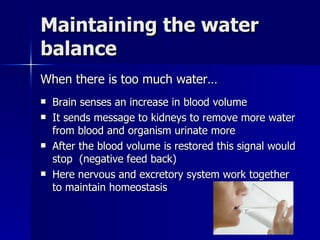
Maintaining the water balance When there is too much water… Brain senses an increase in blood volume It sends message to kidneys to remove more water from blood and organism urinate more After the blood volume is restored this signal would stop  (negative feed back) Here nervous and excretory system work together to maintain homeostasis
When there is less water in blood / blood volume is low Brain sends message to pituatary gland to produce anti diuretic hormone ADH gives message to kidneys to take less water from blood and organism urinate less  Brain signals for thirst When blood volume is restores both these signals would stop( negative fed back) Here nervous system works with endocrine system and circulatory system
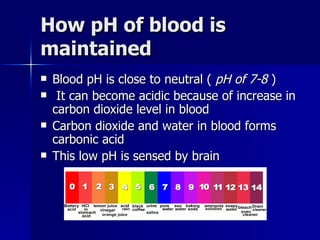
How pH of blood is maintained Blood pH is close to neutral (  pH of 7-8  ) It can become acidic because of increase in carbon dioxide level in blood Carbon dioxide and water in blood forms carbonic acid This low pH is sensed by brain
How pH of blood is maintained It gives  message to lungs to work more to expel carbon dioxide and bring in more oxygen When the carbon dioxide level decreases and pH is maintained the signal stops Here nervous system works with circulatory and respiratory systems to maintain homeostasis of body pH.
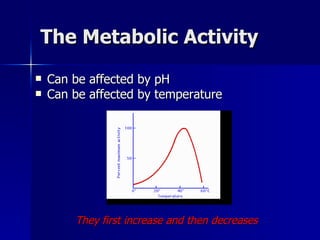
The Metabolic Activity Can be affected by pH  Can be affected by temperature They first increase and then decreases
The Metabolic Activity Can be affected by light ( photosynthesis ) Can be affected by radiation ( Cancer ) Can be affected by toxic substances ( Drugs )

Regulation of temperature

  • 1.
    Organ systems workingtogether to maintain homeostasis Body’s Mechanisms to maintain homeostasis against the change in environmental factors
  • 2.
  • 3.
    Cold Blooded OrganismsWhen it’s too cold Bask in sun Blood vessel constriction Less activity When it’s too hot Stay in cooler places Dilation of blood vessels
  • 4.
    Thermoregulation in warmblooded vertebrates Too cold Shiver More metabolic activities Goose bumps Vaso constriction (blood vessels constricting) Too hot Sweating and Evaporative cooling Vaso dilation blood vessels expanding Panting in dogs
  • 5.
    Cold the b rain senses the low temperature and sends message to skeletal and muscular system to shiver and form goose bumps it also sends message to circulatory system to constrict its blood vessels Organ systems work together to maintain temperature homeostasis
  • 6.
    Organ systems worktogether to maintain temperature homeostasis Hot Brain sends message to integumentary system to produce more sweat It sends message to circulatory system for vasodilation In both cases after body temperature comes back to normal, the signals are stopped being transmitted from the brain to other systems (negative feed back)
  • 7.
    Maintaining the waterbalance When there is too much water… Brain senses an increase in blood volume It sends message to kidneys to remove more water from blood and organism urinate more After the blood volume is restored this signal would stop (negative feed back) Here nervous and excretory system work together to maintain homeostasis
  • 8.
    When there isless water in blood / blood volume is low Brain sends message to pituatary gland to produce anti diuretic hormone ADH gives message to kidneys to take less water from blood and organism urinate less Brain signals for thirst When blood volume is restores both these signals would stop( negative fed back) Here nervous system works with endocrine system and circulatory system
  • 9.
    How pH ofblood is maintained Blood pH is close to neutral ( pH of 7-8 ) It can become acidic because of increase in carbon dioxide level in blood Carbon dioxide and water in blood forms carbonic acid This low pH is sensed by brain
  • 10.
    How pH ofblood is maintained It gives message to lungs to work more to expel carbon dioxide and bring in more oxygen When the carbon dioxide level decreases and pH is maintained the signal stops Here nervous system works with circulatory and respiratory systems to maintain homeostasis of body pH.
  • 11.
    The Metabolic ActivityCan be affected by pH Can be affected by temperature They first increase and then decreases
  • 12.
    The Metabolic ActivityCan be affected by light ( photosynthesis ) Can be affected by radiation ( Cancer ) Can be affected by toxic substances ( Drugs )