What is Feedback?
What is Feedback?
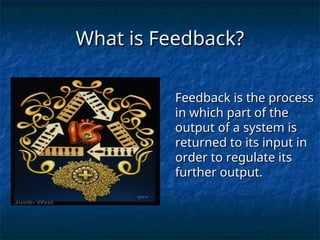
Feedback is the process
in which part of the
output of a system is
returned to its input in
order to regulate its
further output.
further output.
Negative Feedback
Negative Feedback
 Negative
Negative feedback occurs when the
feedback occurs when the
output of a system acts to
output of a system acts to oppose
oppose
changes to the input of the system.
 A thermostat is an example of a
A thermostat is an example of a
negative feedback system.
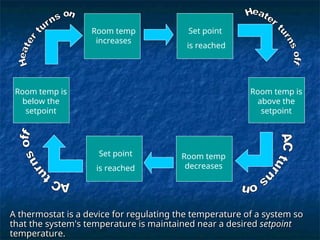
A thermostat is a device for regulating the temperature of a system so
that the system's temperature is maintained near a desired
that the system's temperature is maintained near a desired setpoint
setpoint
temperature.
temperature.
Room temp is
below the
setpoint
Room temp is
above the
setpoint
Room temp
increases
Room temp
decreases
Set point
is reached
Set point
is reached
Negative Feedback in Biology
 Negative feedback also
Negative feedback also
regulates many systems in
organisms.
organisms.
 The endocrine system is
The endocrine system is
one example.
one example.
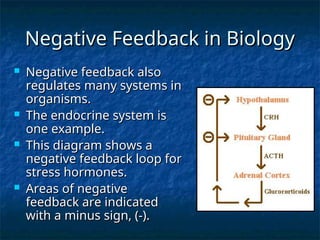
 This diagram shows a
This diagram shows a
negative feedback loop for
stress hormones.
stress hormones.
 Areas of negative
Areas of negative
feedback are indicated
with a minus sign, (-).
Endocrine System
Endocrine System
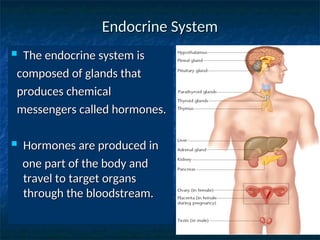
 The endocrine system is
The endocrine system is
composed of glands that
produces chemical
produces chemical
messengers called hormones.
 Hormones are produced in
Hormones are produced in
one part of the body and
travel to target organs
through the bloodstream.
Endocrine system
Endocrine system
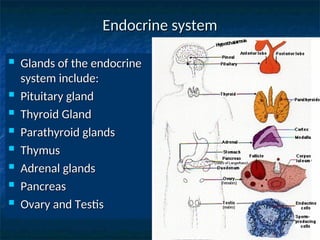
 Glands of the endocrine
Glands of the endocrine
system include:
system include:
 Pituitary gland
Pituitary gland
 Thyroid Gland
Thyroid Gland
 Parathyroid glands
Parathyroid glands
 Thymus
Thymus
 Adrenal glands
Adrenal glands
 Pancreas
Pancreas
 Ovary and Testis
Ovary and Testis
Endocrine System
Endocrine System
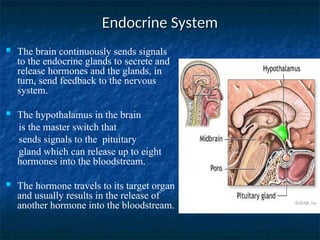
 The brain continuously sends signals
to the endocrine glands to secrete and
release hormones and the glands, in
turn, send feedback to the nervous
system.
 The hypothalamus in the brain
is the master switch that
sends signals to the pituitary
gland which can release up to eight
hormones into the bloodstream.
 The hormone travels to its target organ
and usually results in the release of
another hormone into the bloodstream.
Endocrine System
Endocrine System
 The hypothalamus then detects the rising hormone
The hypothalamus then detects the rising hormone
levels from the target organ and decreases the
release of hormones from the pituitary which results
in a decrease in hormone release from the target
organ.
organ.
 The process of maintaining normal body function
The process of maintaining normal body function
through negative feedback mechanisms is called
homeostasis
homeostasis.
.
Glucose and Insulin
Glucose and Insulin
 Glucose intake occurs during
Glucose intake occurs during
digestion of food that is needed
for energy expenditure to perform
routine physical activities.
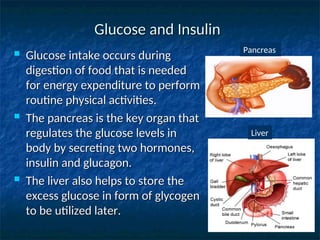
 The pancreas is the key organ that
The pancreas is the key organ that
regulates the glucose levels in
body by secreting two hormones,
insulin and glucagon.
 The liver also helps to store the
The liver also helps to store the
excess glucose in form of glycogen
to be utilized later.
Pancreas
Liver
Glucose and Insulin Negative Feedback
Loop
Loop
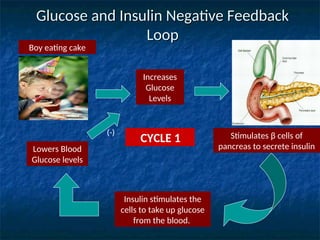
Increases
Glucose
Levels
Boy eating cake
Stimulates β cells of
pancreas to secrete insulin
Insulin stimulates the
cells to take up glucose
from the blood.
Lowers Blood
Glucose levels
CYCLE 1
(-)
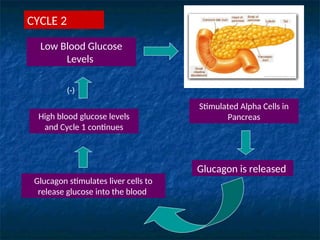
Low Blood Glucose
Levels
Stimulated Alpha Cells in
Pancreas
Glucagon is released
Glucagon stimulates liver cells to
release glucose into the blood
High blood glucose levels
and Cycle 1 continues
CYCLE 2
(-)
Glucose and Insulin Negative Feedback
Loop
Loop
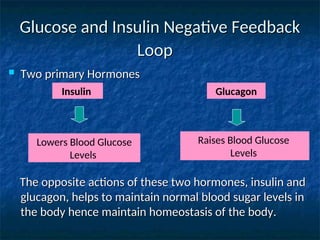
 Two primary Hormones
Two primary Hormones
The opposite actions of these two hormones, insulin and
glucagon, helps to maintain normal blood sugar levels in
the body hence maintain homeostasis of the body.
Insulin Glucagon
Lowers Blood Glucose
Levels
Raises Blood Glucose
Levels
Take a Break and Chat With Your
Neighbor!
Neighbor!
 Turn to the person behind or in front of you
Turn to the person behind or in front of you
and discuss the following topics:
 What is a
What is a feedback
feedback and an example of a
and an example of a
negative AND positive system?
 What is the
What is the endocrine system
endocrine system and why is it
and why is it
important?
important?
 Define
Define homeostasis
homeostasis and how normal body
and how normal body
function is maintained with feedback
mechanisms.
mechanisms.
Kidneys and Water Regulation
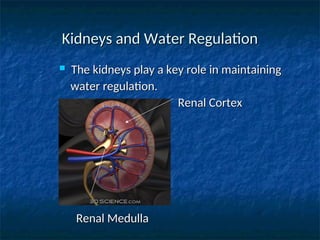
 The kidneys play a key role in maintaining
The kidneys play a key role in maintaining
water regulation.
water regulation.
Renal Cortex
Renal Cortex
Renal Medulla
Renal Medulla
Kidney and Water Regulation
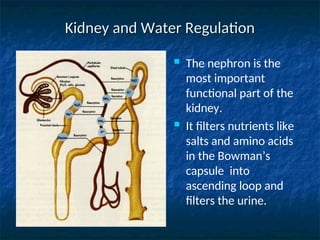
 The nephron is the
most important
functional part of the
kidney.
 It filters nutrients like
salts and amino acids
in the Bowman’s
capsule into
ascending loop and
filters the urine.
Kidney and Water Regulation
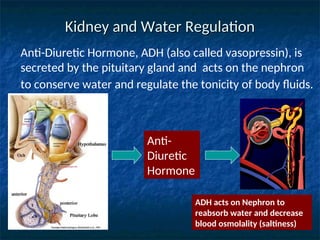
Anti-Diuretic Hormone, ADH (also called vasopressin), is
secreted by the pituitary gland and acts on the nephron
to conserve water and regulate the tonicity of body fluids.
Anti-
Diuretic
Hormone
ADH acts on Nephron to
reabsorb water and decrease
blood osmolality (saltiness)
ADH regulated water conservation in
kidneys
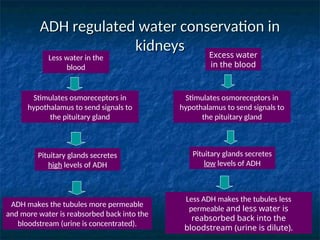
kidneys Excess water
in the blood
Stimulates osmoreceptors in
hypothalamus to send signals to
the pituitary gland
Pituitary glands secretes
low levels of ADH
Less ADH makes the tubules less
permeable and less water is
reabsorbed back into the
bloodstream (urine is dilute).
Less water in the
blood
ADH makes the tubules more permeable
and more water is reabsorbed back into the
bloodstream (urine is concentrated).
Stimulates osmoreceptors in
hypothalamus to send signals to
the pituitary gland
Pituitary glands secretes
high levels of ADH
ADH regulated water conservation in
kidneys
kidneys
 Osmoregulators send negative feedback to the
hypothalamus about the concentration of water in the
bloodstream.
 The hypothalamus then stimulates the pituitary
glands to secrete high or low concentrations of anti-
diuretic hormone.
 ADH then makes the tubules more or less permeable
and hence, maintains water and electrolyte
homeostasis.
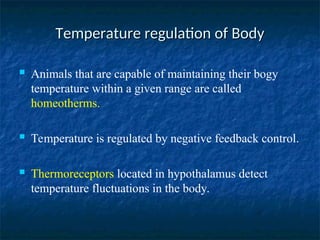
Temperature regulation of Body
 Animals that are capable of maintaining their bogy
temperature within a given range are called
homeotherms.
 Temperature is regulated by negative feedback control.
 Thermoreceptors located in hypothalamus detect
temperature fluctuations in the body.
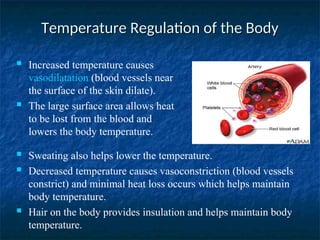
Temperature Regulation of the Body
 Increased temperature causes
vasodilatation (blood vessels near
the surface of the skin dilate).
 The large surface area allows heat
to be lost from the blood and
lowers the body temperature.
 Sweating also helps lower the temperature.
 Decreased temperature causes vasoconstriction (blood vessels
constrict) and minimal heat loss occurs which helps maintain
body temperature.
 Hair on the body provides insulation and helps maintain body
temperature.
Positive Feedback
Positive Feedback
 A positive feedback loop occurs when the output of a
system acts to enhance the changes to the input of the
system.
 One example of a biological positive feedback loop is
the onset of contractions in childbirth.
 When a contraction occurs, the hormone oxytocin is
released into the body, which stimulates further
contractions.
 This results in contractions increasing in amplitude
and frequency.
Positive Feedback
Positive Feedback
 Another example is blood clotting.
 The loop is initiated when injured tissue releases
signal chemicals that activate platelets in the
blood.
 An activated platelet releases chemicals to activate
more platelets, causing a rapid cascade and the
formation of a blood clot.
 Lactation involves positive feedback so that the more
the baby suckles, the more milk is produced.
Positive Feedback
Positive Feedback
 In most cases, once the purpose of the feedback loop is
completed, counter-signals are released that suppress or
break the loop.
 Childbirth contractions stop when the baby is out of
the mother's body.
 Chemicals break down the blood clot.
 Lactation stops when the baby no longer nurses.
Take a Break and Chat With Your
Neighbor!
Neighbor!
 Turn to the person behind or in front of you
Turn to the person behind or in front of you
and discuss the following topics:
 What are the roles of the
What are the roles of the kidneys
kidneys in the body?
in the body?
 How do the
How do the kidneys
kidneys compare or contrast to
compare or contrast to
the
the feedback
feedback systems in the
systems in the endocrine
endocrine system?
system?
 How does the body
How does the body regulate temperature
regulate temperature?
?
 Define and give examples of a
Define and give examples of a positive
positive
feedback
feedback system in the body.
system in the body.

DLC911_Feedback mechanism science topic.ppt

  • 2.
    What is Feedback? Whatis Feedback? Feedback is the process Feedback is the process in which part of the in which part of the output of a system is output of a system is returned to its input in returned to its input in order to regulate its order to regulate its further output. further output.
  • 3.
    Negative Feedback Negative Feedback Negative Negative feedback occurs when the feedback occurs when the output of a system acts to output of a system acts to oppose oppose changes to the input of the system. changes to the input of the system.  A thermostat is an example of a A thermostat is an example of a negative feedback system. negative feedback system.
  • 4.
    A thermostat isa device for regulating the temperature of a system so A thermostat is a device for regulating the temperature of a system so that the system's temperature is maintained near a desired that the system's temperature is maintained near a desired setpoint setpoint temperature. temperature. Room temp is below the setpoint Room temp is above the setpoint Room temp increases Room temp decreases Set point is reached Set point is reached
  • 5.
    Negative Feedback inBiology Negative Feedback in Biology  Negative feedback also Negative feedback also regulates many systems in regulates many systems in organisms. organisms.  The endocrine system is The endocrine system is one example. one example.  This diagram shows a This diagram shows a negative feedback loop for negative feedback loop for stress hormones. stress hormones.  Areas of negative Areas of negative feedback are indicated feedback are indicated with a minus sign, (-). with a minus sign, (-).
  • 6.
    Endocrine System Endocrine System The endocrine system is The endocrine system is composed of glands that composed of glands that produces chemical produces chemical messengers called hormones. messengers called hormones.  Hormones are produced in Hormones are produced in one part of the body and one part of the body and travel to target organs travel to target organs through the bloodstream. through the bloodstream.
  • 7.
    Endocrine system Endocrine system Glands of the endocrine Glands of the endocrine system include: system include:  Pituitary gland Pituitary gland  Thyroid Gland Thyroid Gland  Parathyroid glands Parathyroid glands  Thymus Thymus  Adrenal glands Adrenal glands  Pancreas Pancreas  Ovary and Testis Ovary and Testis
  • 8.
    Endocrine System Endocrine System The brain continuously sends signals to the endocrine glands to secrete and release hormones and the glands, in turn, send feedback to the nervous system.  The hypothalamus in the brain is the master switch that sends signals to the pituitary gland which can release up to eight hormones into the bloodstream.  The hormone travels to its target organ and usually results in the release of another hormone into the bloodstream.
  • 9.
    Endocrine System Endocrine System The hypothalamus then detects the rising hormone The hypothalamus then detects the rising hormone levels from the target organ and decreases the levels from the target organ and decreases the release of hormones from the pituitary which results release of hormones from the pituitary which results in a decrease in hormone release from the target in a decrease in hormone release from the target organ. organ.  The process of maintaining normal body function The process of maintaining normal body function through negative feedback mechanisms is called through negative feedback mechanisms is called homeostasis homeostasis. .
  • 10.
    Glucose and Insulin Glucoseand Insulin  Glucose intake occurs during Glucose intake occurs during digestion of food that is needed digestion of food that is needed for energy expenditure to perform for energy expenditure to perform routine physical activities. routine physical activities.  The pancreas is the key organ that The pancreas is the key organ that regulates the glucose levels in regulates the glucose levels in body by secreting two hormones, body by secreting two hormones, insulin and glucagon. insulin and glucagon.  The liver also helps to store the The liver also helps to store the excess glucose in form of glycogen excess glucose in form of glycogen to be utilized later. to be utilized later. Pancreas Liver
  • 11.
    Glucose and InsulinNegative Feedback Glucose and Insulin Negative Feedback Loop Loop Increases Glucose Levels Boy eating cake Stimulates β cells of pancreas to secrete insulin Insulin stimulates the cells to take up glucose from the blood. Lowers Blood Glucose levels CYCLE 1 (-)
  • 12.
    Low Blood Glucose Levels StimulatedAlpha Cells in Pancreas Glucagon is released Glucagon stimulates liver cells to release glucose into the blood High blood glucose levels and Cycle 1 continues CYCLE 2 (-)
  • 13.
    Glucose and InsulinNegative Feedback Glucose and Insulin Negative Feedback Loop Loop  Two primary Hormones Two primary Hormones The opposite actions of these two hormones, insulin and The opposite actions of these two hormones, insulin and glucagon, helps to maintain normal blood sugar levels in glucagon, helps to maintain normal blood sugar levels in the body hence maintain homeostasis of the body. the body hence maintain homeostasis of the body. Insulin Glucagon Lowers Blood Glucose Levels Raises Blood Glucose Levels
  • 14.
    Take a Breakand Chat With Your Take a Break and Chat With Your Neighbor! Neighbor!  Turn to the person behind or in front of you Turn to the person behind or in front of you and discuss the following topics: and discuss the following topics:  What is a What is a feedback feedback and an example of a and an example of a negative AND positive system? negative AND positive system?  What is the What is the endocrine system endocrine system and why is it and why is it important? important?  Define Define homeostasis homeostasis and how normal body and how normal body function is maintained with feedback function is maintained with feedback mechanisms. mechanisms.
  • 15.
    Kidneys and WaterRegulation Kidneys and Water Regulation  The kidneys play a key role in maintaining The kidneys play a key role in maintaining water regulation. water regulation. Renal Cortex Renal Cortex Renal Medulla Renal Medulla
  • 16.
    Kidney and WaterRegulation Kidney and Water Regulation  The nephron is the most important functional part of the kidney.  It filters nutrients like salts and amino acids in the Bowman’s capsule into ascending loop and filters the urine.
  • 17.
    Kidney and WaterRegulation Kidney and Water Regulation Anti-Diuretic Hormone, ADH (also called vasopressin), is secreted by the pituitary gland and acts on the nephron to conserve water and regulate the tonicity of body fluids. Anti- Diuretic Hormone ADH acts on Nephron to reabsorb water and decrease blood osmolality (saltiness)
  • 18.
    ADH regulated waterconservation in ADH regulated water conservation in kidneys kidneys Excess water in the blood Stimulates osmoreceptors in hypothalamus to send signals to the pituitary gland Pituitary glands secretes low levels of ADH Less ADH makes the tubules less permeable and less water is reabsorbed back into the bloodstream (urine is dilute). Less water in the blood ADH makes the tubules more permeable and more water is reabsorbed back into the bloodstream (urine is concentrated). Stimulates osmoreceptors in hypothalamus to send signals to the pituitary gland Pituitary glands secretes high levels of ADH
  • 19.
    ADH regulated waterconservation in ADH regulated water conservation in kidneys kidneys  Osmoregulators send negative feedback to the hypothalamus about the concentration of water in the bloodstream.  The hypothalamus then stimulates the pituitary glands to secrete high or low concentrations of anti- diuretic hormone.  ADH then makes the tubules more or less permeable and hence, maintains water and electrolyte homeostasis.
  • 20.
    Temperature regulation ofBody Temperature regulation of Body  Animals that are capable of maintaining their bogy temperature within a given range are called homeotherms.  Temperature is regulated by negative feedback control.  Thermoreceptors located in hypothalamus detect temperature fluctuations in the body.
  • 21.
    Temperature Regulation ofthe Body Temperature Regulation of the Body  Increased temperature causes vasodilatation (blood vessels near the surface of the skin dilate).  The large surface area allows heat to be lost from the blood and lowers the body temperature.  Sweating also helps lower the temperature.  Decreased temperature causes vasoconstriction (blood vessels constrict) and minimal heat loss occurs which helps maintain body temperature.  Hair on the body provides insulation and helps maintain body temperature.
  • 22.
    Positive Feedback Positive Feedback A positive feedback loop occurs when the output of a system acts to enhance the changes to the input of the system.  One example of a biological positive feedback loop is the onset of contractions in childbirth.  When a contraction occurs, the hormone oxytocin is released into the body, which stimulates further contractions.  This results in contractions increasing in amplitude and frequency.
  • 23.
    Positive Feedback Positive Feedback Another example is blood clotting.  The loop is initiated when injured tissue releases signal chemicals that activate platelets in the blood.  An activated platelet releases chemicals to activate more platelets, causing a rapid cascade and the formation of a blood clot.  Lactation involves positive feedback so that the more the baby suckles, the more milk is produced.
  • 24.
    Positive Feedback Positive Feedback In most cases, once the purpose of the feedback loop is completed, counter-signals are released that suppress or break the loop.  Childbirth contractions stop when the baby is out of the mother's body.  Chemicals break down the blood clot.  Lactation stops when the baby no longer nurses.
  • 25.
    Take a Breakand Chat With Your Take a Break and Chat With Your Neighbor! Neighbor!  Turn to the person behind or in front of you Turn to the person behind or in front of you and discuss the following topics: and discuss the following topics:  What are the roles of the What are the roles of the kidneys kidneys in the body? in the body?  How do the How do the kidneys kidneys compare or contrast to compare or contrast to the the feedback feedback systems in the systems in the endocrine endocrine system? system?  How does the body How does the body regulate temperature regulate temperature? ?  Define and give examples of a Define and give examples of a positive positive feedback feedback system in the body. system in the body.

Editor's Notes

  • #3 http://en.wikipedia.org/wiki/Negative_feedback
  • #5 Corticotropin-releasing hormone (CRH) is a peptide hormone involved in stress responses. It is a releasing hormone that belongs to corticotropin-releasing factor family. Adrenocorticotropic hormone in turn travels in the bloodstream to the adrenal glands, where it causes the secretion of the stress hormone cortisol. Glucocorticoids keep your body from pumping out so many of the chemicals involved in inflammation. They can also dial back your immune system's
  • #22 http://en.wikipedia.org/wiki/Positive_feedback_loop#In_biology
  • #23 http://en.wikipedia.org/wiki/Positive_feedback_loop#In_biology
  • #24 http://en.wikipedia.org/wiki/Positive_feedback_loop#In_biology