Animal Structure By: R. Mochammad Ridwan XI SCIENCE 3
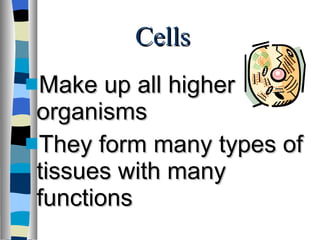
Cells Make up all higher organisms They form many types of tissues with many functions
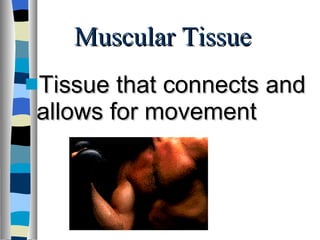
Muscular Tissue Tissue that connects and allows for movement
Muscle Types Voluntary: animal can control these Involuntary: not under control
Heart Is a major involuntary muscle that pumps blood through the circulatory system
Connective Tissue Holds other tissues Tendons and ligaments
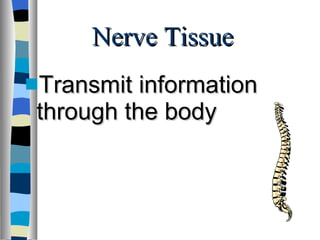
Nerve Tissue Transmit information through the body
Epithelial Tissue Covering for most internal and external surfaces of the body and organs
Fluid Tissue Ex. Blood
Organs Are groups of tissues that perform complex functions in the body Any organ contains 2 or more tissues
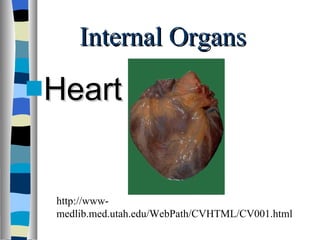
Internal Organs Heart http://www-medlib.med.utah.edu/WebPath/CVHTML/CV001.html
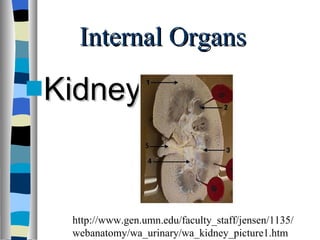
Internal Organs Kidneys http://www.gen.umn.edu/faculty_staff/jensen/1135/webanatomy/wa_urinary/wa_kidney_picture1.htm
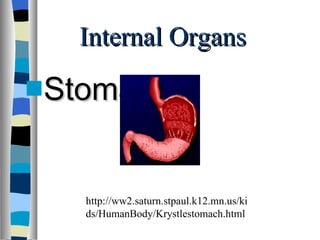
Internal Organs Stomach http://ww2.saturn.stpaul.k12.mn.us/kids/HumanBody/Krystlestomach.html
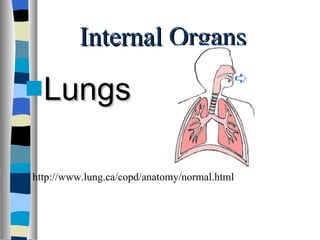
Internal Organs Lungs  http://www.lung.ca/copd/anatomy/normal.html                                    
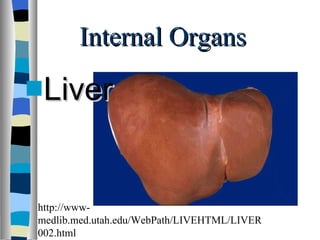
Internal Organs Liver http://www-medlib.med.utah.edu/WebPath/LIVEHTML/LIVER002.html
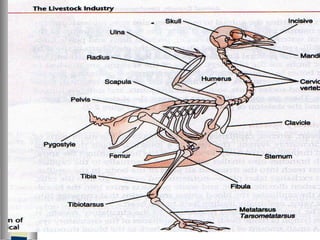
Skeletal System Provides form, protection, support, and strength With the aid of muscles it allows movement The bones store minerals
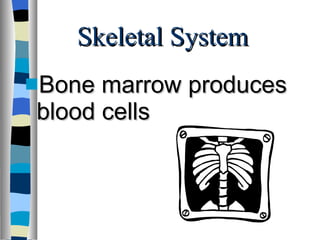
Skeletal System Bone marrow produces blood cells
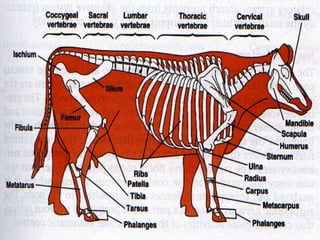
3 componets Axial skeleton  Pectoral limb Pelvic limb
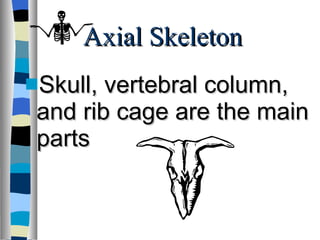
Axial Skeleton Skull, vertebral column, and rib cage are the main parts
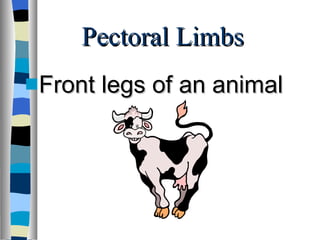
Pectoral Limbs Front legs of an animal
Pelvic Limbs Hind Legs
Joints Connect different Bones Ball and socket Sliding Hinge
 
 
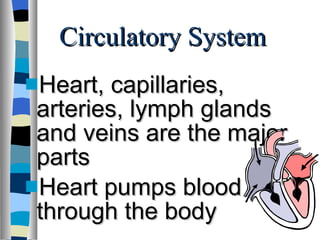
Circulatory System Heart, capillaries, arteries, lymph glands and veins are the major parts Heart pumps blood through the body
Circulatory System Blood leaves the heart through the aorta Then to smaller arteries Finally to very small capillaries which feed the body
Circulatory System Nutrients and Oxygen to cells Carbon Dioxide, water and waste are taken away
Circulatory System From the capillaries it goes to small veins then larger veins and finally to the heart
Lymph System Works with the circulatory system to get nutrients to the body from the small intestines
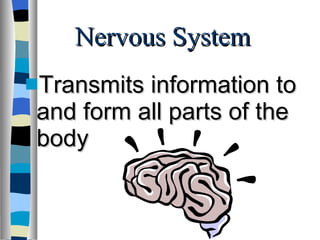
Nervous System Transmits information to and form all parts of the body
Nervous System 2 parts: Central ( brain and spine) Peripheral (nerves that connect the body to the central)
Nervous System Autonomic Nervous system controls automatic body activities  Uses the 5 senses
Endocrine System Hormones are organic catalyst that influence growth, development of the body, reproduction Endocrine glands
Endocrine System Blood transports hormones Pancreas, pituitary gland, ovaries, testicles, adrenal glands, etc
Urinary System Kidneys, ureters, bladder, urethra Blood passes through the kidneys and waste and some water is filtered out
Urinary System Then the waste moves through the ureters to the bladder where it is stored Then through the urethra as urine and out the body
Urinary System Poultry have no urethra or bladder Goes out cloaca with the feces
Respiratory System Muscles pull air in and out Air goes in the nose or mouth to the pharynx, then to the trachea to the lungs
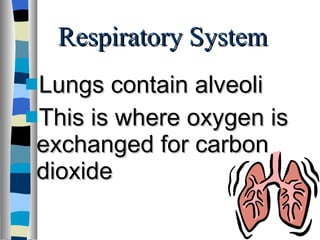
Respiratory System Lungs contain alveoli  This is where oxygen is exchanged for carbon dioxide
Respiratory System Also helps regulate temp. Makes sound using the larynx
Muscular System  Works with the skeletal system to support, form and move the body
Muscular System 3 kinds of muscle Striated  Smooth Cardiac
Growth in Livestock Divided into 3 phases Zygote: fertilized egg Embryo Fetal
Zygote While it moves to the uterus Attaches to uterine wall Cell division takes place
Embryo  This is when placenta forms Tissues begin to differentiate Controlled by DNA
Fetus End of embryo phase-birth Organs develop and size increases
Fetus Kidneys, heart, central nervous system and liver develop 1 st Skeleton and muscles develop later
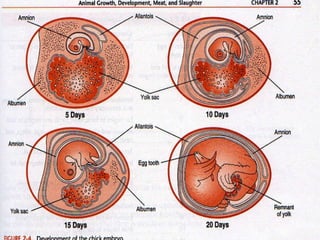
Poultry Embryo After laid it is kept between 70-80 o . Stops cell division 1 st  48 hours get blood flowing from embryo and yolk
 
Structure of Meat
Meat Consist of muscle, fat, bone and connective tissue Most is striated skeletal muscle
Meat  Smooth muscle composes internal organs Combinations of muscle are called visceral muscles
Meat The more connective tissue in the meat the less tender it is 70% water 20% protein
Color of meat Caused by the amount of myoglobin Age, storing, packing, time exposed to air all effect color

Animal structure