1 / 25
School of Mechanical, Chemical and Materials
Engineering
Department of Chemical Engineering
Introduction to Chemical Engineering
Thermodynamics
Course Code ChE3201
Department of Chemical Engineering
Adama Science and Technology
University
2 / 25
PREPARED BY
YOHANNES ENDALE…..…..UGR/19971/12
YEROKET KUMA……….…...UGR/20666/12
OLIYAD WAKE ……………...UGR/19635/12
WUDNEW CHALIE……...….UGR/17766/11
TADELE FEKADU…………...UGR/17681/11
SUBMITTED TO : Instructor Kefyalew H.
3 / 25
Definition of Refrigerants

What is Refrigerant ?

Refrigerant is a working substance in a
Refrigeration systems.

Fluids suitable for refrigeration purposes can
classified as :

Primary

secondary
4 / 25
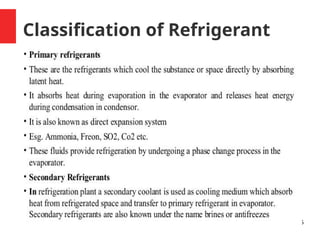
Classification of Refrigerant
5 / 25
The choice of Refrigerant
• Selection of refrigerant for a particular application is
based on the following requirements:
– Thermodynamic and thermo-physical properties
– Environmental and safety properties
– Economics
6 / 25
Thermodynamic and Thermo-physical properties
The requirements are:
a) Suction pressure:
At a given evaporator temperature, the saturation pressure should be
above atmospheric for prevention of air or moisture ingress into the
system and ease of leak detection.
Higher suction pressure is better as it leads to smaller compressor
displacement.
b) Discharge pressure:
At a given condenser temperature, the discharge pressure should be as
small as possible to allow light-weight construction of compressor,
condenser etc.
c) Pressure ratio:
Should be as small as possible for high volumetric efficiency and low
power consumption.
d) Latent heat of vaporization:
Should be as large as possible so that the required mass flow rate
per unit cooling capacity will be small.
In addition to the above properties; the following properties are
also important:
e) Isentropic index of compression:
Should be as small as possible so that the temperature rise during
compression will be small.
f) Liquid specific heat:
7 / 25
h) Thermal conductivity:
Thermal conductivity in both liquid as well as vapour phase should be high
for higher heat transfer coefficients .
i) Viscosity:
Viscosity should be small in both liquid and vapour phases for smaller
frictional pressure drops.

The thermodynamic properties are interrelated and
mainly depend on normal boiling point, critical
temperature, molecular weight and structure.
...Continued
8 / 25
Environmental and safety properties.

At present the environment friendliness of the refrigerant is a
major factor in deciding the usefulness of a particular
refrigerant.

The important environmental and safety properties are:

a) Ozone Depletion Potential (ODP):
According to the Montreal protocol, the ODP of refrigerants should be zero,
i.e., they should be non-ozone depleting substances.
Refrigerants having non-zero ODP have either already been phased-out
(e.g. R 11, R 12) or will be phased-out in near-future(e.g. R22).
Since ODP depends mainly on the presence of chlorine or bromine in the
molecules, refrigerants having either chlorine (i.e., CFCs and HCFCs) or
bromine cannot be used under the new regulations.
Note: CFC stands for chlorofluorocarbon
And HCFC for hydrochlorofluorocarbon
9 / 25
b) Global Warming Potential (GWP):
Refrigerants should have as low a GWP value as possible to minimize the
problem of global warming.
Refrigerants with zero ODP but a high value of GWP (e.g. R134a) are
likely to be regulated in future.
c) Total Equivalent Warming Index (TEWI):
The factor TEWI considers both direct (due to release into atmosphere) and
indirect (through energy consumption) contributions of refrigerants to global
warming.
Naturally, refrigerants with as a low a value of TEWI are preferable from
global warming point of view.
...Continued
10 / 25
d) Toxicity:
Ideally, refrigerants should be non-toxic.
Toxicity is a relative term, which becomes meaningful only when the
degree of concentration and time of exposure required to produce harmful
effects are specified.
In general the degree of hazard depends on:
- Amount of refrigerant used vs total space
- Type of occupancy
- Presence of open flames
- Odor of refrigerant, and
 - Maintenance condition
...Continued
11 / 25
...Continued
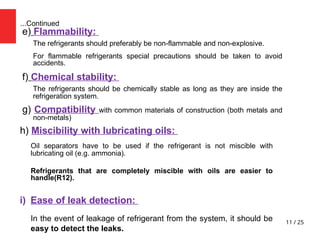
e) Flammability:
The refrigerants should preferably be non-flammable and non-explosive.
For flammable refrigerants special precautions should be taken to avoid
accidents.
f) Chemical stability:
The refrigerants should be chemically stable as long as they are inside the
refrigeration system.
g) Compatibility with common materials of construction (both metals and
non-metals)
h) Miscibility with lubricating oils:
Oil separators have to be used if the refrigerant is not miscible with
lubricating oil (e.g. ammonia).
Refrigerants that are completely miscible with oils are easier to
handle(R12).
i) Ease of leak detection:
In the event of leakage of refrigerant from the system, it should be
easy to detect the leaks.
12 / 25
Economic Properties

The refrigerant used should preferably be inexpensive
and easily available.
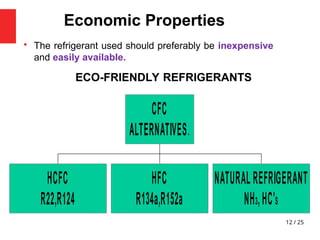
HCFC
R22,R124
HFC
R134a,R152a
NATURAL REFRIGERANT
NH3,HC'S
CFC
ALTERNATIVES.
ECO-FRIENDLY REFRIGERANTS
13 / 25
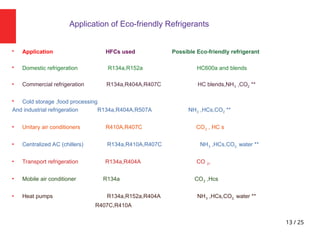
Application of Eco-friendly Refrigerants

Application HFCs used Possible Eco-friendly refrigerant

Domestic refrigeration R134a,R152a HC600a and blends
 Commercial refrigeration R134a,R404A,R407C HC blends,NH3 ,CO2 **

Cold storage ,food processing
And industrial refrigeration R134a,R404A,R507A NH3 ,HCs,CO2 **
 Unitary air conditioners R410A,R407C CO2 , HC s
 Centralized AC (chillers) R134a,R410A,R407C NH3 ,HCs,CO2, water **
 Transport refrigeration R134a,R404A CO 2,
 Mobile air conditioner R134a CO2 ,Hcs
 Heat pumps R134a,R152a,R404A NH3 ,HCs,CO2, water **
R407C,R410A
14 / 25
R123

ODP-0.02,GWP-90

As a replacement for R11 as similar thermodynamic
properties.

Very short atmospheric life

Retrofit alternative to R11
Freon™ 123 refrigerant is a hydrochlorofluorocarbon (HCFC)
15 / 25
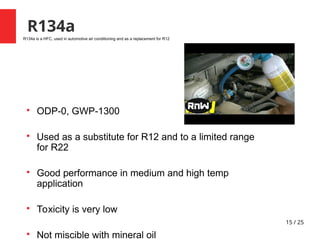
R134a

ODP-0, GWP-1300

Used as a substitute for R12 and to a limited range
for R22

Good performance in medium and high temp
application

Toxicity is very low

Not miscible with mineral oil
R134a is a HFC, used in automotive air conditioning and as a replacement for R12
16 / 25
R152a

ODP-0,GWP-140

R152a is another attractive HFC with similar
properties to R12.

GWP is one order less than HFC134a but it is
slightly flammable.

Also it has lower energy consumption. Hence the
Environmental Protection Agency of Europe prefers
HFC152a to HFC134a
Difluoroethane or R152a is an environmentally friendly, low greenhouse refrigerant, a substitute for R134a in industrial
refrigeration
17 / 25
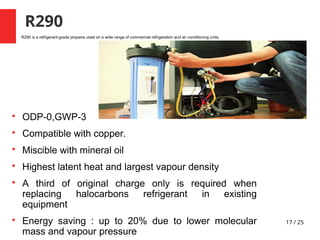
R290

ODP-0,GWP-3

Compatible with copper.

Miscible with mineral oil

Highest latent heat and largest vapour density

A third of original charge only is required when
replacing halocarbons refrigerant in existing
equipment

Energy saving : up to 20% due to lower molecular
mass and vapour pressure
R290 is a refrigerant-grade propane used on a wide range of commercial refrigeration and air conditioning units.
18 / 25
Carbon Dioxide

Zero ODP & GWP

Non Flammable, Non toxic

Inexpensive and widely available

Its high operating pressure provides potential for system size
and weight reducing potential.
Drawbacks:

Operating pressure (high side) : 80 bars

Low efficiency
Carbon dioxide (chemical formula CO 2) is an acidic colorless gas with a density about 53% higher than that of dry air
19 / 25
Ammonia as Refrigerant
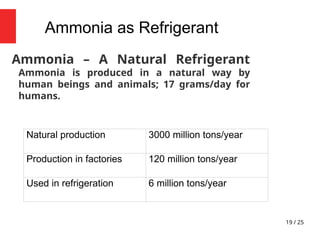
Ammonia – A Natural Refrigerant
Ammonia is produced in a natural way by
human beings and animals; 17 grams/day for
humans.
Natural production 3000 million tons/year
Production in factories 120 million tons/year
Used in refrigeration 6 million tons/year
20 / 25

ODP = 0 and GWP = 0

Excellent thermodynamic characteristics: small molecular
mass, large latent heat, large vapour density and excellent
heat transfer characteristics

High critical temperature (132C) : highly efficient cycles at
high condensing temperatures

Its smell causes leaks to be detected and fixed before
reaching dangerous concentration

Relatively Low price
Ammonia as Refrigerant
21 / 25

Toxic

Flammable ( 16 – 28% concentration )

Not compatible with copper

Temperature on discharge side of compressor is higher
compared to other refrigerants
Some drawbacks of Ammonia
22 / 25
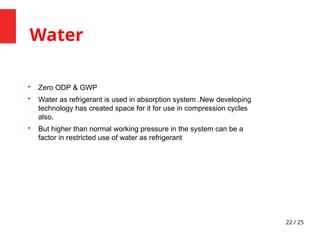
Water

Zero ODP & GWP

Water as refrigerant is used in absorption system .New developing
technology has created space for it for use in compression cycles
also.

But higher than normal working pressure in the system can be a
factor in restricted use of water as refrigerant
23 / 25
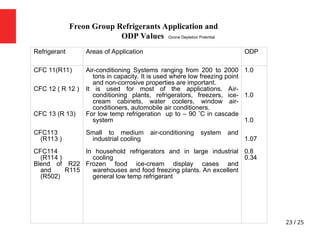
Freon Group Refrigerants Application and
ODP Values
Refrigerant Areas of Application ODP
CFC 11(R11)
CFC 12 ( R 12 )
CFC 13 (R 13)
CFC113
(R113 )
CFC114
(R114 )
Blend of R22
and R115
(R502)
Air-conditioning Systems ranging from 200 to 2000
tons in capacity. It is used where low freezing point
and non-corrosive properties are important.
It is used for most of the applications. Air-
conditioning plants, refrigerators, freezers, ice-
cream cabinets, water coolers, window air-
conditioners, automobile air conditioners.
For low temp refrigeration up to – 90 C in cascade
system
Small to medium air-conditioning system and
industrial cooling
In household refrigerators and in large industrial
cooling
Frozen food ice-cream display cases and
warehouses and food freezing plants. An excellent
general low temp refrigerant
1.0
1.0
1.0
1.07
0.8
0.34
Ozone Depletion Potential
24 / 25
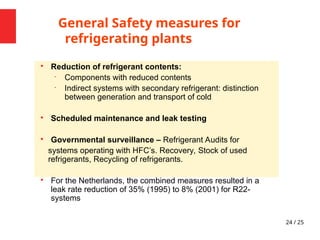
General Safety measures for
refrigerating plants

Reduction of refrigerant contents:
 Components with reduced contents
 Indirect systems with secondary refrigerant: distinction
between generation and transport of cold

Scheduled maintenance and leak testing

Governmental surveillance – Refrigerant Audits for
systems operating with HFC’s. Recovery, Stock of used
refrigerants, Recycling of refrigerants.

For the Netherlands, the combined measures resulted in a
leak rate reduction of 35% (1995) to 8% (2001) for R22-
systems
25 / 25
REFERENCES BOOKS

Thermodynamics An Engineering Approach by YUNUS
A.CENGEL ,MICHAEL A.BOLES

Fundamentals OF Thermodynamics by BORGNAKKE
SONNTAG

Introduction to chemical engineering thermodynamic by
Joe Mauk Smith
WEBSITES

https://www.engineeringtoolbox.com

https://www.sciencedirect.com

https://en.wikipedia.org

thermodynamic fINAL my presentation .ppt

  • 1.
    1 / 25 Schoolof Mechanical, Chemical and Materials Engineering Department of Chemical Engineering Introduction to Chemical Engineering Thermodynamics Course Code ChE3201 Department of Chemical Engineering Adama Science and Technology University
  • 2.
    2 / 25 PREPAREDBY YOHANNES ENDALE…..…..UGR/19971/12 YEROKET KUMA……….…...UGR/20666/12 OLIYAD WAKE ……………...UGR/19635/12 WUDNEW CHALIE……...….UGR/17766/11 TADELE FEKADU…………...UGR/17681/11 SUBMITTED TO : Instructor Kefyalew H.
  • 3.
    3 / 25 Definitionof Refrigerants  What is Refrigerant ?  Refrigerant is a working substance in a Refrigeration systems.  Fluids suitable for refrigeration purposes can classified as :  Primary  secondary
  • 4.
    4 / 25 Classificationof Refrigerant
  • 5.
    5 / 25 Thechoice of Refrigerant • Selection of refrigerant for a particular application is based on the following requirements: – Thermodynamic and thermo-physical properties – Environmental and safety properties – Economics
  • 6.
    6 / 25 Thermodynamicand Thermo-physical properties The requirements are: a) Suction pressure: At a given evaporator temperature, the saturation pressure should be above atmospheric for prevention of air or moisture ingress into the system and ease of leak detection. Higher suction pressure is better as it leads to smaller compressor displacement. b) Discharge pressure: At a given condenser temperature, the discharge pressure should be as small as possible to allow light-weight construction of compressor, condenser etc. c) Pressure ratio: Should be as small as possible for high volumetric efficiency and low power consumption. d) Latent heat of vaporization: Should be as large as possible so that the required mass flow rate per unit cooling capacity will be small. In addition to the above properties; the following properties are also important: e) Isentropic index of compression: Should be as small as possible so that the temperature rise during compression will be small. f) Liquid specific heat:
  • 7.
    7 / 25 h)Thermal conductivity: Thermal conductivity in both liquid as well as vapour phase should be high for higher heat transfer coefficients . i) Viscosity: Viscosity should be small in both liquid and vapour phases for smaller frictional pressure drops.  The thermodynamic properties are interrelated and mainly depend on normal boiling point, critical temperature, molecular weight and structure. ...Continued
  • 8.
    8 / 25 Environmentaland safety properties.  At present the environment friendliness of the refrigerant is a major factor in deciding the usefulness of a particular refrigerant.  The important environmental and safety properties are:  a) Ozone Depletion Potential (ODP): According to the Montreal protocol, the ODP of refrigerants should be zero, i.e., they should be non-ozone depleting substances. Refrigerants having non-zero ODP have either already been phased-out (e.g. R 11, R 12) or will be phased-out in near-future(e.g. R22). Since ODP depends mainly on the presence of chlorine or bromine in the molecules, refrigerants having either chlorine (i.e., CFCs and HCFCs) or bromine cannot be used under the new regulations. Note: CFC stands for chlorofluorocarbon And HCFC for hydrochlorofluorocarbon
  • 9.
    9 / 25 b)Global Warming Potential (GWP): Refrigerants should have as low a GWP value as possible to minimize the problem of global warming. Refrigerants with zero ODP but a high value of GWP (e.g. R134a) are likely to be regulated in future. c) Total Equivalent Warming Index (TEWI): The factor TEWI considers both direct (due to release into atmosphere) and indirect (through energy consumption) contributions of refrigerants to global warming. Naturally, refrigerants with as a low a value of TEWI are preferable from global warming point of view. ...Continued
  • 10.
    10 / 25 d)Toxicity: Ideally, refrigerants should be non-toxic. Toxicity is a relative term, which becomes meaningful only when the degree of concentration and time of exposure required to produce harmful effects are specified. In general the degree of hazard depends on: - Amount of refrigerant used vs total space - Type of occupancy - Presence of open flames - Odor of refrigerant, and  - Maintenance condition ...Continued
  • 11.
    11 / 25 ...Continued e)Flammability: The refrigerants should preferably be non-flammable and non-explosive. For flammable refrigerants special precautions should be taken to avoid accidents. f) Chemical stability: The refrigerants should be chemically stable as long as they are inside the refrigeration system. g) Compatibility with common materials of construction (both metals and non-metals) h) Miscibility with lubricating oils: Oil separators have to be used if the refrigerant is not miscible with lubricating oil (e.g. ammonia). Refrigerants that are completely miscible with oils are easier to handle(R12). i) Ease of leak detection: In the event of leakage of refrigerant from the system, it should be easy to detect the leaks.
  • 12.
    12 / 25 EconomicProperties  The refrigerant used should preferably be inexpensive and easily available. HCFC R22,R124 HFC R134a,R152a NATURAL REFRIGERANT NH3,HC'S CFC ALTERNATIVES. ECO-FRIENDLY REFRIGERANTS
  • 13.
    13 / 25 Applicationof Eco-friendly Refrigerants  Application HFCs used Possible Eco-friendly refrigerant  Domestic refrigeration R134a,R152a HC600a and blends  Commercial refrigeration R134a,R404A,R407C HC blends,NH3 ,CO2 **  Cold storage ,food processing And industrial refrigeration R134a,R404A,R507A NH3 ,HCs,CO2 **  Unitary air conditioners R410A,R407C CO2 , HC s  Centralized AC (chillers) R134a,R410A,R407C NH3 ,HCs,CO2, water **  Transport refrigeration R134a,R404A CO 2,  Mobile air conditioner R134a CO2 ,Hcs  Heat pumps R134a,R152a,R404A NH3 ,HCs,CO2, water ** R407C,R410A
  • 14.
    14 / 25 R123  ODP-0.02,GWP-90  Asa replacement for R11 as similar thermodynamic properties.  Very short atmospheric life  Retrofit alternative to R11 Freon™ 123 refrigerant is a hydrochlorofluorocarbon (HCFC)
  • 15.
    15 / 25 R134a  ODP-0,GWP-1300  Used as a substitute for R12 and to a limited range for R22  Good performance in medium and high temp application  Toxicity is very low  Not miscible with mineral oil R134a is a HFC, used in automotive air conditioning and as a replacement for R12
  • 16.
    16 / 25 R152a  ODP-0,GWP-140  R152ais another attractive HFC with similar properties to R12.  GWP is one order less than HFC134a but it is slightly flammable.  Also it has lower energy consumption. Hence the Environmental Protection Agency of Europe prefers HFC152a to HFC134a Difluoroethane or R152a is an environmentally friendly, low greenhouse refrigerant, a substitute for R134a in industrial refrigeration
  • 17.
    17 / 25 R290  ODP-0,GWP-3  Compatiblewith copper.  Miscible with mineral oil  Highest latent heat and largest vapour density  A third of original charge only is required when replacing halocarbons refrigerant in existing equipment  Energy saving : up to 20% due to lower molecular mass and vapour pressure R290 is a refrigerant-grade propane used on a wide range of commercial refrigeration and air conditioning units.
  • 18.
    18 / 25 CarbonDioxide  Zero ODP & GWP  Non Flammable, Non toxic  Inexpensive and widely available  Its high operating pressure provides potential for system size and weight reducing potential. Drawbacks:  Operating pressure (high side) : 80 bars  Low efficiency Carbon dioxide (chemical formula CO 2) is an acidic colorless gas with a density about 53% higher than that of dry air
  • 19.
    19 / 25 Ammoniaas Refrigerant Ammonia – A Natural Refrigerant Ammonia is produced in a natural way by human beings and animals; 17 grams/day for humans. Natural production 3000 million tons/year Production in factories 120 million tons/year Used in refrigeration 6 million tons/year
  • 20.
    20 / 25  ODP= 0 and GWP = 0  Excellent thermodynamic characteristics: small molecular mass, large latent heat, large vapour density and excellent heat transfer characteristics  High critical temperature (132C) : highly efficient cycles at high condensing temperatures  Its smell causes leaks to be detected and fixed before reaching dangerous concentration  Relatively Low price Ammonia as Refrigerant
  • 21.
    21 / 25  Toxic  Flammable( 16 – 28% concentration )  Not compatible with copper  Temperature on discharge side of compressor is higher compared to other refrigerants Some drawbacks of Ammonia
  • 22.
    22 / 25 Water  ZeroODP & GWP  Water as refrigerant is used in absorption system .New developing technology has created space for it for use in compression cycles also.  But higher than normal working pressure in the system can be a factor in restricted use of water as refrigerant
  • 23.
    23 / 25 FreonGroup Refrigerants Application and ODP Values Refrigerant Areas of Application ODP CFC 11(R11) CFC 12 ( R 12 ) CFC 13 (R 13) CFC113 (R113 ) CFC114 (R114 ) Blend of R22 and R115 (R502) Air-conditioning Systems ranging from 200 to 2000 tons in capacity. It is used where low freezing point and non-corrosive properties are important. It is used for most of the applications. Air- conditioning plants, refrigerators, freezers, ice- cream cabinets, water coolers, window air- conditioners, automobile air conditioners. For low temp refrigeration up to – 90 C in cascade system Small to medium air-conditioning system and industrial cooling In household refrigerators and in large industrial cooling Frozen food ice-cream display cases and warehouses and food freezing plants. An excellent general low temp refrigerant 1.0 1.0 1.0 1.07 0.8 0.34 Ozone Depletion Potential
  • 24.
    24 / 25 GeneralSafety measures for refrigerating plants  Reduction of refrigerant contents:  Components with reduced contents  Indirect systems with secondary refrigerant: distinction between generation and transport of cold  Scheduled maintenance and leak testing  Governmental surveillance – Refrigerant Audits for systems operating with HFC’s. Recovery, Stock of used refrigerants, Recycling of refrigerants.  For the Netherlands, the combined measures resulted in a leak rate reduction of 35% (1995) to 8% (2001) for R22- systems
  • 25.
    25 / 25 REFERENCESBOOKS  Thermodynamics An Engineering Approach by YUNUS A.CENGEL ,MICHAEL A.BOLES  Fundamentals OF Thermodynamics by BORGNAKKE SONNTAG  Introduction to chemical engineering thermodynamic by Joe Mauk Smith WEBSITES  https://www.engineeringtoolbox.com  https://www.sciencedirect.com  https://en.wikipedia.org