Trauma Unleashed!

Case Studies from the Field
    Air Evac EMS, Inc.
Outreach Education Module
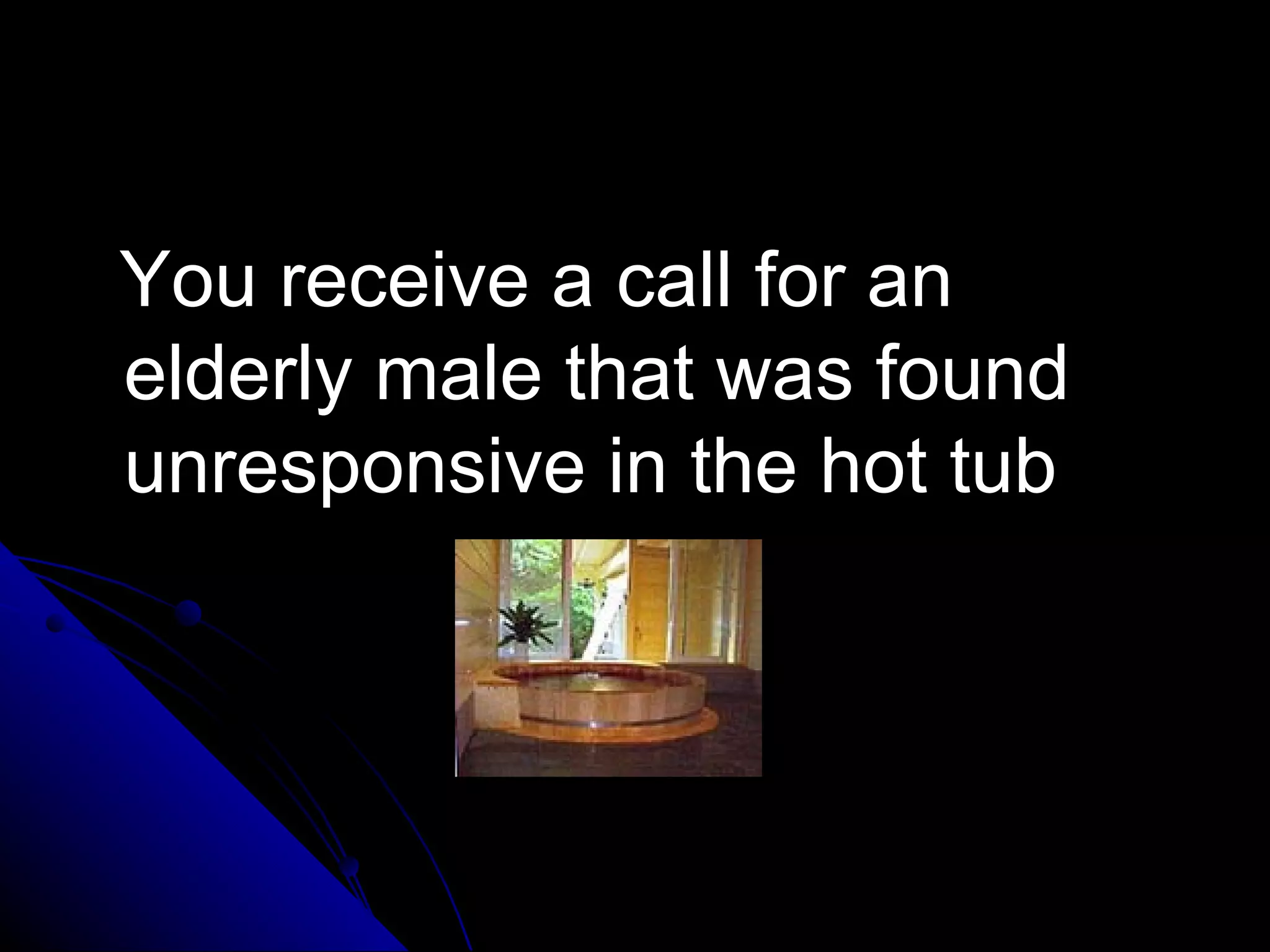
You receive a call for an
elderly male that was found
unresponsive in the hot tub
Case Study
•   What does this have to do
    with trauma?
•   Is he sick, is he injured, is
    he sick and injured?
•   Need more INFORMATION!
Case Study
•   What questions do you have?
    •   How long has he been in the hot
        tub?
    •   How hot is the water?
    •   How old is he?
    •   Any medical Hx?
Case Study
•   When you arrive you find an 85 yr old male
    sitting in the hot tub with agonal breathing and a
    weak pulse
    •   GCS is 3
    •   He has a history of a CVA
    •   He has lost control of his bowel and bladder
    •   Hot tub water is 105 degrees
    •   The pt was last seen, last night with no complaints
                   WHAT DO YOU DO?
                   WHAT IS YOUR DX?
Case Study
•   What is your initial Diagnosis?
•   Unconscious patient due to???
    •   CVA?
    •   MI?
    •   Heat stroke/exposure?
    •   Drug ingestion?
    •   ETOH intoxication?
Case Study
•   Could be any one of the
    aforementioned diagnoses or
    a combination of two or
    more…BUT a more pressing
    matter would be
Case Study
•   The patient is extricated from the hot tub
•   Agonal respirations at 6-8
    •   Intubated
•   Large bore IV’s are started and 2 liters of NS are rapidly
    infused
•   Vital signs
    •   BP is 60P
    •   HR 140
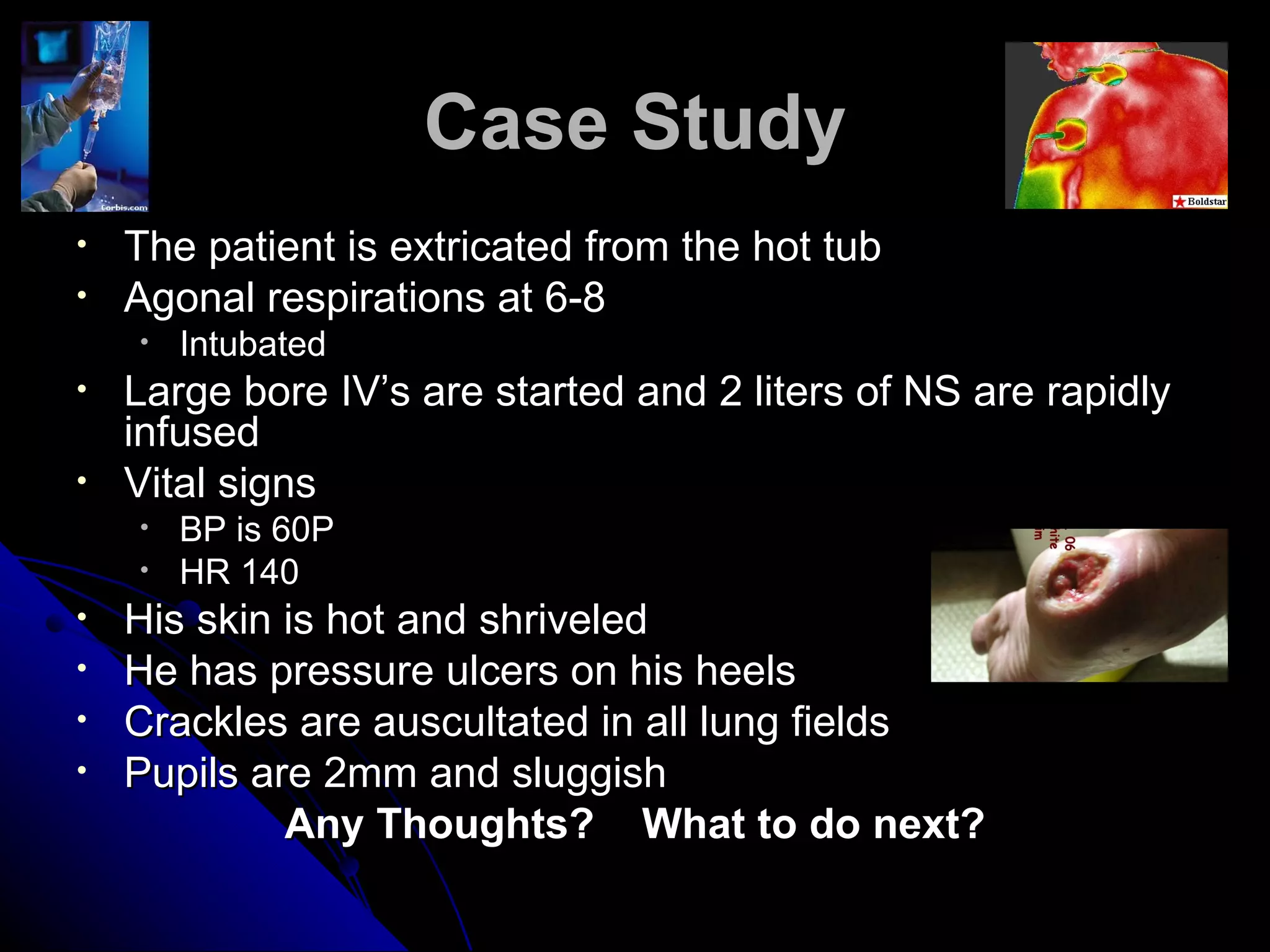
•   His skin is hot and shriveled
•   He has pressure ulcers on his heels
•   Crackles are auscultated in all lung fields
•   Pupils are 2mm and sluggish
             Any Thoughts? What to do next?
Case Study
•   While en route to the hospital the
    patient remained hypotensive
    •   Dopamine gtt initiated
        • Patient weight is 180 lbs
        • What is the dose for Dopamine?
        • How much should you give?
Case Study

•   10mcg/kg/min of Dopamine initiated
    •   SBP increased to 80
•   The quick down and dirty method to calculate
    Dopamine
    •   Take the wt - 180
    •   Drop the 0 and subtract 2
    •   Now you have 16
    •   That is your cc/hr for 5 mcg/kg/min
    •   Administer 32 cc/hr for 10mcg/kg/min
Case Study
•   Why is the patient hypotensive?
•   Is the patient in Shock?
    •   Distributive?
    •   Hypovolemic?
    •   Obstructive?
    •   Cardiogenic?
Case Study
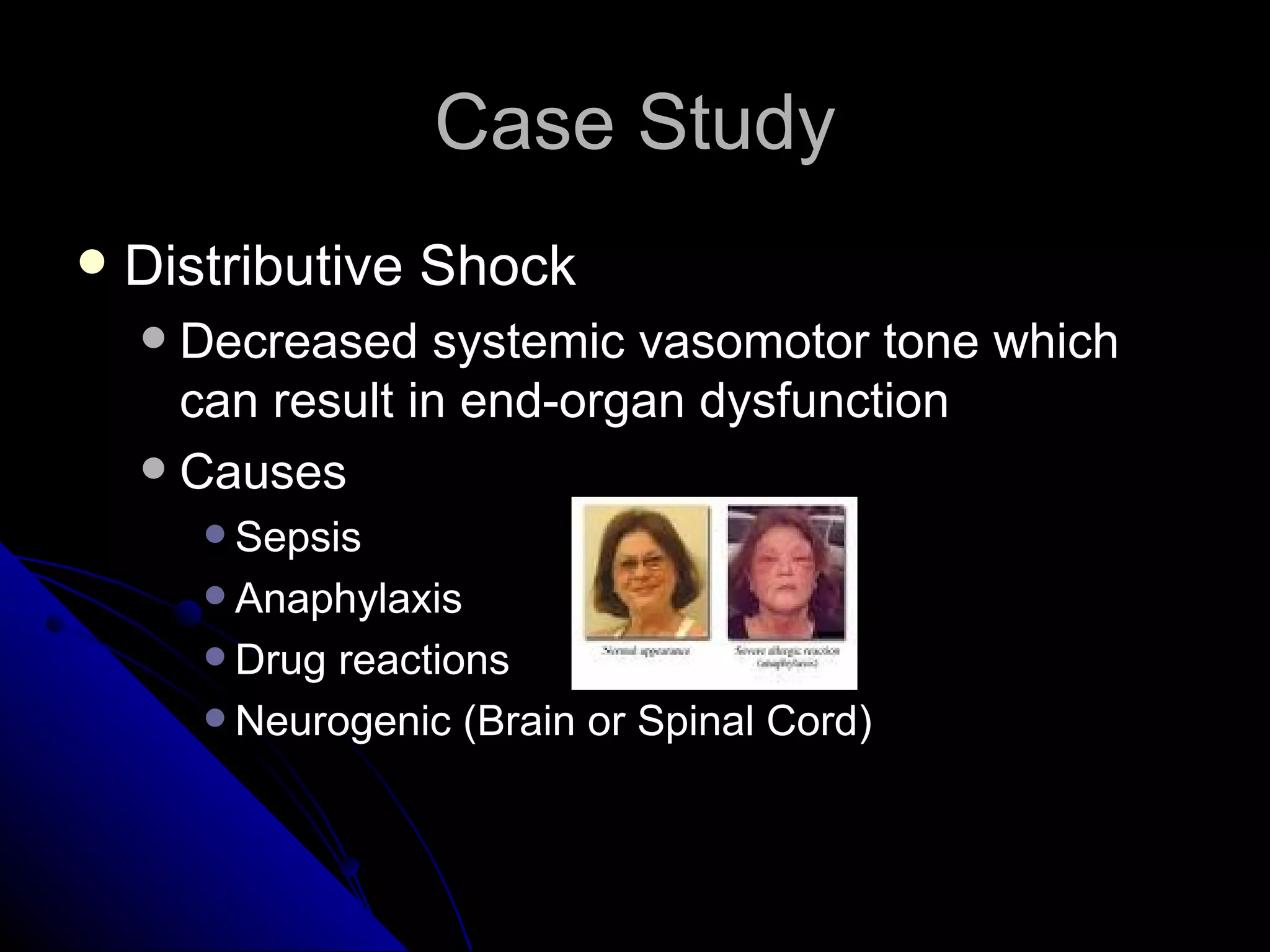
   Distributive Shock
     Decreased systemic vasomotor tone which
      can result in end-organ dysfunction
     Causes
         Sepsis
         Anaphylaxis
         Drug reactions
         Neurogenic (Brain or Spinal Cord)
Case Study
   Hypovolemic Shock
     Decreased systemic vascular resistance
      which can result in end-organ dysfunction
     Causes
         Bloodloss
         Severe burns
              Third spacing and loss of plasma
         Dehydration
Case Study
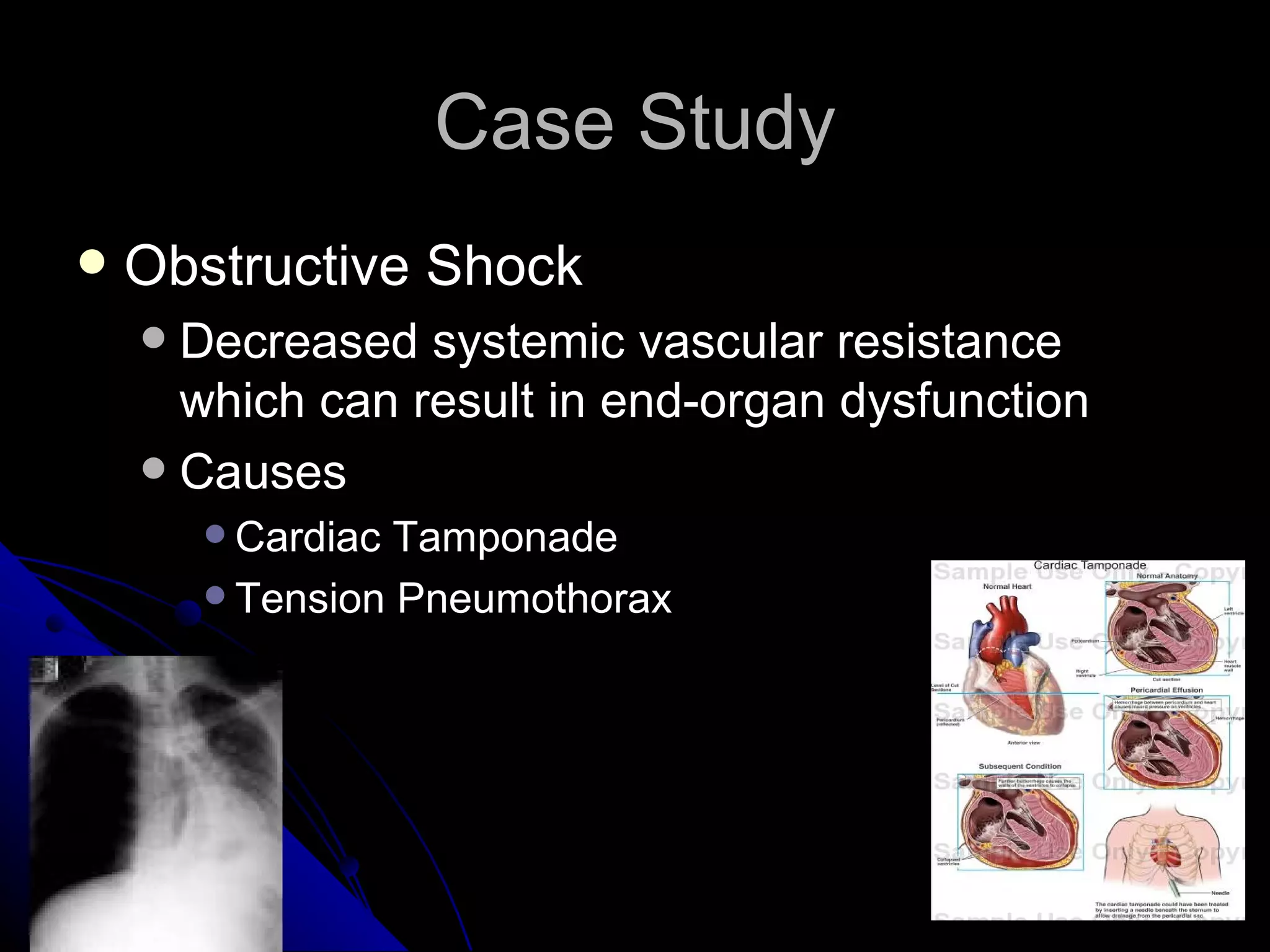
   Obstructive Shock
     Decreased systemic vascular resistance
      which can result in end-organ dysfunction
     Causes
         Cardiac Tamponade
         Tension Pneumothorax
Case Study
   Cardiogenic Shock
     The heart is unable to pump enough blood
      (both force and volume) for the needs of the
      body
     Causes
         Massive MI
         Heart Failure
              Left or right sided**
Case Study
   What type of shock do you think our
    patient is in?
     Distributive?
     Hypovolemic?
     Obstructive?
     Cardiogenic?
Case Study
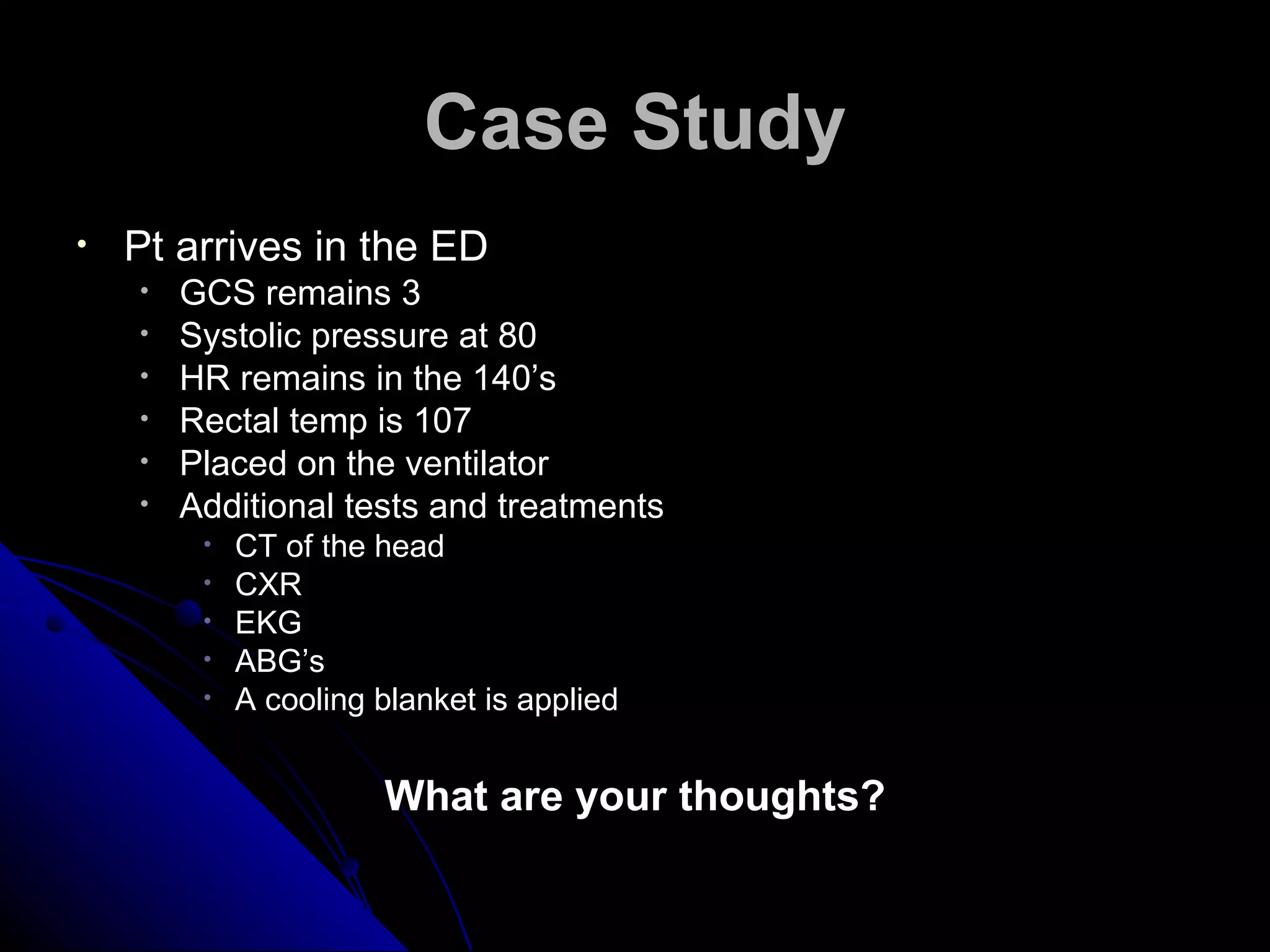
•   Pt arrives in the ED
    •   GCS remains 3
    •   Systolic pressure at 80
    •   HR remains in the 140’s
    •   Rectal temp is 107
    •   Placed on the ventilator
    •   Additional tests and treatments
         •   CT of the head
         •   CXR
         •   EKG
         •   ABG’s
         •   A cooling blanket is applied


                       What are your thoughts?
Case Study
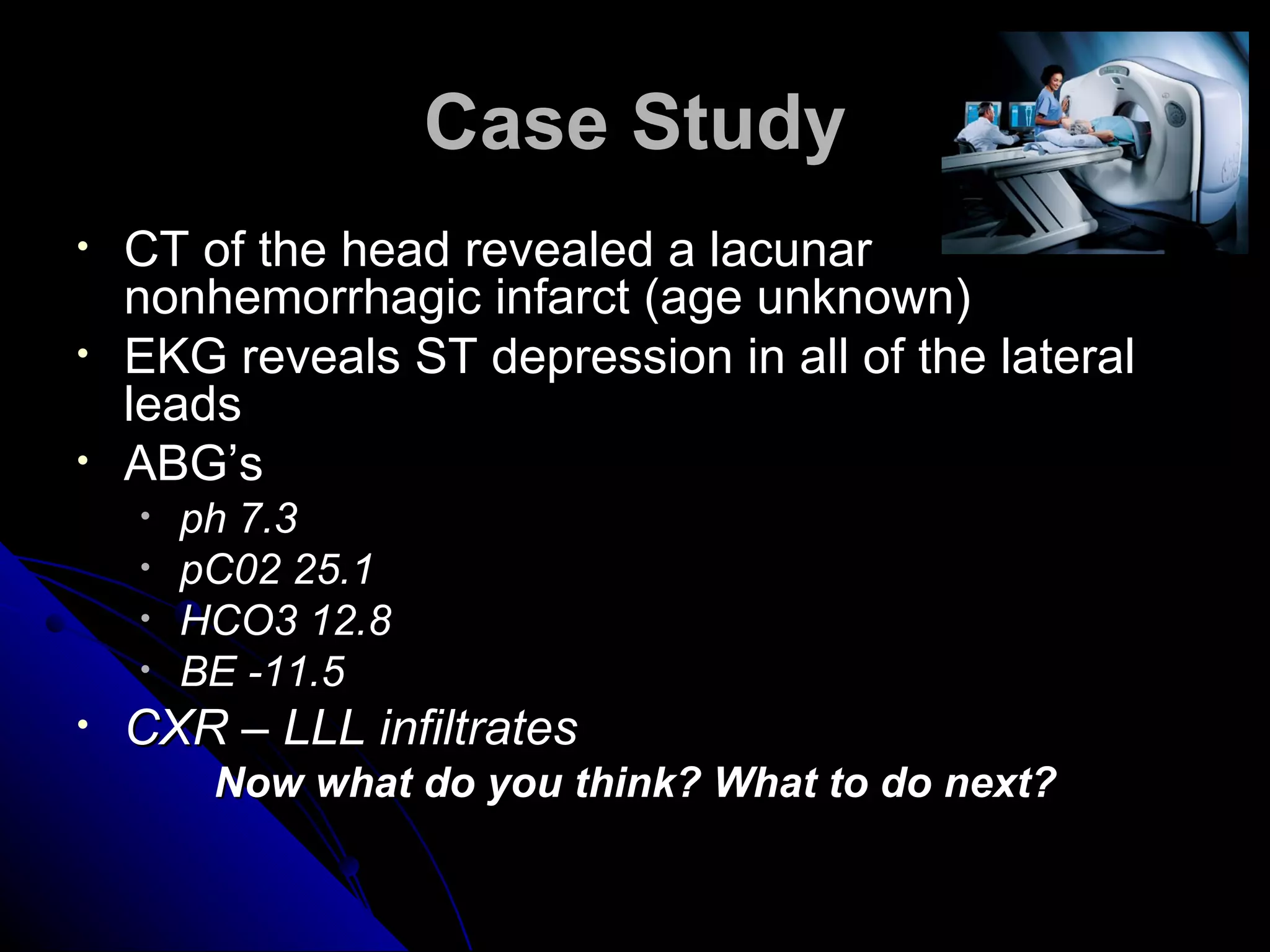
•   CT of the head revealed a lacunar
    nonhemorrhagic infarct (age unknown)
•   EKG reveals ST depression in all of the lateral
    leads
•   ABG’s
    •   ph 7.3
    •   pC02 25.1
    •   HCO3 12.8
    •   BE -11.5
•   CXR – LLL infiltrates
         Now what do you think? What to do next?
Case Study
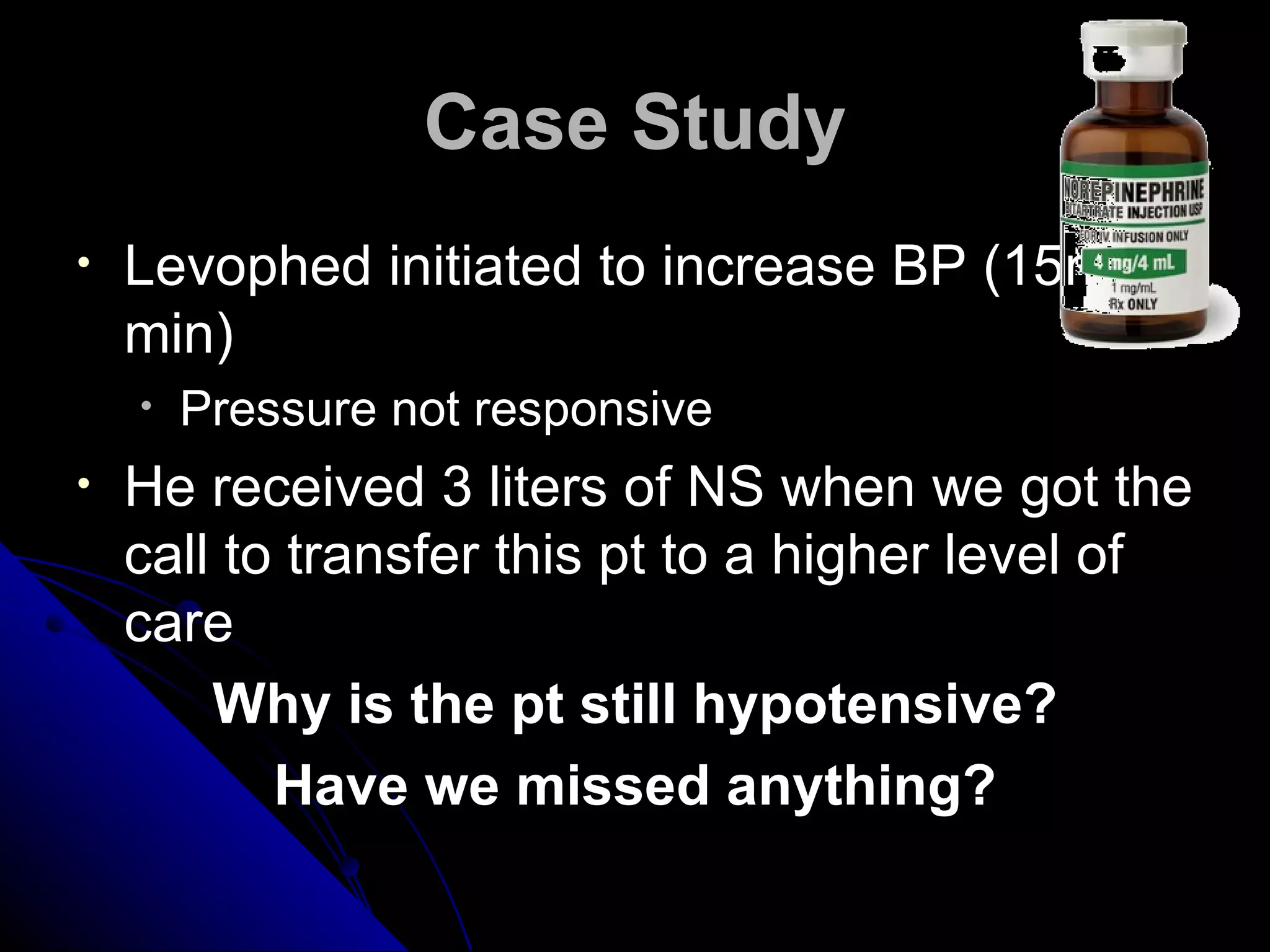
•   Levophed initiated to increase BP (15mcg/
    min)
    •   Pressure not responsive
•   He received 3 liters of NS when we got the
    call to transfer this pt to a higher level of
    care
        Why is the pt still hypotensive?
           Have we missed anything?
Case Study
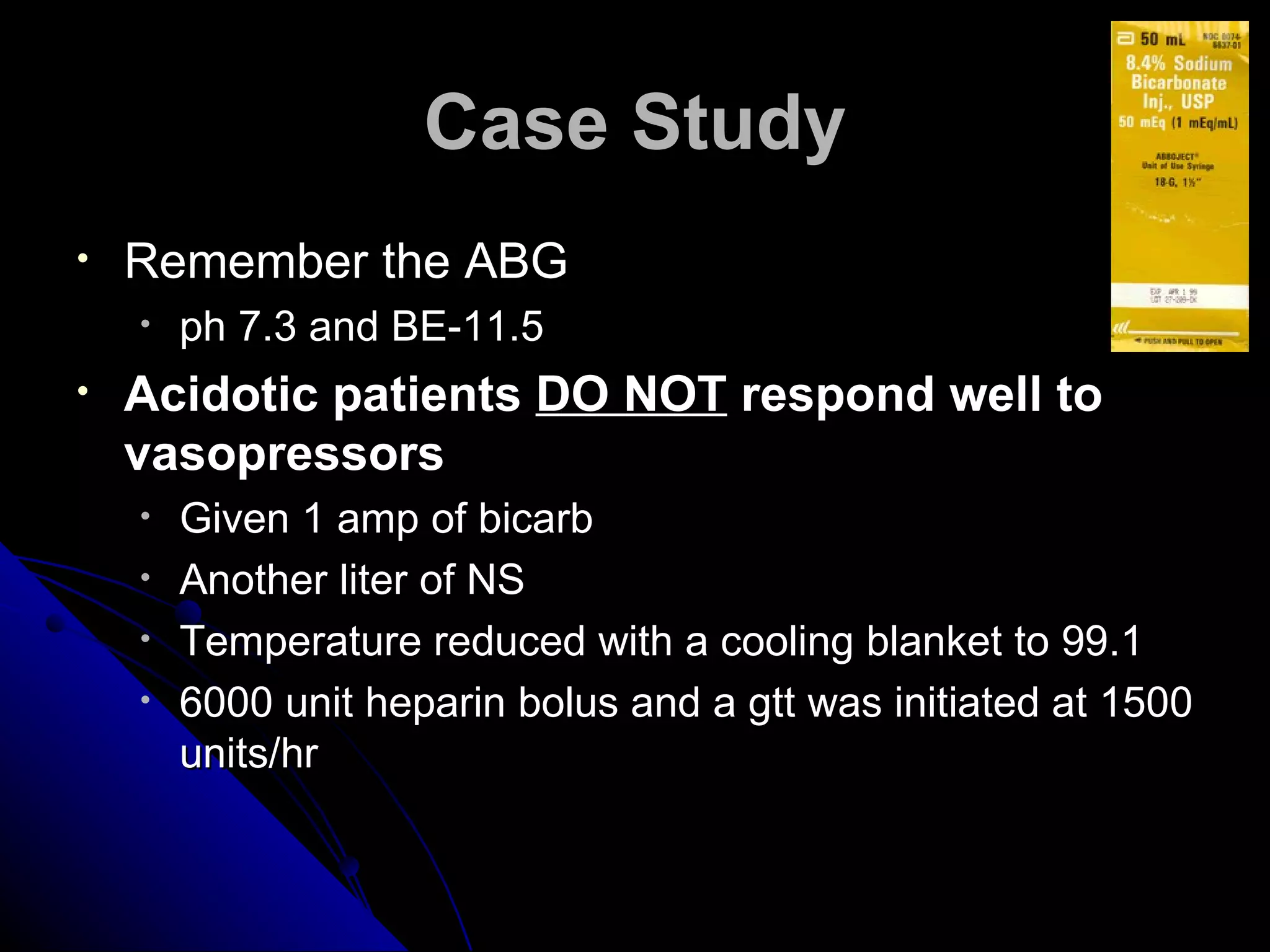
•   Remember the ABG
    •   ph 7.3 and BE-11.5
•   Acidotic patients DO NOT respond well to
    vasopressors
    •   Given 1 amp of bicarb
    •   Another liter of NS
    •   Temperature reduced with a cooling blanket to 99.1
    •   6000 unit heparin bolus and a gtt was initiated at 1500
        units/hr
Case Study
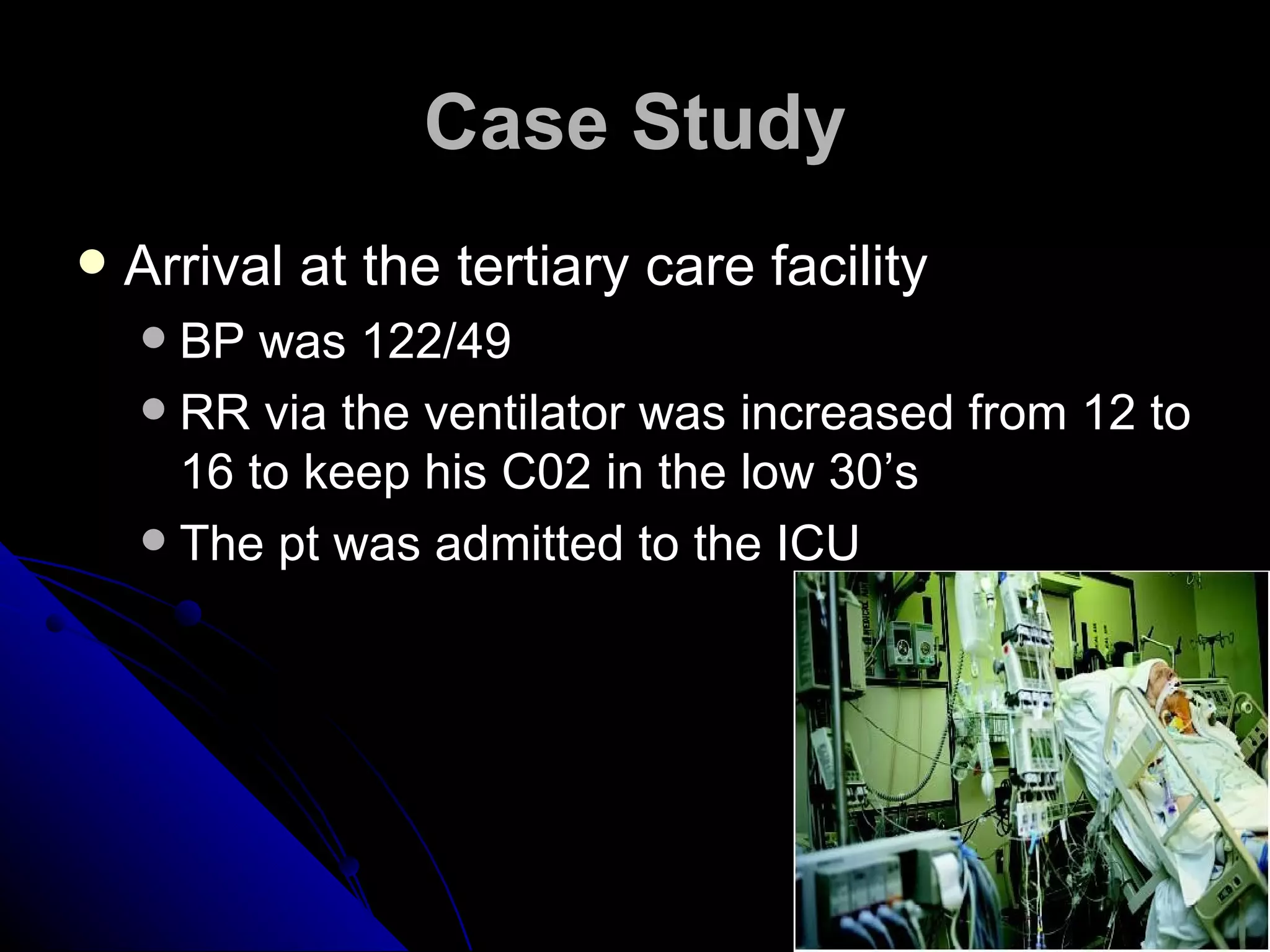
   Arrival at the tertiary care facility
     BP was 122/49
     RR via the ventilator was increased from 12 to
      16 to keep his C02 in the low 30’s
     The pt was admitted to the ICU
Discussion
   Admitting Diagnosis
     MI
     CVA
     Hyperthermia
          Due   to heat exposure
       Dehydration
          Secondary   to heat exposure
       Acute Renal Failure
Questions
Ready for Another??
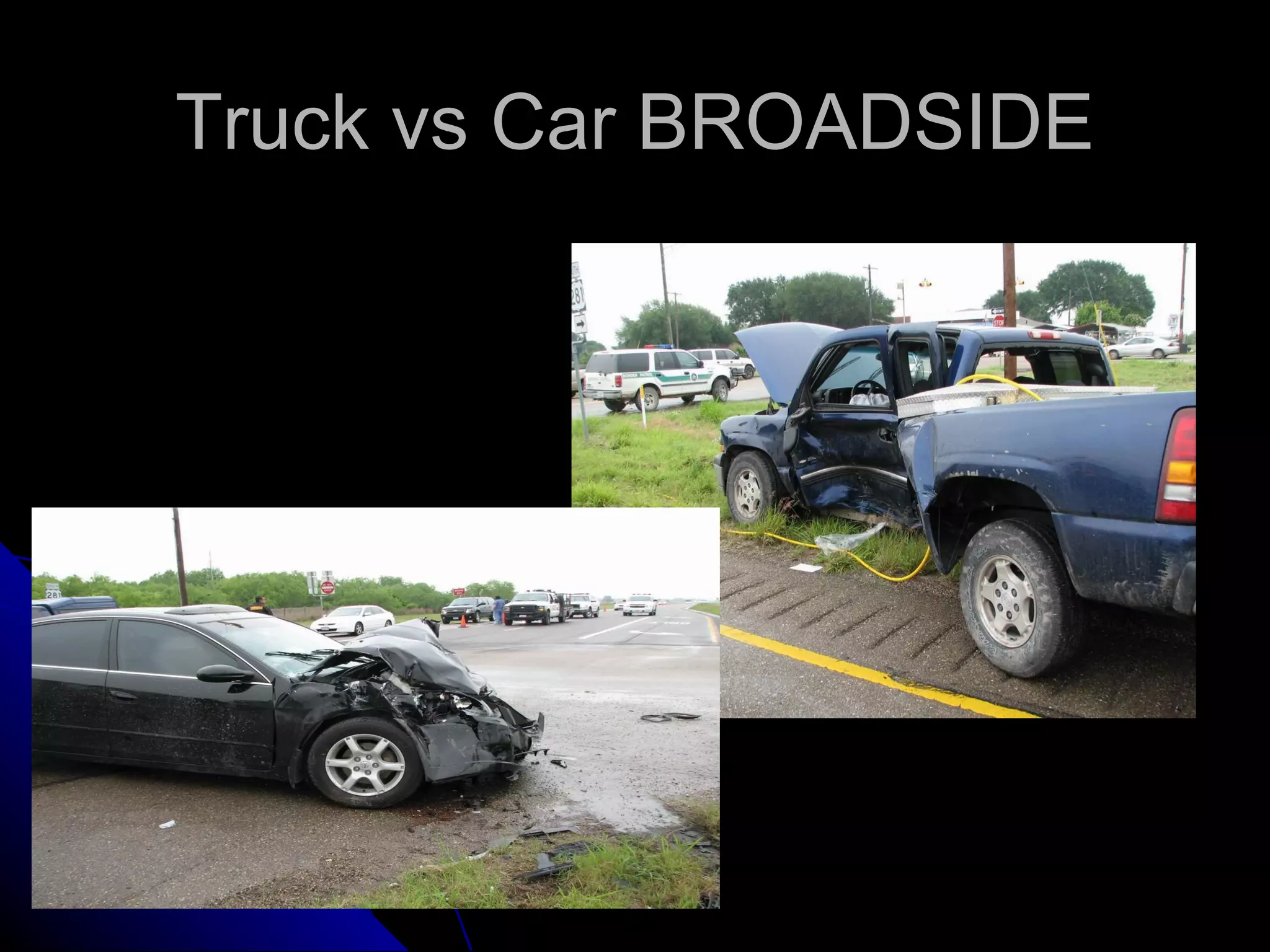
Truck vs Car BROADSIDE
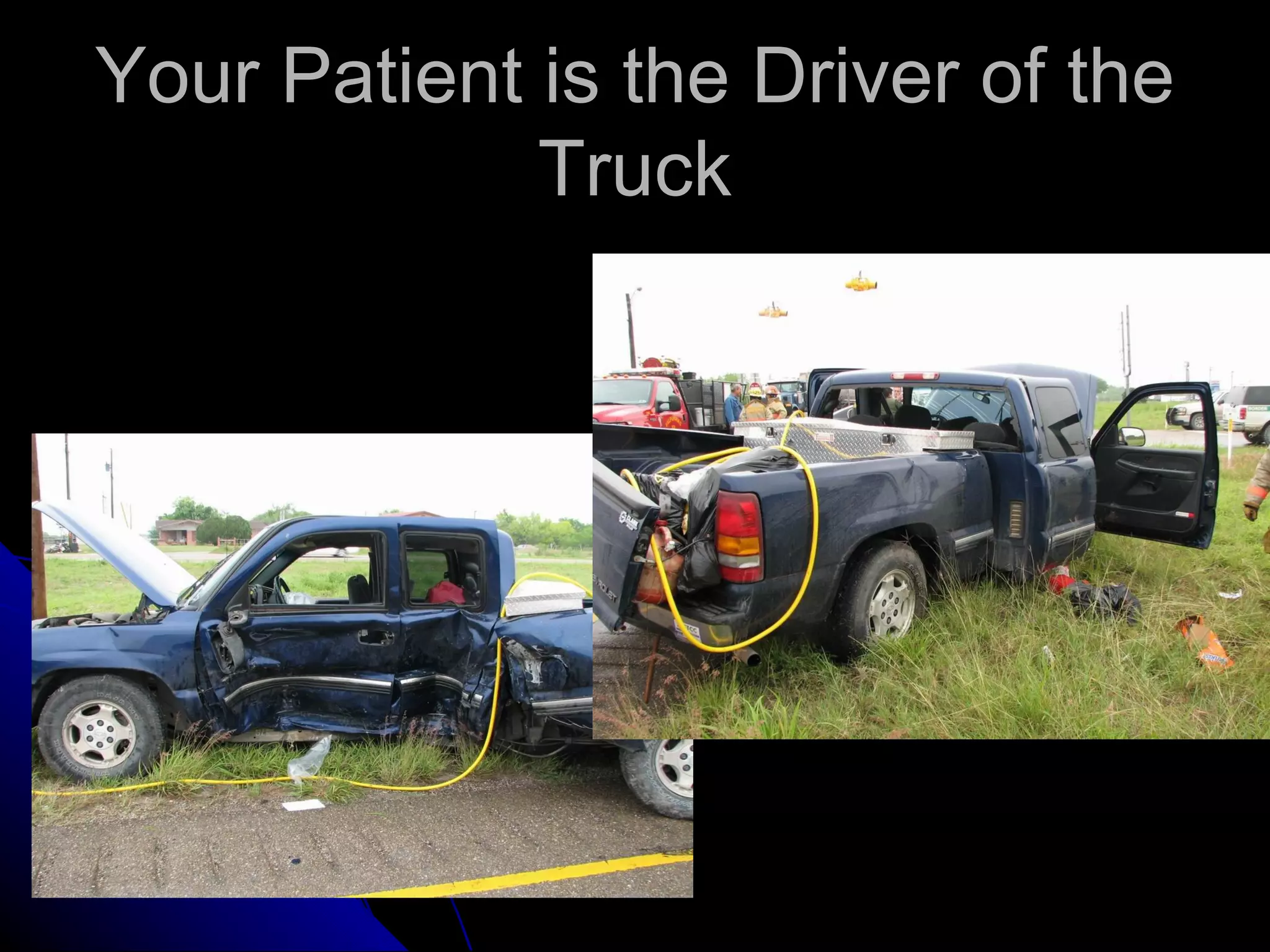
Your Patient is the Driver of the
             Truck
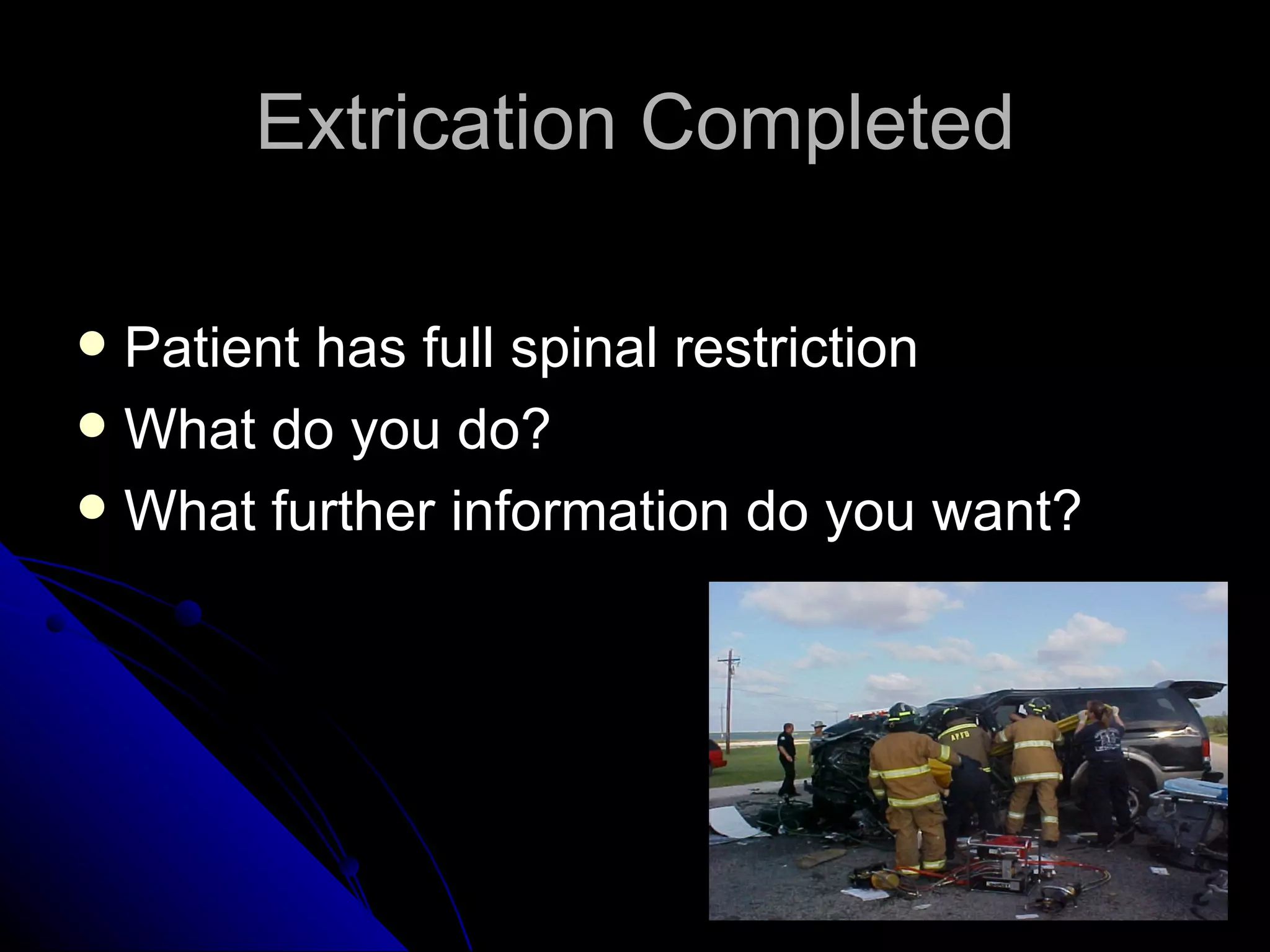
Extrication Completed

 Patient has full spinal restriction
 What do you do?
 What further information do you want?
Report from First Responders
   75 yr old male (driver)
       + Seatbelt
       Airbag deployed
       Trapped with prolonged extrication
       Pt c/o CP
       No surface trauma observed
       GCS is 10
            Eyes open to pain
            Withdraws to pain
            Disoriented and conversant
                           NOW WHAT?
ABC’s
   Airway
       Open and clear
   Breathing
       Respirations are 16 and shallow
   Circulation
     Skin is pale
     Diaphoretic
     Capillary refill is at 5 sec
     Pulses are thready and slow
Vital Signs
 BP:  70/30
 HR: 30’s
 Pulse Ox was 94% but now does
  not read
 GCS is now 8 and pt becomes
  combative
Pre-hospital Course
   Airway management with DAI
   Ventilated with 100% 02
   2 IV’s were established with 2800 ml IV bolus
   25 grams of Albumin was infused
   Gastric tube was passed for decompression
   3 mgs of Atropine
       Without effect
   Two Epi injections (0.5mg)
       Increase HR and BP achieved
In Hospital Course
   VS on arrival were:
       BP 93/38
       HR 115
       EtCO2 30
       GCS 3 (DAI)
   Trauma protocol started
       CXR
       Pelvis Xray done (fractured pelvis seen)
       Blood transfusion started
       Foley inserted with gross bloody urine returned
Outcome
 Patient’s BP and HR steadily declined
 Patient coded in spite of all resuscitation
  efforts
       Continued resuscitation was not successful
   Diagnosis
     Blunt Chest Trauma
     Cardiac and pulmonary contusions
     Pelvic Fractures
Discussion
Last but not least
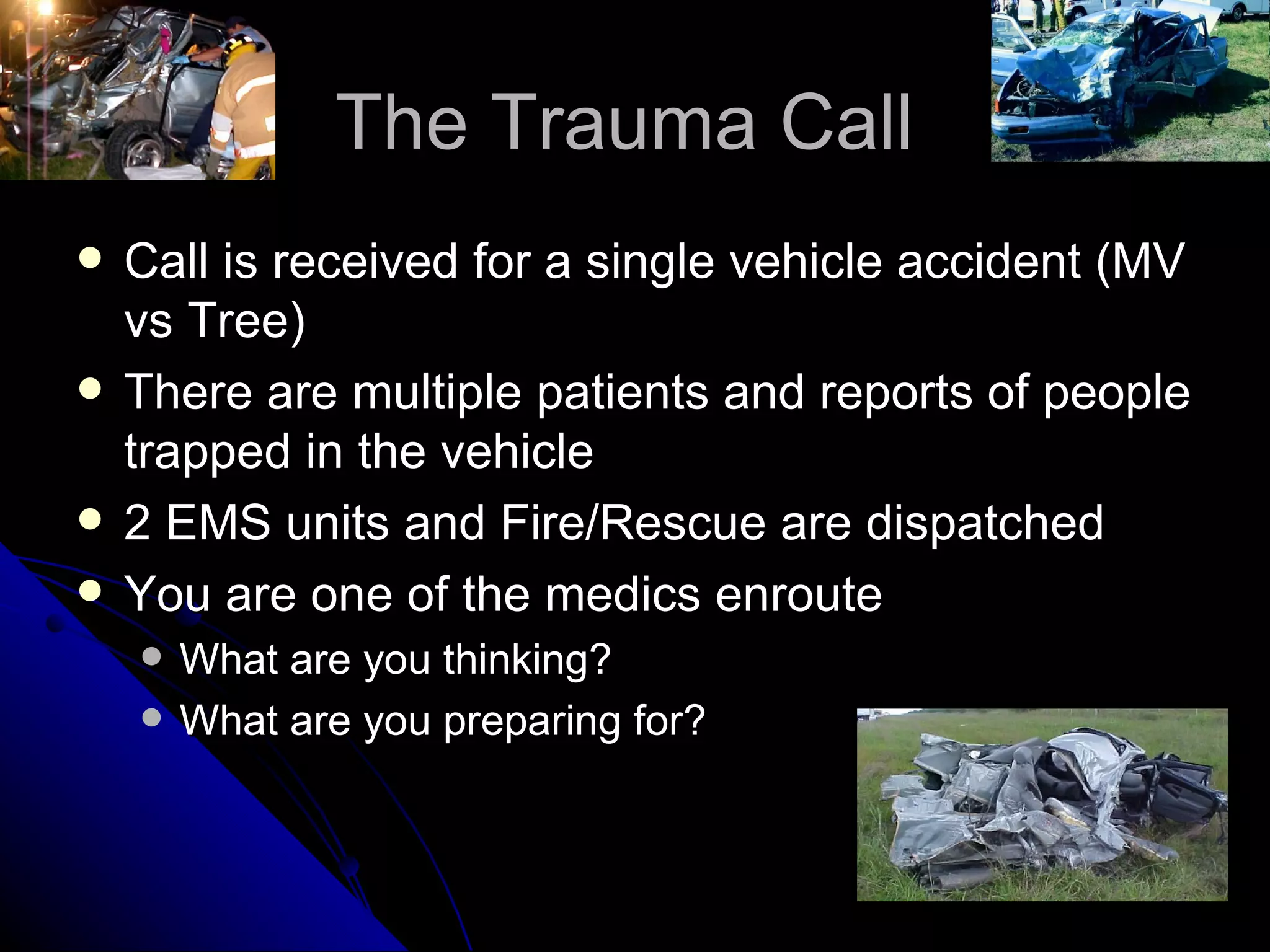
The Trauma Call
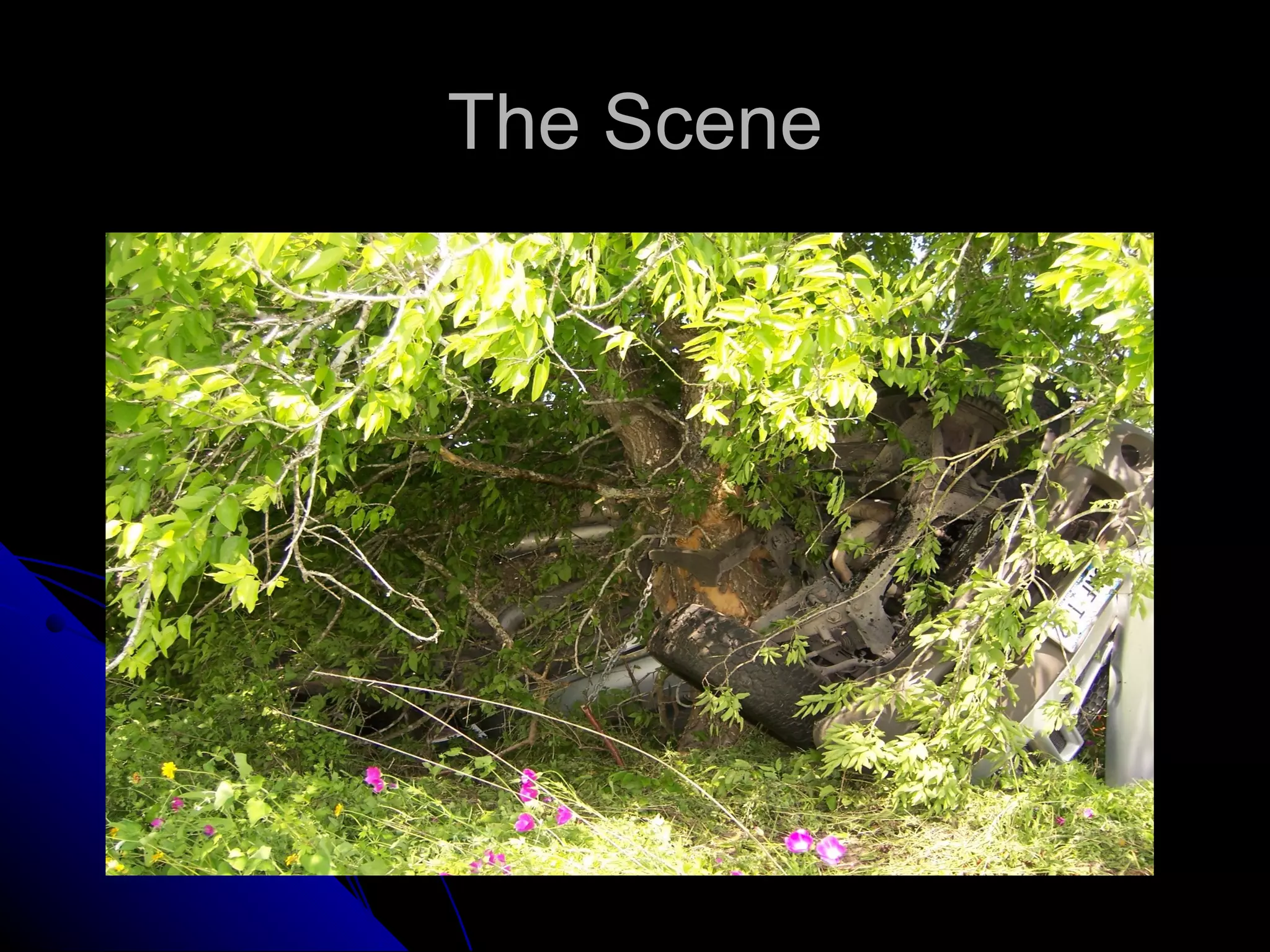
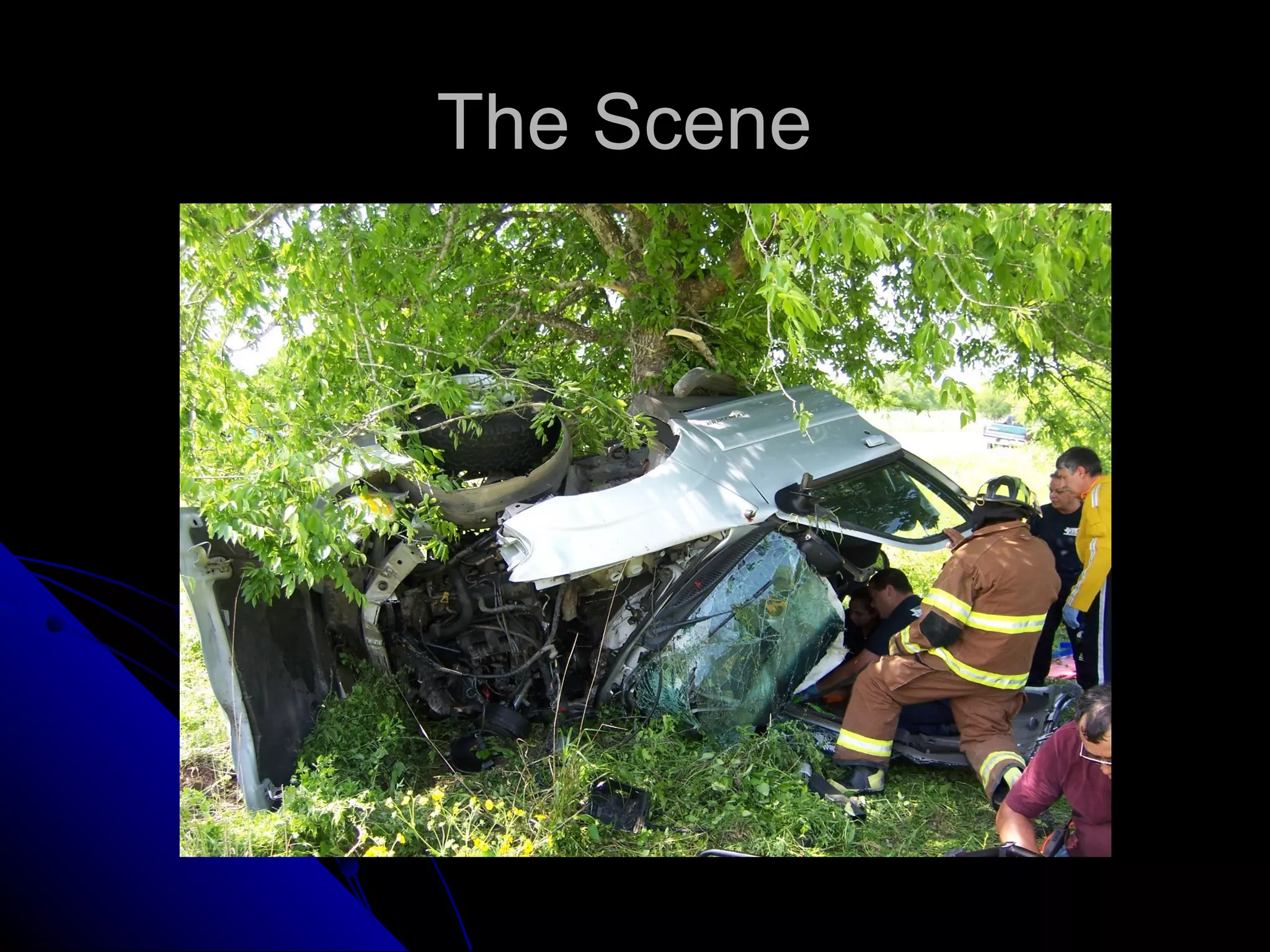
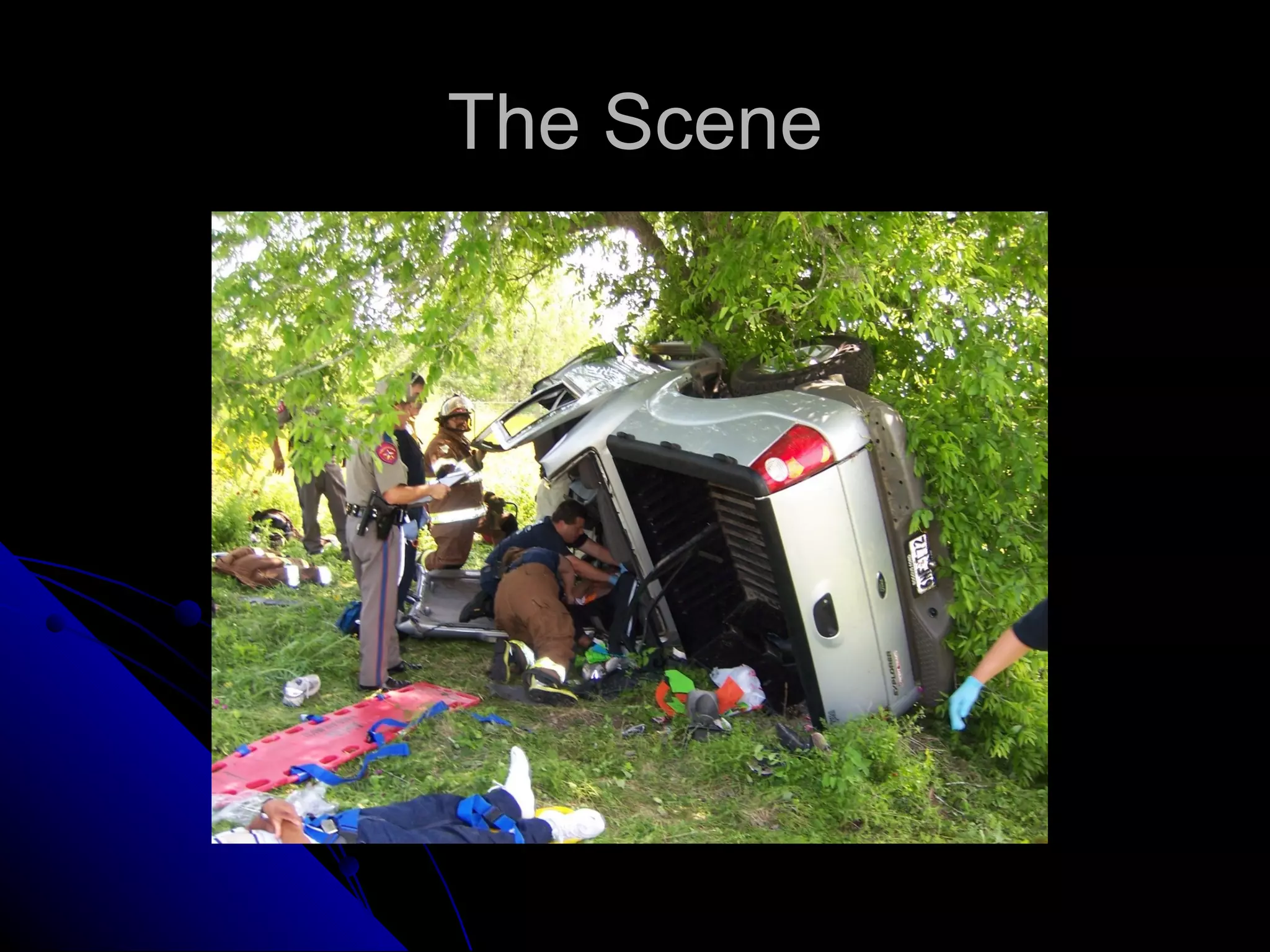
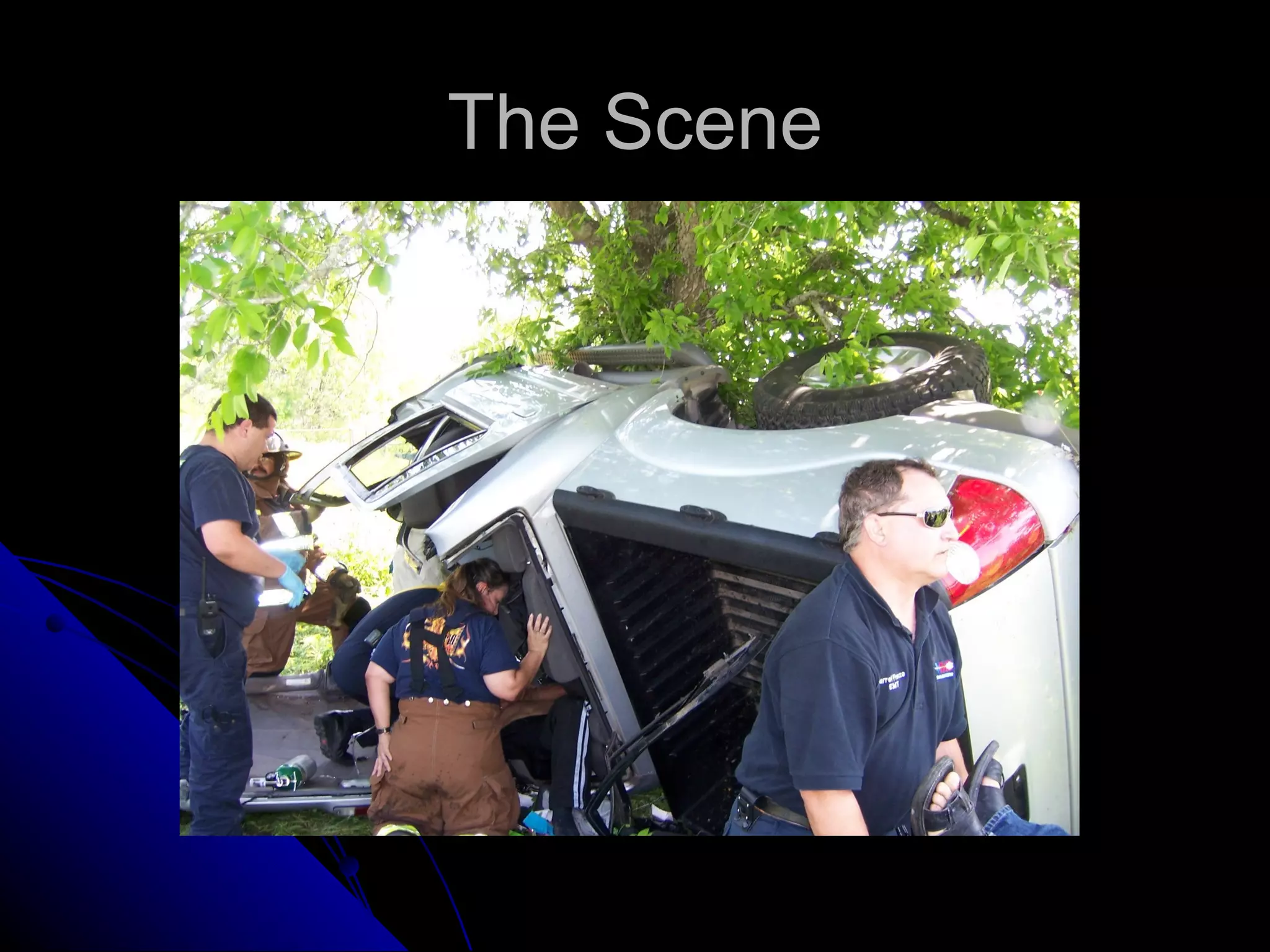
   Call is received for a single vehicle accident (MV
    vs Tree)
   There are multiple patients and reports of people
    trapped in the vehicle
   2 EMS units and Fire/Rescue are dispatched
   You are one of the medics enroute
       What are you thinking?
       What are you preparing for?
First to Arrive
 You find a total of 4 patients, with 1
  trapped
 You are 1 and ½ hours from the closest
  trauma center

            What do you do?
           What do you want?
Triage
 You find 1 patient trapped and 3 outside
  the vehicle
 You classify 2 major and 2 minor


         WHO YA GONNA CALL?
ABC’s
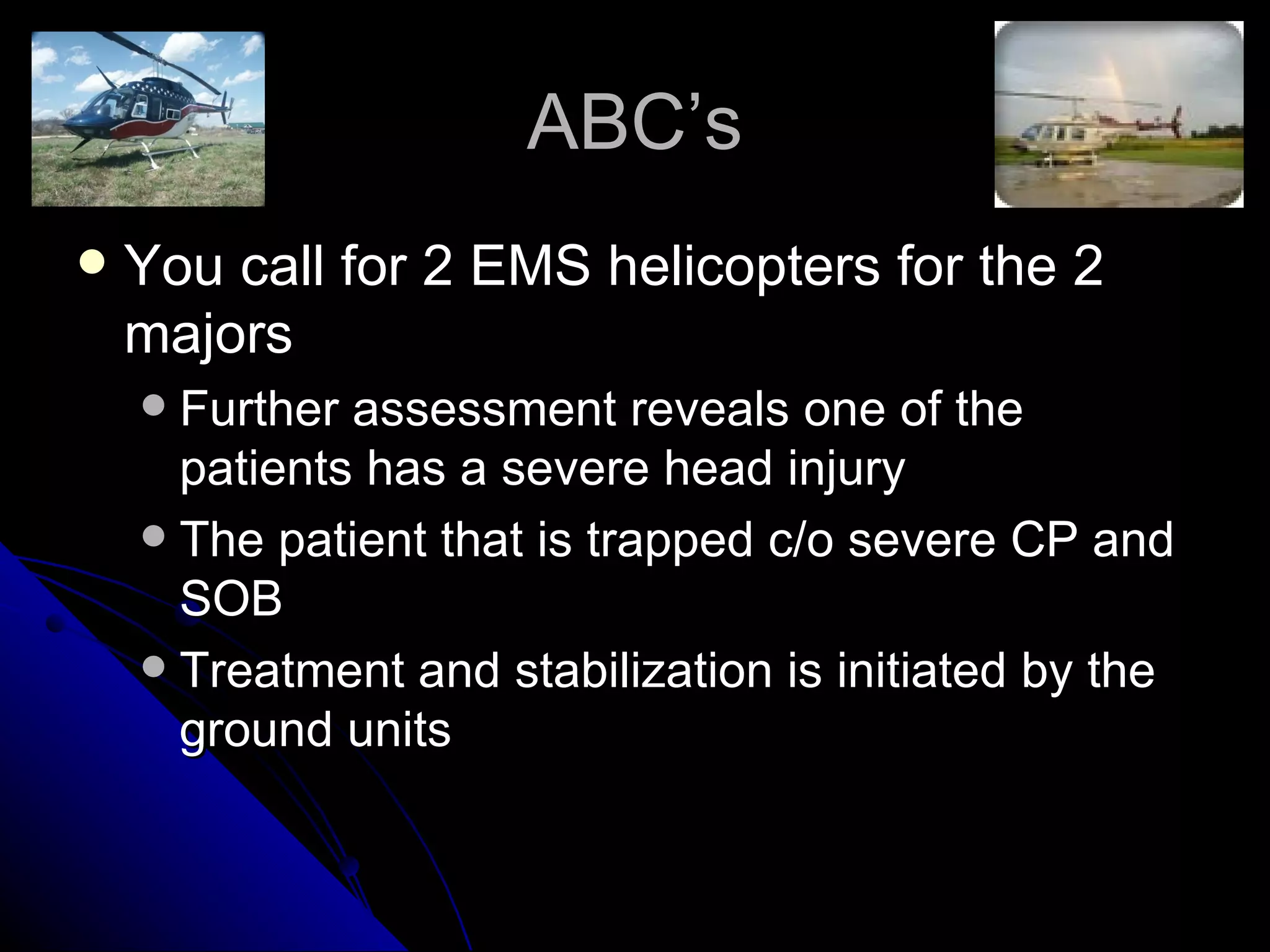
   You call for 2 EMS helicopters for the 2
    majors
     Further assessment reveals one of the
      patients has a severe head injury
     The patient that is trapped c/o severe CP and
      SOB
     Treatment and stabilization is initiated by the
      ground units
The Scene
The Scene
The Scene
The Scene
BIG PICTURE ⇒ Focused
          assessment
 The pt with the severe head injury is flown
  to the closest trauma center
 The 2 minor trauma pt’s are ground
  transported to the closest appropriate
  facility
 The 4th pt that remains trapped inside of
  the vehicle becomes our focus
Trauma Assessment
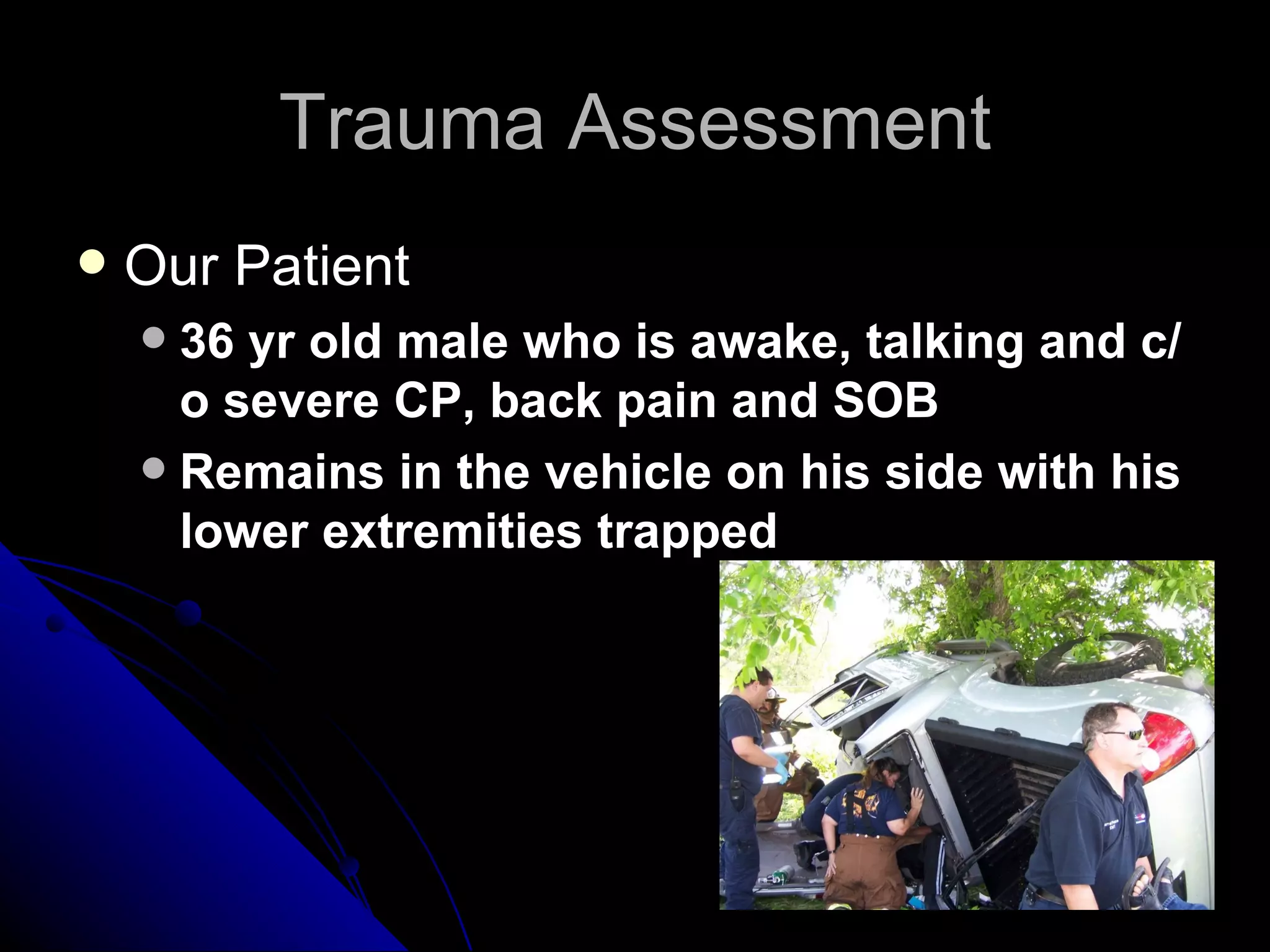
   Our Patient
     36 yr old male who is awake, talking and c/
      o severe CP, back pain and SOB
     Remains in the vehicle on his side with his
      lower extremities trapped
Primary Assessment
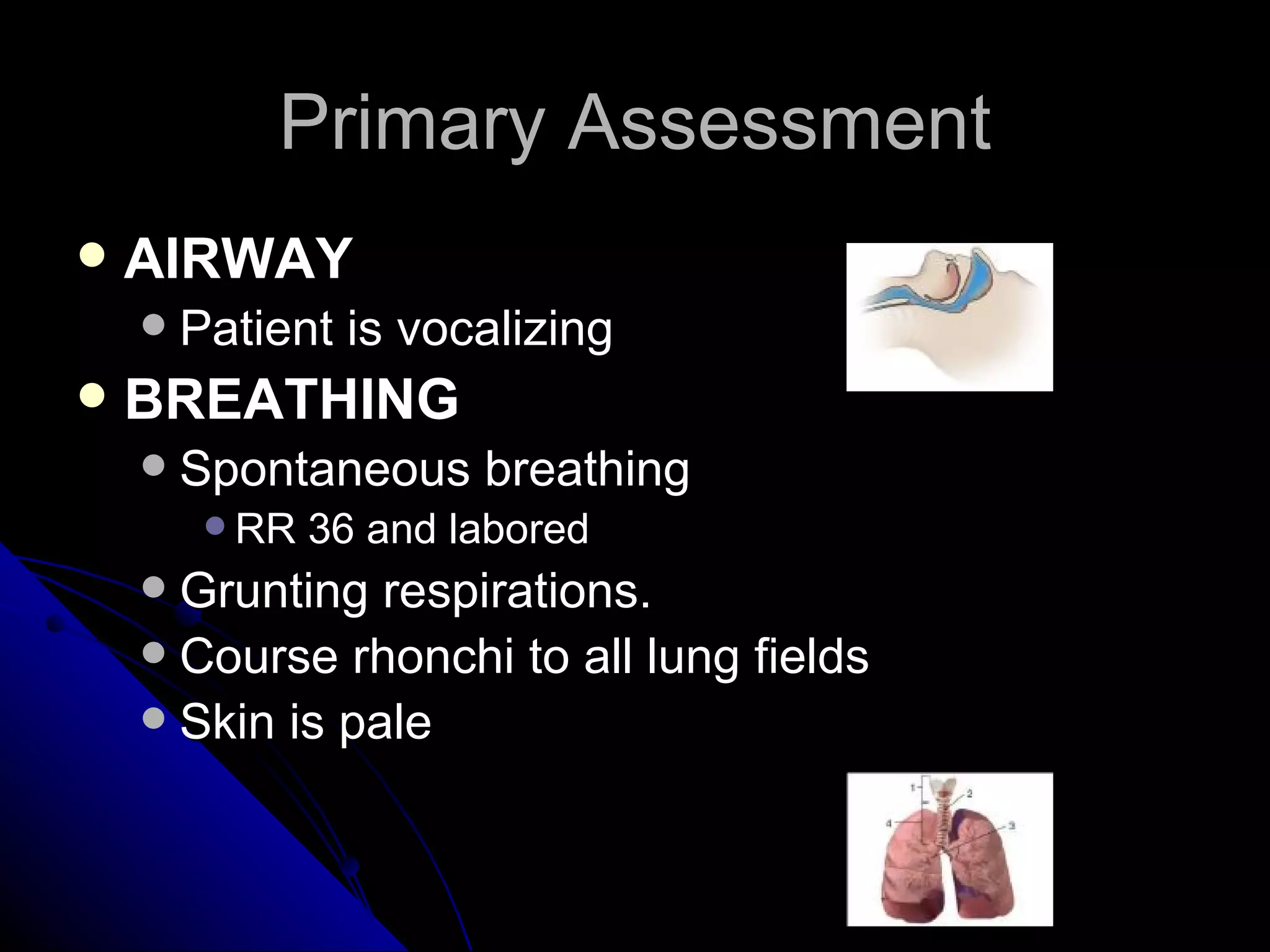
   AIRWAY
       Patient is vocalizing
   BREATHING
       Spontaneous breathing
          RR   36 and labored
     Grunting respirations.
     Course rhonchi to all lung fields
     Skin is pale
Primary Assessment
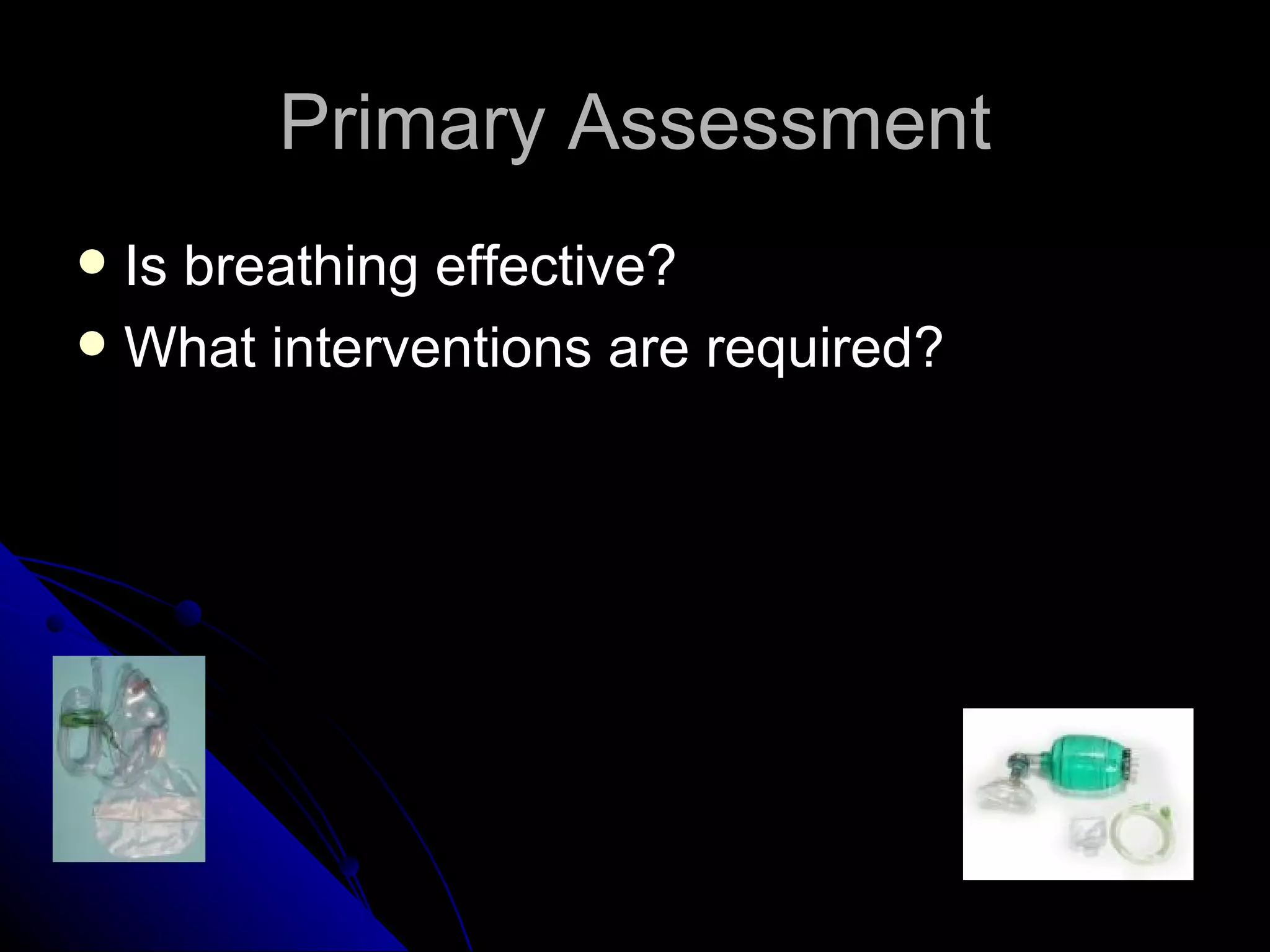
 Is breathing effective?
 What interventions are required?
Primary Assessment
   CIRCULATION
     Central and peripheral pulses are present
     HR 88
     Skin remains pale and clammy
     No uncontrolled bleeding is observed


Intervention: 18g IV started with bolus
Primary Assessment
   DISABILITY
     A0x4
     GCS 15
     Pupils - PERL
Secondary Assessment
   Extrication is complete
       Patient is secured on a backboard with a C-Collar and
        headblocks are in place
   Abdomen soft and nontender
   Pelvis stable and nontender
   MAE well with 4 point pulses
   Surface trauma observed
       Full thickness lower lip laceration with bleeding
        controlled
Secondary Assessment
   Vital Signs
     HR is 88
     RR at 36-40 labored
     SpO2 at 80% on 02 NRB
     BP not available at this time
     Patient is agitated and restless


Do you continue with your secondary?
Interventions
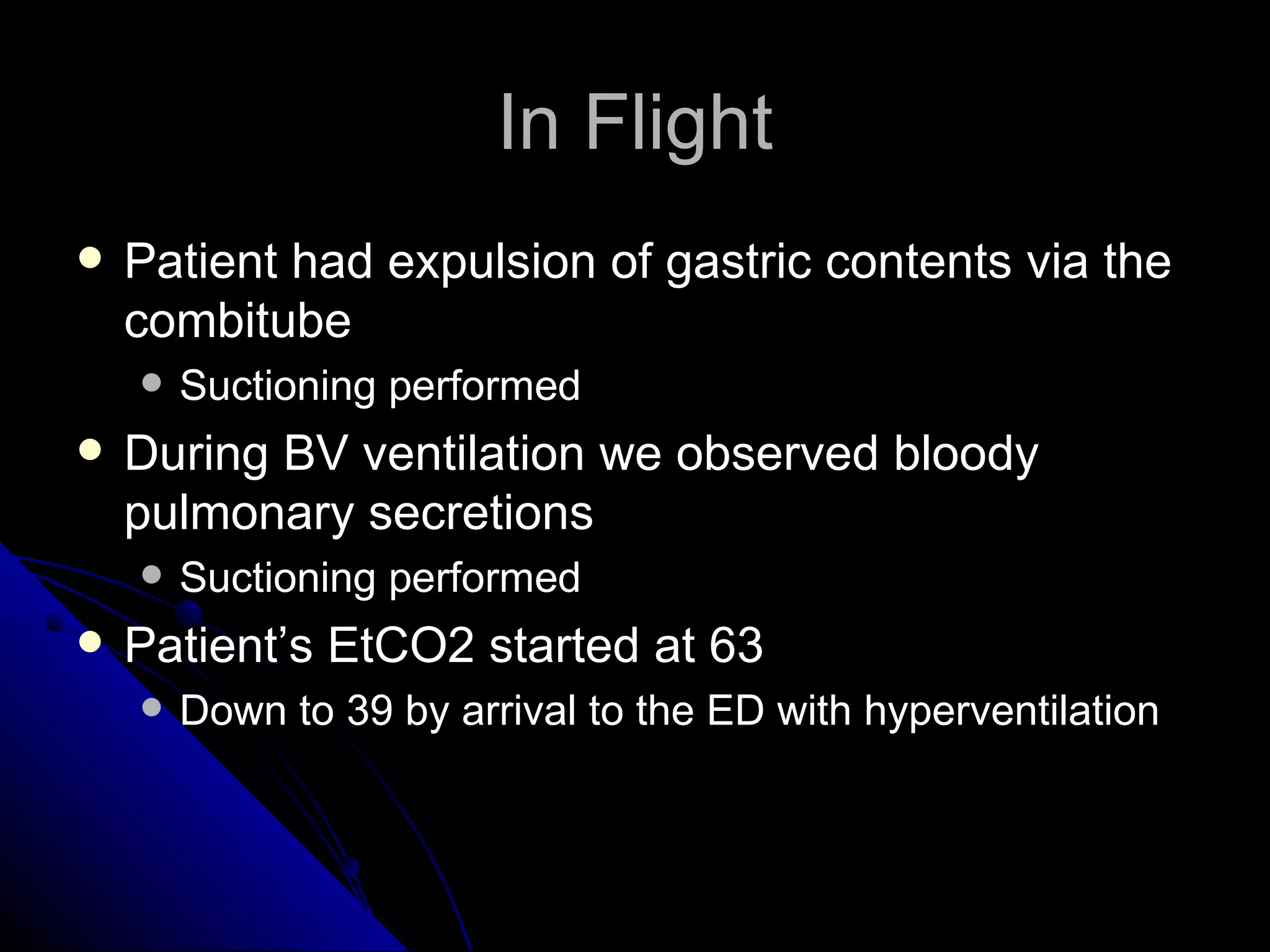
   Breathing continues to be ineffective?
   Airway management with DAI is performed after
    the patient has been moved to the aircraft
       Prior to lift off
   Unsuccessful after three attempts
   Failed airway
       Combitube rescue device used to successfully secure
        the airway
In Flight
   Patient had expulsion of gastric contents via the
    combitube
       Suctioning performed
   During BV ventilation we observed bloody
    pulmonary secretions
       Suctioning performed
   Patient’s EtCO2 started at 63
       Down to 39 by arrival to the ED with hyperventilation
In Flight
 The pt remained normotensive
 Sp02 increased to 99%
 Remained sedated and chemically
  paralyzed
 Received 800cc bolus while enroute to the
  ED
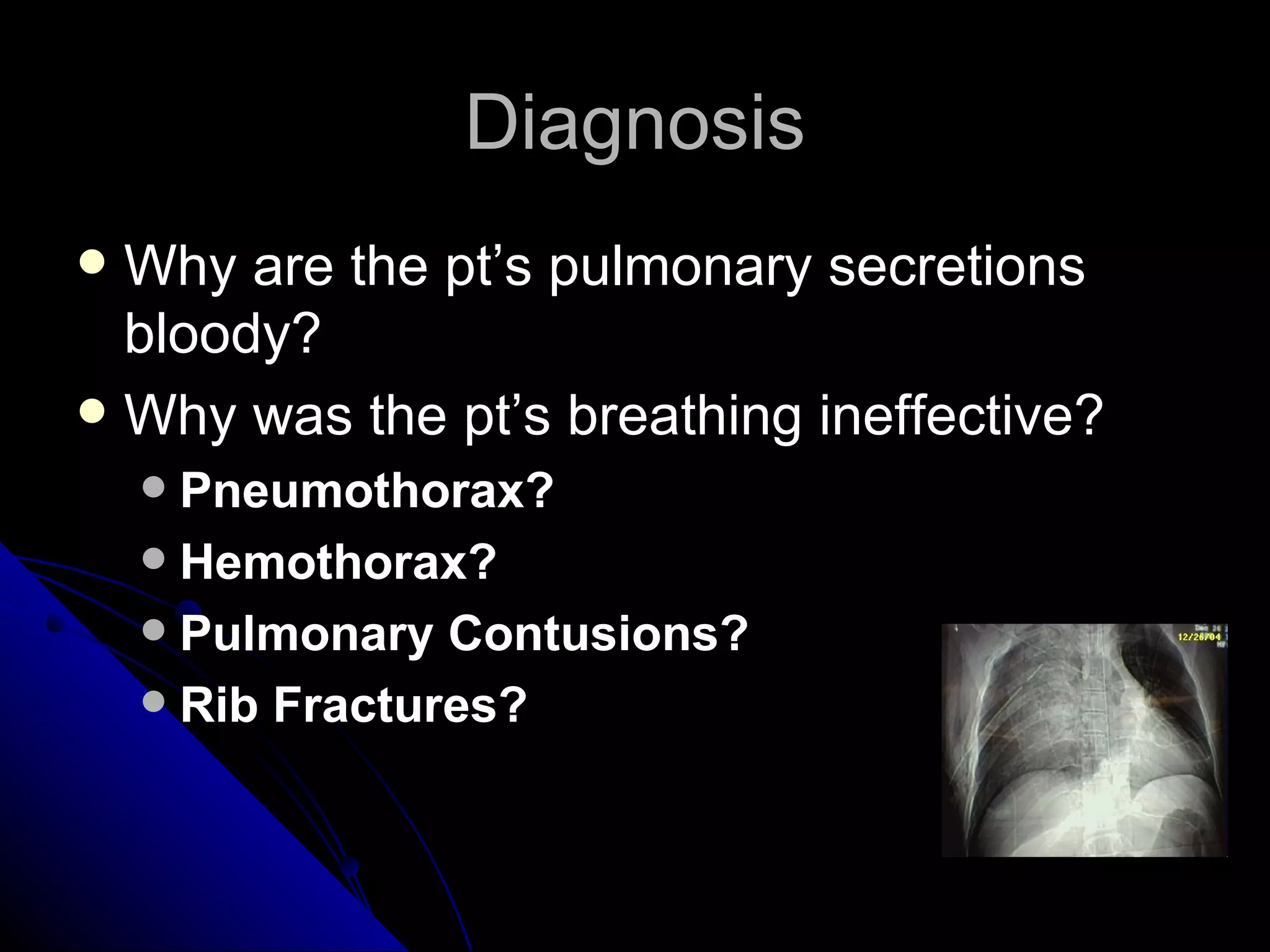
Diagnosis
 Why are the pt’s pulmonary secretions
  bloody?
 Why was the pt’s breathing ineffective?
     Pneumothorax?
     Hemothorax?
     Pulmonary Contusions?
     Rib Fractures?
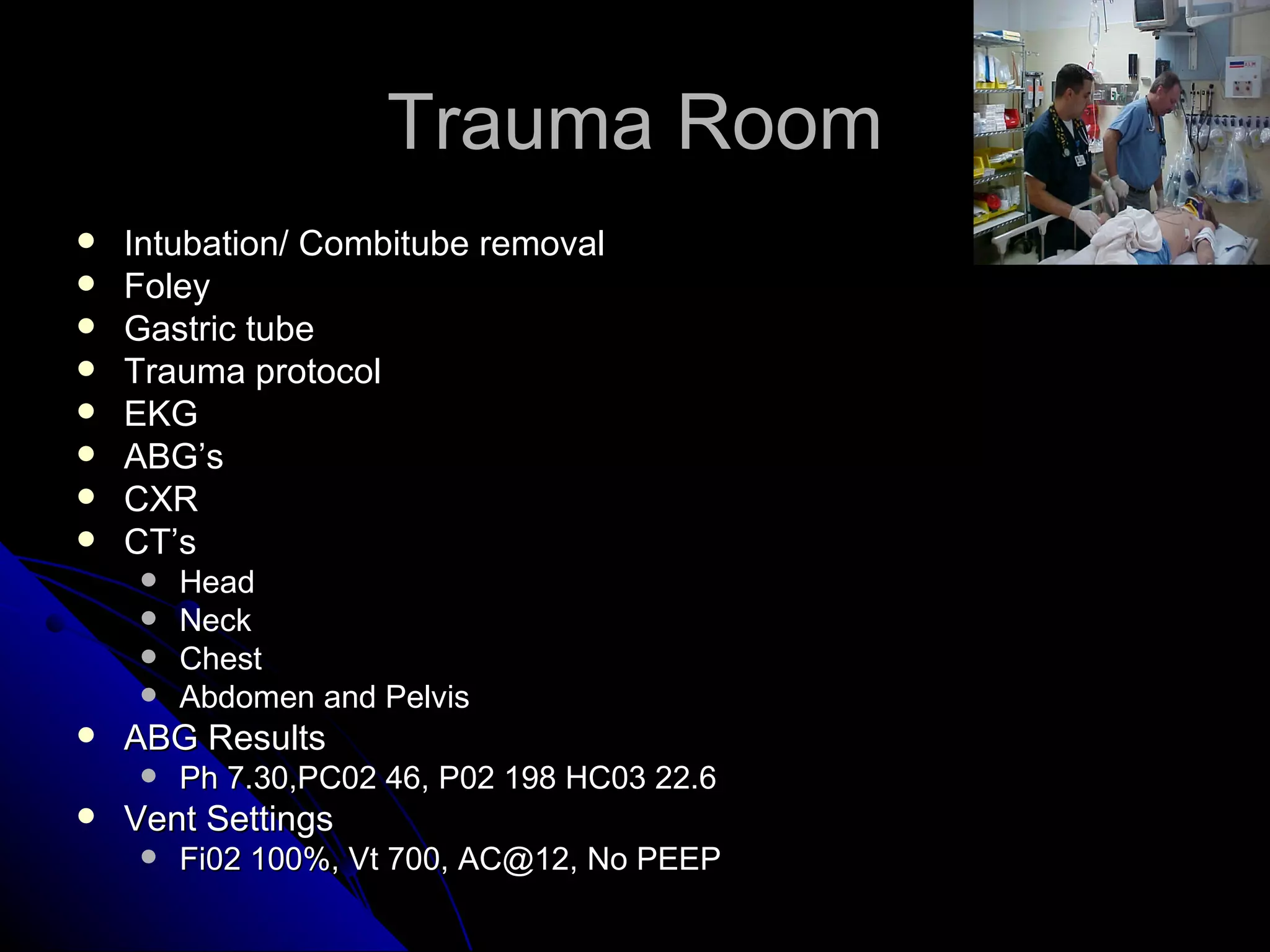
Trauma Room
   Intubation/ Combitube removal
   Foley
   Gastric tube
   Trauma protocol
   EKG
   ABG’s
   CXR
   CT’s
       Head
       Neck
       Chest
       Abdomen and Pelvis
   ABG Results
       Ph 7.30,PC02 46, P02 198 HC03 22.6
   Vent Settings
       Fi02 100%, Vt 700, AC@12, No PEEP
ABG’s
   Vent settings were changed to
       Fi02 55%
       Vt 700
       AC@14
       PEEP of 5

   4 hour ABG results
       Ph 7.40
       PC02 38
       P02 147
       HCO3 23.5
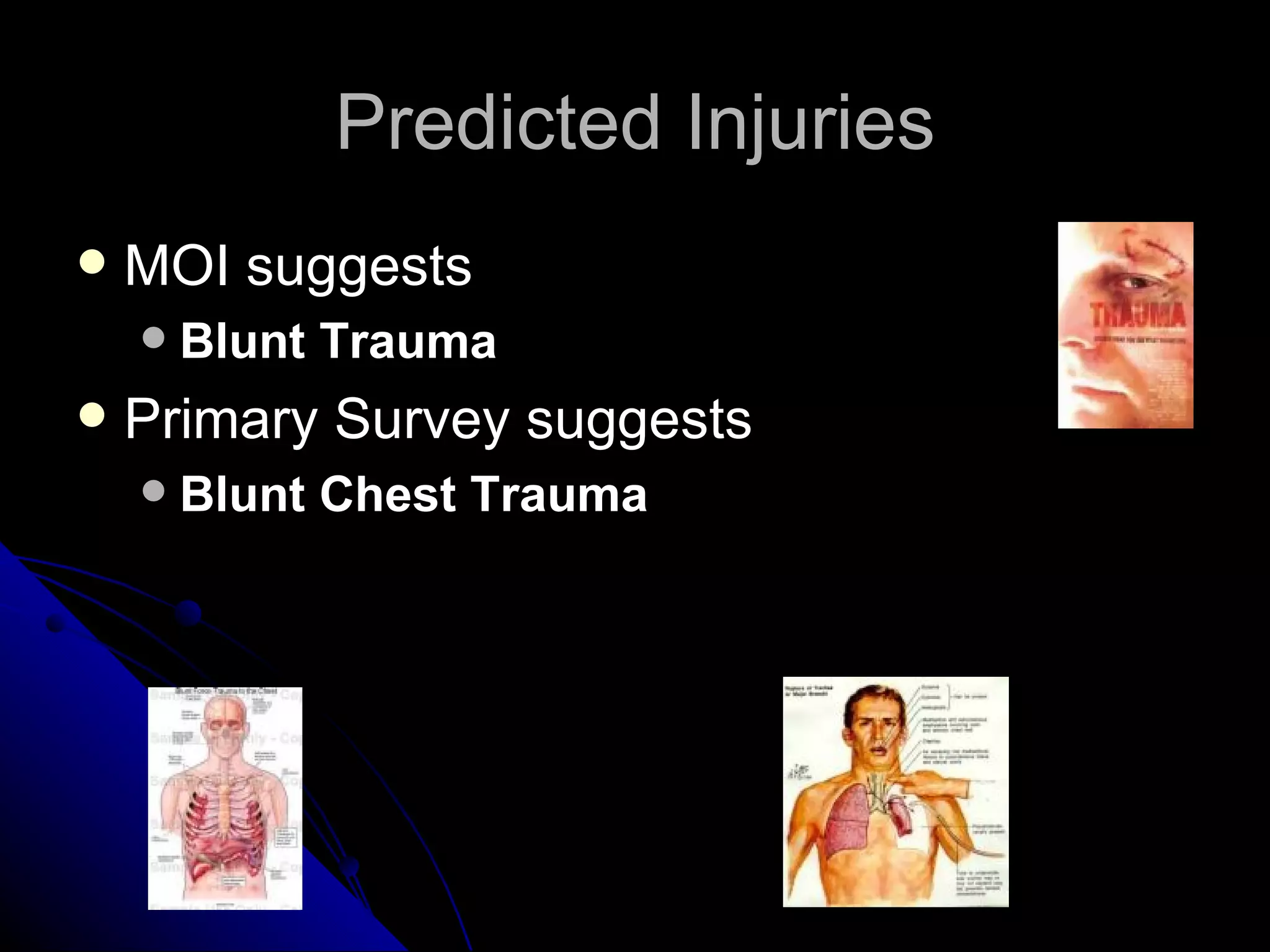
Predicted Injuries
   MOI suggests
       Blunt Trauma
   Primary Survey suggests
       Blunt Chest Trauma
Predicted Injuries
   Possible injuries with blunt chest trauma
       Pneumothorax/ Tension Pneumothorax
       Hemothorax
       Aortic Injuries
       Cardiac Tamponade
       Rib Fractures
       Myocardial and Pulmonary Contusions
       Flail segments
       Scapular Fractures
       Sternal Fractures
Our Patient
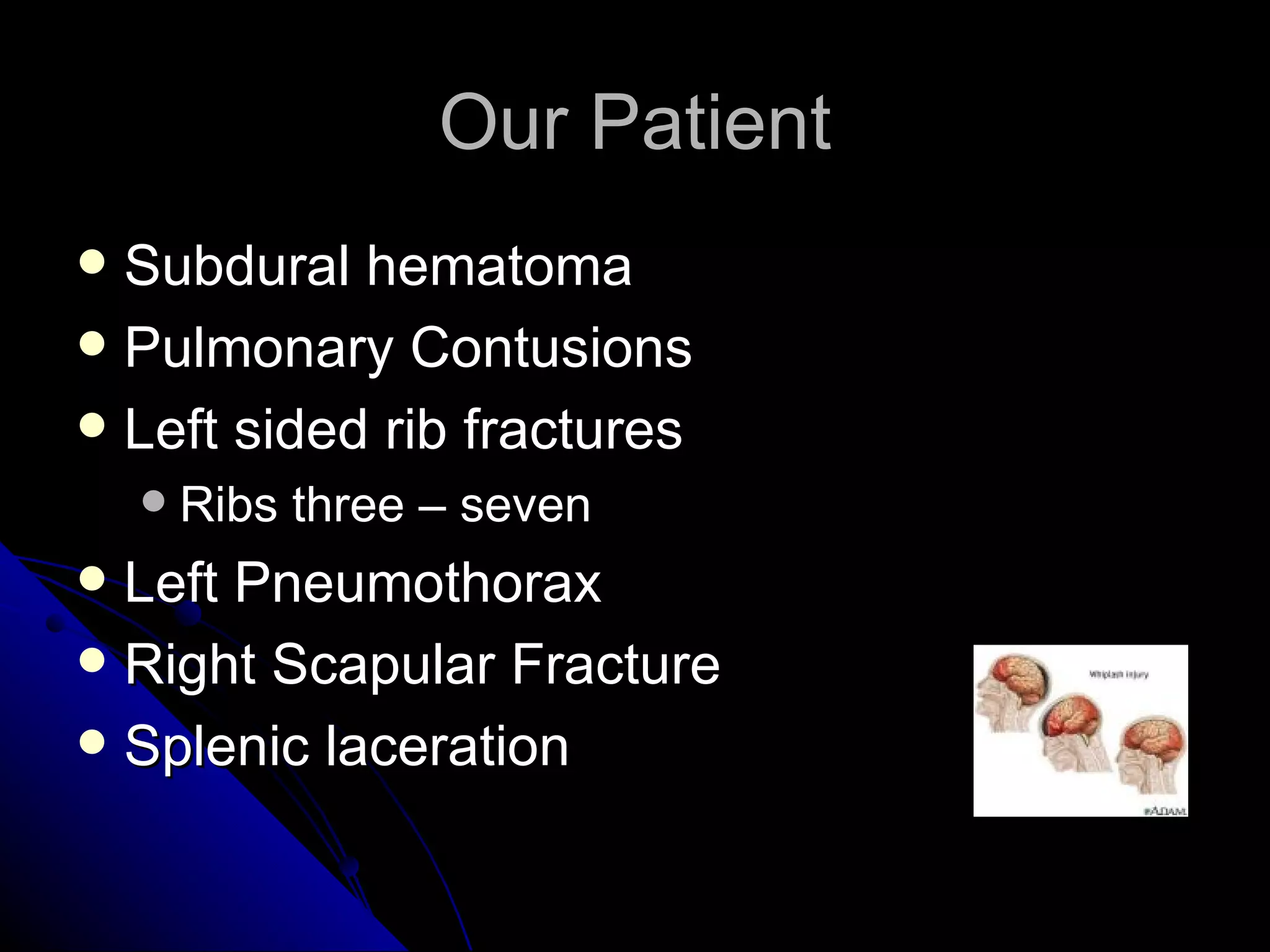
 Subdural hematoma
 Pulmonary Contusions
 Left sided rib fractures
       Ribs three – seven
 Left Pneumothorax
 Right Scapular Fracture
 Splenic laceration
Hospital Course
 Admitted to the trauma ICU
 A chest tube was placed for his
  pneumothorax
 Pulmonology consult for respiratory failure


     Due to massive pulmonary contusions
     Bronchoscopy to remove a mucous plug
Patient Outcome
 Significant improvement over the next 3
  days
 Discharged to home on the 3rd day with a
  PT and OT consult


           QUESTIONS??
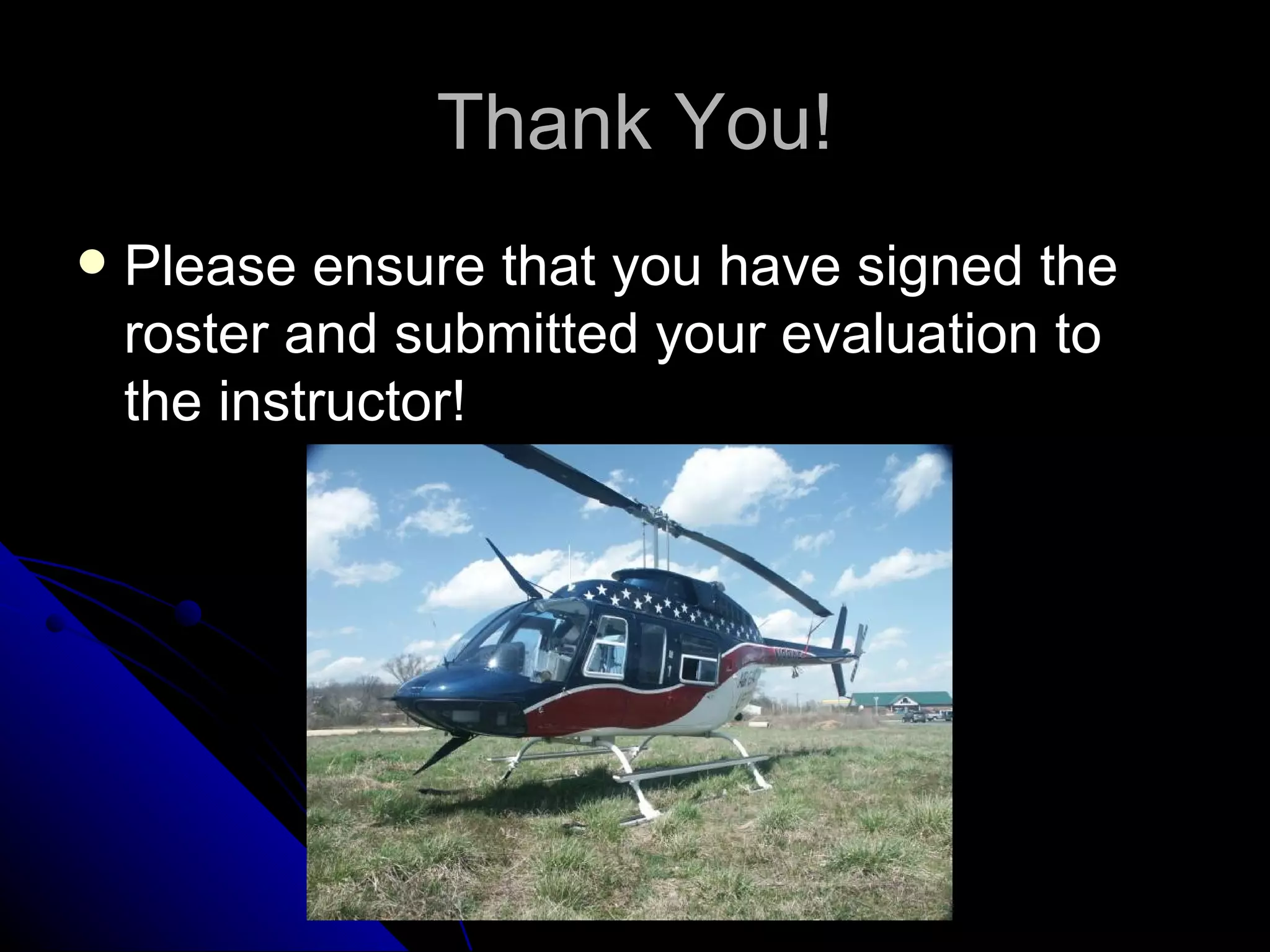
Thank You!
   Please ensure that you have signed the
    roster and submitted your evaluation to
    the instructor!

Trauma unleashed outreach module pp

  • 1.
    Trauma Unleashed! Case Studiesfrom the Field Air Evac EMS, Inc. Outreach Education Module
  • 2.
    You receive acall for an elderly male that was found unresponsive in the hot tub
  • 3.
    Case Study • What does this have to do with trauma? • Is he sick, is he injured, is he sick and injured? • Need more INFORMATION!
  • 4.
    Case Study • What questions do you have? • How long has he been in the hot tub? • How hot is the water? • How old is he? • Any medical Hx?
  • 5.
    Case Study • When you arrive you find an 85 yr old male sitting in the hot tub with agonal breathing and a weak pulse • GCS is 3 • He has a history of a CVA • He has lost control of his bowel and bladder • Hot tub water is 105 degrees • The pt was last seen, last night with no complaints WHAT DO YOU DO? WHAT IS YOUR DX?
  • 6.
    Case Study • What is your initial Diagnosis? • Unconscious patient due to??? • CVA? • MI? • Heat stroke/exposure? • Drug ingestion? • ETOH intoxication?
  • 7.
    Case Study • Could be any one of the aforementioned diagnoses or a combination of two or more…BUT a more pressing matter would be
  • 8.
    Case Study • The patient is extricated from the hot tub • Agonal respirations at 6-8 • Intubated • Large bore IV’s are started and 2 liters of NS are rapidly infused • Vital signs • BP is 60P • HR 140 • His skin is hot and shriveled • He has pressure ulcers on his heels • Crackles are auscultated in all lung fields • Pupils are 2mm and sluggish Any Thoughts? What to do next?
  • 9.
    Case Study • While en route to the hospital the patient remained hypotensive • Dopamine gtt initiated • Patient weight is 180 lbs • What is the dose for Dopamine? • How much should you give?
  • 10.
    Case Study • 10mcg/kg/min of Dopamine initiated • SBP increased to 80 • The quick down and dirty method to calculate Dopamine • Take the wt - 180 • Drop the 0 and subtract 2 • Now you have 16 • That is your cc/hr for 5 mcg/kg/min • Administer 32 cc/hr for 10mcg/kg/min
  • 11.
    Case Study • Why is the patient hypotensive? • Is the patient in Shock? • Distributive? • Hypovolemic? • Obstructive? • Cardiogenic?
  • 12.
    Case Study  Distributive Shock  Decreased systemic vasomotor tone which can result in end-organ dysfunction  Causes  Sepsis  Anaphylaxis  Drug reactions  Neurogenic (Brain or Spinal Cord)
  • 13.
    Case Study  Hypovolemic Shock  Decreased systemic vascular resistance which can result in end-organ dysfunction  Causes  Bloodloss  Severe burns  Third spacing and loss of plasma  Dehydration
  • 14.
    Case Study  Obstructive Shock  Decreased systemic vascular resistance which can result in end-organ dysfunction  Causes  Cardiac Tamponade  Tension Pneumothorax
  • 15.
    Case Study  Cardiogenic Shock  The heart is unable to pump enough blood (both force and volume) for the needs of the body  Causes  Massive MI  Heart Failure  Left or right sided**
  • 16.
    Case Study  What type of shock do you think our patient is in?  Distributive?  Hypovolemic?  Obstructive?  Cardiogenic?
  • 17.
    Case Study • Pt arrives in the ED • GCS remains 3 • Systolic pressure at 80 • HR remains in the 140’s • Rectal temp is 107 • Placed on the ventilator • Additional tests and treatments • CT of the head • CXR • EKG • ABG’s • A cooling blanket is applied What are your thoughts?
  • 18.
    Case Study • CT of the head revealed a lacunar nonhemorrhagic infarct (age unknown) • EKG reveals ST depression in all of the lateral leads • ABG’s • ph 7.3 • pC02 25.1 • HCO3 12.8 • BE -11.5 • CXR – LLL infiltrates Now what do you think? What to do next?
  • 19.
    Case Study • Levophed initiated to increase BP (15mcg/ min) • Pressure not responsive • He received 3 liters of NS when we got the call to transfer this pt to a higher level of care Why is the pt still hypotensive? Have we missed anything?
  • 20.
    Case Study • Remember the ABG • ph 7.3 and BE-11.5 • Acidotic patients DO NOT respond well to vasopressors • Given 1 amp of bicarb • Another liter of NS • Temperature reduced with a cooling blanket to 99.1 • 6000 unit heparin bolus and a gtt was initiated at 1500 units/hr
  • 21.
    Case Study  Arrival at the tertiary care facility  BP was 122/49  RR via the ventilator was increased from 12 to 16 to keep his C02 in the low 30’s  The pt was admitted to the ICU
  • 22.
    Discussion  Admitting Diagnosis  MI  CVA  Hyperthermia  Due to heat exposure  Dehydration  Secondary to heat exposure  Acute Renal Failure
  • 23.
  • 24.
  • 25.
    Truck vs CarBROADSIDE
  • 26.
    Your Patient isthe Driver of the Truck
  • 27.
    Extrication Completed  Patienthas full spinal restriction  What do you do?  What further information do you want?
  • 28.
    Report from FirstResponders  75 yr old male (driver)  + Seatbelt  Airbag deployed  Trapped with prolonged extrication  Pt c/o CP  No surface trauma observed  GCS is 10  Eyes open to pain  Withdraws to pain  Disoriented and conversant NOW WHAT?
  • 29.
    ABC’s  Airway  Open and clear  Breathing  Respirations are 16 and shallow  Circulation  Skin is pale  Diaphoretic  Capillary refill is at 5 sec  Pulses are thready and slow
  • 30.
    Vital Signs  BP: 70/30  HR: 30’s  Pulse Ox was 94% but now does not read  GCS is now 8 and pt becomes combative
  • 31.
    Pre-hospital Course  Airway management with DAI  Ventilated with 100% 02  2 IV’s were established with 2800 ml IV bolus  25 grams of Albumin was infused  Gastric tube was passed for decompression  3 mgs of Atropine  Without effect  Two Epi injections (0.5mg)  Increase HR and BP achieved
  • 32.
    In Hospital Course  VS on arrival were:  BP 93/38  HR 115  EtCO2 30  GCS 3 (DAI)  Trauma protocol started  CXR  Pelvis Xray done (fractured pelvis seen)  Blood transfusion started  Foley inserted with gross bloody urine returned
  • 33.
    Outcome  Patient’s BPand HR steadily declined  Patient coded in spite of all resuscitation efforts  Continued resuscitation was not successful  Diagnosis  Blunt Chest Trauma  Cardiac and pulmonary contusions  Pelvic Fractures
  • 34.
  • 35.
  • 36.
    The Trauma Call  Call is received for a single vehicle accident (MV vs Tree)  There are multiple patients and reports of people trapped in the vehicle  2 EMS units and Fire/Rescue are dispatched  You are one of the medics enroute  What are you thinking?  What are you preparing for?
  • 37.
    First to Arrive You find a total of 4 patients, with 1 trapped  You are 1 and ½ hours from the closest trauma center What do you do? What do you want?
  • 38.
    Triage  You find1 patient trapped and 3 outside the vehicle  You classify 2 major and 2 minor WHO YA GONNA CALL?
  • 39.
    ABC’s  You call for 2 EMS helicopters for the 2 majors  Further assessment reveals one of the patients has a severe head injury  The patient that is trapped c/o severe CP and SOB  Treatment and stabilization is initiated by the ground units
  • 40.
  • 41.
  • 42.
  • 43.
  • 44.
    BIG PICTURE ⇒Focused assessment  The pt with the severe head injury is flown to the closest trauma center  The 2 minor trauma pt’s are ground transported to the closest appropriate facility  The 4th pt that remains trapped inside of the vehicle becomes our focus
  • 45.
    Trauma Assessment  Our Patient  36 yr old male who is awake, talking and c/ o severe CP, back pain and SOB  Remains in the vehicle on his side with his lower extremities trapped
  • 46.
    Primary Assessment  AIRWAY  Patient is vocalizing  BREATHING  Spontaneous breathing  RR 36 and labored  Grunting respirations.  Course rhonchi to all lung fields  Skin is pale
  • 47.
    Primary Assessment  Isbreathing effective?  What interventions are required?
  • 48.
    Primary Assessment  CIRCULATION  Central and peripheral pulses are present  HR 88  Skin remains pale and clammy  No uncontrolled bleeding is observed Intervention: 18g IV started with bolus
  • 49.
    Primary Assessment  DISABILITY  A0x4  GCS 15  Pupils - PERL
  • 50.
    Secondary Assessment  Extrication is complete  Patient is secured on a backboard with a C-Collar and headblocks are in place  Abdomen soft and nontender  Pelvis stable and nontender  MAE well with 4 point pulses  Surface trauma observed  Full thickness lower lip laceration with bleeding controlled
  • 51.
    Secondary Assessment  Vital Signs  HR is 88  RR at 36-40 labored  SpO2 at 80% on 02 NRB  BP not available at this time  Patient is agitated and restless Do you continue with your secondary?
  • 52.
    Interventions  Breathing continues to be ineffective?  Airway management with DAI is performed after the patient has been moved to the aircraft  Prior to lift off  Unsuccessful after three attempts  Failed airway  Combitube rescue device used to successfully secure the airway
  • 53.
    In Flight  Patient had expulsion of gastric contents via the combitube  Suctioning performed  During BV ventilation we observed bloody pulmonary secretions  Suctioning performed  Patient’s EtCO2 started at 63  Down to 39 by arrival to the ED with hyperventilation
  • 54.
    In Flight  Thept remained normotensive  Sp02 increased to 99%  Remained sedated and chemically paralyzed  Received 800cc bolus while enroute to the ED
  • 55.
    Diagnosis  Why arethe pt’s pulmonary secretions bloody?  Why was the pt’s breathing ineffective?  Pneumothorax?  Hemothorax?  Pulmonary Contusions?  Rib Fractures?
  • 56.
    Trauma Room  Intubation/ Combitube removal  Foley  Gastric tube  Trauma protocol  EKG  ABG’s  CXR  CT’s  Head  Neck  Chest  Abdomen and Pelvis  ABG Results  Ph 7.30,PC02 46, P02 198 HC03 22.6  Vent Settings  Fi02 100%, Vt 700, AC@12, No PEEP
  • 57.
    ABG’s  Vent settings were changed to  Fi02 55%  Vt 700  AC@14  PEEP of 5  4 hour ABG results  Ph 7.40  PC02 38  P02 147  HCO3 23.5
  • 58.
    Predicted Injuries  MOI suggests  Blunt Trauma  Primary Survey suggests  Blunt Chest Trauma
  • 59.
    Predicted Injuries  Possible injuries with blunt chest trauma  Pneumothorax/ Tension Pneumothorax  Hemothorax  Aortic Injuries  Cardiac Tamponade  Rib Fractures  Myocardial and Pulmonary Contusions  Flail segments  Scapular Fractures  Sternal Fractures
  • 60.
    Our Patient  Subduralhematoma  Pulmonary Contusions  Left sided rib fractures  Ribs three – seven  Left Pneumothorax  Right Scapular Fracture  Splenic laceration
  • 61.
    Hospital Course  Admittedto the trauma ICU  A chest tube was placed for his pneumothorax  Pulmonology consult for respiratory failure  Due to massive pulmonary contusions  Bronchoscopy to remove a mucous plug
  • 62.
    Patient Outcome  Significantimprovement over the next 3 days  Discharged to home on the 3rd day with a PT and OT consult QUESTIONS??
  • 63.
    Thank You!  Please ensure that you have signed the roster and submitted your evaluation to the instructor!

Editor's Notes

  • #3 The teaching points of this case study will be the different types of shock. This pt will be in both hypovolemic and cardiogenic shock so go over the S/S for each of the 4 shock states. There will be slides for each type of shock.
  • #4 This case study will also have several major problems going on at the same time so stress the importance of not to just focus on the first one you find but continue to predict and treat based on the circumstances surrounding the patient. He will ultimately be dx with CVA, MI, Renal Failure, hyperthermia and hypovolemia due to exposure and dehydration.
  • #5 Stress the importance of a good history, 85% of all diagnosis are based on this alone.
  • #6 Talk about the increased risk and higher mortality rate associated with trauma in the elderly
  • #7 While you are performing your ABC’s stress the importance of thinking ahead concerning MOI and the predicted injuries and conditions you may have to treat.
  • #9 Stress the importance of treating all life threatening conditions found during the primary survey before proceeding to the secondary survey.
  • #10 This is a quick street method to get started on the Dopamine, it will be very close. Share more exact way as well. EMS field guide, PDA, etc… Discuss fluids vs vasopressors for controlling BP.
  • #12 Get input from the class and then the following slides will cover each type of shock
  • #14 Dehydration due to exposure and tempature
  • #16 Predicted injury due to pt’s age and circumstances. Discuss MI coming first and then the exposure or the possiblilty of the MI following the stress on the heart after the exposure. Does it really matter. Discuss the treatment for.
  • #17 Hypovolemic and Cardiogenic and continue appropriate treatments
  • #23 The pt later died from his injuries and never regained consciousness, reiterate the extremely high mortality rates associated with major trauma/illness and the elderly
  • #26 Discuss the importance of MOI and the forces involved to cause this much damage.
  • #27 Was there intrusion into the passenger compartment ? Yes Is the vehicle drivable? No Is there more then 12 inches of intrusion into the passenger compartment? Yes Was the accident at highway speeds (over 40mph)? Yes All these yes questions are predictors of major trauma and the trauma center staff will be asking these questions so they can predict injuries and prepare for the pt’s arrival.
  • #28 Don’t forget your scene safety before the history and start your ABC’s
  • #29 Key points: Elderly, trapped with prolonged extrication, c/o CP what are the predicted injuries? GCS of 10, what could be causing his decreased mental status, head injury ? Hypoxemia? Both?
  • #31 Rapidly deteriorating pt requires aggressive treatment/interventions during your ABC’s. Do you take his airway? Discuss risk vs benefit.
  • #32 Albumin is controversial for use in trauma as a volume expander, has been shown to be associated with poorer outcomes and increased renal failure for trauma pts. The 2 epi injections were done as last ditch effort (thinking outside the box) to prevent the trauma arrest. My partner and I saw the pulse dropping fast and new the pt was seconds away from a CPR situation. It worked!
  • #33 At a Level II trauma center
  • #37 Discuss mass causality situations and the importance of triage and soliciting additional resources when needed.
  • #38 Discuss Ground vs Air transport. Additional resources needed. Discuss the importance of time driven trauma care.
  • #40 Discuss the prediction of injuries based on MOI and S/S of the pt.
  • #42 Discuss forces involved, highway speeds. What is the speed limit of the roadway in which the accident occurred?
  • #43 The vehicle is facing the same direction from which it had come. The tire marks on the shoulder up to the tree suggests that the vehicle left the roadway in a gradual turn. No sharp curves in the roadway and no other vehicles were involved. Vehicle malfunction, driver fell asleep, had a seizure, diabetic problem, all need to be considered along with the obvious.
  • #44 ABC’s while being extricated.
  • #46 Predicted injuries? How and what do you treat while the pt is still trapped.
  • #47 Is breathing effective or ineffective? If ineffective what interventions should you do.
  • #53 We were in the direct sunlight when we attempted intubation on this pt and the sun made it very difficult to observe the airway. Make sure you are out of the direct sunlight when attempted intubation to avoid this problem. Discuss rescue airways.
  • #54 What are bloody pulmonary secretions a sign of : massive pulmonary contusions (in trauma) What is the treatment?
  • #56 All are predicted injuries for this pt. When is the decision to needle a pt’s chest made? After the tension has developed, no that might be to late, before the tension when it is a simple pneumothorax, no to that time as well. The time to decompress is after the pneumothorax and/or hemothorax has caused your breathing to be ineffective in spite of all of your airway and breathing interventions but before the tension develops with the clinical signs present.

  • #57 Level II trauma center. What do these ABG’s reflect and should there be any vent adjustments?
  • #58 Discuss vent changes and why.
  • #60 Discuss the injuries and the associated treatments
  • #61 Mention the amount of force that is needed to break the scapula and the predicted injuries assoc with this much energy.