Golden Principles of  Prehospital Trauma Care Lesson 11
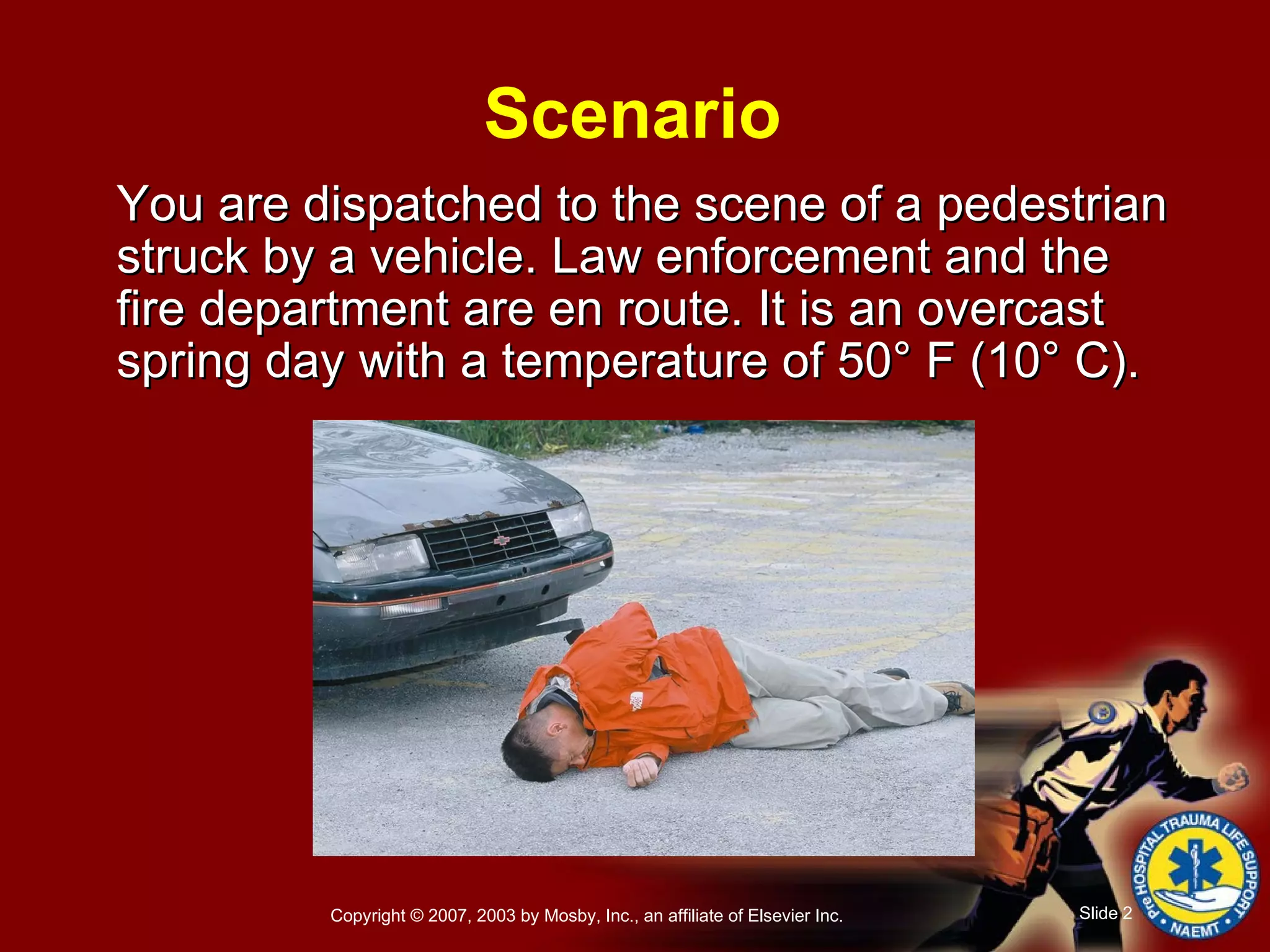
You are dispatched to the scene of a pedestrian struck by a vehicle. Law enforcement and the fire department are en route. It is an overcast spring day with a temperature of 50° F (10° C).  Scenario
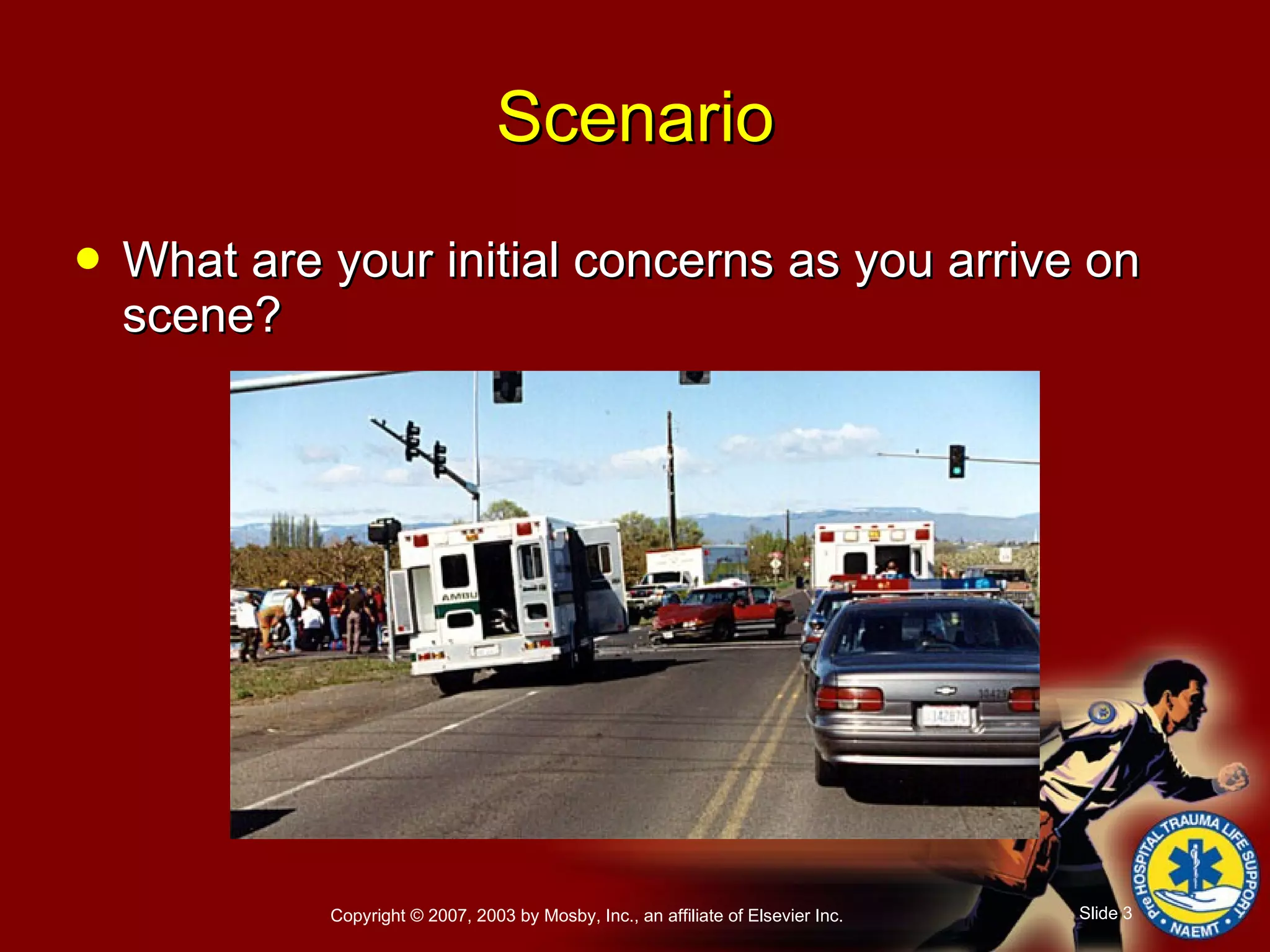
What are your initial concerns as you arrive on scene? Scenario
Ensure the safety of the prehospital care providers and the patient What are the safety concerns with this scene? Scene Size-up
Assess the scene situation to determine the need for additional resources What additional resources may be needed? Scene Size-up
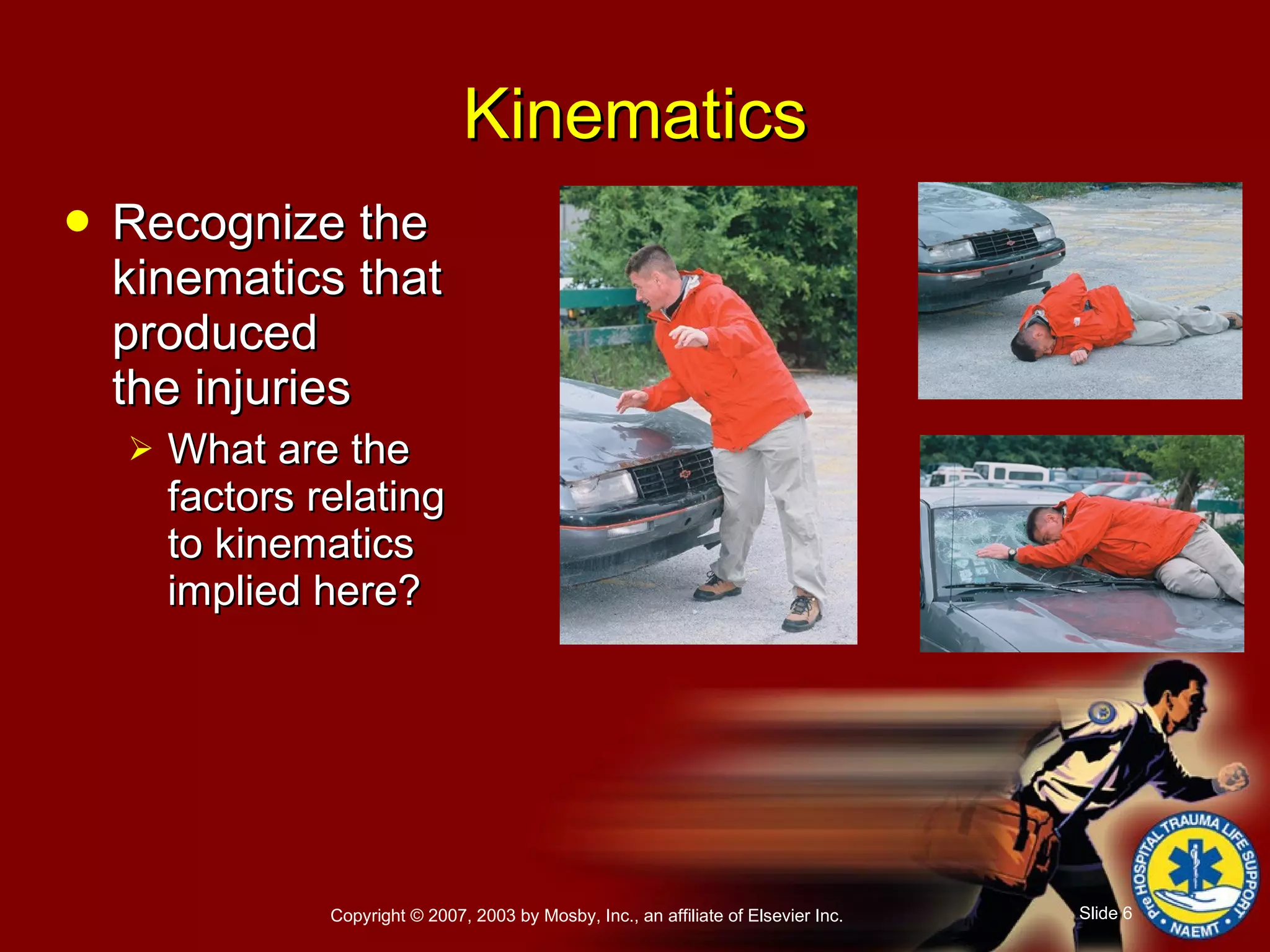
Recognize the kinematics that produced  the injuries What are the factors relating to kinematics  implied here? Kinematics
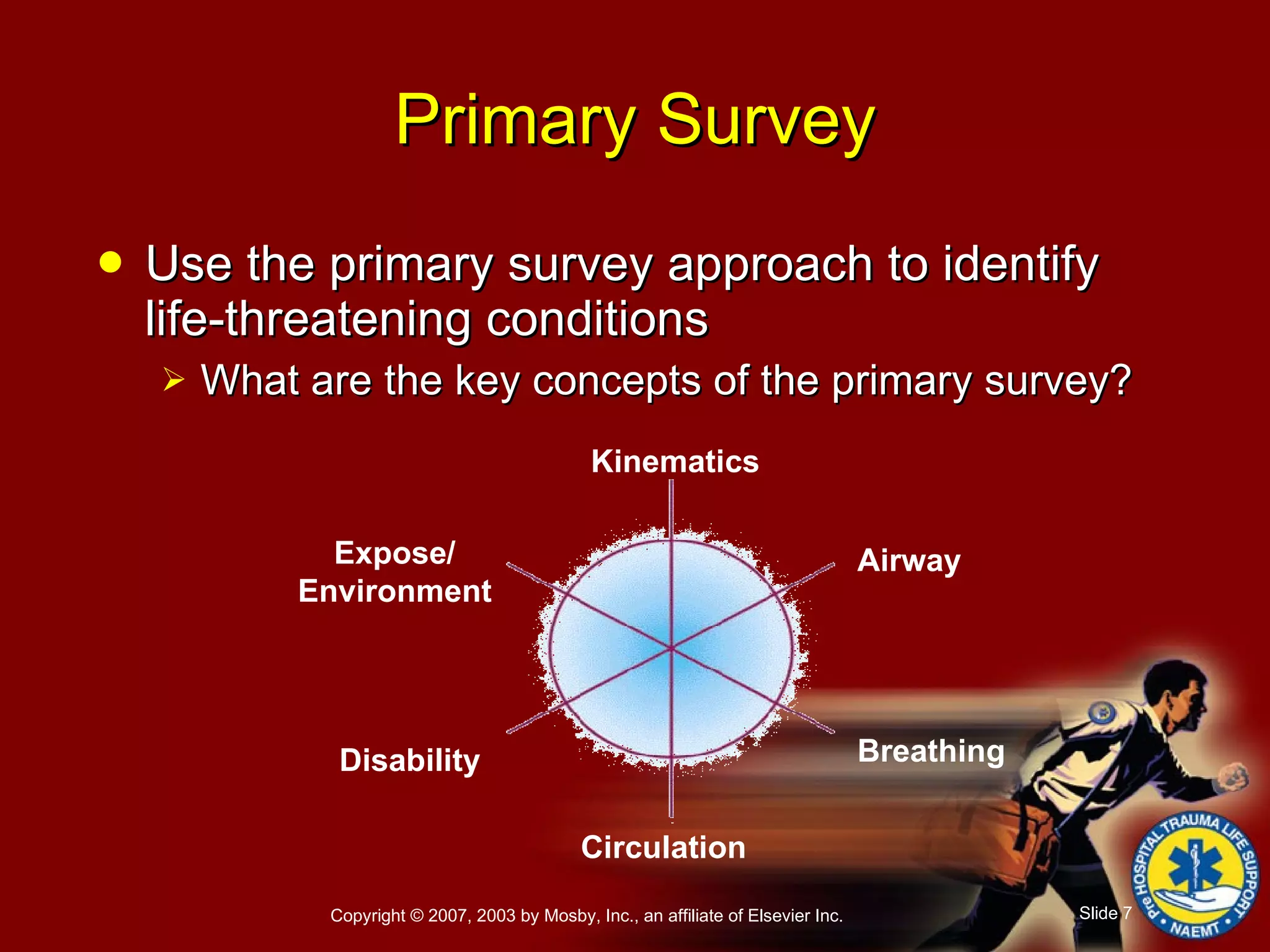
Use the primary survey approach to identify life-threatening conditions What are the key concepts of the primary survey? Primary Survey Breathing Airway Kinematics Circulation Disability Expose/ Environment
Provide appropriate management while maintaining cervical spine stabilization The patient has noisy ventilations and blood is draining from the oropharynx What should be considered when managing this airway? Scenario
The patient’s ventilatory rate is 6 and is shallow. Cyanosis is visible on the patient’s face and fingers. There is bruising across the chest and decreased breath sounds are heard on the left. GCS score is 7 (E-2, V-1, M-4). Support ventilation and deliver oxygen to maintain SpO 2  of 95% or more. How can this be accomplished? Scenario
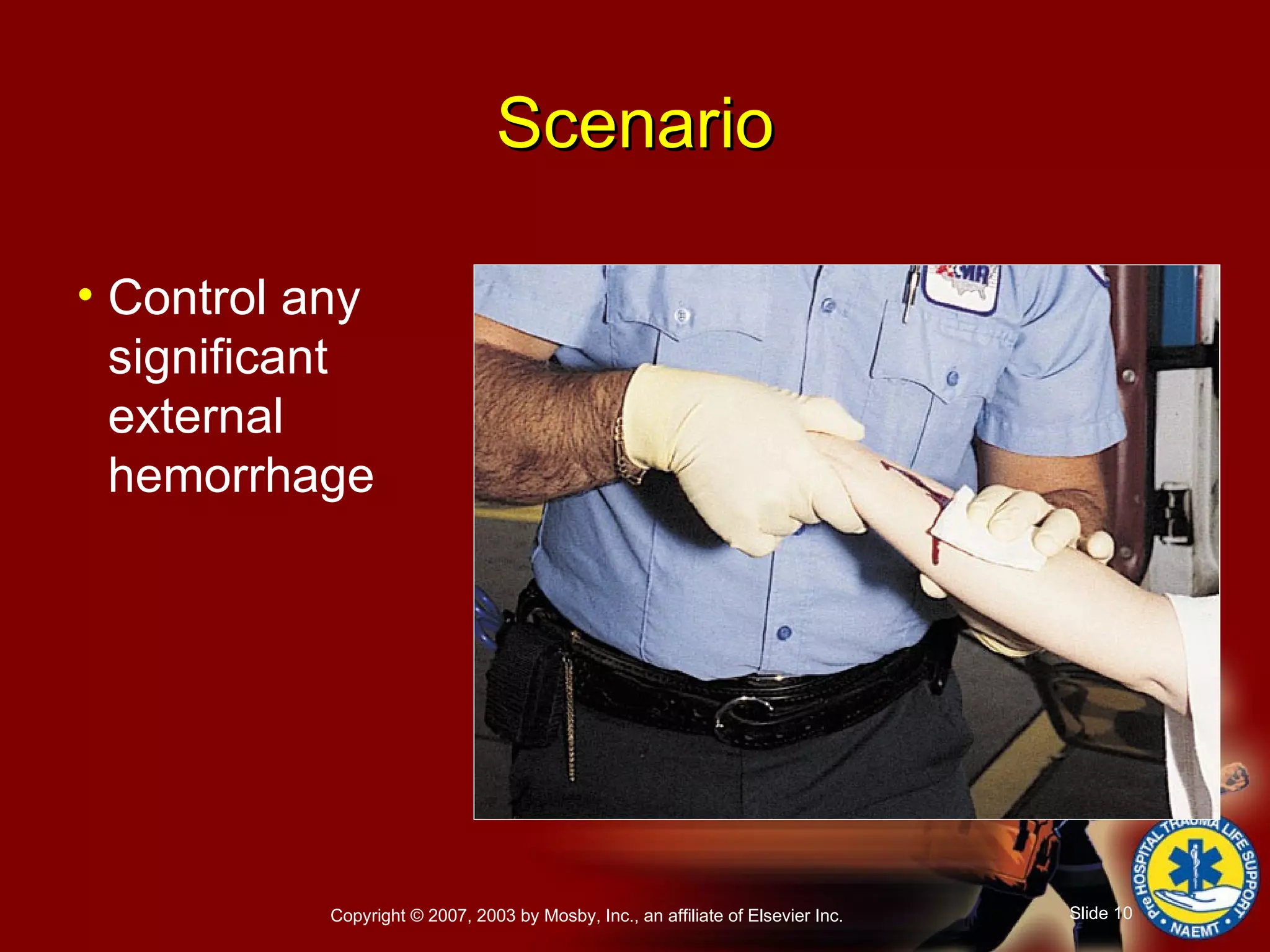
Scenario Control any significant  external hemorrhage
Direct pressure controls the external hemorrhage from the right arm. The radial pulse is weak and rapid at about 140 beats/min. The patient is pale, cold, and clammy. There is crepitus and tenderness on palpation of the pelvis and a left thigh deformity consistent with a left midshaft femur fracture. How would you manage these findings? Scenario
Provide basic shock therapy, including restoring and maintaining normal body temperature and appropriately splinting musculoskeletal injuries  Consider the use of the PASG for patients with decompensated shock (SBP less than 90 mm Hg) and suspected pelvic, intraperitoneal, or retroperitoneal hemorrhage; and in patients with profound hypotension (SBP less than 60 mm Hg) Shock
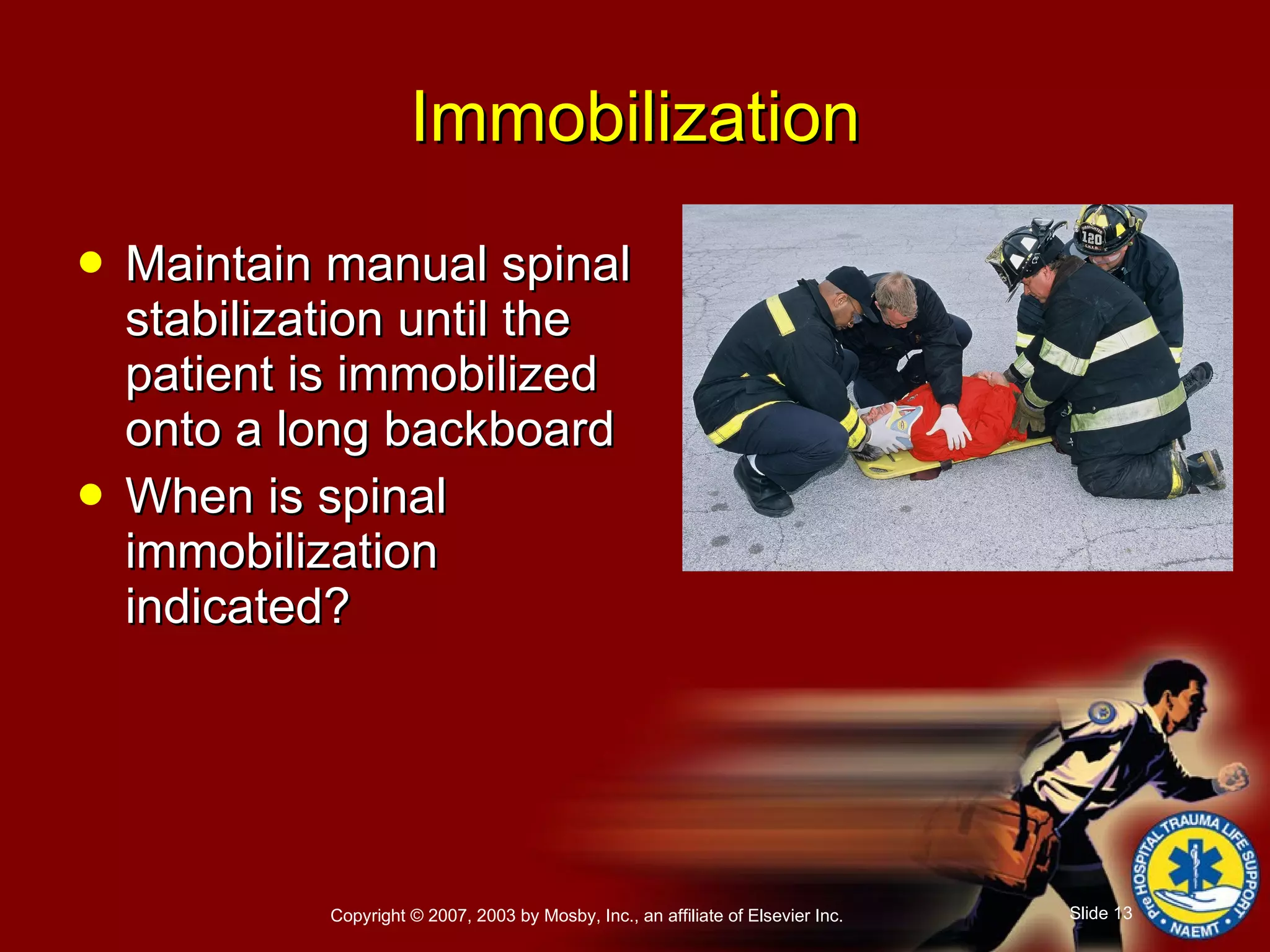
Maintain manual spinal stabilization until the patient is immobilized onto a long backboard When is spinal immobilization indicated?  Immobilization
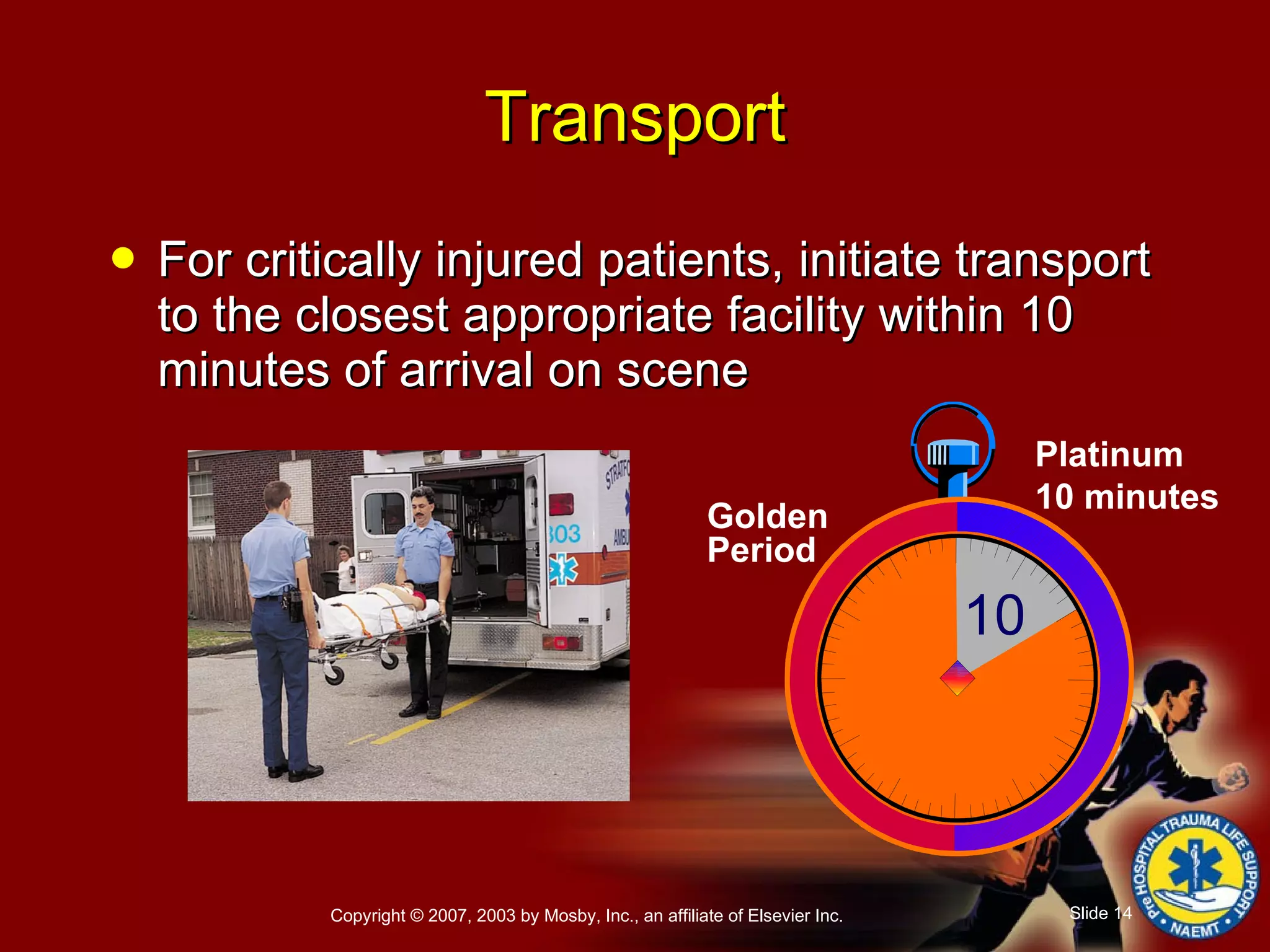
For critically injured patients, initiate transport to the closest appropriate facility within 10 minutes of arrival on scene Transport Platinum 10 minutes Golden  Period 10
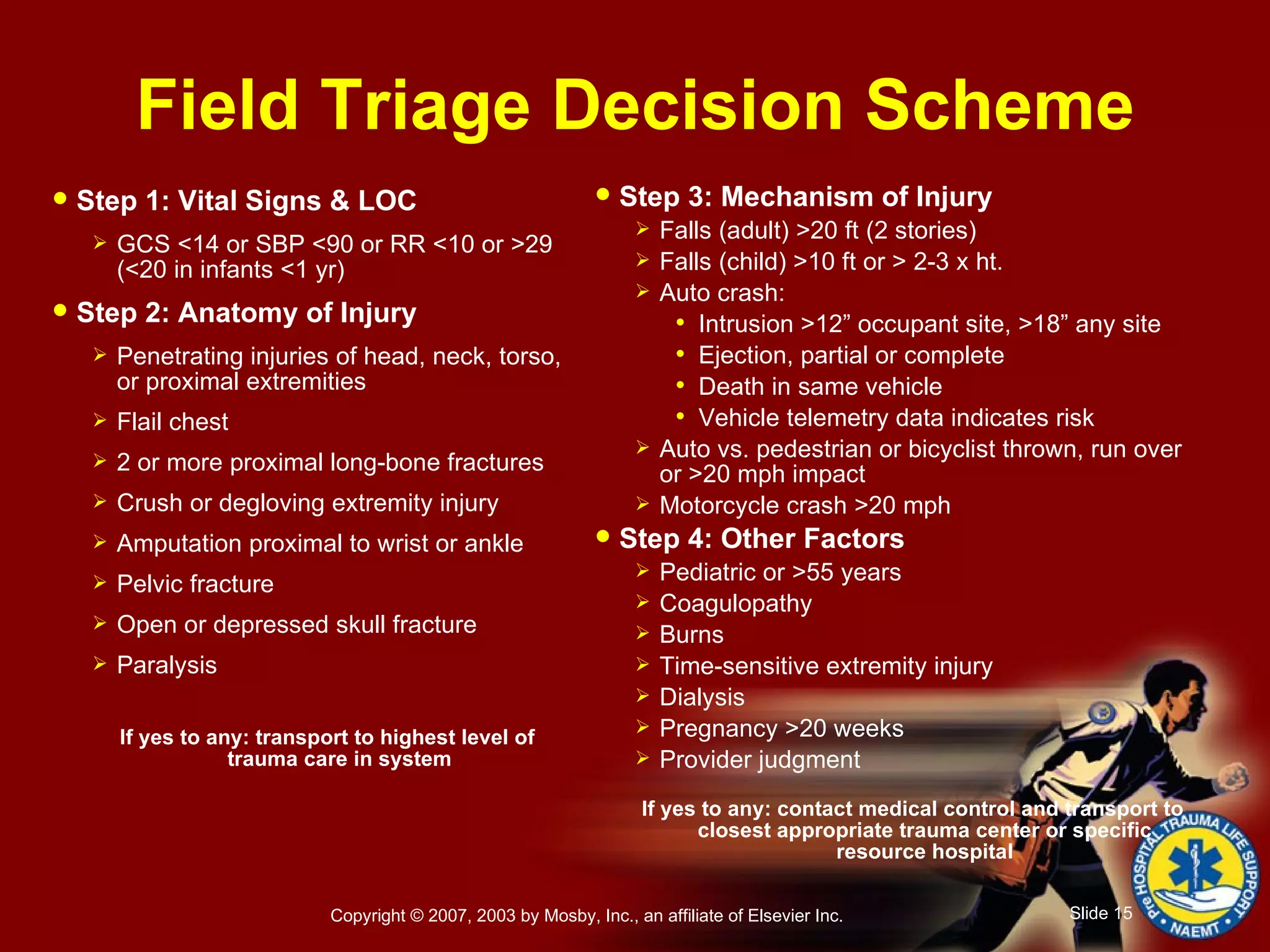
Field Triage Decision Scheme Step 1: Vital Signs & LOC GCS <14 or SBP <90 or RR <10 or >29 (<20 in infants <1 yr) Step 2: Anatomy of Injury Penetrating injuries of head, neck, torso, or proximal extremities Flail chest 2 or more proximal long-bone fractures Crush or degloving extremity injury Amputation proximal to wrist or ankle Pelvic fracture Open or depressed skull fracture Paralysis If yes to any: transport to highest level of trauma care in system Step 3: Mechanism of Injury Falls (adult) >20 ft (2 stories) Falls (child) >10 ft or > 2-3 x ht. Auto crash: Intrusion >12” occupant site, >18” any site Ejection, partial or complete Death in same vehicle Vehicle telemetry data indicates risk Auto vs. pedestrian or bicyclist thrown, run over or >20 mph impact Motorcycle crash >20 mph Step 4: Other Factors Pediatric or >55 years Coagulopathy Burns Time-sensitive extremity injury Dialysis Pregnancy >20 weeks Provider judgment If yes to any: contact medical control and transport to closest appropriate trauma center or specific resource hospital
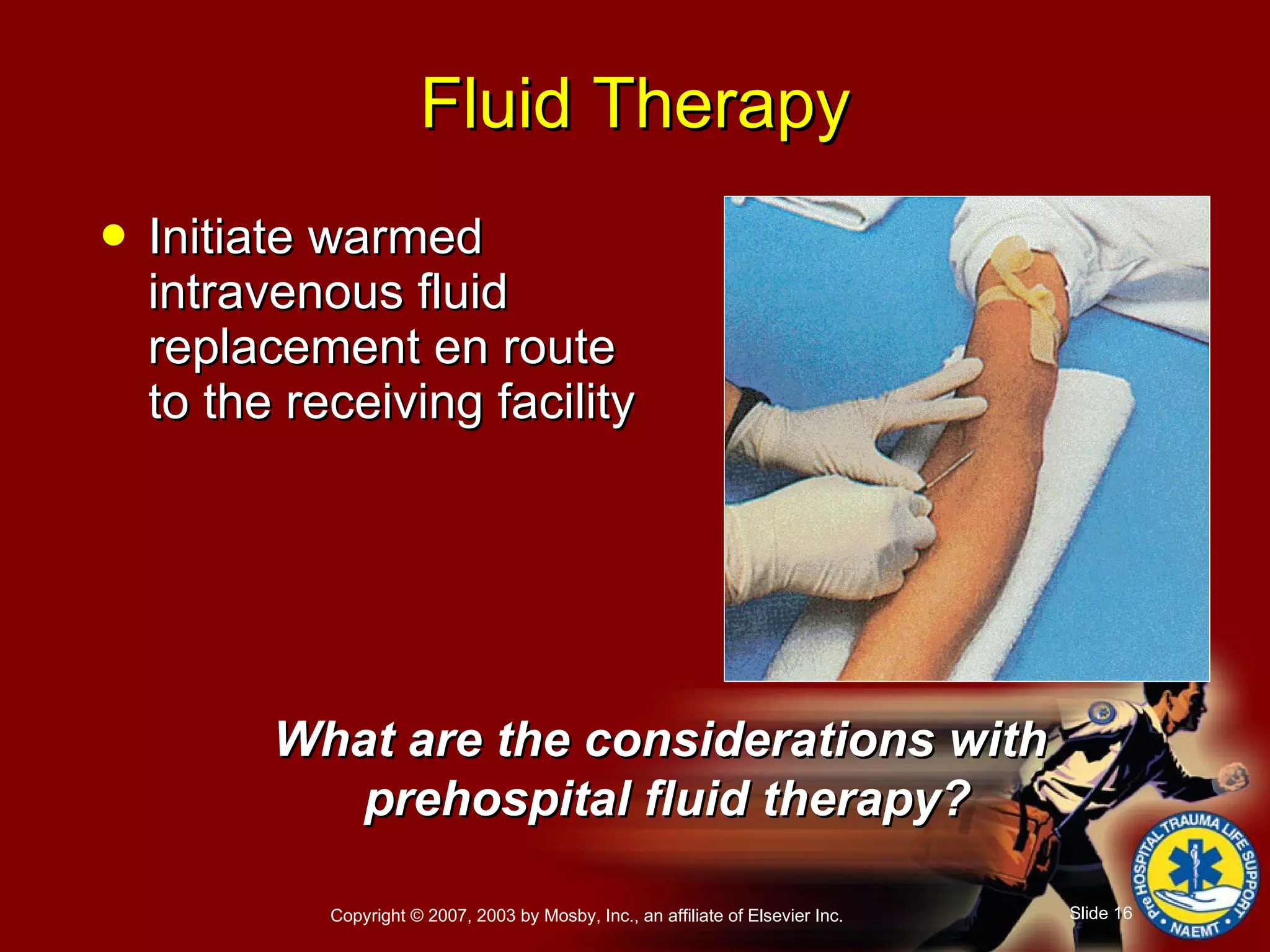
Initiate warmed intravenous fluid replacement en route to the receiving facility Fluid Therapy What are the considerations with  prehospital fluid therapy?
Ascertain the patient’s medical history and perform a secondary survey when life-threatening problems have been satisfactorily managed or have been ruled out. Scenario
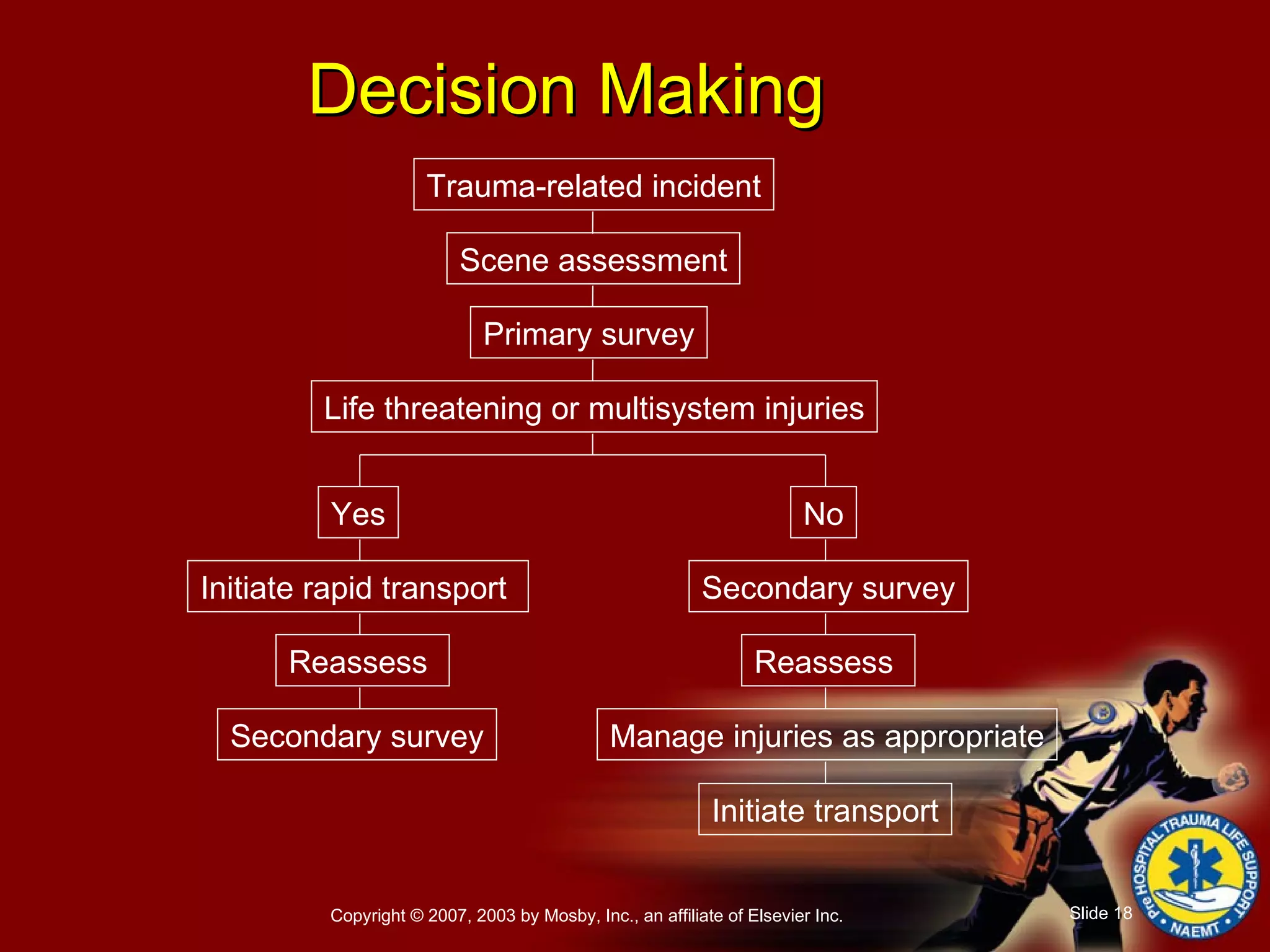
Decision Making Trauma-related incident Scene assessment Primary survey Life threatening or multisystem injuries No Yes Initiate rapid transport  Reassess  Secondary survey Secondary survey Reassess  Manage injuries as appropriate Initiate transport
Above all,  do no further harm.
Fundamental Principles Rapid assessment Key field interventions Rapid transport to the closest appropriate facility
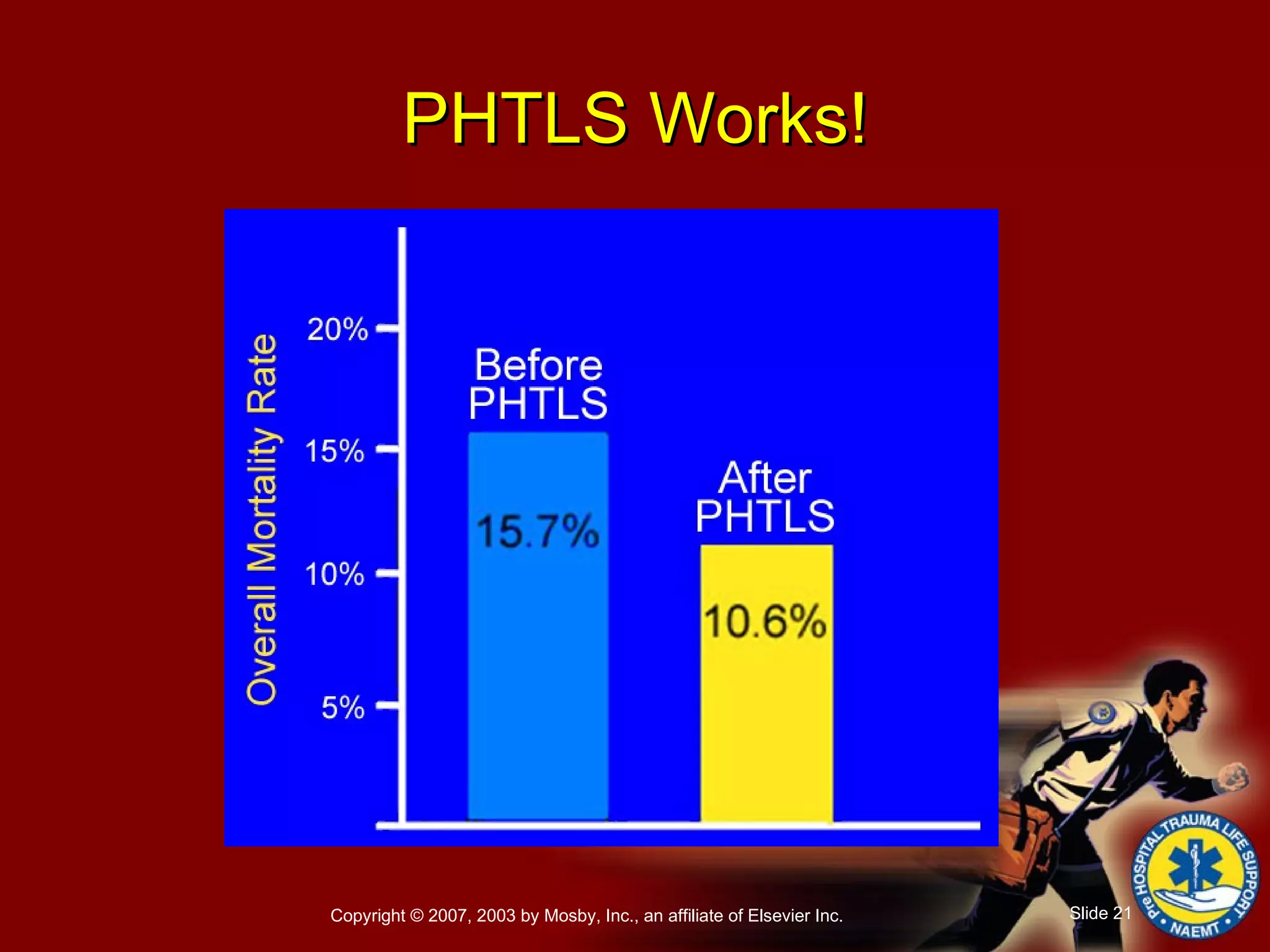
PHTLS Works!
QUESTIONS?

Lesson 11

  • 1.
    Golden Principles of Prehospital Trauma Care Lesson 11
  • 2.
    You are dispatchedto the scene of a pedestrian struck by a vehicle. Law enforcement and the fire department are en route. It is an overcast spring day with a temperature of 50° F (10° C). Scenario
  • 3.
    What are yourinitial concerns as you arrive on scene? Scenario
  • 4.
    Ensure the safetyof the prehospital care providers and the patient What are the safety concerns with this scene? Scene Size-up
  • 5.
    Assess the scenesituation to determine the need for additional resources What additional resources may be needed? Scene Size-up
  • 6.
    Recognize the kinematicsthat produced the injuries What are the factors relating to kinematics implied here? Kinematics
  • 7.
    Use the primarysurvey approach to identify life-threatening conditions What are the key concepts of the primary survey? Primary Survey Breathing Airway Kinematics Circulation Disability Expose/ Environment
  • 8.
    Provide appropriate managementwhile maintaining cervical spine stabilization The patient has noisy ventilations and blood is draining from the oropharynx What should be considered when managing this airway? Scenario
  • 9.
    The patient’s ventilatoryrate is 6 and is shallow. Cyanosis is visible on the patient’s face and fingers. There is bruising across the chest and decreased breath sounds are heard on the left. GCS score is 7 (E-2, V-1, M-4). Support ventilation and deliver oxygen to maintain SpO 2 of 95% or more. How can this be accomplished? Scenario
  • 10.
    Scenario Control anysignificant external hemorrhage
  • 11.
    Direct pressure controlsthe external hemorrhage from the right arm. The radial pulse is weak and rapid at about 140 beats/min. The patient is pale, cold, and clammy. There is crepitus and tenderness on palpation of the pelvis and a left thigh deformity consistent with a left midshaft femur fracture. How would you manage these findings? Scenario
  • 12.
    Provide basic shocktherapy, including restoring and maintaining normal body temperature and appropriately splinting musculoskeletal injuries Consider the use of the PASG for patients with decompensated shock (SBP less than 90 mm Hg) and suspected pelvic, intraperitoneal, or retroperitoneal hemorrhage; and in patients with profound hypotension (SBP less than 60 mm Hg) Shock
  • 13.
    Maintain manual spinalstabilization until the patient is immobilized onto a long backboard When is spinal immobilization indicated? Immobilization
  • 14.
    For critically injuredpatients, initiate transport to the closest appropriate facility within 10 minutes of arrival on scene Transport Platinum 10 minutes Golden Period 10
  • 15.
    Field Triage DecisionScheme Step 1: Vital Signs & LOC GCS <14 or SBP <90 or RR <10 or >29 (<20 in infants <1 yr) Step 2: Anatomy of Injury Penetrating injuries of head, neck, torso, or proximal extremities Flail chest 2 or more proximal long-bone fractures Crush or degloving extremity injury Amputation proximal to wrist or ankle Pelvic fracture Open or depressed skull fracture Paralysis If yes to any: transport to highest level of trauma care in system Step 3: Mechanism of Injury Falls (adult) >20 ft (2 stories) Falls (child) >10 ft or > 2-3 x ht. Auto crash: Intrusion >12” occupant site, >18” any site Ejection, partial or complete Death in same vehicle Vehicle telemetry data indicates risk Auto vs. pedestrian or bicyclist thrown, run over or >20 mph impact Motorcycle crash >20 mph Step 4: Other Factors Pediatric or >55 years Coagulopathy Burns Time-sensitive extremity injury Dialysis Pregnancy >20 weeks Provider judgment If yes to any: contact medical control and transport to closest appropriate trauma center or specific resource hospital
  • 16.
    Initiate warmed intravenousfluid replacement en route to the receiving facility Fluid Therapy What are the considerations with prehospital fluid therapy?
  • 17.
    Ascertain the patient’smedical history and perform a secondary survey when life-threatening problems have been satisfactorily managed or have been ruled out. Scenario
  • 18.
    Decision Making Trauma-relatedincident Scene assessment Primary survey Life threatening or multisystem injuries No Yes Initiate rapid transport Reassess Secondary survey Secondary survey Reassess Manage injuries as appropriate Initiate transport
  • 19.
    Above all, do no further harm.
  • 20.
    Fundamental Principles Rapidassessment Key field interventions Rapid transport to the closest appropriate facility
  • 21.
  • 22.