Initial Assessment and Management of Trauma Capt. Mike Bevers Physician’s Assistant, 173 rd  MDF
Introduction Trauma Leading killer from ages 1 to 44 Up to one-third of deaths are preventable
Introduction Golden Hour Time to reach operating room NOT  time for transport NOT  time in Emergency Department
Introduction EMS does  NOT  have a Golden Hour EMS has a  Platinum Ten Minutes
Introduction Patients in Golden Hour must be: Recognized quickly Transported to  APPROPRIATE  facility
Introduction Survival depends on assessment skills Good assessment results from An organized approach Clearly defined priorities
Size-Up Safety Scene How does scene look? How many patients? Where are they? Situation Additional resources? Critical vs non-critical patient?
Initial Assessment (Primary Survey) Find life threats If life threat present,  CORRECT IT! If life threat can’t be corrected Support ABCs TRANSPORT!!
Primary Survey With critical trauma you may never get beyond primary survey
Airway with C-Spine Control (if MOI dictates) You don’t need a C-collar yet Return head to neutral position Stabilize without traction
Airway Noisy breathing is obstructed breathing But all obstructed breathing is not noisy
Airway Anticipate airway problems with Decreased level of consciousness Head trauma Facial trauma Neck trauma Upper chest trauma Open it, Clear it, Maintain it
Breathing Is air moving? Is it moving adequately? Is oxygen getting to the blood?
Breathing Look Listen Feel
Breathing Give Oxygen immediately if: Decreased level of consciousness ? Shock ? Severe hemorrhage Chest pain Chest trauma Dyspnea Respiratory distress
Breathing If you think about giving oxygen,  GIVE IT!!
Breathing Consider assisting ventilations if: Respirations <12 Respirations >24 Shallow respirations Respiratory effort increased
Breathing If you can’t tell if ventilations are adequate, they aren’t!! If you are wondering whether or not to bag the patient, you should!!
Breathing If respirations are compromised: Expose chest Inspect front and back Palpate front and back Auscultate front and back
Circulation Is heart beating? Is there serious external bleeding? Is the patient perfusing?
Circulation Does patient have radial pulse? Absent radial = systolic BP < 80 Does patient have carotid pulse? Absent carotid = systolic BP < 60
Circulation No carotid pulse? Extricate CPR Pneumatic Antishock Garment Run!!!! Survival rate from cardiac arrest secondary to blunt trauma is < 1%
Circulation Serious external bleeding? Direct pressure (hand, bandage, PASG) Tourniquet as last resort All bleeding stops eventually!
Circulation Is patient in shock? Cool, pale, moist skin = shock, until proven otherwise Capillary refill > 2 sec = shock until proven otherwise Restlessness, anxiety, combativeness = shock until proven otherwise
Circulation If possible internal hemorrhage, QUICKLY expose, palpate: Abdomen – 2 liters Pelvis – 2 liters Thighs – 1.5 liter / side
Disability (CNS Function) Level of Consciousness = Best brain perfusion indicator Use AVPU initially Check pupils The eyes are the window of the CNS
Disability (CNS Function) Decreased LOC in trauma = Head injury until proven otherwise
Expose and Examine You can’t treat what you don’t find! If you don’t look, you won’t see! Remove ALL clothing from critical patients ASAP Avoid delaying resuscitation while disrobing patient Cover patient with blanket when finished
The “Load and Go” Situations Head injury with decreased LOC Airway obstruction unrelieved by mechanical methods Conditions resulting in inadequate breathing Shock Conditions that rapidly lead to shock Tender, distended abdomen Pelvic instability Bilateral femur fractures Traumatic cardiopulmonary arrest
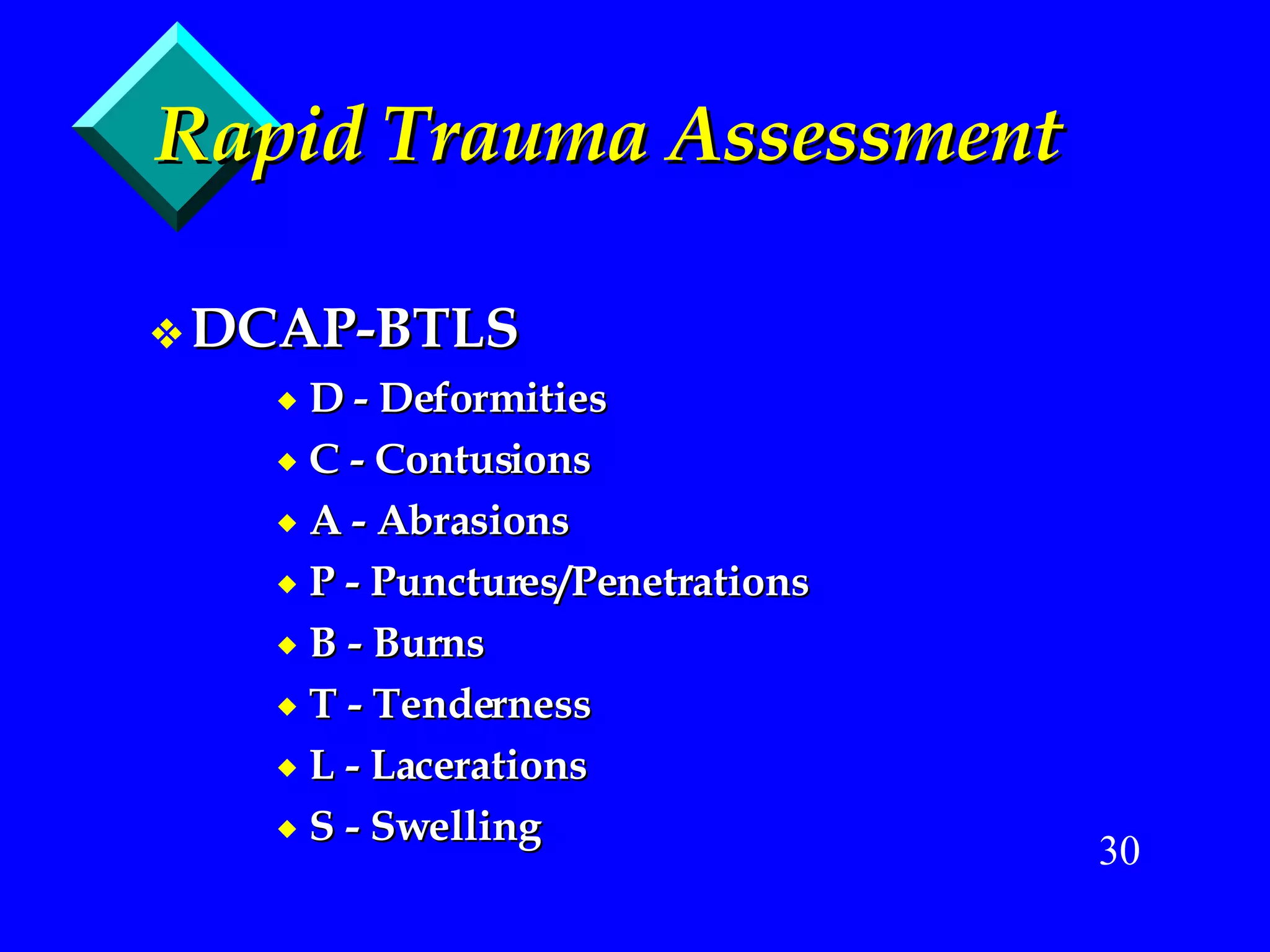
Rapid Trauma Assessment DCAP-BTLS D - Deformities C - Contusions A - Abrasions P - Punctures/Penetrations B - Burns T - Tenderness L - Lacerations S - Swelling
Initial Assessment A blood pressure or an exact respiratory or pulse rate is NOT necessary to tell that your patient is critical !!!!!
Initial Assessment If the patient looks sick, he’s sick!!!
Initial Resuscitation Treat as you go! Aggressively correct hypoxia and inadequate ventilation. Control external blood loss.
Initial Resuscitation Immobilize C-spine ? MOI (rigid collar) Keep airway open Oxygenate Rapidly extricate to long board Begin assisted ventilation with BVM Expose Apply and inflate PASG Transport Reassess  and report in route
Initial Resuscitation Minimum Time On Scene Maximum Treatment In Route
Detailed Exam (Secondary Survey) History and Physical Exam You  WILL  get here with  MOST  trauma patients Perform  ONLY  after initial assessment is completed and life threats corrected Do  NOT  hold critical patients in field for detailed exam
Physical Exam Head to Toe, organized approach Every patient, same way, every time Top to bottom; near to far, front & back Look--Listen--Feel
History Chief complaint What  PATIENT  says problem is Not necessarily what you see
History A = Allergies M = Medications P = Past medical history L = Last oral intake E = Events leading up to incident
Definitive Field Care Performed  ONLY  on stable patients
Definitive Field Care Stable patients can receive attention for individual injuries before transport Bandaging Splinting Reassess carefully for hidden problems If patient becomes unstable at any time,   TRANSPORT
Reevaluation Ventilation and perfusion status Repeat vital signs Continued stabilization of identified problems Continued reassessment for unidentified problems

Initial Assess Trauma

  • 1.
    Initial Assessment andManagement of Trauma Capt. Mike Bevers Physician’s Assistant, 173 rd MDF
  • 2.
    Introduction Trauma Leadingkiller from ages 1 to 44 Up to one-third of deaths are preventable
  • 3.
    Introduction Golden HourTime to reach operating room NOT time for transport NOT time in Emergency Department
  • 4.
    Introduction EMS does NOT have a Golden Hour EMS has a Platinum Ten Minutes
  • 5.
    Introduction Patients inGolden Hour must be: Recognized quickly Transported to APPROPRIATE facility
  • 6.
    Introduction Survival dependson assessment skills Good assessment results from An organized approach Clearly defined priorities
  • 7.
    Size-Up Safety SceneHow does scene look? How many patients? Where are they? Situation Additional resources? Critical vs non-critical patient?
  • 8.
    Initial Assessment (PrimarySurvey) Find life threats If life threat present, CORRECT IT! If life threat can’t be corrected Support ABCs TRANSPORT!!
  • 9.
    Primary Survey Withcritical trauma you may never get beyond primary survey
  • 10.
    Airway with C-SpineControl (if MOI dictates) You don’t need a C-collar yet Return head to neutral position Stabilize without traction
  • 11.
    Airway Noisy breathingis obstructed breathing But all obstructed breathing is not noisy
  • 12.
    Airway Anticipate airwayproblems with Decreased level of consciousness Head trauma Facial trauma Neck trauma Upper chest trauma Open it, Clear it, Maintain it
  • 13.
    Breathing Is airmoving? Is it moving adequately? Is oxygen getting to the blood?
  • 14.
  • 15.
    Breathing Give Oxygenimmediately if: Decreased level of consciousness ? Shock ? Severe hemorrhage Chest pain Chest trauma Dyspnea Respiratory distress
  • 16.
    Breathing If youthink about giving oxygen, GIVE IT!!
  • 17.
    Breathing Consider assistingventilations if: Respirations <12 Respirations >24 Shallow respirations Respiratory effort increased
  • 18.
    Breathing If youcan’t tell if ventilations are adequate, they aren’t!! If you are wondering whether or not to bag the patient, you should!!
  • 19.
    Breathing If respirationsare compromised: Expose chest Inspect front and back Palpate front and back Auscultate front and back
  • 20.
    Circulation Is heartbeating? Is there serious external bleeding? Is the patient perfusing?
  • 21.
    Circulation Does patienthave radial pulse? Absent radial = systolic BP < 80 Does patient have carotid pulse? Absent carotid = systolic BP < 60
  • 22.
    Circulation No carotidpulse? Extricate CPR Pneumatic Antishock Garment Run!!!! Survival rate from cardiac arrest secondary to blunt trauma is < 1%
  • 23.
    Circulation Serious externalbleeding? Direct pressure (hand, bandage, PASG) Tourniquet as last resort All bleeding stops eventually!
  • 24.
    Circulation Is patientin shock? Cool, pale, moist skin = shock, until proven otherwise Capillary refill > 2 sec = shock until proven otherwise Restlessness, anxiety, combativeness = shock until proven otherwise
  • 25.
    Circulation If possibleinternal hemorrhage, QUICKLY expose, palpate: Abdomen – 2 liters Pelvis – 2 liters Thighs – 1.5 liter / side
  • 26.
    Disability (CNS Function)Level of Consciousness = Best brain perfusion indicator Use AVPU initially Check pupils The eyes are the window of the CNS
  • 27.
    Disability (CNS Function)Decreased LOC in trauma = Head injury until proven otherwise
  • 28.
    Expose and ExamineYou can’t treat what you don’t find! If you don’t look, you won’t see! Remove ALL clothing from critical patients ASAP Avoid delaying resuscitation while disrobing patient Cover patient with blanket when finished
  • 29.
    The “Load andGo” Situations Head injury with decreased LOC Airway obstruction unrelieved by mechanical methods Conditions resulting in inadequate breathing Shock Conditions that rapidly lead to shock Tender, distended abdomen Pelvic instability Bilateral femur fractures Traumatic cardiopulmonary arrest
  • 30.
    Rapid Trauma AssessmentDCAP-BTLS D - Deformities C - Contusions A - Abrasions P - Punctures/Penetrations B - Burns T - Tenderness L - Lacerations S - Swelling
  • 31.
    Initial Assessment Ablood pressure or an exact respiratory or pulse rate is NOT necessary to tell that your patient is critical !!!!!
  • 32.
    Initial Assessment Ifthe patient looks sick, he’s sick!!!
  • 33.
    Initial Resuscitation Treatas you go! Aggressively correct hypoxia and inadequate ventilation. Control external blood loss.
  • 34.
    Initial Resuscitation ImmobilizeC-spine ? MOI (rigid collar) Keep airway open Oxygenate Rapidly extricate to long board Begin assisted ventilation with BVM Expose Apply and inflate PASG Transport Reassess and report in route
  • 35.
    Initial Resuscitation MinimumTime On Scene Maximum Treatment In Route
  • 36.
    Detailed Exam (SecondarySurvey) History and Physical Exam You WILL get here with MOST trauma patients Perform ONLY after initial assessment is completed and life threats corrected Do NOT hold critical patients in field for detailed exam
  • 37.
    Physical Exam Headto Toe, organized approach Every patient, same way, every time Top to bottom; near to far, front & back Look--Listen--Feel
  • 38.
    History Chief complaintWhat PATIENT says problem is Not necessarily what you see
  • 39.
    History A =Allergies M = Medications P = Past medical history L = Last oral intake E = Events leading up to incident
  • 40.
    Definitive Field CarePerformed ONLY on stable patients
  • 41.
    Definitive Field CareStable patients can receive attention for individual injuries before transport Bandaging Splinting Reassess carefully for hidden problems If patient becomes unstable at any time, TRANSPORT
  • 42.
    Reevaluation Ventilation andperfusion status Repeat vital signs Continued stabilization of identified problems Continued reassessment for unidentified problems