Author(s): Tim Maxim, BA, RN, 2011
License: Unless otherwise noted, this material is made available under the
terms of the Creative Commons Attribution Share Alike 3.0 License:
http://creativecommons.org/licenses/by-sa/3.0/
We have reviewed this material in accordance with U.S. Copyright Law and have tried to maximize your
ability to use, share, and adapt it.
Copyright holders of content included in this material should contact open.michigan@umich.edu with any
questions, corrections, or clarification regarding the use of content.
For more information about how to cite these materials visit http://open.umich.edu/privacy-and-terms-use.
Any medical information in this material is intended to inform and educate and is not a tool for self-diagnosis
or a replacement for medical evaluation, advice, diagnosis or treatment by a healthcare professional. Please
speak to your physician if you have questions about your medical condition.
Viewer discretion is advised: Some medical content is graphic and may not be suitable for all viewers.
Citation Key
for more information see: http://open.umich.edu/wiki/CitationPolicy

Use + Share + Adapt
{ Content the copyright holder, author, or law permits you to use, share and adapt. }
Public Domain – Government: Works that are produced by the U.S. Government. (17 USC § 105)
Public Domain – Expired: Works that are no longer protected due to an expired copyright term.
Public Domain – Self Dedicated: Works that a copyright holder has dedicated to the public domain.
Creative Commons – Zero Waiver
Creative Commons – Attribution License
Creative Commons – Attribution Share Alike License
Creative Commons – Attribution Noncommercial License
Creative Commons – Attribution Noncommercial Share Alike License
GNU – Free Documentation License

Make Your Own Assessment
{ Content Open.Michigan believes can be used, shared, and adapted because it is ineligible for copyright. }
Public Domain – Ineligible: Works that are ineligible for copyright protection in the U.S. (17 USC § 102(b)) *laws in
your jurisdiction may differ

{ Content Open.Michigan has used under a Fair Use determination. }
Fair Use: Use of works that is determined to be Fair consistent with the U.S. Copyright Act. (17 USC § 107) *laws in your
jurisdiction may differ
Our determination DOES NOT mean that all uses of this 3rd-party content are Fair Uses and we DO NOT guarantee that
your use of the content is Fair.
To use this content you should do your own independent analysis to determine whether or not your use will be Fair.
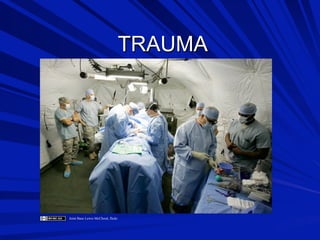
TRAUMA

Joint Base Lewis McChord, flickr
Objectives

 Demonstrate primary and secondary

patient assessment

 Establish priorities in trauma scenarios

 Initiate primary and secondary
management

 Arrange disposition of the patient
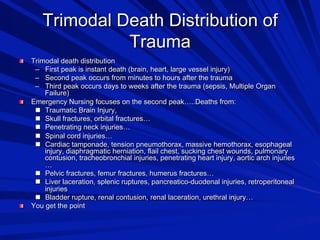
Trimodal Death Distribution of
Trauma


Trimodal death distribution
–  First peak is instant death (brain, heart, large vessel injury)
–  Second peak occurs from minutes to hours after the trauma
–  Third peak occurs days to weeks after the trauma (sepsis, Multiple Organ
Failure)
Emergency Nursing focuses on the second peak…..Deaths from:
  Traumatic Brain Injury,
  Skull fractures, orbital fractures…
  Penetrating neck injuries…
  Spinal cord injuries…
  Cardiac tamponade, tension pneumothorax, massive hemothorax, esophageal
injury, diaphragmatic herniation, flail chest, sucking chest wounds, pulmonary
contusion, tracheobronchial injuries, penetrating heart injury, aortic arch injuries
…
  Pelvic fractures, femur fractures, humerus fractures…
  Liver laceration, splenic ruptures, pancreatico-duodenal injuries, retroperitoneal
injuries
  Bladder rupture, renal contusion, renal laceration, urethral injury…
You get the point
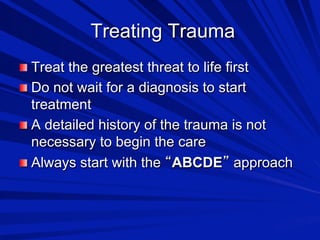
Treating Trauma

 Treat the greatest threat to life first

 Do not wait for a diagnosis to start

treatment

 A detailed history of the trauma is not
necessary to begin the care

 Always start with the ABCDE approach
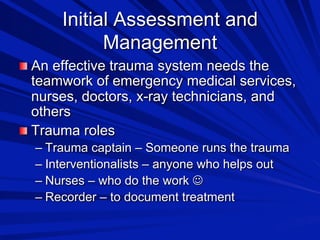
Initial Assessment and
Management

 An effective trauma system needs the

teamwork of emergency medical services,
nurses, doctors, x-ray technicians, and
others

 Trauma roles
–  Trauma captain – Someone runs the trauma
–  Interventionalists – anyone who helps out
–  Nurses – who do the work 
–  Recorder – to document treatment
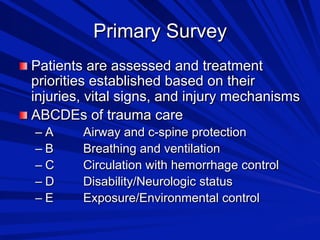
Primary Survey

 Patients are assessed and treatment

priorities established based on their
injuries, vital signs, and injury mechanisms

 ABCDEs of trauma care
–  A
–  B
–  C
–  D
–  E

Airway and c-spine protection
Breathing and ventilation
Circulation with hemorrhage control
Disability/Neurologic status
Exposure/Environmental control
Airway
How do we evaluate the airway?
A- Airway

 Airway should be assessed for patency
–  Is the patient able to talk?
–  Inspect for foreign bodies
–  Examine for stridor, hoarseness, gurgling, pooled
saliva or blood


 Assume there is a spinal injury in patients

with multi-trauma

–  C-spine clearance can be both clinical(by the doctor)
and/or x-ray
–  Spinal protection should remain in place until patient
can cooperate with clinical exam
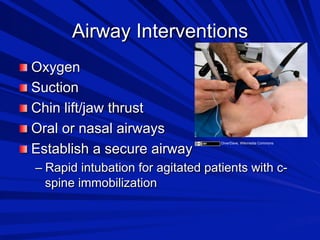
Airway Interventions

 Oxygen

 Suction

 Chin lift/jaw thrust

 Oral or nasal airways

 Establish a secure airway
–  Rapid intubation for agitated patients with cspine immobilization
DiverDave, Wikimedia Commons
Breathing

 What can we look for to assess a patient s

breathing status?
B- Breathing

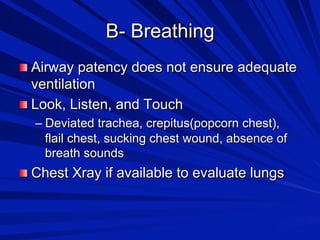
 Airway patency does not ensure adequate

ventilation

 Look, Listen, and Touch
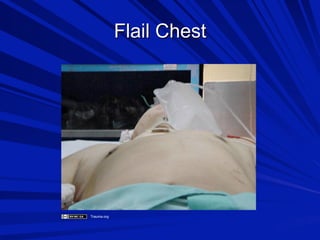
–  Deviated trachea, crepitus(popcorn chest),
flail chest, sucking chest wound, absence of
breath sounds


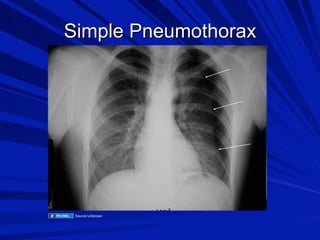
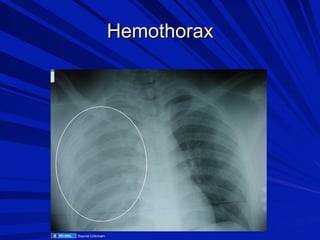
 Chest Xray if available to evaluate lungs
Flail Chest

Trauma.org
Simple Pneumothorax

Source Unknown
Hemothorax

Source Unknown
Breathing Interventions

 Ventilate with 100% oxygen

 Needle decompression if tension

pneumothorax suspected

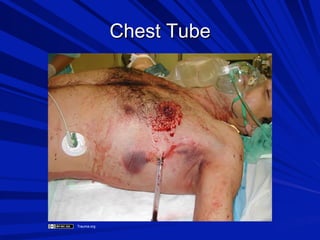
 Chest tubes for pneumothorax /
hemothorax

 Occlusive dressing to sucking chest
wound

 If intubated, evaluate tube position
Chest Tube

Trauma.org
C- Circulation

 Rapid assessment of hemodynamic status
–  Level of consciousness
–  Skin color
–  Pulses in arms and legs
–  Blood pressure
C- Circulation

 Shock should be considered on every

Trauma patient

 Types of shock:

–  Hypovolemic – loss of blood or plasma
–  Cardiogenic – The heart is less able to pump
blood
–  Obstructive – Physical obstruction reduces
cardiac output
–  Distributive – Disruption to vasomotor tone
Hypovolemic Shock

 The physical loss of either
–  Blood – due to hemorrhage
–  Plasma – due to burns

 This patient will present with:
  Decreasing Blood Pressure
  Increasing Heart rate
  Increasing anxiety (until lethargy and unconciousness
set in)
  Increase respiratory rate
  Decreased urine output
Hypovolemic Shock Interventions

 Monitor pulse and blood pressure

continuously

 Apply pressure to bleeding sites

 Establish IV access
–  2 large bore IVs


 Volume resuscitation
–  Have blood and/or fluids ready if needed
–  Foley catheter to monitor output (unless there
are signs of urethral injury)
IV Tips

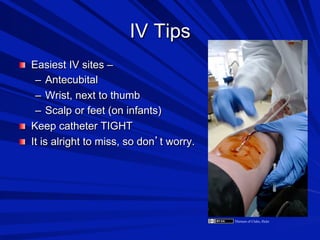
 Easiest IV sites –

–  Antecubital
–  Wrist, next to thumb
–  Scalp or feet (on infants)

 Keep catheter TIGHT

 It is alright to miss, so don t worry.

Thirteen of Clubs, flickr
Cardiogenic Shock

 Inadequate contractility of the heart due to
–  MI
–  Blunt trauma to the heart
–  Dysrhythmias
–  Cardiac Failure

 Rare in Trauma cases

 This pt does not necessarily need fluids
Cardiogenic Shock Interventions

 ECG as soon as possible

 Cardiac Monitor

 Treat the appropriate dysrhythmias
Obstructive Shock

 Physical obstruction or compression of the

heart or vessels around it
–  Cardiac Tamponade
–  Tension Pneumothorax
–  Tension Hemothorax
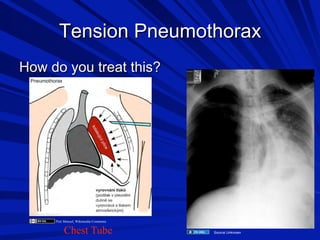
Tension Pneumothorax
How do you treat this?

Petr Menzel, Wikimedia Commons

Chest Tube

Source Unknown
Obstructive Shock Interventions

 Remove the underlying obstruction:
–  Hemo/pneumothorax – Chest Tube
–  Cardiac Tamponade - needle decompression
Distributive Shock

 Loss of vessel tone due to
–  Sepsis (unlikely in an acute trauma)
–  Neurogenic (spinal damage)

 This patient will usually have
–  Dry, warm skin (not sweating)
–  Bradycardia
Distributive Shock Interventions

 Septic shock is treated with antibiotics,

which we will save for another lecture

 Neurogenic shock is covered under the

next step, which is…
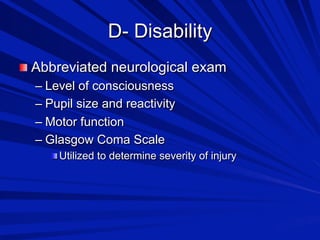
D- Disability

 Abbreviated neurological exam
–  Level of consciousness
–  Pupil size and reactivity
–  Motor function
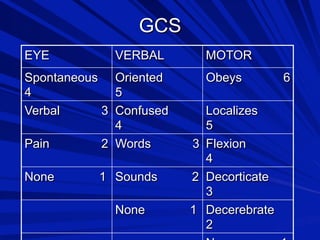
–  Glasgow Coma Scale

 Utilized to determine severity of injury
GCS
EYE

VERBAL

Spontaneous Oriented
4
5
Verbal
3 Confused
4
Pain
2 Words
None

1 Sounds
None

MOTOR
Obeys
Localizes
5
3 Flexion
4
2 Decorticate
3
1 Decerebrate
2

6
Disability Interventions

 Spinal cord injury
–  Keep spine stabalization!
–  High dose steroids may be used

 Decreasing Mental Status may be a sign

of Elevated Intercranial Pressure
–  Sit patient up
–  Hyperventilation – increase breathing and
oxygen
E- Exposure

 Complete disrobing of patient

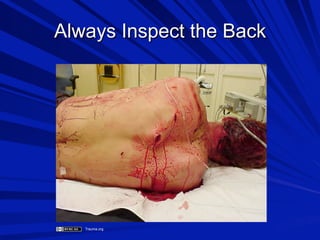
 Logroll to inspect back

 Rectal temperature

 Warm blankets to prevent hypothermia
Always Inspect the Back

Trauma.org
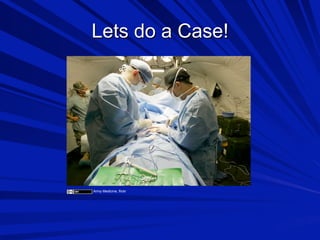
Lets do a Case!

Army Medicine, flickr
Case


28 year old man is involved in a high speed motorcycle accident.
He was not wearing a helmet. He is groaning and utters, my
belly , uggghhh .


Heart Rate 134 Blood Pressure 87/42 Respirations 32 SaO2
89% on 100% oxygen by mask


Patient is drowsy but arousable to voice, has large bruise over the
left side of his scalp, airway is patent, decreased breath sounds over
right chest, abdominal pain to touch, obvious left ankle deformity
ABCDE

 What are the priorities right now?

 What are this patient s possible injuries?

 What are the interventions that need to

happen now?
Secondary Survey

 AMPLE history
–  Allergies, medications, PMH, last meal, events

 Physical exam from head to toe, including

rectal exam

 Frequent reassessment of vitals

 Diagnostic studies at this time simultaneously
–  X-rays, lab work
–  FAST exam (Ultrasound)
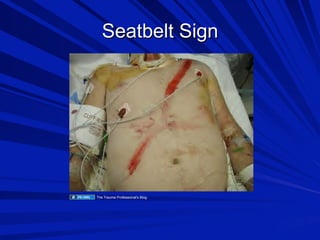
Seatbelt Sign

The Trauma Professional's Blog
Diagnostic Aids

 Bloodwork

 Standard trauma radiographs
–  Chest X-ray, pelvis, lateral C-spine

 Pt should only go to radiology if stable

 Pt must be monitored in xray
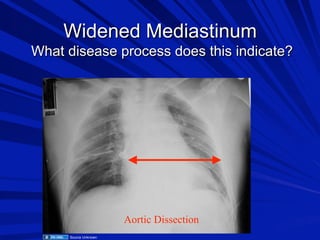
Widened Mediastinum
What disease process does this indicate?

Aortic Dissection
Source Unknown
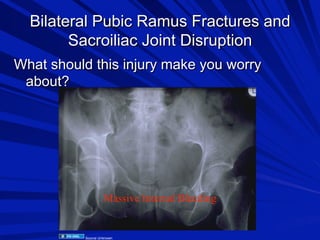
Bilateral Pubic Ramus Fractures and
Sacroiliac Joint Disruption
What should this injury make you worry
about?

Massive Internal Bleeding

Source Unknown
Abdominal Trauma

 Common source of traumatic injury

 Mechanism is important
–  Bike accident over the handlebars
–  Road Traffic Accident with steering wheel
trauma

 High suspicion with tachycardia,

hypotension, and abdominal tenderness

 Can be asymptomatic early on

 Ultrasound can be early screening tool
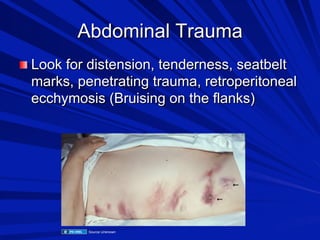
Abdominal Trauma

 Look for distension, tenderness, seatbelt

marks, penetrating trauma, retroperitoneal
ecchymosis (Bruising on the flanks)

Source Unknown
Splenic Injury

 Most commonly injured organ in blunt trauma

 Often associated with other injuries

 Left lower rib pain may be indicative

 Often can be managed non-operatively
Liver injury

 Second most common solid organ injury

 Can be difficult to manage surgically

 Often associated with other abdominal

injuries
Pregnant Trauma Patients

 Pregnant trauma patients are at risk for:
–  Premature Labor
–  Abruptio Placentae
–  Uterine Rupture
Pregnant Trauma Patients
Interventions

 Premature Labor –
–  May be hard to spot in unconscious or intubated pts
–  May be masked as trauma related back pain
–  If mother is stable, can give medications to stop labor

 Abruptio Placentae –
–  Monitor fetal heart tones for 48 hours after trauma

 Uterine Rupture –
–  May be associated with bladder rupture, with blood or
meconium in the urine
–  Rarely repairable – treat mother for blood loss,
possible trauma surgery needed
Pediatric Trauma Patients

 5 months and under, assume they are

obligate nose breathers

 Respiratory and heart rates differ by age

 Can be come hypoglycemic easily

 Children can maintain a normal blood
pressure for much longer than adults, so
BP is NOT a reliable indicator of shock.
Watch the heart rate instead.
Disposition of Trauma Patients

 Dictated by the patient s condition and

available resources
–  OR, admit, or send home


 Serial examinations
–  Look for Mental Status Changes
–  Abdominal exams for increased bruising or
pain
–  Check lungs for changes in air movement
Summary

 Trauma is best managed by a team

approach (there s no I in trauma)

 A thorough primary and secondary survey
is key to identify life threatening injuries

 Once a life threatening injury is
discovered, intervention should not be
delayed

 Disposition is determined by the patient s
condition as well as available resources.
Additional Source Information
for more information see: http://open.umich.edu/wiki/CitationPolicy
Slide 3, Image 1: Joint Base Lewis McChord, "A111028_jb_62nd 010", flickr, http://www.flickr.com/photos/jblmpao/6286561004/, CC: BY-NC-SA
2.0, http://creativecommons.org/licenses/by-nc-sa/2.0/
Slide 11, Image 2: DiverDave, "Glidescope 02", Wikimedia Commons, http://commons.wikimedia.org/wiki/File:Glidescope_02.JPG, CC: BY 3.0,
http://creativecommons.org/licenses/by/3.0/deed.en
Slide 23. Image 1: Thirteen of Clubs, "The poking", flickr, http://www.flickr.com/photos/thirteenofclubs/3272729005/, CC: BY-SA 2.0,
http://creativecommons.org/licenses/by-sa/2.0/
Slide 27, Image 1: Petr Menzel, "Pneumothorax 001 cs", Wikimedia Commons, http://commons.wikimedia.org/wiki/File:Pneumothorax_001_cs.jpg,
CC: BY-SA 3.0, http://creativecommons.org/licenses/by-sa/3.0/cz/deed.en
Slide 36, Image 1: Army Medicine, "Surgery", flickr, http://www.flickr.com/photos/armymedicine/6300225700/, CC: BY 2.0,
http://creativecommons.org/licenses/by/2.0/

GEMC- Trauma- for Nurses

  • 1.
    Author(s): Tim Maxim,BA, RN, 2011 License: Unless otherwise noted, this material is made available under the terms of the Creative Commons Attribution Share Alike 3.0 License: http://creativecommons.org/licenses/by-sa/3.0/ We have reviewed this material in accordance with U.S. Copyright Law and have tried to maximize your ability to use, share, and adapt it. Copyright holders of content included in this material should contact open.michigan@umich.edu with any questions, corrections, or clarification regarding the use of content. For more information about how to cite these materials visit http://open.umich.edu/privacy-and-terms-use. Any medical information in this material is intended to inform and educate and is not a tool for self-diagnosis or a replacement for medical evaluation, advice, diagnosis or treatment by a healthcare professional. Please speak to your physician if you have questions about your medical condition. Viewer discretion is advised: Some medical content is graphic and may not be suitable for all viewers.
  • 2.
    Citation Key for moreinformation see: http://open.umich.edu/wiki/CitationPolicy Use + Share + Adapt { Content the copyright holder, author, or law permits you to use, share and adapt. } Public Domain – Government: Works that are produced by the U.S. Government. (17 USC § 105) Public Domain – Expired: Works that are no longer protected due to an expired copyright term. Public Domain – Self Dedicated: Works that a copyright holder has dedicated to the public domain. Creative Commons – Zero Waiver Creative Commons – Attribution License Creative Commons – Attribution Share Alike License Creative Commons – Attribution Noncommercial License Creative Commons – Attribution Noncommercial Share Alike License GNU – Free Documentation License Make Your Own Assessment { Content Open.Michigan believes can be used, shared, and adapted because it is ineligible for copyright. } Public Domain – Ineligible: Works that are ineligible for copyright protection in the U.S. (17 USC § 102(b)) *laws in your jurisdiction may differ { Content Open.Michigan has used under a Fair Use determination. } Fair Use: Use of works that is determined to be Fair consistent with the U.S. Copyright Act. (17 USC § 107) *laws in your jurisdiction may differ Our determination DOES NOT mean that all uses of this 3rd-party content are Fair Uses and we DO NOT guarantee that your use of the content is Fair. To use this content you should do your own independent analysis to determine whether or not your use will be Fair.
  • 3.
    TRAUMA Joint Base LewisMcChord, flickr
  • 4.
    Objectives Demonstrate primaryand secondary patient assessment Establish priorities in trauma scenarios Initiate primary and secondary management Arrange disposition of the patient
  • 5.
    Trimodal Death Distributionof Trauma Trimodal death distribution –  First peak is instant death (brain, heart, large vessel injury) –  Second peak occurs from minutes to hours after the trauma –  Third peak occurs days to weeks after the trauma (sepsis, Multiple Organ Failure) Emergency Nursing focuses on the second peak…..Deaths from:   Traumatic Brain Injury,   Skull fractures, orbital fractures…   Penetrating neck injuries…   Spinal cord injuries…   Cardiac tamponade, tension pneumothorax, massive hemothorax, esophageal injury, diaphragmatic herniation, flail chest, sucking chest wounds, pulmonary contusion, tracheobronchial injuries, penetrating heart injury, aortic arch injuries …   Pelvic fractures, femur fractures, humerus fractures…   Liver laceration, splenic ruptures, pancreatico-duodenal injuries, retroperitoneal injuries   Bladder rupture, renal contusion, renal laceration, urethral injury… You get the point
  • 6.
    Treating Trauma Treatthe greatest threat to life first Do not wait for a diagnosis to start treatment A detailed history of the trauma is not necessary to begin the care Always start with the ABCDE approach
  • 7.
    Initial Assessment and Management An effective trauma system needs the teamwork of emergency medical services, nurses, doctors, x-ray technicians, and others Trauma roles –  Trauma captain – Someone runs the trauma –  Interventionalists – anyone who helps out –  Nurses – who do the work  –  Recorder – to document treatment
  • 8.
    Primary Survey Patientsare assessed and treatment priorities established based on their injuries, vital signs, and injury mechanisms ABCDEs of trauma care –  A –  B –  C –  D –  E Airway and c-spine protection Breathing and ventilation Circulation with hemorrhage control Disability/Neurologic status Exposure/Environmental control
  • 9.
    Airway How do weevaluate the airway?
  • 10.
    A- Airway Airwayshould be assessed for patency –  Is the patient able to talk? –  Inspect for foreign bodies –  Examine for stridor, hoarseness, gurgling, pooled saliva or blood Assume there is a spinal injury in patients with multi-trauma –  C-spine clearance can be both clinical(by the doctor) and/or x-ray –  Spinal protection should remain in place until patient can cooperate with clinical exam
  • 11.
    Airway Interventions Oxygen Suction Chin lift/jaw thrust Oral or nasal airways Establish a secure airway –  Rapid intubation for agitated patients with cspine immobilization DiverDave, Wikimedia Commons
  • 12.
    Breathing What canwe look for to assess a patient s breathing status?
  • 13.
    B- Breathing Airwaypatency does not ensure adequate ventilation Look, Listen, and Touch –  Deviated trachea, crepitus(popcorn chest), flail chest, sucking chest wound, absence of breath sounds Chest Xray if available to evaluate lungs
  • 14.
  • 15.
  • 16.
  • 17.
    Breathing Interventions Ventilatewith 100% oxygen Needle decompression if tension pneumothorax suspected Chest tubes for pneumothorax / hemothorax Occlusive dressing to sucking chest wound If intubated, evaluate tube position
  • 18.
  • 19.
    C- Circulation Rapidassessment of hemodynamic status –  Level of consciousness –  Skin color –  Pulses in arms and legs –  Blood pressure
  • 20.
    C- Circulation Shockshould be considered on every Trauma patient Types of shock: –  Hypovolemic – loss of blood or plasma –  Cardiogenic – The heart is less able to pump blood –  Obstructive – Physical obstruction reduces cardiac output –  Distributive – Disruption to vasomotor tone
  • 21.
    Hypovolemic Shock Thephysical loss of either –  Blood – due to hemorrhage –  Plasma – due to burns This patient will present with:   Decreasing Blood Pressure   Increasing Heart rate   Increasing anxiety (until lethargy and unconciousness set in)   Increase respiratory rate   Decreased urine output
  • 22.
    Hypovolemic Shock Interventions Monitor pulse and blood pressure continuously Apply pressure to bleeding sites Establish IV access –  2 large bore IVs Volume resuscitation –  Have blood and/or fluids ready if needed –  Foley catheter to monitor output (unless there are signs of urethral injury)
  • 23.
    IV Tips EasiestIV sites – –  Antecubital –  Wrist, next to thumb –  Scalp or feet (on infants) Keep catheter TIGHT It is alright to miss, so don t worry. Thirteen of Clubs, flickr
  • 24.
    Cardiogenic Shock Inadequatecontractility of the heart due to –  MI –  Blunt trauma to the heart –  Dysrhythmias –  Cardiac Failure Rare in Trauma cases This pt does not necessarily need fluids
  • 25.
    Cardiogenic Shock Interventions ECG as soon as possible Cardiac Monitor Treat the appropriate dysrhythmias
  • 26.
    Obstructive Shock Physicalobstruction or compression of the heart or vessels around it –  Cardiac Tamponade –  Tension Pneumothorax –  Tension Hemothorax
  • 27.
    Tension Pneumothorax How doyou treat this? Petr Menzel, Wikimedia Commons Chest Tube Source Unknown
  • 28.
    Obstructive Shock Interventions Remove the underlying obstruction: –  Hemo/pneumothorax – Chest Tube –  Cardiac Tamponade - needle decompression
  • 29.
    Distributive Shock Lossof vessel tone due to –  Sepsis (unlikely in an acute trauma) –  Neurogenic (spinal damage) This patient will usually have –  Dry, warm skin (not sweating) –  Bradycardia
  • 30.
    Distributive Shock Interventions Septic shock is treated with antibiotics, which we will save for another lecture Neurogenic shock is covered under the next step, which is…
  • 31.
    D- Disability Abbreviatedneurological exam –  Level of consciousness –  Pupil size and reactivity –  Motor function –  Glasgow Coma Scale Utilized to determine severity of injury
  • 32.
    GCS EYE VERBAL Spontaneous Oriented 4 5 Verbal 3 Confused 4 Pain 2Words None 1 Sounds None MOTOR Obeys Localizes 5 3 Flexion 4 2 Decorticate 3 1 Decerebrate 2 6
  • 33.
    Disability Interventions Spinalcord injury –  Keep spine stabalization! –  High dose steroids may be used Decreasing Mental Status may be a sign of Elevated Intercranial Pressure –  Sit patient up –  Hyperventilation – increase breathing and oxygen
  • 34.
    E- Exposure Completedisrobing of patient Logroll to inspect back Rectal temperature Warm blankets to prevent hypothermia
  • 35.
    Always Inspect theBack Trauma.org
  • 36.
    Lets do aCase! Army Medicine, flickr
  • 37.
    Case 28 year oldman is involved in a high speed motorcycle accident. He was not wearing a helmet. He is groaning and utters, my belly , uggghhh . Heart Rate 134 Blood Pressure 87/42 Respirations 32 SaO2 89% on 100% oxygen by mask Patient is drowsy but arousable to voice, has large bruise over the left side of his scalp, airway is patent, decreased breath sounds over right chest, abdominal pain to touch, obvious left ankle deformity
  • 38.
    ABCDE What arethe priorities right now? What are this patient s possible injuries? What are the interventions that need to happen now?
  • 39.
    Secondary Survey AMPLEhistory –  Allergies, medications, PMH, last meal, events Physical exam from head to toe, including rectal exam Frequent reassessment of vitals Diagnostic studies at this time simultaneously –  X-rays, lab work –  FAST exam (Ultrasound)
  • 40.
    Seatbelt Sign The TraumaProfessional's Blog
  • 41.
    Diagnostic Aids Bloodwork Standard trauma radiographs –  Chest X-ray, pelvis, lateral C-spine Pt should only go to radiology if stable Pt must be monitored in xray
  • 42.
    Widened Mediastinum What diseaseprocess does this indicate? Aortic Dissection Source Unknown
  • 43.
    Bilateral Pubic RamusFractures and Sacroiliac Joint Disruption What should this injury make you worry about? Massive Internal Bleeding Source Unknown
  • 44.
    Abdominal Trauma Commonsource of traumatic injury Mechanism is important –  Bike accident over the handlebars –  Road Traffic Accident with steering wheel trauma High suspicion with tachycardia, hypotension, and abdominal tenderness Can be asymptomatic early on Ultrasound can be early screening tool
  • 45.
    Abdominal Trauma Lookfor distension, tenderness, seatbelt marks, penetrating trauma, retroperitoneal ecchymosis (Bruising on the flanks) Source Unknown
  • 46.
    Splenic Injury Mostcommonly injured organ in blunt trauma Often associated with other injuries Left lower rib pain may be indicative Often can be managed non-operatively
  • 47.
    Liver injury Secondmost common solid organ injury Can be difficult to manage surgically Often associated with other abdominal injuries
  • 48.
    Pregnant Trauma Patients Pregnant trauma patients are at risk for: –  Premature Labor –  Abruptio Placentae –  Uterine Rupture
  • 49.
    Pregnant Trauma Patients Interventions Premature Labor – –  May be hard to spot in unconscious or intubated pts –  May be masked as trauma related back pain –  If mother is stable, can give medications to stop labor Abruptio Placentae – –  Monitor fetal heart tones for 48 hours after trauma Uterine Rupture – –  May be associated with bladder rupture, with blood or meconium in the urine –  Rarely repairable – treat mother for blood loss, possible trauma surgery needed
  • 50.
    Pediatric Trauma Patients 5 months and under, assume they are obligate nose breathers Respiratory and heart rates differ by age Can be come hypoglycemic easily Children can maintain a normal blood pressure for much longer than adults, so BP is NOT a reliable indicator of shock. Watch the heart rate instead.
  • 51.
    Disposition of TraumaPatients Dictated by the patient s condition and available resources –  OR, admit, or send home Serial examinations –  Look for Mental Status Changes –  Abdominal exams for increased bruising or pain –  Check lungs for changes in air movement
  • 52.
    Summary Trauma isbest managed by a team approach (there s no I in trauma) A thorough primary and secondary survey is key to identify life threatening injuries Once a life threatening injury is discovered, intervention should not be delayed Disposition is determined by the patient s condition as well as available resources.
  • 53.
    Additional Source Information formore information see: http://open.umich.edu/wiki/CitationPolicy Slide 3, Image 1: Joint Base Lewis McChord, "A111028_jb_62nd 010", flickr, http://www.flickr.com/photos/jblmpao/6286561004/, CC: BY-NC-SA 2.0, http://creativecommons.org/licenses/by-nc-sa/2.0/ Slide 11, Image 2: DiverDave, "Glidescope 02", Wikimedia Commons, http://commons.wikimedia.org/wiki/File:Glidescope_02.JPG, CC: BY 3.0, http://creativecommons.org/licenses/by/3.0/deed.en Slide 23. Image 1: Thirteen of Clubs, "The poking", flickr, http://www.flickr.com/photos/thirteenofclubs/3272729005/, CC: BY-SA 2.0, http://creativecommons.org/licenses/by-sa/2.0/ Slide 27, Image 1: Petr Menzel, "Pneumothorax 001 cs", Wikimedia Commons, http://commons.wikimedia.org/wiki/File:Pneumothorax_001_cs.jpg, CC: BY-SA 3.0, http://creativecommons.org/licenses/by-sa/3.0/cz/deed.en Slide 36, Image 1: Army Medicine, "Surgery", flickr, http://www.flickr.com/photos/armymedicine/6300225700/, CC: BY 2.0, http://creativecommons.org/licenses/by/2.0/