RELATING TO THE PREVIOUS
CHAPTER
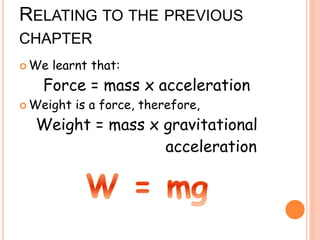
 We learnt that:
Force = mass x acceleration
 Weight is a force, therefore,
Weight = mass x gravitational
acceleration
ON THE MOON...
 Did Buzz Aldrin lose any mass?
 What does Neil Armstrong mean?
MASS VS. WEIGHT
 Mass of an
object will be
the same no
matter where
the object is
located
 Weight of an
object will vary
according to the
gravitational
force
experienced by
the object
Acceleration due to gravity on the
moon is one-sixth that of Earth
COMMON MEASUREMENT
INSTRUMENTS
 Electronic balance  Newton-meter
(Spring balance)
Mass Weight
SUMMARY
Mass Weight
The amount of
substance in the body
The force of gravity
acting on the body
Constant in any location Depends on the
acceleration due to
gravity at the location
Scalar quantity Vector quantity
Measured in kilograms Measured in Newtons
Measured using a beam
balance or electronic
balance
Measured using a spring
balance
INERTIA
 All bodies with mass possess a property
called inertia
 The inertia of an object is the
reluctance of the object to change its
state of rest, or if it is moving
 Consistent with Newton’s first law
INERTIA
 Force is needed to overcome inertia.
Inertia depends on mass and not weight
 The greater the mass, the greater the
inertia.
IN A MOVING VEHICLE
 Sudden braking
 Round a corner
GRAVITATIONAL
FIELD
GRAVITATIONAL FIELD
 A gravitational field is a region where a
mass experiences a force due to
gravitational attraction.
 Gravitational field strength, g, is defined
as force per unit mass.
GRAVITATIONAL FIELD
 Near the Earth’s surface, the
gravitational field is uniform
 The field lines are drawn parallel to each
other
UNITS ANALYSIS
 Using W = mg,
 g = W/m
 Units of g is N/kg
 Recall free-fall
 Using F = ma
 Acceleration due to gravity is 9.8 m/s^2
 Units of g is also m/s^2

Mass, weight

  • 1.
    RELATING TO THEPREVIOUS CHAPTER  We learnt that: Force = mass x acceleration  Weight is a force, therefore, Weight = mass x gravitational acceleration
  • 2.
    ON THE MOON... Did Buzz Aldrin lose any mass?  What does Neil Armstrong mean?
  • 3.
    MASS VS. WEIGHT Mass of an object will be the same no matter where the object is located  Weight of an object will vary according to the gravitational force experienced by the object Acceleration due to gravity on the moon is one-sixth that of Earth
  • 4.
    COMMON MEASUREMENT INSTRUMENTS  Electronicbalance  Newton-meter (Spring balance) Mass Weight
  • 5.
    SUMMARY Mass Weight The amountof substance in the body The force of gravity acting on the body Constant in any location Depends on the acceleration due to gravity at the location Scalar quantity Vector quantity Measured in kilograms Measured in Newtons Measured using a beam balance or electronic balance Measured using a spring balance
  • 6.
    INERTIA  All bodieswith mass possess a property called inertia  The inertia of an object is the reluctance of the object to change its state of rest, or if it is moving  Consistent with Newton’s first law
  • 7.
    INERTIA  Force isneeded to overcome inertia. Inertia depends on mass and not weight  The greater the mass, the greater the inertia.
  • 8.
    IN A MOVINGVEHICLE  Sudden braking  Round a corner
  • 10.
  • 11.
    GRAVITATIONAL FIELD  Agravitational field is a region where a mass experiences a force due to gravitational attraction.  Gravitational field strength, g, is defined as force per unit mass.
  • 12.
    GRAVITATIONAL FIELD  Nearthe Earth’s surface, the gravitational field is uniform  The field lines are drawn parallel to each other
  • 13.
    UNITS ANALYSIS  UsingW = mg,  g = W/m  Units of g is N/kg  Recall free-fall  Using F = ma  Acceleration due to gravity is 9.8 m/s^2  Units of g is also m/s^2