The document provides an overview of the Progressive Era in America from the late 19th century to the 1920s. It describes the social problems that reformers sought to address through goals like protecting social welfare, promoting moral improvement, and creating economic reforms. Some key reforms included regulations on child labor, women's working hours, and food/drug safety. The movement gained momentum under presidents Theodore Roosevelt and Woodrow Wilson through trustbusting, conservation efforts, and establishment of agencies like the Federal Trade Commission. Women's suffrage was another major success, though racial equality made less progress.
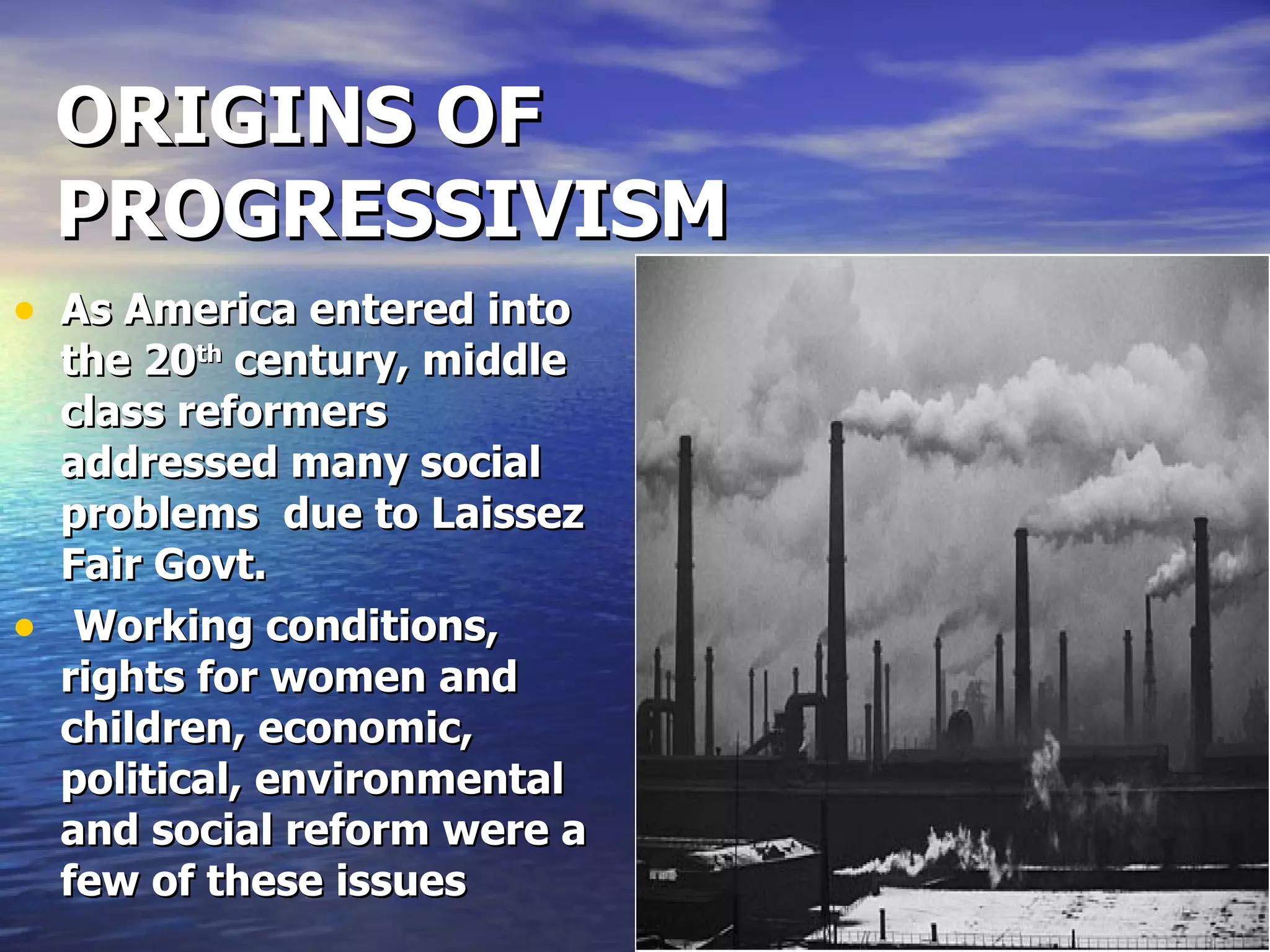
ORIGINS OF PROGRESSIVISMAs America entered into the 20 th century, middle class reformers addressed many social problems due to Laissez Fair Govt. Working conditions, rights for women and children, economic, political, environmental and social reform were a few of these issues
3.
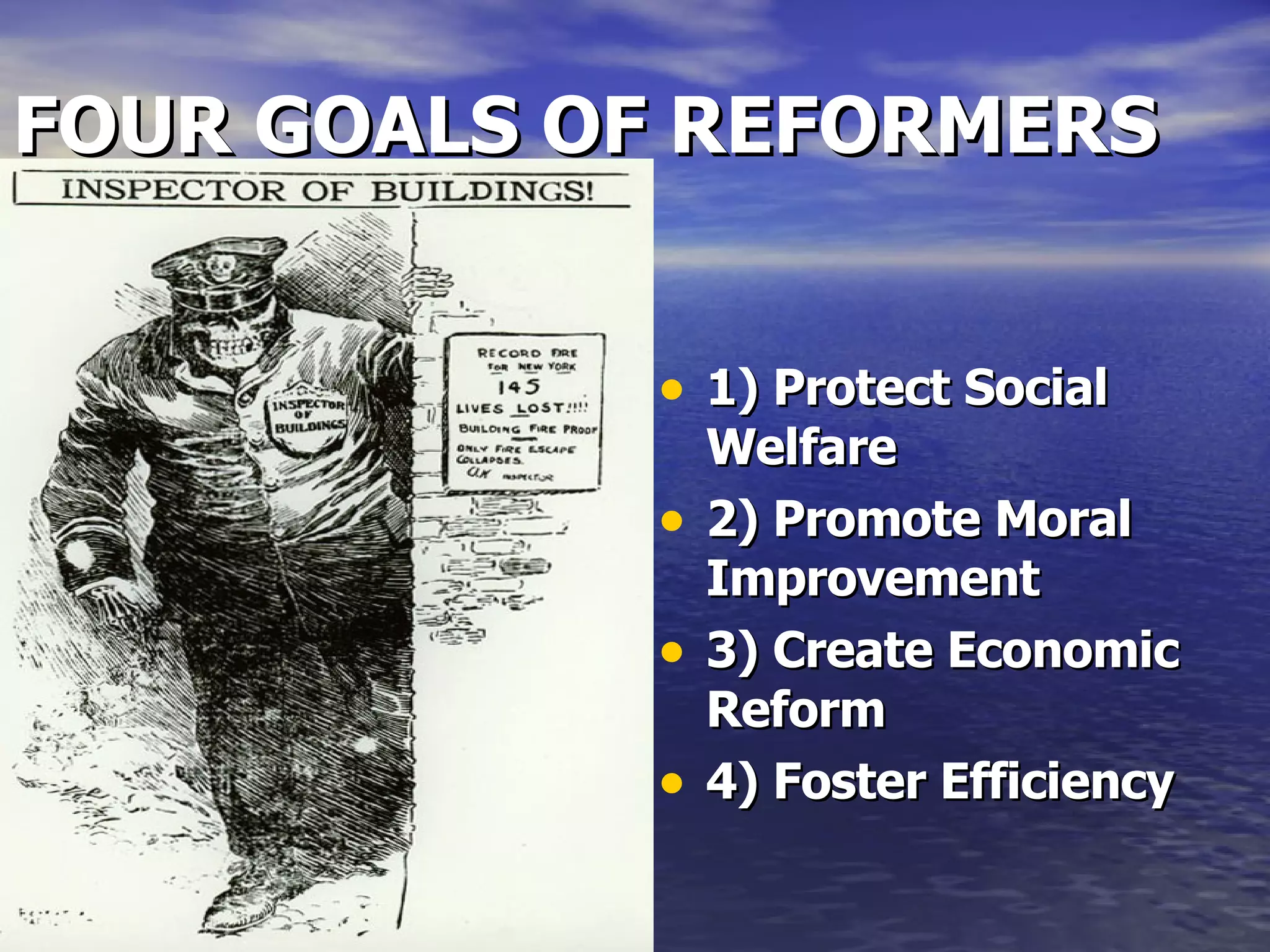
FOUR GOALS OFREFORMERS 1) Protect Social Welfare 2) Promote Moral Improvement 3) Create Economic Reform 4) Foster Efficiency
4.
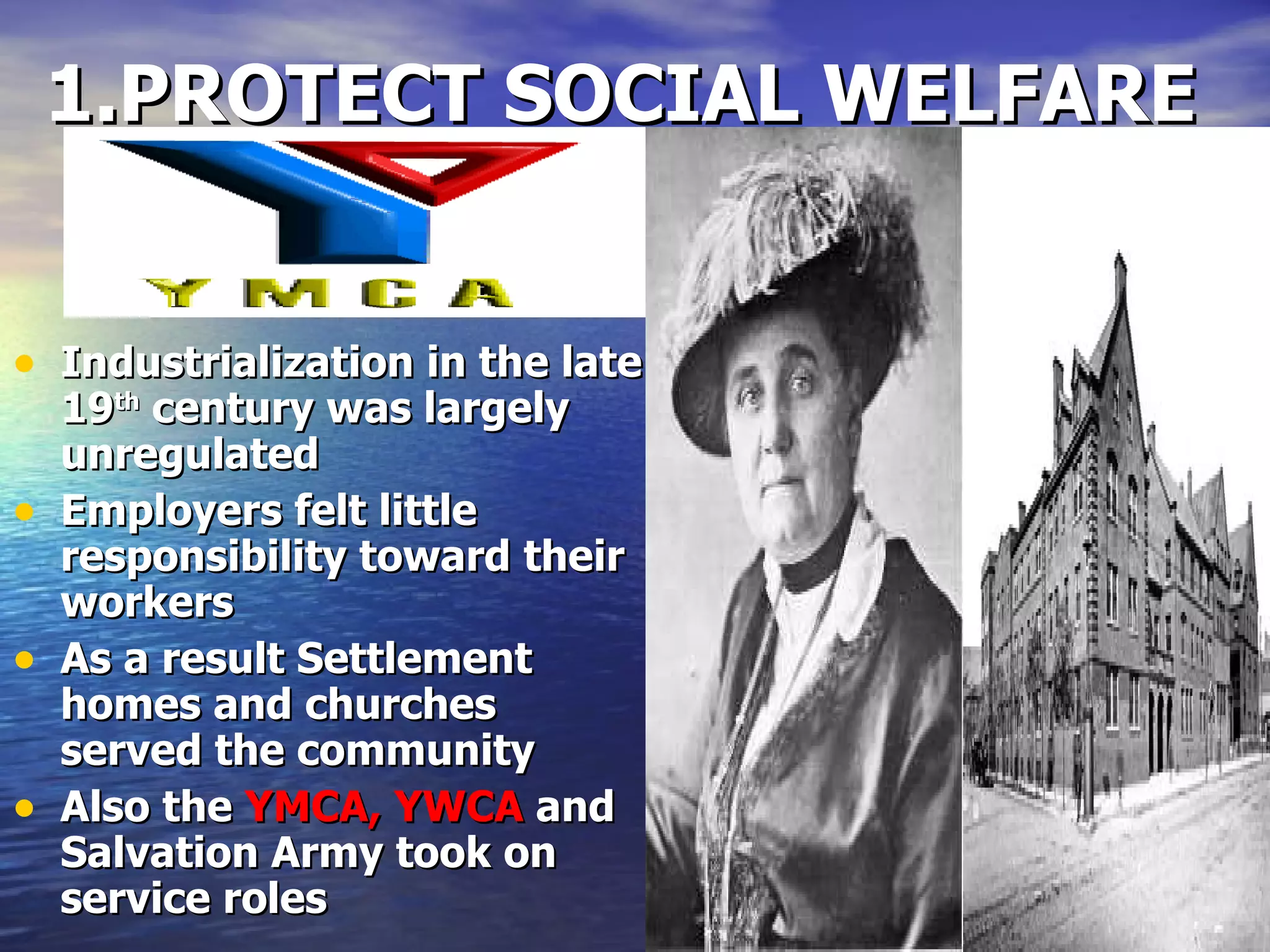
1.PROTECT SOCIAL WELFAREIndustrialization in the late 19 th century was largely unregulated Employers felt little responsibility toward their workers As a result Settlement homes and churches served the community Also the YMCA, YWCA and Salvation Army took on service roles
5.
2. PROMOTE MORALDEVELOPMENT Some reformers felt that the answer to societies problems was personal behavior They proposed such reforms as prohibition Groups wishing to ban alcohol included the Woman’s Christian Temperance Union (WCTU)
6.
3. CREATE ECONOMICREFORM The Panic of 1893 prompted some Americans to question the capitalist economic system As a result some workers embraced socialism Eugene Debs organized the American Socialist Party in 1901 Debs encouraged workers to reject American Capitalism
7.
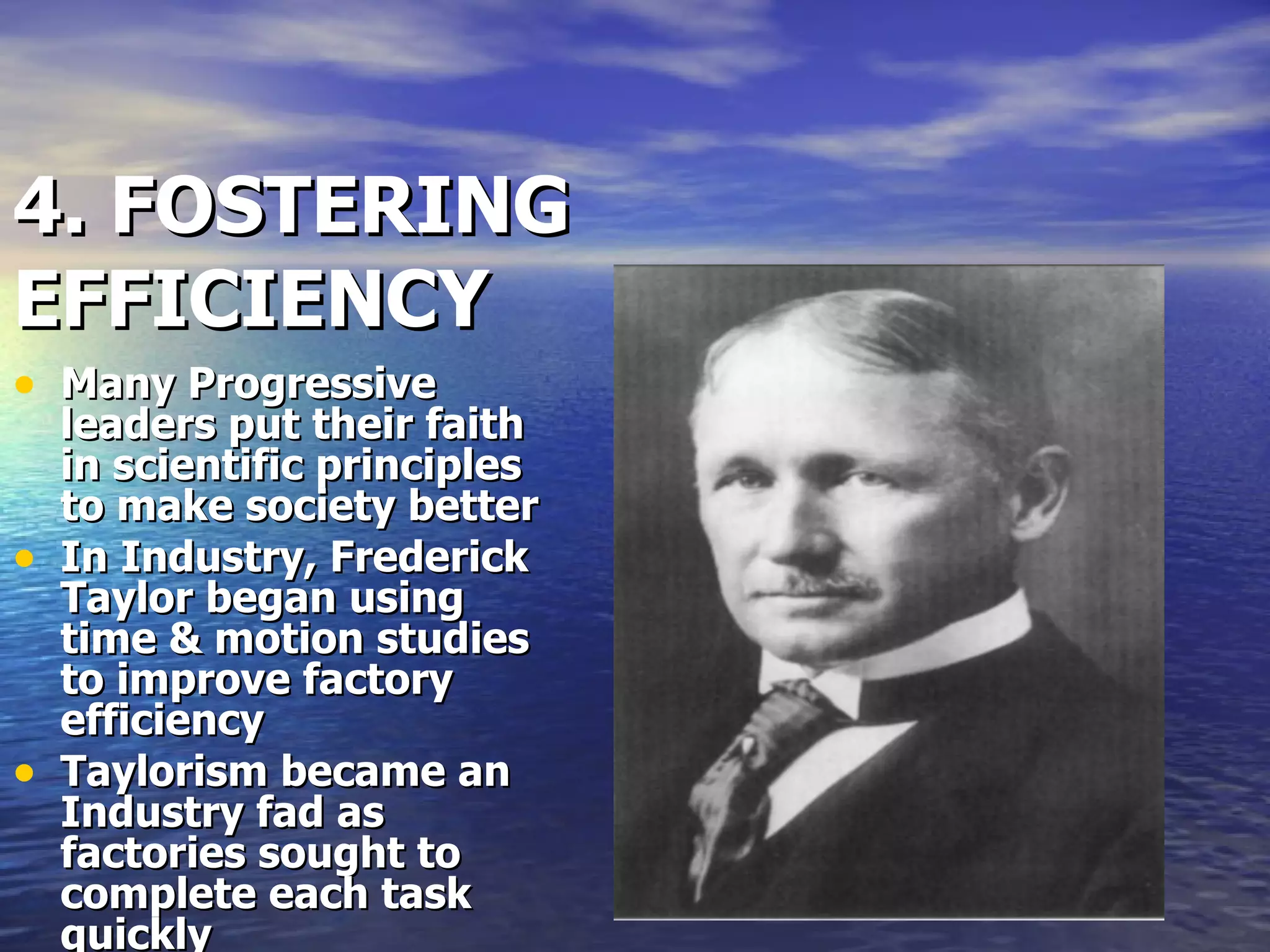
4. FOSTERING EFFICIENCYMany Progressive leaders put their faith in scientific principles to make society better In Industry, Frederick Taylor began using time & motion studies to improve factory efficiency Taylorism became an Industry fad as factories sought to complete each task quickly
8.
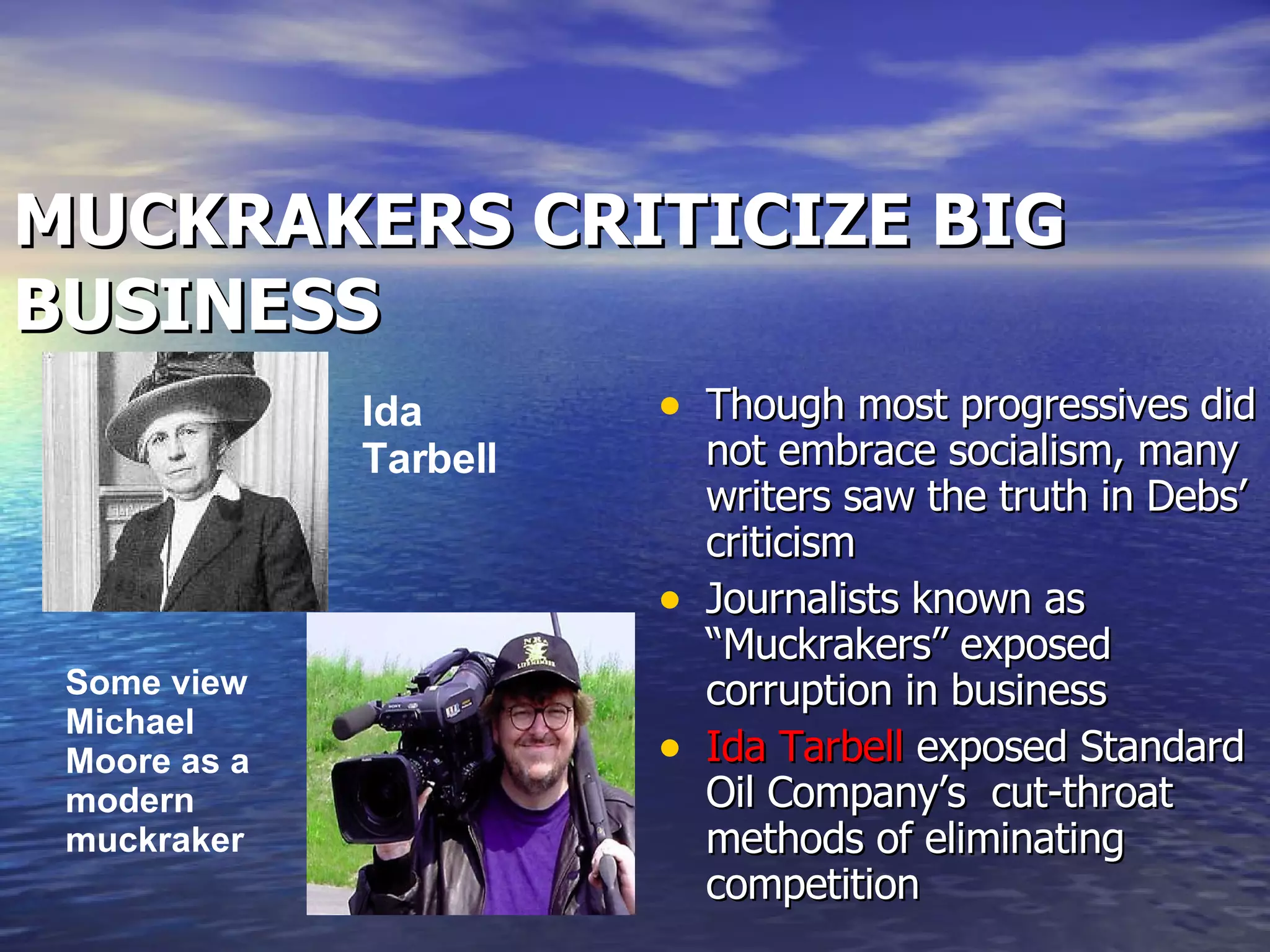
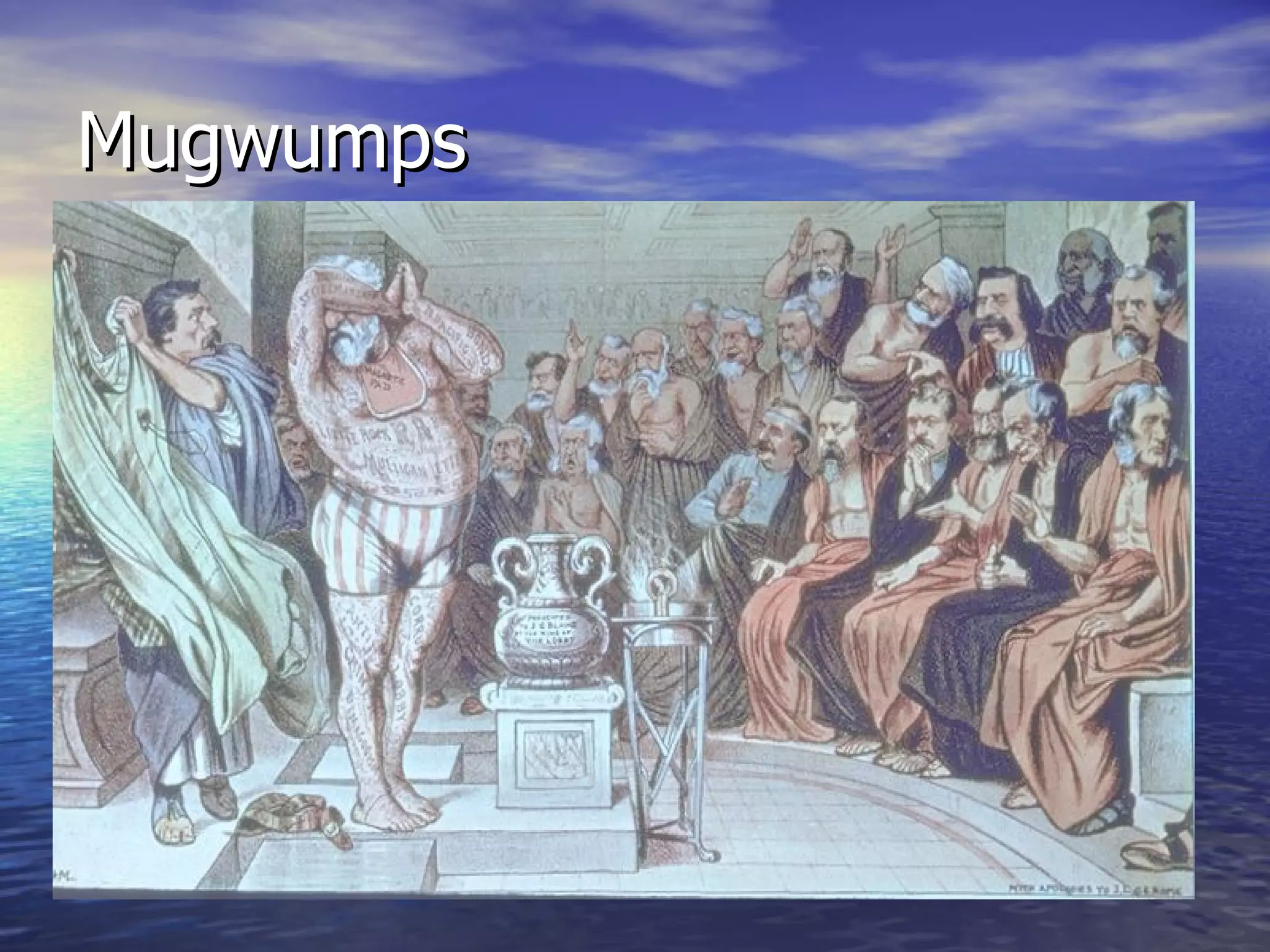
MUCKRAKERS CRITICIZE BIGBUSINESS Though most progressives did not embrace socialism, many writers saw the truth in Debs’ criticism Journalists known as “Muckrakers” exposed corruption in business Ida Tarbell exposed Standard Oil Company’s cut-throat methods of eliminating competition Ida Tarbell Some view Michael Moore as a modern muckraker
9.
“ There are,in the body politic, economic and social, many and grave evils, and there is urgent necessity for the sternest war upon them. There should be relentless exposure of and attack upon every evil man whether politician or business man, every evil practice, whether in politics, in business, or in social life. I hail as a benefactor every writer or speaker, every man who, on the platform, or in book, magazine, or newspaper, with merciless severity makes such attack, provided always that he in his turn remembers that the attack is of use only if it is absolutely truthful." Teddy Roosevelt http://www.youtube.com/watch?v=VGIQJSq_vHU
10.
“ THE JUNGLE” LEADS TO FOOD REGULATION After reading The Jungle by Upton Sinclair, Roosevelt pushed for passage of the Meat Inspection Act of 1906 The Act mandated cleaner conditions for meatpacking plants
11.
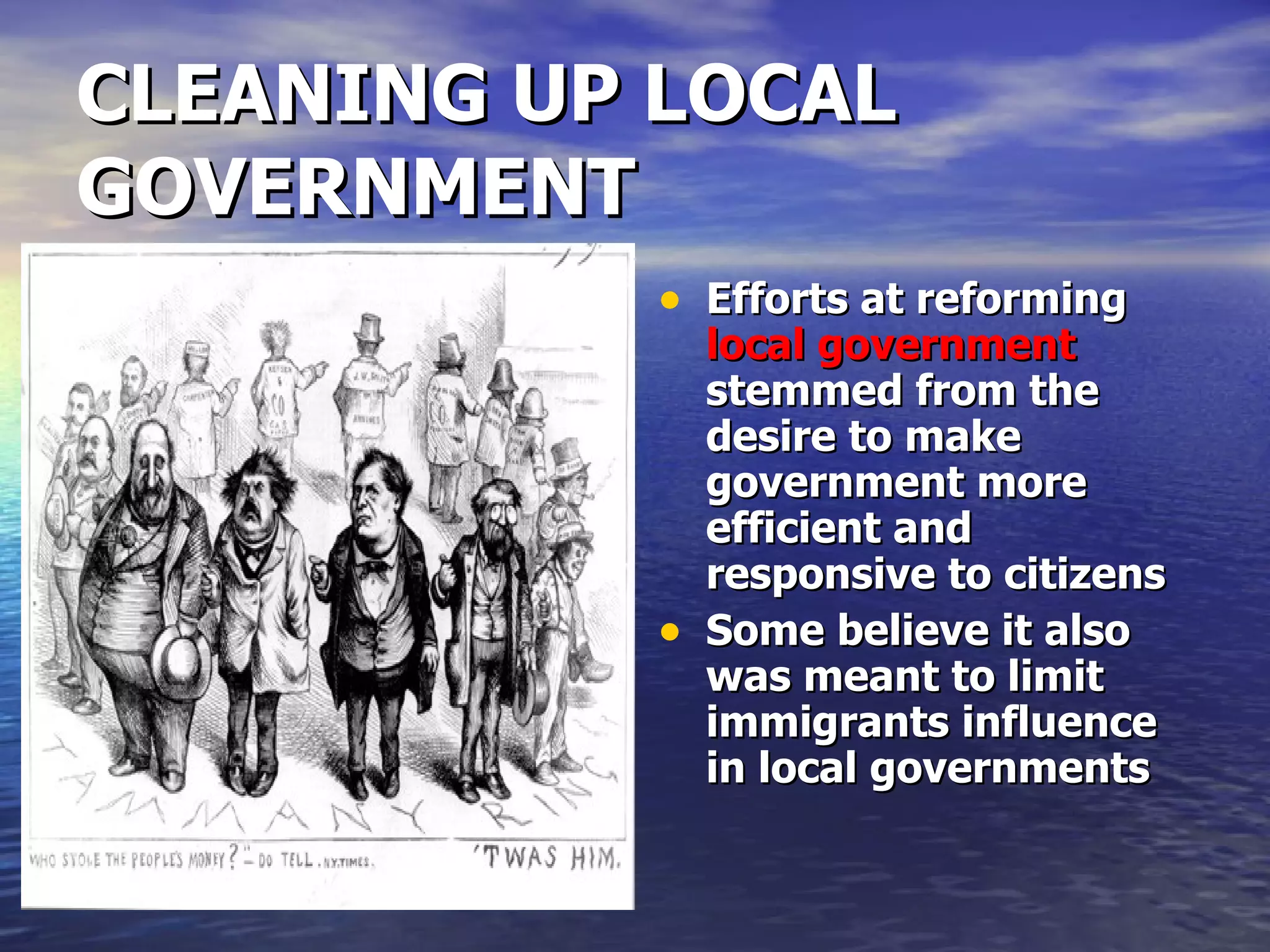
CLEANING UP LOCALGOVERNMENT Efforts at reforming local government stemmed from the desire to make government more efficient and responsive to citizens Some believe it also was meant to limit immigrants influence in local governments
12.
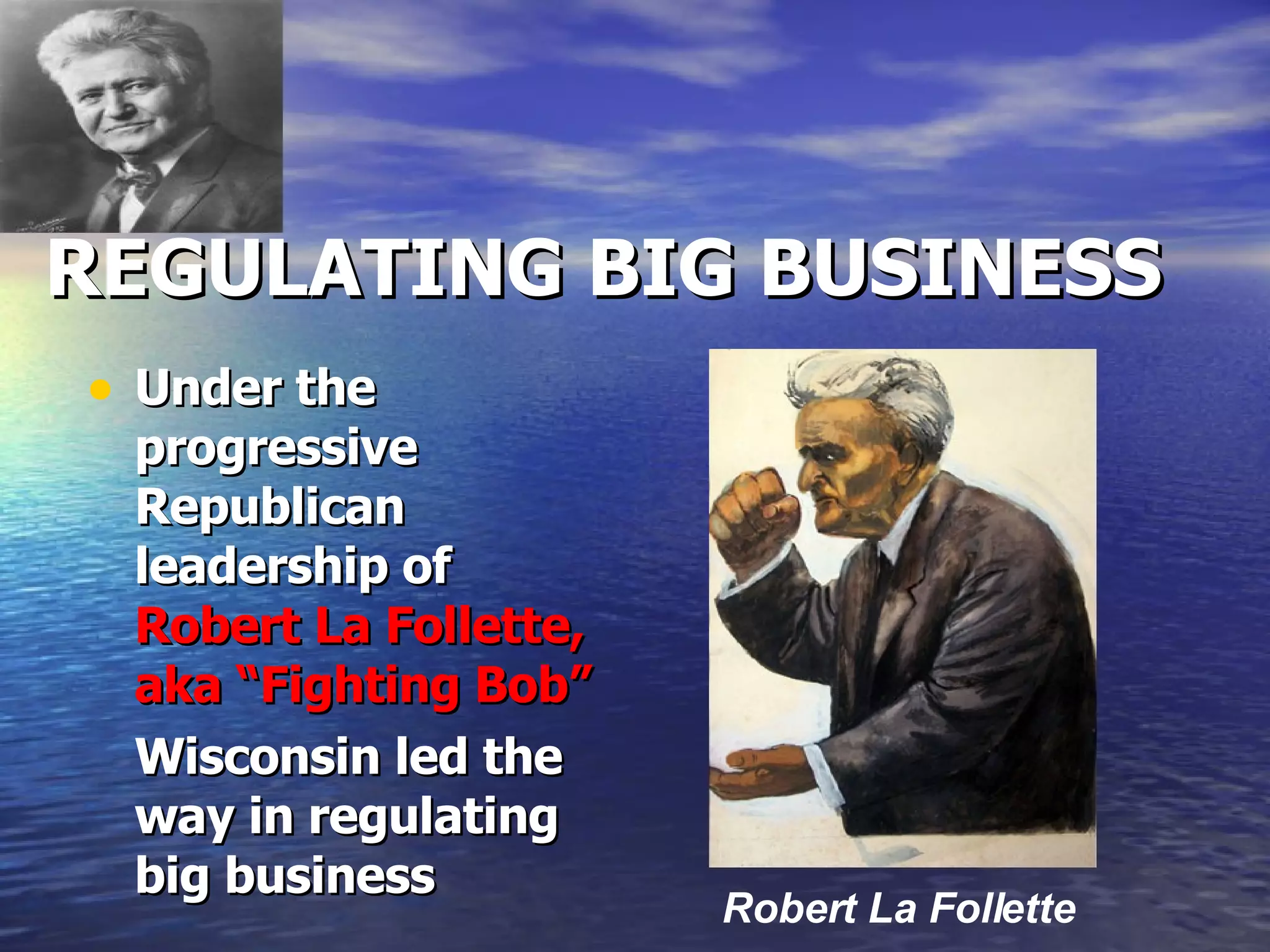
REGULATING BIG BUSINESSUnder the progressive Republican leadership of Robert La Follette, aka “Fighting Bob” Wisconsin led the way in regulating big business Robert La Follette
PROTECTING WORKING CHILDRENAs the number of child workers rose, reformers worked to end child labor Children were more prone to accidents caused by fatigue Nearly every state limited or banned child labor by 1918
15.
EFFORTS TO LIMITHOURS The Supreme Court and the states enacted or strengthened laws reducing women’s hours of work 8 hours labor, 8 hours sleep, 8 hours leisure Progressives also succeeded in winning worker’s compensation to aid families of injured workers
16.
ELECTION REFORM Citizensfought for, and won, such measures as secret ballots, referendum votes, and the recall Citizens could petition and get initiatives on the ballot In 1899, Minnesota passed the first statewide primary system
17.
DIRECT ELECTION OFSENATORS Before 1913, each state’s legislature had chosen its own U.S. senators To force senators to be more responsive to the public, progressives pushed for the popular election of senators As a result, Congress passed the 17 th Amendment (1913 )
18.
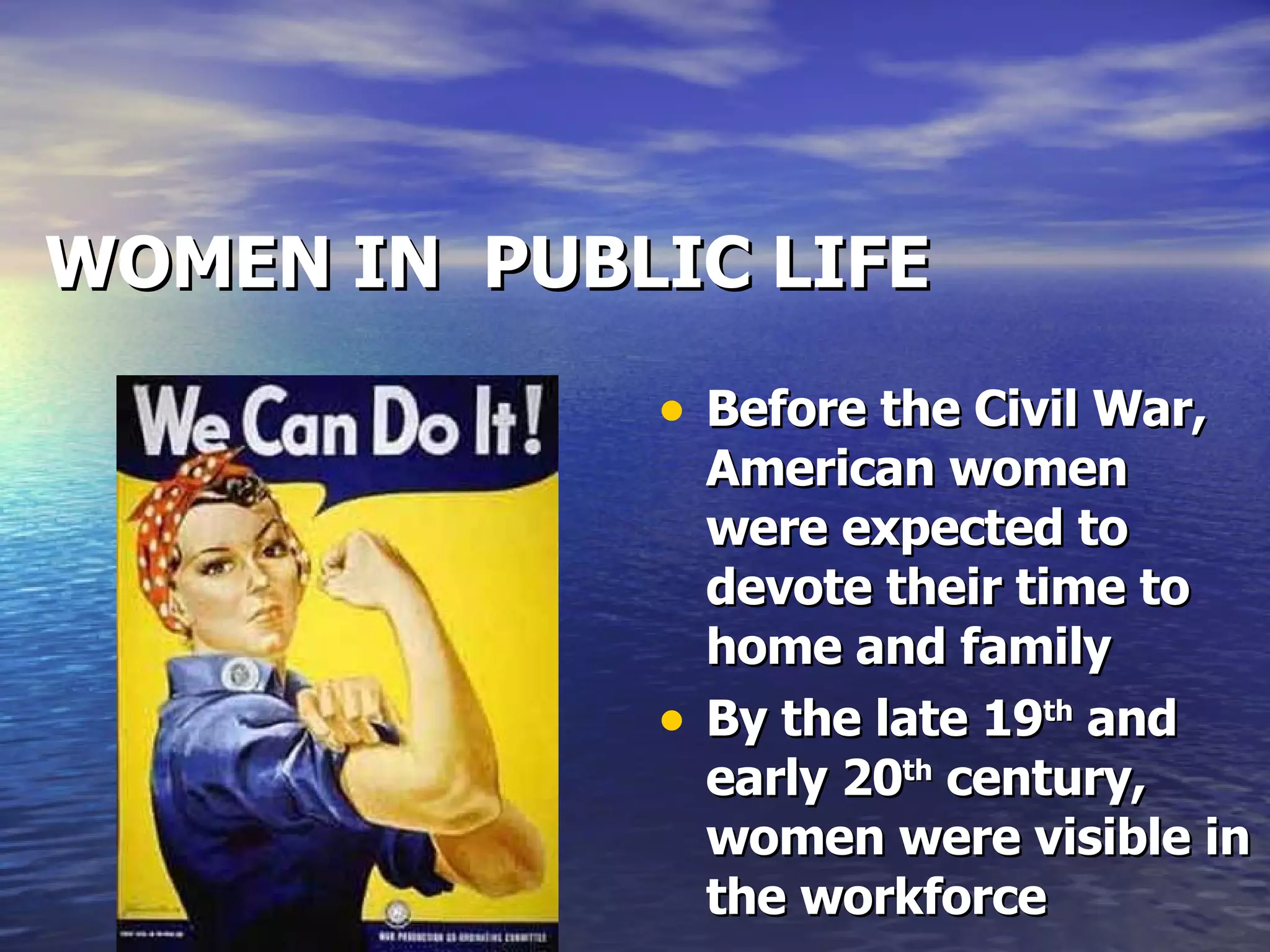
WOMEN IN PUBLIC LIFE Before the Civil War, American women were expected to devote their time to home and family By the late 19 th and early 20 th century, women were visible in the workforce
19.
DOMESTIC WORKERS Beforethe turn-of-the-century women without formal education contributed to the economic welfare of their families by doing domestic work Altogether, 70% of women employed in 1870 were servants
20.
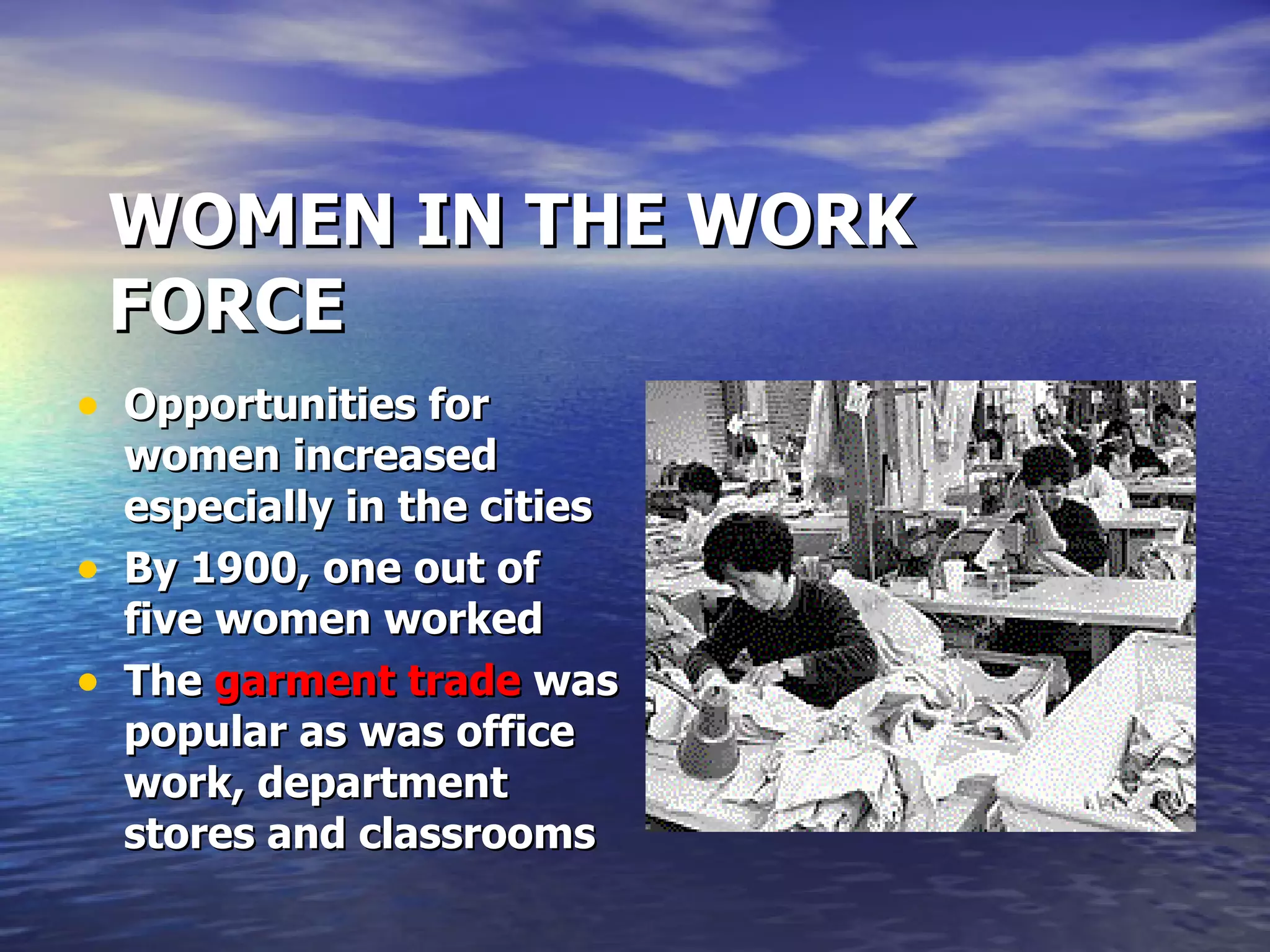
WOMEN IN THEWORK FORCE Opportunities for women increased especially in the cities By 1900, one out of five women worked The garment trade was popular as was office work, department stores and classrooms
21.
WOMEN AND REFORMWomen reformers strove to improve conditions at work and home In 1896, black women formed the National Association of Colored Women (NACW) Suffrage was another important issue for women
22.
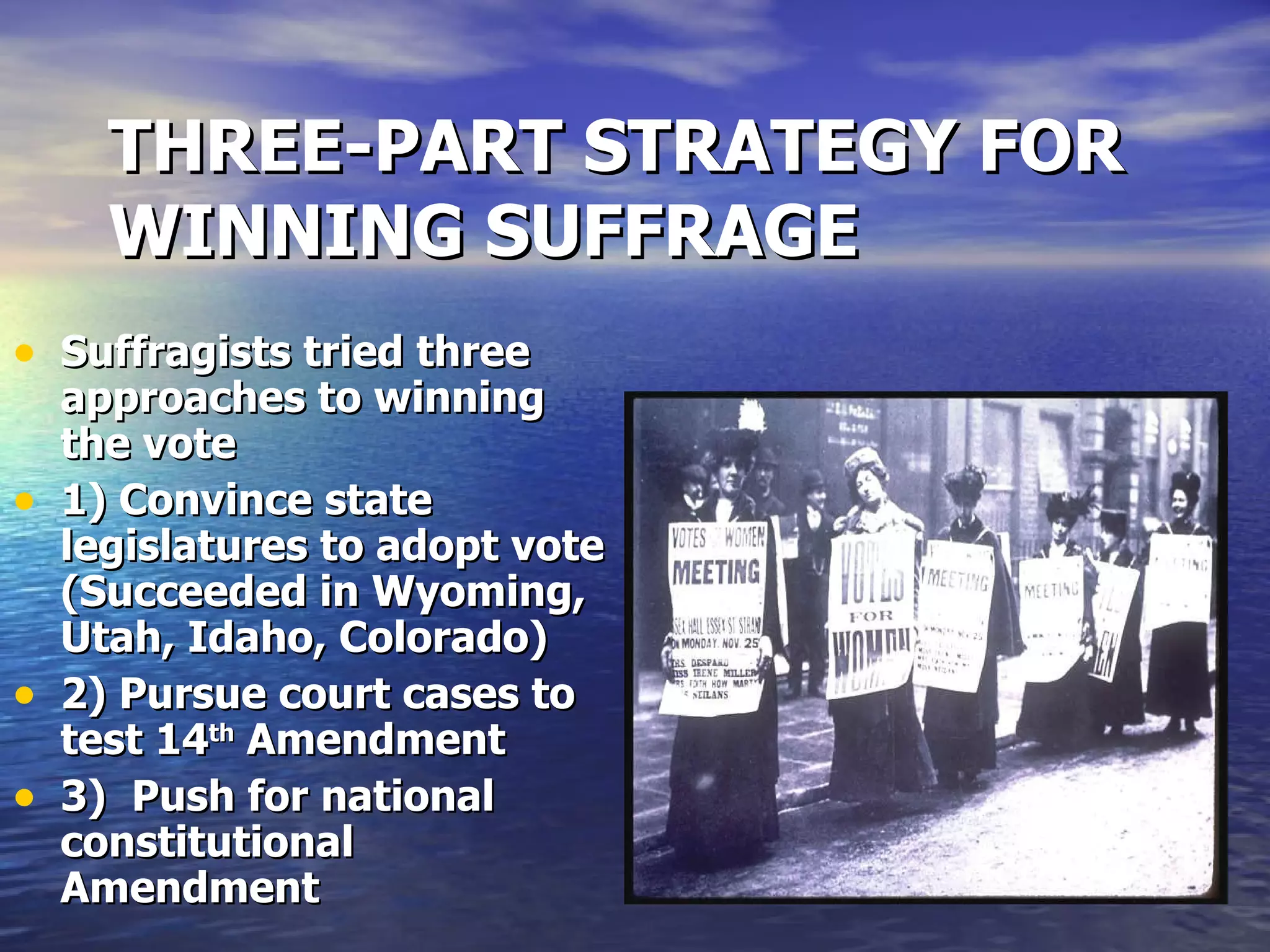
THREE-PART STRATEGY FORWINNING SUFFRAGE Suffragists tried three approaches to winning the vote 1) Convince state legislatures to adopt vote (Succeeded in Wyoming, Utah, Idaho, Colorado) 2) Pursue court cases to test 14 th Amendment 3) Push for national constitutional Amendment
23.
24.
25.
TEDDY ROOSEVELT’S SQUAREDEAL When President William McKinley was assassinated 6 months into his second term, Theodore Roosevelt became the nations 26 th president McKinley was assassinated by an anarchist in Buffalo in September of 1901
26.
ROOSEVELT AND THE ROUGH RIDERS Roosevelt grabbed national attention by advocating war with Spain in 1898 His volunteer cavalry brigade, the Rough Riders, won public acclaim for its role in the battle at San Juan Hill in Cuba Roosevelt returned a hero and was soon elected governor of NY and later McKinley’s vice-president
THE MODERN PRESIDENTWhen Roosevelt was thrust into the presidency in 1901, he became the youngest president ever at age 42 He quickly established himself as a modern president who could influence the media and shape legislation
29.
TRUSTBUSTING By 1900, Trusts – legal bodies created to hold stock in many companies – controlled 80% of U.S. industries Roosevelt filed 44 antitrust suits under the Sherman Antitrust Act
30.
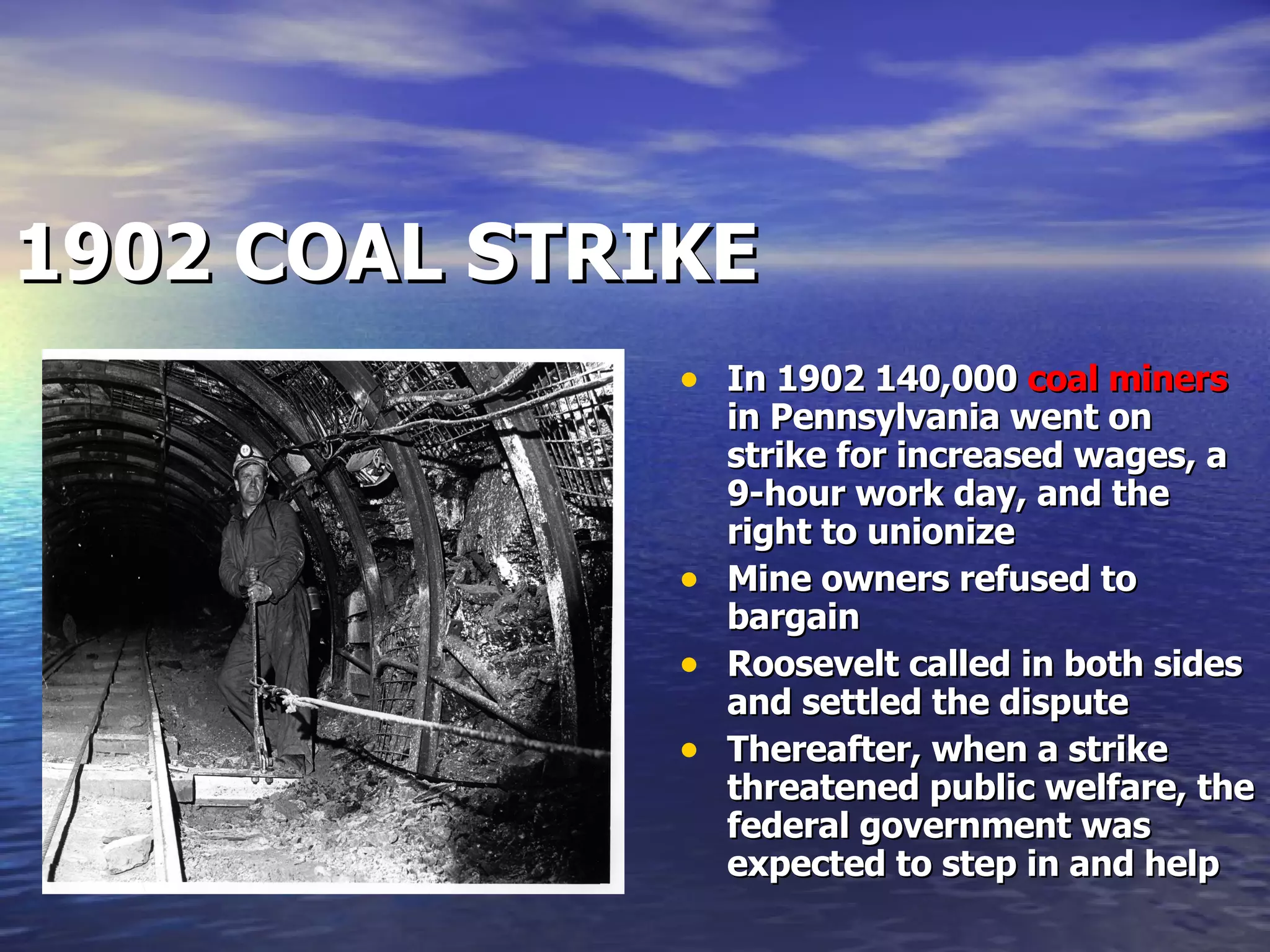
1902 COAL STRIKE In 1902 140,000 coal miners in Pennsylvania went on strike for increased wages, a 9-hour work day, and the right to unionize Mine owners refused to bargain Roosevelt called in both sides and settled the dispute Thereafter, when a strike threatened public welfare, the federal government was expected to step in and help
31.
PURE FOOD ANDDRUG ACT In response to unregulated claims and unhealthy products, Congress passed the Pure Food and Drug Act in 1906 The Act halted the sale of contaminated foods and medicines and called for truth in labeling The Pure Food and Drug Act took medicines with cocaine and other harmful ingredients off the market
32.
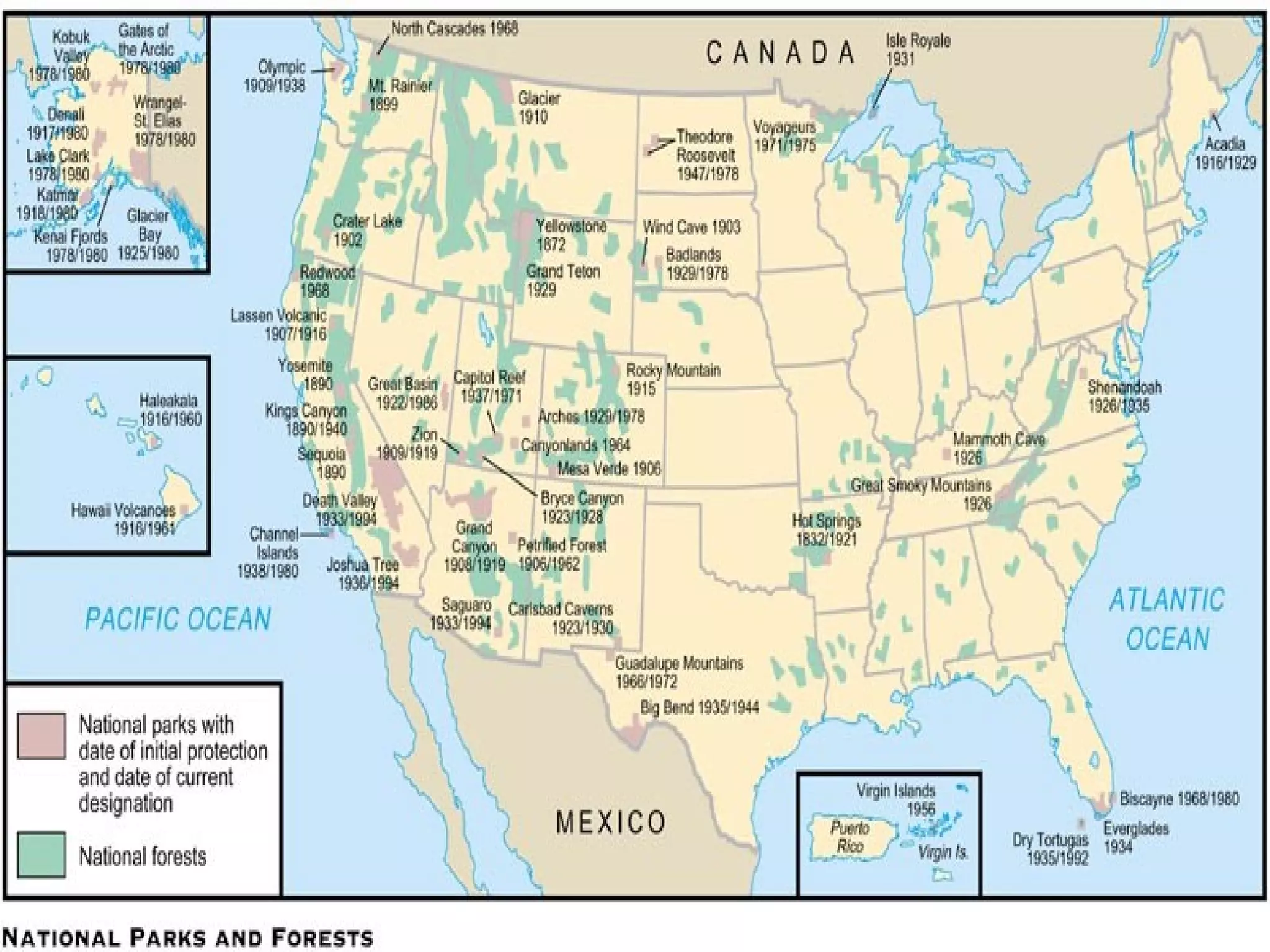
ROOSEVELT AND THEENVIRONMENT Before Roosevelt’s presidency, the federal government paid very little attention to the nation’s natural resources Roosevelt made conservation a primary concern of his administration Roosevelt, left, was an avid outdoorsman – here he is with author John Muir at Yosemite Park
33.
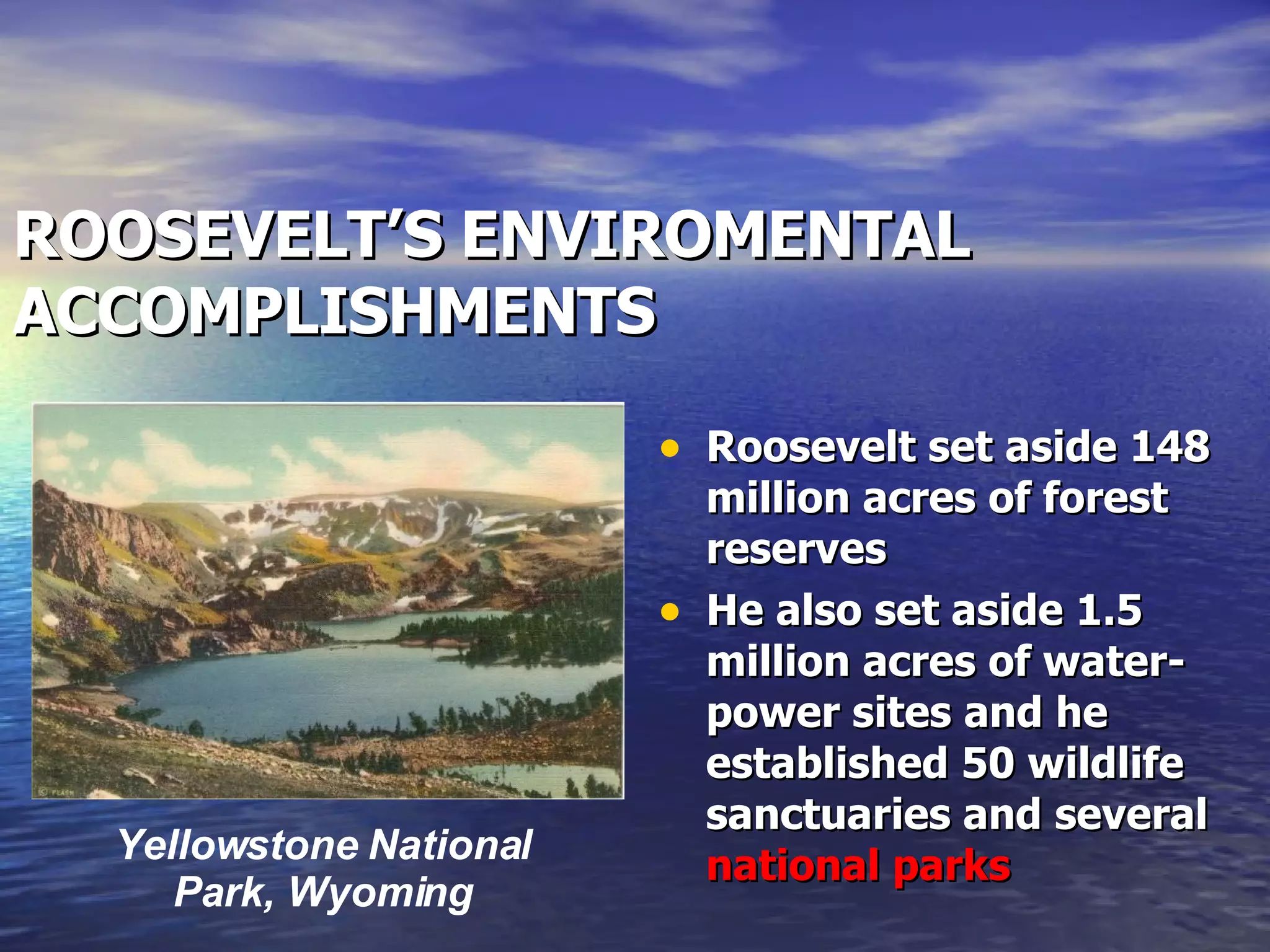
ROOSEVELT’S ENVIROMENTAL ACCOMPLISHMENTSRoosevelt set aside 148 million acres of forest reserves He also set aside 1.5 million acres of water-power sites and he established 50 wildlife sanctuaries and several national parks Yellowstone National Park, Wyoming
34.
35.
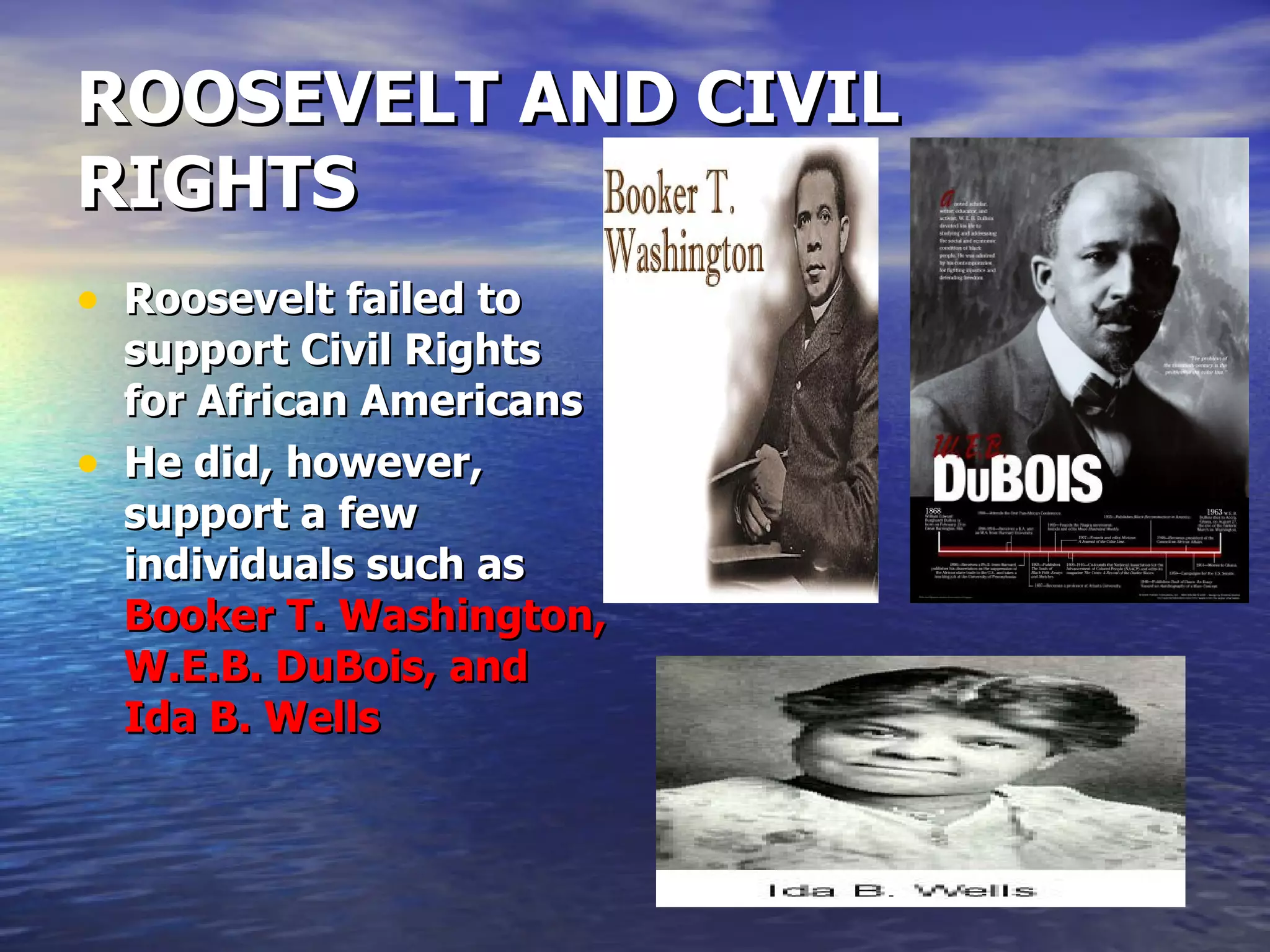
ROOSEVELT AND CIVILRIGHTS Roosevelt failed to support Civil Rights for African Americans He did, however, support a few individuals such as Booker T. Washington, W.E.B. DuBois, and Ida B. Wells
36.
NAACP FORMED TOPROMOTE RIGHTS In 1909 a number of African Americans and prominent white reformers formed the National Association for the Advancement of Colored People The NAACP had 6,000 members by 1914 The goal of the organization was full equality among the races The means to achieve this was the court system 1964 Application
37.
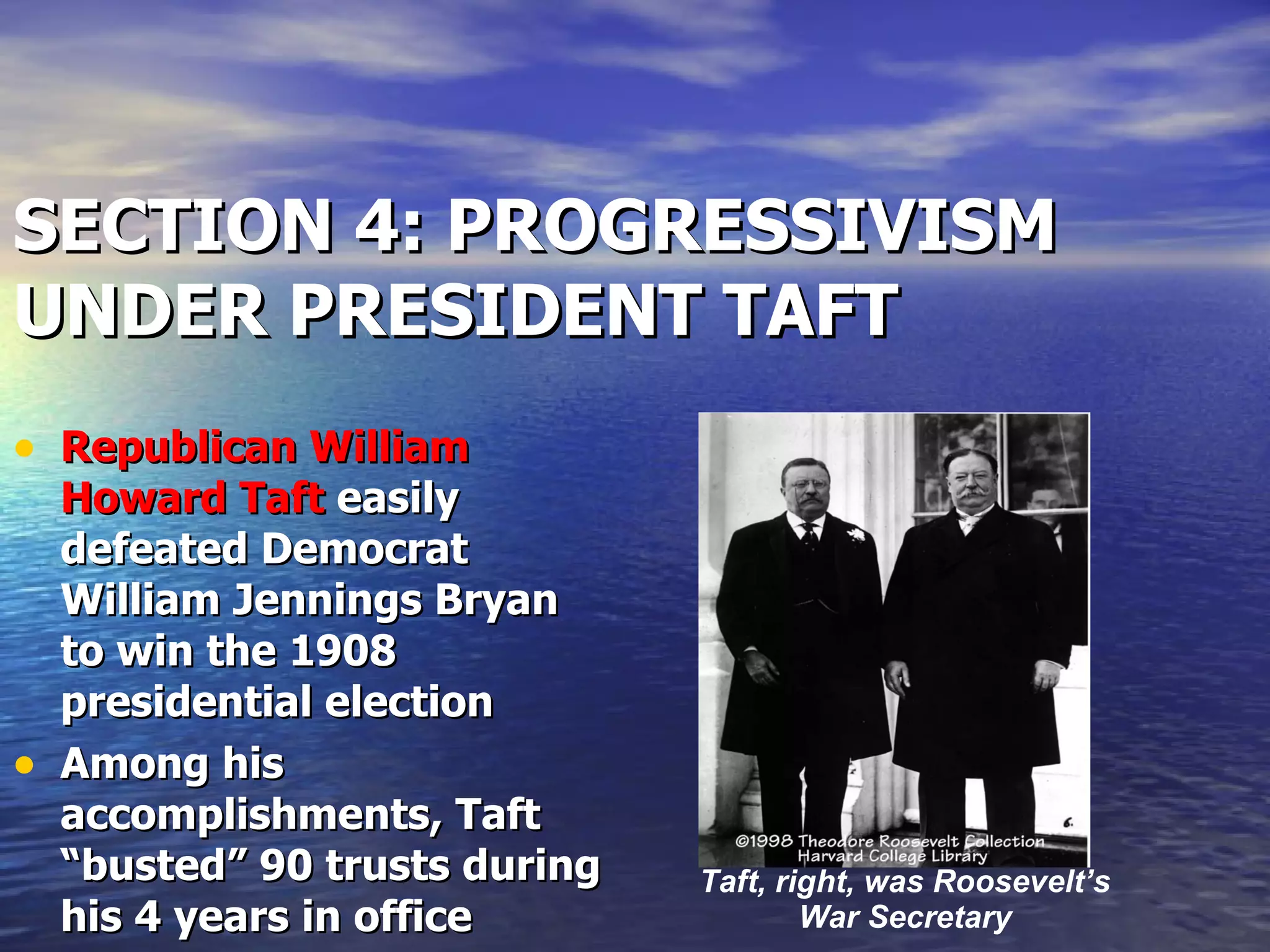
SECTION 4: PROGRESSIVISMUNDER PRESIDENT TAFT Republican William Howard Taft easily defeated Democrat William Jennings Bryan to win the 1908 presidential election Among his accomplishments, Taft “busted” 90 trusts during his 4 years in office Taft, right, was Roosevelt’s War Secretary
38.
TAFT LOSES POWERTaft was not popular with the American public nor reform minded Republicans By 1910, Democrats had regained control of the House of Representatives Taft called the Presidency, “The lonesomest job in the world”
39.
1912 ELECTION Republicans split in 1912 between Taft and Teddy Roosevelt (who returned after a long trip to Africa) Convention delegates nominated Taft Some Republicans formed a third party – The Bull Moose Party and nominated Roosevelt The Democrats put forward a reform - minded New Jersey Governor, Woodrow Wilson Republicans split in 1912
40.
41.
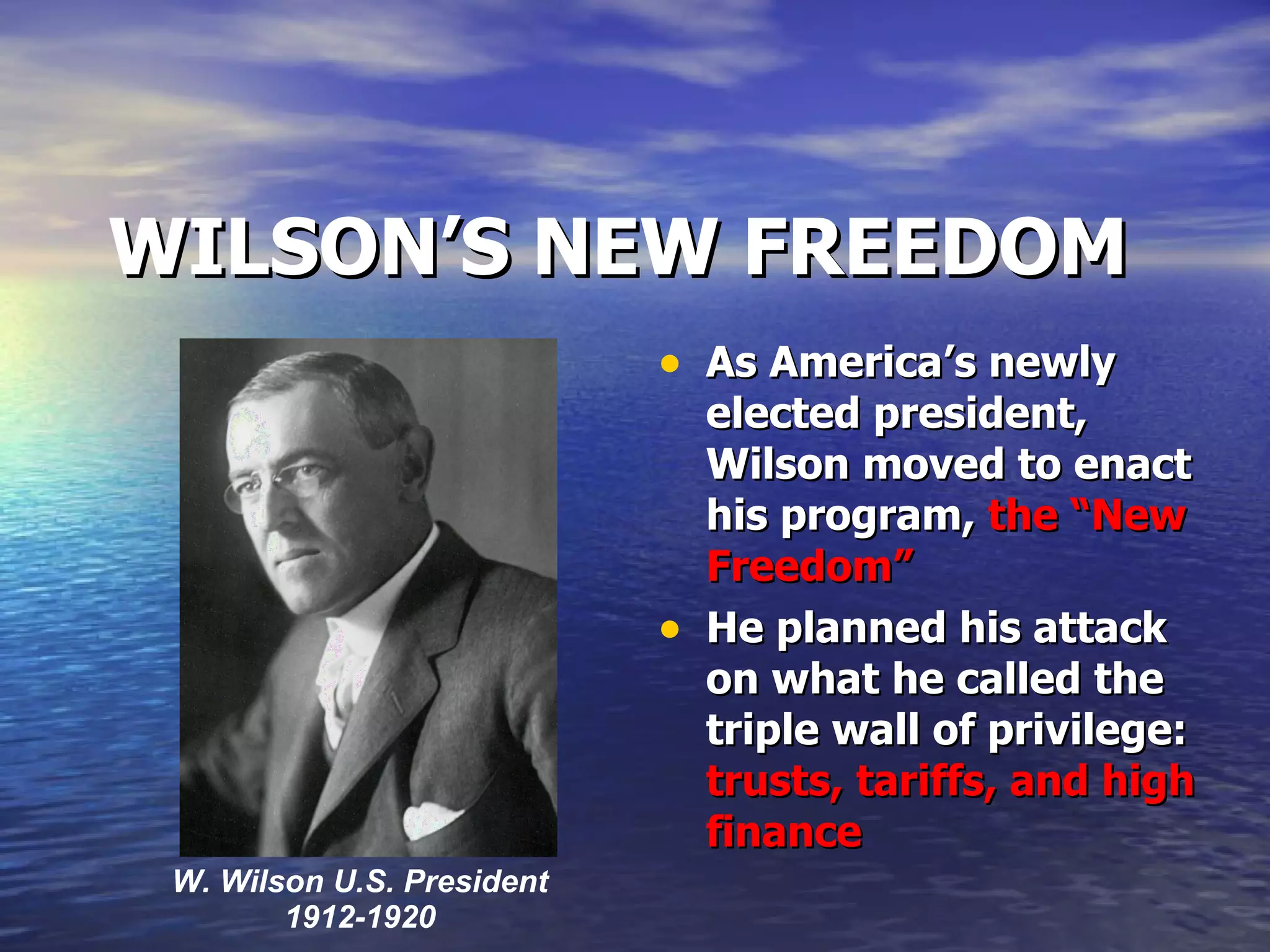
WILSON’S NEW FREEDOMAs America’s newly elected president, Wilson moved to enact his program, the “New Freedom” He planned his attack on what he called the triple wall of privilege: trusts, tariffs, and high finance W. Wilson U.S. President 1912-1920
42.
CLAYTON ANTITRUST ACTIn 1914 Congress enacted the Clayton Antitrust Act which strengthened the Sherman Act The Clayton Act prevented companies from acquiring stock from another company (Anti-monopoly) The Act also supported workers unions
43.
FEDERAL TRADE COMMISSIONFORMED The FTC was formed in 1914 to serve as a “watchdog” agency to end unfair business practices The FTC protects consumers from business fraud Today the FTC has been working on protecting consumers from ID theft
44.
FEDERAL INCOME TAXARRIVES Wilson worked hard to lower tariffs, however that lost revenue had to be made up Ratified in 1916, the 16 th Amendment legalized a graduated federal income tax
45.
WOMEN WIN SUFFRAGENative-born, educated, middle-class women grew more and more impatient Through local, state and national organization, vigorous protests and World War I, women finally realized their dream in 1920 The 19 th Amendment gave women the right to vote in 1920
46.
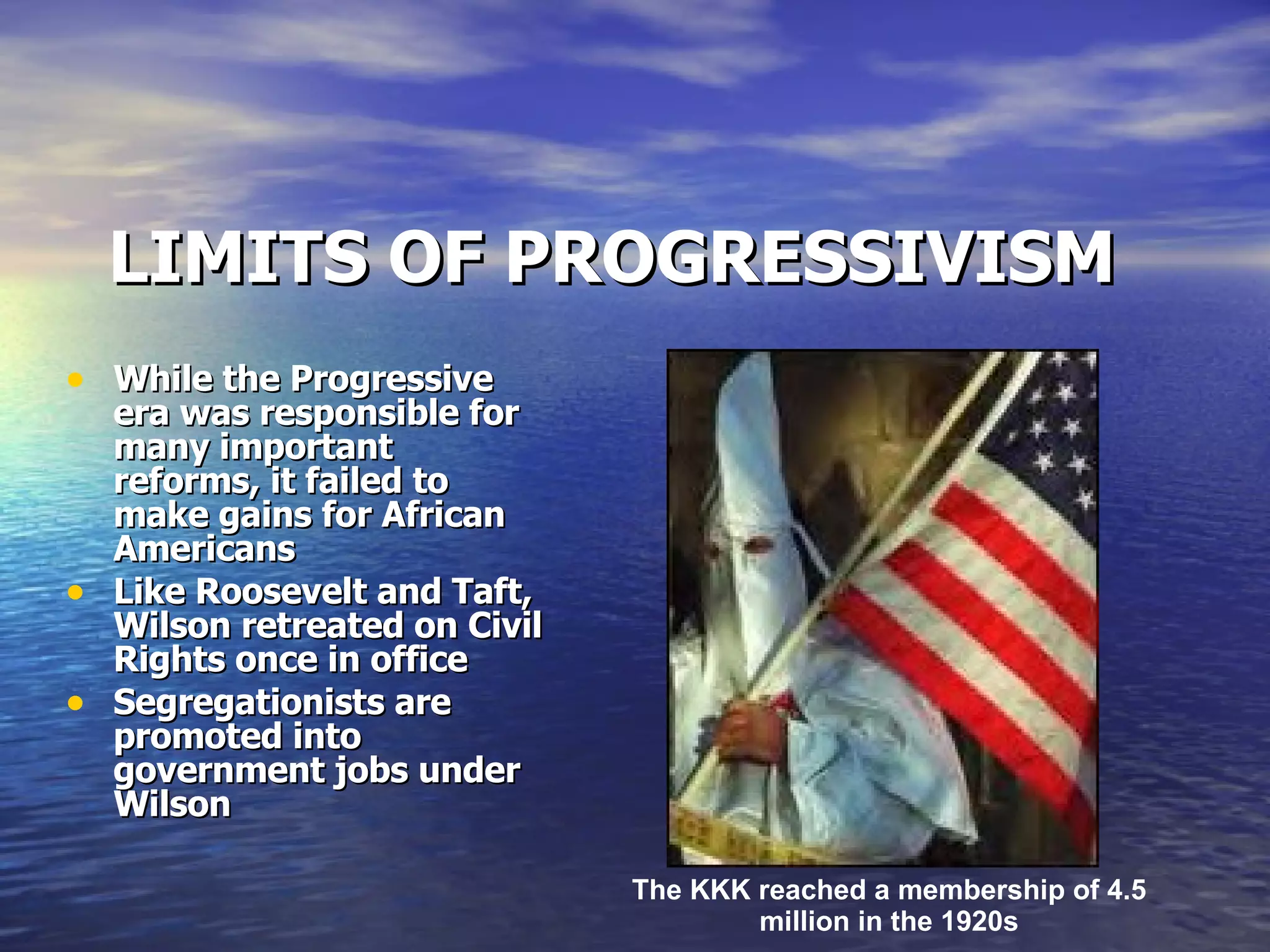
LIMITS OF PROGRESSIVISMWhile the Progressive era was responsible for many important reforms, it failed to make gains for African Americans Like Roosevelt and Taft, Wilson retreated on Civil Rights once in office Segregationists are promoted into government jobs under Wilson The KKK reached a membership of 4.5 million in the 1920s