Writing a
reflective
essay
Sharing your experience . . .
Writing their essays, Emerson and Thoreau
reflected upon basic truths about life that they
derived from personal experience.
Writing Reflective
Essays
Sharing your experience . . .
Emerson wrote, “Whoso would be a man, must be
a nonconformist,” still prods us as learners to
examine our lives today.
Writing Reflective
Essays
Sharing your experience . . .
Like Emerson and Thoreau, as learners you, too,
have experiences from which you learn important
lessons.
Writing Reflective
Essays
Sharing your experience . . .
A reflective essay describes a personal
experience and explores its significance.
Writing Reflective
Essays
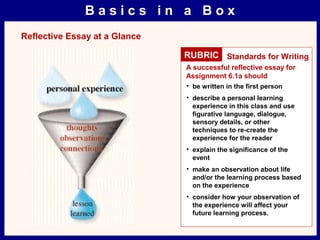
B a s i c s i n a B o x
Reflective Essay at a Glance
RUBRIC Standards for Writing
A successful reflective essay for
Assignment 6.1a should
• be written in the first person
• describe a personal learning
experience in this class and use
figurative language, dialogue,
sensory details, or other
techniques to re-create the
experience for the reader
• explain the significance of the
event
• make an observation about life
and/or the learning process based
on the experience
• consider how your observation of
the experience will affect your
future learning process.
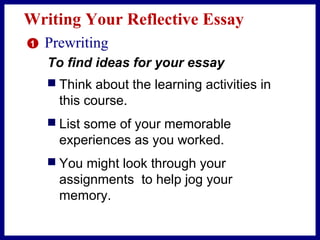
Writing Your Reflective Essay
 Think about the learning activities in
this course.
 List some of your memorable
experiences as you worked.
 You might look through your
assignments to help jog your
memory.
1 Prewriting
To find ideas for your essay
Writing Your Reflective Essay
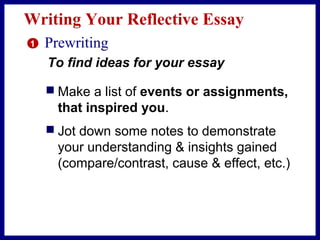
 Make a list of events or assignments,
that inspired you.
 Jot down some notes to demonstrate
your understanding & insights gained
(compare/contrast, cause & effect, etc.)
1 Prewriting
To find ideas for your essay
Planning Your Reflective Essay
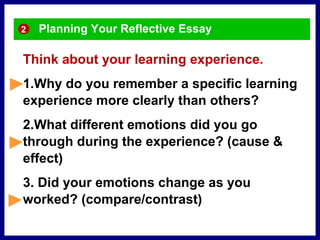
Think about your learning experience.
1.Why do you remember a specific learning
experience more clearly than others?
2.What different emotions did you go
through during the experience? (cause &
effect)
3. Did your emotions change as you
worked? (compare/contrast)
2
Planning Your Reflective Essay
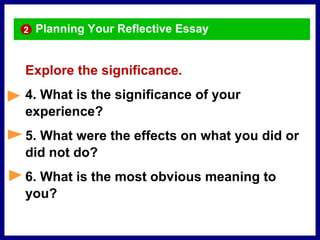
Explore the significance.
4. What is the significance of your
experience?
5. What were the effects on what you did or
did not do?
6. What is the most obvious meaning to
you?
2
Planning Your Reflective Essay
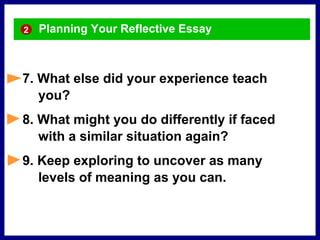
7. What else did your experience teach
you?
8. What might you do differently if faced
with a similar situation again?
9. Keep exploring to uncover as many
levels of meaning as you can.
2
Planning Your Reflective Essay
10. Decide on the scope of your essay. Will
you dwell on one example in-depth or
relate several events to create your
essay?
11. Decide on the message you want to
convey. How will you apply the meaning
of the experience to your life?
2
Writing Your Reflective Essay
3 Drafting
Begin Writing
 You might write about your experience
as though you were writing a journal
entry.
 You may want to begin your draft by
trying out a variety of ideas.
 Let your ideas flow even though you
sense problems you may need to
address later.
Writing Your Reflective Essay
3 Drafting
Organize Your Essay
 Start your paper with an account of your
experience & then explain its
significance.
 Go on to discuss the larger lesson that
the experience has taught you.
 Or, begin with the larger lesson you
want to share with your readers &
describe the experience that helped you
learn this lesson.
Writing Your Reflective Essay
3 Drafting
Organize Your Essay
 Or you could begin with the larger
lesson you want to share with your
readers & then describe the experience
that helped you learn this lesson.
Writing Your Reflective Essay
3 Drafting
Elaborate on Ideas
 Precise, vivid language will help you
convey the lesson about the learning
process that you want to explain.
 After you write a rough draft of your whole
essay, set it aside for a while.
Writing Your Reflective Essay
3 Drafting
 After a few days go back to review & to
revise the essay.
 Taking a fresh look will help you see
problems that you may have overlooked.
Writing Your Reflective Essay
4 Final Essay
 Review your essay against the rubric.
 REMINDER:
If you refer to information that is taken from a
source which you should cite, you must
include your reference section at the end of
your essay with proper citations.
References:
McDougal, Littell. (2015). The Language of Literature Power Point Presentations.
Retrieved from myteacherpages.com/webpages/.../unit3pt1%20reflective
%20essay.ppt
Nicolls, B. (February 2, 2013). How to write a reflective essay). Retrieved from Slide
Share. http://www.slideshare.net/b.nicolls/how-to-write-a-reflective-essay

Reflective essay in an online class

  • 1.
  • 2.
    Sharing your experience. . . Writing their essays, Emerson and Thoreau reflected upon basic truths about life that they derived from personal experience. Writing Reflective Essays
  • 3.
    Sharing your experience. . . Emerson wrote, “Whoso would be a man, must be a nonconformist,” still prods us as learners to examine our lives today. Writing Reflective Essays
  • 4.
    Sharing your experience. . . Like Emerson and Thoreau, as learners you, too, have experiences from which you learn important lessons. Writing Reflective Essays
  • 5.
    Sharing your experience. . . A reflective essay describes a personal experience and explores its significance. Writing Reflective Essays
  • 6.
    B a si c s i n a B o x Reflective Essay at a Glance RUBRIC Standards for Writing A successful reflective essay for Assignment 6.1a should • be written in the first person • describe a personal learning experience in this class and use figurative language, dialogue, sensory details, or other techniques to re-create the experience for the reader • explain the significance of the event • make an observation about life and/or the learning process based on the experience • consider how your observation of the experience will affect your future learning process.
  • 7.
    Writing Your ReflectiveEssay  Think about the learning activities in this course.  List some of your memorable experiences as you worked.  You might look through your assignments to help jog your memory. 1 Prewriting To find ideas for your essay
  • 8.
    Writing Your ReflectiveEssay  Make a list of events or assignments, that inspired you.  Jot down some notes to demonstrate your understanding & insights gained (compare/contrast, cause & effect, etc.) 1 Prewriting To find ideas for your essay
  • 9.
    Planning Your ReflectiveEssay Think about your learning experience. 1.Why do you remember a specific learning experience more clearly than others? 2.What different emotions did you go through during the experience? (cause & effect) 3. Did your emotions change as you worked? (compare/contrast) 2
  • 10.
    Planning Your ReflectiveEssay Explore the significance. 4. What is the significance of your experience? 5. What were the effects on what you did or did not do? 6. What is the most obvious meaning to you? 2
  • 11.
    Planning Your ReflectiveEssay 7. What else did your experience teach you? 8. What might you do differently if faced with a similar situation again? 9. Keep exploring to uncover as many levels of meaning as you can. 2
  • 12.
    Planning Your ReflectiveEssay 10. Decide on the scope of your essay. Will you dwell on one example in-depth or relate several events to create your essay? 11. Decide on the message you want to convey. How will you apply the meaning of the experience to your life? 2
  • 13.
    Writing Your ReflectiveEssay 3 Drafting Begin Writing  You might write about your experience as though you were writing a journal entry.  You may want to begin your draft by trying out a variety of ideas.  Let your ideas flow even though you sense problems you may need to address later.
  • 14.
    Writing Your ReflectiveEssay 3 Drafting Organize Your Essay  Start your paper with an account of your experience & then explain its significance.  Go on to discuss the larger lesson that the experience has taught you.  Or, begin with the larger lesson you want to share with your readers & describe the experience that helped you learn this lesson.
  • 15.
    Writing Your ReflectiveEssay 3 Drafting Organize Your Essay  Or you could begin with the larger lesson you want to share with your readers & then describe the experience that helped you learn this lesson.
  • 16.
    Writing Your ReflectiveEssay 3 Drafting Elaborate on Ideas  Precise, vivid language will help you convey the lesson about the learning process that you want to explain.  After you write a rough draft of your whole essay, set it aside for a while.
  • 17.
    Writing Your ReflectiveEssay 3 Drafting  After a few days go back to review & to revise the essay.  Taking a fresh look will help you see problems that you may have overlooked.
  • 18.
    Writing Your ReflectiveEssay 4 Final Essay  Review your essay against the rubric.  REMINDER: If you refer to information that is taken from a source which you should cite, you must include your reference section at the end of your essay with proper citations.
  • 19.
    References: McDougal, Littell. (2015).The Language of Literature Power Point Presentations. Retrieved from myteacherpages.com/webpages/.../unit3pt1%20reflective %20essay.ppt Nicolls, B. (February 2, 2013). How to write a reflective essay). Retrieved from Slide Share. http://www.slideshare.net/b.nicolls/how-to-write-a-reflective-essay