B.Ed (Hons)
Teaching Practice
A Session on Reflection
Dhani Bux Jillani
Saturday, September 15, 2018
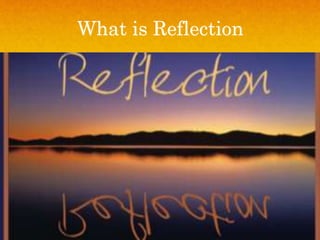
What is Reflection
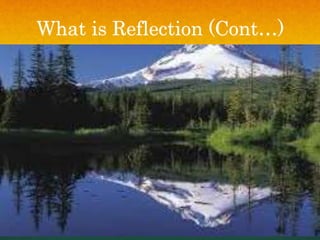
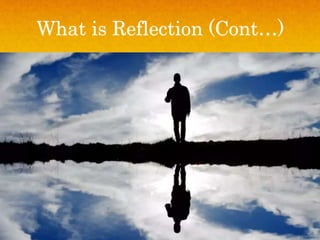
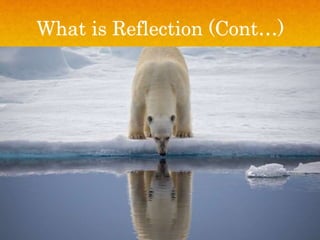
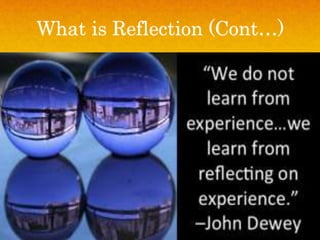
What is Reflection (Cont…)
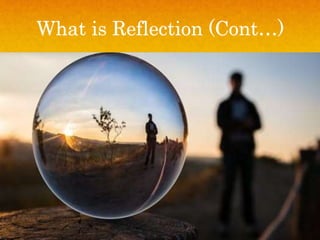
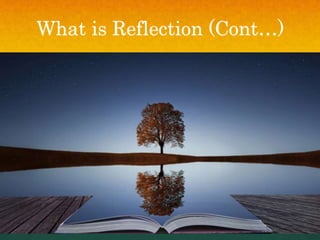
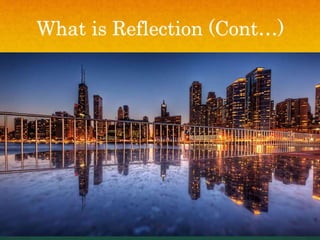
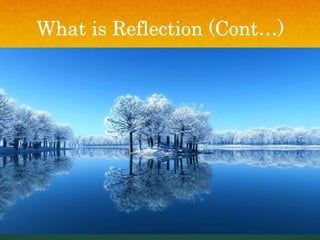
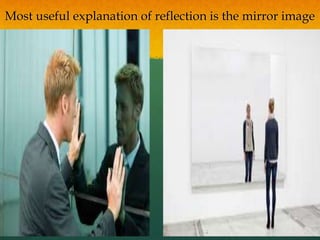
Most useful explanation of reflection is the mirror image
Why Reflection? Early in the Morning
 Just after awakening from your deep sleep and melodious
dreams
 When you look in a Mirror
 You may think to take some actions to improve your image
 You may recognize the need to comb your hairs
 You may recognize the need to shave
 You may recognize to put Fair and Lovely Cream on your
face
 You may recognize a White hair or some White hairs on
your head (Dye, 2011)
So, you think of dying your hairs by applying a dying colour
Or, you think of dying your hairs by applying a black
Mehndi
Why Reflection?
 So, you do, all this,
 Whatever is needed - To improve your image
 Likewise: Reflective thinking:
 Should inform to take an action for improvement
 Like in our image, when we see in mirror
 So, in our learning
 The crux is to improve – whether our image or our
learning – We have to take action for improvement
in the current situation
(Dye, 2011)
What is Reflective Writing?
Reflective writing is evidence - reflective thinking
 In an academic context:
 Reflective thinking usually involves:
1. Looking back at something (What Happened)
1. Often an event, i.e. something that happened, but it could also
be an idea or object
2. Analyzing the event or idea (Why Happened)
2. Thinking in depth and from different perspectives, and trying
to explain, often with reference to a model or theory from your
subject
What is Reflective Writing? (Cont…)
3. Thinking carefully about what the event or idea means for
you (Now So What)
3. What did you learn?
4. How will you apply
5. In sum, your ongoing progress as a learner and/or practicing
professional
 Reflective writing is thus more personal than other kinds of
academic writing
 We all think reflectively in everyday life
 But perhaps not to the same depth as that expected in good
reflective writing at university level
( University of Portsmouth)
Models of Reflective Writing
 There are different models of Reflective Writing / Reflection.
Such As,
 Bortons Model of Reflection – 1970
 Gibb’s Model of Reflection - 1988
 John’s Model of Reflection - 2009
 Mezirow’s Model of Reflection – 2000
 Schon’s Model of Reflection – 1991
 Smyth’s Model of Reflection – 1989
 Zarezadeh, et. al, Model of Reflection – 2009
(Mcclean, 2013)
Reflective Writing
 Divide the class in 7 groups. Each group should read one
model of reflection, and share the key points to class
 Group: 1- Bortons Model of Reflection – 1970
 Group: 2- Gibb’s Model of Reflection - 1988
 Group: 3- John’s Model of Reflection - 2009
 Group: 4- Mezirow’s Model of Reflection – 2000
 Group: 5- Schon’s Model of Reflection - 1991
 Group: 6- Smyth’s Model of Reflection – 1989
 Group: 7- Zarezadeh, et. al, Model of Reflection – 2009
Models???
 Models of Reflection – Also known as Frameworks
for reflection
 Suggest a structured process to guide the act of reflection.
 There is no right model
 It is important to choose the one that feels most comfortable
for you
 Best assists you to learn from your experience
https://www.google.com
How to Structure your Writing OR
How to Write a Reflection
 Regardless of which model or approach you use
 Some common elements are generally present in every
reflective writing, such as:
3 Ws
 So, when you write reflection, use the three W's:
What? (Description-Keep this short)
 What happened?
 Who was involved? What is being observed / examined?
https://learn.solent.ac.uk/mod/book/tool/print/index.php?id=2732#ch1113
How to Structure your Writing OR
How to Write a Reflection (Cont…)
Why Happened / So what? (Interpretation)
 What is most important/interesting/relevant/ useful aspect
of the event/idea/situation?
 How can it be explained?
What next? /Now So What (outcome)
 What have I learned?
 How can it be applied in the future?
https://learn.solent.ac.uk/mod/book/tool/print/index.php?id=2732#ch1113
Hands-On Activity of Reflection Writing
 Group Work - Divide the class in groups
 Share ‘Guidelines for Writing a Reflection’
 Instruct each group to write the Reflection on previous
school visit by using the Guidelines’ Pager
 B.Ed (Hons) Semester 3
 Write about your School Places’ Observation and
Classroom Observations
 B.Ed (Hons) Semester 8
 Write about your Independent Teaching and
Classroom Observations
 Share your group work to class
Recommended Readings
 Department of Curriculum and Quality Enhancement. University
of Portsmouth. Reflective writing: A basic introduction. Retrieved
from, http://www2.port.ac.uk/media/contacts-and-
departments/student-support-
services/ask/downloads/Reflective-writing---a-basic-
introduction.pdf
 Monash University. Common elements of reflective writing.
Retrievedhttps://www.monash.edu/rlo/assignment-
samples/education/education-reflective-writing/reflective-
writing-structure
Recommended Readings (Cont…)
 Mcclean, T. (2013). Models of Reflection. Retrieved from,
www..gov.gg/theinstitute
 Guidelines for writing a Reflection - Semester 3
 Guidelines for writing a Reflection – Semester 8
Questions and Comments…

How to Write a Perfect Reflection

  • 1.
    B.Ed (Hons) Teaching Practice ASession on Reflection Dhani Bux Jillani Saturday, September 15, 2018
  • 2.
  • 3.
  • 4.
  • 5.
  • 6.
  • 7.
  • 8.
  • 9.
  • 10.
  • 11.
    Most useful explanationof reflection is the mirror image
  • 12.
    Why Reflection? Earlyin the Morning  Just after awakening from your deep sleep and melodious dreams  When you look in a Mirror  You may think to take some actions to improve your image  You may recognize the need to comb your hairs  You may recognize the need to shave  You may recognize to put Fair and Lovely Cream on your face  You may recognize a White hair or some White hairs on your head (Dye, 2011)
  • 13.
    So, you thinkof dying your hairs by applying a dying colour
  • 14.
    Or, you thinkof dying your hairs by applying a black Mehndi
  • 15.
    Why Reflection?  So,you do, all this,  Whatever is needed - To improve your image  Likewise: Reflective thinking:  Should inform to take an action for improvement  Like in our image, when we see in mirror  So, in our learning  The crux is to improve – whether our image or our learning – We have to take action for improvement in the current situation (Dye, 2011)
  • 16.
    What is ReflectiveWriting? Reflective writing is evidence - reflective thinking  In an academic context:  Reflective thinking usually involves: 1. Looking back at something (What Happened) 1. Often an event, i.e. something that happened, but it could also be an idea or object 2. Analyzing the event or idea (Why Happened) 2. Thinking in depth and from different perspectives, and trying to explain, often with reference to a model or theory from your subject
  • 17.
    What is ReflectiveWriting? (Cont…) 3. Thinking carefully about what the event or idea means for you (Now So What) 3. What did you learn? 4. How will you apply 5. In sum, your ongoing progress as a learner and/or practicing professional  Reflective writing is thus more personal than other kinds of academic writing  We all think reflectively in everyday life  But perhaps not to the same depth as that expected in good reflective writing at university level ( University of Portsmouth)
  • 18.
    Models of ReflectiveWriting  There are different models of Reflective Writing / Reflection. Such As,  Bortons Model of Reflection – 1970  Gibb’s Model of Reflection - 1988  John’s Model of Reflection - 2009  Mezirow’s Model of Reflection – 2000  Schon’s Model of Reflection – 1991  Smyth’s Model of Reflection – 1989  Zarezadeh, et. al, Model of Reflection – 2009 (Mcclean, 2013)
  • 19.
    Reflective Writing  Dividethe class in 7 groups. Each group should read one model of reflection, and share the key points to class  Group: 1- Bortons Model of Reflection – 1970  Group: 2- Gibb’s Model of Reflection - 1988  Group: 3- John’s Model of Reflection - 2009  Group: 4- Mezirow’s Model of Reflection – 2000  Group: 5- Schon’s Model of Reflection - 1991  Group: 6- Smyth’s Model of Reflection – 1989  Group: 7- Zarezadeh, et. al, Model of Reflection – 2009
  • 20.
    Models???  Models ofReflection – Also known as Frameworks for reflection  Suggest a structured process to guide the act of reflection.  There is no right model  It is important to choose the one that feels most comfortable for you  Best assists you to learn from your experience https://www.google.com
  • 21.
    How to Structureyour Writing OR How to Write a Reflection  Regardless of which model or approach you use  Some common elements are generally present in every reflective writing, such as: 3 Ws  So, when you write reflection, use the three W's: What? (Description-Keep this short)  What happened?  Who was involved? What is being observed / examined? https://learn.solent.ac.uk/mod/book/tool/print/index.php?id=2732#ch1113
  • 22.
    How to Structureyour Writing OR How to Write a Reflection (Cont…) Why Happened / So what? (Interpretation)  What is most important/interesting/relevant/ useful aspect of the event/idea/situation?  How can it be explained? What next? /Now So What (outcome)  What have I learned?  How can it be applied in the future? https://learn.solent.ac.uk/mod/book/tool/print/index.php?id=2732#ch1113
  • 23.
    Hands-On Activity ofReflection Writing  Group Work - Divide the class in groups  Share ‘Guidelines for Writing a Reflection’  Instruct each group to write the Reflection on previous school visit by using the Guidelines’ Pager  B.Ed (Hons) Semester 3  Write about your School Places’ Observation and Classroom Observations  B.Ed (Hons) Semester 8  Write about your Independent Teaching and Classroom Observations  Share your group work to class
  • 24.
    Recommended Readings  Departmentof Curriculum and Quality Enhancement. University of Portsmouth. Reflective writing: A basic introduction. Retrieved from, http://www2.port.ac.uk/media/contacts-and- departments/student-support- services/ask/downloads/Reflective-writing---a-basic- introduction.pdf  Monash University. Common elements of reflective writing. Retrievedhttps://www.monash.edu/rlo/assignment- samples/education/education-reflective-writing/reflective- writing-structure
  • 25.
    Recommended Readings (Cont…) Mcclean, T. (2013). Models of Reflection. Retrieved from, www..gov.gg/theinstitute  Guidelines for writing a Reflection - Semester 3  Guidelines for writing a Reflection – Semester 8
  • 26.