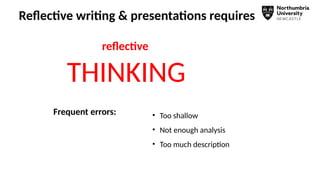
What does reflection(& being reflective) mean?
• Thinking about and evaluating…
- Your experience and/or your performance
- Your strong and weak points
- What knowledge or skills you’ve gained and why that experience was
interesting, important or useful
- Reasons behind success / failure
- Reasons for / or causes behind events, or behaviours, or attitudes
- Ways to improve oneself
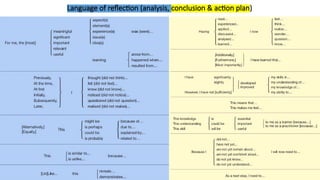
- Language of reflection is often rich in explanation (words such as because, as,
since…)
5.
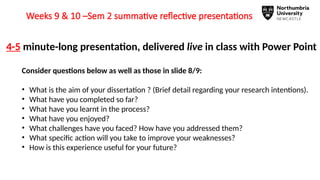
Weeks 9 &10 –Sem 2 summative reflective presentations
4-5 minute-long presentation, delivered live in class with Power Point
Consider questions below as well as those in slide 8/9:
• What is the aim of your dissertation ? (Brief detail regarding your research intentions).
• What have you completed so far?
• What have you learnt in the process?
• What have you enjoyed?
• What challenges have you faced? How have you addressed them?
• What specific action will you take to improve your weaknesses?
• How is this experience useful for your future?
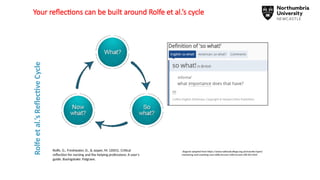
Rolfe, G., Freshwater,D., & Jasper, M. (2001). Critical
reflection for nursing and the helping professions: A user's
guide. Basingstoke: Palgrave.
Rolfe
et
al.’s
Reflective
Cycle
diagram adapted from https://www.nationalcollege.org.uk/transfer/open/
mentoring-and-coaching-core-skills/mccore-s06/mccore-s06-t01.html
Your reflections can be built around Rolfe et al.’s cycle
8.
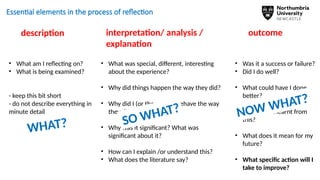
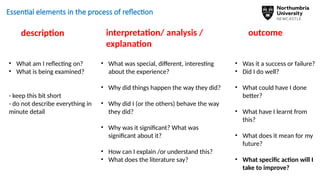
Essential elements inthe process of reflection
interpretation/ analysis /
explanation
• What was special, different, interesting
about the experience?
• Why did things happen the way they did?
• Why did I (or the others) behave the way
they did?
• Why was it significant? What was
significant about it?
• How can I explain /or understand this?
• What does the literature say?
description
• What am I reflecting on?
• What is being examined?
- keep this bit short
- do not describe everything in
minute detail
outcome
• Was it a success or failure?
• Did I do well?
• What could have I done
better?
• What have I learnt from
this?
• What does it mean for my
future?
• What specific action will I
take to improve?
WHAT? SO WHAT? NOW WHAT?
9.
interpretation/ analysis /
explanation
•What was special, different, interesting
about the experience?
• Why did things happen the way they did?
• Why did I (or the others) behave the way
they did?
• Why was it significant? What was
significant about it?
• How can I explain /or understand this?
• What does the literature say?
description
• What am I reflecting on?
• What is being examined?
- keep this bit short
- do not describe everything in
minute detail
outcome
• Was it a success or failure?
• Did I do well?
• What could have I done
better?
• What have I learnt from
this?
• What does it mean for my
future?
• What specific action will I
take to improve?
Essential elements in the process of reflection
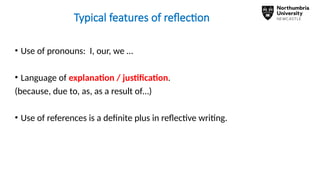
Typical features ofreflection
• Use of pronouns: I, our, we …
• Language of explanation / justification.
(because, due to, as, as a result of…)
• Use of references is a definite plus in reflective writing.
12.
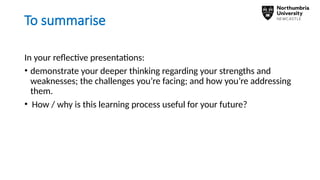
To summarise
In yourreflective presentations:
• demonstrate your deeper thinking regarding your strengths and
weaknesses; the challenges you’re facing; and how you’re addressing
them.
• How / why is this learning process useful for your future?