Reflective Writing
             The Learning Centre • http://www.lc.unsw.edu.au

A great deal of your time university will be spent thinking; thinking about what people have said,
what you have read, what you yourself are thinking and how your thinking has changed. It is
generally believed that the thinking process involves two aspects: reflective thinking and critical
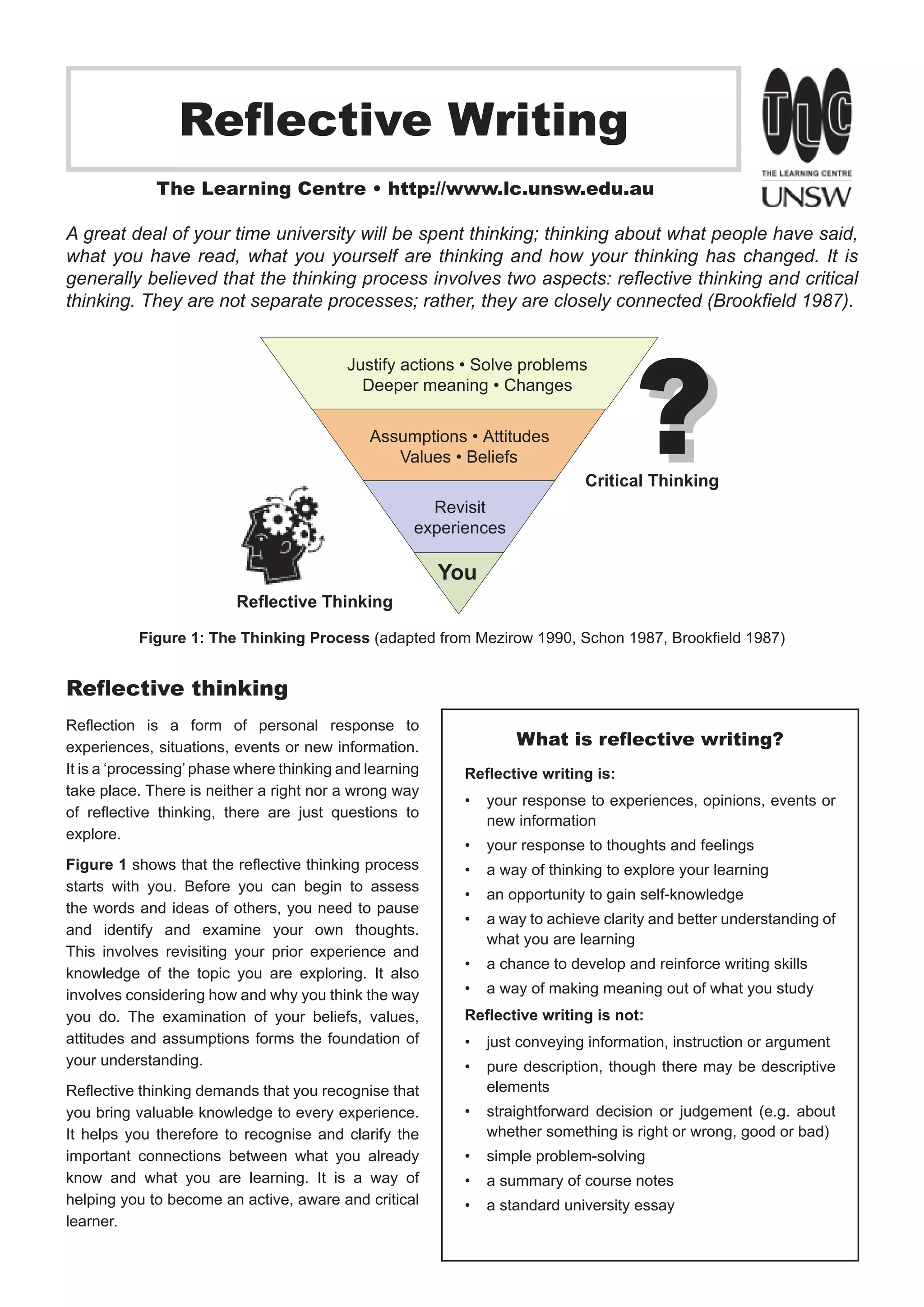
thinking. They are not separate processes; rather, they are closely connected (Brookfield 1987).


                                                                                    ?
                                          Justify actions • Solve problems
                                            Deeper meaning • Changes

                                              Assumptions • Attitudes
                                                 Values • Beliefs
                                                                            Critical Thinking
                                                       Revisit
                                                     experiences

                                                         You
                          Reflective Thinking

           Figure 1: The Thinking Process (adapted from Mezirow 1990, Schon 1987, Brookfield 1987)


Reflective thinking
Reflection is a form of personal response to
experiences, situations, events or new information.                What is reflective writing?
It is a ‘processing’ phase where thinking and learning     Reflective writing is:
take place. There is neither a right nor a wrong way
                                                           •	 your response to experiences, opinions, events or
of reflective thinking, there are just questions to
                                                              new information
explore.
                                                           •	 your response to thoughts and feelings
Figure 1 shows that the reflective thinking process        •	 a way of thinking to explore your learning
starts with you. Before you can begin to assess
                                                           •	 an opportunity to gain self-knowledge
the words and ideas of others, you need to pause
                                                           •	 a way to achieve clarity and better understanding of
and identify and examine your own thoughts.
                                                              what you are learning
This involves revisiting your prior experience and
                                                           •	 a chance to develop and reinforce writing skills
knowledge of the topic you are exploring. It also
involves considering how and why you think the way         •	 a way of making meaning out of what you study
you do. The examination of your beliefs, values,           Reflective writing is not:
attitudes and assumptions forms the foundation of          •	 just conveying information, instruction or argument
your understanding.                                        •	 pure description, though there may be descriptive
Reflective thinking demands that you recognise that           elements
you bring valuable knowledge to every experience.          •	 straightforward decision or judgement (e.g. about
It helps you therefore to recognise and clarify the           whether something is right or wrong, good or bad)
important connections between what you already             •	 simple problem-solving
know and what you are learning. It is a way of             •	 a summary of course notes
helping you to become an active, aware and critical        •	 a standard university essay
learner.
Why are we asked to do
this type of assignment?                                                     Writing Style
• To make connections                                      As it concerns your thoughts, reflective writing is mostly
The idea behind reflective writing is that what you        subjective. Therefore in addition to being reflective
learn at university builds on your prior knowledge,        and logical, you can be personal, hypothetical,
whether it is formal (e.g. education) or informal (e.g.    critical and creative. You can comment based on your
gained through experience). Reflective writing helps       experience, rather than limiting yourself to academic
you develop and clarify the connections between            evidence.
what you already know and what you are learning,           •	 Reflective writing is an activity that includes
between theory and practice and between what you              description (what, when, who) and analysis (how,
are doing and how and why you do it.                          why, what if). It is an explorative tool often resulting
                                                              in more questions than answers.
• To examine your learning processes
                                                           •	 A reflective task may allow you to use different
Reflective writing encourages you to consider and
                                                              modes of writing and language:
comment on your learning experiences—not only
WHAT you’ve learned, but HOW you did so.                      √ descriptive (outlining what something is or how
• To clarify what you are learning                              something was done)

Reflecting helps you to clarify what you have studied,        √ explanatory (explaining why or how it is like
integrate new knowledge with previous knowledge,                that)
and identify the questions you have and what you
                                                              √ expressive (I think, I feel, I believe)
have yet to learn.
                                                           •	 Use full sentences and complete paragraphs
• To reflect on mistakes and successes
                                                           •	 You can usually use personal pronouns like ‘I’, ‘my’
Reflecting on mistakes can help you avoid repeating
                                                              or ‘we’
them. At the same time, reflecting on your discoveries
                                                           •	 Keep colloquial language to a minimum (eg, kid,
helps identify successful principles to use again.
                                                              bloke, stuff)
• To become an active and aware learner
• To become a reflective practitioner once you 	           Types of reflective writing assignments
  graduate and begin your professional life                Journal: requires you to write weekly entries
                                                           throughout a semester. May require you to base your
How do I write reflectively?                               reflection on course content.
                                                           Learning diary: similar to a journal, but may require
What can I discuss?
                                                           group participation. The diary then becomes a place
•	 Your perceptions of the course and the content.         for you to communicate in writing with other group
•	 Experiences, ideas and observations you have            members.
   had, and how they relate to the course or topic.        Log book: often used in disciplines based on
•	 What you found confusing, inspiring, difficult,         experimental work, such as science. You note down
   interesting and why.                                    or ‘log’ what you have done. A log gives you an
•	 Questions you have and conclusions you have             accurate record of a process and helps you reflect
   drawn.                                                  on past actions and make better decisions for future
• 	 How you solved a problem, reached a conclusion,        actions.
    found an answer or reached a point of                  Reflective note: often used in law. A reflective note
    understanding.                                         encourages you to think about your personal reaction
•	 Possibilities,   speculations,    hypotheses      or    to a legal issue raised in a course.
   solutions.                                              Essay diary: can take the form of an annotated
•	 Alternative interpretations or different perspectives   bibliography (where you examine sources of evidence
   on what you have read or done in your course.           you might include in your essay) and a critique (where you
•	 Comparisons and connections between what your           reflect on your own writing and research processes).
   are learning and:                                       Peer review: usually involves students showing their
   √ your prior knowledge and experience;                  work to their peers for feedback.

   √ your prior assumptions and preconceptions;            Self-assessment: requires you to to comment on
                                                           your own work.
   √ what you know from other courses or
     disciplines.
•	 How new ideas challenge what you already know.
•	 What you need to explore next in terms of thoughts and actions.         Tips to help you in your reflective
                                                                                    writing process

Getting Started                                                            •	 Think of an interaction, event or
                                                                              episode you experienced that can be
Clarify your task                                                             connected to the topic
Reflective writing assignments can take many forms, so check               •	 Describe what happened
the guidelines in your course outline before you begin. Clarify any        •	 What was your role?
questions or uncertainties with your lecturer or tutor.
                                                                           •	 What feelings and perceptions
Clarify the practical aspects                                                 surrounded the experience?
You may need to submit a book or folder or complete an online              •	 How would you explain the situation to
component. In addition to writing, you may be able to include pictures,       someone else?
diagrams, media clippings etc.                                             •	 What might this experience mean in
Gather your ideas                                                             the context of your course?
Before you write, you need to think and reflect. Start by drawing up       •	 What other perspectives, theories
a Mindmap. Mindmapping is a technique that can help you expand                or concepts could be applied to the
your thinking, structure your ideas and make connections. You                 situation?
can use a Mindmap to plan your assignment and arrange items to
create the structure of your writing.
1.	 Write your topic in the centre of a blank page.
2.	 Draw related ideas on ‘branches’ that radiate from the central topic. When you get a new idea, start a new branch
    from the centre. Include any ideas, topics, authors, theories, experiences associated with your topic.
3.	 Map quickly, without pausing, to maintain a flow of ideas. Associate freely and do not self-edit; at this stage
    anything and everything is OK.
4.	 Circle the key points or ideas. Look at each item and consider how it relates to others, and to the topic as a whole.
5.	 Map the relationships between the ideas or key points using lines, arrows, colours. Use words or phrases to link them.


Some examples of reflective writing

Social Science fieldwork report (methods section)


  The field notes were written by hand on lined paper. They consisted of jotted notes and
                                                                                                        1.	 Description/
  ‘mental triggers’ (personal notes that would remind me of specific things when it came to             explanation of
  writing the notes up). I took some direct observational notes recording what I saw where              method.
  this was relevant to the research questions and, as I was aiming to get a sense of the                2. Includes
  culture and working environment, I also made researcher inference notes [1] [2].                      discipline-specific
                                                                                                        language
  [3] I found the notetaking process itself helpful, as it ensured that I listened carefully and
                                                                                                        3.	 Critical
  decoded information. Not all the information I recorded was relevant, but noting what I
                                                                                                        evaluation
  found informative contributed to my ability to form an overview on re-reading. However, the
                                                                                                        of method
  reliability of jotted notes alone can be questionable. For example, the notes were not a direct
                                                                                                        4.	 Conclusion
  transcription of what the subjects said but consisted of pertinent or interesting information.
                                                                                                        and
  Rarely did I have time to transcribe a direct quotation, so relied on my own fairly rapid             recommendation
  paraphrasing, which risks changing the meaning. Some technical information was difficult              based on
  to note down accurately [3]. A tape recorder would have been a better, more accurate                  the writer’s
                                                                                                        experience
  method. However, one student brought a tape recorder and was asked to switch it off by a
  participant who was uneasy about her comments being directly recorded. It seemes that
  subjects feel differently about being recorded or photographed (as opposed to observers
  taking notes), so specific consent should be sought before using these technologies [4].
Engineering design report


 Question: Discuss at least two things you learnt or discovered – for example about design, or working
                                                                                                              1.	 Addresses
 in groups or the physical world – through participating in the Impromptu Design activities.                  the assignment
                                                                                                              question
 Firstly, the most obvious thing that I discovered was the advantage of working as part of
 a group [1]. I learned that good teamwork is the key to success in design activities when                    2.	 Reflects
                                                                                                              on direct
 time and resources are limited. As everyone had their own point of view, many different
                                                                                                              experiences
 ideas could be produced and I found the energy of group participation made me feel more
                                                                                                              3.	 Direct
 energetic about contributing something [2].
                                                                                                              reference to the
 Secondly I discovered that even the simplest things on earth could be turned into something                  course activity.

 amazing if we put enough creativity and effort into working on them [1]. With the Impromptu                  4.The style
 Design activities [3] we used some simple materials such as straws, string, and balloons, but                is relatively
                                                                                                              informal, yet
 were still able to create some ‘cool stuff’ [4]. I learned that every design has its weaknesses
                                                                                                              still uses full
 and strengths and working with a group can help discover what they are. We challenged                        sentences.
 each other’s preconceptions about what would and would not work. We could also see the
                                                                                                              6. Relating what
 reality of the way changing a design actually affected its performance [5].                                  was learnt.


Learning journal (weekly reflection)
                                                                                                              1.	 Description
 Last week’s lecture presented the idea that science is the most powerful form of evidence [1].               of topic
 My position as a student studying both physics and law makes this an important issue for me                  encountered
                                                                                                              in the course
 [2] and one I was thinking about while watching the ‘The New Inventors’ television program last
 Tuesday [3]. The two ‘inventors’ (an odd name considering that, as Smith (2002) says, nobody                 2.	 The author’s
                                                                                                              voice is clear
 thinks of things in a vacuum) were accompanied by their marketing people. The conversations
 were quite contrived, but also funny and enlightening. I realised that the marketing people                  3.	 Introduces
                                                                                                              ‘everyday’ life
 used a certain form of evidence to persuade the viewers (us?) of the value of the inventions
                                                                                                              experience
 [4]. To them, this value was determined solely by whether something could be bought or
                                                                                                              4.The style
 sold—in other words, whether something was ‘marketable’. In contrast, the inventors seemed
                                                                                                              is relatively
 quite shy and reluctant to use anything more than technical language, almost as if this was the              informal, yet
 only evidence required – as if no further explanation was needed.                                            still uses full
                                                                                                              sentences
 This difference forced me to reflect on the aims of this course—how communication skills
                                                                                                              5.	 Makes
 are not generic, but differ according to time and place. Like in the ‘Research Methodology’
                                                                                                              an explicit
 textbook discussed in the first lecture, these communication skills are the result of a form of              link between
 triangulation, [5] which I have made into the following diagram:                                             ‘everyday’ life
                                                                                                              and the topic


   References
   Brookfield, S 1987, Developing critical thinkers: challenging adults to explore alternative ways of thinking and acting,
   Open University Press, Milton Keynes.
   Mezirow, J 1990, Fostering critical reflection in adulthood: a guide to transformative and emancipatory learning, Jossey-
   Bass, San Francisco.
   Schön, DA 1987, Educating the reflective practitioner, Jossey-Bass. San Francisco.
   The Learning Centre thanks the students who permitted us to feature examples of their writing.
   Prepared by The Learning Centre, The University of New South Wales © 2008. This guide may be distributed or adapted
   for educational purposes. Full and proper acknowledgement is required. Email: learningcentre@unsw.edu.au

What is reflection

  • 1.
    Reflective Writing The Learning Centre • http://www.lc.unsw.edu.au A great deal of your time university will be spent thinking; thinking about what people have said, what you have read, what you yourself are thinking and how your thinking has changed. It is generally believed that the thinking process involves two aspects: reflective thinking and critical thinking. They are not separate processes; rather, they are closely connected (Brookfield 1987). ? Justify actions • Solve problems Deeper meaning • Changes Assumptions • Attitudes Values • Beliefs Critical Thinking Revisit experiences You Reflective Thinking Figure 1: The Thinking Process (adapted from Mezirow 1990, Schon 1987, Brookfield 1987) Reflective thinking Reflection is a form of personal response to experiences, situations, events or new information. What is reflective writing? It is a ‘processing’ phase where thinking and learning Reflective writing is: take place. There is neither a right nor a wrong way • your response to experiences, opinions, events or of reflective thinking, there are just questions to new information explore. • your response to thoughts and feelings Figure 1 shows that the reflective thinking process • a way of thinking to explore your learning starts with you. Before you can begin to assess • an opportunity to gain self-knowledge the words and ideas of others, you need to pause • a way to achieve clarity and better understanding of and identify and examine your own thoughts. what you are learning This involves revisiting your prior experience and • a chance to develop and reinforce writing skills knowledge of the topic you are exploring. It also involves considering how and why you think the way • a way of making meaning out of what you study you do. The examination of your beliefs, values, Reflective writing is not: attitudes and assumptions forms the foundation of • just conveying information, instruction or argument your understanding. • pure description, though there may be descriptive Reflective thinking demands that you recognise that elements you bring valuable knowledge to every experience. • straightforward decision or judgement (e.g. about It helps you therefore to recognise and clarify the whether something is right or wrong, good or bad) important connections between what you already • simple problem-solving know and what you are learning. It is a way of • a summary of course notes helping you to become an active, aware and critical • a standard university essay learner.
  • 2.
    Why are weasked to do this type of assignment? Writing Style • To make connections As it concerns your thoughts, reflective writing is mostly The idea behind reflective writing is that what you subjective. Therefore in addition to being reflective learn at university builds on your prior knowledge, and logical, you can be personal, hypothetical, whether it is formal (e.g. education) or informal (e.g. critical and creative. You can comment based on your gained through experience). Reflective writing helps experience, rather than limiting yourself to academic you develop and clarify the connections between evidence. what you already know and what you are learning, • Reflective writing is an activity that includes between theory and practice and between what you description (what, when, who) and analysis (how, are doing and how and why you do it. why, what if). It is an explorative tool often resulting in more questions than answers. • To examine your learning processes • A reflective task may allow you to use different Reflective writing encourages you to consider and modes of writing and language: comment on your learning experiences—not only WHAT you’ve learned, but HOW you did so. √ descriptive (outlining what something is or how • To clarify what you are learning something was done) Reflecting helps you to clarify what you have studied, √ explanatory (explaining why or how it is like integrate new knowledge with previous knowledge, that) and identify the questions you have and what you √ expressive (I think, I feel, I believe) have yet to learn. • Use full sentences and complete paragraphs • To reflect on mistakes and successes • You can usually use personal pronouns like ‘I’, ‘my’ Reflecting on mistakes can help you avoid repeating or ‘we’ them. At the same time, reflecting on your discoveries • Keep colloquial language to a minimum (eg, kid, helps identify successful principles to use again. bloke, stuff) • To become an active and aware learner • To become a reflective practitioner once you Types of reflective writing assignments graduate and begin your professional life Journal: requires you to write weekly entries throughout a semester. May require you to base your How do I write reflectively? reflection on course content. Learning diary: similar to a journal, but may require What can I discuss? group participation. The diary then becomes a place • Your perceptions of the course and the content. for you to communicate in writing with other group • Experiences, ideas and observations you have members. had, and how they relate to the course or topic. Log book: often used in disciplines based on • What you found confusing, inspiring, difficult, experimental work, such as science. You note down interesting and why. or ‘log’ what you have done. A log gives you an • Questions you have and conclusions you have accurate record of a process and helps you reflect drawn. on past actions and make better decisions for future • How you solved a problem, reached a conclusion, actions. found an answer or reached a point of Reflective note: often used in law. A reflective note understanding. encourages you to think about your personal reaction • Possibilities, speculations, hypotheses or to a legal issue raised in a course. solutions. Essay diary: can take the form of an annotated • Alternative interpretations or different perspectives bibliography (where you examine sources of evidence on what you have read or done in your course. you might include in your essay) and a critique (where you • Comparisons and connections between what your reflect on your own writing and research processes). are learning and: Peer review: usually involves students showing their √ your prior knowledge and experience; work to their peers for feedback. √ your prior assumptions and preconceptions; Self-assessment: requires you to to comment on your own work. √ what you know from other courses or disciplines.
  • 3.
    • How newideas challenge what you already know. • What you need to explore next in terms of thoughts and actions. Tips to help you in your reflective writing process Getting Started • Think of an interaction, event or episode you experienced that can be Clarify your task connected to the topic Reflective writing assignments can take many forms, so check • Describe what happened the guidelines in your course outline before you begin. Clarify any • What was your role? questions or uncertainties with your lecturer or tutor. • What feelings and perceptions Clarify the practical aspects surrounded the experience? You may need to submit a book or folder or complete an online • How would you explain the situation to component. In addition to writing, you may be able to include pictures, someone else? diagrams, media clippings etc. • What might this experience mean in Gather your ideas the context of your course? Before you write, you need to think and reflect. Start by drawing up • What other perspectives, theories a Mindmap. Mindmapping is a technique that can help you expand or concepts could be applied to the your thinking, structure your ideas and make connections. You situation? can use a Mindmap to plan your assignment and arrange items to create the structure of your writing. 1. Write your topic in the centre of a blank page. 2. Draw related ideas on ‘branches’ that radiate from the central topic. When you get a new idea, start a new branch from the centre. Include any ideas, topics, authors, theories, experiences associated with your topic. 3. Map quickly, without pausing, to maintain a flow of ideas. Associate freely and do not self-edit; at this stage anything and everything is OK. 4. Circle the key points or ideas. Look at each item and consider how it relates to others, and to the topic as a whole. 5. Map the relationships between the ideas or key points using lines, arrows, colours. Use words or phrases to link them. Some examples of reflective writing Social Science fieldwork report (methods section) The field notes were written by hand on lined paper. They consisted of jotted notes and 1. Description/ ‘mental triggers’ (personal notes that would remind me of specific things when it came to explanation of writing the notes up). I took some direct observational notes recording what I saw where method. this was relevant to the research questions and, as I was aiming to get a sense of the 2. Includes culture and working environment, I also made researcher inference notes [1] [2]. discipline-specific language [3] I found the notetaking process itself helpful, as it ensured that I listened carefully and 3. Critical decoded information. Not all the information I recorded was relevant, but noting what I evaluation found informative contributed to my ability to form an overview on re-reading. However, the of method reliability of jotted notes alone can be questionable. For example, the notes were not a direct 4. Conclusion transcription of what the subjects said but consisted of pertinent or interesting information. and Rarely did I have time to transcribe a direct quotation, so relied on my own fairly rapid recommendation paraphrasing, which risks changing the meaning. Some technical information was difficult based on to note down accurately [3]. A tape recorder would have been a better, more accurate the writer’s experience method. However, one student brought a tape recorder and was asked to switch it off by a participant who was uneasy about her comments being directly recorded. It seemes that subjects feel differently about being recorded or photographed (as opposed to observers taking notes), so specific consent should be sought before using these technologies [4].
  • 4.
    Engineering design report Question: Discuss at least two things you learnt or discovered – for example about design, or working 1. Addresses in groups or the physical world – through participating in the Impromptu Design activities. the assignment question Firstly, the most obvious thing that I discovered was the advantage of working as part of a group [1]. I learned that good teamwork is the key to success in design activities when 2. Reflects on direct time and resources are limited. As everyone had their own point of view, many different experiences ideas could be produced and I found the energy of group participation made me feel more 3. Direct energetic about contributing something [2]. reference to the Secondly I discovered that even the simplest things on earth could be turned into something course activity. amazing if we put enough creativity and effort into working on them [1]. With the Impromptu 4.The style Design activities [3] we used some simple materials such as straws, string, and balloons, but is relatively informal, yet were still able to create some ‘cool stuff’ [4]. I learned that every design has its weaknesses still uses full and strengths and working with a group can help discover what they are. We challenged sentences. each other’s preconceptions about what would and would not work. We could also see the 6. Relating what reality of the way changing a design actually affected its performance [5]. was learnt. Learning journal (weekly reflection) 1. Description Last week’s lecture presented the idea that science is the most powerful form of evidence [1]. of topic My position as a student studying both physics and law makes this an important issue for me encountered in the course [2] and one I was thinking about while watching the ‘The New Inventors’ television program last Tuesday [3]. The two ‘inventors’ (an odd name considering that, as Smith (2002) says, nobody 2. The author’s voice is clear thinks of things in a vacuum) were accompanied by their marketing people. The conversations were quite contrived, but also funny and enlightening. I realised that the marketing people 3. Introduces ‘everyday’ life used a certain form of evidence to persuade the viewers (us?) of the value of the inventions experience [4]. To them, this value was determined solely by whether something could be bought or 4.The style sold—in other words, whether something was ‘marketable’. In contrast, the inventors seemed is relatively quite shy and reluctant to use anything more than technical language, almost as if this was the informal, yet only evidence required – as if no further explanation was needed. still uses full sentences This difference forced me to reflect on the aims of this course—how communication skills 5. Makes are not generic, but differ according to time and place. Like in the ‘Research Methodology’ an explicit textbook discussed in the first lecture, these communication skills are the result of a form of link between triangulation, [5] which I have made into the following diagram: ‘everyday’ life and the topic References Brookfield, S 1987, Developing critical thinkers: challenging adults to explore alternative ways of thinking and acting, Open University Press, Milton Keynes. Mezirow, J 1990, Fostering critical reflection in adulthood: a guide to transformative and emancipatory learning, Jossey- Bass, San Francisco. Schön, DA 1987, Educating the reflective practitioner, Jossey-Bass. San Francisco. The Learning Centre thanks the students who permitted us to feature examples of their writing. Prepared by The Learning Centre, The University of New South Wales © 2008. This guide may be distributed or adapted for educational purposes. Full and proper acknowledgement is required. Email: learningcentre@unsw.edu.au