
R E F L E C T I V E P R A C T I C E
Unit 4
What is Reflection?
 What do you see in the mirror?
 Why do you see mirror before you leave home?
 How does reflection help you?
Reflection is important!
 Home: A family is a social structure; every family
member needs to reflect upon what they do? why they do
it? And how they can do it better for family’s
betterment?
 Organizations: A set up in which people interact for a
purpose and they need to reflect if their actions and
behaviors are fulfilling the purpose/s without harming
anyone.
 Society: A larger structure of personal, private and public
set ups in which individuals and groups need to reflect
before during and after any social interaction.
REFLECTIVE PRACTICE
 Reflective practice is the ability to reflect on
action in order to keep the learning process in cycle.
(Schon, 1983)
 After analysing and evaluating, we develop the
theoretical aspects in practice. This practice is being
done for the better future. Such process is known as
Reflection. (Reid, 1993)
 Reflection is more than merely thinking or musing.
Reflection is a not simple, but complex in nature. It
is planned and brainy activity that flourishes
learning from experience. (Dewey, 1933)
THEORETICAL PERSPECTIVES AND MODELS
John Dewey on Reflection: What contribute to
learning is not confined to imagination, belief, and
stream of consciousness.
 They are certainly part of our thinking activities, but play
too less a part in lifelong learning. In the context of
learning; reflection plays a different role.
Dewey defines reflection as the
" …active, persistent, and careful consideration of any
belief or supposed form of knowledge in the light of the
grounds that support it and the further conclusions to
which it tends “(Dewey, How We Think, 1933).
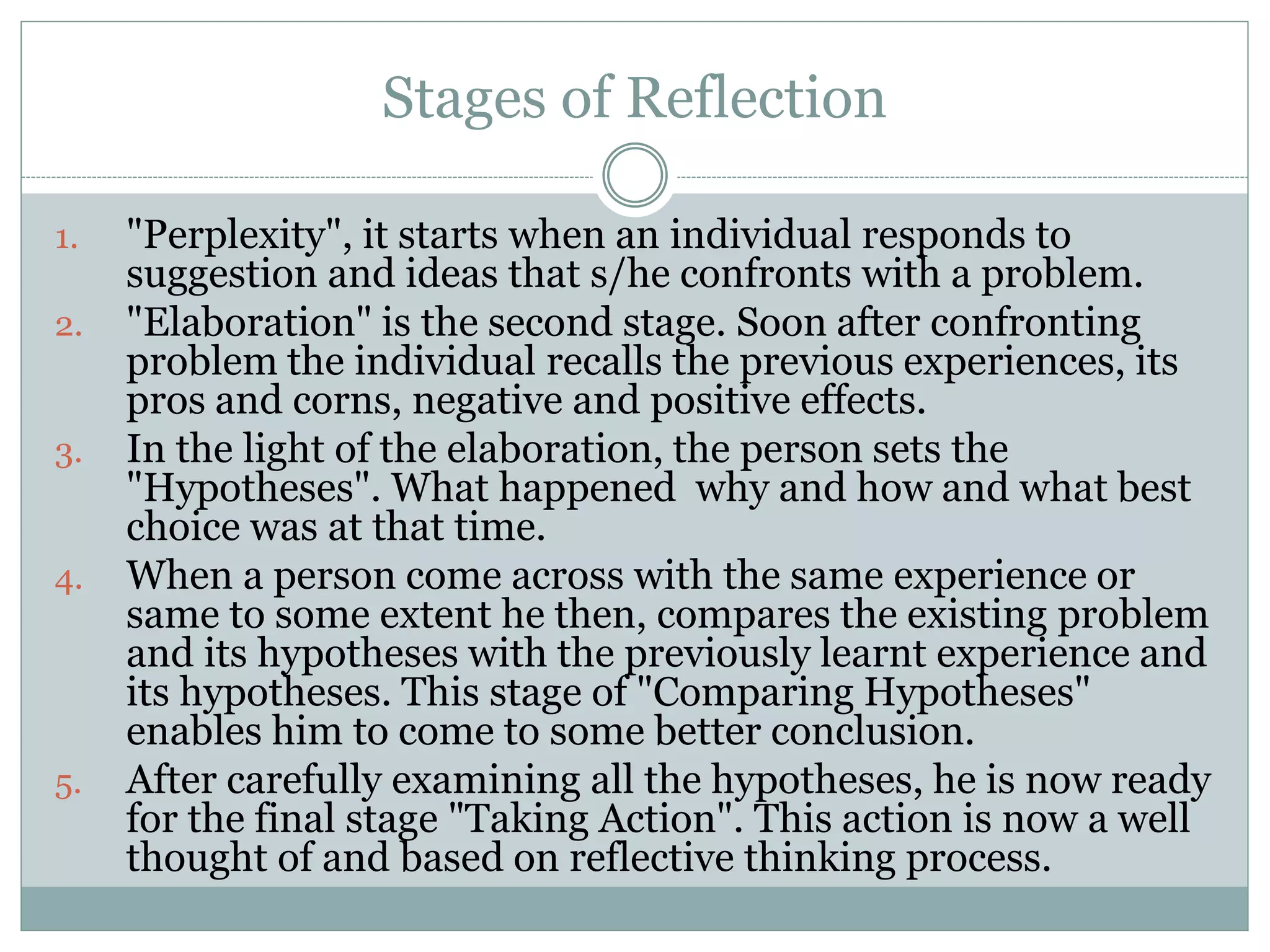
Stages of Reflection
1. "Perplexity", it starts when an individual responds to
suggestion and ideas that s/he confronts with a problem.
2. "Elaboration" is the second stage. Soon after confronting
problem the individual recalls the previous experiences, its
pros and corns, negative and positive effects.
3. In the light of the elaboration, the person sets the
"Hypotheses". What happened why and how and what best
choice was at that time.
4. When a person come across with the same experience or
same to some extent he then, compares the existing problem
and its hypotheses with the previously learnt experience and
its hypotheses. This stage of "Comparing Hypotheses"
enables him to come to some better conclusion.
5. After carefully examining all the hypotheses, he is now ready
for the final stage "Taking Action". This action is now a well
thought of and based on reflective thinking process.
Three Attitudes
In fact, to Dewey, reflective thinking fosters the
development of three attitudes that further the
“habit of thinking in a reflective way.” These three
attitudes are:
 Open mindedness (freedom from prejudice)
 Wholeheartedness or absorbed interest
 Responsibility in facing consequences (Dewey,
1944)
Schon’s Model of Reflective Practice
 According to Schon (1983) "Professional knowledge
and expertise is developed through reflective
practices". Schon was basically interested in knowing
as to when and how the professionals use reflection
for professional development.
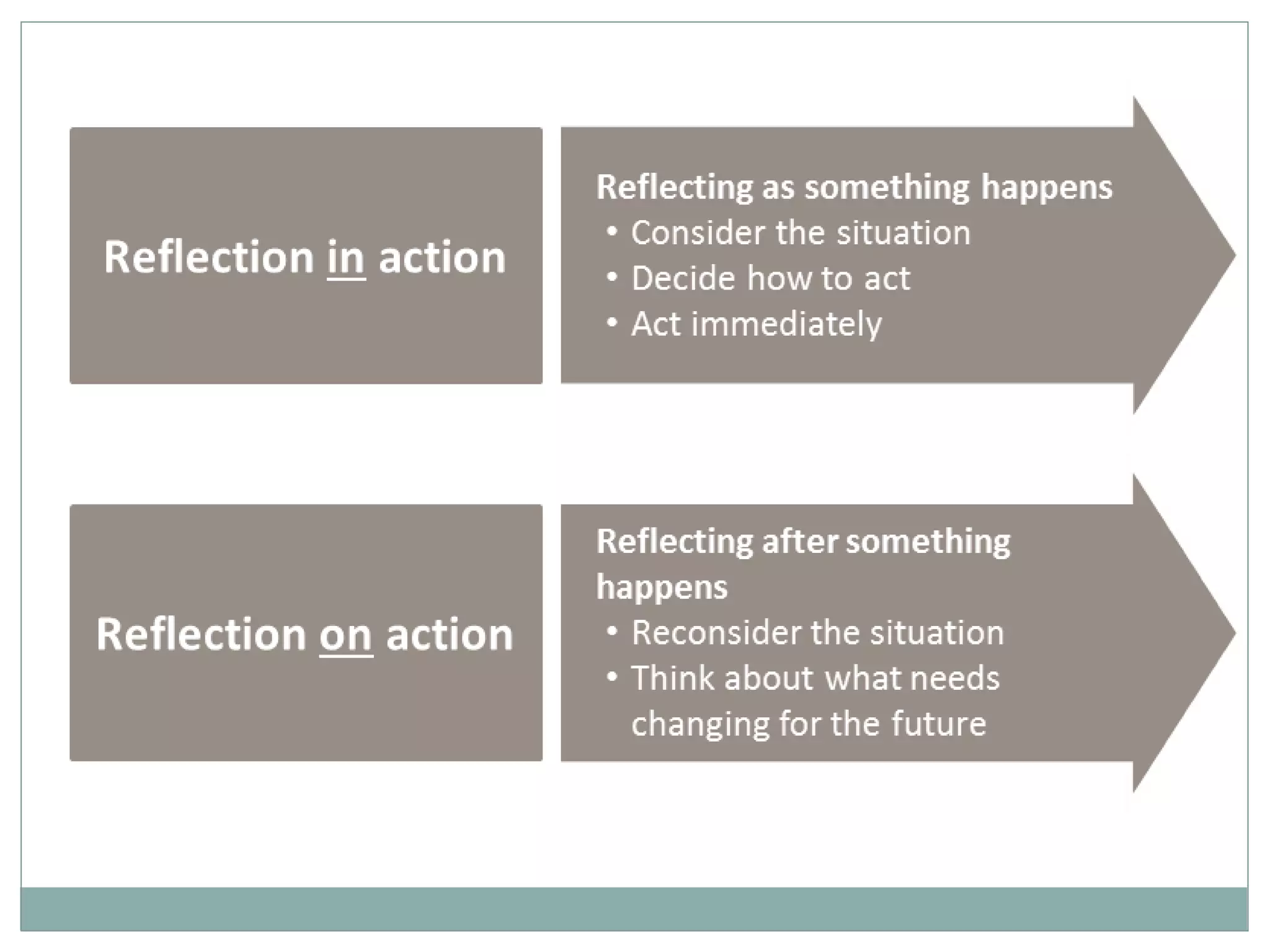
 Schon's work was based on the proximal
development of theory and practice of reflection. His
work is on reflection in-action and reflection on-
action.
Kolb’s Model of Reflective Practice
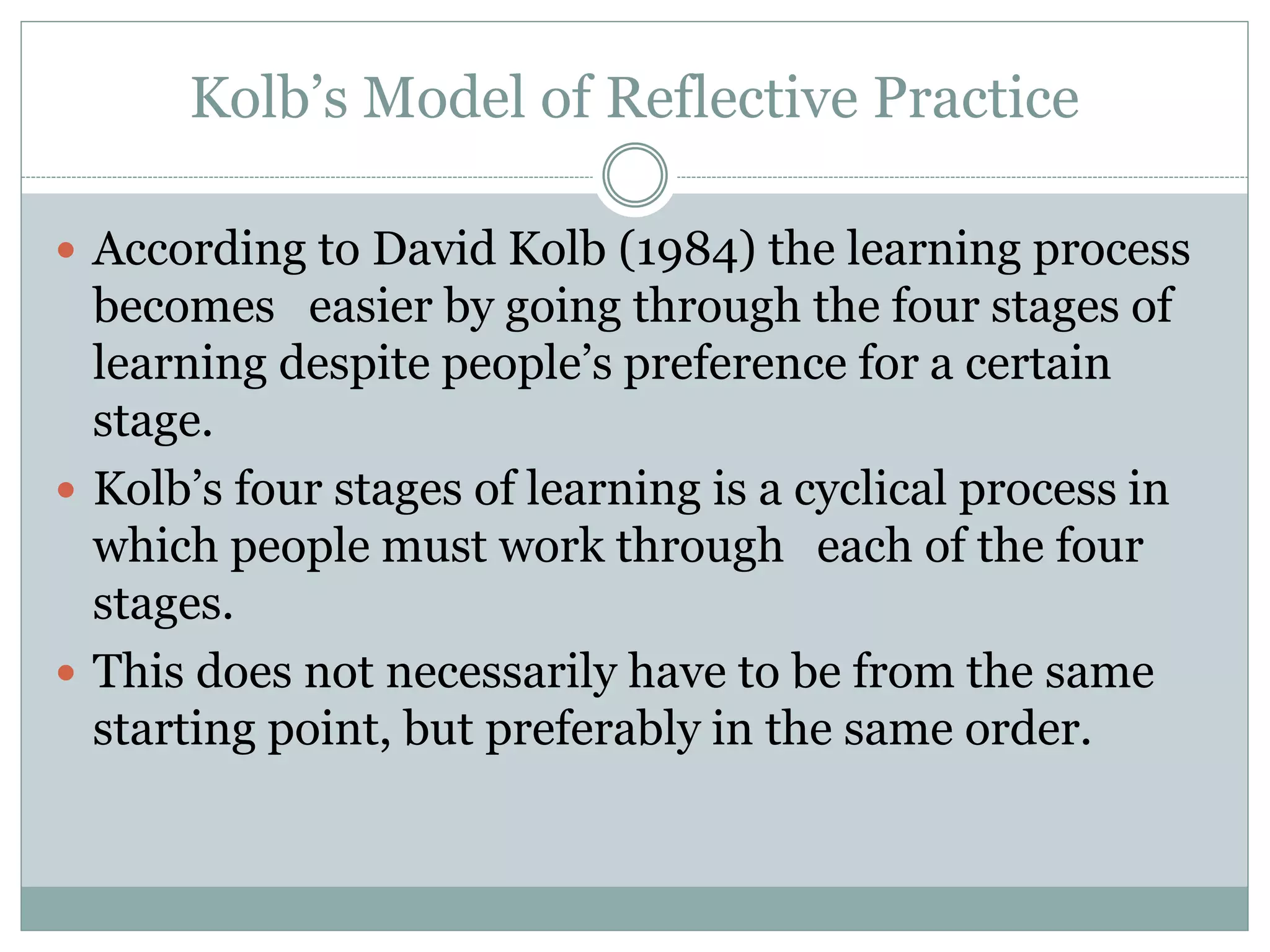
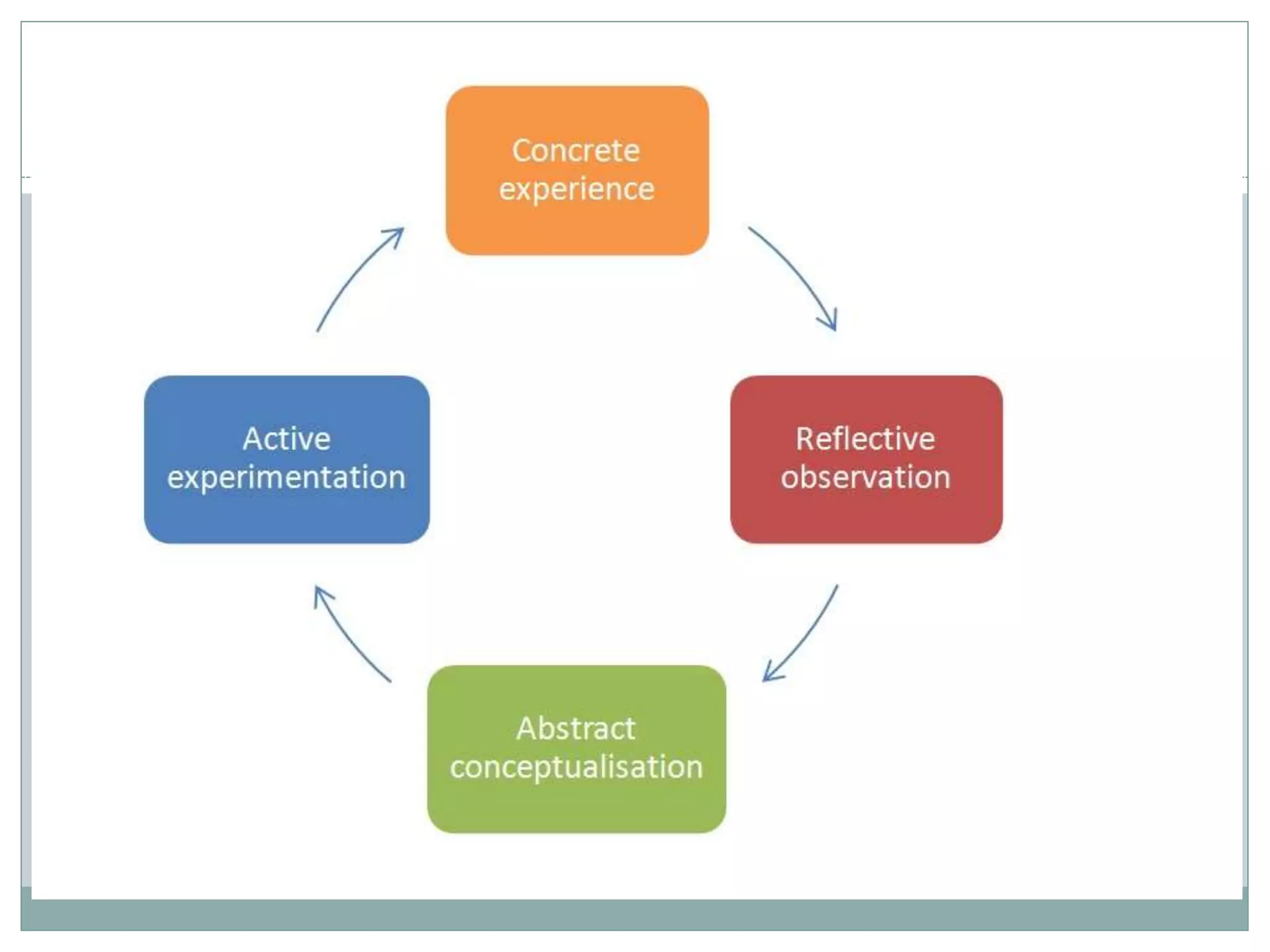
 According to David Kolb (1984) the learning process
becomes easier by going through the four stages of
learning despite people’s preference for a certain
stage.
 Kolb’s four stages of learning is a cyclical process in
which people must work through each of the four
stages.
 This does not necessarily have to be from the same
starting point, but preferably in the same order.
Peter’s DATA Model
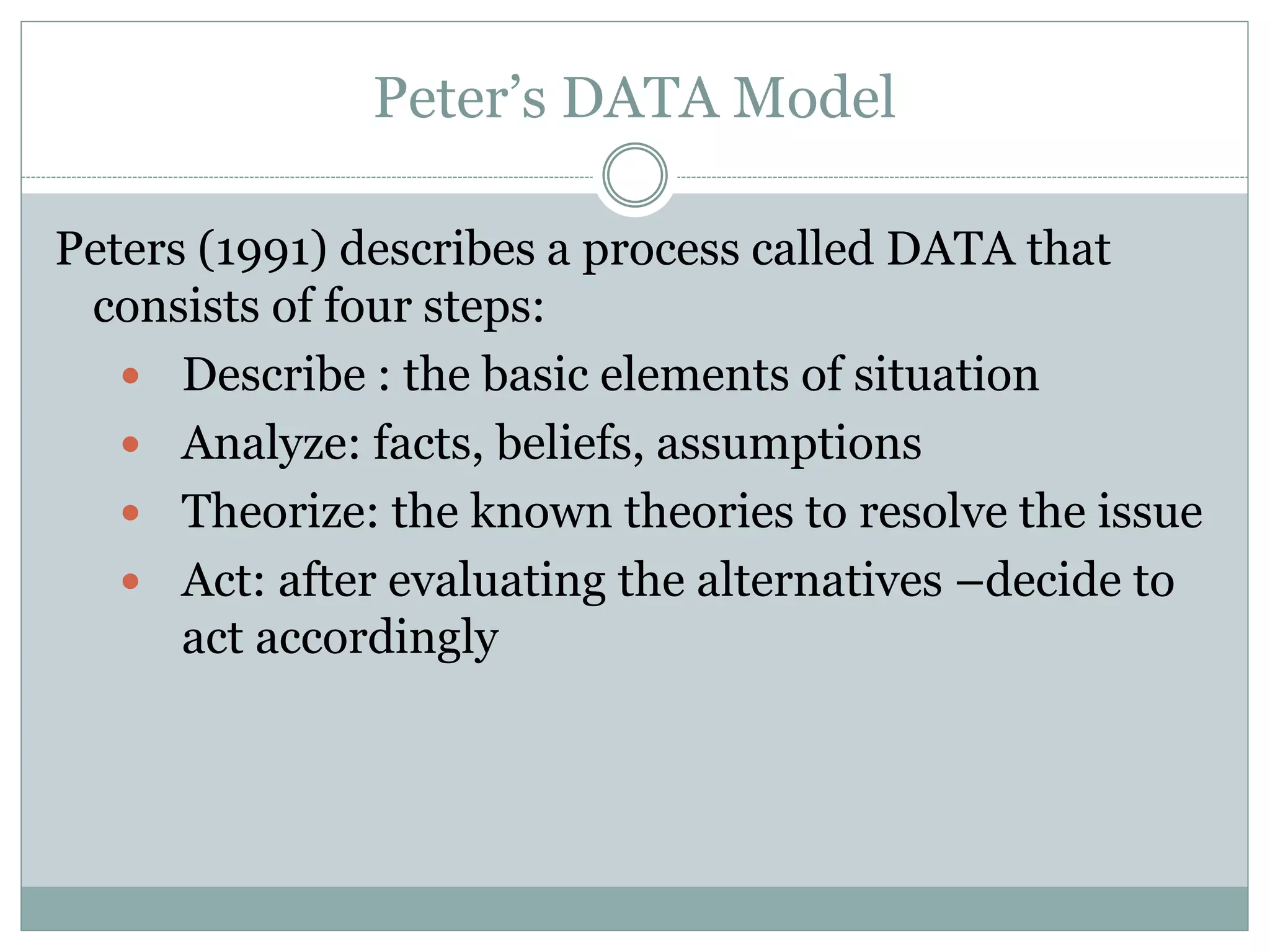
Peters (1991) describes a process called DATA that
consists of four steps:
 Describe : the basic elements of situation
 Analyze: facts, beliefs, assumptions
 Theorize: the known theories to resolve the issue
 Act: after evaluating the alternatives –decide to
act accordingly
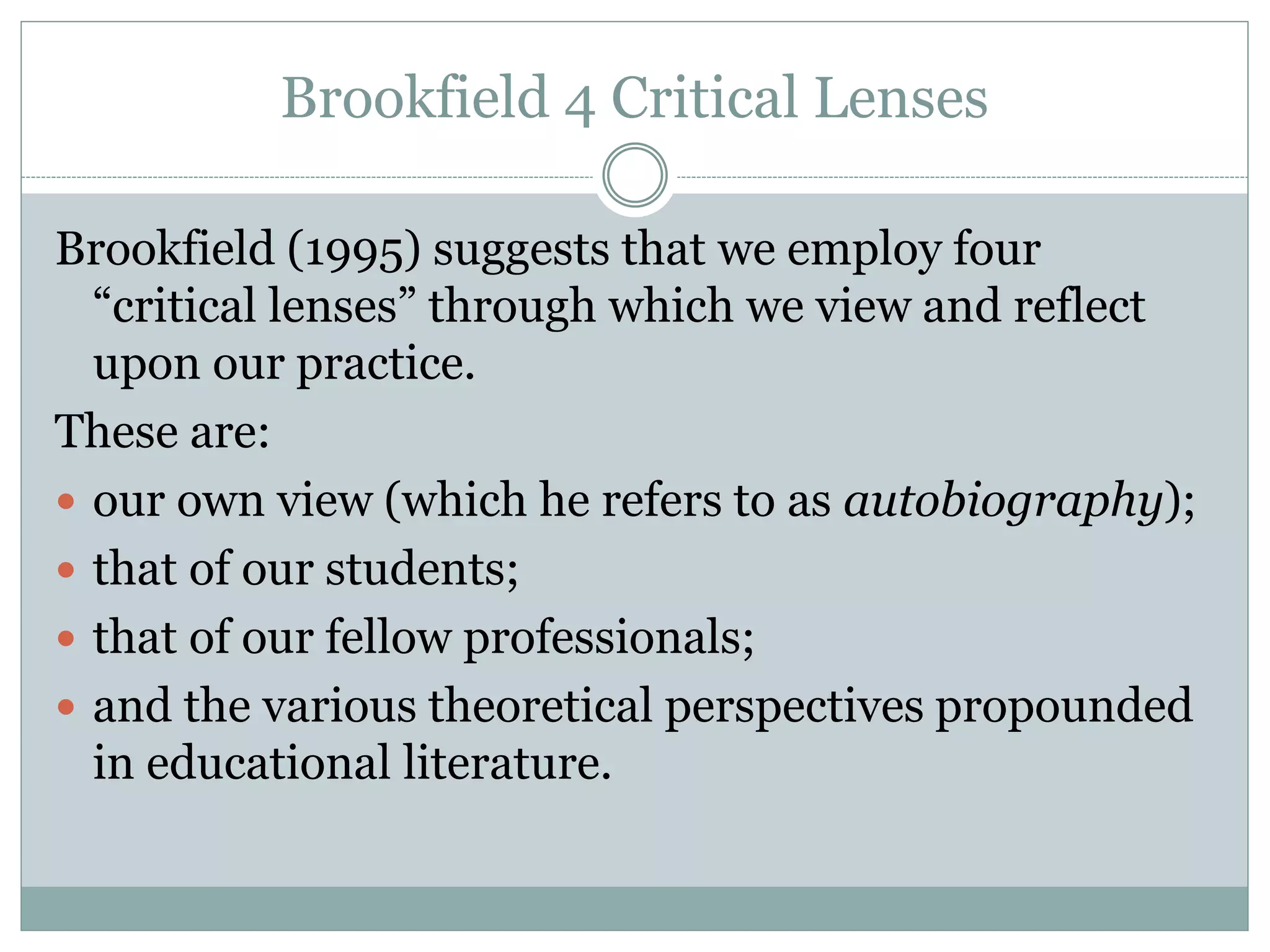
Brookfield 4 Critical Lenses
Brookfield (1995) suggests that we employ four
“critical lenses” through which we view and reflect
upon our practice.
These are:
 our own view (which he refers to as autobiography);
 that of our students;
 that of our fellow professionals;
 and the various theoretical perspectives propounded
in educational literature.
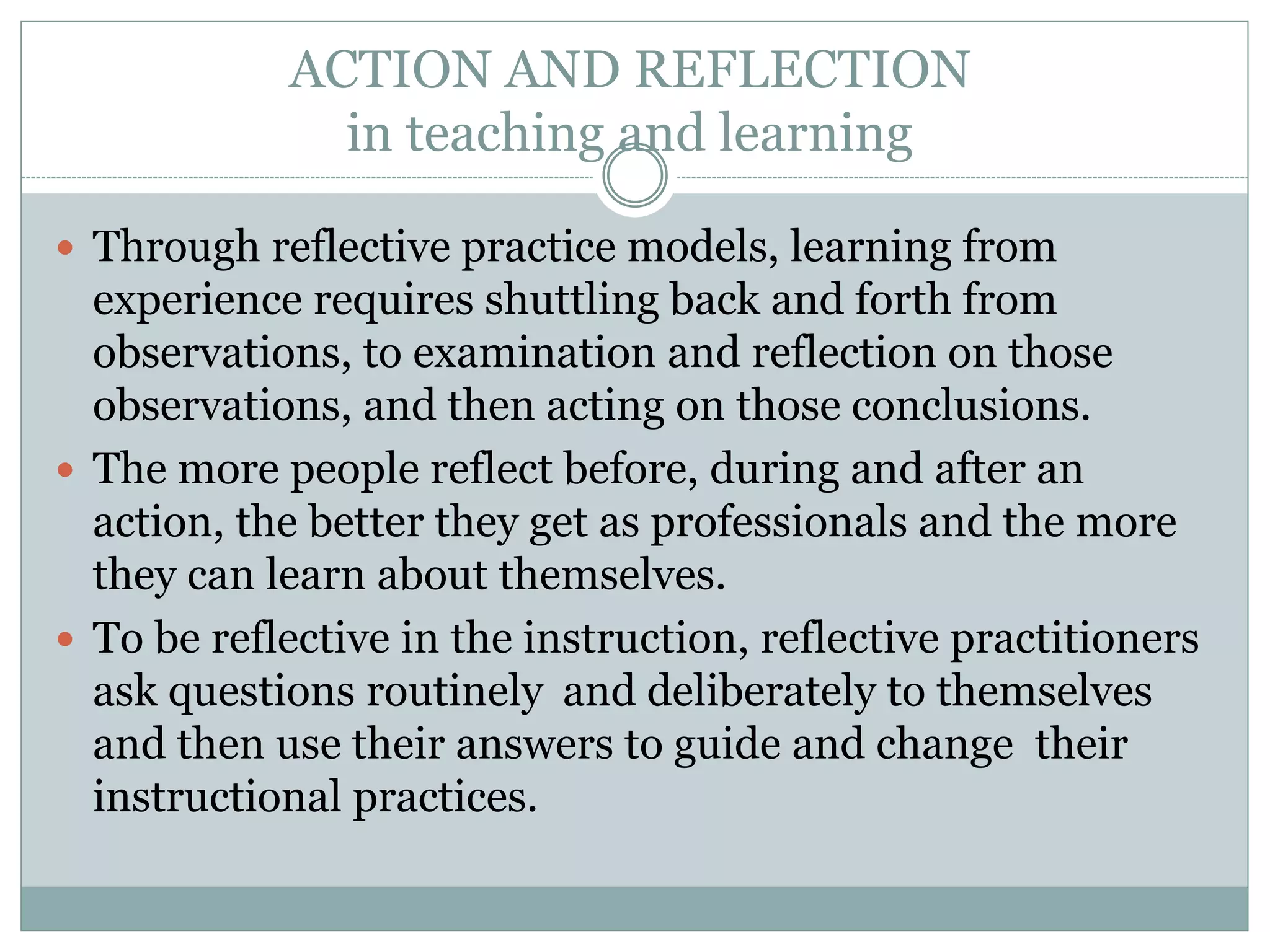
ACTION AND REFLECTION
in teaching and learning
 Through reflective practice models, learning from
experience requires shuttling back and forth from
observations, to examination and reflection on those
observations, and then acting on those conclusions.
 The more people reflect before, during and after an
action, the better they get as professionals and the more
they can learn about themselves.
 To be reflective in the instruction, reflective practitioners
ask questions routinely and deliberately to themselves
and then use their answers to guide and change their
instructional practices.
Thanks
AnyQuestion?

Reflective Practice-8611-UNIT 4

  • 1.
    R E FL E C T I V E P R A C T I C E Unit 4
  • 2.
    What is Reflection? What do you see in the mirror?  Why do you see mirror before you leave home?  How does reflection help you?
  • 3.
    Reflection is important! Home: A family is a social structure; every family member needs to reflect upon what they do? why they do it? And how they can do it better for family’s betterment?  Organizations: A set up in which people interact for a purpose and they need to reflect if their actions and behaviors are fulfilling the purpose/s without harming anyone.  Society: A larger structure of personal, private and public set ups in which individuals and groups need to reflect before during and after any social interaction.
  • 4.
    REFLECTIVE PRACTICE  Reflectivepractice is the ability to reflect on action in order to keep the learning process in cycle. (Schon, 1983)  After analysing and evaluating, we develop the theoretical aspects in practice. This practice is being done for the better future. Such process is known as Reflection. (Reid, 1993)  Reflection is more than merely thinking or musing. Reflection is a not simple, but complex in nature. It is planned and brainy activity that flourishes learning from experience. (Dewey, 1933)
  • 5.
    THEORETICAL PERSPECTIVES ANDMODELS John Dewey on Reflection: What contribute to learning is not confined to imagination, belief, and stream of consciousness.  They are certainly part of our thinking activities, but play too less a part in lifelong learning. In the context of learning; reflection plays a different role. Dewey defines reflection as the " …active, persistent, and careful consideration of any belief or supposed form of knowledge in the light of the grounds that support it and the further conclusions to which it tends “(Dewey, How We Think, 1933).
  • 6.
    Stages of Reflection 1."Perplexity", it starts when an individual responds to suggestion and ideas that s/he confronts with a problem. 2. "Elaboration" is the second stage. Soon after confronting problem the individual recalls the previous experiences, its pros and corns, negative and positive effects. 3. In the light of the elaboration, the person sets the "Hypotheses". What happened why and how and what best choice was at that time. 4. When a person come across with the same experience or same to some extent he then, compares the existing problem and its hypotheses with the previously learnt experience and its hypotheses. This stage of "Comparing Hypotheses" enables him to come to some better conclusion. 5. After carefully examining all the hypotheses, he is now ready for the final stage "Taking Action". This action is now a well thought of and based on reflective thinking process.
  • 7.
    Three Attitudes In fact,to Dewey, reflective thinking fosters the development of three attitudes that further the “habit of thinking in a reflective way.” These three attitudes are:  Open mindedness (freedom from prejudice)  Wholeheartedness or absorbed interest  Responsibility in facing consequences (Dewey, 1944)
  • 8.
    Schon’s Model ofReflective Practice  According to Schon (1983) "Professional knowledge and expertise is developed through reflective practices". Schon was basically interested in knowing as to when and how the professionals use reflection for professional development.  Schon's work was based on the proximal development of theory and practice of reflection. His work is on reflection in-action and reflection on- action.
  • 10.
    Kolb’s Model ofReflective Practice  According to David Kolb (1984) the learning process becomes easier by going through the four stages of learning despite people’s preference for a certain stage.  Kolb’s four stages of learning is a cyclical process in which people must work through each of the four stages.  This does not necessarily have to be from the same starting point, but preferably in the same order.
  • 12.
    Peter’s DATA Model Peters(1991) describes a process called DATA that consists of four steps:  Describe : the basic elements of situation  Analyze: facts, beliefs, assumptions  Theorize: the known theories to resolve the issue  Act: after evaluating the alternatives –decide to act accordingly
  • 13.
    Brookfield 4 CriticalLenses Brookfield (1995) suggests that we employ four “critical lenses” through which we view and reflect upon our practice. These are:  our own view (which he refers to as autobiography);  that of our students;  that of our fellow professionals;  and the various theoretical perspectives propounded in educational literature.
  • 15.
    ACTION AND REFLECTION inteaching and learning  Through reflective practice models, learning from experience requires shuttling back and forth from observations, to examination and reflection on those observations, and then acting on those conclusions.  The more people reflect before, during and after an action, the better they get as professionals and the more they can learn about themselves.  To be reflective in the instruction, reflective practitioners ask questions routinely and deliberately to themselves and then use their answers to guide and change their instructional practices.
  • 16.