Educational Theory and Simulation
Exploring and Understanding Theories
About Why Simulation Works
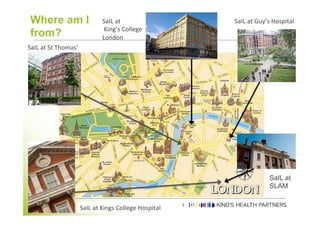
Where am I                                   SaIL	
  at	
                         SaIL	
  at	
  Guy’s	
  Hospital	
  
                                              	
  King’s	
  College	
  
 from?                                        London	
  
SaIL	
  at	
  St	
  Thomas’	


                                                                                                      SaIL at
                                                                                                      SLAM


                                  SaIL	
  at	
  Kings	
  College	
  Hospital	
  
Who are we?                         Page	
  3	


1.  Nurse or Nurse Practitioner
2.  Midwife
3.  Doctor
4.  Other Healthcare Professional
   (e.g., Respiratory Therapist,
   Pharmacist, etc)
5.  Healthcare Administrator
6.  Educator/Academic
Objec'ves	
  

Understand how simulation as a medical
 education medium can be informed by research
 and theory on how people learn.
Propose a few cognitive theoretical perspectives
  that could be used to inform the use and
  evaluation of simulation in medical education.
Evaluate the applicability of various cognitive
  theoretical perspectives on simulation as a
  medical education medium.


Page	
  5	


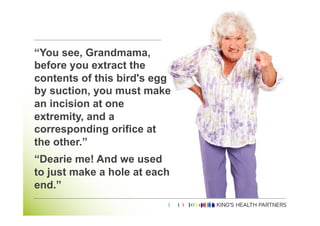
“You see, Grandmama,
before you extract the
contents of this bird's egg
by suction, you must make
an incision at one
extremity, and a
corresponding orifice at
the other.”
“Dearie me! And we used
to just make a hole at each
end.”
Page	
  6	
  
Page	
  7	
  
Page	
  8	
  
What learning theory is most useful?                           Page	
  9	


1.  Instructional Design Theory/ISD
2.  Expert/Novice Skill Acquisition Theory (Dreyfus)
3.  See one, do one, teach one
4.  Action learning (Argyris), Reflective Practice (Schön)
5.  Experiential learning (Kolb, Honey and Mumford)
6.  Deliberate Practice (Ericsson), Mastery learning (Bloom)
7.  Constructivist Learning (Bruner)
8.  Sociocultural theory (Vygotsky)
9.  Communities of Practice (Lave and Wenger)
10.  YOU DIDN’T LIST MY FAVORITE THEORY!
Learning Sciences: Help for Understanding Simulation?      Page	
  10	


                  Cognitive      Computer
                 psychology       science


                                            Anthropology
   Educational                               and other
   technology              What                social
                          happens             sciences
                             in
                         learning?
Page	
  11	
  
Page	
  12	
  
Page	
  13	
  
Learning Sciences Research Questions          Page	
  14	


What is the nature of learning
 that occurs in simulation?
  What does learning look like?
  How can we gather evidence of learning?
  How is simulation reflective of practice?
  How can we design learning experiences in
   order to take advantage of what we know
   about how people learn?
Learning Sciences Research Questions                       Page	
  15	


Legitimate Peripheral Participation as a lens for
  understanding what we are trying to do in simulation
   •  What roles do learners to take and why?
   •  What opportunities do we create for safe but legitimate
      peripheral participation opportunities for simulation
      learners?
   •  How can we bring highly trained and motivated faculty
      into the world of simulation education?
   •  How do we push some learners to the margins in
      simulation learning?
Learning Sciences Research Questions                       Page	
  16	


Situated Cognition as a framework for appreciating,
   evaluating, or understanding what is happening in
   simulation
    •  To what extent is learning embedded in the social and
       physical contexts of practice?
    •  How do traditional notions of fidelity need to be re-
       examined in order to provide a valuable learning
       experience?
    •  How does true inter-professional education in a
       simulated environment impact the learning experience
       for doctors, nurses, and midwives?
Learning Sciences Research Questions                   Page	
  17	


Distributed Cognition as a way of understanding how
  artifacts, people, and the environment work together
  and how learning occurs in those settings
   •  How is learning to be a medical professional
      distributed among the tools, the environment, and
      other aspects of the context in which we work?
   •  How can we create meaningful learning environments
      that recognize the distributed nature of our work?
   •  How does a group of professionals at a GP practice
      work together in their own setting to manage rare
      emergency events?
What	
  have	
  we	
  done?	
  

Look at simulation as a medical education
  medium that can be informed by research and
  theory on how people learn.
Propose a few cognitive theoretical perspectives
  that could be used to inform the use and
  evaluation of simulation in medical education.
Evaluate the applicability of various cognitive
  theoretical perspectives on simulation as a
  medical education medium.


The emphasis on finding and describing “knowledge
structures” that are somewhere “inside” the individual
encourages us to overlook the fact that human
cognition is always situated in a complex sociocultural
world and cannot be unaffected by it.
—Hutchins, 1995
Dr Gabriel Reedy
Lecturer in Higher Education
King’s College London
Simulation and Interactive Learning (SaIL Centre)
gabriel.reedy@kcl.ac.uk

Learning Theory and Simulation

  • 1.
    Educational Theory andSimulation Exploring and Understanding Theories About Why Simulation Works
  • 2.
    Where am I SaIL  at   SaIL  at  Guy’s  Hospital    King’s  College   from? London   SaIL  at  St  Thomas’   SaIL at SLAM SaIL  at  Kings  College  Hospital  
  • 3.
    Who are we? Page  3   1.  Nurse or Nurse Practitioner 2.  Midwife 3.  Doctor 4.  Other Healthcare Professional (e.g., Respiratory Therapist, Pharmacist, etc) 5.  Healthcare Administrator 6.  Educator/Academic
  • 4.
    Objec'ves   Understand howsimulation as a medical education medium can be informed by research and theory on how people learn. Propose a few cognitive theoretical perspectives that could be used to inform the use and evaluation of simulation in medical education. Evaluate the applicability of various cognitive theoretical perspectives on simulation as a medical education medium.    
  • 5.
    Page  5   “Yousee, Grandmama, before you extract the contents of this bird's egg by suction, you must make an incision at one extremity, and a corresponding orifice at the other.” “Dearie me! And we used to just make a hole at each end.”
  • 6.
  • 7.
  • 8.
  • 9.
    What learning theoryis most useful? Page  9   1.  Instructional Design Theory/ISD 2.  Expert/Novice Skill Acquisition Theory (Dreyfus) 3.  See one, do one, teach one 4.  Action learning (Argyris), Reflective Practice (Schön) 5.  Experiential learning (Kolb, Honey and Mumford) 6.  Deliberate Practice (Ericsson), Mastery learning (Bloom) 7.  Constructivist Learning (Bruner) 8.  Sociocultural theory (Vygotsky) 9.  Communities of Practice (Lave and Wenger) 10.  YOU DIDN’T LIST MY FAVORITE THEORY!
  • 10.
    Learning Sciences: Helpfor Understanding Simulation? Page  10   Cognitive Computer psychology science Anthropology Educational and other technology What social happens sciences in learning?
  • 11.
  • 12.
  • 13.
  • 14.
    Learning Sciences ResearchQuestions Page  14   What is the nature of learning that occurs in simulation? What does learning look like? How can we gather evidence of learning? How is simulation reflective of practice? How can we design learning experiences in order to take advantage of what we know about how people learn?
  • 15.
    Learning Sciences ResearchQuestions Page  15   Legitimate Peripheral Participation as a lens for understanding what we are trying to do in simulation •  What roles do learners to take and why? •  What opportunities do we create for safe but legitimate peripheral participation opportunities for simulation learners? •  How can we bring highly trained and motivated faculty into the world of simulation education? •  How do we push some learners to the margins in simulation learning?
  • 16.
    Learning Sciences ResearchQuestions Page  16   Situated Cognition as a framework for appreciating, evaluating, or understanding what is happening in simulation •  To what extent is learning embedded in the social and physical contexts of practice? •  How do traditional notions of fidelity need to be re- examined in order to provide a valuable learning experience? •  How does true inter-professional education in a simulated environment impact the learning experience for doctors, nurses, and midwives?
  • 17.
    Learning Sciences ResearchQuestions Page  17   Distributed Cognition as a way of understanding how artifacts, people, and the environment work together and how learning occurs in those settings •  How is learning to be a medical professional distributed among the tools, the environment, and other aspects of the context in which we work? •  How can we create meaningful learning environments that recognize the distributed nature of our work? •  How does a group of professionals at a GP practice work together in their own setting to manage rare emergency events?
  • 18.
    What  have  we  done?   Look at simulation as a medical education medium that can be informed by research and theory on how people learn. Propose a few cognitive theoretical perspectives that could be used to inform the use and evaluation of simulation in medical education. Evaluate the applicability of various cognitive theoretical perspectives on simulation as a medical education medium.    
  • 19.
    The emphasis onfinding and describing “knowledge structures” that are somewhere “inside” the individual encourages us to overlook the fact that human cognition is always situated in a complex sociocultural world and cannot be unaffected by it. —Hutchins, 1995 Dr Gabriel Reedy Lecturer in Higher Education King’s College London Simulation and Interactive Learning (SaIL Centre) gabriel.reedy@kcl.ac.uk