Embedding and integration of ePortfolios 
in Medical and Dental curricula 
Simon Cotterill 
Faculty of Medical Sciences 
Cotterill S, Horner P, Teasdale D, Ellis J, Thomason JM, 
Vernazza C, Bradley P, Peterson J, Skelly G, Ball S. Effective 
embedding and integration of ePortfolios in medical and dental 
curricula Int.J.Clin. Skills. 2011; (5): 18-23. 
http://www.eportfolios.ac.uk
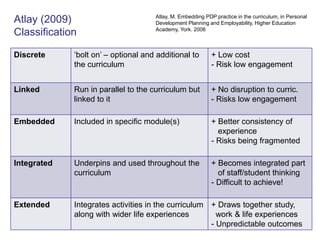
Discrete ‘bolt on’ – optional and additional to 
the curriculum 
+ Low cost 
- Risk low engagement 
Linked Run in parallel to the curriculum but 
linked to it 
+ No disruption to curric. 
- Risks low engagement 
Embedded Included in specific module(s) + Better consistency of 
experience 
- Risks being fragmented 
Integrated Underpins and used throughout the 
curriculum 
+ Becomes integrated part 
of staff/student thinking 
- Difficult to achieve! 
Extended Integrates activities in the curriculum 
along with wider life experiences 
+ Draws together study, 
work & life experiences 
- Unpredictable outcomes 
Atlay (2009) 
Classification 
Atlay, M. Embedding PDP practice in the curriculum, in Personal 
Development Planning and Employability, Higher Education 
Academy, York. 2006
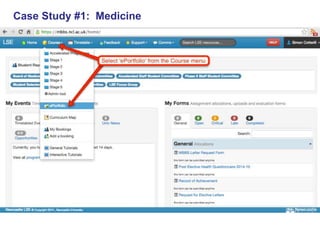
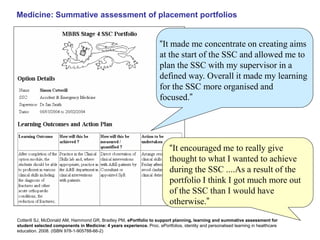
Case Study #1: Medicine
MMeBdiBcinSe: SeuPmmorattifvoel aioss efossrm SenSt Mof p Placlaemceenmt peorntftoslios 
“It made me concentrate on creating aims 
at the start of the SSC and allowed me to 
plan the SSC with my supervisor in a 
defined way. Overall it made my learning 
for the SSC more organised and 
focused.” 
“It encouraged me to really give 
thought to what I wanted to achieve 
during the SSC ....As a result of the 
portfolio I think I got much more out 
of the SSC than I would have 
otherwise.” 
Cotterill SJ, McDonald AM, Hammond GR, Bradley PM. ePortfolio to support planning, learning and summative assessment for 
student selected components in Medicine: 4 years experience. Proc. ePortfolios, identity and personalised learning in healthcare 
education. 2008. (ISBN 978-1-905788-66-2)
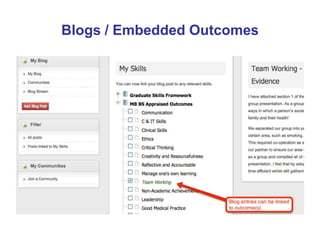
Blogs / Embedded Outcomes
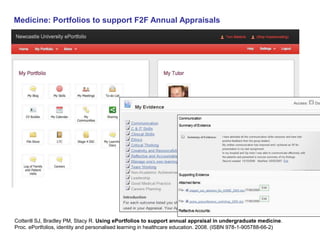
Medicine: Portfolios to support F2F Annual Appraisals 
Cotterill SJ, Bradley PM, Stacy R. Using ePortfolios to support annual appraisal in undergraduate medicine. 
Proc. ePortfolios, identity and personalised learning in healthcare education. 2008. (ISBN 978-1-905788-66-2)
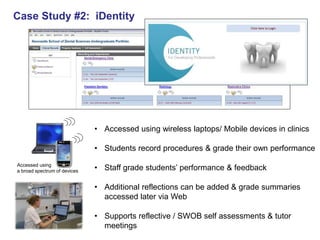
Case Study #2: iDentity 
Accessed using 
a broad spectrum of devices 
• Accessed using wireless laptops/ Mobile devices in clinics 
• Students record procedures & grade their own performance 
• Staff grade students’ performance & feedback 
• Additional reflections can be added & grade summaries 
accessed later via Web 
• Supports reflective / SWOB self assessments & tutor 
meetings
Vernazza C, Ellis, J, Teasdale D, Cotterill S, Scott L, Thomason M, Drummond P, Moss J. Introduction of an 
e-portfolio in clinical dentistry: Staff and student views. Eur J Dent Education 2011;15:36-41 
Ellis JS, Teasdale D, Cotterill SJ, Thomason JM. Is a generic UK e-portfolio for dentistry desirable and 
achievable? Eur J Dent Educ 2010; 14:254-6 
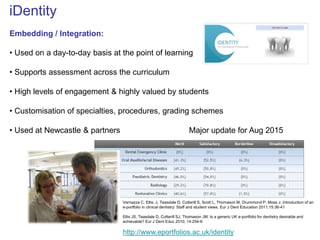
iDentity 
Embedding / Integration: 
• Used on a day-to-day basis at the point of learning 
• Supports assessment across the curriculum 
• High levels of engagement & highly valued by students 
• Customisation of specialties, procedures, grading schemes 
• Used at Newcastle & partners Major update for Aug 2015 
http://www.eportfolios.ac.uk/identity
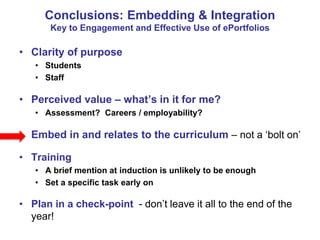
Conclusions: Embedding & Integration 
Key to Engagement and Effective Use of ePortfolios 
• Clarity of purpose 
• Students 
• Staff 
• Perceived value – what’s in it for me? 
• Assessment? Careers / employability? 
• Embed in and relates to the curriculum – not a ‘bolt on’ 
• Training 
• A brief mention at induction is unlikely to be enough 
• Set a specific task early on 
• Plan in a check-point - don’t leave it all to the end of the 
year!
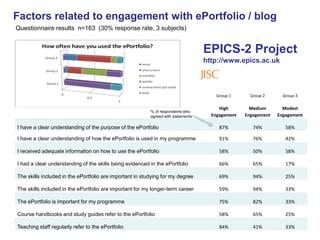
Factors related to engagement with ePortfolio / blog 
EPICS-2 Project 
http://www.epics.ac.uk 
Group 1 
High 
Engagement 
Group 2 
Medium 
Engagement 
Group 3 
Modest 
Engagement 
Questionnaire results n=163 (30% response rate, 3 subjects) 
% of respondents who 
agreed with statements 
I have a clear understanding of the purpose of the ePortfolio 87% 74% 58% 
I have a clear understanding of how the ePortfolio is used in my programme 91% 76% 42% 
I received adequate information on how to use the ePortfolio 58% 50% 58% 
I had a clear understanding of the skills being evidenced in the ePortfolio 66% 65% 17% 
The skills included in the ePortfolio are important in studying for my degree 69% 94% 25% 
The skills included in the ePortfolio are important for my longer-term career 59% 94% 33% 
The ePortfolio is important for my programme 75% 82% 33% 
Course handbooks and study guides refer to the ePortfolio 58% 65% 25% 
Teaching staff regularly refer to the ePortfolio 84% 41% 33%
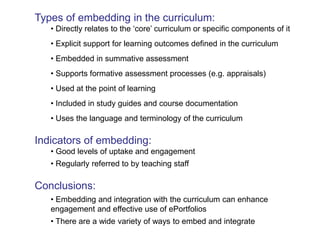
Types of embedding in the curriculum: 
• Directly relates to the ‘core’ curriculum or specific components of it 
• Explicit support for learning outcomes defined in the curriculum 
• Embedded in summative assessment 
• Supports formative assessment processes (e.g. appraisals) 
• Used at the point of learning 
• Included in study guides and course documentation 
• Uses the language and terminology of the curriculum 
Indicators of embedding: 
• Good levels of uptake and engagement 
• Regularly referred to by teaching staff 
Conclusions: 
• Embedding and integration with the curriculum can enhance 
engagement and effective use of ePortfolios 
• There are a wide variety of ways to embed and integrate
Embedding and integration in the curriculum = 
better engagement and effective use of ePortfolios 
Driessen E et al. Portfolios in medical education: why do they meet 
with mixed success? A systematic review. Med Educ. 2007;41:1224- 
33. 
Atlay, M. Embedding PDP practice in the curriculum, in Personal 
Development Planning and Employability, Higher Education 
Academy, York. 2006 
… but, what do we mean by embedding?
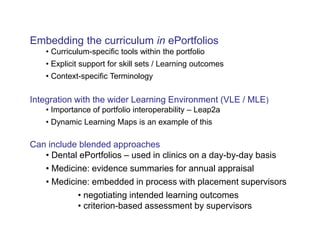
Embedding the curriculum in ePortfolios 
• Curriculum-specific tools within the portfolio 
• Explicit support for skill sets / Learning outcomes 
• Context-specific Terminology 
Integration with the wider Learning Environment (VLE / MLE) 
• Importance of portfolio interoperability – Leap2a 
• Dynamic Learning Maps is an example of this 
Can include blended approaches 
• Dental ePortfolios – used in clinics on a day-by-day basis 
• Medicine: evidence summaries for annual appraisal 
• Medicine: embedded in process with placement supervisors 
• negotiating intended learning outcomes 
• criterion-based assessment by supervisors

Embedding and Integration of ePortfolios

  • 1.
    Embedding and integrationof ePortfolios in Medical and Dental curricula Simon Cotterill Faculty of Medical Sciences Cotterill S, Horner P, Teasdale D, Ellis J, Thomason JM, Vernazza C, Bradley P, Peterson J, Skelly G, Ball S. Effective embedding and integration of ePortfolios in medical and dental curricula Int.J.Clin. Skills. 2011; (5): 18-23. http://www.eportfolios.ac.uk
  • 2.
    Discrete ‘bolt on’– optional and additional to the curriculum + Low cost - Risk low engagement Linked Run in parallel to the curriculum but linked to it + No disruption to curric. - Risks low engagement Embedded Included in specific module(s) + Better consistency of experience - Risks being fragmented Integrated Underpins and used throughout the curriculum + Becomes integrated part of staff/student thinking - Difficult to achieve! Extended Integrates activities in the curriculum along with wider life experiences + Draws together study, work & life experiences - Unpredictable outcomes Atlay (2009) Classification Atlay, M. Embedding PDP practice in the curriculum, in Personal Development Planning and Employability, Higher Education Academy, York. 2006
  • 3.
  • 4.
    MMeBdiBcinSe: SeuPmmorattifvoel aiossefossrm SenSt Mof p Placlaemceenmt peorntftoslios “It made me concentrate on creating aims at the start of the SSC and allowed me to plan the SSC with my supervisor in a defined way. Overall it made my learning for the SSC more organised and focused.” “It encouraged me to really give thought to what I wanted to achieve during the SSC ....As a result of the portfolio I think I got much more out of the SSC than I would have otherwise.” Cotterill SJ, McDonald AM, Hammond GR, Bradley PM. ePortfolio to support planning, learning and summative assessment for student selected components in Medicine: 4 years experience. Proc. ePortfolios, identity and personalised learning in healthcare education. 2008. (ISBN 978-1-905788-66-2)
  • 5.
  • 6.
    Medicine: Portfolios tosupport F2F Annual Appraisals Cotterill SJ, Bradley PM, Stacy R. Using ePortfolios to support annual appraisal in undergraduate medicine. Proc. ePortfolios, identity and personalised learning in healthcare education. 2008. (ISBN 978-1-905788-66-2)
  • 7.
    Case Study #2:iDentity Accessed using a broad spectrum of devices • Accessed using wireless laptops/ Mobile devices in clinics • Students record procedures & grade their own performance • Staff grade students’ performance & feedback • Additional reflections can be added & grade summaries accessed later via Web • Supports reflective / SWOB self assessments & tutor meetings
  • 8.
    Vernazza C, Ellis,J, Teasdale D, Cotterill S, Scott L, Thomason M, Drummond P, Moss J. Introduction of an e-portfolio in clinical dentistry: Staff and student views. Eur J Dent Education 2011;15:36-41 Ellis JS, Teasdale D, Cotterill SJ, Thomason JM. Is a generic UK e-portfolio for dentistry desirable and achievable? Eur J Dent Educ 2010; 14:254-6 iDentity Embedding / Integration: • Used on a day-to-day basis at the point of learning • Supports assessment across the curriculum • High levels of engagement & highly valued by students • Customisation of specialties, procedures, grading schemes • Used at Newcastle & partners Major update for Aug 2015 http://www.eportfolios.ac.uk/identity
  • 9.
    Conclusions: Embedding &Integration Key to Engagement and Effective Use of ePortfolios • Clarity of purpose • Students • Staff • Perceived value – what’s in it for me? • Assessment? Careers / employability? • Embed in and relates to the curriculum – not a ‘bolt on’ • Training • A brief mention at induction is unlikely to be enough • Set a specific task early on • Plan in a check-point - don’t leave it all to the end of the year!
  • 10.
    Factors related toengagement with ePortfolio / blog EPICS-2 Project http://www.epics.ac.uk Group 1 High Engagement Group 2 Medium Engagement Group 3 Modest Engagement Questionnaire results n=163 (30% response rate, 3 subjects) % of respondents who agreed with statements I have a clear understanding of the purpose of the ePortfolio 87% 74% 58% I have a clear understanding of how the ePortfolio is used in my programme 91% 76% 42% I received adequate information on how to use the ePortfolio 58% 50% 58% I had a clear understanding of the skills being evidenced in the ePortfolio 66% 65% 17% The skills included in the ePortfolio are important in studying for my degree 69% 94% 25% The skills included in the ePortfolio are important for my longer-term career 59% 94% 33% The ePortfolio is important for my programme 75% 82% 33% Course handbooks and study guides refer to the ePortfolio 58% 65% 25% Teaching staff regularly refer to the ePortfolio 84% 41% 33%
  • 11.
    Types of embeddingin the curriculum: • Directly relates to the ‘core’ curriculum or specific components of it • Explicit support for learning outcomes defined in the curriculum • Embedded in summative assessment • Supports formative assessment processes (e.g. appraisals) • Used at the point of learning • Included in study guides and course documentation • Uses the language and terminology of the curriculum Indicators of embedding: • Good levels of uptake and engagement • Regularly referred to by teaching staff Conclusions: • Embedding and integration with the curriculum can enhance engagement and effective use of ePortfolios • There are a wide variety of ways to embed and integrate
  • 12.
    Embedding and integrationin the curriculum = better engagement and effective use of ePortfolios Driessen E et al. Portfolios in medical education: why do they meet with mixed success? A systematic review. Med Educ. 2007;41:1224- 33. Atlay, M. Embedding PDP practice in the curriculum, in Personal Development Planning and Employability, Higher Education Academy, York. 2006 … but, what do we mean by embedding?
  • 13.
    Embedding the curriculumin ePortfolios • Curriculum-specific tools within the portfolio • Explicit support for skill sets / Learning outcomes • Context-specific Terminology Integration with the wider Learning Environment (VLE / MLE) • Importance of portfolio interoperability – Leap2a • Dynamic Learning Maps is an example of this Can include blended approaches • Dental ePortfolios – used in clinics on a day-by-day basis • Medicine: evidence summaries for annual appraisal • Medicine: embedded in process with placement supervisors • negotiating intended learning outcomes • criterion-based assessment by supervisors