Clinical Nursing Education Redesign: A Call for Action, Are We Ready? Victoria Niederhauser Interim Associate Dean for Academic Affairs University of Hawaii Manoa
Where are we today? Practice & Nursing Education have a long history of separation Students visit healthcare facilities and do not feel part of the system Faculty members are typically visitors and not part of the health care team School Administrators are disconnected from practice unless attending some high level meetings
Practicing Nurses are disconnected from schools Limited knowledge of curriculum and competencies expected of students Some may see students on units as “burdens” instead of a plus Nurse Leaders in practice settings may not feel vested in any aspect of nursing education “We/they” situations Where are we today?
The Gap Between Practice & Education is Too Large The world makes way for the nurse who knows where he/she is going. Ralph Waldo Emerson
Nursing Practice: Then & Now 1978 2008 What is Different? What is the Same?
Circa 1978: Bridgeport Hospital Mrs. Jenkins, a master’s prepared nurses, make the assignments for the next clinical day on the pediatric ward at Bridgeport Hospital. Nursing student, Ms. Victoria Jordhamo, arrives on the unit, finds the piece of paper posted among the other important papers at the Unit Secretaries desk, finds her name on the list and the two patient names and room numbers, and finds the two patient chart in the circular rack, and begins to review. That evening, Ms. Jordhamo spends about 2 hours reviewing the patients’ diagnosis and medication, preparing medication cards, and reading about how to care for her patients the following day. At 6:45AM the next day, Ms. Jordhamo meets Mrs. Jenkins and the other 7 pediatric nursing students in the break room to listen to tapped change of shift report…….
Fast forward…30 years to 2008 Mrs. Locquiao, a master’s prepared nurses, make the assignments for the next clinical day on the pediatric ward at Kapiolani Hospital. Second year nursing student, Ms. Leilani Cho, arrives on the unit, finds the piece of paper posted among the other important papers at the Unit Secretaries desk, finds her name on the list and the two patient names and room numbers, and finds the patient information on the EMR and begins to review. That evening, Ms. Cho spends about 2 hours reviewing the patients’ diagnosis and medication, preparing medication cards, and reading about how to care for her patients the following day. At 6:45AM the next day, Ms. Cho meets Mrs. Locquiao and the other 7 pediatric nursing students in the break room to listen to tapped change of shift report…….
“ I have an almost complete disregard of precedent, and a faith in the possibility of something better. It irritates me to be told how things have always been done. I defy the tyranny of precedent. I go for anything new that might improve the past.” Clara Barton
Challenge 101: DEATH to the Sacred Cows!!
Nursing Education Re-design? Re-Define? Re-invent? Buzz or What? AARP, RWJF, DOL: “Blowing Open the Bottleneck: designing New Approaches to Increase Nurse Education Capacity” (Joynt & Kimball, 2008)  Creating Strategic Partnership to Align & Leverage Stakeholder Resources Increasing Nursing Faculty Capacity & Diversity Redesigning Nursing Education Flexing Policy & Education Prepared for by the Nursing Education Capacity Summit in VA in June 2008
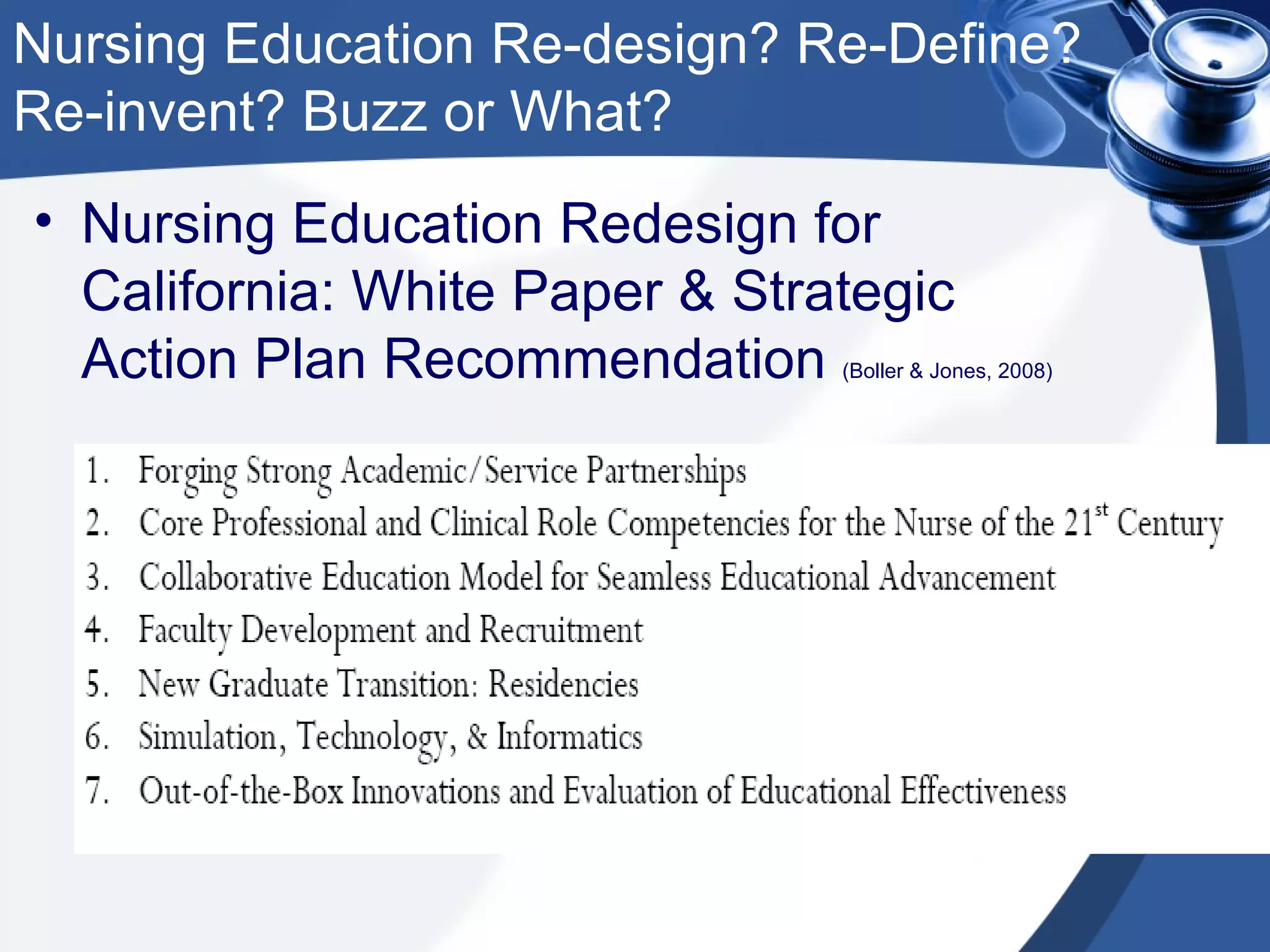
Nursing Education Redesign for California: White Paper & Strategic Action Plan Recommendation  (Boller & Jones, 2008) Nursing Education Re-design? Re-Define? Re-invent? Buzz or What?
IHI: Reinventing Nursing Education: Transforming Care at the Bedside IOM Reports, including “Health Professions Education” emphasizes a need for change Emphasis on teamwork and active collaboration (academics and practice working together) Nursing Education Re-design? Re-Define? Re-invent? Buzz or What?
What does Nursing Academics Need to do? Align Education with Clinical Practice Incorporate Real Word into Curricula, including IOM reports, safety and quality Increase interactive learning Look to technology as teaching tool Teach knowledge management Redesign clinical education being reasonable about what we can & cannot teach, teaching what we need to teach.
What does Nursing Academics Need to do? MUST include students and clinicians in our decisions about nursing education Need nurse leaders in practice to help solve limited clinical sites, how to provide experiences through coops and internships, how to improve staff acceptance of students, improve preceptor experiences for preceptor and students, and create innovative clinical education models
5 Recommendations for Clinical Nursing Education Re-envision student-staff nurses working with students Re-conceptualize clinical nurse faculty role Enhance development of school-based faculty & staff nurses working w/students Reexamine the depth and breath of clinical component Strengthen evidence for best practice in nursing education
HSNC: Clinical Education Redesign Create an increase in capacity for clinical nursing education Provide clinical experiences that better prepare students for future practice Reduce staff nurse strain & risks for patient safety (high patient acuity = more student supervision) Focus on concepts rather than memorization of excessive information Interactive learning geared towards deep understanding of concepts Increase in clinical time using non-traditional models
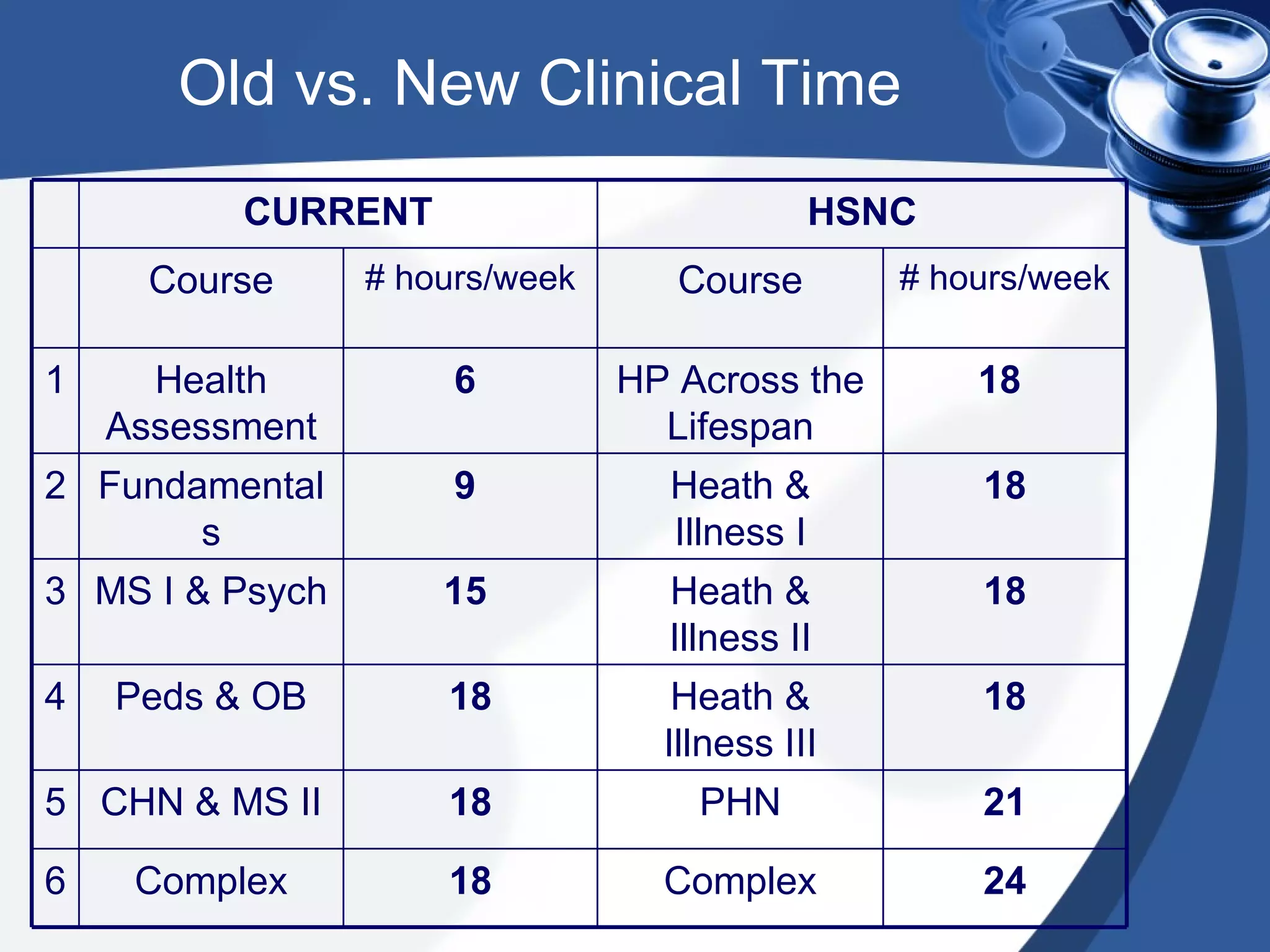
Old vs. New Clinical Time HSNC CURRENT 24 Complex 18 Complex 6 21 PHN 18 CHN & MS II 5 18 Heath & Illness III 18 Peds & OB 4 18 Heath & Illness II 15  MS I & Psych 3 18 Heath & Illness I 9  Fundamentals 2 18  HP Across the Lifespan 6  Health Assessment 1 # hours/week Course # hours/week Course
HSNC: Clinical Redesign Team Implementation Plan Phase I: Build Clinical Education Redesign Team (CERT), Engage Stakeholders, Information Gathering, Summit Meeting Phase II: Development of Clinical Nursing Education Innovation Models Phase III: Pilot Models and Evaluation
HSNC Clinical Education Redesign Team Who? What? Where? How?
What if…… Nursing Practice and Nursing Academics Redesigned Clinical Nursing Education…. Re-examine the current separation of clinical and didactic teaching? Dedicated Education Units? Created innovative models where students & faculty were an integrated part of the healthcare facility Nursing school prepared students so well that there was a decrease in the need for new graduate programs IMAGINE THE POSSIBILITIES!
Are We Up to the Challenge?
CNO Meeting October 2008 Discuss over lunch the follow 3 questions. Take Notes. Plan to Report back to the group after lunch. What are the most important qualities in new graduate nurses? If you were inventing clinical nursing education for the 1 st  time, what would it look like? Who should be part of the Clinical Nursing Education Redesign Team?
What are the most important qualities in new graduate nurses? Team Player Being Collaborative Lifelong Learner Passion for Nursing Compassion & Caring Seeker of Knowledge Self Directed Mature Sense of Inquiry Inquisitive Patient Advocate Knows Scope of Practice Communication Intellectual Humility
If you were inventing clinical nursing education for the 1 st  time, what would it look like? Sense of student belonging in setting (like Old Diploma Setting) DTU Concept Standarize clinical education setting Look for more clinical opportunities Total staff buy-in, how to motivate to want to be part of it Increase use of simulation Partnership (faculty-students-nurse) Recruit/develop best staff as educators Faculty should know the unit well
Distance education Self-paced learning (military model) Teach communication/safety standards Design communication between academics and practice Train-the-Trainer modules Joint appointments Health care redesign, change things that are not role models for students Make it win-win Clinical time at high activity
National Efforts in Clinical Redesign Dedicated Teaching Unit (St. Louis) 24 accelerated nursing students 1:1 matched with RN, takes on RN schedule for 2 days per week on unit (D,E,N) 1 day preceptor orientation for RN w/CEU’s Faculty visits students (8) once per week  RNs get coaching card with ideas to spark critical thinking Done early on in nursing program RNs get 5% stipend for taking student, part of clinical ladder, free CEU’s per semester
National Efforts in Clinical Redesign Mt Hood College & Fairlawn Retirement Center Designed to facilitate development of RN leadership in LTC Simulated experiences related to making assignments, delegation & prioritizing care QA project Students will provide in-service education for un-liscensed staff
Next Steps for Today! Lunch first! The breakout sessions (30 minutes, pick 3 to attend) Room 423: Guiding principles & assumptions for faculty, students and nurses Room 430: Brainstorming ideas for clinical experiences in outpatient setting Room 311: Brainstorming ideas for inpatient settings Room 311: Brainstorming ideas for simulation At 2:30 all report back to W311 for reports

Clinical Nursing Education Redesign

  • 1.
    Clinical Nursing EducationRedesign: A Call for Action, Are We Ready? Victoria Niederhauser Interim Associate Dean for Academic Affairs University of Hawaii Manoa
  • 2.
    Where are wetoday? Practice & Nursing Education have a long history of separation Students visit healthcare facilities and do not feel part of the system Faculty members are typically visitors and not part of the health care team School Administrators are disconnected from practice unless attending some high level meetings
  • 3.
    Practicing Nurses aredisconnected from schools Limited knowledge of curriculum and competencies expected of students Some may see students on units as “burdens” instead of a plus Nurse Leaders in practice settings may not feel vested in any aspect of nursing education “We/they” situations Where are we today?
  • 4.
    The Gap BetweenPractice & Education is Too Large The world makes way for the nurse who knows where he/she is going. Ralph Waldo Emerson
  • 5.
    Nursing Practice: Then& Now 1978 2008 What is Different? What is the Same?
  • 6.
    Circa 1978: BridgeportHospital Mrs. Jenkins, a master’s prepared nurses, make the assignments for the next clinical day on the pediatric ward at Bridgeport Hospital. Nursing student, Ms. Victoria Jordhamo, arrives on the unit, finds the piece of paper posted among the other important papers at the Unit Secretaries desk, finds her name on the list and the two patient names and room numbers, and finds the two patient chart in the circular rack, and begins to review. That evening, Ms. Jordhamo spends about 2 hours reviewing the patients’ diagnosis and medication, preparing medication cards, and reading about how to care for her patients the following day. At 6:45AM the next day, Ms. Jordhamo meets Mrs. Jenkins and the other 7 pediatric nursing students in the break room to listen to tapped change of shift report…….
  • 7.
    Fast forward…30 yearsto 2008 Mrs. Locquiao, a master’s prepared nurses, make the assignments for the next clinical day on the pediatric ward at Kapiolani Hospital. Second year nursing student, Ms. Leilani Cho, arrives on the unit, finds the piece of paper posted among the other important papers at the Unit Secretaries desk, finds her name on the list and the two patient names and room numbers, and finds the patient information on the EMR and begins to review. That evening, Ms. Cho spends about 2 hours reviewing the patients’ diagnosis and medication, preparing medication cards, and reading about how to care for her patients the following day. At 6:45AM the next day, Ms. Cho meets Mrs. Locquiao and the other 7 pediatric nursing students in the break room to listen to tapped change of shift report…….
  • 8.
    “ I havean almost complete disregard of precedent, and a faith in the possibility of something better. It irritates me to be told how things have always been done. I defy the tyranny of precedent. I go for anything new that might improve the past.” Clara Barton
  • 9.
    Challenge 101: DEATHto the Sacred Cows!!
  • 10.
    Nursing Education Re-design?Re-Define? Re-invent? Buzz or What? AARP, RWJF, DOL: “Blowing Open the Bottleneck: designing New Approaches to Increase Nurse Education Capacity” (Joynt & Kimball, 2008) Creating Strategic Partnership to Align & Leverage Stakeholder Resources Increasing Nursing Faculty Capacity & Diversity Redesigning Nursing Education Flexing Policy & Education Prepared for by the Nursing Education Capacity Summit in VA in June 2008
  • 11.
    Nursing Education Redesignfor California: White Paper & Strategic Action Plan Recommendation (Boller & Jones, 2008) Nursing Education Re-design? Re-Define? Re-invent? Buzz or What?
  • 12.
    IHI: Reinventing NursingEducation: Transforming Care at the Bedside IOM Reports, including “Health Professions Education” emphasizes a need for change Emphasis on teamwork and active collaboration (academics and practice working together) Nursing Education Re-design? Re-Define? Re-invent? Buzz or What?
  • 13.
    What does NursingAcademics Need to do? Align Education with Clinical Practice Incorporate Real Word into Curricula, including IOM reports, safety and quality Increase interactive learning Look to technology as teaching tool Teach knowledge management Redesign clinical education being reasonable about what we can & cannot teach, teaching what we need to teach.
  • 14.
    What does NursingAcademics Need to do? MUST include students and clinicians in our decisions about nursing education Need nurse leaders in practice to help solve limited clinical sites, how to provide experiences through coops and internships, how to improve staff acceptance of students, improve preceptor experiences for preceptor and students, and create innovative clinical education models
  • 15.
    5 Recommendations forClinical Nursing Education Re-envision student-staff nurses working with students Re-conceptualize clinical nurse faculty role Enhance development of school-based faculty & staff nurses working w/students Reexamine the depth and breath of clinical component Strengthen evidence for best practice in nursing education
  • 16.
    HSNC: Clinical EducationRedesign Create an increase in capacity for clinical nursing education Provide clinical experiences that better prepare students for future practice Reduce staff nurse strain & risks for patient safety (high patient acuity = more student supervision) Focus on concepts rather than memorization of excessive information Interactive learning geared towards deep understanding of concepts Increase in clinical time using non-traditional models
  • 17.
    Old vs. NewClinical Time HSNC CURRENT 24 Complex 18 Complex 6 21 PHN 18 CHN & MS II 5 18 Heath & Illness III 18 Peds & OB 4 18 Heath & Illness II 15 MS I & Psych 3 18 Heath & Illness I 9 Fundamentals 2 18 HP Across the Lifespan 6 Health Assessment 1 # hours/week Course # hours/week Course
  • 18.
    HSNC: Clinical RedesignTeam Implementation Plan Phase I: Build Clinical Education Redesign Team (CERT), Engage Stakeholders, Information Gathering, Summit Meeting Phase II: Development of Clinical Nursing Education Innovation Models Phase III: Pilot Models and Evaluation
  • 19.
    HSNC Clinical EducationRedesign Team Who? What? Where? How?
  • 20.
    What if…… NursingPractice and Nursing Academics Redesigned Clinical Nursing Education…. Re-examine the current separation of clinical and didactic teaching? Dedicated Education Units? Created innovative models where students & faculty were an integrated part of the healthcare facility Nursing school prepared students so well that there was a decrease in the need for new graduate programs IMAGINE THE POSSIBILITIES!
  • 21.
    Are We Upto the Challenge?
  • 22.
    CNO Meeting October2008 Discuss over lunch the follow 3 questions. Take Notes. Plan to Report back to the group after lunch. What are the most important qualities in new graduate nurses? If you were inventing clinical nursing education for the 1 st time, what would it look like? Who should be part of the Clinical Nursing Education Redesign Team?
  • 23.
    What are themost important qualities in new graduate nurses? Team Player Being Collaborative Lifelong Learner Passion for Nursing Compassion & Caring Seeker of Knowledge Self Directed Mature Sense of Inquiry Inquisitive Patient Advocate Knows Scope of Practice Communication Intellectual Humility
  • 24.
    If you wereinventing clinical nursing education for the 1 st time, what would it look like? Sense of student belonging in setting (like Old Diploma Setting) DTU Concept Standarize clinical education setting Look for more clinical opportunities Total staff buy-in, how to motivate to want to be part of it Increase use of simulation Partnership (faculty-students-nurse) Recruit/develop best staff as educators Faculty should know the unit well
  • 25.
    Distance education Self-pacedlearning (military model) Teach communication/safety standards Design communication between academics and practice Train-the-Trainer modules Joint appointments Health care redesign, change things that are not role models for students Make it win-win Clinical time at high activity
  • 26.
    National Efforts inClinical Redesign Dedicated Teaching Unit (St. Louis) 24 accelerated nursing students 1:1 matched with RN, takes on RN schedule for 2 days per week on unit (D,E,N) 1 day preceptor orientation for RN w/CEU’s Faculty visits students (8) once per week RNs get coaching card with ideas to spark critical thinking Done early on in nursing program RNs get 5% stipend for taking student, part of clinical ladder, free CEU’s per semester
  • 27.
    National Efforts inClinical Redesign Mt Hood College & Fairlawn Retirement Center Designed to facilitate development of RN leadership in LTC Simulated experiences related to making assignments, delegation & prioritizing care QA project Students will provide in-service education for un-liscensed staff
  • 28.
    Next Steps forToday! Lunch first! The breakout sessions (30 minutes, pick 3 to attend) Room 423: Guiding principles & assumptions for faculty, students and nurses Room 430: Brainstorming ideas for clinical experiences in outpatient setting Room 311: Brainstorming ideas for inpatient settings Room 311: Brainstorming ideas for simulation At 2:30 all report back to W311 for reports