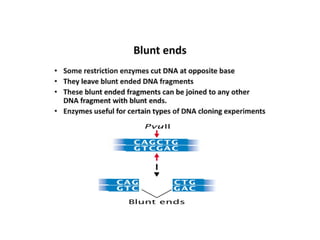
Restriction endonuclease:
Their types and restriction digestion
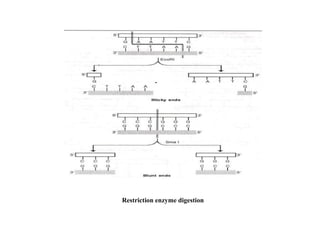
Restriction enzyme digestion
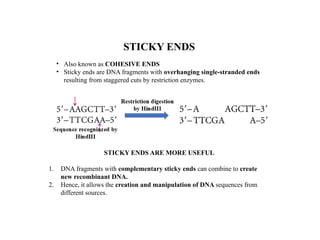
STICKY ENDS ARE MORE USEFUL
1. DNA fragments with complementary sticky ends can combine to create
new recombinant DNA.
2. Hence, it allows the creation and manipulation of DNA sequences from
different sources.
STICKY ENDS
• Also known as COHESIVE ENDS
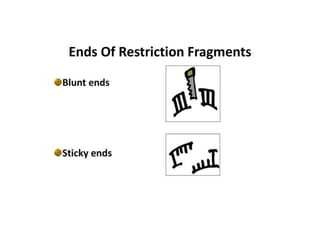
• Sticky ends are DNA fragments with overhanging single-stranded ends
resulting from staggered cuts by restriction enzymes.
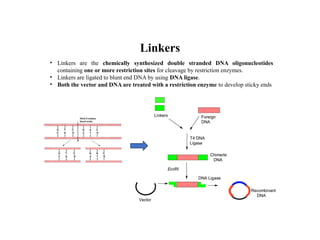
Linkers
• Linkers are the chemically synthesized double stranded DNA oligonucleotides
containing one or more restriction sites for cleavage by restriction enzymes.
• Linkers are ligated to blunt end DNA by using DNA ligase.
• Both the vector and DNA are treated with a restriction enzyme to develop sticky ends
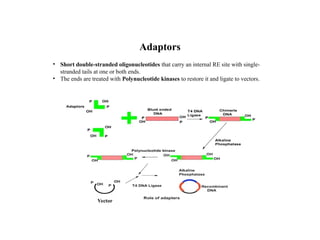
Adaptors
• Short double-stranded oligonucleotides that carry an internal RE site with single-
stranded tails at one or both ends.
• The ends are treated with Polynucleotide kinases to restore it and ligate to vectors.
Vector
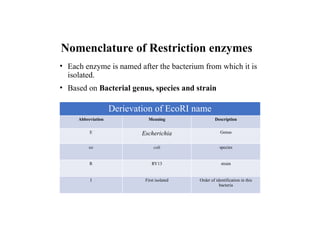
Nomenclature of Restriction enzymes
• Each enzyme is named after the bacterium from which it is
isolated.
• Based on Bacterial genus, species and strain
Derievation of EcoRI name
Abbreviation Meaning Description
E Escherichia Genus
co coli species
R RY13 strain
I First isolated Order of identification in this
bacteria
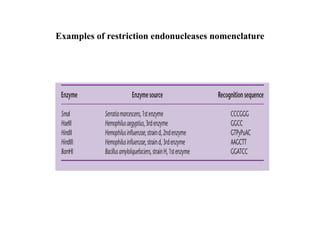
Examples of restriction endonucleases nomenclature
Types of Restriction Enzymes
RE is categorised into sub-types based on
1. Composition- The structural and functional complexity
of the enzyme.
2. Enzyme cofactor requirement- specific cofactors such
as ATP, Mg² , or S-adenosylmethionine for enzymatic
⁺
activity
3. The nature of their target sequence - Specific
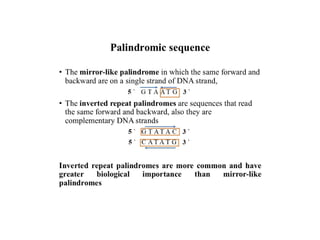
recognition sequences on the DNA, typically palindromic,
vary between types.
4. Position of their DNA cleavage site relative to the
target sequence
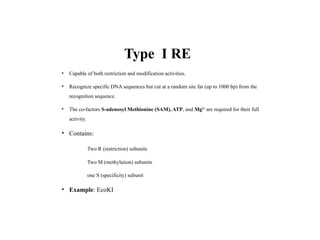
Type I RE
• Capable of both restriction and modification activities.
• Recognize specific DNA sequences but cut at a random site far (up to 1000 bp) from the
recognition sequence.
• The co-factors S-adenosyl Methionine (SAM), ATP, and Mg2+
are required for their full
activity.
• Contains:
Two R (restriction) subunits
Two M (methylation) subunits
one S (specificity) subunit
• Example: EcoKI
Type II RE
• These are most commonly available and used as restriction enzymes
• They are composed of only one subunit.
• Their recognition sites are usually undivided, palindromic and 4-8 nucleotides in
length.
• They recognize and cleave DNA at the same site.
• They do not use ATP for their activity.
• They usually require only Mg2+
as a cofactor
• Example: EcoRI,
HindIII,
BamHI
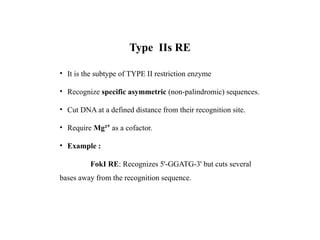
Type IIs RE
• It is the subtype of TYPE II restriction enzyme
• Recognize specific asymmetric (non-palindromic) sequences.
• Cut DNA at a defined distance from their recognition site.
• Require Mg²⁺ as a cofactor.
• Example :
FokI RE: Recognizes 5'-GGATG-3' but cuts several
bases away from the recognition sequence.
Type III RE
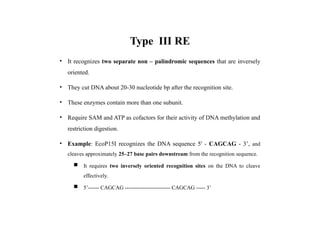
• It recognizes two separate non – palindromic sequences that are inversely
oriented.
• They cut DNA about 20-30 nucleotide bp after the recognition site.
• These enzymes contain more than one subunit.
• Require SAM and ATP as cofactors for their activity of DNA methylation and
restriction digestion.
• Example: EcoP15I recognizes the DNA sequence 5' - CAGCAG - 3’, and
cleaves approximately 25–27 base pairs downstream from the recognition sequence.
 It requires two inversely oriented recognition sites on the DNA to cleave
effectively.
 5’------ CAGCAG ------------------------- CAGCAG ----- 3’
Type IV RE
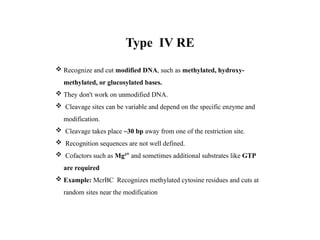
 Recognize and cut modified DNA, such as methylated, hydroxy-
methylated, or glucosylated bases.
 They don't work on unmodified DNA.
 Cleavage sites can be variable and depend on the specific enzyme and
modification.
 Cleavage takes place ~30 bp away from one of the restriction site.
 Recognition sequences are not well defined.
 Cofactors such as Mg²⁺ and sometimes additional substrates like GTP
are required
 Example: McrBC Recognizes methylated cytosine residues and cuts at
random sites near the modification
Type V RE
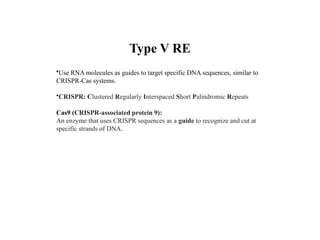
•Use RNA molecules as guides to target specific DNA sequences, similar to
CRISPR-Cas systems.
•CRISPR: Clustered Regularly Interspaced Short Palindromic Repeats
Cas9 (CRISPR-associated protein 9):
An enzyme that uses CRISPR sequences as a guide to recognize and cut at
specific strands of DNA.

Restriction endonuclease types and digestion.pptx

  • 1.
    Restriction endonuclease: Their typesand restriction digestion
  • 4.
  • 5.
    STICKY ENDS AREMORE USEFUL 1. DNA fragments with complementary sticky ends can combine to create new recombinant DNA. 2. Hence, it allows the creation and manipulation of DNA sequences from different sources. STICKY ENDS • Also known as COHESIVE ENDS • Sticky ends are DNA fragments with overhanging single-stranded ends resulting from staggered cuts by restriction enzymes.
  • 7.
    Linkers • Linkers arethe chemically synthesized double stranded DNA oligonucleotides containing one or more restriction sites for cleavage by restriction enzymes. • Linkers are ligated to blunt end DNA by using DNA ligase. • Both the vector and DNA are treated with a restriction enzyme to develop sticky ends
  • 8.
    Adaptors • Short double-strandedoligonucleotides that carry an internal RE site with single- stranded tails at one or both ends. • The ends are treated with Polynucleotide kinases to restore it and ligate to vectors. Vector
  • 9.
    Nomenclature of Restrictionenzymes • Each enzyme is named after the bacterium from which it is isolated. • Based on Bacterial genus, species and strain Derievation of EcoRI name Abbreviation Meaning Description E Escherichia Genus co coli species R RY13 strain I First isolated Order of identification in this bacteria
  • 10.
    Examples of restrictionendonucleases nomenclature
  • 11.
    Types of RestrictionEnzymes RE is categorised into sub-types based on 1. Composition- The structural and functional complexity of the enzyme. 2. Enzyme cofactor requirement- specific cofactors such as ATP, Mg² , or S-adenosylmethionine for enzymatic ⁺ activity 3. The nature of their target sequence - Specific recognition sequences on the DNA, typically palindromic, vary between types. 4. Position of their DNA cleavage site relative to the target sequence
  • 12.
    Type I RE •Capable of both restriction and modification activities. • Recognize specific DNA sequences but cut at a random site far (up to 1000 bp) from the recognition sequence. • The co-factors S-adenosyl Methionine (SAM), ATP, and Mg2+ are required for their full activity. • Contains: Two R (restriction) subunits Two M (methylation) subunits one S (specificity) subunit • Example: EcoKI
  • 13.
    Type II RE •These are most commonly available and used as restriction enzymes • They are composed of only one subunit. • Their recognition sites are usually undivided, palindromic and 4-8 nucleotides in length. • They recognize and cleave DNA at the same site. • They do not use ATP for their activity. • They usually require only Mg2+ as a cofactor • Example: EcoRI, HindIII, BamHI
  • 14.
    Type IIs RE •It is the subtype of TYPE II restriction enzyme • Recognize specific asymmetric (non-palindromic) sequences. • Cut DNA at a defined distance from their recognition site. • Require Mg²⁺ as a cofactor. • Example : FokI RE: Recognizes 5'-GGATG-3' but cuts several bases away from the recognition sequence.
  • 15.
    Type III RE •It recognizes two separate non – palindromic sequences that are inversely oriented. • They cut DNA about 20-30 nucleotide bp after the recognition site. • These enzymes contain more than one subunit. • Require SAM and ATP as cofactors for their activity of DNA methylation and restriction digestion. • Example: EcoP15I recognizes the DNA sequence 5' - CAGCAG - 3’, and cleaves approximately 25–27 base pairs downstream from the recognition sequence.  It requires two inversely oriented recognition sites on the DNA to cleave effectively.  5’------ CAGCAG ------------------------- CAGCAG ----- 3’
  • 16.
    Type IV RE Recognize and cut modified DNA, such as methylated, hydroxy- methylated, or glucosylated bases.  They don't work on unmodified DNA.  Cleavage sites can be variable and depend on the specific enzyme and modification.  Cleavage takes place ~30 bp away from one of the restriction site.  Recognition sequences are not well defined.  Cofactors such as Mg²⁺ and sometimes additional substrates like GTP are required  Example: McrBC Recognizes methylated cytosine residues and cuts at random sites near the modification
  • 17.
    Type V RE •UseRNA molecules as guides to target specific DNA sequences, similar to CRISPR-Cas systems. •CRISPR: Clustered Regularly Interspaced Short Palindromic Repeats Cas9 (CRISPR-associated protein 9): An enzyme that uses CRISPR sequences as a guide to recognize and cut at specific strands of DNA.

Editor's Notes

  • #8 The sticky ends of individual adaptors may base pair with themselves to form dimers resulting in a new DNA molecule. As a solution to this problem, the 5' terminus is modified from 5'-P to 5'-OH terminus by an enzymatic treatment of the enzyme Alkaline phosphatase but the 3’ terminus is left unchanged. As a result DNA ligase can't form a phosphodiester bond between 5'-OH and 3'-OH ends thus preventing self ligation.
  • #11 Composition: The structural and functional complexity of the enzyme.