Presented by
G. Ndlovu
2
Ch.2- Negotiating
 Negotiation is a process in which two or more parties
try to resolve differences, solve problems and reach
aggreement. Effective negotiation meets as many
interests as possible in an agreement that is durable.
 Negotiation strategies: Although negotiation has a
specific aim – to reach agreement – not all negotiation
achieves this aim.
1. Win-win strategy
2. Win-lose strategy
3. Lose-win strategy
4. Lose-lose strategy
2
3
Ch.-2 Negotiating
 Win-win strategy: This gives a situation in which both
parties are satisfied with the settlement negotiated. It
is a process that seeks to meet the needs of both
parties.
 Win-lose strategy: This gives a situation in which one
party is satisfied and one is dissatisfied. The focus is on
the party’s problem to the exclusion of the other’s,
until one side gives in or is defeated. People who adopt
this strategy often use a confusing presentation or a
dominant speaking style and body movement.
3
4
Ch.2- Negotiating
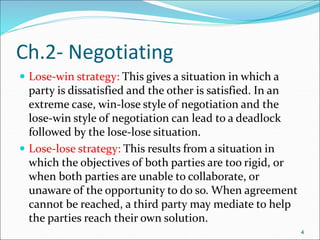
 Lose-win strategy: This gives a situation in which a
party is dissatisfied and the other is satisfied. In an
extreme case, win-lose style of negotiation and the
lose-win style of negotiation can lead to a deadlock
followed by the lose-lose situation.
 Lose-lose strategy: This results from a situation in
which the objectives of both parties are too rigid, or
when both parties are unable to collaborate, or
unaware of the opportunity to do so. When agreement
cannot be reached, a third party may mediate to help
the parties reach their own solution.
4
5
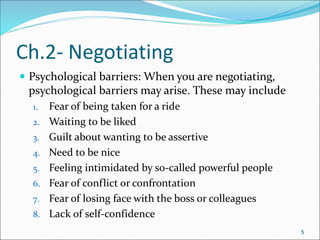
 Psychological barriers: When you are negotiating,
psychological barriers may arise. These may include
1. Fear of being taken for a ride
2. Waiting to be liked
3. Guilt about wanting to be assertive
4. Need to be nice
5. Feeling intimidated by so-called powerful people
6. Fear of conflict or confrontation
7. Fear of losing face with the boss or colleagues
8. Lack of self-confidence
5
Ch.2- Negotiating
Negotiating
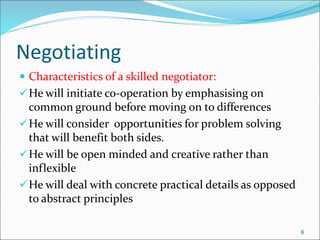
 Characteristics of a skilled negotiator:
He will initiate co-operation by emphasising on
common ground before moving on to differences
He will consider opportunities for problem solving
that will benefit both sides.
He will be open minded and creative rather than
inflexible
He will deal with concrete practical details as opposed
to abstract principles
6
Negotiating
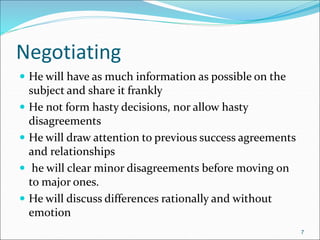
 He will have as much information as possible on the
subject and share it frankly
 He not form hasty decisions, nor allow hasty
disagreements
 He will draw attention to previous success agreements
and relationships
 he will clear minor disagreements before moving on
to major ones.
 He will discuss differences rationally and without
emotion
7
Cont’d
 He will deal patiently with others ‘ emotional outburst
 He will try to guide and educate less experienced
negotiators
 He will give praise to the other side whenever possible
 He will minimize the feeling of ‘loss ‘ among the
parties – he will make sure the other party does not
feel like it has lost its face.
 He will resort to force only as a last resort and ensure
that there are no empty threats.
8
9
 A five step approach to negotiation:
1. Plan: Create a set of clear objectives to steer you in the right
direction to achieve the results you want.
2. Discuss: Identify areas of agreement and try to establish some
rapport with the other party.
3. Purpose: Define the issues at a time. Attempt to stay with the
issue rather than generalizing into other situations.
4. Negotiate the issue: Start by asking for what you want, but accept
that your goals may have to be modified. Link compromises to
other objectives.
5. .
9
Negotiating
Cont’d
 Check: Check the agreement that you have just concluded
and confirm that each party is committed to the agreement
10
11
Principled Bargaining. To implement it you need to;
 State your case clearly and persuasively
 Organize your facts well
 Be aware of the timing and speed of the talks
 Access the others’needs properly
 Have patience
 Not be unduly worried by conflict
 Be committed to a win-win philosophy
11
Ch.2- Negotiating
12
 BATNA stands for the Best Alternative to a Negotiated
Agreement. If an agreement cannot be achieved by
negotiation, the alternative action to be taken is
identified in the BATNA.
 WATNA stands for the Worst Alternative to a
Negotiated Agreement. If the person you are
negotiating with is your manager or supervisor you
may have to think about WATNA. Becasue the other
person has the legitimate power, or because because
you want the relationship to continue as it is, you may
decide on less than your preferred outcome.
12
Ch.2- Negotiating
13
 Problem solving by negotiating: It is necessary that the
relationship is important to both parties and there is a
genuine desire to solve the problem rather than to win.
1. Select best time
2. Define needs
3. Brainstorm solutions
4. Evaluate solutions
5. Choose solutions
6. Implement solutions
Ch.2- Negotiating
14
 Negotiating options: In the negotiation process, the parties
involved may use different negotiation styles or options. A
skillfull negotiator is able to identify each of the five options
and recognize the style being used by other party.
1. Compromise: the settlement of differences through
concessions/compromise by one or both parties.
2. Collaboration: it results when people cooperate to produce a solution
satisfactory to both parties.
3. Competition: it leads to one party gaining the advantage over the other.
4.Accomodation: is a negotiation style
where one party is willing to oblige or
adapt to meet the needs of other party.
5. Withdrawal or avoidance: it is a negotiation style where both parties
lose. In this style, one party retracts their point of view or backs away
from the situation. (lose-lose)
Ch.2- Negotiating
 Conflict occurs when two people, teams or groups have
differing wants or goals and one party interferes with
the other’s attempts to satisfy their wants or goals.
 Levels of Conflict: Conflict moves through different
levels before it reaches the crisis level.
1. Discomfort
2. Incidents
3. Misunderstandings
4. Tension
5. Crisis
15
Ch.2- Negotiating
 Discomforts: Perhaps nothing is said yet. Things don’t feel
right. It may be difficult to identify what the problem is. Do
you feel uncomfortable about a situaition, but not quite
sure.
 Incidents: Here a short, sharp exchange occurs without any
lasting internal reaction. Has someting occured between
you and someone else that has left you upset, irritated or
with a result you did not want.
 Misunderstandings: Here motives and facts
are often confused or misperceived. Do your
thoughts keep returning frequently to the
16
Ch.2- Negotiating
 Tension: Here relationships are weighed down by
negative attitudes and fixed opinions. Has the way you
feel about and regard the other person significantly
changed for the worse? Is the relationship a source of
constant worry and concern?
 Crisis: Behavior is affected, normal
functioning becomes difficult, extreme
gestures are contemplated or executed. Are
you dealing with a major event like a
possible rupture in a relationship, leaving a
17
Ch.2- Negotiating
 Constructive responses to conflict: Responses to
conflict are learnt early in our childhood. These
responses become habits and reactions used without
thought in our adult life.
1. Assertion
2. Nonverbal messages
3. Listening with emphaty
18
Ch.2- Negotiating
Ch.2- Negotiating
 END OF PRESENTATION
19

chapter 2 B.ppt

  • 1.
  • 2.
    2 Ch.2- Negotiating  Negotiationis a process in which two or more parties try to resolve differences, solve problems and reach aggreement. Effective negotiation meets as many interests as possible in an agreement that is durable.  Negotiation strategies: Although negotiation has a specific aim – to reach agreement – not all negotiation achieves this aim. 1. Win-win strategy 2. Win-lose strategy 3. Lose-win strategy 4. Lose-lose strategy 2
  • 3.
    3 Ch.-2 Negotiating  Win-winstrategy: This gives a situation in which both parties are satisfied with the settlement negotiated. It is a process that seeks to meet the needs of both parties.  Win-lose strategy: This gives a situation in which one party is satisfied and one is dissatisfied. The focus is on the party’s problem to the exclusion of the other’s, until one side gives in or is defeated. People who adopt this strategy often use a confusing presentation or a dominant speaking style and body movement. 3
  • 4.
    4 Ch.2- Negotiating  Lose-winstrategy: This gives a situation in which a party is dissatisfied and the other is satisfied. In an extreme case, win-lose style of negotiation and the lose-win style of negotiation can lead to a deadlock followed by the lose-lose situation.  Lose-lose strategy: This results from a situation in which the objectives of both parties are too rigid, or when both parties are unable to collaborate, or unaware of the opportunity to do so. When agreement cannot be reached, a third party may mediate to help the parties reach their own solution. 4
  • 5.
    5  Psychological barriers:When you are negotiating, psychological barriers may arise. These may include 1. Fear of being taken for a ride 2. Waiting to be liked 3. Guilt about wanting to be assertive 4. Need to be nice 5. Feeling intimidated by so-called powerful people 6. Fear of conflict or confrontation 7. Fear of losing face with the boss or colleagues 8. Lack of self-confidence 5 Ch.2- Negotiating
  • 6.
    Negotiating  Characteristics ofa skilled negotiator: He will initiate co-operation by emphasising on common ground before moving on to differences He will consider opportunities for problem solving that will benefit both sides. He will be open minded and creative rather than inflexible He will deal with concrete practical details as opposed to abstract principles 6
  • 7.
    Negotiating  He willhave as much information as possible on the subject and share it frankly  He not form hasty decisions, nor allow hasty disagreements  He will draw attention to previous success agreements and relationships  he will clear minor disagreements before moving on to major ones.  He will discuss differences rationally and without emotion 7
  • 8.
    Cont’d  He willdeal patiently with others ‘ emotional outburst  He will try to guide and educate less experienced negotiators  He will give praise to the other side whenever possible  He will minimize the feeling of ‘loss ‘ among the parties – he will make sure the other party does not feel like it has lost its face.  He will resort to force only as a last resort and ensure that there are no empty threats. 8
  • 9.
    9  A fivestep approach to negotiation: 1. Plan: Create a set of clear objectives to steer you in the right direction to achieve the results you want. 2. Discuss: Identify areas of agreement and try to establish some rapport with the other party. 3. Purpose: Define the issues at a time. Attempt to stay with the issue rather than generalizing into other situations. 4. Negotiate the issue: Start by asking for what you want, but accept that your goals may have to be modified. Link compromises to other objectives. 5. . 9 Negotiating
  • 10.
    Cont’d  Check: Checkthe agreement that you have just concluded and confirm that each party is committed to the agreement 10
  • 11.
    11 Principled Bargaining. Toimplement it you need to;  State your case clearly and persuasively  Organize your facts well  Be aware of the timing and speed of the talks  Access the others’needs properly  Have patience  Not be unduly worried by conflict  Be committed to a win-win philosophy 11 Ch.2- Negotiating
  • 12.
    12  BATNA standsfor the Best Alternative to a Negotiated Agreement. If an agreement cannot be achieved by negotiation, the alternative action to be taken is identified in the BATNA.  WATNA stands for the Worst Alternative to a Negotiated Agreement. If the person you are negotiating with is your manager or supervisor you may have to think about WATNA. Becasue the other person has the legitimate power, or because because you want the relationship to continue as it is, you may decide on less than your preferred outcome. 12 Ch.2- Negotiating
  • 13.
    13  Problem solvingby negotiating: It is necessary that the relationship is important to both parties and there is a genuine desire to solve the problem rather than to win. 1. Select best time 2. Define needs 3. Brainstorm solutions 4. Evaluate solutions 5. Choose solutions 6. Implement solutions Ch.2- Negotiating
  • 14.
    14  Negotiating options:In the negotiation process, the parties involved may use different negotiation styles or options. A skillfull negotiator is able to identify each of the five options and recognize the style being used by other party. 1. Compromise: the settlement of differences through concessions/compromise by one or both parties. 2. Collaboration: it results when people cooperate to produce a solution satisfactory to both parties. 3. Competition: it leads to one party gaining the advantage over the other. 4.Accomodation: is a negotiation style where one party is willing to oblige or adapt to meet the needs of other party. 5. Withdrawal or avoidance: it is a negotiation style where both parties lose. In this style, one party retracts their point of view or backs away from the situation. (lose-lose) Ch.2- Negotiating
  • 15.
     Conflict occurswhen two people, teams or groups have differing wants or goals and one party interferes with the other’s attempts to satisfy their wants or goals.  Levels of Conflict: Conflict moves through different levels before it reaches the crisis level. 1. Discomfort 2. Incidents 3. Misunderstandings 4. Tension 5. Crisis 15 Ch.2- Negotiating
  • 16.
     Discomforts: Perhapsnothing is said yet. Things don’t feel right. It may be difficult to identify what the problem is. Do you feel uncomfortable about a situaition, but not quite sure.  Incidents: Here a short, sharp exchange occurs without any lasting internal reaction. Has someting occured between you and someone else that has left you upset, irritated or with a result you did not want.  Misunderstandings: Here motives and facts are often confused or misperceived. Do your thoughts keep returning frequently to the 16 Ch.2- Negotiating
  • 17.
     Tension: Hererelationships are weighed down by negative attitudes and fixed opinions. Has the way you feel about and regard the other person significantly changed for the worse? Is the relationship a source of constant worry and concern?  Crisis: Behavior is affected, normal functioning becomes difficult, extreme gestures are contemplated or executed. Are you dealing with a major event like a possible rupture in a relationship, leaving a 17 Ch.2- Negotiating
  • 18.
     Constructive responsesto conflict: Responses to conflict are learnt early in our childhood. These responses become habits and reactions used without thought in our adult life. 1. Assertion 2. Nonverbal messages 3. Listening with emphaty 18 Ch.2- Negotiating
  • 19.
    Ch.2- Negotiating  ENDOF PRESENTATION 19