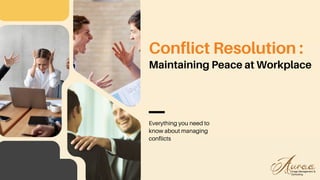
Everything you need to
know about managing
conflicts
Conflict Resolution :
Maintaining Peace at Workplace
“IF WE MANAGE CONFLICT CONSTRUCTIVELY ,
WE HARNESS ITS ENERGY FOR CREATIVITY AND DEVELOPMENT “
D O N ' T F O R G E T :
Kenneth Kaye
A Conflict refers to a disagreement or clash
between two or more parties with opposing
interests, needs, or perspectives.
It is a natural part of human interactions and
can occur in various settings, including the
workplace. Conflicts can arise due to differences
in values, goals, expectations, or communication
styles.
What is a Conflict?
"You're not getting my point of
view. You should not have said
that!"
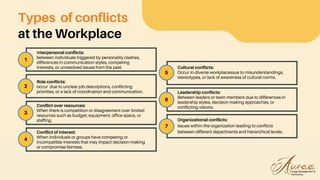
Types of conflicts
at the Workplace
1
3
2
4
5
Interpersonal conflicts:
between individuals triggered by personality clashes,
differences in communication styles, competing
interests, or unresolved issues from the past.
Role conflicts:
occur due to unclear job descriptions, conflicting
priorities, or a lack of coordination and communication.
Conflict over resources:
When there is competition or disagreement over limited
resources such as budget, equipment, office space, or
staffing.
Conflict of interest:
When individuals or groups have competing or
incompatible interests that may impact decision-making
or compromise fairness.
Cultural conflicts:
Occur in diverse workplacessue to misunderstandings,
stereotypes, or lack of awareness of cultural norms.
6
7
Leadership conflicts:
Between leaders or team members due to differences in
leadership styles, decision-making approaches, or
conflicting visions.
Organizational conflicts:
Issues within the organization leading to conflicts
between different departments and hierarchical levels.
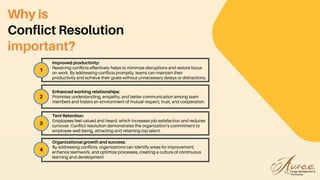
Why is
Conflict Resolution
important?
1
3
2
4
Improved productivity:
Resolving conflicts effectively helps to minimize disruptions and restore focus
on work. By addressing conflicts promptly, teams can maintain their
productivity and achieve their goals without unnecessary delays or distractions.
Enhanced working relationships:
Promotes understanding, empathy, and better communication among team
members and fosters an environment of mutual respect, trust, and cooperation.
Tent Retention:
Employees feel valued and heard, which increases job satisfaction and reduces
turnover. Conflict resolution demonstrates the organization's commitment to
employee well-being, attracting and retaining top talent.
Organizational growth and success:
By addressing conflicts, organizations can identify areas for improvement,
enhance teamwork, and optimize processes, creating a culture of continuous
learning and development
Esther Perel
"CONFLICT RESOLUTION DOES NOT MEAN ONE PERSON ALWAYS GETS THEIR WAY;
IT MEANS FINDING A WAY THAT BOTH PARTIES CAN LIVE WITH AND THRIVE."
D O N ' T F O R G E T :
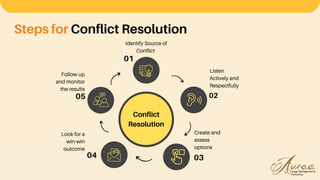
Steps for Conflict Resolution
Conflict
Resolution
Identify Source of
Conflict
Look for a
win-win
outcome
Follow up
and monitor
the results
Create and
assess
options
01
03
02
05
04
Listen
Actively and
Respectfully
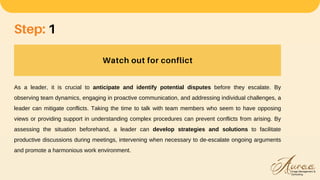
Watch out for conflict
Step: 1
As a leader, it is crucial to anticipate and identify potential disputes before they escalate. By
observing team dynamics, engaging in proactive communication, and addressing individual challenges, a
leader can mitigate conflicts. Taking the time to talk with team members who seem to have opposing
views or providing support in understanding complex procedures can prevent conflicts from arising. By
assessing the situation beforehand, a leader can develop strategies and solutions to facilitate
productive discussions during meetings, intervening when necessary to de-escalate ongoing arguments
and promote a harmonious work environment.
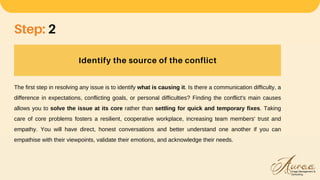
Identify the source of the conflict
Step: 2
The first step in resolving any issue is to identify what is causing it. Is there a communication difficulty, a
difference in expectations, conflicting goals, or personal difficulties? Finding the conflict's main causes
allows you to solve the issue at its core rather than settling for quick and temporary fixes. Taking
care of core problems fosters a resilient, cooperative workplace, increasing team members' trust and
empathy. You will have direct, honest conversations and better understand one another if you can
empathise with their viewpoints, validate their emotions, and acknowledge their needs.
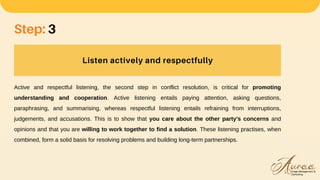
Listen actively and respectfully
Step: 3
Active and respectful listening, the second step in conflict resolution, is critical for promoting
understanding and cooperation. Active listening entails paying attention, asking questions,
paraphrasing, and summarising, whereas respectful listening entails refraining from interruptions,
judgements, and accusations. This is to show that you care about the other party's concerns and
opinions and that you are willing to work together to find a solution. These listening practises, when
combined, form a solid basis for resolving problems and building long-term partnerships.
Create and assess options
Step: 4
The generation and evaluation of possibilities for a potential resolution is the fourth step in resolving any
issue. Creating choices entails thinking about several possible solutions to the problem while
considering the requirements and interests of those involved. Evaluating options entails assessing the
pros and cons, feasibility, acceptability, and sustainability of each alternative. As a leader , you can
explore several options and discover the optimum solution for both parties.
Look for a win-win outcome
Step: 5
The objective of conflict management is to find a solution that satisfies all parties while maintaining
the relationship, not to win or lose. A win-win situation is one in which all parties feel heard,
appreciated, and respected and in which both parties benefit from the conclusion. Avoid situations where
one party dominates or cedes and both sides experience resentment, bitterness, or dissatisfaction. A
compromise result, where both parties concede something and accept less than they desire, should also
be avoided.
Establish Boundaries
Step: 6
When engaging in problem resolution, it is crucial to establish clear workplace boundaries. This serves
as a guide for team members, helping them navigate their actions and behaviors in a manner that
prevents conflicts from arising. By upholding these boundaries throughout the resolution process,
individuals involved in the conflict are encouraged to treat each other with respect. Moreover, it provides
an opportunity for them to reflect on the specific behaviors that may have crossed the line and led to
the conflict. This introspection and understanding can contribute to personal growth, improved
communication, and a more harmonious work environment.
Follow up and monitor the results
Step: 7
Monitoring and evaluating the effects of the solution is the last step in the conflict resolution process.
Checking in with the other party to make sure the solution is operating as intended. Measuring the
impact and efficacy of the solution and making adjustments as necessary are part of monitoring results.
As a leader make sure the disagreement is completely addressed and avoid its recurrence by
constantly following up and monitoring results. This continual dedication to conflict resolution results in
long-lasting relationships and a more peaceful workplace.
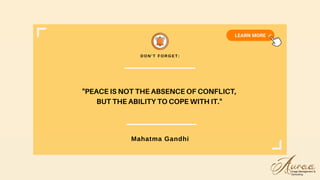
"PEACE IS NOT THE ABSENCE OF CONFLICT,
BUT THE ABILITY TO COPE WITH IT."
D O N ' T F O R G E T :
Mahatma Gandhi
Contact Us
For personalized coaching & training
Phone Number
+91 9958934766/ +91 7830222285
Email Address
samira@auraaimage.com/
nayanika@auraaimage.com
Website
https://auraaimage.com
https://samiragupta.com
For more of such interesting content,
follow us on:
@auraaimageandlife
@coachsamira
https://www.facebook.com/auraaimage
https://www.linkedin.com/company/auraa-
image-management-and-consulting/
https://www.linkedin.com/in/coach-samira-gupta-pcc
Thank You
Samira Chandra Gupta
Executive Presence Coach, Life Coach, Corporate Facilitator, NLP
Practitioner, National Award Winning Image Consultant (IMPA), Fire-
walking Instructor, International Best-Selling Author, Motivational
Speaker
+91 9958934766 / +91 7830222285

Conflict Resolution - Maintaining Peace at Workplace

  • 2.
    Everything you needto know about managing conflicts Conflict Resolution : Maintaining Peace at Workplace
  • 3.
    “IF WE MANAGECONFLICT CONSTRUCTIVELY , WE HARNESS ITS ENERGY FOR CREATIVITY AND DEVELOPMENT “ D O N ' T F O R G E T : Kenneth Kaye
  • 4.
    A Conflict refersto a disagreement or clash between two or more parties with opposing interests, needs, or perspectives. It is a natural part of human interactions and can occur in various settings, including the workplace. Conflicts can arise due to differences in values, goals, expectations, or communication styles. What is a Conflict? "You're not getting my point of view. You should not have said that!"
  • 5.
    Types of conflicts atthe Workplace 1 3 2 4 5 Interpersonal conflicts: between individuals triggered by personality clashes, differences in communication styles, competing interests, or unresolved issues from the past. Role conflicts: occur due to unclear job descriptions, conflicting priorities, or a lack of coordination and communication. Conflict over resources: When there is competition or disagreement over limited resources such as budget, equipment, office space, or staffing. Conflict of interest: When individuals or groups have competing or incompatible interests that may impact decision-making or compromise fairness. Cultural conflicts: Occur in diverse workplacessue to misunderstandings, stereotypes, or lack of awareness of cultural norms. 6 7 Leadership conflicts: Between leaders or team members due to differences in leadership styles, decision-making approaches, or conflicting visions. Organizational conflicts: Issues within the organization leading to conflicts between different departments and hierarchical levels.
  • 6.
    Why is Conflict Resolution important? 1 3 2 4 Improvedproductivity: Resolving conflicts effectively helps to minimize disruptions and restore focus on work. By addressing conflicts promptly, teams can maintain their productivity and achieve their goals without unnecessary delays or distractions. Enhanced working relationships: Promotes understanding, empathy, and better communication among team members and fosters an environment of mutual respect, trust, and cooperation. Tent Retention: Employees feel valued and heard, which increases job satisfaction and reduces turnover. Conflict resolution demonstrates the organization's commitment to employee well-being, attracting and retaining top talent. Organizational growth and success: By addressing conflicts, organizations can identify areas for improvement, enhance teamwork, and optimize processes, creating a culture of continuous learning and development
  • 7.
    Esther Perel "CONFLICT RESOLUTIONDOES NOT MEAN ONE PERSON ALWAYS GETS THEIR WAY; IT MEANS FINDING A WAY THAT BOTH PARTIES CAN LIVE WITH AND THRIVE." D O N ' T F O R G E T :
  • 8.
    Steps for ConflictResolution Conflict Resolution Identify Source of Conflict Look for a win-win outcome Follow up and monitor the results Create and assess options 01 03 02 05 04 Listen Actively and Respectfully
  • 9.
    Watch out forconflict Step: 1 As a leader, it is crucial to anticipate and identify potential disputes before they escalate. By observing team dynamics, engaging in proactive communication, and addressing individual challenges, a leader can mitigate conflicts. Taking the time to talk with team members who seem to have opposing views or providing support in understanding complex procedures can prevent conflicts from arising. By assessing the situation beforehand, a leader can develop strategies and solutions to facilitate productive discussions during meetings, intervening when necessary to de-escalate ongoing arguments and promote a harmonious work environment.
  • 10.
    Identify the sourceof the conflict Step: 2 The first step in resolving any issue is to identify what is causing it. Is there a communication difficulty, a difference in expectations, conflicting goals, or personal difficulties? Finding the conflict's main causes allows you to solve the issue at its core rather than settling for quick and temporary fixes. Taking care of core problems fosters a resilient, cooperative workplace, increasing team members' trust and empathy. You will have direct, honest conversations and better understand one another if you can empathise with their viewpoints, validate their emotions, and acknowledge their needs.
  • 11.
    Listen actively andrespectfully Step: 3 Active and respectful listening, the second step in conflict resolution, is critical for promoting understanding and cooperation. Active listening entails paying attention, asking questions, paraphrasing, and summarising, whereas respectful listening entails refraining from interruptions, judgements, and accusations. This is to show that you care about the other party's concerns and opinions and that you are willing to work together to find a solution. These listening practises, when combined, form a solid basis for resolving problems and building long-term partnerships.
  • 12.
    Create and assessoptions Step: 4 The generation and evaluation of possibilities for a potential resolution is the fourth step in resolving any issue. Creating choices entails thinking about several possible solutions to the problem while considering the requirements and interests of those involved. Evaluating options entails assessing the pros and cons, feasibility, acceptability, and sustainability of each alternative. As a leader , you can explore several options and discover the optimum solution for both parties.
  • 13.
    Look for awin-win outcome Step: 5 The objective of conflict management is to find a solution that satisfies all parties while maintaining the relationship, not to win or lose. A win-win situation is one in which all parties feel heard, appreciated, and respected and in which both parties benefit from the conclusion. Avoid situations where one party dominates or cedes and both sides experience resentment, bitterness, or dissatisfaction. A compromise result, where both parties concede something and accept less than they desire, should also be avoided.
  • 14.
    Establish Boundaries Step: 6 Whenengaging in problem resolution, it is crucial to establish clear workplace boundaries. This serves as a guide for team members, helping them navigate their actions and behaviors in a manner that prevents conflicts from arising. By upholding these boundaries throughout the resolution process, individuals involved in the conflict are encouraged to treat each other with respect. Moreover, it provides an opportunity for them to reflect on the specific behaviors that may have crossed the line and led to the conflict. This introspection and understanding can contribute to personal growth, improved communication, and a more harmonious work environment.
  • 15.
    Follow up andmonitor the results Step: 7 Monitoring and evaluating the effects of the solution is the last step in the conflict resolution process. Checking in with the other party to make sure the solution is operating as intended. Measuring the impact and efficacy of the solution and making adjustments as necessary are part of monitoring results. As a leader make sure the disagreement is completely addressed and avoid its recurrence by constantly following up and monitoring results. This continual dedication to conflict resolution results in long-lasting relationships and a more peaceful workplace.
  • 16.
    "PEACE IS NOTTHE ABSENCE OF CONFLICT, BUT THE ABILITY TO COPE WITH IT." D O N ' T F O R G E T : Mahatma Gandhi
  • 17.
    Contact Us For personalizedcoaching & training Phone Number +91 9958934766/ +91 7830222285 Email Address samira@auraaimage.com/ nayanika@auraaimage.com Website https://auraaimage.com https://samiragupta.com For more of such interesting content, follow us on: @auraaimageandlife @coachsamira https://www.facebook.com/auraaimage https://www.linkedin.com/company/auraa- image-management-and-consulting/ https://www.linkedin.com/in/coach-samira-gupta-pcc
  • 18.
    Thank You Samira ChandraGupta Executive Presence Coach, Life Coach, Corporate Facilitator, NLP Practitioner, National Award Winning Image Consultant (IMPA), Fire- walking Instructor, International Best-Selling Author, Motivational Speaker +91 9958934766 / +91 7830222285