Change Management for Technical Communicators Presented by / Bogo Vatovec Change Management / Knowledge Engineering / User Experience / Interaction Design / Process Engineering
Getting to know each other Who are you? Why are you here? What do you understand under Change Management? Why are you interested in it? What is your experience with Change Management? Describe one example of a change activity you have been involved with in the past 12 months.
Agenda Introduction to Change Management Organizational Change Management Individual Change Management How people react to change A guide to implementing the change The Change Process Communication in a Change Process Technical Communication in a Change Process
Change Management: An Introduction
Some examples of a change /  but not necessarily of Change Management Merging of two companies. Introducing a new marketing department in a software organization is about Change Management.  Merging of a training and publication departments. Moving from MS Word to FrameMaker. Going from printed to online documentation, from a Windows to a Web based interface. A team is not productive to the extend desired. Employees feel they are not involved and informed about directions, decisions and their role. Need to develop certain skills to remain competitive.
How can I avoid being involved with Change Management? A guide to ignorance As a manager: Ignore all discussions about performance improvement, cost saving, business focusing, ROI, costs centers, business processes. In am employee yearly goal setting meeting, do not set any goals or define any plan. Let it just be as it has been. As an employee and a person: Do what you always have been doing.  Don’t ask yourself about the meaning and purpose of your work. If you never took vacation, don’t take it now. If your wife/husband has always been unhappy about something, let it be like this. It’s not your business anyhow.
How can I avoid being involved with Change Management In fact, you can’t.  Marriage counseling is often about managing change. Death in a family is about change. Getting in love is about change.
In a business context,  Change Management is about performance Change Management serves business goals: Maximize the profit margin Reduce costs Reduce overhead Produce more with less Faster time to market Change Management is not about: Making employees happy. Soft factors Change management is the effective management of a business change such that executive leaders, managers and front line employees work in concert to successfully implement the needed process, technology or organizational changes.  (HBR, a Change Management Primer)
Essential of Change Management: Different perspectives Two perspectives: Management perspective (change leader): “I need results” Recipients perspective: “What does this change mean to me?” Typically lead to: Employees resist the change. Valued personnel leave the organization.  Critical projects are delayed. Customers feel the impact indirectly through upset employees. Productivity declines.
The two perspectives define two aspects of Change Management Organizational Change Management (Improvement) Individual Change Management (Improvement)
What has Change Management to do with Technical Communication? Technical Communication as a profession is changing rapidly. Companies we work for are changing continuously. Responsibilities of the Publication Department change continuously. Processes, tools and skills needed change continuously.  A new management style is required. A new self-understanding from the employees is required. Various roles in a change process provide job enrichment possibilities for Technical Communicators. Understanding Change Management aspects improve productivity and team work.
Exercise: the last change project you have seen or been involved with Think about the last project that involved making a change and you have been involved with: Write down what worked well? Why? Write down what failed? Why? Time: 15 minutes 15 minutes summaries
Organizational Change Management:  An Overview
Organizational Change Management A business view from the top. The goal is to develop organizational capabilities to understand, accept and support the needed business change.  The primary focus is on change management strategies, communication plans and training programs. The involved parties include project team members, human resources and key business leaders that sponsor the change.
A manager’s view on a change: “I need results!” When can the change be completed?  How much improvement will be realized? How will this change impact our financial performance? What is the required investment? How will this change impact our customers?
The goal is to develop the following organizational capabilities and skills: Change management roles  Critical barriers to implementing change  Change management planning and strategies  Organizational change management methodologies  Managing employee resistance  Building executive sponsorship  Creating communication plans  Creating training and educational programs  Incentive and recognition programs
Individual Change Management:  An Overview
Individual Change Management Change from a perspective of the employees. The focus on tools and techniques to help an employee transition through the change process. Coaching required to help them understand the role and decisions in the change process. Personal and professional changes/improvement needed to support the new business goals.
A recipient’s view of a change: “What will this change mean to me?” Why are we doing this? Am I still going to be needed? What is expected from me? Am I able to deliver? What will I have to do differently? How will I learn new things? When will the change take place?
You will need to develop skills and capabilities in the following areas Diagnosing resistance to change  Models for managing individual change  Decisions and consequences around supporting change that face employees  Coaching tools and techniques for helping employees navigate the change process  Activities and exercises for supervisors to use with their employees to manage change
Useful skills and competencies for an individual participating in a Change Process Moderation skills Goals settings and personal feedback  Handling the resistance Project management Communication skills Conflict handling Team development Coaching and mentoring How would you go about to develop and hone these skills?
A guide to implementing change
Critical barriers to implementing change  and why change projects fail Don’t touch the working system Everything good comes from above Not invented here The wrong question The solution is a part of the problem Function follows Form organizational design Superman profiles for employees Dishonest communication  Island solutions No or bad communication  No engagement of employees in the change process
Successful organizations… Create energy through honest communication Think in processes instead of structures Design the organization as an open system Organize from outside to inside Connect the process through communication Define measurable criteria Involve participants early Ensure learning
Principles for successful Change Implementation Goal oriented management No actions without a proper diagnose Holistic thinking and acting Involve the affected Help to self-help Process-oriented governance Careful selection of key persons High acceptance from management and affected employees Live communication
How do people react to a change?
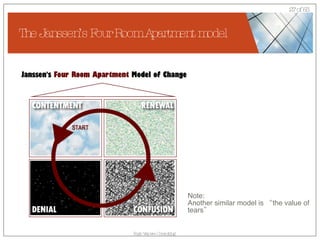
The Janssen’s Four Room Apartment model Note:  Another similar model is “the value of tears”
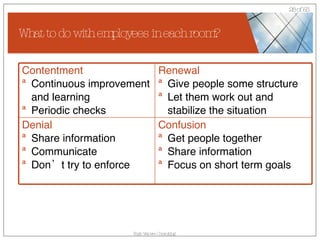
What to do with employees in each room? Confusion Get people together Share information Focus on short term goals Denial Share information Communicate Don’t try to enforce Renewal Give people some structure Let them work out and stabilize the situation Contentment Continuous improvement and learning Periodic checks
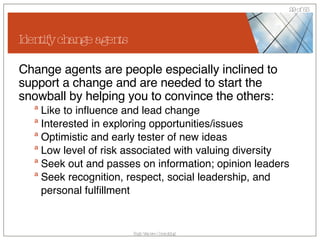
Identify change agents Change agents are people especially inclined to support a change and are needed to start the snowball by helping you to convince the others: Like to influence and lead change  Interested in exploring opportunities/issues  Optimistic and early tester of new ideas  Low level of risk associated with valuing diversity  Seek out and passes on information; opinion leaders  Seek recognition, respect, social leadership, and personal fulfillment
The Change Process
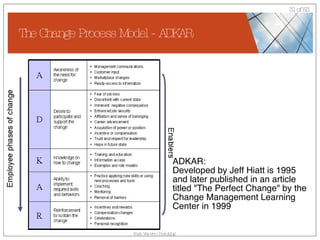
The Change Process Model - ADKAR ADKAR: Developed by Jeff Hiatt is 1995 and later published in an article titled "The Perfect Change" by the Change Management Learning Center in 1999
ADKAR Model Helps answer questions like: Why is communication so important during change?  Why do employees resist change?  Why do executive business leaders need to be active and visible sponsors of change? Why do employees become stressed and distracted from day to day work?  How can I find the barrier point to change, and manage employee or management resistance?  Why should front-line supervisors be active in coaching employees during change? 
ADKAR - Awareness Awareness is created through communication: Who should communicate what? Communicators When is the best time to communicate? Timing Face to face Memos and other media Channels (enablers) Messages about the business today. Messages about the change. Messages about the impact on the employees. Status updates and reports. Key messages
ADKAR : Building Desire Enablers to build a desired may include: Fear of job loss Discontent with the current state Imminent negative consequences Enhanced job security  Affiliation and sense of belonging  Career advancement  Acquisition of power or position  Ownership for the future state Incentive or compensation  Trust and respect for leadership  Hope in future state
ADKAR: Creating Knowledge In general, knowledge can be created through: Training and education programs Open and ready access to information Examples and role models
ADKAR: Creating Ability to change Creating the ability to change consists of: Practice applying new skills, processes and tools. Coaching Mentoring Removal of barriers Abilities to change include: Physical motor skill ability Cognitive or analytical ability Behavior change
ADKAR - Reinforcement Reinforcement may include the following:   Incentives and rewards Compensational changes Celebrations Personal recognition
Communication in a change process
The key issue in Change Management: Communication The need and the goals for a change may be clear to the management, but are vague to the employees. The employee can’t see the connection between the change goals and his professional/personal goals. The management has been thinking about the change for a long time, but it is completely new to the employee.  The trust to the initiator may vary: is it really about what they are telling us or they just want to lay-off people?
The key issue in Change Management: Communication A communication plan: Conduct a stakeholder analysis Analyze the existing communication ways Consolidate and define the communication channels Define a stakeholder communication plan Prepare feedback and evaluation channels Prepare the communication materials Differentiate between a “lack of information” and “lack of communication”. Differentiate between “being informed” and “knowing”
Questions to answer in a change process Why is the change needed? What do we want to actually achieve? What are the alternatives? Why like this and not somehow else? What kind of risks are we facing?  What can we lose? What will we do differently in the future? Is there any future for us? For me? What role are we playing in the change? Can we trust those who planned everything? Can’t we wait with it longer?
Facts about communication in a change process Each change process is only as good as its communication. Efficiency of communication is based on a live dialogue.  You can’t not communicate. Communication comes usually too late. Everybody hears only what he wants. To effectively communicate you need to know the audience. No communication without purpose. Quick communication requires short flows. Too much communication is, well, too much. Communication doesn’t mean “everybody discussed with everyone” There are also things that shouldn’t be communicated (to everyone)
Exercise: A change in the Publications Department Build groups of 2/3 persons. Task: You are a manager of a 15 people publication department. Your team uses MS Word. Your company just merged with another company whose publication group with 30 people uses FrameMaker.  You agreed to move from MS Word to FrameMaker. How would you approach the task? Time:   30 minutes Each group presents the results
Exercise: Did you consider the following? What are the reasons for this change? What is the planed impact? Who are the stakeholders? What is the impact on them? Did you consider the ROI? What kind of changes are needed to the publication process? Did you think about the impact on reviewers and subject matter experts? How will you train the employees?
Exercise: Continued Detail the stakeholder list: Who is affected by the proposed solution? How will they react? What does interest them? What do they need to know? How will you handle their needs? Time: 30 minutes
The role of a Technical Communication  in a Change Process
How to identify (potential) change projects? Organizational change projects: Merges of companies/departments Process changes Quality initiatives (ISO, Balanced Scorecard, CMM,TQM, TickIt, …) Team and individual level: Conflicts and frictions in a team. The mixed competency team doesn’t really work as a team. Performance lower than expected. Implementation of new roles, employee profiles, titles.
Exercise: Think about (change) projects in your organization. Write the projects on the paper. Why do you feel it is a change project? What could a technical communicator do in this project? What could you do in the project? Discuss the projects with your colleague. Time: 30 minutes
Some typical roles a Technical Communicator can take in a Change Process Be the representative of the recipients side. Manage and organize the communication activities. Take over specific tasks in the change process, such as workshops preparation and moderation, conflict management. Define or co-develop concepts and materials for individual performance improvement (training, coaching, …) In the ADKAR process, Technical Communicators are strongly involved in: D – building Desired K – creating Knowledge A – develop Ability
Next steps
How to proceed? How mature is change management in your organization? Join the existing group. Become a change management champion. Look for project with a change management dimension. Make sure to participate. If you are a manager, make sure to include change management aspects to your activities and projects. Improve your skills in change management.
Recommended literature Recommended books: William Bridges, Managing Transitions John P. Kotter, Leading Change Harvard Business School Press, Managing Change and Transition Peter P. Senge, The Dance of Change Peter P. Senge, The fifth Discipline Jeff Davidsion, The Complete Idiot's Guide to Change Management Recommended magazines: Harvard Business Review ISPI (International Society for Performance Improvement) Quarterly
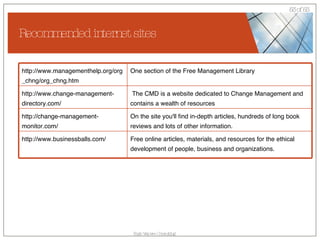
Recommended internet sites Free online articles, materials, and resources for the ethical development of people, business and organizations. http://www.businessballs.com/ On the site you'll find in-depth articles, hundreds of long book reviews and lots of other information. http://change-management-monitor.com/ The CMD is a website dedicated to Change Management and contains a wealth of resources http://www.change-management-directory.com/ One section of the Free Management Library http://www.managementhelp.org/org_chng/org_chng.htm
Thanks! Bogo Vatovec Consulting Office Gabriel-Max-Str. 20 / 10245 Berlin T +49 30 20078666 / F +49 30 20078661 / office@bovacon.com / www.bovacon.com © Bogo Vatovec Consultig

Change Management for Publication Department

  • 1.
    Change Management forTechnical Communicators Presented by / Bogo Vatovec Change Management / Knowledge Engineering / User Experience / Interaction Design / Process Engineering
  • 2.
    Getting to knoweach other Who are you? Why are you here? What do you understand under Change Management? Why are you interested in it? What is your experience with Change Management? Describe one example of a change activity you have been involved with in the past 12 months.
  • 3.
    Agenda Introduction toChange Management Organizational Change Management Individual Change Management How people react to change A guide to implementing the change The Change Process Communication in a Change Process Technical Communication in a Change Process
  • 4.
  • 5.
    Some examples ofa change / but not necessarily of Change Management Merging of two companies. Introducing a new marketing department in a software organization is about Change Management. Merging of a training and publication departments. Moving from MS Word to FrameMaker. Going from printed to online documentation, from a Windows to a Web based interface. A team is not productive to the extend desired. Employees feel they are not involved and informed about directions, decisions and their role. Need to develop certain skills to remain competitive.
  • 6.
    How can Iavoid being involved with Change Management? A guide to ignorance As a manager: Ignore all discussions about performance improvement, cost saving, business focusing, ROI, costs centers, business processes. In am employee yearly goal setting meeting, do not set any goals or define any plan. Let it just be as it has been. As an employee and a person: Do what you always have been doing. Don’t ask yourself about the meaning and purpose of your work. If you never took vacation, don’t take it now. If your wife/husband has always been unhappy about something, let it be like this. It’s not your business anyhow.
  • 7.
    How can Iavoid being involved with Change Management In fact, you can’t. Marriage counseling is often about managing change. Death in a family is about change. Getting in love is about change.
  • 8.
    In a businesscontext, Change Management is about performance Change Management serves business goals: Maximize the profit margin Reduce costs Reduce overhead Produce more with less Faster time to market Change Management is not about: Making employees happy. Soft factors Change management is the effective management of a business change such that executive leaders, managers and front line employees work in concert to successfully implement the needed process, technology or organizational changes. (HBR, a Change Management Primer)
  • 9.
    Essential of ChangeManagement: Different perspectives Two perspectives: Management perspective (change leader): “I need results” Recipients perspective: “What does this change mean to me?” Typically lead to: Employees resist the change. Valued personnel leave the organization. Critical projects are delayed. Customers feel the impact indirectly through upset employees. Productivity declines.
  • 10.
    The two perspectivesdefine two aspects of Change Management Organizational Change Management (Improvement) Individual Change Management (Improvement)
  • 11.
    What has ChangeManagement to do with Technical Communication? Technical Communication as a profession is changing rapidly. Companies we work for are changing continuously. Responsibilities of the Publication Department change continuously. Processes, tools and skills needed change continuously. A new management style is required. A new self-understanding from the employees is required. Various roles in a change process provide job enrichment possibilities for Technical Communicators. Understanding Change Management aspects improve productivity and team work.
  • 12.
    Exercise: the lastchange project you have seen or been involved with Think about the last project that involved making a change and you have been involved with: Write down what worked well? Why? Write down what failed? Why? Time: 15 minutes 15 minutes summaries
  • 13.
  • 14.
    Organizational Change ManagementA business view from the top. The goal is to develop organizational capabilities to understand, accept and support the needed business change. The primary focus is on change management strategies, communication plans and training programs. The involved parties include project team members, human resources and key business leaders that sponsor the change.
  • 15.
    A manager’s viewon a change: “I need results!” When can the change be completed? How much improvement will be realized? How will this change impact our financial performance? What is the required investment? How will this change impact our customers?
  • 16.
    The goal isto develop the following organizational capabilities and skills: Change management roles Critical barriers to implementing change Change management planning and strategies Organizational change management methodologies Managing employee resistance Building executive sponsorship Creating communication plans Creating training and educational programs Incentive and recognition programs
  • 17.
  • 18.
    Individual Change ManagementChange from a perspective of the employees. The focus on tools and techniques to help an employee transition through the change process. Coaching required to help them understand the role and decisions in the change process. Personal and professional changes/improvement needed to support the new business goals.
  • 19.
    A recipient’s viewof a change: “What will this change mean to me?” Why are we doing this? Am I still going to be needed? What is expected from me? Am I able to deliver? What will I have to do differently? How will I learn new things? When will the change take place?
  • 20.
    You will needto develop skills and capabilities in the following areas Diagnosing resistance to change Models for managing individual change Decisions and consequences around supporting change that face employees Coaching tools and techniques for helping employees navigate the change process Activities and exercises for supervisors to use with their employees to manage change
  • 21.
    Useful skills andcompetencies for an individual participating in a Change Process Moderation skills Goals settings and personal feedback Handling the resistance Project management Communication skills Conflict handling Team development Coaching and mentoring How would you go about to develop and hone these skills?
  • 22.
    A guide toimplementing change
  • 23.
    Critical barriers toimplementing change and why change projects fail Don’t touch the working system Everything good comes from above Not invented here The wrong question The solution is a part of the problem Function follows Form organizational design Superman profiles for employees Dishonest communication Island solutions No or bad communication No engagement of employees in the change process
  • 24.
    Successful organizations… Createenergy through honest communication Think in processes instead of structures Design the organization as an open system Organize from outside to inside Connect the process through communication Define measurable criteria Involve participants early Ensure learning
  • 25.
    Principles for successfulChange Implementation Goal oriented management No actions without a proper diagnose Holistic thinking and acting Involve the affected Help to self-help Process-oriented governance Careful selection of key persons High acceptance from management and affected employees Live communication
  • 26.
    How do peoplereact to a change?
  • 27.
    The Janssen’s FourRoom Apartment model Note: Another similar model is “the value of tears”
  • 28.
    What to dowith employees in each room? Confusion Get people together Share information Focus on short term goals Denial Share information Communicate Don’t try to enforce Renewal Give people some structure Let them work out and stabilize the situation Contentment Continuous improvement and learning Periodic checks
  • 29.
    Identify change agentsChange agents are people especially inclined to support a change and are needed to start the snowball by helping you to convince the others: Like to influence and lead change Interested in exploring opportunities/issues Optimistic and early tester of new ideas Low level of risk associated with valuing diversity Seek out and passes on information; opinion leaders Seek recognition, respect, social leadership, and personal fulfillment
  • 30.
  • 31.
    The Change ProcessModel - ADKAR ADKAR: Developed by Jeff Hiatt is 1995 and later published in an article titled "The Perfect Change" by the Change Management Learning Center in 1999
  • 32.
    ADKAR Model Helpsanswer questions like: Why is communication so important during change?  Why do employees resist change?  Why do executive business leaders need to be active and visible sponsors of change? Why do employees become stressed and distracted from day to day work?  How can I find the barrier point to change, and manage employee or management resistance?  Why should front-line supervisors be active in coaching employees during change? 
  • 33.
    ADKAR - AwarenessAwareness is created through communication: Who should communicate what? Communicators When is the best time to communicate? Timing Face to face Memos and other media Channels (enablers) Messages about the business today. Messages about the change. Messages about the impact on the employees. Status updates and reports. Key messages
  • 34.
    ADKAR : BuildingDesire Enablers to build a desired may include: Fear of job loss Discontent with the current state Imminent negative consequences Enhanced job security Affiliation and sense of belonging Career advancement Acquisition of power or position Ownership for the future state Incentive or compensation Trust and respect for leadership Hope in future state
  • 35.
    ADKAR: Creating KnowledgeIn general, knowledge can be created through: Training and education programs Open and ready access to information Examples and role models
  • 36.
    ADKAR: Creating Abilityto change Creating the ability to change consists of: Practice applying new skills, processes and tools. Coaching Mentoring Removal of barriers Abilities to change include: Physical motor skill ability Cognitive or analytical ability Behavior change
  • 37.
    ADKAR - ReinforcementReinforcement may include the following: Incentives and rewards Compensational changes Celebrations Personal recognition
  • 38.
    Communication in achange process
  • 39.
    The key issuein Change Management: Communication The need and the goals for a change may be clear to the management, but are vague to the employees. The employee can’t see the connection between the change goals and his professional/personal goals. The management has been thinking about the change for a long time, but it is completely new to the employee. The trust to the initiator may vary: is it really about what they are telling us or they just want to lay-off people?
  • 40.
    The key issuein Change Management: Communication A communication plan: Conduct a stakeholder analysis Analyze the existing communication ways Consolidate and define the communication channels Define a stakeholder communication plan Prepare feedback and evaluation channels Prepare the communication materials Differentiate between a “lack of information” and “lack of communication”. Differentiate between “being informed” and “knowing”
  • 41.
    Questions to answerin a change process Why is the change needed? What do we want to actually achieve? What are the alternatives? Why like this and not somehow else? What kind of risks are we facing? What can we lose? What will we do differently in the future? Is there any future for us? For me? What role are we playing in the change? Can we trust those who planned everything? Can’t we wait with it longer?
  • 42.
    Facts about communicationin a change process Each change process is only as good as its communication. Efficiency of communication is based on a live dialogue. You can’t not communicate. Communication comes usually too late. Everybody hears only what he wants. To effectively communicate you need to know the audience. No communication without purpose. Quick communication requires short flows. Too much communication is, well, too much. Communication doesn’t mean “everybody discussed with everyone” There are also things that shouldn’t be communicated (to everyone)
  • 43.
    Exercise: A changein the Publications Department Build groups of 2/3 persons. Task: You are a manager of a 15 people publication department. Your team uses MS Word. Your company just merged with another company whose publication group with 30 people uses FrameMaker. You agreed to move from MS Word to FrameMaker. How would you approach the task? Time: 30 minutes Each group presents the results
  • 44.
    Exercise: Did youconsider the following? What are the reasons for this change? What is the planed impact? Who are the stakeholders? What is the impact on them? Did you consider the ROI? What kind of changes are needed to the publication process? Did you think about the impact on reviewers and subject matter experts? How will you train the employees?
  • 45.
    Exercise: Continued Detailthe stakeholder list: Who is affected by the proposed solution? How will they react? What does interest them? What do they need to know? How will you handle their needs? Time: 30 minutes
  • 46.
    The role ofa Technical Communication in a Change Process
  • 47.
    How to identify(potential) change projects? Organizational change projects: Merges of companies/departments Process changes Quality initiatives (ISO, Balanced Scorecard, CMM,TQM, TickIt, …) Team and individual level: Conflicts and frictions in a team. The mixed competency team doesn’t really work as a team. Performance lower than expected. Implementation of new roles, employee profiles, titles.
  • 48.
    Exercise: Think about(change) projects in your organization. Write the projects on the paper. Why do you feel it is a change project? What could a technical communicator do in this project? What could you do in the project? Discuss the projects with your colleague. Time: 30 minutes
  • 49.
    Some typical rolesa Technical Communicator can take in a Change Process Be the representative of the recipients side. Manage and organize the communication activities. Take over specific tasks in the change process, such as workshops preparation and moderation, conflict management. Define or co-develop concepts and materials for individual performance improvement (training, coaching, …) In the ADKAR process, Technical Communicators are strongly involved in: D – building Desired K – creating Knowledge A – develop Ability
  • 50.
  • 51.
    How to proceed?How mature is change management in your organization? Join the existing group. Become a change management champion. Look for project with a change management dimension. Make sure to participate. If you are a manager, make sure to include change management aspects to your activities and projects. Improve your skills in change management.
  • 52.
    Recommended literature Recommendedbooks: William Bridges, Managing Transitions John P. Kotter, Leading Change Harvard Business School Press, Managing Change and Transition Peter P. Senge, The Dance of Change Peter P. Senge, The fifth Discipline Jeff Davidsion, The Complete Idiot's Guide to Change Management Recommended magazines: Harvard Business Review ISPI (International Society for Performance Improvement) Quarterly
  • 53.
    Recommended internet sitesFree online articles, materials, and resources for the ethical development of people, business and organizations. http://www.businessballs.com/ On the site you'll find in-depth articles, hundreds of long book reviews and lots of other information. http://change-management-monitor.com/ The CMD is a website dedicated to Change Management and contains a wealth of resources http://www.change-management-directory.com/ One section of the Free Management Library http://www.managementhelp.org/org_chng/org_chng.htm
  • 54.
    Thanks! Bogo VatovecConsulting Office Gabriel-Max-Str. 20 / 10245 Berlin T +49 30 20078666 / F +49 30 20078661 / office@bovacon.com / www.bovacon.com © Bogo Vatovec Consultig