Collective learning in organizations

THE THEORY & PRACTICE OF CHANGE MANAGEMENT 3rd Ediiton, John Hayes, Palgrave, 2010

1
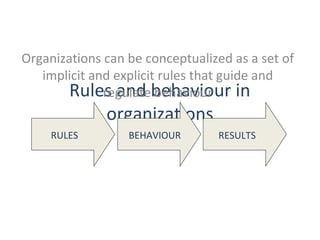
Organizations can be conceptualized as a set of
implicit and explicit rules that guide and
Rules and behaviour in
regulate behaviour

organizations

RULES

BEHAVIOUR

RESULTS

THE THEORY & PRACTICE OF CHANGE MANAGEMENT 3rd Edition, John Hayes, Palgrave, 2010

2
Organisational learning
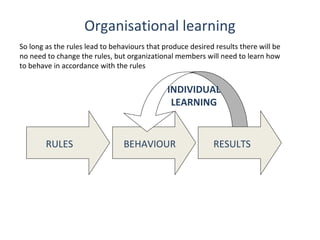
So long as the rules lead to behaviours that produce desired results there will be
no need to change the rules, but organizational members will need to learn how
to behave in accordance with the rules

INDIVIDUAL
LEARNING

RULES

BEHAVIOUR

RESULTS

THE THEORY & PRACTICE OF CHANGE MANAGEMENT 3rd Edition, John Hayes, Palgrave, 2010

3
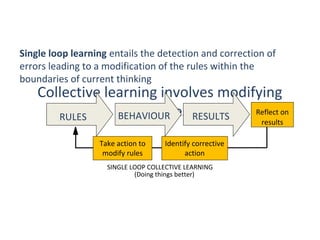
Single loop learning entails the detection and correction of
errors leading to a modification of the rules within the
boundaries of current thinking

Collective learning involves modifying
Reflect on
the rules RESULTS
BEHAVIOUR
RULES
results

Take action to
modify rules

Identify corrective
action

SINGLE LOOP COLLECTIVE LEARNING
(Doing things better)

THE THEORY & PRACTICE OF CHANGE MANAGEMENT 3rd Edition, John Hayes, Palgrave, 2010

4
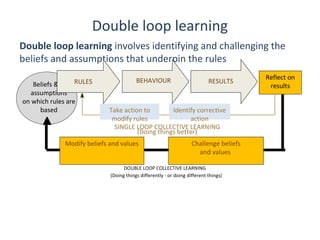
Double loop learning
Double loop learning involves identifying and challenging the
beliefs and assumptions that underpin the rules
RULES

Beliefs &
assumptions
on which rules are
based

BEHAVIOUR

RESULTS

Reflect on
results

Take action to
Identify corrective
modify rules
action
SINGLE LOOP COLLECTIVE LEARNING
(Doing things better)

Modify beliefs and values

Challenge beliefs
and values

DOUBLE LOOP COLLECTIVE LEARNING
(Doing things differently - or doing different things)

THE THEORY & PRACTICE OF CHANGE MANAGEMENT 3rd Edition, John Hayes, Palgrave, 2010

5
Impediments to organisational
learning

THE THEORY & PRACTICE OF CHANGE MANAGEMENT 3rd Edition, John Hayes, Palgrave, 2010

6
A poor appreciation of the systemic
qualities of the organisation
People can become too preoccupied with the details of
their bit of the organization and ignore how what they do can
affect others and impact on business effectiveness.

THE THEORY & PRACTICE OF CHANGE MANAGEMENT 3rd Edition, John Hayes, Palgrave, 2010

7
Lack of accessible channels for dialogue
and the sharing of meaning
The process of articulating one’s own meanings and
comprehending the meanings that others have constructed can
alter the meanings held by organizational members.
Dialogue and the joint construction of meaning is the essence of
collective learning
Often the conditions that facilitate this process are lacking.

THE THEORY & PRACTICE OF CHANGE MANAGEMENT 3rd Edition, John Hayes, Palgrave, 2010

8
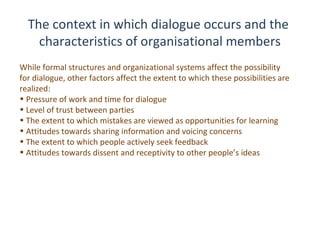
The context in which dialogue occurs and the
characteristics of organisational members
While formal structures and organizational systems affect the possibility
for dialogue, other factors affect the extent to which these possibilities are
realized:
• Pressure of work and time for dialogue
• Level of trust between parties
• The extent to which mistakes are viewed as opportunities for learning
• Attitudes towards sharing information and voicing concerns
• The extent to which people actively seek feedback
• Attitudes towards dissent and receptivity to other people’s ideas

THE THEORY & PRACTICE OF CHANGE MANAGEMENT 3rd Edition, John Hayes, Palgrave, 2010

9
The management of knowledge transfer
Top management attempts to ‘roll-out’ new ideas and
innovative practices may be ineffective if they fail to develop:

•employee commitment
•new competencies required for the innovation to
persist

THE THEORY & PRACTICE OF CHANGE MANAGEMENT 3rd Edition, John Hayes, Palgrave, 2010

10
Ideologies
Shared mental models can be dysfunctional when they
are never challenged and when they distort understanding.

“having become true believers of a specific schema,

group members direct their attention towards an environment
and sample it in a way that the true belief becomes selfvalidating and the group becomes even more fervent in its
attachment to the schema.” Weick 1979.

THE THEORY & PRACTICE OF CHANGE MANAGEMENT 3rd Edition, John Hayes, Palgrave, 2010

11
Dysfunctional interactions between ideologies
Sub-groups or communities of practice within pluralistic
organizations may have conflicting ideologies that may lead
to a group’s ideas and concerns being de-valued by others,
thus inhibiting dialogue and learning.

THE THEORY & PRACTICE OF CHANGE MANAGEMENT 3rd Edition, John Hayes, Palgrave, 2010

12
?

What factors affect the quality of
collective learning in your organisation?

THE THEORY & PRACTICE OF CHANGE MANAGEMENT 3rd Edition, John Hayes, Palgrave, 2010

13

Collective learning in organizations

  • 1.
    Collective learning inorganizations THE THEORY & PRACTICE OF CHANGE MANAGEMENT 3rd Ediiton, John Hayes, Palgrave, 2010 1
  • 2.
    Organizations can beconceptualized as a set of implicit and explicit rules that guide and Rules and behaviour in regulate behaviour organizations RULES BEHAVIOUR RESULTS THE THEORY & PRACTICE OF CHANGE MANAGEMENT 3rd Edition, John Hayes, Palgrave, 2010 2
  • 3.
    Organisational learning So longas the rules lead to behaviours that produce desired results there will be no need to change the rules, but organizational members will need to learn how to behave in accordance with the rules INDIVIDUAL LEARNING RULES BEHAVIOUR RESULTS THE THEORY & PRACTICE OF CHANGE MANAGEMENT 3rd Edition, John Hayes, Palgrave, 2010 3
  • 4.
    Single loop learningentails the detection and correction of errors leading to a modification of the rules within the boundaries of current thinking Collective learning involves modifying Reflect on the rules RESULTS BEHAVIOUR RULES results Take action to modify rules Identify corrective action SINGLE LOOP COLLECTIVE LEARNING (Doing things better) THE THEORY & PRACTICE OF CHANGE MANAGEMENT 3rd Edition, John Hayes, Palgrave, 2010 4
  • 5.
    Double loop learning Doubleloop learning involves identifying and challenging the beliefs and assumptions that underpin the rules RULES Beliefs & assumptions on which rules are based BEHAVIOUR RESULTS Reflect on results Take action to Identify corrective modify rules action SINGLE LOOP COLLECTIVE LEARNING (Doing things better) Modify beliefs and values Challenge beliefs and values DOUBLE LOOP COLLECTIVE LEARNING (Doing things differently - or doing different things) THE THEORY & PRACTICE OF CHANGE MANAGEMENT 3rd Edition, John Hayes, Palgrave, 2010 5
  • 6.
    Impediments to organisational learning THETHEORY & PRACTICE OF CHANGE MANAGEMENT 3rd Edition, John Hayes, Palgrave, 2010 6
  • 7.
    A poor appreciationof the systemic qualities of the organisation People can become too preoccupied with the details of their bit of the organization and ignore how what they do can affect others and impact on business effectiveness. THE THEORY & PRACTICE OF CHANGE MANAGEMENT 3rd Edition, John Hayes, Palgrave, 2010 7
  • 8.
    Lack of accessiblechannels for dialogue and the sharing of meaning The process of articulating one’s own meanings and comprehending the meanings that others have constructed can alter the meanings held by organizational members. Dialogue and the joint construction of meaning is the essence of collective learning Often the conditions that facilitate this process are lacking. THE THEORY & PRACTICE OF CHANGE MANAGEMENT 3rd Edition, John Hayes, Palgrave, 2010 8
  • 9.
    The context inwhich dialogue occurs and the characteristics of organisational members While formal structures and organizational systems affect the possibility for dialogue, other factors affect the extent to which these possibilities are realized: • Pressure of work and time for dialogue • Level of trust between parties • The extent to which mistakes are viewed as opportunities for learning • Attitudes towards sharing information and voicing concerns • The extent to which people actively seek feedback • Attitudes towards dissent and receptivity to other people’s ideas THE THEORY & PRACTICE OF CHANGE MANAGEMENT 3rd Edition, John Hayes, Palgrave, 2010 9
  • 10.
    The management ofknowledge transfer Top management attempts to ‘roll-out’ new ideas and innovative practices may be ineffective if they fail to develop: •employee commitment •new competencies required for the innovation to persist THE THEORY & PRACTICE OF CHANGE MANAGEMENT 3rd Edition, John Hayes, Palgrave, 2010 10
  • 11.
    Ideologies Shared mental modelscan be dysfunctional when they are never challenged and when they distort understanding. “having become true believers of a specific schema, group members direct their attention towards an environment and sample it in a way that the true belief becomes selfvalidating and the group becomes even more fervent in its attachment to the schema.” Weick 1979. THE THEORY & PRACTICE OF CHANGE MANAGEMENT 3rd Edition, John Hayes, Palgrave, 2010 11
  • 12.
    Dysfunctional interactions betweenideologies Sub-groups or communities of practice within pluralistic organizations may have conflicting ideologies that may lead to a group’s ideas and concerns being de-valued by others, thus inhibiting dialogue and learning. THE THEORY & PRACTICE OF CHANGE MANAGEMENT 3rd Edition, John Hayes, Palgrave, 2010 12
  • 13.
    ? What factors affectthe quality of collective learning in your organisation? THE THEORY & PRACTICE OF CHANGE MANAGEMENT 3rd Edition, John Hayes, Palgrave, 2010 13