Mid 19th Century Art & Architecture:
Realism, Photography, and Iron

          Iron Opens Doors…
Industrial Revolution - Economy
Time Frame of Realism: 1848-late 1860s
  – beginning: conclusion of Napoleonic Wars
  – trains – transport raw materials to factories in city
  – effect: class system
      • capitalists --> gained centralized economic control
      • laboring class --> lack of education & poor living
      • middle class --> adopted “laissez-faire” policy
Industrial Revolution: Technology


• Photography
• Trains
• Iron – steel in
  building!
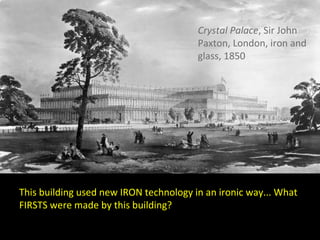
Crystal Palace, Sir John
                                        Paxton, London, iron and
                                        glass, 1850


This building used new IRON technology in an ironic way... What
FIRSTS were made by this building?
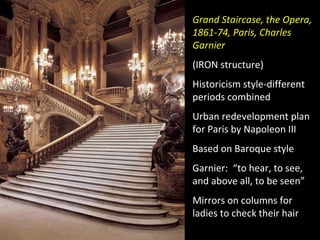
Grand Staircase, the Opera,
1861-74, Paris, Charles
Garnier
(IRON structure)
Historicism style-different
periods combined
Urban redevelopment plan
for Paris by Napoleon III
Based on Baroque style
Garnier: “to hear, to see,
and above all, to be seen”
Mirrors on columns for
ladies to check their hair
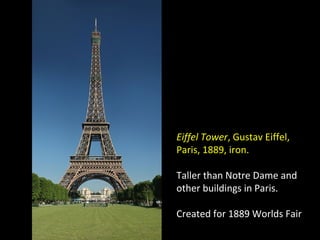
Eiffel Tower, Gustav Eiffel,
Paris, 1889, iron.

Taller than Notre Dame and
other buildings in Paris.

Created for 1889 Worlds Fair
Brooklyn Bridge
John Augustus and Washington
Augustus Roebling, NY, 1867-1883


•Greatest construction
achievement of era.
•Designer +11 workers
killed in its construction.
•Carries millions of people
each day.
•Roebling, German
Immigrant, had major
breakthrough in
suspension bridge
technology (web truss).
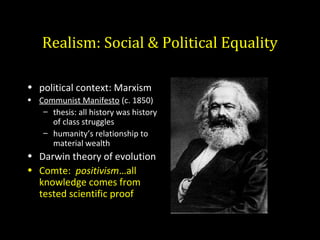
Realism: Social & Political Equality

• political context: Marxism
• Communist Manifesto (c. 1850)
   – thesis: all history was history
     of class struggles
   – humanity’s relationship to
     material wealth
• Darwin theory of evolution
• Comte: positivism…all
  knowledge comes from
  tested scientific proof
Tenement Interior in Poverty Gap, an English Coal Heaver’s Home, Jacob Riis, 1889.
             Published study in NY called How the Other Half Lives
                http://www.youtube.com/watch?v=SZl4KXsaKVE
Realism – Cultural Context
– Role of Artist:
   • no longer to simply reveal beautiful & sublime
   • aimed to tell the truth
   • not beholden to higher, idealized reality (i.e., God)
– Subjects:
   • ordinary events and objects
   • working class & broad panorama of society
   • psychological motivation of characters
Realism in France: Courbet


                           The Stonebreakers, 1850
Miserable job; socialist ideals; Monumentality of everyday -Self educated artist, SALON REJECT …
“Show me an angel, and I’ll paint you one.” - hugely influential to Impressionists and Modern Art
             Painting was destroyed in WWII so that is why image quality is so poor
Courbet’s The Burial at Ornans (c. 1850)


 Huge scale = monumental, but not glorified. Earth tones,
everyday people. S curve composition. Unflattering pics of
    provincial officials, dog and people are distracted.
Realism- Jean Francois Millet

• Millet (1814-75)
   – theme: class distinction
        • Peasantry v. urban
          middle class
   – allegory: religious
   – Wanted to “make the trivial
      seem sublime.”
   – portrayal of nature:
        • atmospheric qualities
        • golden glow of sunlight
Millet’s The Gleaners (c. 1857)
                           •Barbizon School of
                           French painting
                           •Poorest of the
                           poor, picking up
                           scraps of grain
                           •Figures become
                           part of landscape
                           •Haystacks and
                           wagon reflect
                           shapes of gleaners
                           •Seen as socialist
                           painting
Rosa Bonheur’s Plowing on the Ninverais (c. 1850)


Influenced by Positivism.. Large canvas, virtues of simple country living in a
sweeping panorama… noted animal painter who fought for women’s rights
French Realism- Honore Daumier

•   Soldiers killed
    everyone in a
    workers apt.
    complex
•   Illustrates 3
    generations
    murdered in
    surprise attack
•   Lithograph (print)
    used to mass
    produce image
•   French government
    tried to suppress

                         Rue Transomonain, Daumier, lithograph, 1834
Daumier’s Third Class Carriage (c. 1865)

                              Influence of William
                              Hogarth
                              Daumier was jailed for
                              satirizing king political
                              cartoon
                              Dignity of working class,
                              even though crammed
                              together in mass
                              transportation
                              1st piece showing
                              dehumanizing mass
                              transport
American Realism- Eakins the Anatomist

• Thomas Eakins (1844-1916)
   – teacher: Philadelphia Academy of Fine Arts
      • taught anatomy to medical students & figure
        drawing to art students
      • disapproved of academic technique of drawing
        from plaster casts
          – used nude model
          – allowed female students to study male nude
      • Critics called him a “butcher” and “degrading”
Eakins’ Gross Clinic (c. 1875)

              Triangular composition with
              Baroque lighting
              Eakins worked from photograph
              of Dr. Gross (medical professor)
              Celebrates advances in medical
              science
              Eakins was noted anatomist who
              taught anatomy & figure drawing,
              pioneered letting black and female
              students study and draw nudes
Eakins vs. Rembrandt…
Henry O. Tanner’s The Banjo Lesson, 1893


                  •American realist taught by Eakins
                  •1st noted black painter
                  •Painterly brushwork,
                  monumental forms
                  •Dignity of exchange between
                  generations; answers ugly
                  stereotypes of African Americans
                  •Unsentimental yet affectionate
US Realism: Winslow Homer’s The Lifeline


                                      •Homer
                                      began as
                                      freelance
                                      illustrator
                                      Spent a year
                                      on N. Sea
                                      Coast of
                                      England
                                      •Sketches of
                                      an actual
                                      event
Central Park, Frederick Las Olmstead and
      Calvert Vaux, 1858-80, New York City

•    1st public park in US; contest held in late 1850s
•    NYC population had tripled in recent years
•    Designers created Romantic English landscape on swamps and bluffs
•    Provided recreation and nature for city workers and immigrants
John Singer Sargent’s Madame X, 1988
                •American portrait artist much
                sought after in US and Europe
                •This portrait caused a scandal in
                the Paris salon of 1888
                •Sargent moved to England and
                painted quasi impressionist
                •Captured personality of his
                subjects
                •Painterly brushwork, outstanding
                capture of clothing/fashions
English – Pre-Raphaelites: the anti-Realists
• Dante Gabriel Rosetti - poet
  & painter
• Returned to more Venetian
  styles; influenced
  Symbolism
• Medieval stories &
  spirituality

“I have been here before,
   But when or how I cannot tell:
   I know the grass beyond the
   door,
   The sweet keen smell,
   The sighing sound, the lights
   around the shore.”
                                    The Roman Widow, Rosetti, 1848
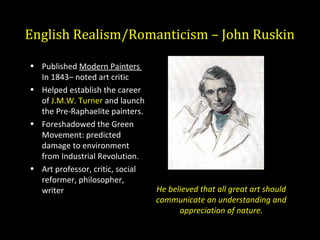
English Realism/Romanticism – John Ruskin

• Published Modern Painters
  In 1843– noted art critic
• Helped establish the career
  of J.M.W. Turner and launch
  the Pre-Raphaelite painters.
• Foreshadowed the Green
  Movement: predicted
  damage to environment
  from Industrial Revolution.
• Art professor, critic, social
  reformer, philosopher,
  writer                          He believed that all great art should
                                  communicate an understanding and
                                        appreciation of nature.
English Realism – Arts and Crafts


• Ruskin - loss of fine craft
  through Industrialization
• Movement leader: Morris,
  ardent socialist, poet, artist
• Dehumanized factory labor;
  loss of pride in work…
  search for nature
• Female artisans in metal
  working, textile arts, etc.
• Morris worked w/PRB artists
  like Rosetti and Burne-Jones

                                   Flora Tapestry, 1885, William Morris
US Arts and Crafts Movement
• In US,: home design, furniture,
  and ceramics – still in use today
• Stickley furniture (Mission
  Style) -buy today !
• Home Depot Authentic Mission Style Lighting Collection
• Simplicity, Honesty, Truth
• Emphasizing wood grain


                                     Mission Media Cabinet, Walnut,
                                     Target, Assembly Required,
                                     $159.99
Realism co-
    existed with
      other art
  movements like
      the Pre-
     Raphaelite
   Brotherhood
  and the tail end
         of
   Romanticism.

NADAR, Eugène Delacroix,
       ca. 1855.

                           30
Edouard Manet - Realism
• Manet - Realist movement
• However, exhibited with Impressionists
• Luncheon on the Grass caused a scandal
  although inspired by Giorgione
• Salon de les Refusés Exhibition
• Olympia scandalized Paris Salon
ÉDOUARD MANET, Le Déjeuner sur l’Herbe (Luncheon on the Grass), 1863.   32
33
ÉDOUARD MANET, Olympia, 1863.   34
Realism in Art and Architecture

Realism in Art and Architecture

  • 1.
    Mid 19th CenturyArt & Architecture: Realism, Photography, and Iron Iron Opens Doors…
  • 2.
    Industrial Revolution -Economy Time Frame of Realism: 1848-late 1860s – beginning: conclusion of Napoleonic Wars – trains – transport raw materials to factories in city – effect: class system • capitalists --> gained centralized economic control • laboring class --> lack of education & poor living • middle class --> adopted “laissez-faire” policy
  • 3.
    Industrial Revolution: Technology •Photography • Trains • Iron – steel in building!
  • 4.
    Crystal Palace, SirJohn Paxton, London, iron and glass, 1850 This building used new IRON technology in an ironic way... What FIRSTS were made by this building?
  • 5.
    Grand Staircase, theOpera, 1861-74, Paris, Charles Garnier (IRON structure) Historicism style-different periods combined Urban redevelopment plan for Paris by Napoleon III Based on Baroque style Garnier: “to hear, to see, and above all, to be seen” Mirrors on columns for ladies to check their hair
  • 6.
    Eiffel Tower, GustavEiffel, Paris, 1889, iron. Taller than Notre Dame and other buildings in Paris. Created for 1889 Worlds Fair
  • 7.
    Brooklyn Bridge John Augustusand Washington Augustus Roebling, NY, 1867-1883 •Greatest construction achievement of era. •Designer +11 workers killed in its construction. •Carries millions of people each day. •Roebling, German Immigrant, had major breakthrough in suspension bridge technology (web truss).
  • 8.
    Realism: Social &Political Equality • political context: Marxism • Communist Manifesto (c. 1850) – thesis: all history was history of class struggles – humanity’s relationship to material wealth • Darwin theory of evolution • Comte: positivism…all knowledge comes from tested scientific proof
  • 9.
    Tenement Interior inPoverty Gap, an English Coal Heaver’s Home, Jacob Riis, 1889. Published study in NY called How the Other Half Lives http://www.youtube.com/watch?v=SZl4KXsaKVE
  • 10.
    Realism – CulturalContext – Role of Artist: • no longer to simply reveal beautiful & sublime • aimed to tell the truth • not beholden to higher, idealized reality (i.e., God) – Subjects: • ordinary events and objects • working class & broad panorama of society • psychological motivation of characters
  • 11.
    Realism in France:Courbet The Stonebreakers, 1850 Miserable job; socialist ideals; Monumentality of everyday -Self educated artist, SALON REJECT … “Show me an angel, and I’ll paint you one.” - hugely influential to Impressionists and Modern Art Painting was destroyed in WWII so that is why image quality is so poor
  • 12.
    Courbet’s The Burialat Ornans (c. 1850) Huge scale = monumental, but not glorified. Earth tones, everyday people. S curve composition. Unflattering pics of provincial officials, dog and people are distracted.
  • 13.
    Realism- Jean FrancoisMillet • Millet (1814-75) – theme: class distinction • Peasantry v. urban middle class – allegory: religious – Wanted to “make the trivial seem sublime.” – portrayal of nature: • atmospheric qualities • golden glow of sunlight
  • 14.
    Millet’s The Gleaners(c. 1857) •Barbizon School of French painting •Poorest of the poor, picking up scraps of grain •Figures become part of landscape •Haystacks and wagon reflect shapes of gleaners •Seen as socialist painting
  • 15.
    Rosa Bonheur’s Plowingon the Ninverais (c. 1850) Influenced by Positivism.. Large canvas, virtues of simple country living in a sweeping panorama… noted animal painter who fought for women’s rights
  • 16.
    French Realism- HonoreDaumier • Soldiers killed everyone in a workers apt. complex • Illustrates 3 generations murdered in surprise attack • Lithograph (print) used to mass produce image • French government tried to suppress Rue Transomonain, Daumier, lithograph, 1834
  • 17.
    Daumier’s Third ClassCarriage (c. 1865) Influence of William Hogarth Daumier was jailed for satirizing king political cartoon Dignity of working class, even though crammed together in mass transportation 1st piece showing dehumanizing mass transport
  • 18.
    American Realism- Eakinsthe Anatomist • Thomas Eakins (1844-1916) – teacher: Philadelphia Academy of Fine Arts • taught anatomy to medical students & figure drawing to art students • disapproved of academic technique of drawing from plaster casts – used nude model – allowed female students to study male nude • Critics called him a “butcher” and “degrading”
  • 19.
    Eakins’ Gross Clinic(c. 1875) Triangular composition with Baroque lighting Eakins worked from photograph of Dr. Gross (medical professor) Celebrates advances in medical science Eakins was noted anatomist who taught anatomy & figure drawing, pioneered letting black and female students study and draw nudes
  • 20.
  • 21.
    Henry O. Tanner’sThe Banjo Lesson, 1893 •American realist taught by Eakins •1st noted black painter •Painterly brushwork, monumental forms •Dignity of exchange between generations; answers ugly stereotypes of African Americans •Unsentimental yet affectionate
  • 22.
    US Realism: WinslowHomer’s The Lifeline •Homer began as freelance illustrator Spent a year on N. Sea Coast of England •Sketches of an actual event
  • 23.
    Central Park, FrederickLas Olmstead and Calvert Vaux, 1858-80, New York City • 1st public park in US; contest held in late 1850s • NYC population had tripled in recent years • Designers created Romantic English landscape on swamps and bluffs • Provided recreation and nature for city workers and immigrants
  • 24.
    John Singer Sargent’sMadame X, 1988 •American portrait artist much sought after in US and Europe •This portrait caused a scandal in the Paris salon of 1888 •Sargent moved to England and painted quasi impressionist •Captured personality of his subjects •Painterly brushwork, outstanding capture of clothing/fashions
  • 25.
    English – Pre-Raphaelites:the anti-Realists • Dante Gabriel Rosetti - poet & painter • Returned to more Venetian styles; influenced Symbolism • Medieval stories & spirituality “I have been here before, But when or how I cannot tell: I know the grass beyond the door, The sweet keen smell, The sighing sound, the lights around the shore.” The Roman Widow, Rosetti, 1848
  • 27.
    English Realism/Romanticism –John Ruskin • Published Modern Painters In 1843– noted art critic • Helped establish the career of J.M.W. Turner and launch the Pre-Raphaelite painters. • Foreshadowed the Green Movement: predicted damage to environment from Industrial Revolution. • Art professor, critic, social reformer, philosopher, writer He believed that all great art should communicate an understanding and appreciation of nature.
  • 28.
    English Realism –Arts and Crafts • Ruskin - loss of fine craft through Industrialization • Movement leader: Morris, ardent socialist, poet, artist • Dehumanized factory labor; loss of pride in work… search for nature • Female artisans in metal working, textile arts, etc. • Morris worked w/PRB artists like Rosetti and Burne-Jones Flora Tapestry, 1885, William Morris
  • 29.
    US Arts andCrafts Movement • In US,: home design, furniture, and ceramics – still in use today • Stickley furniture (Mission Style) -buy today ! • Home Depot Authentic Mission Style Lighting Collection • Simplicity, Honesty, Truth • Emphasizing wood grain Mission Media Cabinet, Walnut, Target, Assembly Required, $159.99
  • 30.
    Realism co- existed with other art movements like the Pre- Raphaelite Brotherhood and the tail end of Romanticism. NADAR, Eugène Delacroix, ca. 1855. 30
  • 31.
    Edouard Manet -Realism • Manet - Realist movement • However, exhibited with Impressionists • Luncheon on the Grass caused a scandal although inspired by Giorgione • Salon de les Refusés Exhibition • Olympia scandalized Paris Salon
  • 32.
    ÉDOUARD MANET, LeDéjeuner sur l’Herbe (Luncheon on the Grass), 1863. 32
  • 33.
  • 34.

Editor's Notes

  • #5 Artist: Joseph Paxton Title: Crystal Palace Medium: Iron, glass, and wood Size: n/a Date: 1850–51 Source/ Museum: London
  • #6 Artist: n/a Title: Grand Staircase, the Opéra Medium: n/a Size: n/a Date: n/a Source/ Museum: n/a
  • #10 Artist: Jacob Riis Title: Tenement Interior in Poverty Gap: An English Coal-Heaver ’ s Home Medium: n/a Size: n/a Date: c. 1889 Source/ Museum: Museum of the City of New York. The Jacob A. Riis Collection