Final Year Project
Title: Gesture Recognition Applications
Under guidance: Presented By:
Shruthi H R G. Sai Samhitha
Asst. Professor, Dept. of CSE Imon Barua
Rishav Kumar
Sana Aram
Problem Statement
▪ To develop a user-friendly gesture recognition application
by eliminating dependency on colour markers.
▪ The objective of this project is to:
recognize the gestures successfully
perform certain application tasks using hand gestures.
Introduction
▪ The application will allow people to interact with the
machine without physical contact using gesture
recognition
▪ It can be run on computers that have a camera to detect
gestures from the physical world to interact with the digital
world.
▪ Based on gesture, predefined actions are performed.
Machine Learning
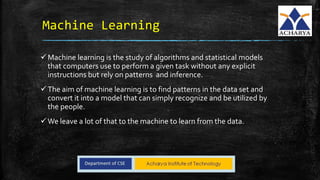
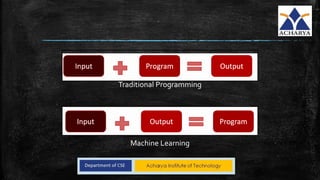
Machine learning is the study of algorithms and statistical models
that computers use to perform a given task without any explicit
instructions but rely on patterns and inference.
The aim of machine learning is to find patterns in the data set and
convert it into a model that can simply recognize and be utilized by
the people.
We leave a lot of that to the machine to learn from the data.
Traditional Programming
Machine Learning
Computer Vision
▪ It deals with how computers can be made to gain a high-level
understanding from images and videos. It aims to automate tasks
that the human visual system performs.
▪ The tasks include methods for
– Acquiring
– Processing
– Analyzing
– Understanding digital images
– Extracting high-dimensional data to produce numerical information
Gesture Recognition
 Gesture recognition is a domain of computer vision which is the
study of recognizing and interpreting human gestures by using
mathematical algorithms.
These gestures can be identified by different body motion that can
come from face or hand.
Types of Gestures –
▪ Online gestures:These are the direct manipulation gestures, used to
scale or rotate an object.
▪ Offline gestures:These gestures act as an input that is later used to
process after user interaction with the object.
System Design
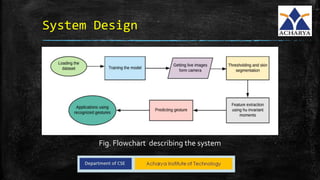
Fig. Flowchart describing the system
▪
Implementation
▪ LOADINGTHE DATA SET
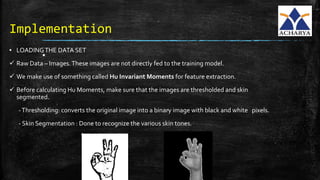
 Raw Data – Images.These images are not directly fed to the training model.
 We make use of something called Hu Invariant Moments for feature extraction.
 Before calculating Hu Moments, make sure that the images are thresholded and skin
segmented.
-Thresholding: converts the original image into a binary image with black and white pixels.
- Skin Segmentation : Done to recognize the various skin tones.
Training The Model
▪ Training is a process in Machine Learning where a model is fed
(fitted) with data to learn from it.
▪ The learning algorithm tries to find a pattern in the dataset and maps
the provided input to the target value and then creates a model of
machine learning with these patterns learnt.
▪ The algorithms used to train the model –
- K means
- HMM
- BaumWelch
K-Means
• K-means is a type of unsupervised learning
• It is used to do the classification of objects into different groups
• Each data point is assigned to its nearest centroid
• Updation of centroid is done by finding out the mean value of all the
data points assigned to that centroid’s cluster
• Optimum number of clusters k is found by the elbow point
• 30 clusters have been used to preprocess the data in this project
HMM
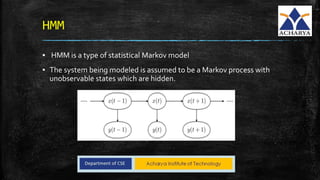
▪ HMM is a type of statistical Markov model
▪ The system being modeled is assumed to be a Markov process with
unobservable states which are hidden.
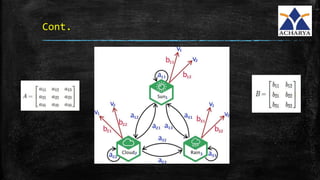
Cont.
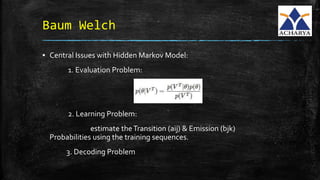
Baum Welch
▪ Central Issues with Hidden Markov Model:
1. Evaluation Problem:
2. Learning Problem:
estimate theTransition (aij) & Emission (bjk)
Probabilities using the training sequences.
3. Decoding Problem
Cont.
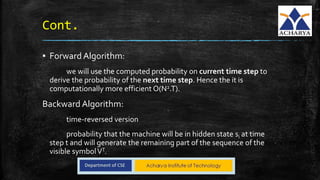
▪ Forward Algorithm:
we will use the computed probability on current time step to
derive the probability of the next time step. Hence the it is
computationally more efficient O(N2.T).
Backward Algorithm:
time-reversed version
probability that the machine will be in hidden state si at time
step t and will generate the remaining part of the sequence of the
visible symbolVT.
Cont.
▪ BaumWelch algorithm uses a special case of the Expectation
Maximization(EM) Algorithm.
▪ Steps:
1. Start with initial probability estimates [A,B]. Initially set equal
probabilities or define them randomly.
2. Compute expectation of how often each transition/emission has been
used.We will estimate latent variables [ ξ,γ ] (This is common approach
for EM Algorithm)
3. Re-estimate the probabilities [A,B] based on those estimates (latent
variable).
4. Repeat until convergence
Further Steps
▪ Getting the live images from the camera.
▪ Thresholding and skin segmentation.
▪ Feature extraction using the same process of calculating
Hu Moments.
▪ Prediticting the gesture.
▪ Performing the task using the gesture.
Implementation
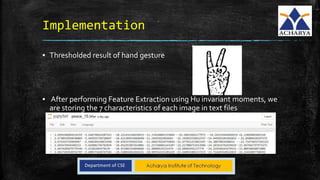
▪ Thresholded result of hand gesture
▪ After performing Feature Extraction using Hu invariant moments, we
are storing the 7 characteristics of each image in text files
Cont.
▪ Using the dataset, we are classifying the gesture values using
k-means classifier. All the similar Hu invariant moments are
clustered together.
▪ Now using HMM algorithm we predict a sequence of unknown
variables from a set of observed variables
▪ Once the model is trained we give live input (gestures) from the
webcam
▪ Each gesture is mapped to one or more applications. When the
gesture is recognized, the task is performed.
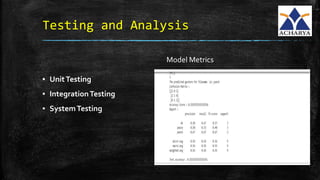
Testing and Analysis
▪ UnitTesting
▪ IntegrationTesting
▪ SystemTesting
Model Metrics
Results
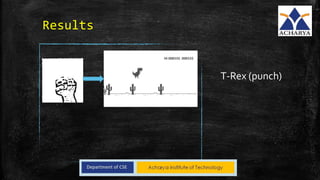
T-Rex (punch)
Results
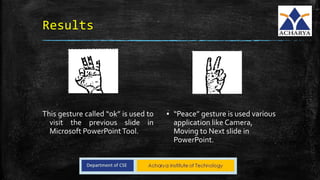
This gesture called “ok” is used to
visit the previous slide in
Microsoft PowerPointTool.
▪ “Peace” gesture is used various
application like Camera,
Moving to Next slide in
PowerPoint.
Cont.
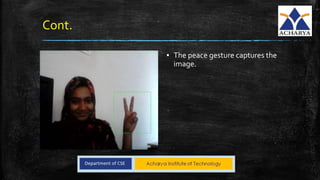
▪ The peace gesture captures the
image.
Future Enhancement
 Including more number of gestures.
Different loops can be defined within
an application to perform different
tasks within that application.
 Gestures to speech or text system to
help physically challenged people.The
sign language can be directly
converted to text.
 Can be connected to a mobile device
that can perform actions to make it
more usable.
 Improve the system, so that it can be
used with any kind of background.
Problems Faced
 Non-availability of Hu
Invariant Dataset.
 Replication of values due
to execution updation
latency.
 Cache of the previous
data was stored and was
not able to clear
instantly due to the
limited speed of the
system.
Conclusion
▪ Eliminate the dependency on colour markers.
▪ Able to recognize hand gestures successfully by using
the mentioned algorithm (HMM) with accuracy of about
60%.
▪ Hand gestures can now be easily used to perform
various tasks without the use of any coloured markers.
▪ Becomes easy to integrate the physical world with the
digital world.
Hand Gesture Recognition Applications

Hand Gesture Recognition Applications

  • 1.
    Final Year Project Title:Gesture Recognition Applications Under guidance: Presented By: Shruthi H R G. Sai Samhitha Asst. Professor, Dept. of CSE Imon Barua Rishav Kumar Sana Aram
  • 2.
    Problem Statement ▪ Todevelop a user-friendly gesture recognition application by eliminating dependency on colour markers. ▪ The objective of this project is to: recognize the gestures successfully perform certain application tasks using hand gestures.
  • 3.
    Introduction ▪ The applicationwill allow people to interact with the machine without physical contact using gesture recognition ▪ It can be run on computers that have a camera to detect gestures from the physical world to interact with the digital world. ▪ Based on gesture, predefined actions are performed.
  • 4.
    Machine Learning Machine learningis the study of algorithms and statistical models that computers use to perform a given task without any explicit instructions but rely on patterns and inference. The aim of machine learning is to find patterns in the data set and convert it into a model that can simply recognize and be utilized by the people. We leave a lot of that to the machine to learn from the data.
  • 5.
  • 6.
    Computer Vision ▪ Itdeals with how computers can be made to gain a high-level understanding from images and videos. It aims to automate tasks that the human visual system performs. ▪ The tasks include methods for – Acquiring – Processing – Analyzing – Understanding digital images – Extracting high-dimensional data to produce numerical information
  • 7.
    Gesture Recognition  Gesturerecognition is a domain of computer vision which is the study of recognizing and interpreting human gestures by using mathematical algorithms. These gestures can be identified by different body motion that can come from face or hand. Types of Gestures – ▪ Online gestures:These are the direct manipulation gestures, used to scale or rotate an object. ▪ Offline gestures:These gestures act as an input that is later used to process after user interaction with the object.
  • 8.
    System Design Fig. Flowchartdescribing the system
  • 9.
    ▪ Implementation ▪ LOADINGTHE DATASET  Raw Data – Images.These images are not directly fed to the training model.  We make use of something called Hu Invariant Moments for feature extraction.  Before calculating Hu Moments, make sure that the images are thresholded and skin segmented. -Thresholding: converts the original image into a binary image with black and white pixels. - Skin Segmentation : Done to recognize the various skin tones.
  • 10.
    Training The Model ▪Training is a process in Machine Learning where a model is fed (fitted) with data to learn from it. ▪ The learning algorithm tries to find a pattern in the dataset and maps the provided input to the target value and then creates a model of machine learning with these patterns learnt. ▪ The algorithms used to train the model – - K means - HMM - BaumWelch
  • 11.
    K-Means • K-means isa type of unsupervised learning • It is used to do the classification of objects into different groups • Each data point is assigned to its nearest centroid • Updation of centroid is done by finding out the mean value of all the data points assigned to that centroid’s cluster • Optimum number of clusters k is found by the elbow point • 30 clusters have been used to preprocess the data in this project
  • 12.
    HMM ▪ HMM isa type of statistical Markov model ▪ The system being modeled is assumed to be a Markov process with unobservable states which are hidden.
  • 13.
  • 14.
    Baum Welch ▪ CentralIssues with Hidden Markov Model: 1. Evaluation Problem: 2. Learning Problem: estimate theTransition (aij) & Emission (bjk) Probabilities using the training sequences. 3. Decoding Problem
  • 15.
    Cont. ▪ Forward Algorithm: wewill use the computed probability on current time step to derive the probability of the next time step. Hence the it is computationally more efficient O(N2.T). Backward Algorithm: time-reversed version probability that the machine will be in hidden state si at time step t and will generate the remaining part of the sequence of the visible symbolVT.
  • 16.
    Cont. ▪ BaumWelch algorithmuses a special case of the Expectation Maximization(EM) Algorithm. ▪ Steps: 1. Start with initial probability estimates [A,B]. Initially set equal probabilities or define them randomly. 2. Compute expectation of how often each transition/emission has been used.We will estimate latent variables [ ξ,γ ] (This is common approach for EM Algorithm) 3. Re-estimate the probabilities [A,B] based on those estimates (latent variable). 4. Repeat until convergence
  • 17.
    Further Steps ▪ Gettingthe live images from the camera. ▪ Thresholding and skin segmentation. ▪ Feature extraction using the same process of calculating Hu Moments. ▪ Prediticting the gesture. ▪ Performing the task using the gesture.
  • 18.
    Implementation ▪ Thresholded resultof hand gesture ▪ After performing Feature Extraction using Hu invariant moments, we are storing the 7 characteristics of each image in text files
  • 19.
    Cont. ▪ Using thedataset, we are classifying the gesture values using k-means classifier. All the similar Hu invariant moments are clustered together. ▪ Now using HMM algorithm we predict a sequence of unknown variables from a set of observed variables ▪ Once the model is trained we give live input (gestures) from the webcam ▪ Each gesture is mapped to one or more applications. When the gesture is recognized, the task is performed.
  • 20.
    Testing and Analysis ▪UnitTesting ▪ IntegrationTesting ▪ SystemTesting Model Metrics
  • 21.
  • 22.
    Results This gesture called“ok” is used to visit the previous slide in Microsoft PowerPointTool. ▪ “Peace” gesture is used various application like Camera, Moving to Next slide in PowerPoint.
  • 23.
    Cont. ▪ The peacegesture captures the image.
  • 24.
    Future Enhancement  Includingmore number of gestures. Different loops can be defined within an application to perform different tasks within that application.  Gestures to speech or text system to help physically challenged people.The sign language can be directly converted to text.  Can be connected to a mobile device that can perform actions to make it more usable.  Improve the system, so that it can be used with any kind of background. Problems Faced  Non-availability of Hu Invariant Dataset.  Replication of values due to execution updation latency.  Cache of the previous data was stored and was not able to clear instantly due to the limited speed of the system.
  • 25.
    Conclusion ▪ Eliminate thedependency on colour markers. ▪ Able to recognize hand gestures successfully by using the mentioned algorithm (HMM) with accuracy of about 60%. ▪ Hand gestures can now be easily used to perform various tasks without the use of any coloured markers. ▪ Becomes easy to integrate the physical world with the digital world.