
1ABHISHEK MISHRA
CONTENT
I. PRIOR KNOWLEDGE
II. EUCLID’S DIVISION ALGORITHM
III. FINDING HCF BY EUCLID’S DIVISION ALGORITHM
IV. THE FUNDAMENTAL THEOREM OF ARITHMETIC
V. RELATION OF LCM AND HCF WITH TWO NUMBERS
VI. REVISION OF THE CONCEPT OF IRRTAIONAL NUMBERS
VII. PROVE OF SOME OF IRRATIONAL NUMBER
VIII. RATIONAL NUMBER AND THEIR DECIMAL EXPANSIONS
IX. LIST OF ALL THE THEOREMS OF THE CHAPTER
X. VARIOUS TYPES OF QUESTIONS
2ABHISHEK MISHRA
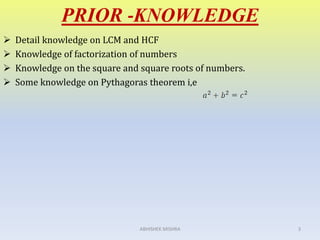
PRIOR -KNOWLEDGE
 Detail knowledge on LCM and HCF
 Knowledge of factorization of numbers
 Knowledge on the square and square roots of numbers.
 Some knowledge on Pythagoras theorem i,e
3ABHISHEK MISHRA
EUCLID’S DIVISION ALGORITHM
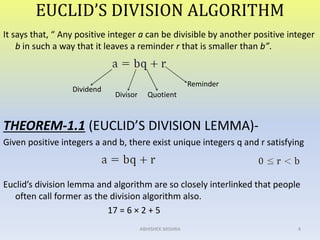
It says that, “ Any positive integer a can be divisible by another positive integer
b in such a way that it leaves a reminder r that is smaller than b”.
THEOREM-1.1 (EUCLID’S DIVISION LEMMA)-
Given positive integers a and b, there exist unique integers q and r satisfying
Euclid’s division lemma and algorithm are so closely interlinked that people
often call former as the division algorithm also.
17 = 6 × 2 + 5
Dividend
Divisor Quotient
Reminder
4ABHISHEK MISHRA
FINDING HCF BY EUCLID’S DIVISION
ALGORITHM
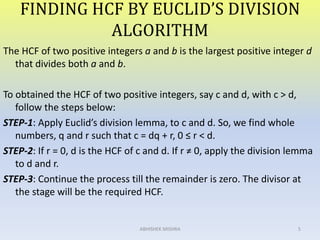
The HCF of two positive integers a and b is the largest positive integer d
that divides both a and b.
To obtained the HCF of two positive integers, say c and d, with c > d,
follow the steps below:
STEP-1: Apply Euclid’s division lemma, to c and d. So, we find whole
numbers, q and r such that c = dq + r, 0 ≤ r < d.
STEP-2: If r = 0, d is the HCF of c and d. If r ≠ 0, apply the division lemma
to d and r.
STEP-3: Continue the process till the remainder is zero. The divisor at
the stage will be the required HCF.
5ABHISHEK MISHRA
THE FUNDAMENTAL THEOREM OF
ARITHMETIC
THEOREM 1.2 (Fundamental theorem of arithmetic)
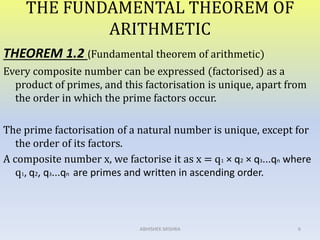
Every composite number can be expressed (factorised) as a
product of primes, and this factorisation is unique, apart from
the order in which the prime factors occur.
The prime factorisation of a natural number is unique, except for
the order of its factors.
A composite number x, we factorise it as x = q1 × q2 × q3...qn where
q1, q2, q3...qn are primes and written in ascending order.
6ABHISHEK MISHRA
RELATION OF LCM AND HCF WITH TWO
NUMBERS
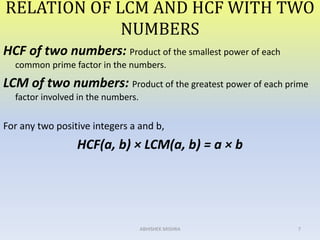
HCF of two numbers: Product of the smallest power of each
common prime factor in the numbers.
LCM of two numbers: Product of the greatest power of each prime
factor involved in the numbers.
For any two positive integers a and b,
HCF(a, b) × LCM(a, b) = a × b
7ABHISHEK MISHRA
REVISION OF THE CONCEPT OF
IRRTAIONAL NUMBERS
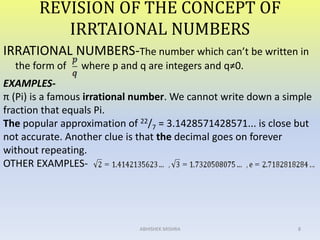
IRRATIONAL NUMBERS-The number which can’t be written in
the form of where p and q are integers and q≠0.
EXAMPLES-
π (Pi) is a famous irrational number. We cannot write down a simple
fraction that equals Pi.
The popular approximation of 22/7 = 3.1428571428571... is close but
not accurate. Another clue is that the decimal goes on forever
without repeating.
OTHER EXAMPLES-
8ABHISHEK MISHRA
PROVE OF SOME OF IRRATIONAL
NUMBER
THEOREM-1.3: Let p be a prime number. If p divides , then p
divides a, where a is a positive integer.
PROOF:
Let the prime factorisation of a be as follows:
a=p1p2p3…pn , where p1, p2, p3…pn are primes, not necessarily distinct.
Therefore, = (p1p2p3…pn)(p1p2p3…pn)
Now, we are given that p divides . Therefore, from the Fundamental
Theorem of Arithmetic, it follows that p is one of the prime factor of
.
Clearly p is one of p1p2p3…pn.
Since a=p1p2p3…pn , p divides a.
9ABHISHEK MISHRA
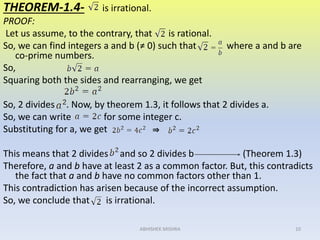
THEOREM-1.4- is irrational.
PROOF:
Let us assume, to the contrary, that is rational.
So, we can find integers a and b (≠ 0) such that where a and b are
co-prime numbers.
So,
Squaring both the sides and rearranging, we get
So, 2 divides . Now, by theorem 1.3, it follows that 2 divides a.
So, we can write for some integer c.
Substituting for a, we get
This means that 2 divides and so 2 divides b (Theorem 1.3)
Therefore, a and b have at least 2 as a common factor. But, this contradicts
the fact that a and b have no common factors other than 1.
This contradiction has arisen because of the incorrect assumption.
So, we conclude that is irrational.
⇒
10ABHISHEK MISHRA
RATIONAL NUMBER AND THEIR
DECIMAL EXPANSIONS
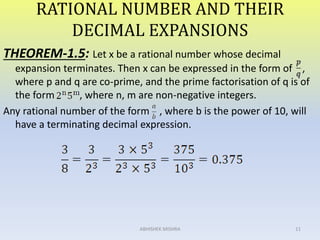
THEOREM-1.5: Let x be a rational number whose decimal
expansion terminates. Then x can be expressed in the form of ,
where p and q are co-prime, and the prime factorisation of q is of
the form , where n, m are non-negative integers.
Any rational number of the form , where b is the power of 10, will
have a terminating decimal expression.
11ABHISHEK MISHRA
THEOREM-1.6: Let x = be a rational number, such that
the prime factorization of q is of the form , where n, m
are non-negative integers. Then x has decimal expansion
which terminates.
THEOREM-1.7: Let x = be a rational number, such that
the prime factorization of q is not of the form , where
n, m are non-negative integers. Then x has decimal
expansion which is terminating or non terminating
repeating.
12ABHISHEK MISHRA
LIST OF ALL THE THEOREMS OF THE
CHAPTER
THEOREM-1.1 (EUCLID’S DIVISION LEMMA)-
Given positive integers a and b, there exist unique integers q and r
satisfying
THEOREM 1.2 (Fundamental theorem of arithmetic)
Every composite number can be expressed (factorised) as a product
of primes, and this factorisation is unique, apart from the order in
which the prime factors occur.
THEOREM-1.3: Let p be a prime number. If p divides , then p
divides a, where a is a positive integer.
THEOREM-1.4 - is irrational.
13ABHISHEK MISHRA
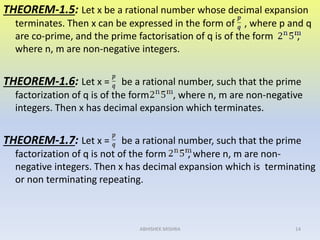
THEOREM-1.5: Let x be a rational number whose decimal expansion
terminates. Then x can be expressed in the form of , where p and q
are co-prime, and the prime factorisation of q is of the form ,
where n, m are non-negative integers.
THEOREM-1.6: Let x = be a rational number, such that the prime
factorization of q is of the form , where n, m are non-negative
integers. Then x has decimal expansion which terminates.
THEOREM-1.7: Let x = be a rational number, such that the prime
factorization of q is not of the form , where n, m are non-
negative integers. Then x has decimal expansion which is terminating
or non terminating repeating.
14ABHISHEK MISHRA
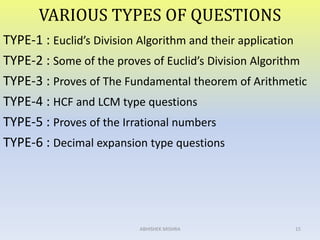
VARIOUS TYPES OF QUESTIONS
TYPE-1 : Euclid’s Division Algorithm and their application
TYPE-2 : Some of the proves of Euclid’s Division Algorithm
TYPE-3 : Proves of The Fundamental theorem of Arithmetic
TYPE-4 : HCF and LCM type questions
TYPE-5 : Proves of the Irrational numbers
TYPE-6 : Decimal expansion type questions
15ABHISHEK MISHRA
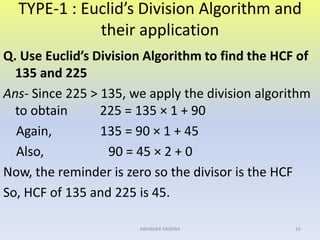
TYPE-1 : Euclid’s Division Algorithm and
their application
Q. Use Euclid’s Division Algorithm to find the HCF of
135 and 225
Ans- Since 225 > 135, we apply the division algorithm
to obtain 225 = 135 × 1 + 90
Again, 135 = 90 × 1 + 45
Also, 90 = 45 × 2 + 0
Now, the reminder is zero so the divisor is the HCF
So, HCF of 135 and 225 is 45.
16ABHISHEK MISHRA
TYPE-2 : Some of the proves of Euclid’s
Division Algorithm
Q. Show that every positive even integer is of the form 2q,
and that every positive odd integer is of the form 2q + 1,
where q is some integers.
ANS- Let a be a positive integer and b = 2.
By Euclid’s division algorithm, a = 2q + r
Where q ≥ 0, and r = 0, or r = 1, as 0 ≤ r < 2
So, a = 2q or a = 2q + 1
Clearly if a integer is of the form 2q then it is even integer.
And the rest of all will be odd integer in the form 2q + 1
17ABHISHEK MISHRA
TYPE-3 : Proves of The Fundamental
theorem of Arithmetic
Q. Consider the numbers , where n is a natural
number. Check whether there is any value of n for
which ends with the digit zero.
ANS- If the number , for any n, were to end with
zero, then it would be divisible by 5.
That is the prime factorization of would contain 5.
This is not possible because = , so the only prime
number is 2 present in .
So there is no natural number n for which ends
with the digit zero.
18ABHISHEK MISHRA
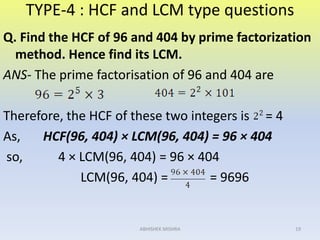
TYPE-4 : HCF and LCM type questions
Q. Find the HCF of 96 and 404 by prime factorization
method. Hence find its LCM.
ANS- The prime factorisation of 96 and 404 are
Therefore, the HCF of these two integers is = 4
As, HCF(96, 404) × LCM(96, 404) = 96 × 404
so, 4 × LCM(96, 404) = 96 × 404
LCM(96, 404) = = 9696
19ABHISHEK MISHRA
THANK YOU
ABHISHEK MISHRA
FACEBOOK PAGE- LEARNING WITH ABHISHEK
YOUTUBE - ABHISHEK MISHRA
ABHISHEK MISHRA 20

Real number Class 10th

  • 1.
  • 2.
    CONTENT I. PRIOR KNOWLEDGE II.EUCLID’S DIVISION ALGORITHM III. FINDING HCF BY EUCLID’S DIVISION ALGORITHM IV. THE FUNDAMENTAL THEOREM OF ARITHMETIC V. RELATION OF LCM AND HCF WITH TWO NUMBERS VI. REVISION OF THE CONCEPT OF IRRTAIONAL NUMBERS VII. PROVE OF SOME OF IRRATIONAL NUMBER VIII. RATIONAL NUMBER AND THEIR DECIMAL EXPANSIONS IX. LIST OF ALL THE THEOREMS OF THE CHAPTER X. VARIOUS TYPES OF QUESTIONS 2ABHISHEK MISHRA
  • 3.
    PRIOR -KNOWLEDGE  Detailknowledge on LCM and HCF  Knowledge of factorization of numbers  Knowledge on the square and square roots of numbers.  Some knowledge on Pythagoras theorem i,e 3ABHISHEK MISHRA
  • 4.
    EUCLID’S DIVISION ALGORITHM Itsays that, “ Any positive integer a can be divisible by another positive integer b in such a way that it leaves a reminder r that is smaller than b”. THEOREM-1.1 (EUCLID’S DIVISION LEMMA)- Given positive integers a and b, there exist unique integers q and r satisfying Euclid’s division lemma and algorithm are so closely interlinked that people often call former as the division algorithm also. 17 = 6 × 2 + 5 Dividend Divisor Quotient Reminder 4ABHISHEK MISHRA
  • 5.
    FINDING HCF BYEUCLID’S DIVISION ALGORITHM The HCF of two positive integers a and b is the largest positive integer d that divides both a and b. To obtained the HCF of two positive integers, say c and d, with c > d, follow the steps below: STEP-1: Apply Euclid’s division lemma, to c and d. So, we find whole numbers, q and r such that c = dq + r, 0 ≤ r < d. STEP-2: If r = 0, d is the HCF of c and d. If r ≠ 0, apply the division lemma to d and r. STEP-3: Continue the process till the remainder is zero. The divisor at the stage will be the required HCF. 5ABHISHEK MISHRA
  • 6.
    THE FUNDAMENTAL THEOREMOF ARITHMETIC THEOREM 1.2 (Fundamental theorem of arithmetic) Every composite number can be expressed (factorised) as a product of primes, and this factorisation is unique, apart from the order in which the prime factors occur. The prime factorisation of a natural number is unique, except for the order of its factors. A composite number x, we factorise it as x = q1 × q2 × q3...qn where q1, q2, q3...qn are primes and written in ascending order. 6ABHISHEK MISHRA
  • 7.
    RELATION OF LCMAND HCF WITH TWO NUMBERS HCF of two numbers: Product of the smallest power of each common prime factor in the numbers. LCM of two numbers: Product of the greatest power of each prime factor involved in the numbers. For any two positive integers a and b, HCF(a, b) × LCM(a, b) = a × b 7ABHISHEK MISHRA
  • 8.
    REVISION OF THECONCEPT OF IRRTAIONAL NUMBERS IRRATIONAL NUMBERS-The number which can’t be written in the form of where p and q are integers and q≠0. EXAMPLES- π (Pi) is a famous irrational number. We cannot write down a simple fraction that equals Pi. The popular approximation of 22/7 = 3.1428571428571... is close but not accurate. Another clue is that the decimal goes on forever without repeating. OTHER EXAMPLES- 8ABHISHEK MISHRA
  • 9.
    PROVE OF SOMEOF IRRATIONAL NUMBER THEOREM-1.3: Let p be a prime number. If p divides , then p divides a, where a is a positive integer. PROOF: Let the prime factorisation of a be as follows: a=p1p2p3…pn , where p1, p2, p3…pn are primes, not necessarily distinct. Therefore, = (p1p2p3…pn)(p1p2p3…pn) Now, we are given that p divides . Therefore, from the Fundamental Theorem of Arithmetic, it follows that p is one of the prime factor of . Clearly p is one of p1p2p3…pn. Since a=p1p2p3…pn , p divides a. 9ABHISHEK MISHRA
  • 10.
    THEOREM-1.4- is irrational. PROOF: Letus assume, to the contrary, that is rational. So, we can find integers a and b (≠ 0) such that where a and b are co-prime numbers. So, Squaring both the sides and rearranging, we get So, 2 divides . Now, by theorem 1.3, it follows that 2 divides a. So, we can write for some integer c. Substituting for a, we get This means that 2 divides and so 2 divides b (Theorem 1.3) Therefore, a and b have at least 2 as a common factor. But, this contradicts the fact that a and b have no common factors other than 1. This contradiction has arisen because of the incorrect assumption. So, we conclude that is irrational. ⇒ 10ABHISHEK MISHRA
  • 11.
    RATIONAL NUMBER ANDTHEIR DECIMAL EXPANSIONS THEOREM-1.5: Let x be a rational number whose decimal expansion terminates. Then x can be expressed in the form of , where p and q are co-prime, and the prime factorisation of q is of the form , where n, m are non-negative integers. Any rational number of the form , where b is the power of 10, will have a terminating decimal expression. 11ABHISHEK MISHRA
  • 12.
    THEOREM-1.6: Let x= be a rational number, such that the prime factorization of q is of the form , where n, m are non-negative integers. Then x has decimal expansion which terminates. THEOREM-1.7: Let x = be a rational number, such that the prime factorization of q is not of the form , where n, m are non-negative integers. Then x has decimal expansion which is terminating or non terminating repeating. 12ABHISHEK MISHRA
  • 13.
    LIST OF ALLTHE THEOREMS OF THE CHAPTER THEOREM-1.1 (EUCLID’S DIVISION LEMMA)- Given positive integers a and b, there exist unique integers q and r satisfying THEOREM 1.2 (Fundamental theorem of arithmetic) Every composite number can be expressed (factorised) as a product of primes, and this factorisation is unique, apart from the order in which the prime factors occur. THEOREM-1.3: Let p be a prime number. If p divides , then p divides a, where a is a positive integer. THEOREM-1.4 - is irrational. 13ABHISHEK MISHRA
  • 14.
    THEOREM-1.5: Let xbe a rational number whose decimal expansion terminates. Then x can be expressed in the form of , where p and q are co-prime, and the prime factorisation of q is of the form , where n, m are non-negative integers. THEOREM-1.6: Let x = be a rational number, such that the prime factorization of q is of the form , where n, m are non-negative integers. Then x has decimal expansion which terminates. THEOREM-1.7: Let x = be a rational number, such that the prime factorization of q is not of the form , where n, m are non- negative integers. Then x has decimal expansion which is terminating or non terminating repeating. 14ABHISHEK MISHRA
  • 15.
    VARIOUS TYPES OFQUESTIONS TYPE-1 : Euclid’s Division Algorithm and their application TYPE-2 : Some of the proves of Euclid’s Division Algorithm TYPE-3 : Proves of The Fundamental theorem of Arithmetic TYPE-4 : HCF and LCM type questions TYPE-5 : Proves of the Irrational numbers TYPE-6 : Decimal expansion type questions 15ABHISHEK MISHRA
  • 16.
    TYPE-1 : Euclid’sDivision Algorithm and their application Q. Use Euclid’s Division Algorithm to find the HCF of 135 and 225 Ans- Since 225 > 135, we apply the division algorithm to obtain 225 = 135 × 1 + 90 Again, 135 = 90 × 1 + 45 Also, 90 = 45 × 2 + 0 Now, the reminder is zero so the divisor is the HCF So, HCF of 135 and 225 is 45. 16ABHISHEK MISHRA
  • 17.
    TYPE-2 : Someof the proves of Euclid’s Division Algorithm Q. Show that every positive even integer is of the form 2q, and that every positive odd integer is of the form 2q + 1, where q is some integers. ANS- Let a be a positive integer and b = 2. By Euclid’s division algorithm, a = 2q + r Where q ≥ 0, and r = 0, or r = 1, as 0 ≤ r < 2 So, a = 2q or a = 2q + 1 Clearly if a integer is of the form 2q then it is even integer. And the rest of all will be odd integer in the form 2q + 1 17ABHISHEK MISHRA
  • 18.
    TYPE-3 : Provesof The Fundamental theorem of Arithmetic Q. Consider the numbers , where n is a natural number. Check whether there is any value of n for which ends with the digit zero. ANS- If the number , for any n, were to end with zero, then it would be divisible by 5. That is the prime factorization of would contain 5. This is not possible because = , so the only prime number is 2 present in . So there is no natural number n for which ends with the digit zero. 18ABHISHEK MISHRA
  • 19.
    TYPE-4 : HCFand LCM type questions Q. Find the HCF of 96 and 404 by prime factorization method. Hence find its LCM. ANS- The prime factorisation of 96 and 404 are Therefore, the HCF of these two integers is = 4 As, HCF(96, 404) × LCM(96, 404) = 96 × 404 so, 4 × LCM(96, 404) = 96 × 404 LCM(96, 404) = = 9696 19ABHISHEK MISHRA
  • 20.
    THANK YOU ABHISHEK MISHRA FACEBOOKPAGE- LEARNING WITH ABHISHEK YOUTUBE - ABHISHEK MISHRA ABHISHEK MISHRA 20