HOLIDAY HOMEWORK
1
SUBMITTED BY-
LAKSHMI SINGH
SUBMITTED TO-
2
RATIONAL NUMBERS
 A rational number is a number that can be written in the form p/q , where
p and q are integers and q is not equal to 0. EXAMPLES- 2/5, -3/4
 The collection of numbers in the form of p/q, where q ≠ 0, is represented
by Q.
3
Rational numbers include natural numbers, whole
numbers, integers and all negative and positive
fractions.
TYPES OF RATIONAL NUMBERS
Positive rational number
Rational number is positive if its numerator and denominator are both
either positive integers or negative integers. Eg : 2/5 , -8/-5.
Negative rational number
If either the numerator or the denominator of a rational number is a
negative integer ,then the rational number is called a negative rational
number. Eg: -2/5
Standard form
A rational number is said to be in its standard form if its numerator and
denominator have no common factor other than 1,and its denominator is
a positive integer . Eg: 4/7
4
5Representation of Rational Numbers on
the Number Line
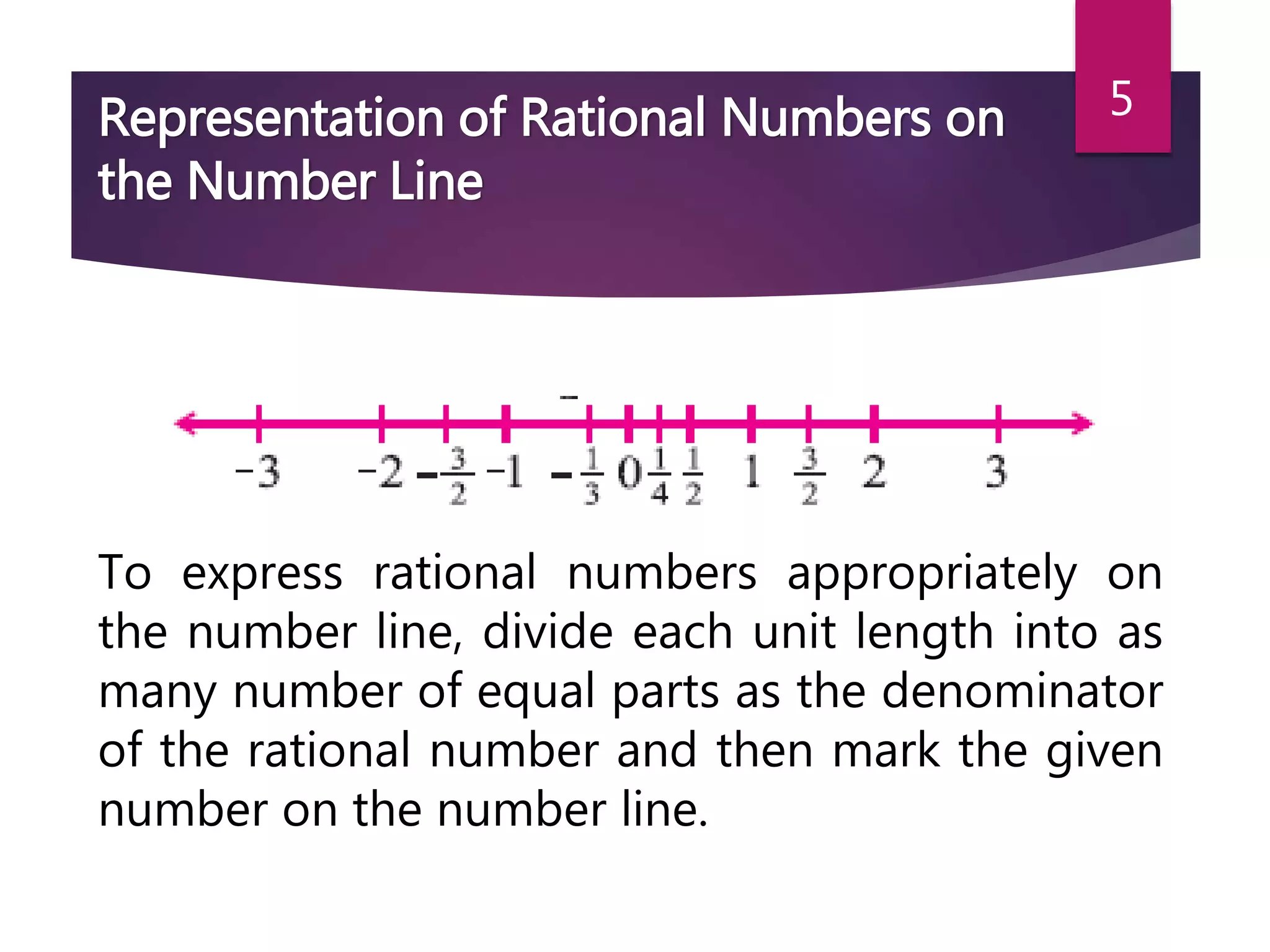
To express rational numbers appropriately on
the number line, divide each unit length into as
many number of equal parts as the denominator
of the rational number and then mark the given
number on the number line.
OPERATION ON RATIONAL NUMBERS
6
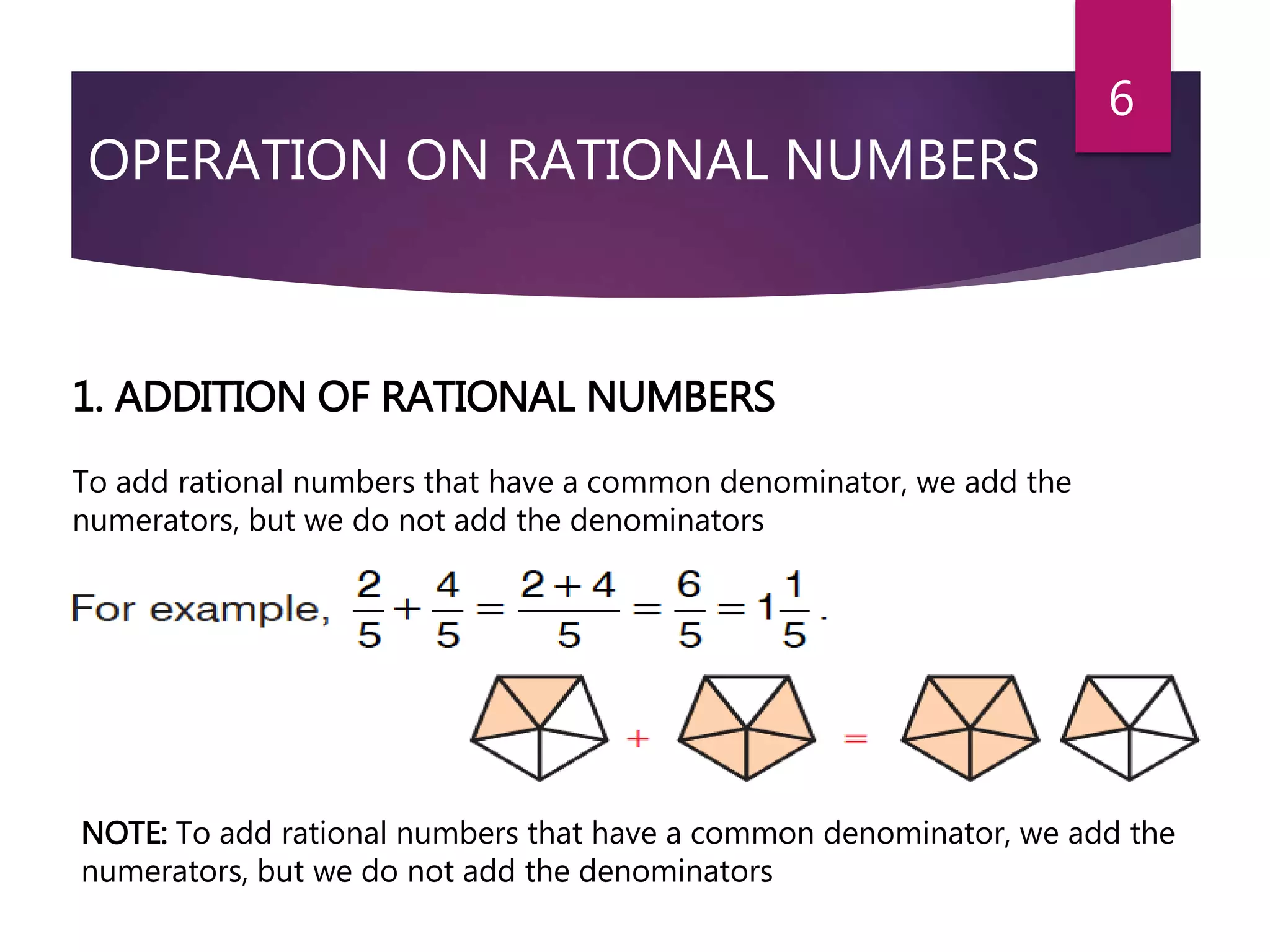
1. ADDITION OF RATIONAL NUMBERS
To add rational numbers that have a common denominator, we add the
numerators, but we do not add the denominators
NOTE: To add rational numbers that have a common denominator, we add the
numerators, but we do not add the denominators
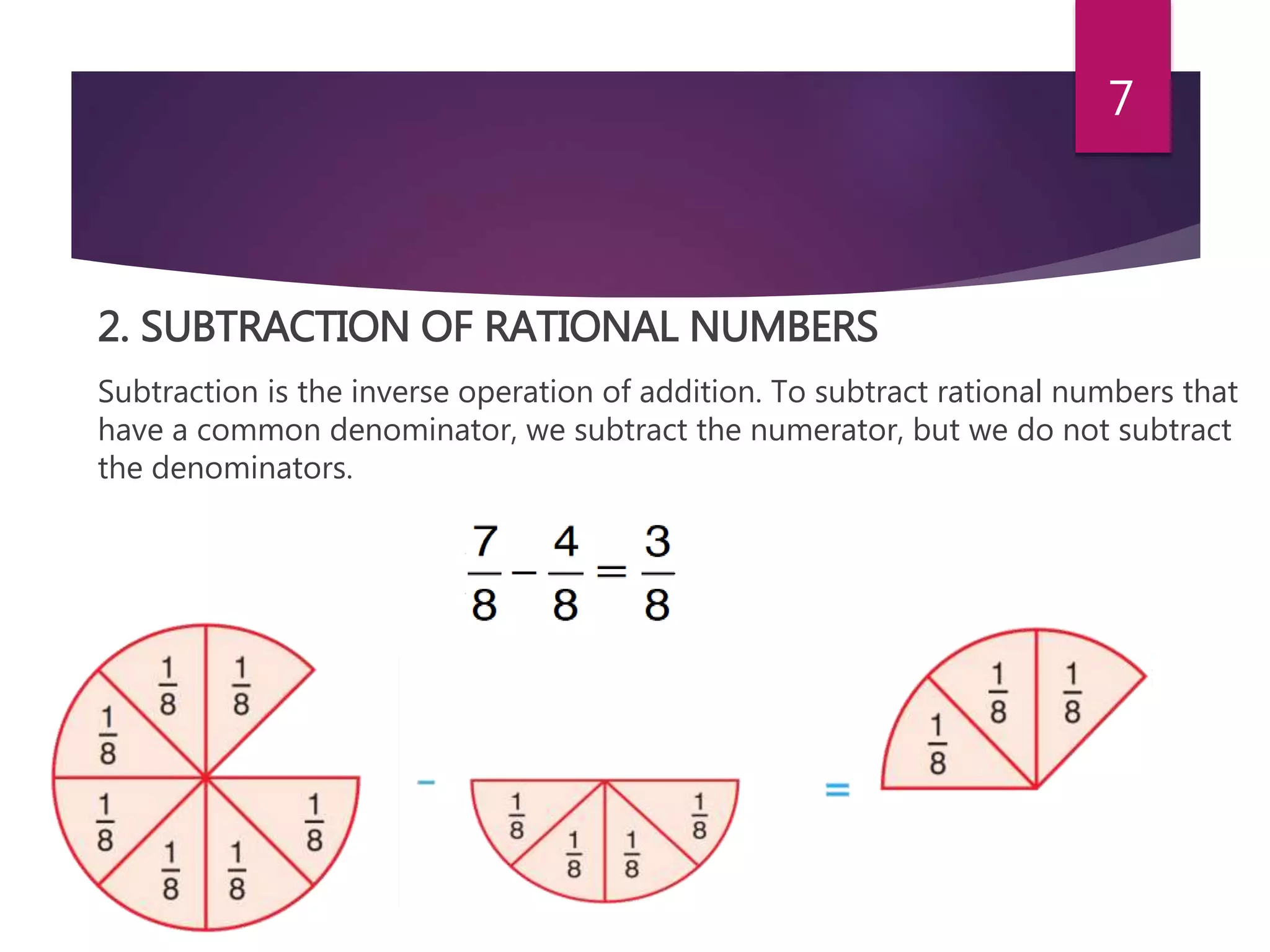
2. SUBTRACTION OF RATIONAL NUMBERS
Subtraction is the inverse operation of addition. To subtract rational numbers that
have a common denominator, we subtract the numerator, but we do not subtract
the denominators.
7
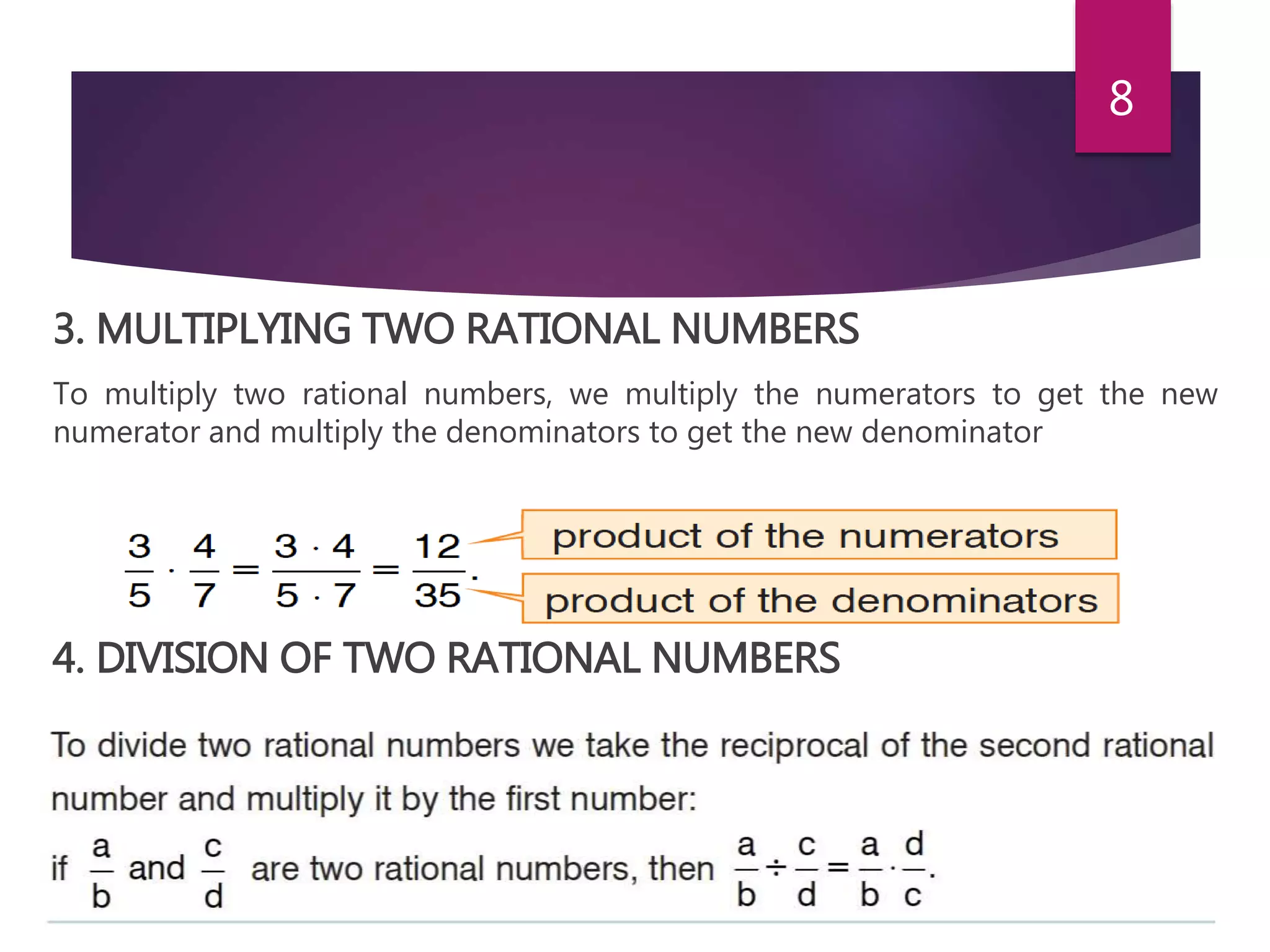
3. MULTIPLYING TWO RATIONAL NUMBERS
To multiply two rational numbers, we multiply the numerators to get the new
numerator and multiply the denominators to get the new denominator
4. DIVISION OF TWO RATIONAL NUMBERS
8
IRRATIONAL NUMBERS
 An irrational number is any real number that cannot be expressed as a
ratio a/b, where a and b are integers, with b non-zero, and therefore
not a rational number.
 All numbers which cannot be written as an integer upon integer where the
denominator is zero and both integers are co-primes are irrational numbers.
 They are non - terminating non-repeating decimal expansions.
 The roots of prime number are irrational.
9
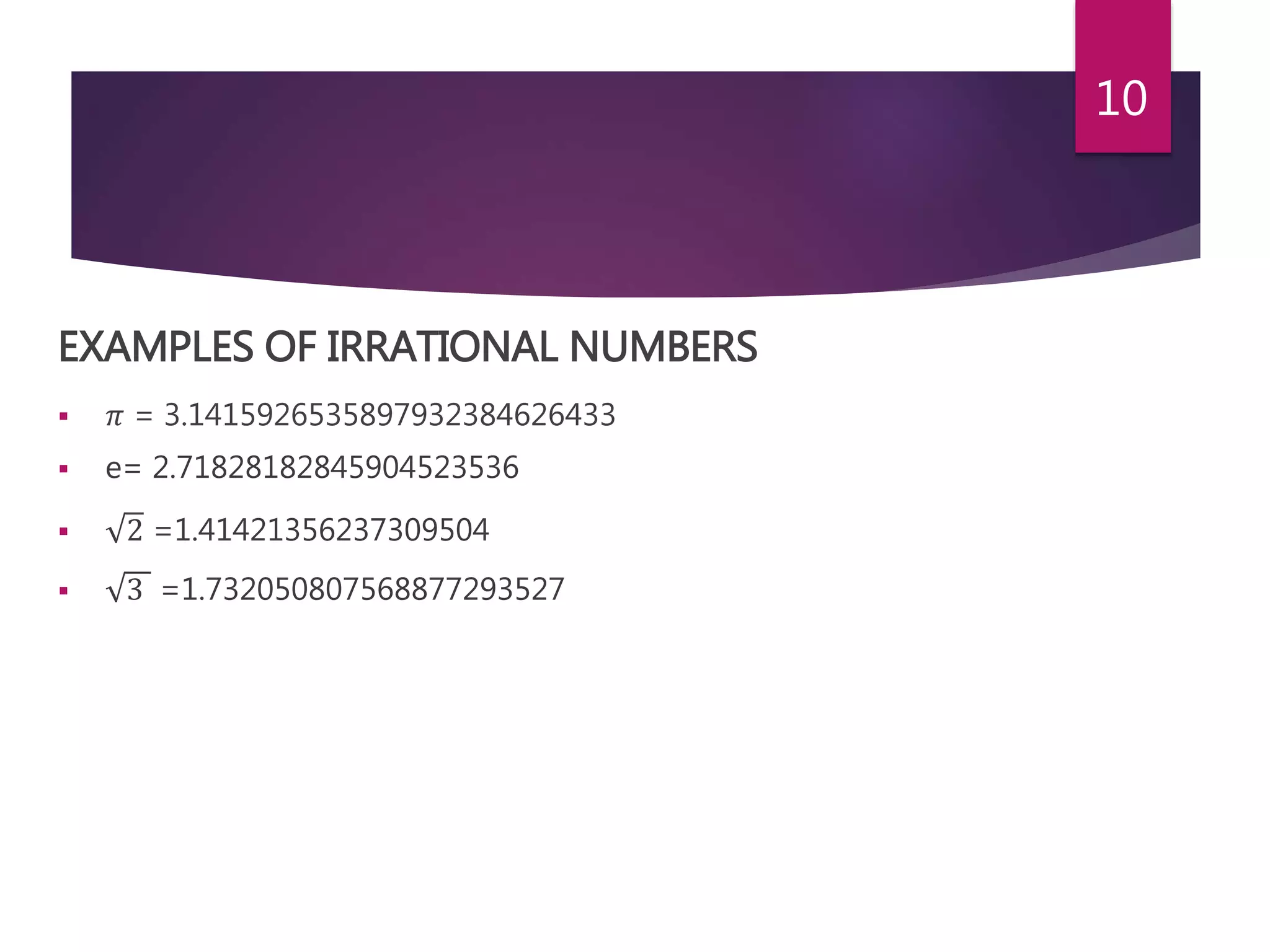
EXAMPLES OF IRRATIONAL NUMBERS
 𝜋 = 3.1415926535897932384626433
 e= 2.71828182845904523536
 2 =1.41421356237309504
 3 =1.732050807568877293527
10
11

Rational and irrational numbers

  • 1.
  • 2.
  • 3.
    RATIONAL NUMBERS  Arational number is a number that can be written in the form p/q , where p and q are integers and q is not equal to 0. EXAMPLES- 2/5, -3/4  The collection of numbers in the form of p/q, where q ≠ 0, is represented by Q. 3 Rational numbers include natural numbers, whole numbers, integers and all negative and positive fractions.
  • 4.
    TYPES OF RATIONALNUMBERS Positive rational number Rational number is positive if its numerator and denominator are both either positive integers or negative integers. Eg : 2/5 , -8/-5. Negative rational number If either the numerator or the denominator of a rational number is a negative integer ,then the rational number is called a negative rational number. Eg: -2/5 Standard form A rational number is said to be in its standard form if its numerator and denominator have no common factor other than 1,and its denominator is a positive integer . Eg: 4/7 4
  • 5.
    5Representation of RationalNumbers on the Number Line To express rational numbers appropriately on the number line, divide each unit length into as many number of equal parts as the denominator of the rational number and then mark the given number on the number line.
  • 6.
    OPERATION ON RATIONALNUMBERS 6 1. ADDITION OF RATIONAL NUMBERS To add rational numbers that have a common denominator, we add the numerators, but we do not add the denominators NOTE: To add rational numbers that have a common denominator, we add the numerators, but we do not add the denominators
  • 7.
    2. SUBTRACTION OFRATIONAL NUMBERS Subtraction is the inverse operation of addition. To subtract rational numbers that have a common denominator, we subtract the numerator, but we do not subtract the denominators. 7
  • 8.
    3. MULTIPLYING TWORATIONAL NUMBERS To multiply two rational numbers, we multiply the numerators to get the new numerator and multiply the denominators to get the new denominator 4. DIVISION OF TWO RATIONAL NUMBERS 8
  • 9.
    IRRATIONAL NUMBERS  Anirrational number is any real number that cannot be expressed as a ratio a/b, where a and b are integers, with b non-zero, and therefore not a rational number.  All numbers which cannot be written as an integer upon integer where the denominator is zero and both integers are co-primes are irrational numbers.  They are non - terminating non-repeating decimal expansions.  The roots of prime number are irrational. 9
  • 10.
    EXAMPLES OF IRRATIONALNUMBERS  𝜋 = 3.1415926535897932384626433  e= 2.71828182845904523536  2 =1.41421356237309504  3 =1.732050807568877293527 10
  • 11.