WELCOME
REAL
NUMBERS
TOPIC:
Presenting By-
SHRADDHA MANTRI-27
(Xth B)
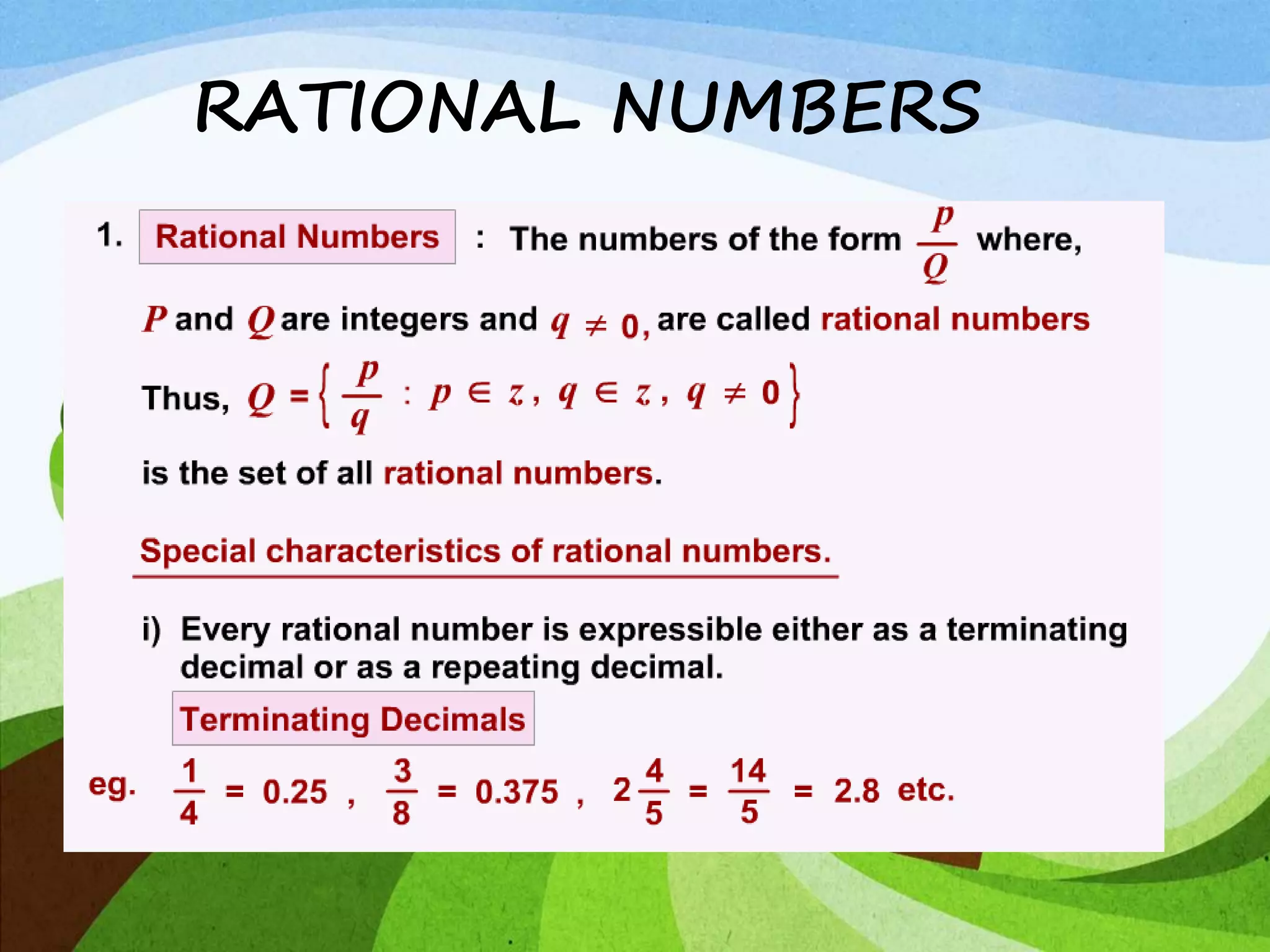
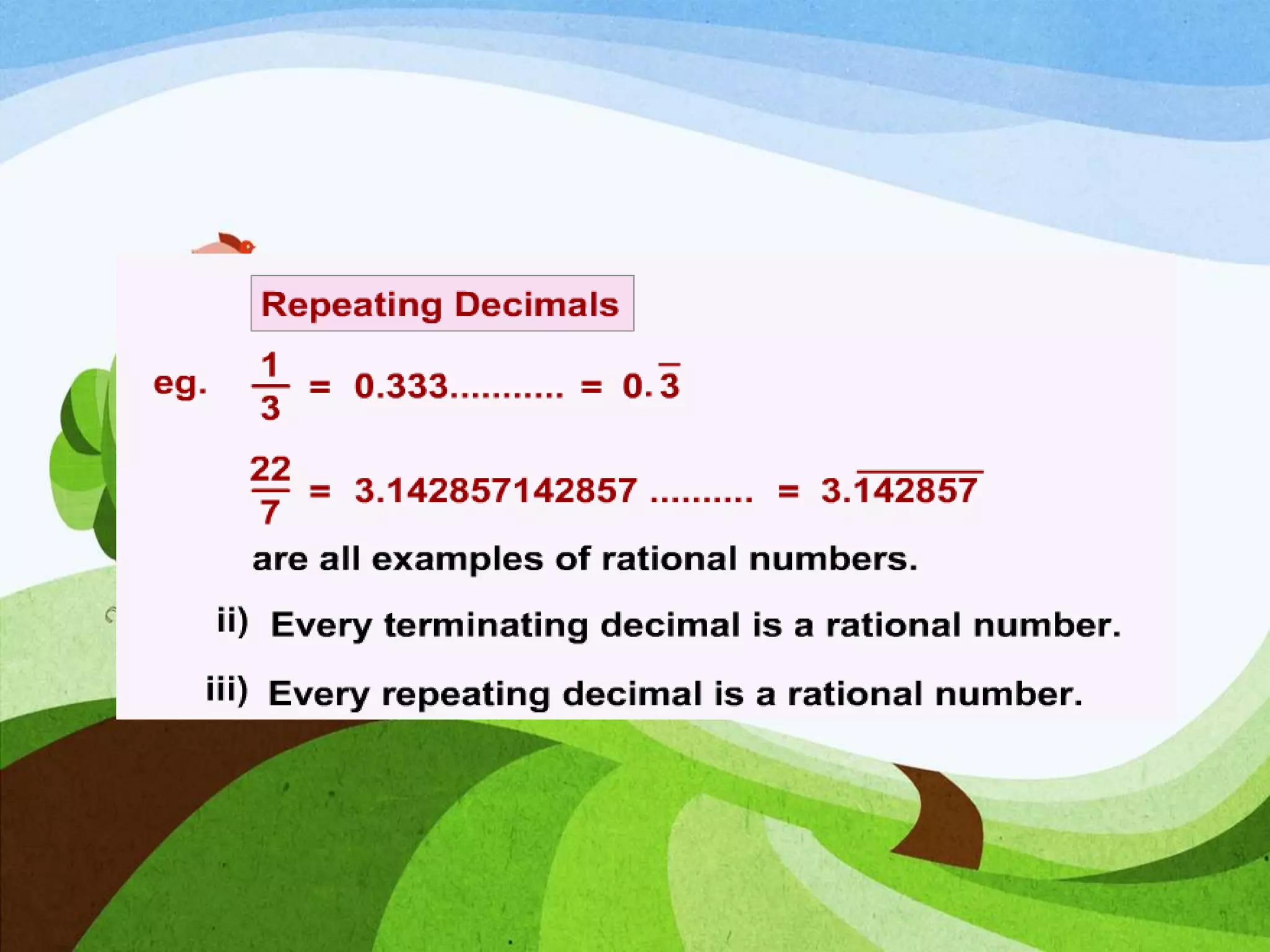
RATIONAL NUMBERS
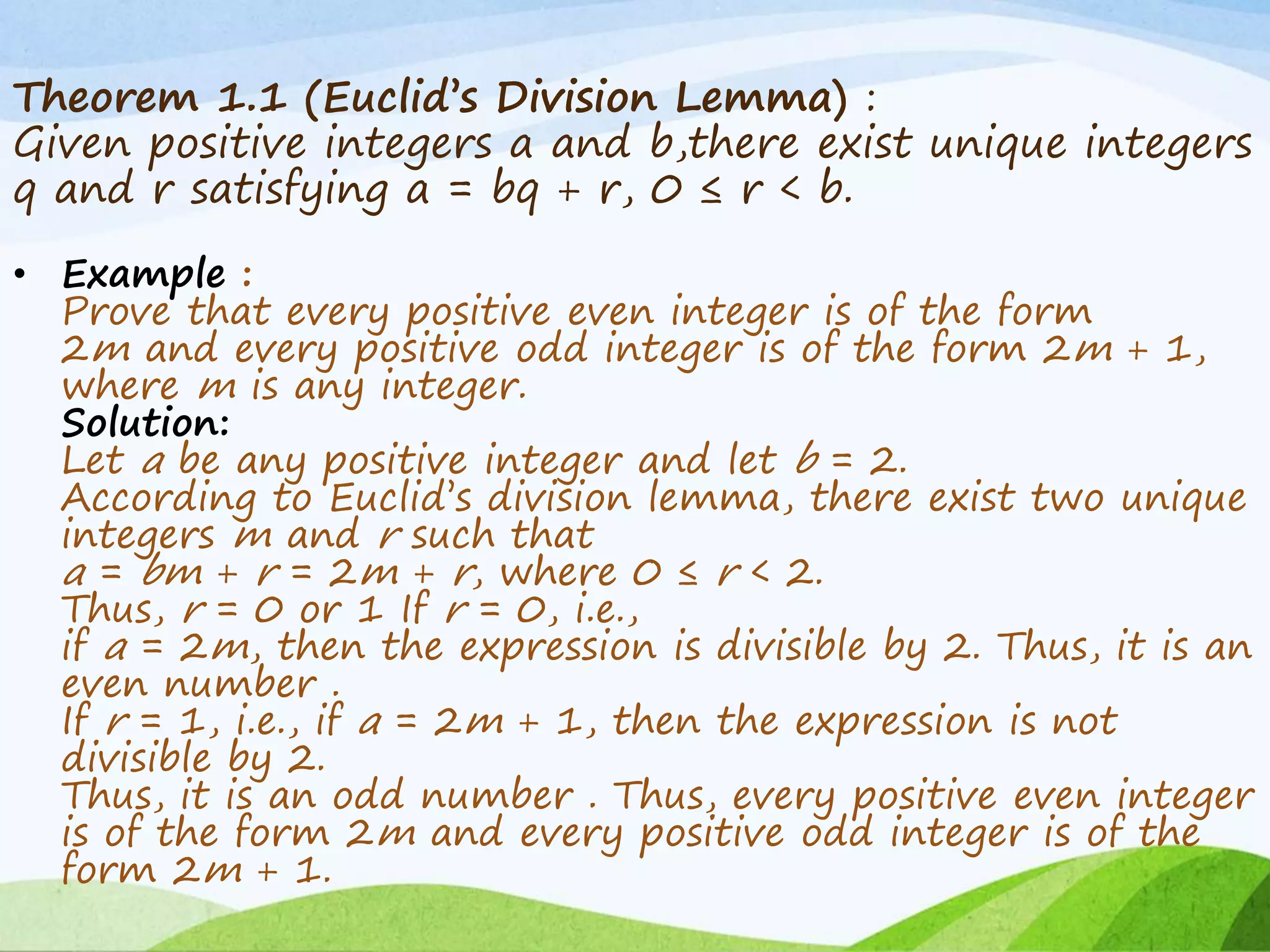
Theorem 1.1 (Euclid’s Division Lemma) :
Given positive integers a and b,there exist unique integers
q and r satisfying a = bq + r, 0 ≤ r < b.
• Example :
Prove that every positive even integer is of the form
2m and every positive odd integer is of the form 2m + 1,
where m is any integer.
Solution:
Let a be any positive integer and let b = 2.
According to Euclid’s division lemma, there exist two unique
integers m and r such that
a = bm + r = 2m + r, where 0 ≤ r < 2.
Thus, r = 0 or 1 If r = 0, i.e.,
if a = 2m, then the expression is divisible by 2. Thus, it is an
even number .
If r = 1, i.e., if a = 2m + 1, then the expression is not
divisible by 2.
Thus, it is an odd number . Thus, every positive even integer
is of the form 2m and every positive odd integer is of the
form 2m + 1.
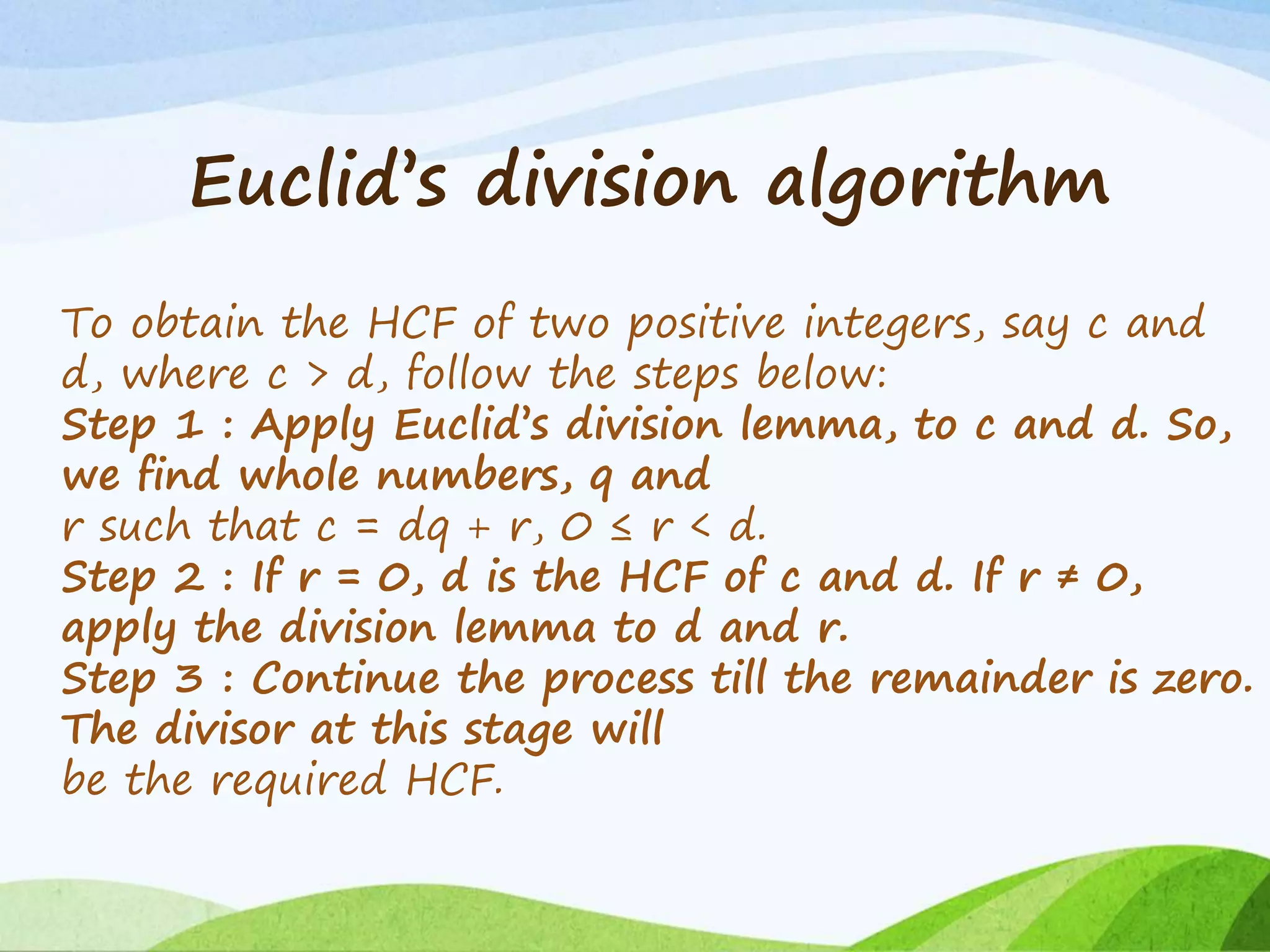
Euclid’s division algorithm
To obtain the HCF of two positive integers, say c and
d, where c > d, follow the steps below:
Step 1 : Apply Euclid’s division lemma, to c and d. So,
we find whole numbers, q and
r such that c = dq + r, 0 ≤ r < d.
Step 2 : If r = 0, d is the HCF of c and d. If r ≠ 0,
apply the division lemma to d and r.
Step 3 : Continue the process till the remainder is zero.
The divisor at this stage will
be the required HCF.
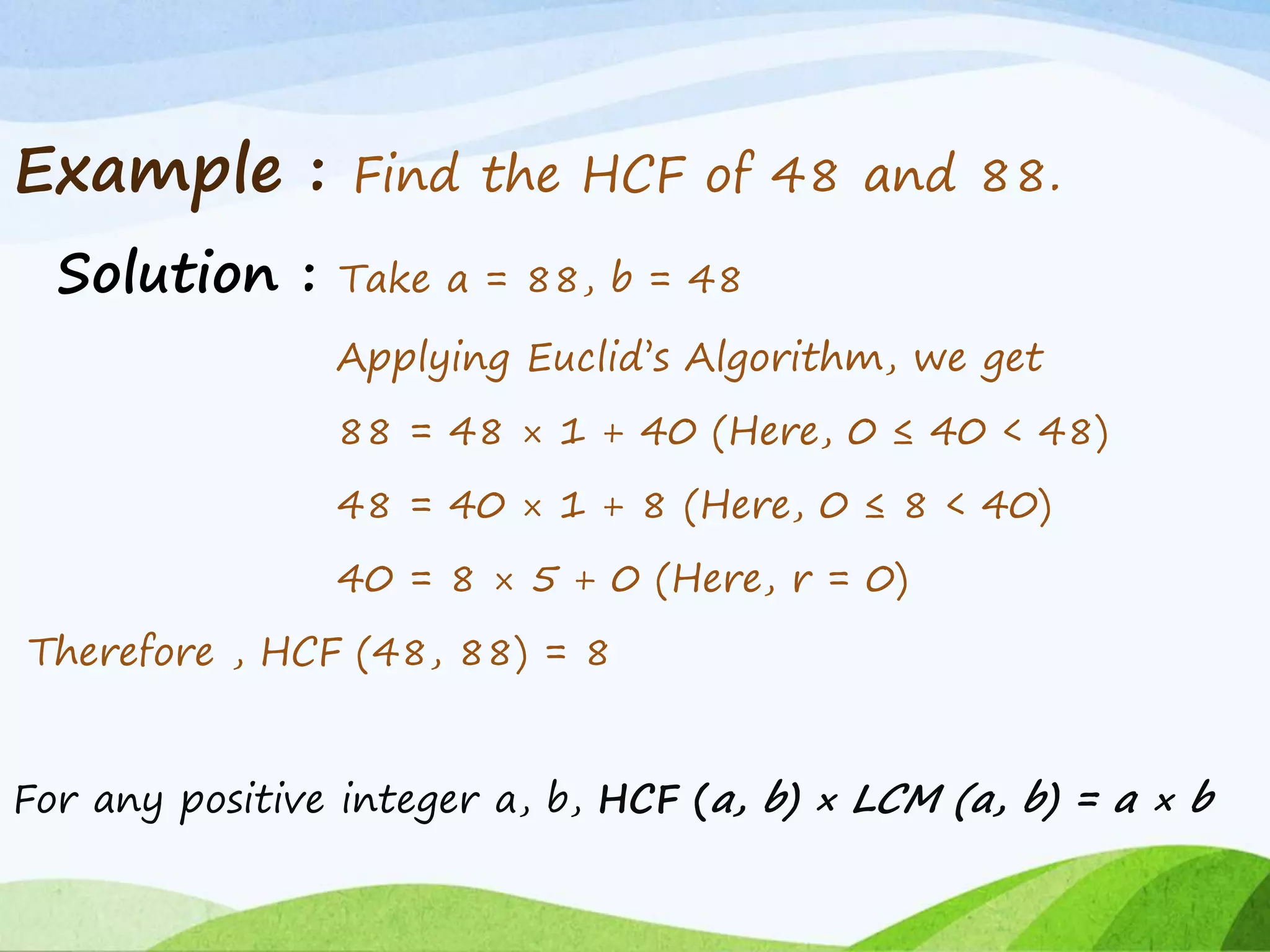
Example : Find the HCF of 48 and 88.
Solution : Take a = 88, b = 48
Applying Euclid’s Algorithm, we get
88 = 48 × 1 + 40 (Here, 0 ≤ 40 < 48)
48 = 40 × 1 + 8 (Here, 0 ≤ 8 < 40)
40 = 8 × 5 + 0 (Here, r = 0)
Therefore , HCF (48, 88) = 8
For any positive integer a, b, HCF (a, b) × LCM (a, b) = a × b
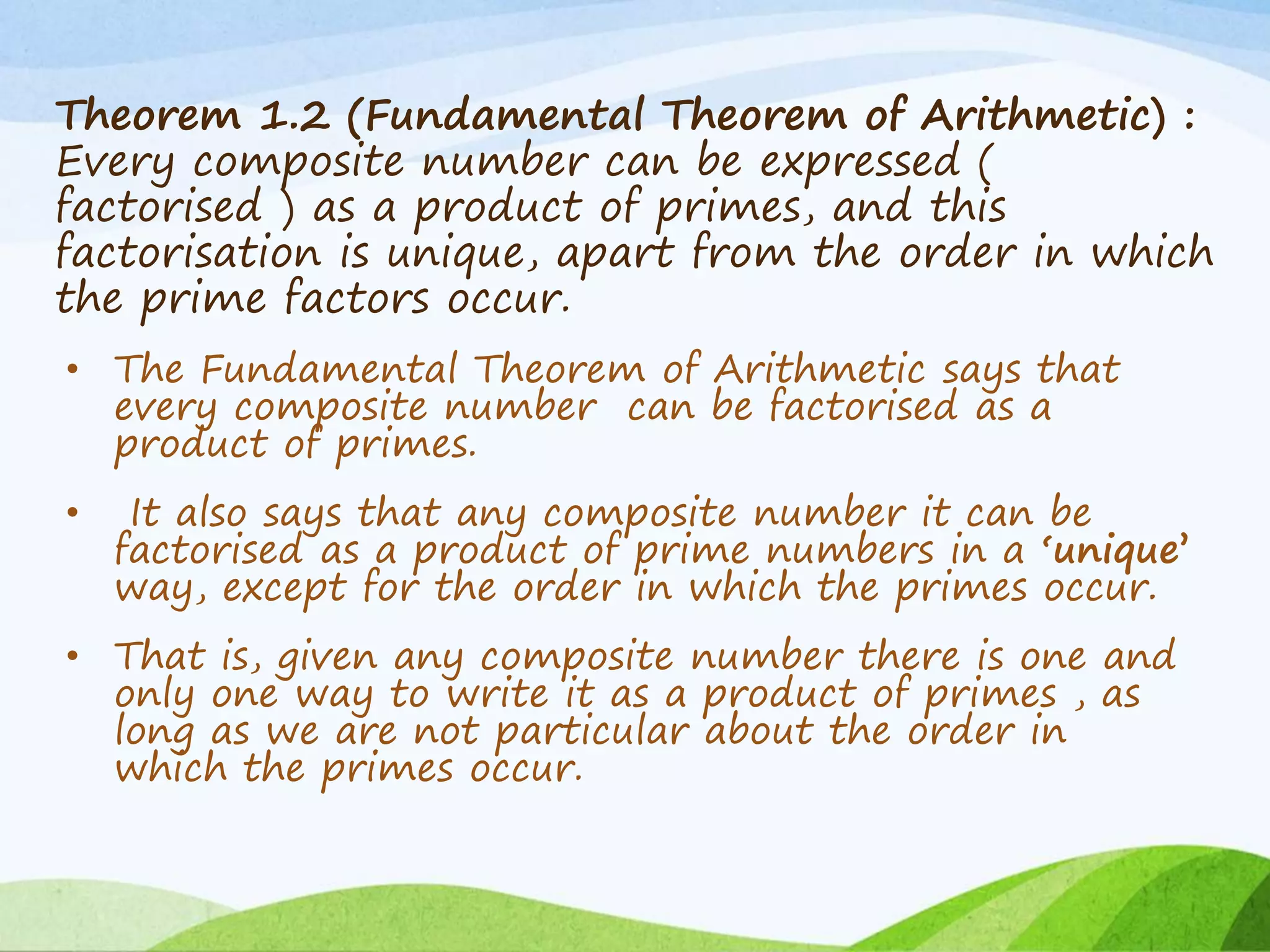
Theorem 1.2 (Fundamental Theorem of Arithmetic) :
Every composite number can be expressed (
factorised ) as a product of primes, and this
factorisation is unique, apart from the order in which
the prime factors occur.
• The Fundamental Theorem of Arithmetic says that
every composite number can be factorised as a
product of primes.
• It also says that any composite number it can be
factorised as a product of prime numbers in a ‘unique’
way, except for the order in which the primes occur.
• That is, given any composite number there is one and
only one way to write it as a product of primes , as
long as we are not particular about the order in
which the primes occur.
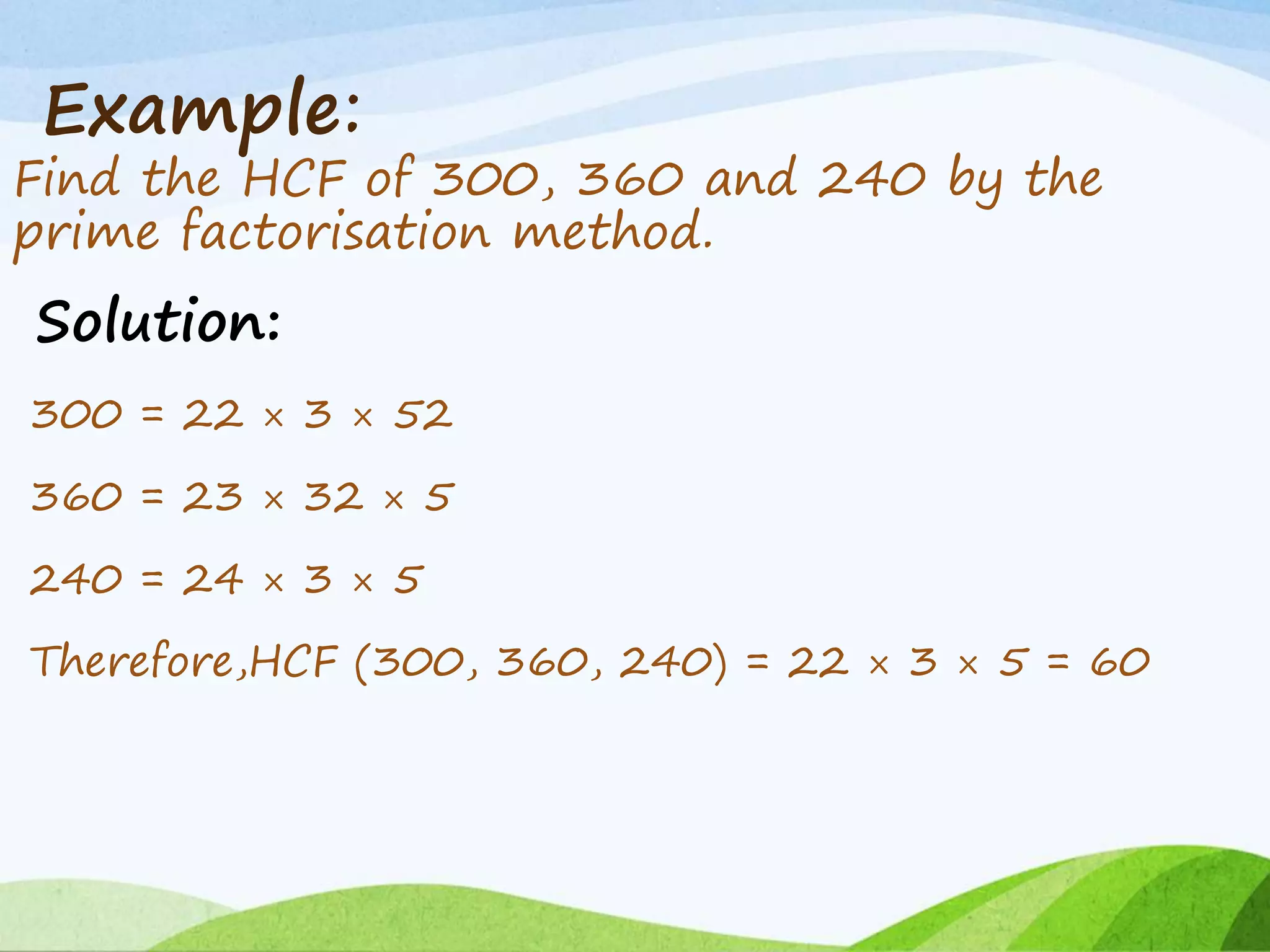
Example:
Find the HCF of 300, 360 and 240 by the
prime factorisation method.
Solution:
300 = 22 × 3 × 52
360 = 23 × 32 × 5
240 = 24 × 3 × 5
Therefore,HCF (300, 360, 240) = 22 × 3 × 5 = 60
Video….
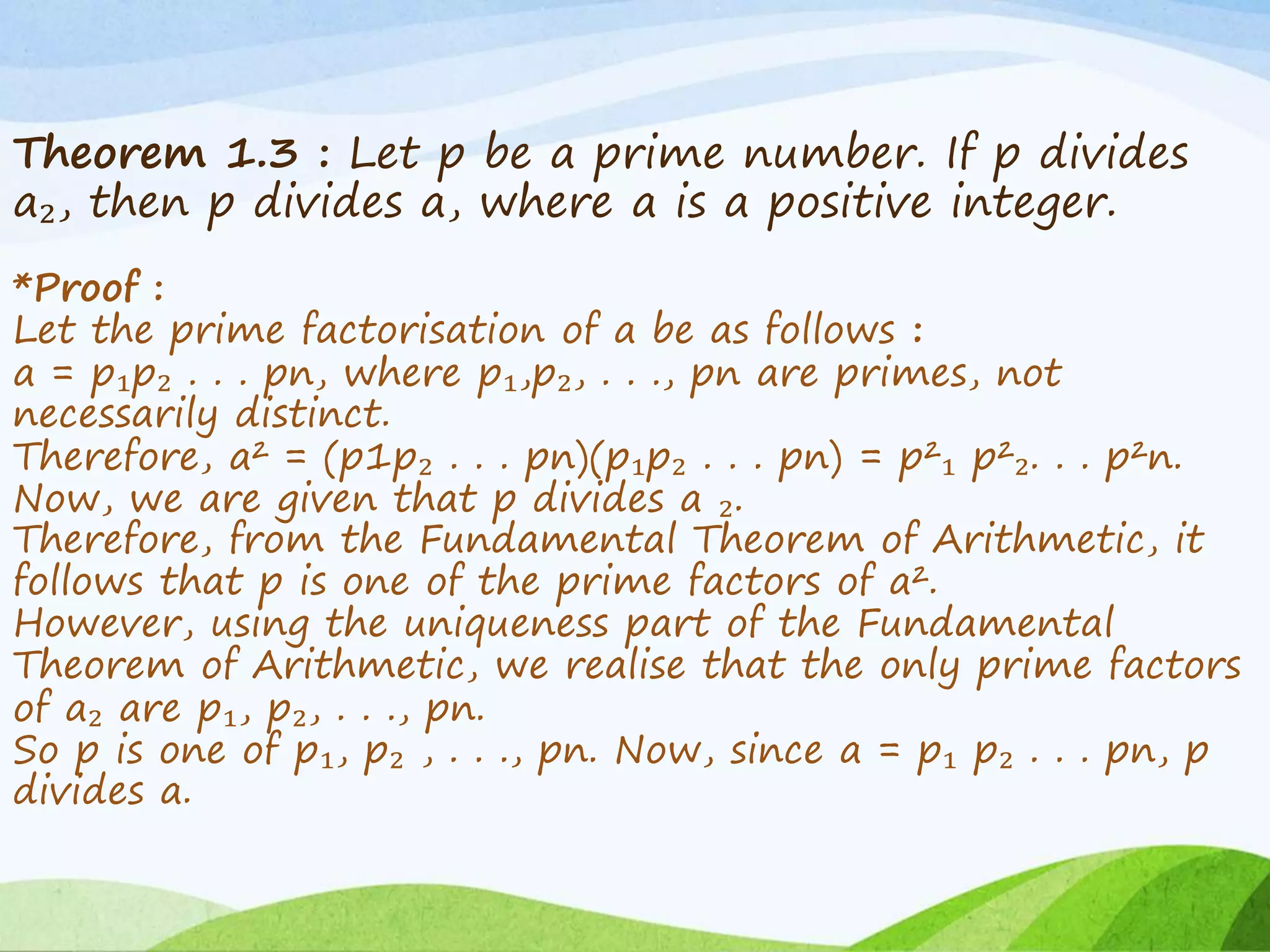
Theorem 1.3 : Let p be a prime number. If p divides
a₂, then p divides a, where a is a positive integer.
*Proof :
Let the prime factorisation of a be as follows :
a = p₁p₂ . . . pn, where p₁,p₂, . . ., pn are primes, not
necessarily distinct.
Therefore, a² = (p1p₂ . . . pn)(p₁p₂ . . . pn) = p²₁ p²₂. . . p²n.
Now, we are given that p divides a ₂.
Therefore, from the Fundamental Theorem of Arithmetic, it
follows that p is one of the prime factors of a².
However, using the uniqueness part of the Fundamental
Theorem of Arithmetic, we realise that the only prime factors
of a₂ are p₁, p₂, . . ., pn.
So p is one of p₁, p₂ , . . ., pn. Now, since a = p₁ p₂ . . . pn, p
divides a.
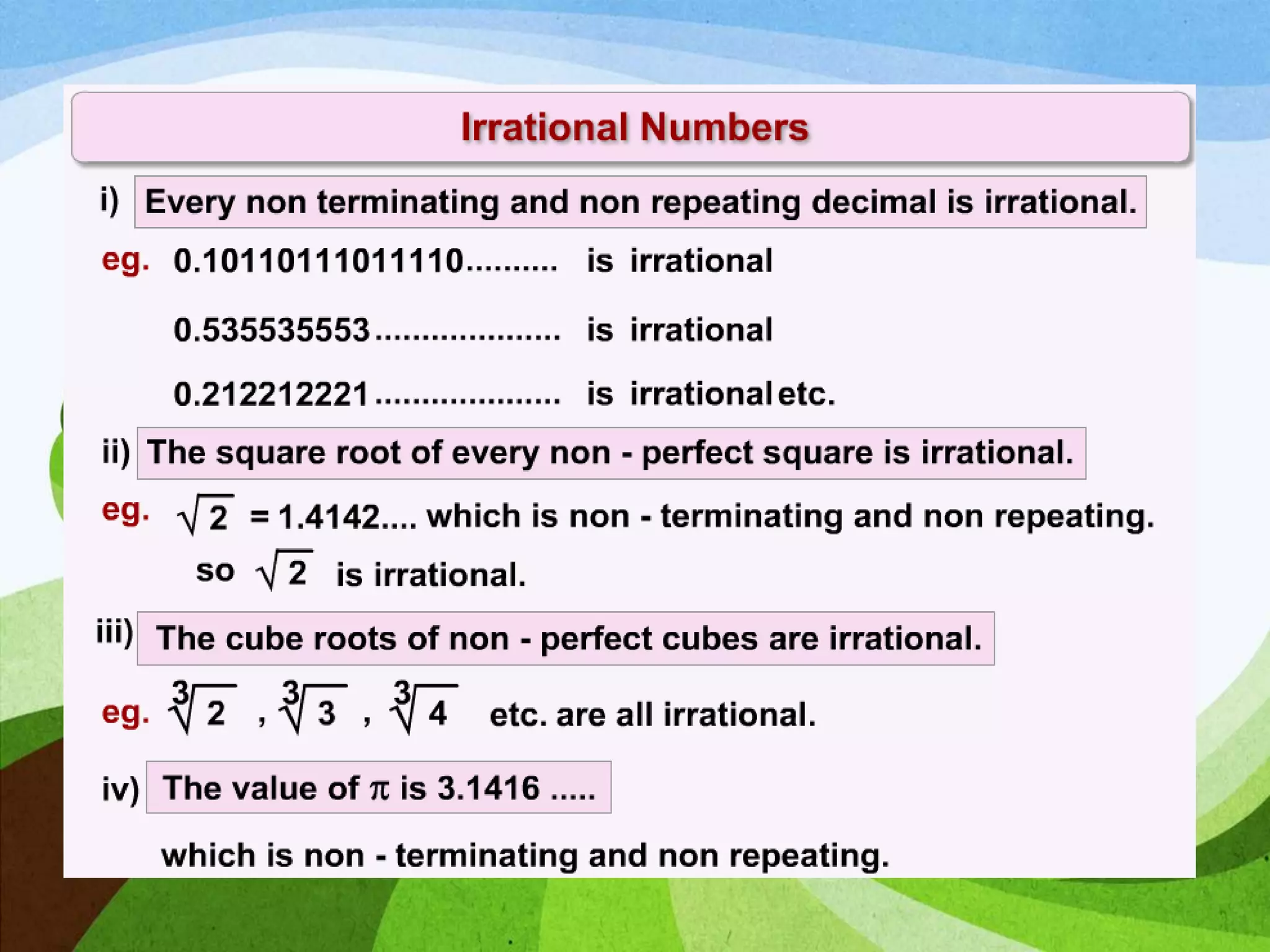
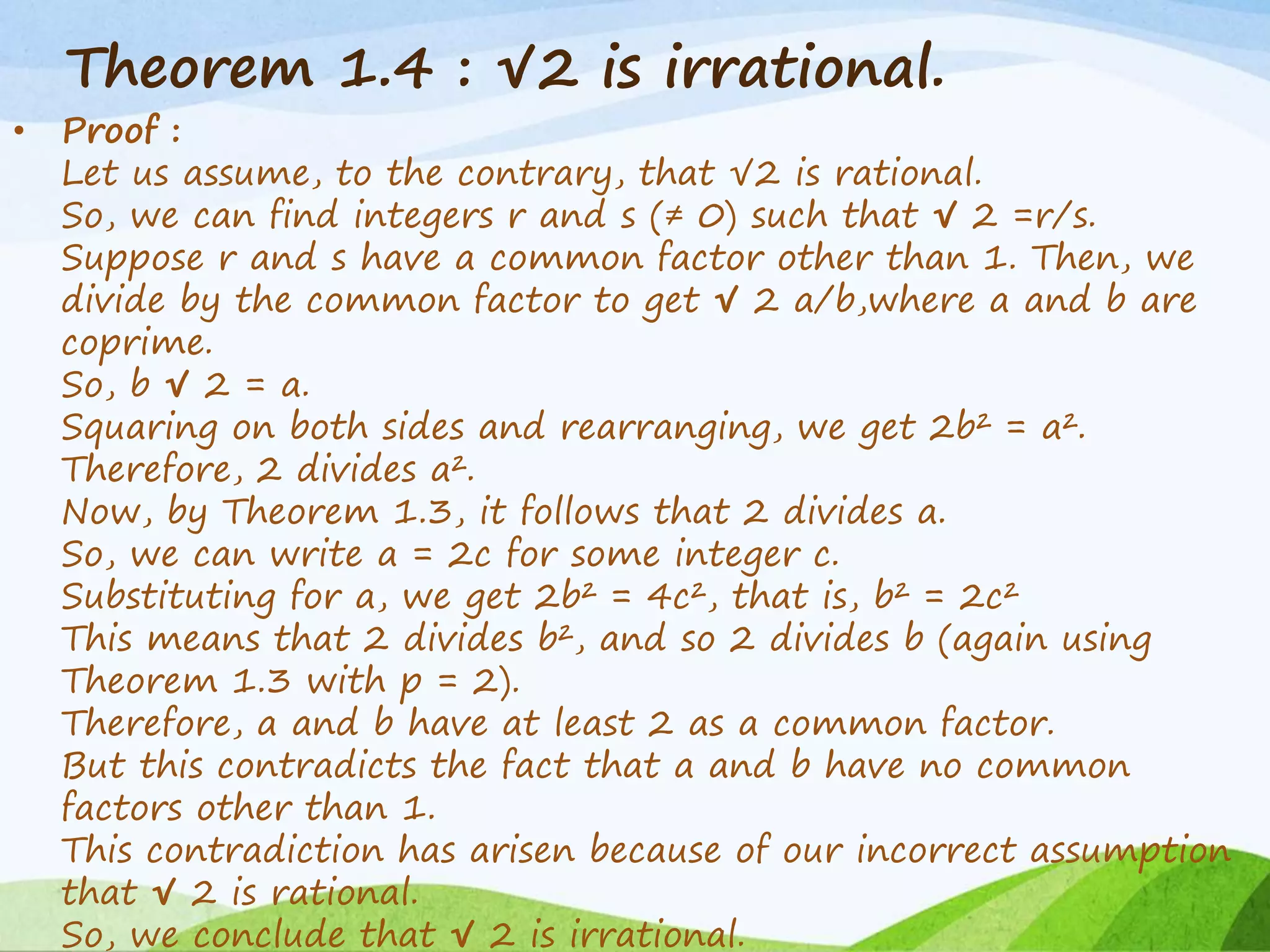
Theorem 1.4 : √2 is irrational.
• Proof :
Let us assume, to the contrary, that √2 is rational.
So, we can find integers r and s (≠ 0) such that √ 2 =r/s.
Suppose r and s have a common factor other than 1. Then, we
divide by the common factor to get √ 2 a/b,where a and b are
coprime.
So, b √ 2 = a.
Squaring on both sides and rearranging, we get 2b² = a².
Therefore, 2 divides a².
Now, by Theorem 1.3, it follows that 2 divides a.
So, we can write a = 2c for some integer c.
Substituting for a, we get 2b² = 4c², that is, b² = 2c²
This means that 2 divides b², and so 2 divides b (again using
Theorem 1.3 with p = 2).
Therefore, a and b have at least 2 as a common factor.
But this contradicts the fact that a and b have no common
factors other than 1.
This contradiction has arisen because of our incorrect assumption
that √ 2 is rational.
So, we conclude that √ 2 is irrational.
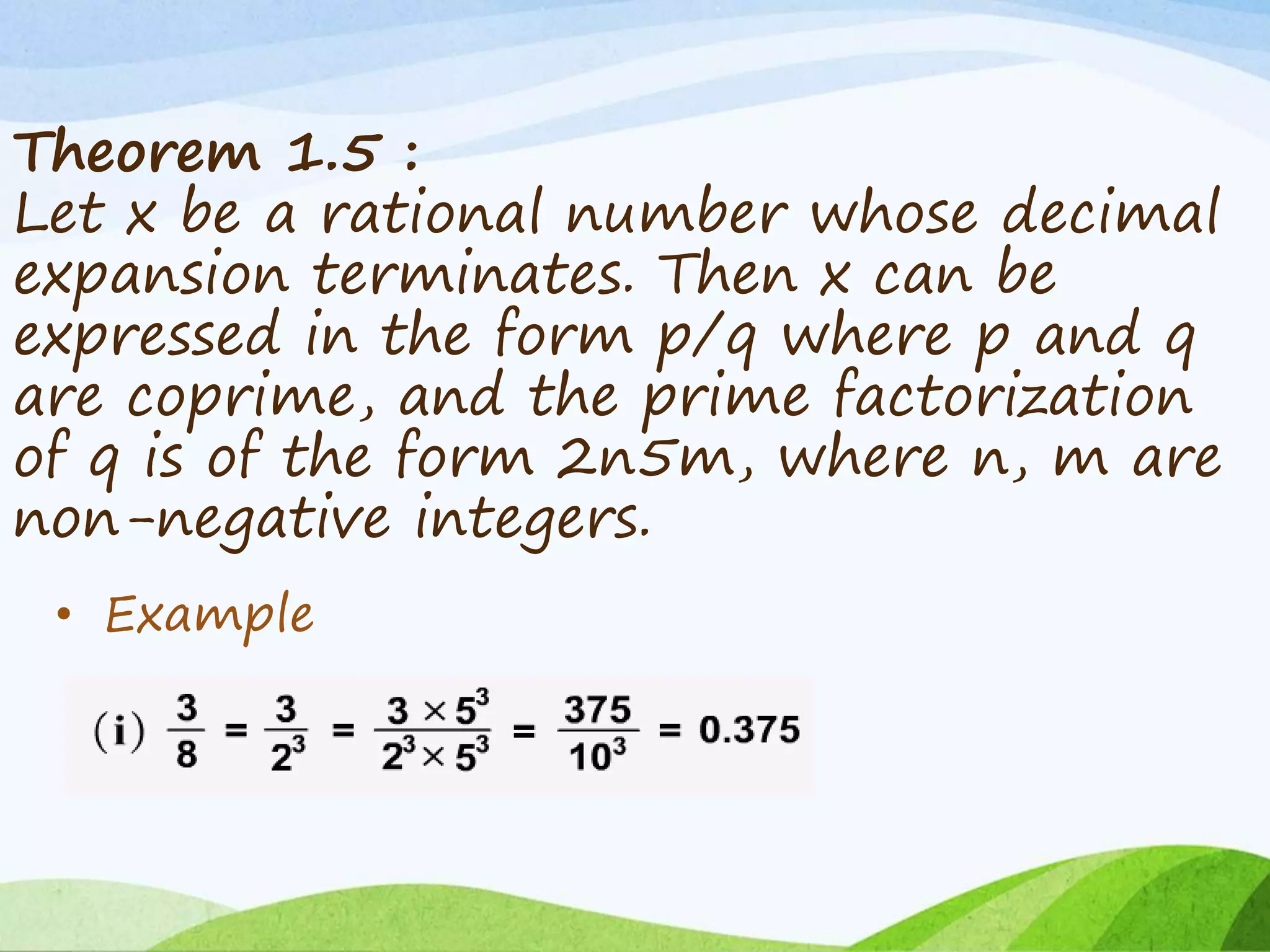
Theorem 1.5 :
Let x be a rational number whose decimal
expansion terminates. Then x can be
expressed in the form p/q where p and q
are coprime, and the prime factorization
of q is of the form 2n5m, where n, m are
non-negative integers.
• Example
Theorem 1.6 :
Let x = p/q be a rational number, such
that the prime factorization of q is of the
form 2n5m, where n, m are non-negative
integers. Then x has a decimal expansion
which terminates.
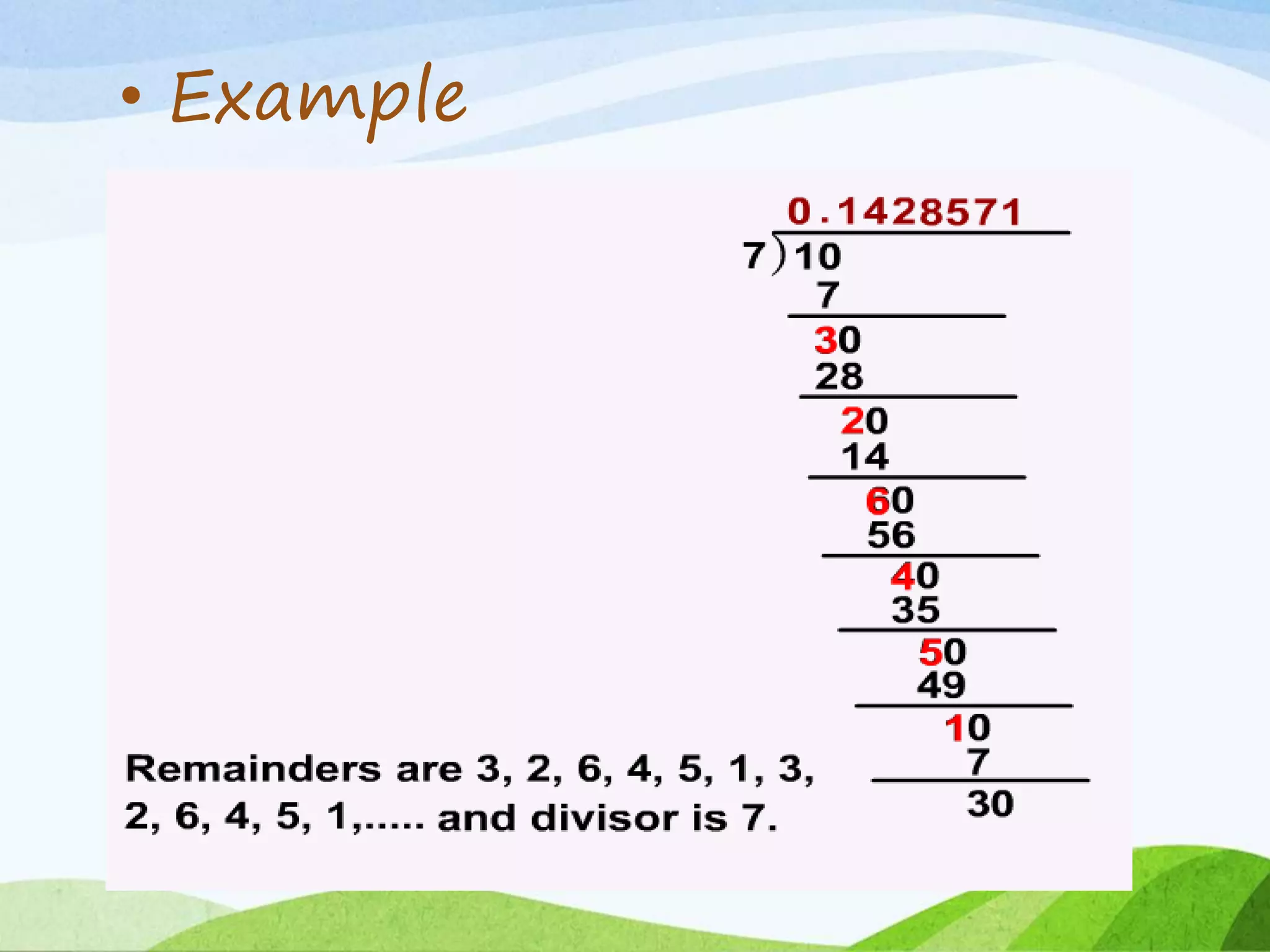
• Example
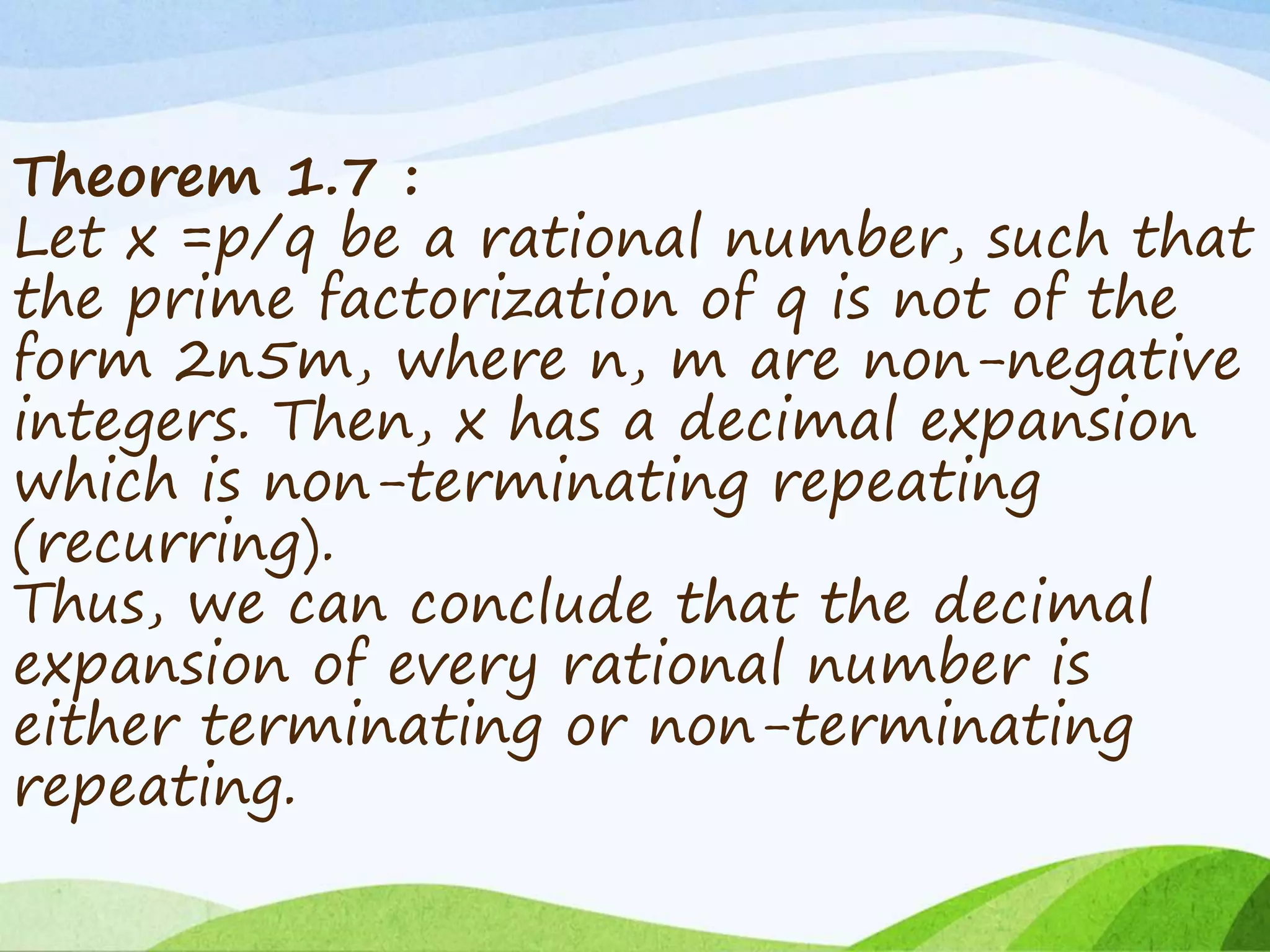
Theorem 1.7 :
Let x =p/q be a rational number, such that
the prime factorization of q is not of the
form 2n5m, where n, m are non-negative
integers. Then, x has a decimal expansion
which is non-terminating repeating
(recurring).
Thus, we can conclude that the decimal
expansion of every rational number is
either terminating or non-terminating
repeating.
THANK
YOU

Real numbers

  • 1.
  • 2.
  • 3.
  • 6.
  • 9.
    Theorem 1.1 (Euclid’sDivision Lemma) : Given positive integers a and b,there exist unique integers q and r satisfying a = bq + r, 0 ≤ r < b. • Example : Prove that every positive even integer is of the form 2m and every positive odd integer is of the form 2m + 1, where m is any integer. Solution: Let a be any positive integer and let b = 2. According to Euclid’s division lemma, there exist two unique integers m and r such that a = bm + r = 2m + r, where 0 ≤ r < 2. Thus, r = 0 or 1 If r = 0, i.e., if a = 2m, then the expression is divisible by 2. Thus, it is an even number . If r = 1, i.e., if a = 2m + 1, then the expression is not divisible by 2. Thus, it is an odd number . Thus, every positive even integer is of the form 2m and every positive odd integer is of the form 2m + 1.
  • 10.
    Euclid’s division algorithm Toobtain the HCF of two positive integers, say c and d, where c > d, follow the steps below: Step 1 : Apply Euclid’s division lemma, to c and d. So, we find whole numbers, q and r such that c = dq + r, 0 ≤ r < d. Step 2 : If r = 0, d is the HCF of c and d. If r ≠ 0, apply the division lemma to d and r. Step 3 : Continue the process till the remainder is zero. The divisor at this stage will be the required HCF.
  • 11.
    Example : Findthe HCF of 48 and 88. Solution : Take a = 88, b = 48 Applying Euclid’s Algorithm, we get 88 = 48 × 1 + 40 (Here, 0 ≤ 40 < 48) 48 = 40 × 1 + 8 (Here, 0 ≤ 8 < 40) 40 = 8 × 5 + 0 (Here, r = 0) Therefore , HCF (48, 88) = 8 For any positive integer a, b, HCF (a, b) × LCM (a, b) = a × b
  • 12.
    Theorem 1.2 (FundamentalTheorem of Arithmetic) : Every composite number can be expressed ( factorised ) as a product of primes, and this factorisation is unique, apart from the order in which the prime factors occur. • The Fundamental Theorem of Arithmetic says that every composite number can be factorised as a product of primes. • It also says that any composite number it can be factorised as a product of prime numbers in a ‘unique’ way, except for the order in which the primes occur. • That is, given any composite number there is one and only one way to write it as a product of primes , as long as we are not particular about the order in which the primes occur.
  • 13.
    Example: Find the HCFof 300, 360 and 240 by the prime factorisation method. Solution: 300 = 22 × 3 × 52 360 = 23 × 32 × 5 240 = 24 × 3 × 5 Therefore,HCF (300, 360, 240) = 22 × 3 × 5 = 60
  • 14.
  • 15.
    Theorem 1.3 :Let p be a prime number. If p divides a₂, then p divides a, where a is a positive integer. *Proof : Let the prime factorisation of a be as follows : a = p₁p₂ . . . pn, where p₁,p₂, . . ., pn are primes, not necessarily distinct. Therefore, a² = (p1p₂ . . . pn)(p₁p₂ . . . pn) = p²₁ p²₂. . . p²n. Now, we are given that p divides a ₂. Therefore, from the Fundamental Theorem of Arithmetic, it follows that p is one of the prime factors of a². However, using the uniqueness part of the Fundamental Theorem of Arithmetic, we realise that the only prime factors of a₂ are p₁, p₂, . . ., pn. So p is one of p₁, p₂ , . . ., pn. Now, since a = p₁ p₂ . . . pn, p divides a.
  • 16.
    Theorem 1.4 :√2 is irrational. • Proof : Let us assume, to the contrary, that √2 is rational. So, we can find integers r and s (≠ 0) such that √ 2 =r/s. Suppose r and s have a common factor other than 1. Then, we divide by the common factor to get √ 2 a/b,where a and b are coprime. So, b √ 2 = a. Squaring on both sides and rearranging, we get 2b² = a². Therefore, 2 divides a². Now, by Theorem 1.3, it follows that 2 divides a. So, we can write a = 2c for some integer c. Substituting for a, we get 2b² = 4c², that is, b² = 2c² This means that 2 divides b², and so 2 divides b (again using Theorem 1.3 with p = 2). Therefore, a and b have at least 2 as a common factor. But this contradicts the fact that a and b have no common factors other than 1. This contradiction has arisen because of our incorrect assumption that √ 2 is rational. So, we conclude that √ 2 is irrational.
  • 17.
    Theorem 1.5 : Letx be a rational number whose decimal expansion terminates. Then x can be expressed in the form p/q where p and q are coprime, and the prime factorization of q is of the form 2n5m, where n, m are non-negative integers. • Example
  • 18.
    Theorem 1.6 : Letx = p/q be a rational number, such that the prime factorization of q is of the form 2n5m, where n, m are non-negative integers. Then x has a decimal expansion which terminates.
  • 19.
  • 20.
    Theorem 1.7 : Letx =p/q be a rational number, such that the prime factorization of q is not of the form 2n5m, where n, m are non-negative integers. Then, x has a decimal expansion which is non-terminating repeating (recurring). Thus, we can conclude that the decimal expansion of every rational number is either terminating or non-terminating repeating.
  • 21.