Advanced ComplexAnalysis
Type-VI
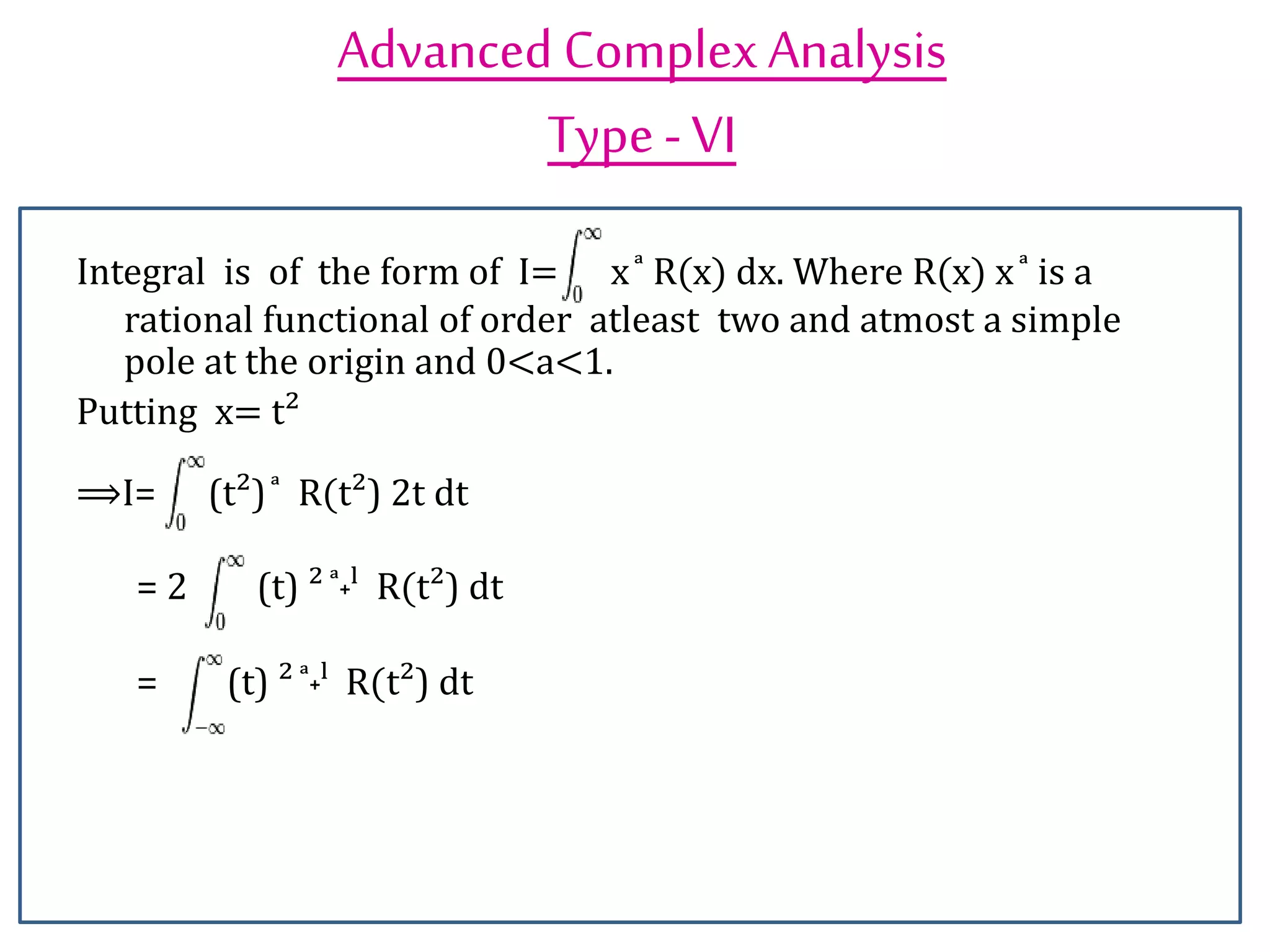
Integral is of the form of I= x ͣ R(x) dx. Where R(x) x ͣ is a
rational functional of order atleast two and atmost a simple
pole at the origin and 0<a<1.
Putting x= t²
⟹I= (t²) ͣ R(t²) 2t dt
= 2 (t) ² ͣ˖ˡ R(t²) dt
= (t) ² ͣ˖ˡ R(t²) dt
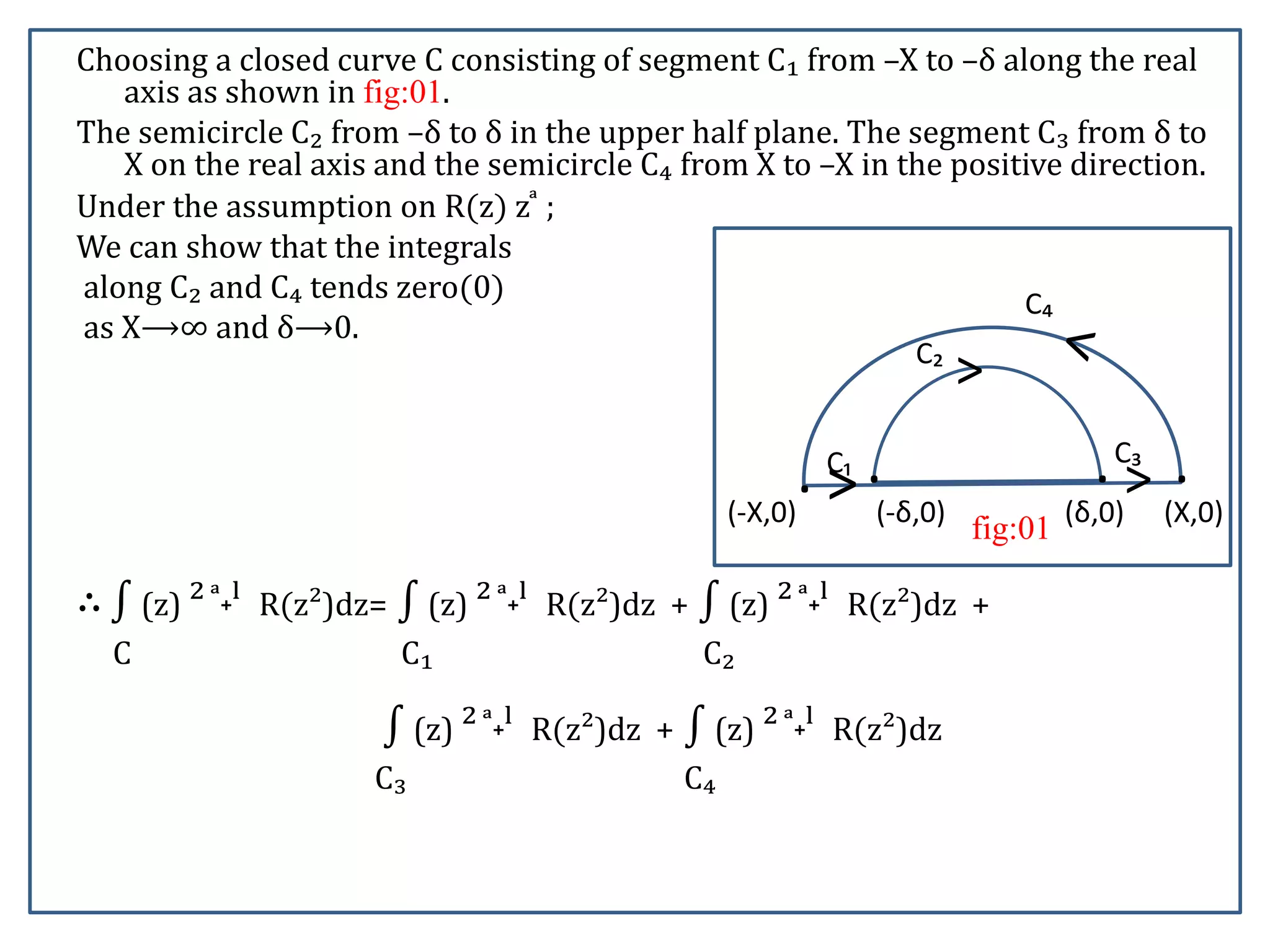
Choosing a closed curve C consisting of segment C₁ from –X to –δ along the real
axis as shown in fig:01.
The semicircle C₂ from –δ to δ in the upper half plane. The segment C₃ from δ to
X on the real axis and the semicircle C₄ from X to –X in the positive direction.
Under the assumption on R(z) z ͣ ;
We can show that the integrals
along C₂ and C₄ tends zero(0)
as X⟶∞ and δ⟶0.
fig:01
∴ ∫ (z) ² ͣ˖ˡ R(z²)dz= ∫ (z) ² ͣ˖ˡ R(z²)dz + ∫ (z) ² ͣ˖ˡ R(z²)dz +
C C₁ C₂
∫ (z) ² ͣ˖ˡ R(z²)dz + ∫ (z) ² ͣ˖ˡ R(z²)dz
C₃ C₄
.> >
>
C₁ C₃
C₂
C₄
. . . .
(-X,0) (-δ,0) (δ,0) (X,0)
As X⟶∞ and δ⟶0;
∫ (z) ² ͣ˖ˡ R(z²)dz=0 & ∫ (z) ² ͣ˖ˡ R(z²)dz=0
C ₂ C₄
∴ ∫(z) ² ͣ˖ˡ R(z²)dz= ∫ (z) ² ͣ˖ˡ R(z²)dz + ∫ (z) ² ͣ˖ˡ R(z²)dz
C C₁ C₃
=∫ ̅ᵟ (z) ² ͣ˖ˡ R(z²) dz +∫ˣ (z) ² ͣ˖ˡ R(z²) dz
-X δ
⟹Lt ∫(z) ² ͣ˖ˡ R(z²)dz = Lt [ ∫ᵟ (-z) ² ͣ˖ˡ R(z²)(-dz) +∫ˣ (z) ² ͣ˖ˡ R(z²)dz]
X⟶∞ C X⟶∞ X δ
δ⟶0 δ⟶0
⟹ (z) ² ͣ˖ˡ R(z²)dz = = Lt [ ∫ˣ (-z) ² ͣ˖ˡ R(z²)(dz) +∫ˣ (z) ² ͣ˖ˡ R(z²)dz]
X⟶∞ δ δ
δ⟶0
⟹ (z) ² ͣ˖ˡ R(z²)dz= (-z) ² ͣ˖ˡ R(z²)(dz) +
(z) ² ͣ˖ˡ R(z²)dz
= [(-z) ² ͣ˖ˡ + (z) ² ͣ˖ˡ ] R(z²)dz
= [z ² ͣ˖ˡ (-1) ² ͣ˖ˡ + z ² ͣ˖ˡ ] R(z²)dz
= [z ² ͣ˖ˡ (-1)(-1) ² ͣ + z ² ͣ˖ˡ ] R(z²)dz
= [z ² ͣ˖ˡ (-1)( ) ² ͣ + z ² ͣ˖ˡ ] R(z²)dz
{ ∵ =cos 𝜋+isin𝜋=-1}
= [ [ - ² ͣ z ² ͣ˖ˡ + z ² ͣ˖ˡ ] R(z²) dz
.
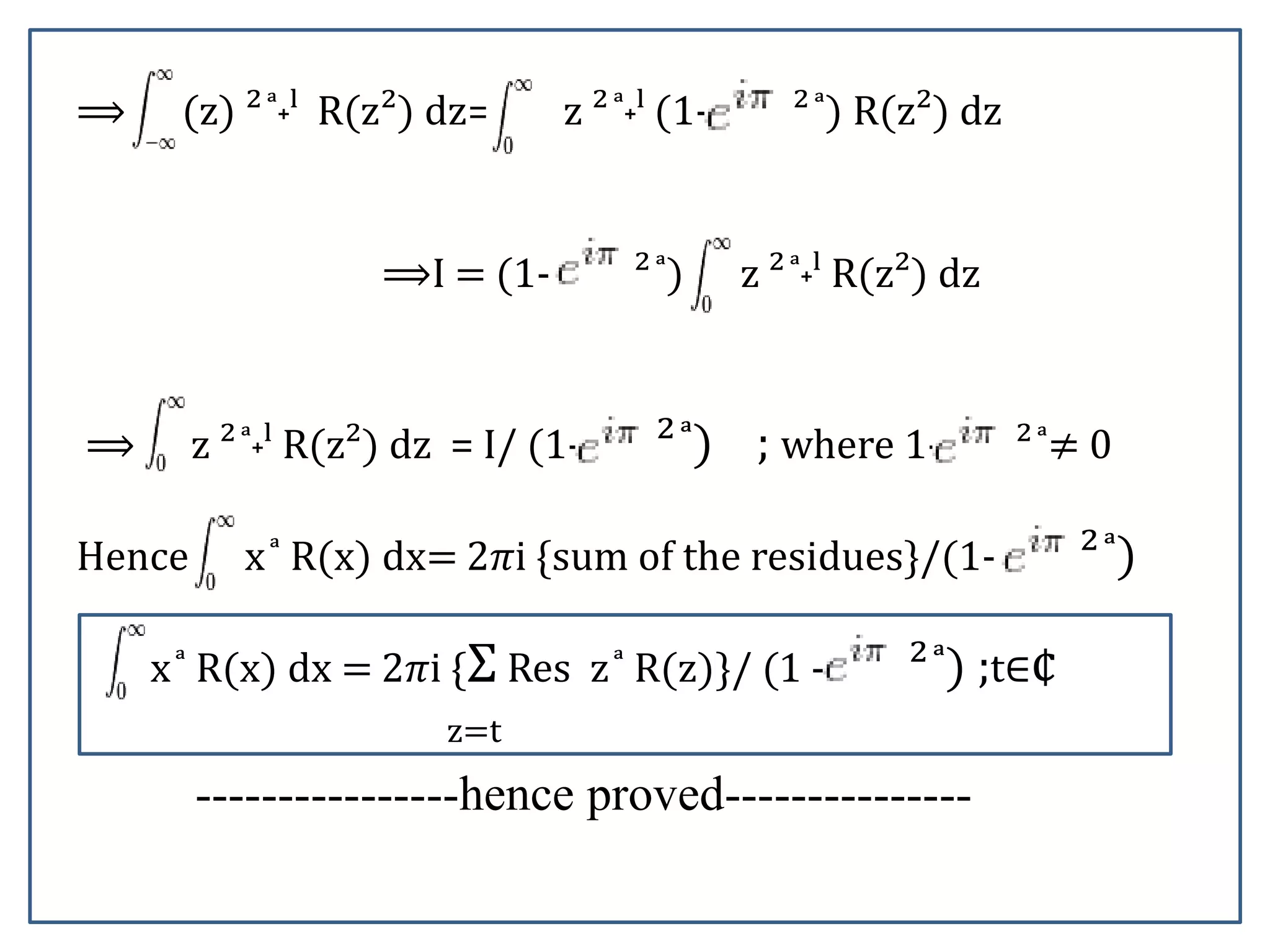
⟹ (z) ² ͣ˖ˡ R(z²) dz= z ² ͣ˖ˡ (1- ² ͣ) R(z²) dz
⟹I = (1- ² ͣ) z ² ͣ˖ˡ R(z²) dz
⟹ z ² ͣ˖ˡ R(z²) dz = I/ (1- ² ͣ) ; where 1- ² ͣ≠ 0
Hence x ͣ R(x) dx= 2𝜋i {sum of the residues}/(1- ² ͣ)
x ͣ R(x) dx = 2𝜋i {Σ Res z ͣ R(z)}/ (1 - ² ͣ) ;t∈¢
z=t
----------------hence proved---------------
Thank You!!!

Advanced Complex Analysis

  • 1.
    Advanced ComplexAnalysis Type-VI Integral isof the form of I= x ͣ R(x) dx. Where R(x) x ͣ is a rational functional of order atleast two and atmost a simple pole at the origin and 0<a<1. Putting x= t² ⟹I= (t²) ͣ R(t²) 2t dt = 2 (t) ² ͣ˖ˡ R(t²) dt = (t) ² ͣ˖ˡ R(t²) dt
  • 2.
    Choosing a closedcurve C consisting of segment C₁ from –X to –δ along the real axis as shown in fig:01. The semicircle C₂ from –δ to δ in the upper half plane. The segment C₃ from δ to X on the real axis and the semicircle C₄ from X to –X in the positive direction. Under the assumption on R(z) z ͣ ; We can show that the integrals along C₂ and C₄ tends zero(0) as X⟶∞ and δ⟶0. fig:01 ∴ ∫ (z) ² ͣ˖ˡ R(z²)dz= ∫ (z) ² ͣ˖ˡ R(z²)dz + ∫ (z) ² ͣ˖ˡ R(z²)dz + C C₁ C₂ ∫ (z) ² ͣ˖ˡ R(z²)dz + ∫ (z) ² ͣ˖ˡ R(z²)dz C₃ C₄ .> > > C₁ C₃ C₂ C₄ . . . . (-X,0) (-δ,0) (δ,0) (X,0)
  • 3.
    As X⟶∞ andδ⟶0; ∫ (z) ² ͣ˖ˡ R(z²)dz=0 & ∫ (z) ² ͣ˖ˡ R(z²)dz=0 C ₂ C₄ ∴ ∫(z) ² ͣ˖ˡ R(z²)dz= ∫ (z) ² ͣ˖ˡ R(z²)dz + ∫ (z) ² ͣ˖ˡ R(z²)dz C C₁ C₃ =∫ ̅ᵟ (z) ² ͣ˖ˡ R(z²) dz +∫ˣ (z) ² ͣ˖ˡ R(z²) dz -X δ ⟹Lt ∫(z) ² ͣ˖ˡ R(z²)dz = Lt [ ∫ᵟ (-z) ² ͣ˖ˡ R(z²)(-dz) +∫ˣ (z) ² ͣ˖ˡ R(z²)dz] X⟶∞ C X⟶∞ X δ δ⟶0 δ⟶0 ⟹ (z) ² ͣ˖ˡ R(z²)dz = = Lt [ ∫ˣ (-z) ² ͣ˖ˡ R(z²)(dz) +∫ˣ (z) ² ͣ˖ˡ R(z²)dz] X⟶∞ δ δ δ⟶0
  • 4.
    ⟹ (z) ²ͣ˖ˡ R(z²)dz= (-z) ² ͣ˖ˡ R(z²)(dz) + (z) ² ͣ˖ˡ R(z²)dz = [(-z) ² ͣ˖ˡ + (z) ² ͣ˖ˡ ] R(z²)dz = [z ² ͣ˖ˡ (-1) ² ͣ˖ˡ + z ² ͣ˖ˡ ] R(z²)dz = [z ² ͣ˖ˡ (-1)(-1) ² ͣ + z ² ͣ˖ˡ ] R(z²)dz = [z ² ͣ˖ˡ (-1)( ) ² ͣ + z ² ͣ˖ˡ ] R(z²)dz { ∵ =cos 𝜋+isin𝜋=-1} = [ [ - ² ͣ z ² ͣ˖ˡ + z ² ͣ˖ˡ ] R(z²) dz .
  • 5.
    ⟹ (z) ²ͣ˖ˡ R(z²) dz= z ² ͣ˖ˡ (1- ² ͣ) R(z²) dz ⟹I = (1- ² ͣ) z ² ͣ˖ˡ R(z²) dz ⟹ z ² ͣ˖ˡ R(z²) dz = I/ (1- ² ͣ) ; where 1- ² ͣ≠ 0 Hence x ͣ R(x) dx= 2𝜋i {sum of the residues}/(1- ² ͣ) x ͣ R(x) dx = 2𝜋i {Σ Res z ͣ R(z)}/ (1 - ² ͣ) ;t∈¢ z=t ----------------hence proved---------------
  • 6.