GROUPS
ADVANCED GROUP THEORY
References
GROUP THEORY
Shinoj K.M.
Department of Mathematics
St.Joseph’s College,Devagiri
Kozhikode-8
shinusaraswathy@gmail.com
8 December 2018
Shinoj K.M. Department of MathematicsGROUP THEORY
GROUPS
ADVANCED GROUP THEORY
References
Outline
1 GROUPS
Order
Cyclic Groups
Normal Subgroups
2 ADVANCED GROUP THEORY
Direct product of groups
Fundamental Theorem of finite Abelian groups
Classification of groups of order up to 10
Shinoj K.M. Department of MathematicsGROUP THEORY
GROUPS
ADVANCED GROUP THEORY
References
Order
Cyclic Groups
Normal Subgroups
Definition
A set G together with a binary operation ∗ is called a group if
G is closed w.r.t. ∗
∗ is associative
there exists an identity element in G
for each element in G there is an inverse in G
If ∗ is commutative, then G is an Abelian group.
If ∗ is not commutative, then G is called a non-Abelian group.
Shinoj K.M. Department of MathematicsGROUP THEORY
GROUPS
ADVANCED GROUP THEORY
References
Order
Cyclic Groups
Normal Subgroups
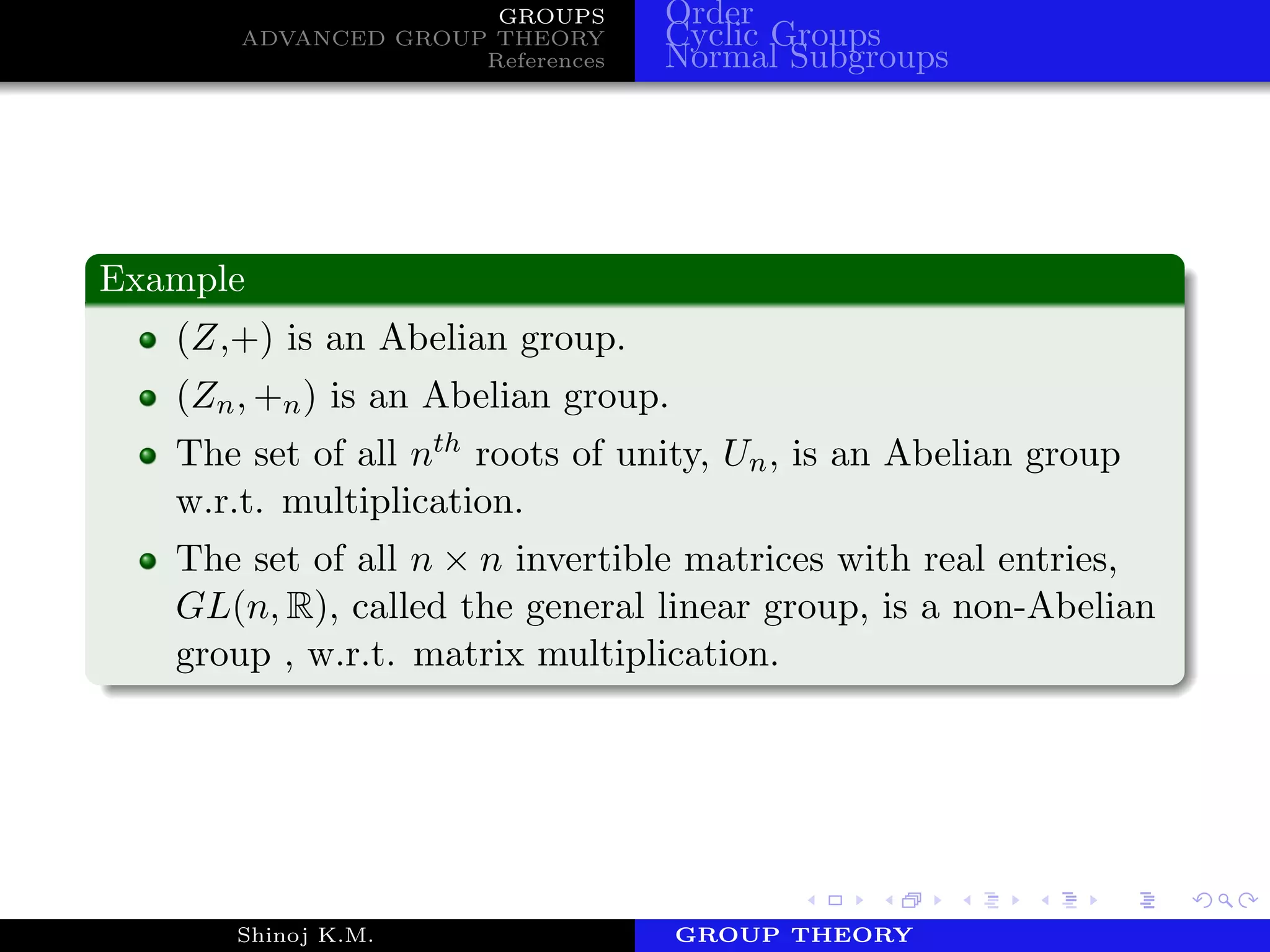
Example
(Z,+) is an Abelian group.
(Zn, +n) is an Abelian group.
The set of all nth roots of unity, Un, is an Abelian group
w.r.t. multiplication.
The set of all n × n invertible matrices with real entries,
GL(n, R), called the general linear group, is a non-Abelian
group , w.r.t. matrix multiplication.
Shinoj K.M. Department of MathematicsGROUP THEORY
GROUPS
ADVANCED GROUP THEORY
References
Order
Cyclic Groups
Normal Subgroups
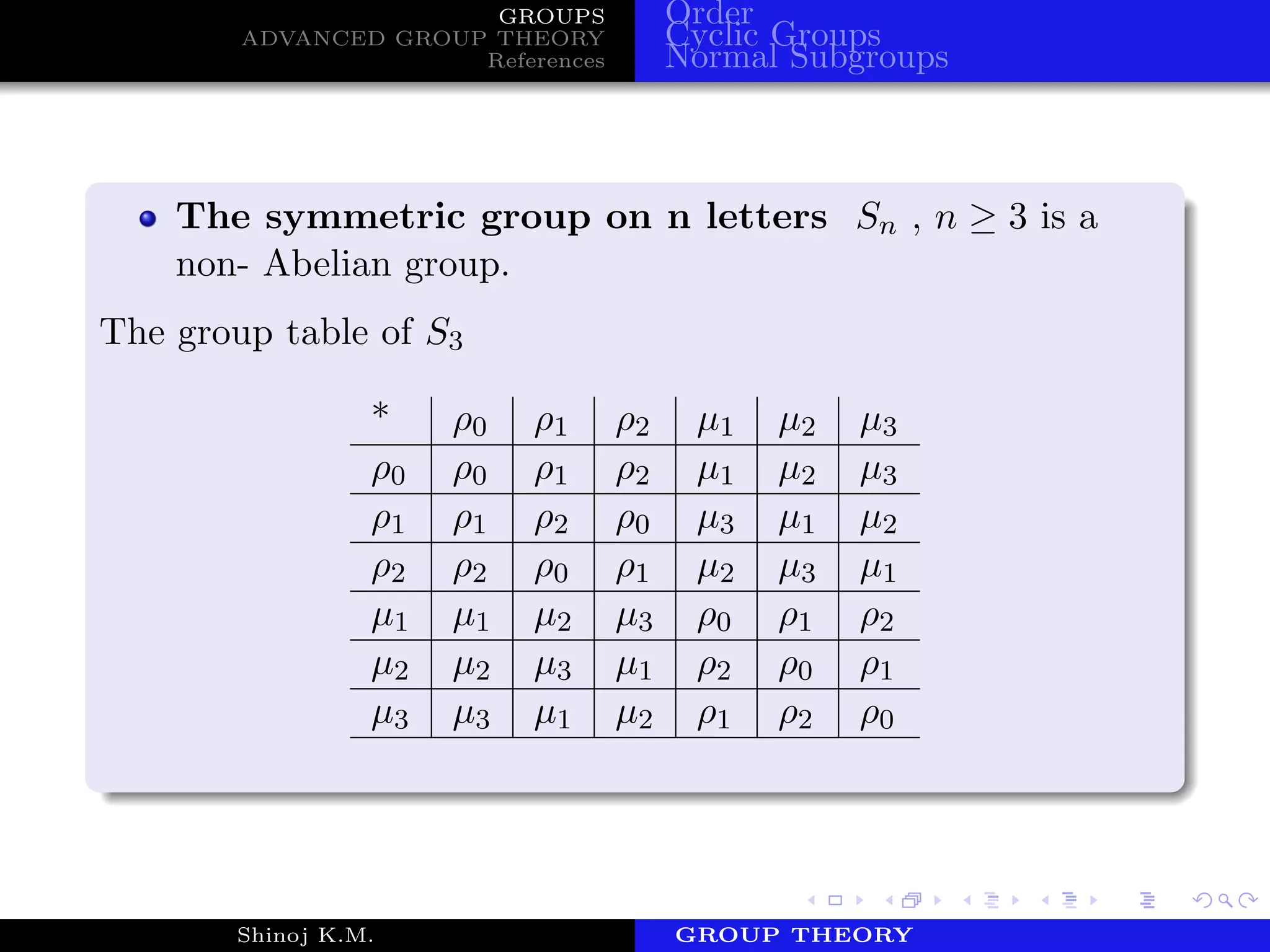
The symmetric group on n letters Sn , n ≥ 3 is a
non- Abelian group.
The group table of S3
* ρ0 ρ1 ρ2 µ1 µ2 µ3
ρ0 ρ0 ρ1 ρ2 µ1 µ2 µ3
ρ1 ρ1 ρ2 ρ0 µ3 µ1 µ2
ρ2 ρ2 ρ0 ρ1 µ2 µ3 µ1
µ1 µ1 µ2 µ3 ρ0 ρ1 ρ2
µ2 µ2 µ3 µ1 ρ2 ρ0 ρ1
µ3 µ3 µ1 µ2 ρ1 ρ2 ρ0
Shinoj K.M. Department of MathematicsGROUP THEORY
GROUPS
ADVANCED GROUP THEORY
References
Order
Cyclic Groups
Normal Subgroups
Fact
The equation x2 = e has 4 solutions in Klein-4 group.
The equation x2 = −1 has 6 solutions in Q8.
So a polynomial equation of degree n can have
more than n solutions in a group.
Shinoj K.M. Department of MathematicsGROUP THEORY
GROUPS
ADVANCED GROUP THEORY
References
Order
Cyclic Groups
Normal Subgroups
Order
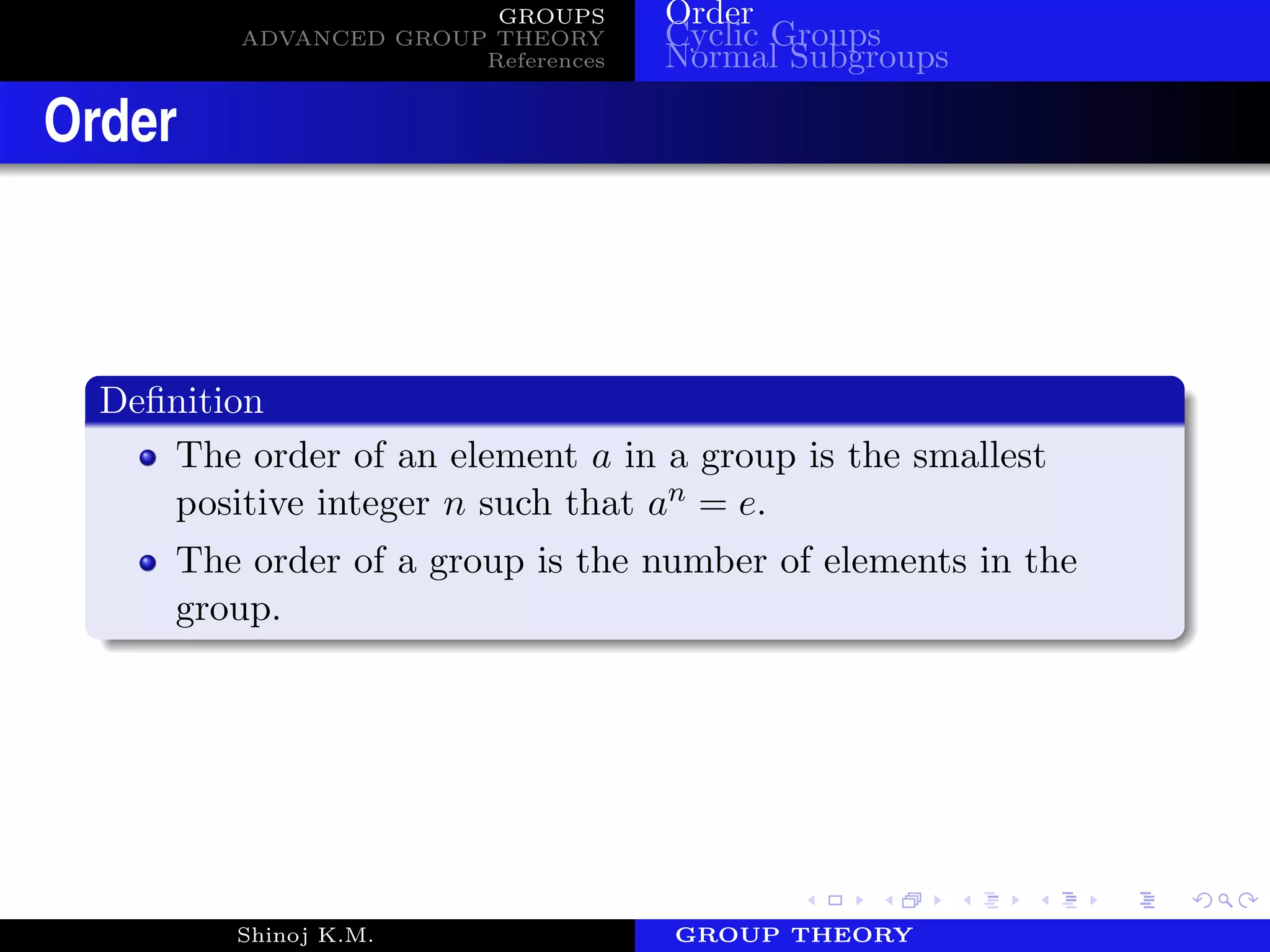
Definition
The order of an element a in a group is the smallest
positive integer n such that an = e.
The order of a group is the number of elements in the
group.
Shinoj K.M. Department of MathematicsGROUP THEORY
GROUPS
ADVANCED GROUP THEORY
References
Order
Cyclic Groups
Normal Subgroups
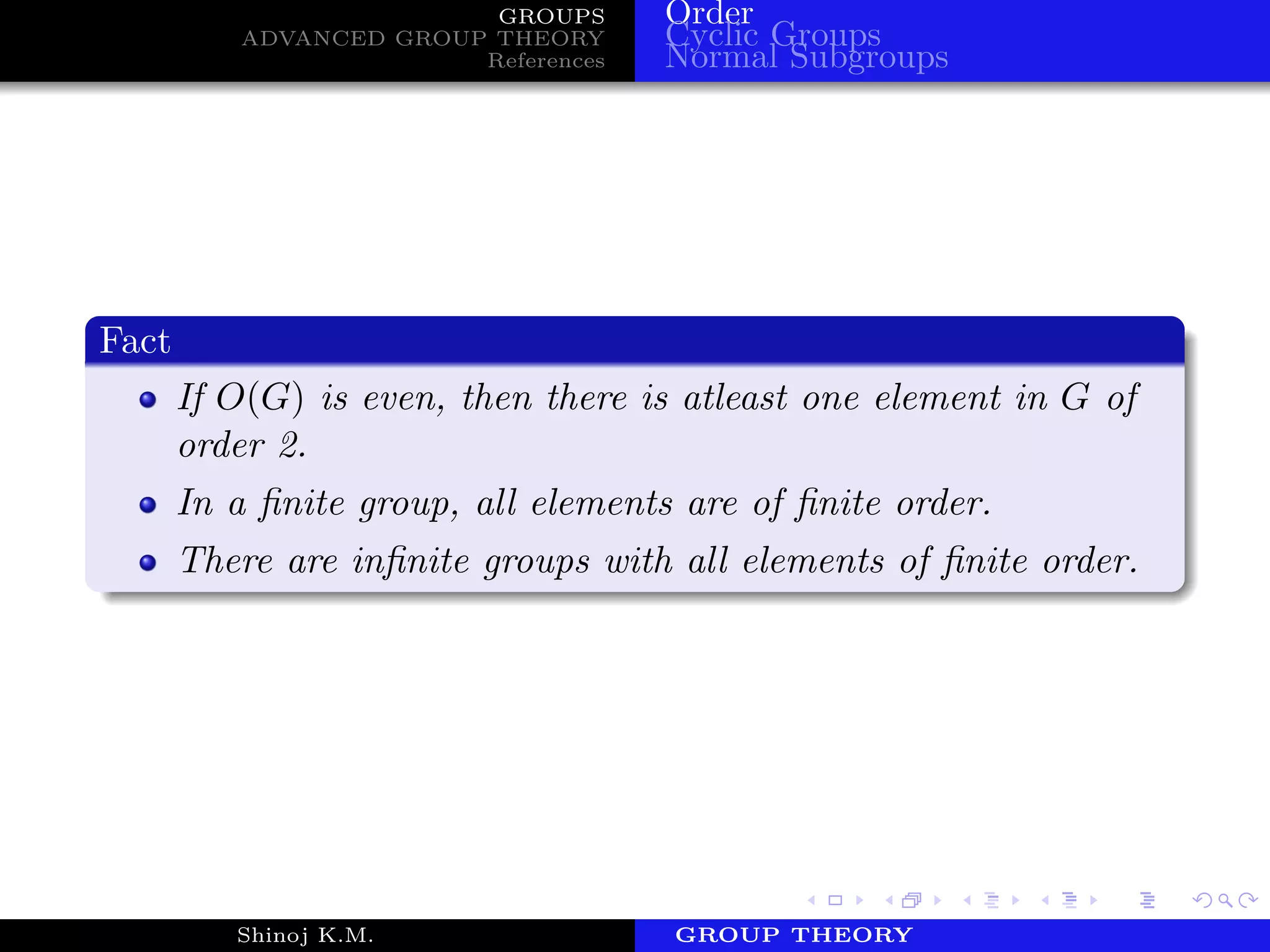
Fact
If O(G) is even, then there is atleast one element in G of
order 2.
In a finite group, all elements are of finite order.
There are infinite groups with all elements of finite order.
Shinoj K.M. Department of MathematicsGROUP THEORY
GROUPS
ADVANCED GROUP THEORY
References
Order
Cyclic Groups
Normal Subgroups
Definition
Let G be an abelian group.
Then Gt = {u ∈ G/O(u) is finite }, is a subgroup of G,
called the torsion subgroup of G.
If Gt = {0}, then G is said to be torsion free.
If Gt = G, then G is called a torsion group.
Shinoj K.M. Department of MathematicsGROUP THEORY
GROUPS
ADVANCED GROUP THEORY
References
Order
Cyclic Groups
Normal Subgroups
Example
Zn and all finite Abelian groups are torsion groups.
Z and Z × Z are torsion free groups.
Z × Z2 is neither torsion group nor torsion free group.
Shinoj K.M. Department of MathematicsGROUP THEORY
GROUPS
ADVANCED GROUP THEORY
References
Order
Cyclic Groups
Normal Subgroups
If G is a non-abelian group, there can be two
elements of finite order whose product is of infinite
order.
Shinoj K.M. Department of MathematicsGROUP THEORY
GROUPS
ADVANCED GROUP THEORY
References
Order
Cyclic Groups
Normal Subgroups
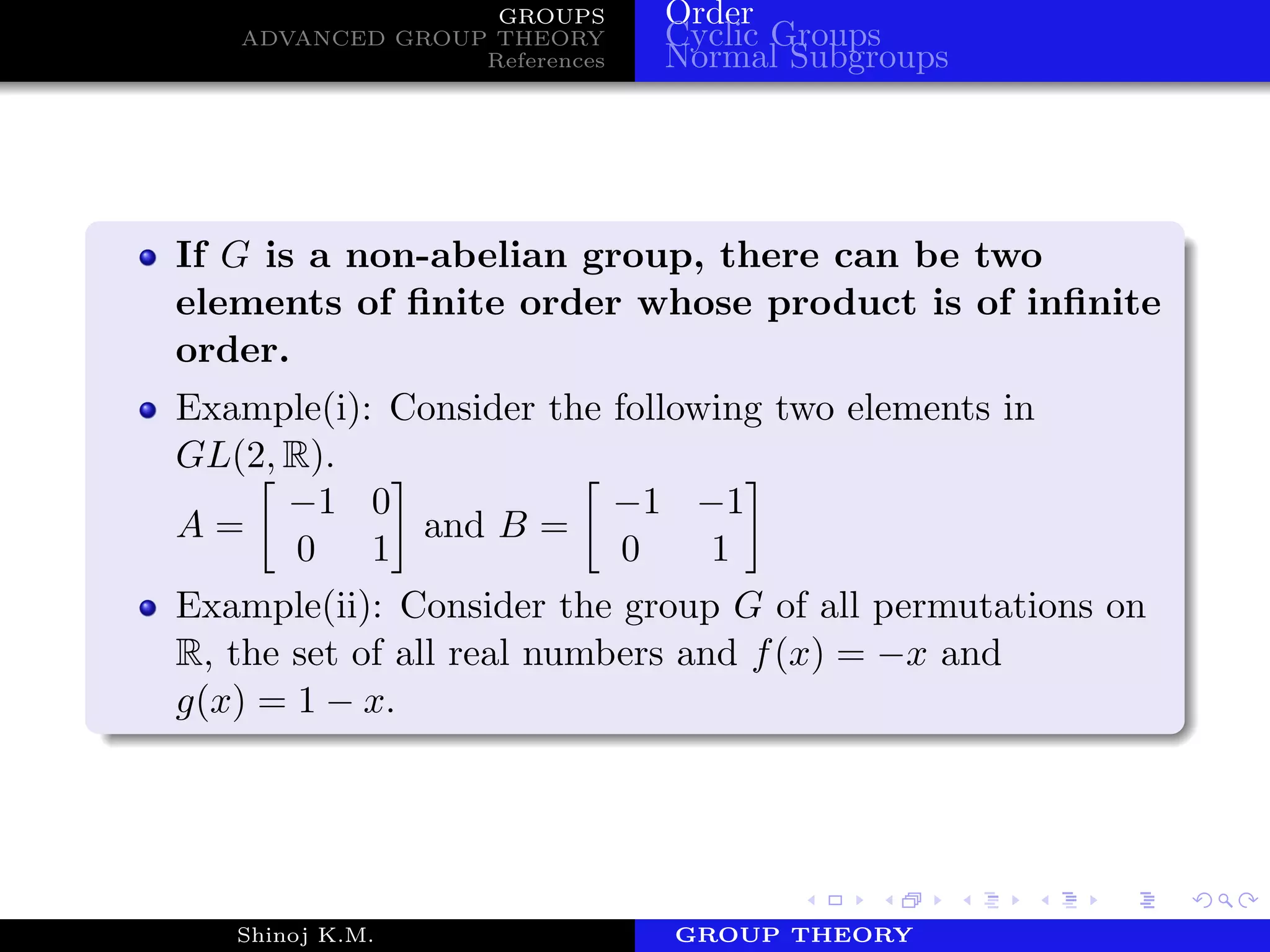
If G is a non-abelian group, there can be two
elements of finite order whose product is of infinite
order.
Example(i): Consider the following two elements in
GL(2, R).
A =
−1 0
0 1
and B =
−1 −1
0 1
Example(ii): Consider the group G of all permutations on
R, the set of all real numbers and f(x) = −x and
g(x) = 1 − x.
Shinoj K.M. Department of MathematicsGROUP THEORY
GROUPS
ADVANCED GROUP THEORY
References
Order
Cyclic Groups
Normal Subgroups
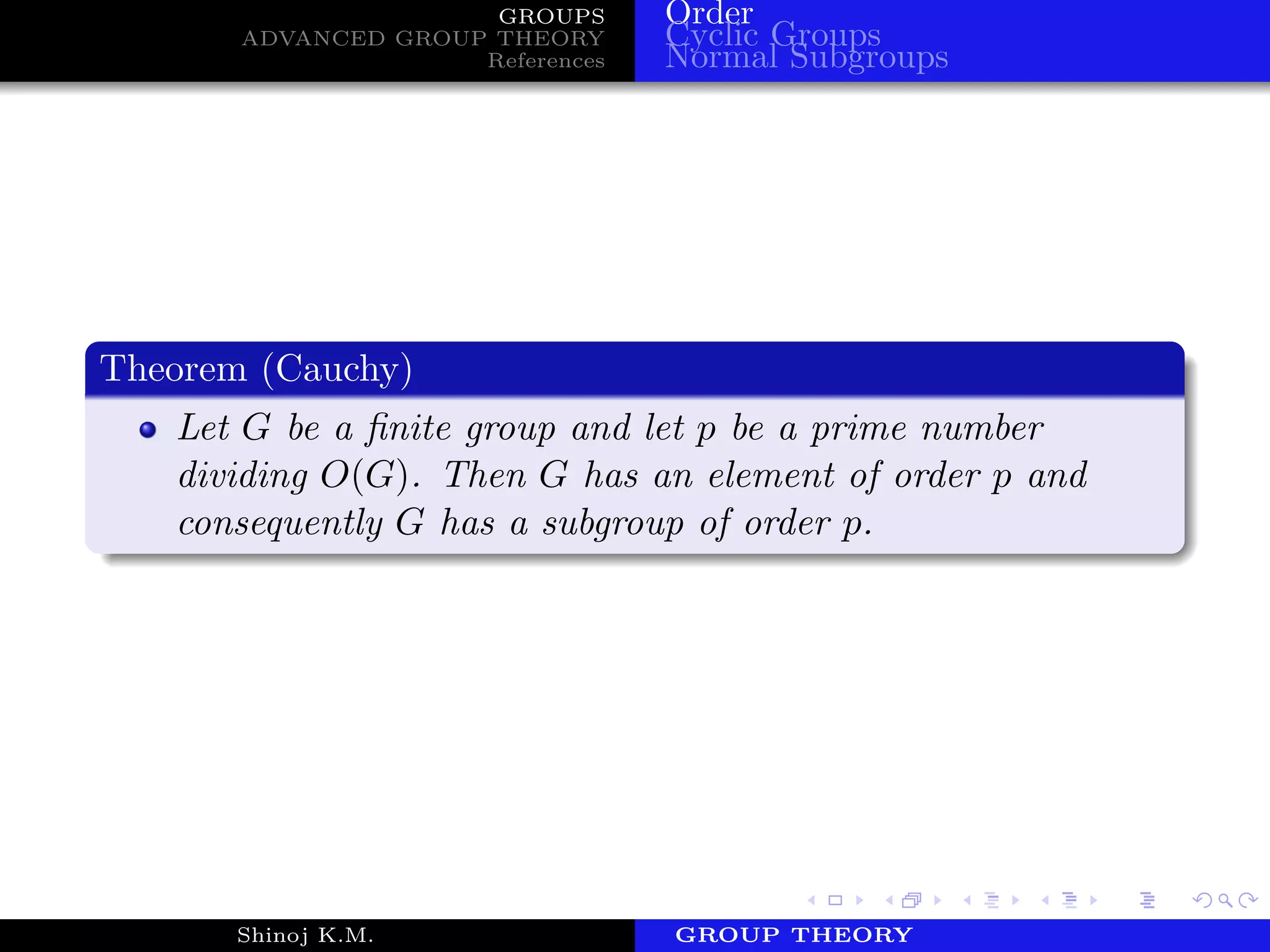
Theorem (Cauchy)
Let G be a finite group and let p be a prime number
dividing O(G). Then G has an element of order p and
consequently G has a subgroup of order p.
Shinoj K.M. Department of MathematicsGROUP THEORY
GROUPS
ADVANCED GROUP THEORY
References
Order
Cyclic Groups
Normal Subgroups
Let O(G) = n and d divides n. Does there always exist
an element in G of order d ?
Shinoj K.M. Department of MathematicsGROUP THEORY
GROUPS
ADVANCED GROUP THEORY
References
Order
Cyclic Groups
Normal Subgroups
Let O(G) = n and d divides n. Does there always exist
an element in G of order d ?
Need not!! Look at the following examples.
Klein-4 group.
S3
Z2 × Z4.
Z2 × Z2 × Z2
Shinoj K.M. Department of MathematicsGROUP THEORY
GROUPS
ADVANCED GROUP THEORY
References
Order
Cyclic Groups
Normal Subgroups
Cyclic Groups
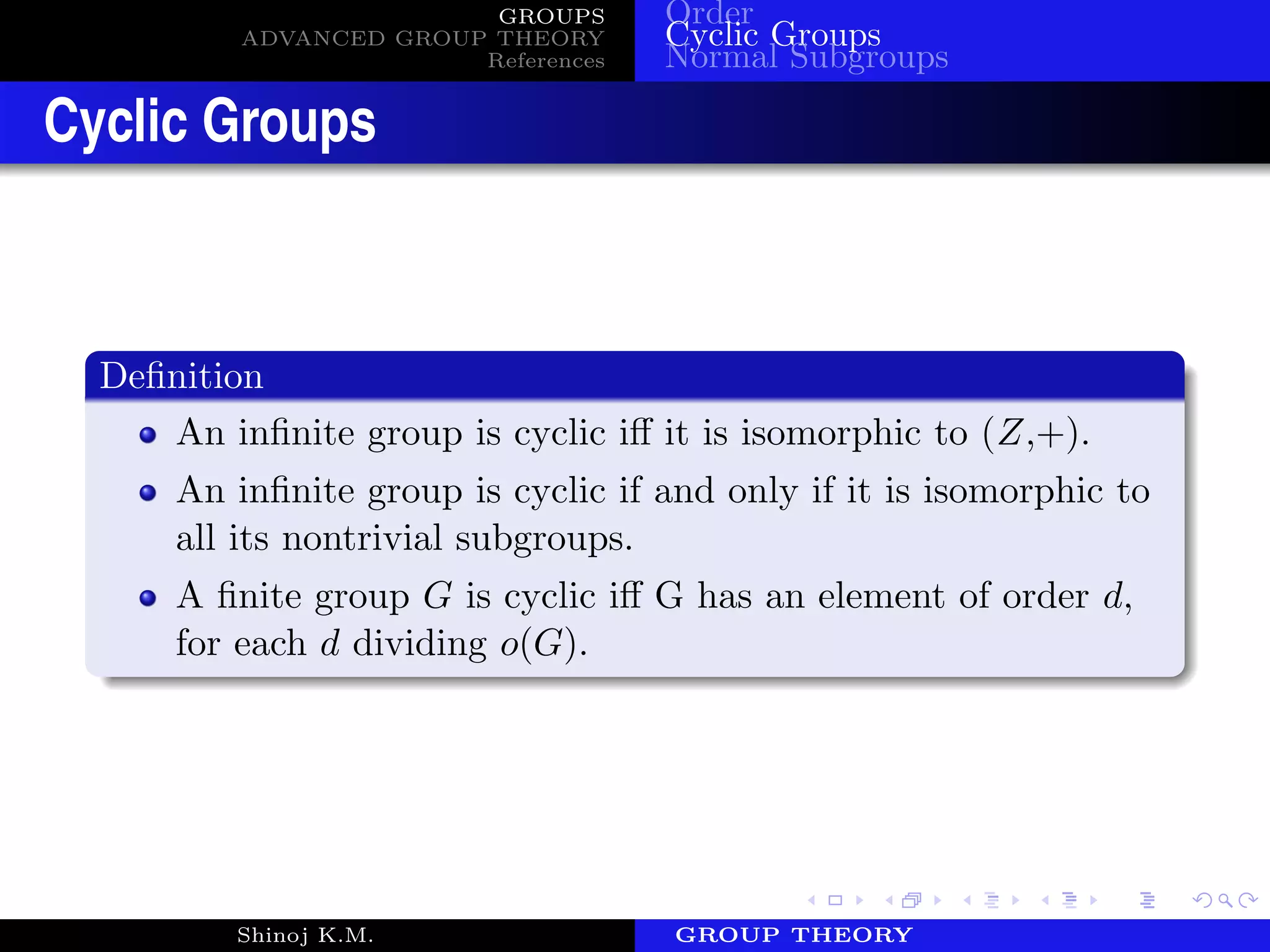
Definition
An infinite group is cyclic iff it is isomorphic to (Z,+).
An infinite group is cyclic if and only if it is isomorphic to
all its nontrivial subgroups.
A finite group G is cyclic iff G has an element of order d,
for each d dividing o(G).
Shinoj K.M. Department of MathematicsGROUP THEORY
GROUPS
ADVANCED GROUP THEORY
References
Order
Cyclic Groups
Normal Subgroups
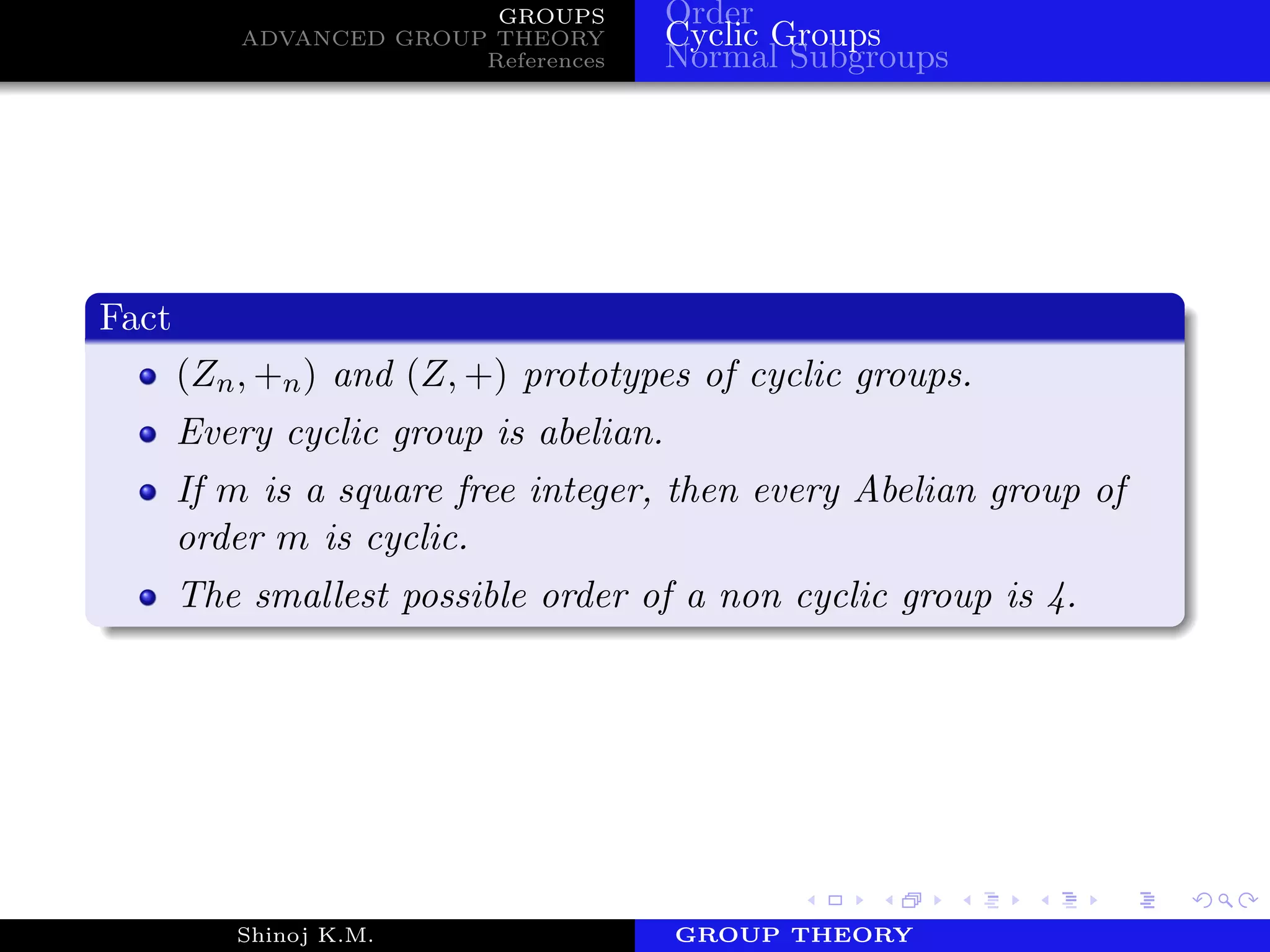
Fact
(Zn, +n) and (Z, +) prototypes of cyclic groups.
Every cyclic group is abelian.
If m is a square free integer, then every Abelian group of
order m is cyclic.
The smallest possible order of a non cyclic group is 4.
Shinoj K.M. Department of MathematicsGROUP THEORY
GROUPS
ADVANCED GROUP THEORY
References
Order
Cyclic Groups
Normal Subgroups
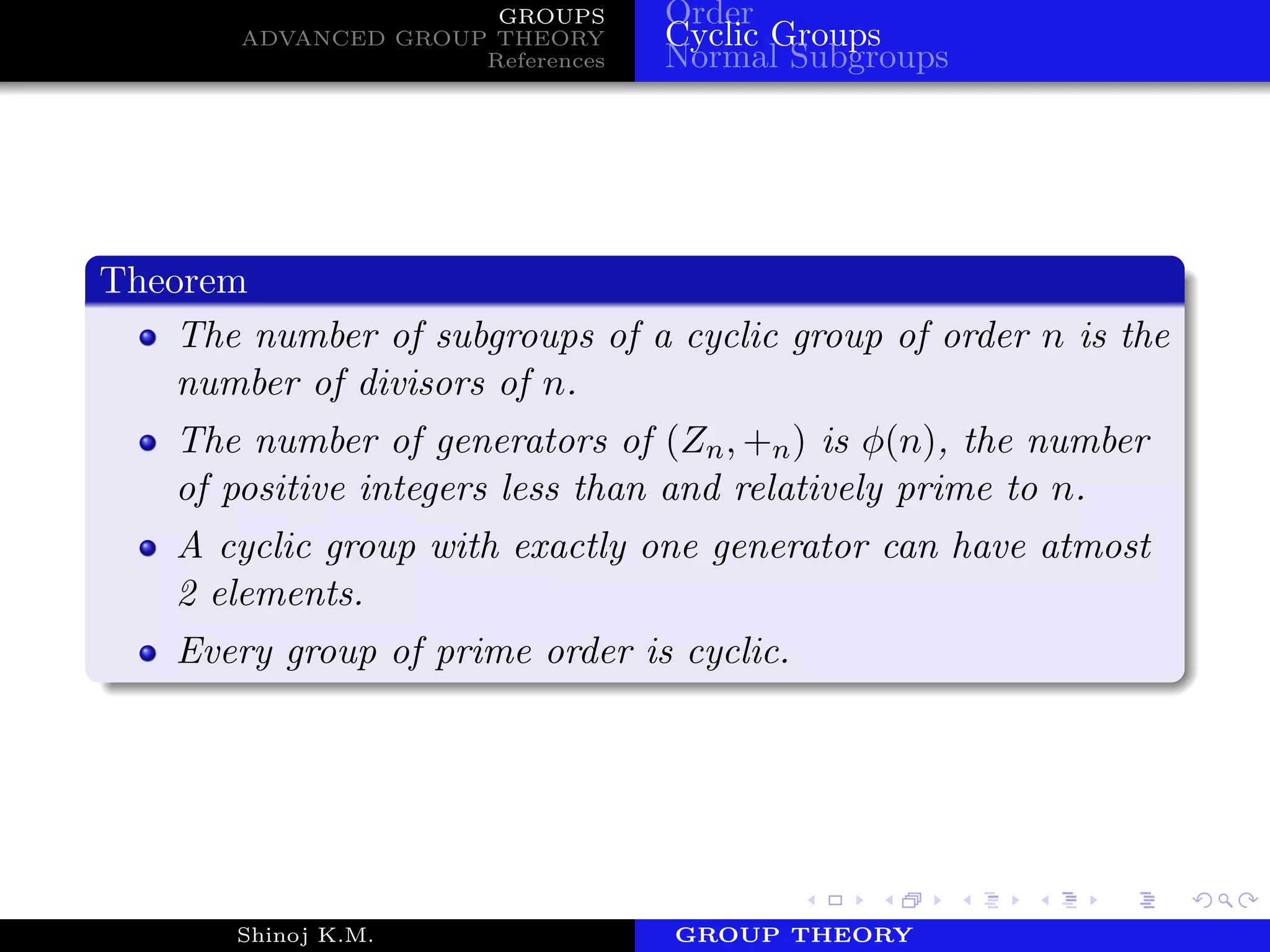
Theorem
The number of subgroups of a cyclic group of order n is the
number of divisors of n.
The number of generators of (Zn, +n) is φ(n), the number
of positive integers less than and relatively prime to n.
A cyclic group with exactly one generator can have atmost
2 elements.
Every group of prime order is cyclic.
Shinoj K.M. Department of MathematicsGROUP THEORY
GROUPS
ADVANCED GROUP THEORY
References
Order
Cyclic Groups
Normal Subgroups
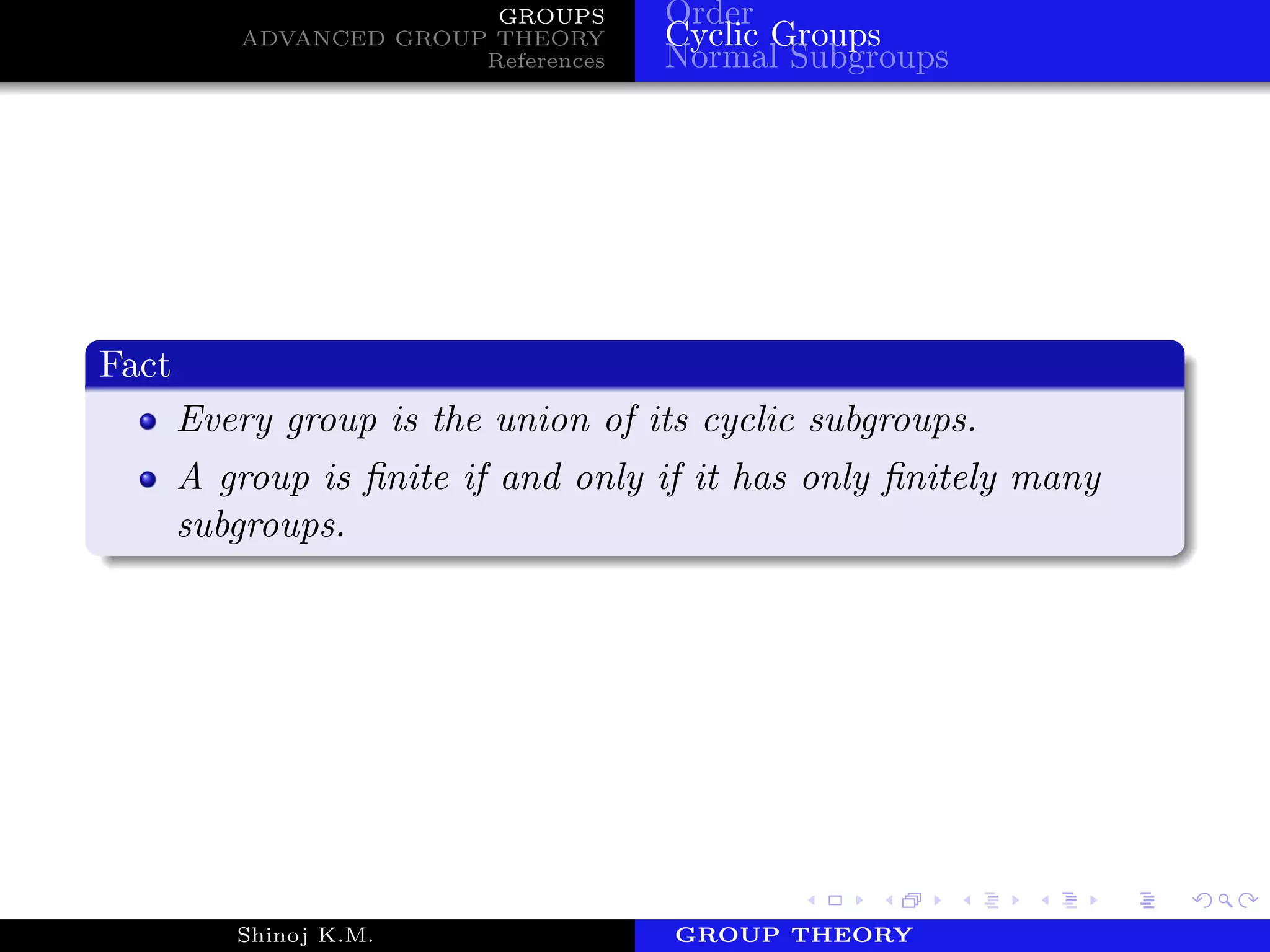
Fact
Every group is the union of its cyclic subgroups.
A group is finite if and only if it has only finitely many
subgroups.
Shinoj K.M. Department of MathematicsGROUP THEORY
GROUPS
ADVANCED GROUP THEORY
References
Order
Cyclic Groups
Normal Subgroups
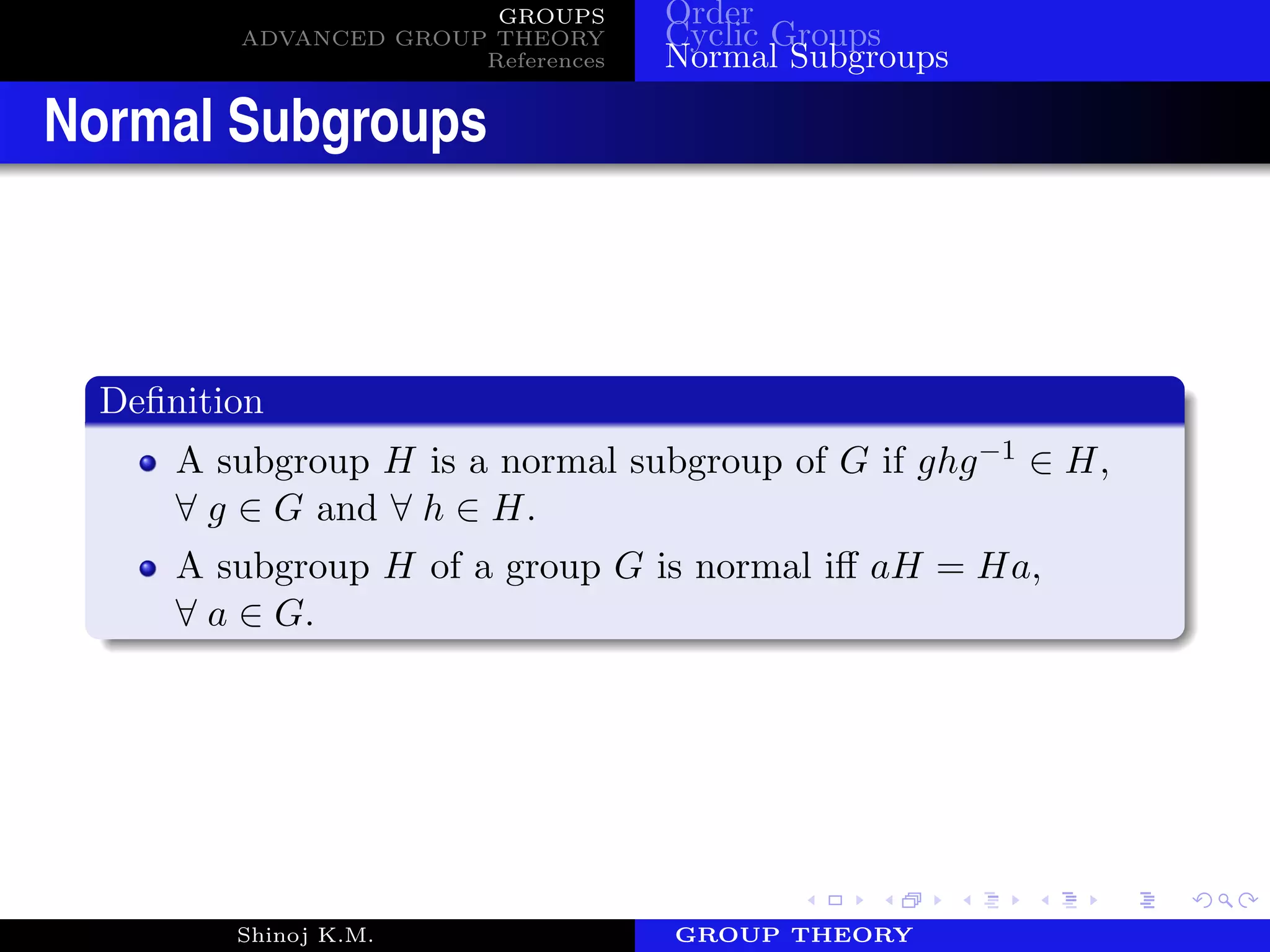
Normal Subgroups
Definition
A subgroup H is a normal subgroup of G if ghg−1 ∈ H,
∀ g ∈ G and ∀ h ∈ H.
A subgroup H of a group G is normal iff aH = Ha,
∀ a ∈ G.
Shinoj K.M. Department of MathematicsGROUP THEORY
GROUPS
ADVANCED GROUP THEORY
References
Order
Cyclic Groups
Normal Subgroups
Example
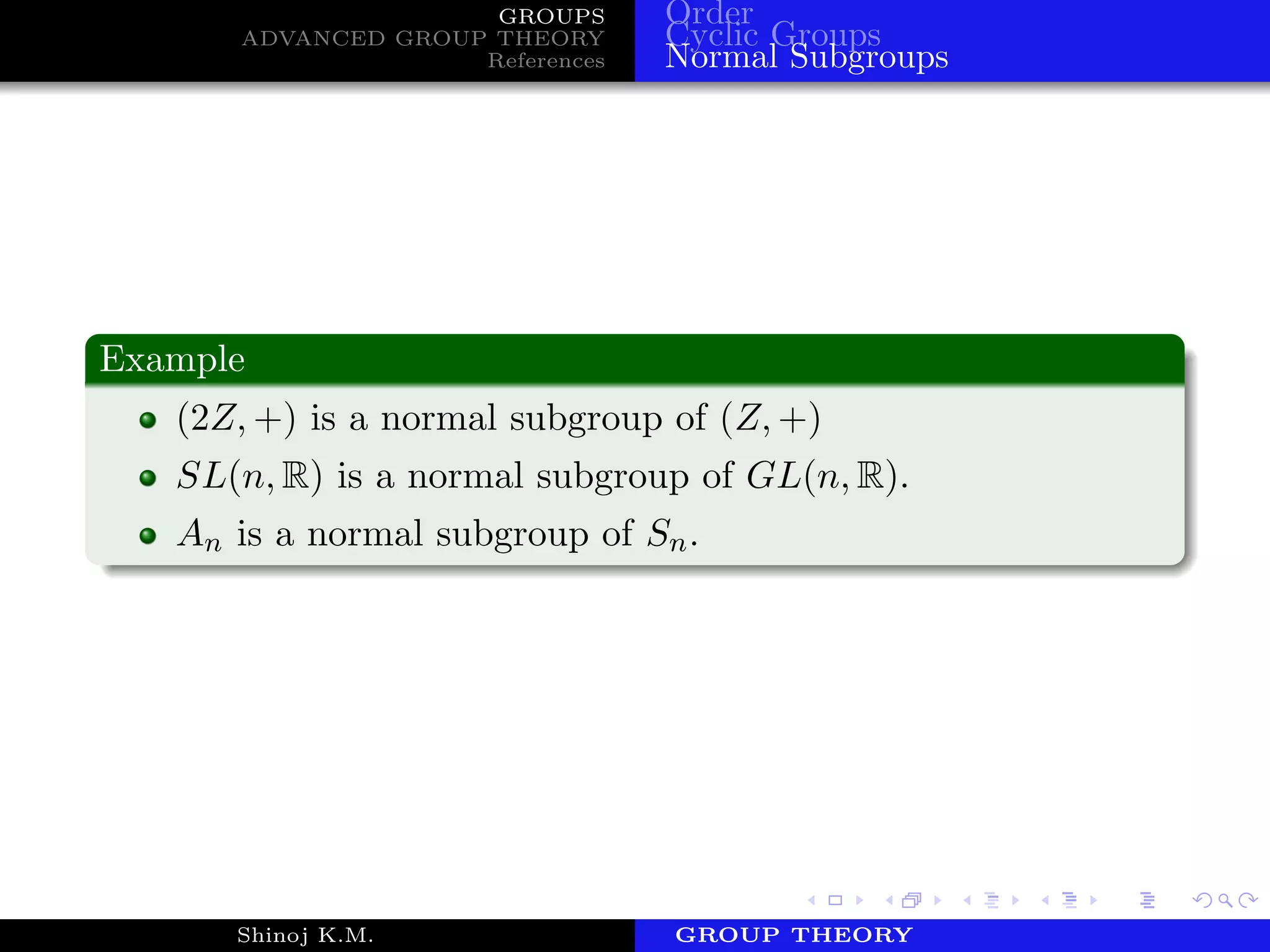
(2Z, +) is a normal subgroup of (Z, +)
SL(n, R) is a normal subgroup of GL(n, R).
An is a normal subgroup of Sn.
Shinoj K.M. Department of MathematicsGROUP THEORY
GROUPS
ADVANCED GROUP THEORY
References
Order
Cyclic Groups
Normal Subgroups
Theorem
Every subgroup of an abelian group is normal.
Shinoj K.M. Department of MathematicsGROUP THEORY
GROUPS
ADVANCED GROUP THEORY
References
Order
Cyclic Groups
Normal Subgroups
Theorem
Every subgroup of an abelian group is normal.
Question:Let G be a group such that all its
subgroups are normal. Can we conclude that G is
abelian?
Shinoj K.M. Department of MathematicsGROUP THEORY
GROUPS
ADVANCED GROUP THEORY
References
Order
Cyclic Groups
Normal Subgroups
Theorem
Every subgroup of an abelian group is normal.
Question:Let G be a group such that all its
subgroups are normal. Can we conclude that G is
abelian?
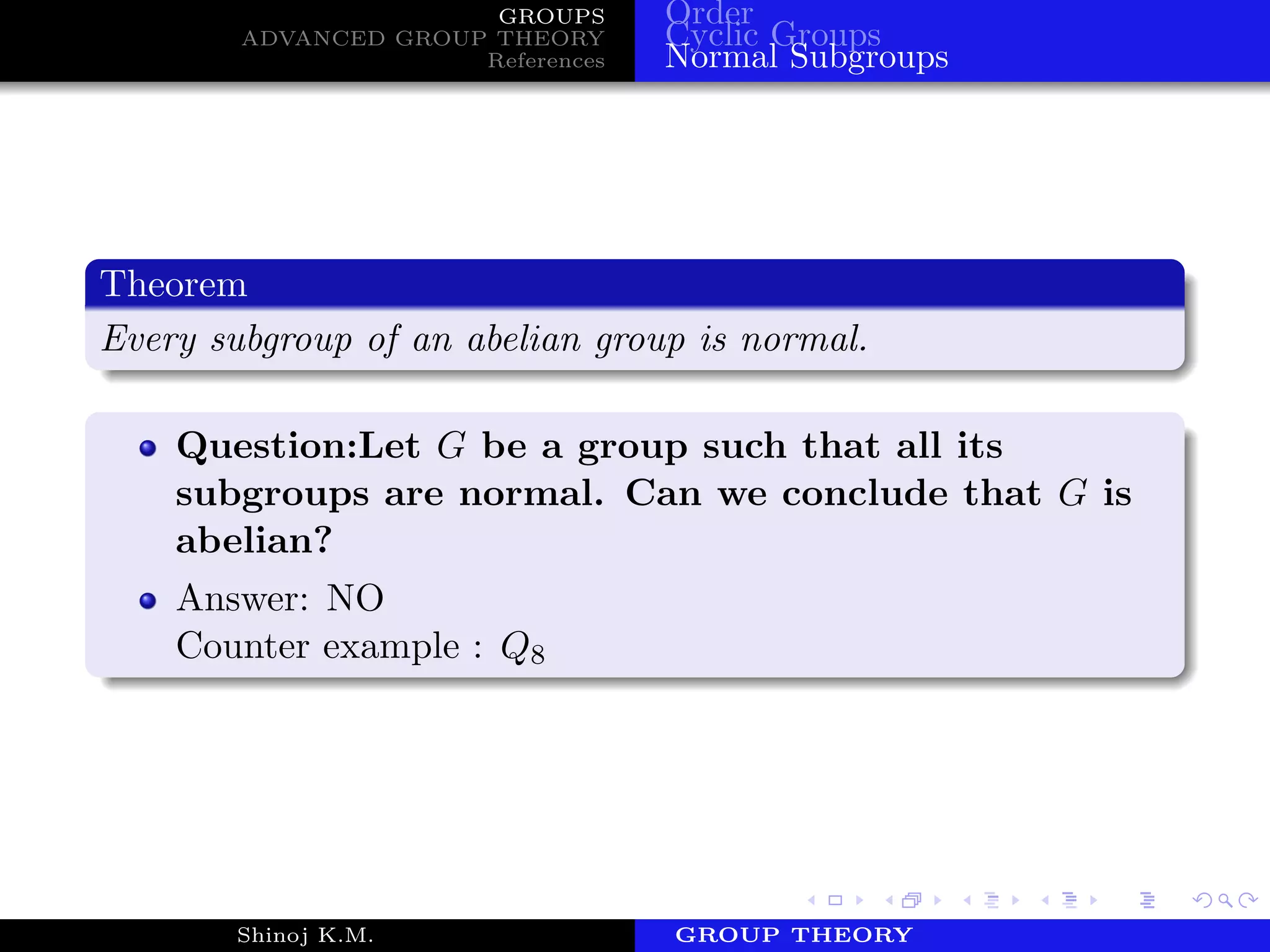
Answer: NO
Counter example : Q8
Shinoj K.M. Department of MathematicsGROUP THEORY
GROUPS
ADVANCED GROUP THEORY
References
Order
Cyclic Groups
Normal Subgroups
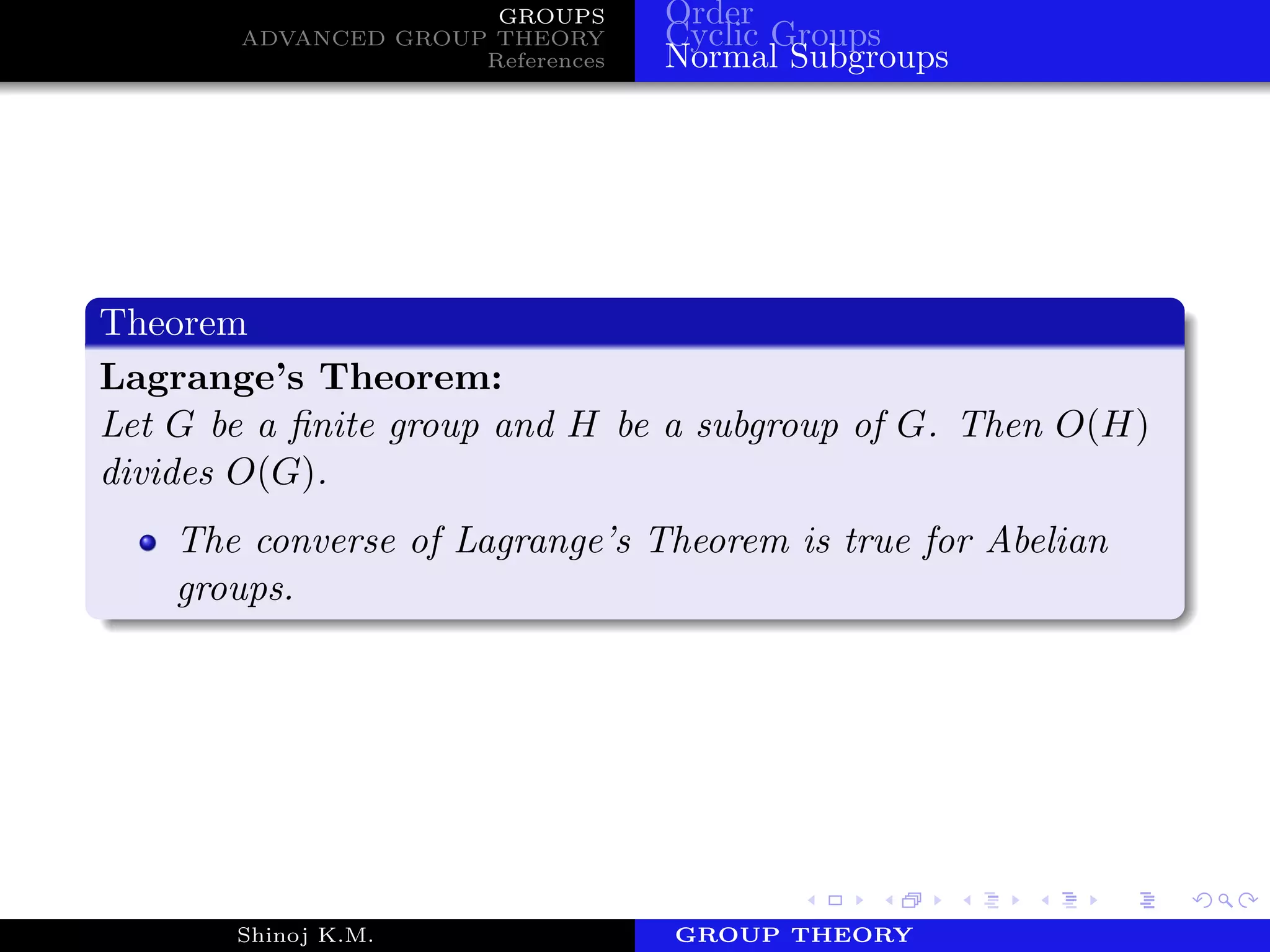
Theorem
Lagrange’s Theorem:
Let G be a finite group and H be a subgroup of G. Then O(H)
divides O(G).
The converse of Lagrange’s Theorem is true for Abelian
groups.
Shinoj K.M. Department of MathematicsGROUP THEORY
GROUPS
ADVANCED GROUP THEORY
References
Order
Cyclic Groups
Normal Subgroups
Question: Suppose G is a finite group and it has
subgroups of order d for each d dividing n. Can we
conclude that G is abelian?
Shinoj K.M. Department of MathematicsGROUP THEORY
GROUPS
ADVANCED GROUP THEORY
References
Order
Cyclic Groups
Normal Subgroups
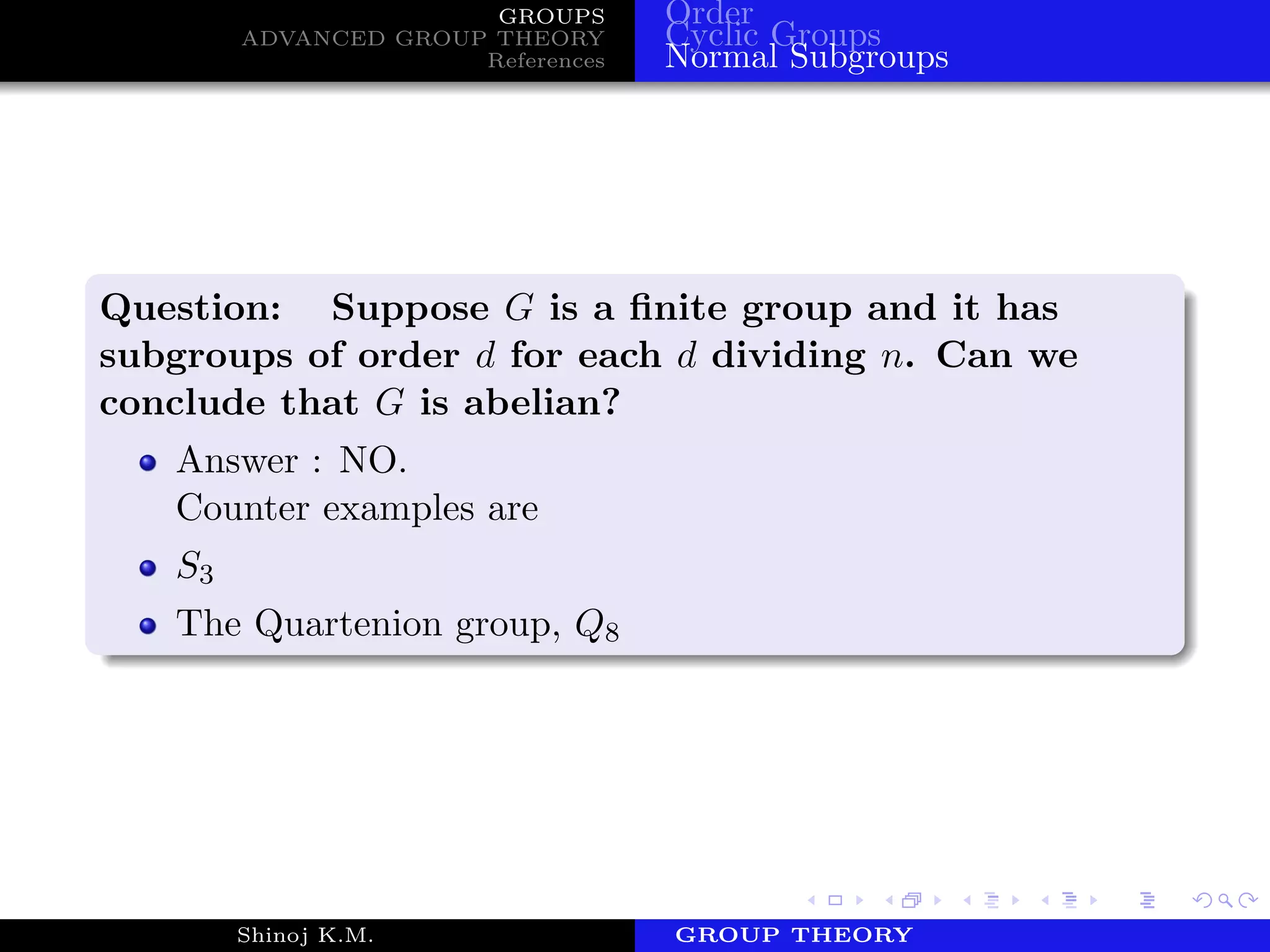
Question: Suppose G is a finite group and it has
subgroups of order d for each d dividing n. Can we
conclude that G is abelian?
Answer : NO.
Counter examples are
S3
The Quartenion group, Q8
Shinoj K.M. Department of MathematicsGROUP THEORY
GROUPS
ADVANCED GROUP THEORY
References
Order
Cyclic Groups
Normal Subgroups
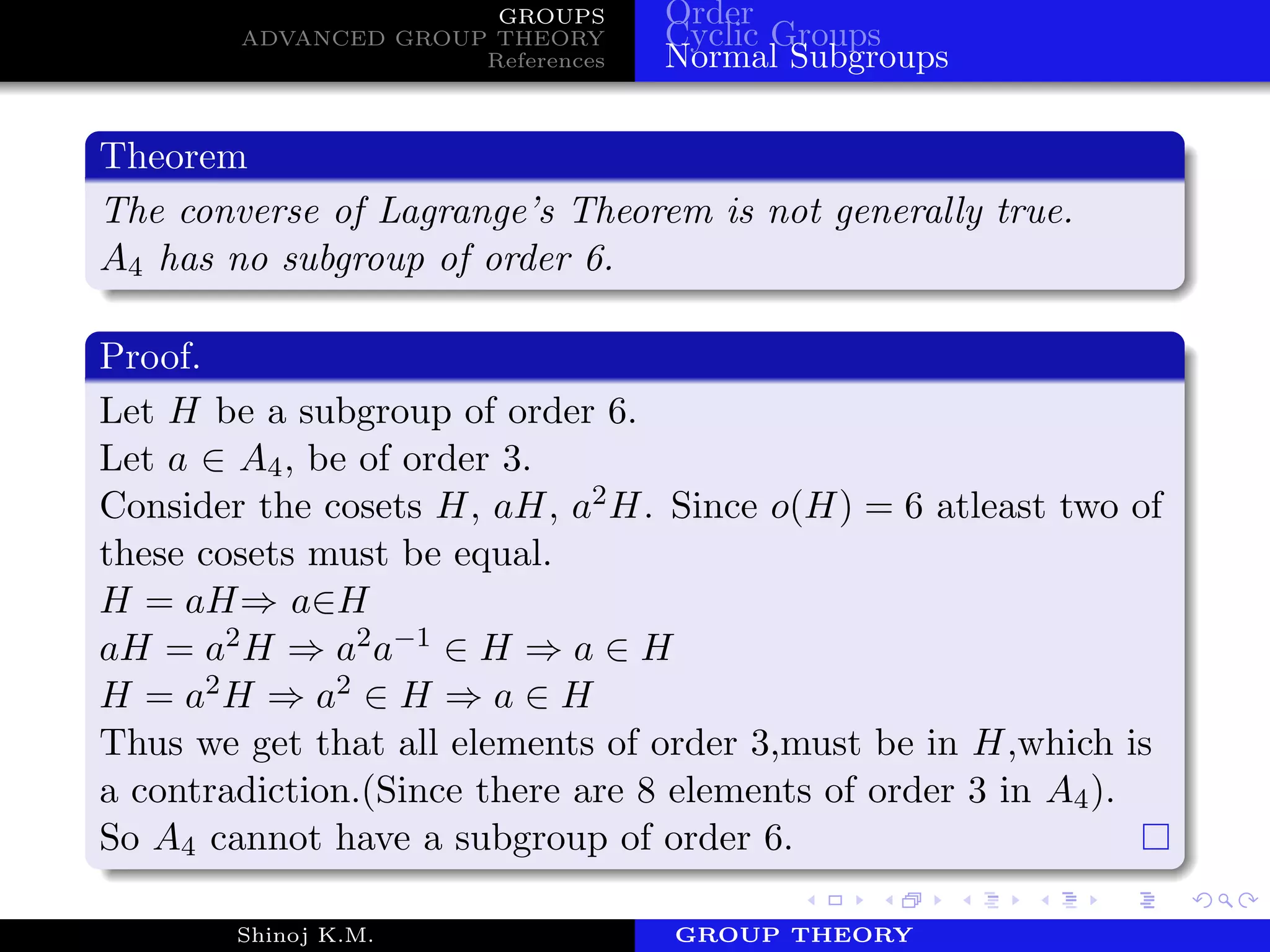
Theorem
The converse of Lagrange’s Theorem is not generally true.
A4 has no subgroup of order 6.
Proof.
Let H be a subgroup of order 6.
Let a ∈ A4, be of order 3.
Consider the cosets H, aH, a2H. Since o(H) = 6 atleast two of
these cosets must be equal.
H = aH⇒ a∈H
aH = a2H ⇒ a2a−1 ∈ H ⇒ a ∈ H
H = a2H ⇒ a2 ∈ H ⇒ a ∈ H
Thus we get that all elements of order 3,must be in H,which is
a contradiction.(Since there are 8 elements of order 3 in A4).
So A4 cannot have a subgroup of order 6.
Shinoj K.M. Department of MathematicsGROUP THEORY
GROUPS
ADVANCED GROUP THEORY
References
Order
Cyclic Groups
Normal Subgroups
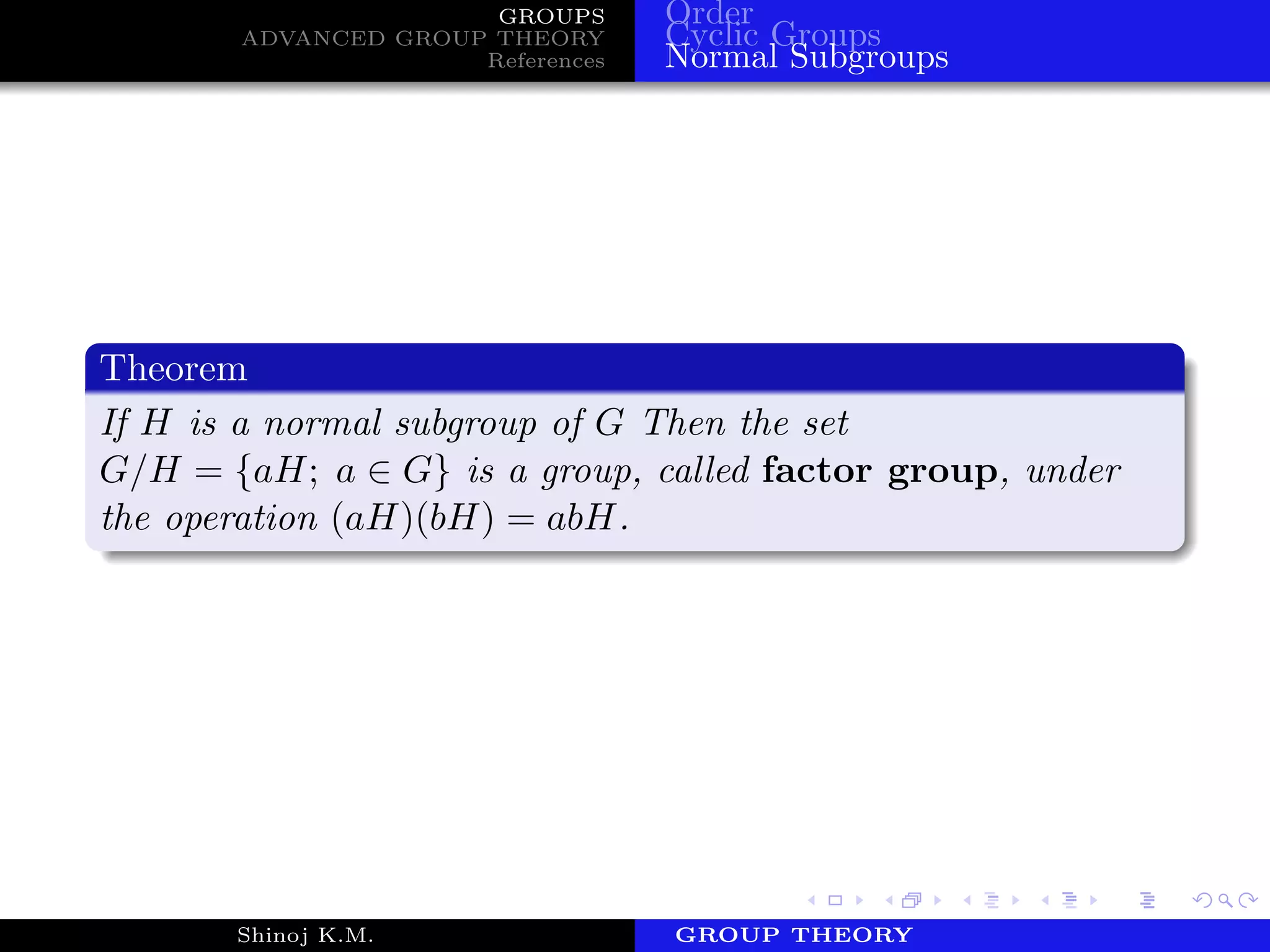
Theorem
If H is a normal subgroup of G Then the set
G/H = {aH; a ∈ G} is a group, called factor group, under
the operation (aH)(bH) = abH.
Shinoj K.M. Department of MathematicsGROUP THEORY
GROUPS
ADVANCED GROUP THEORY
References
Order
Cyclic Groups
Normal Subgroups
Definition
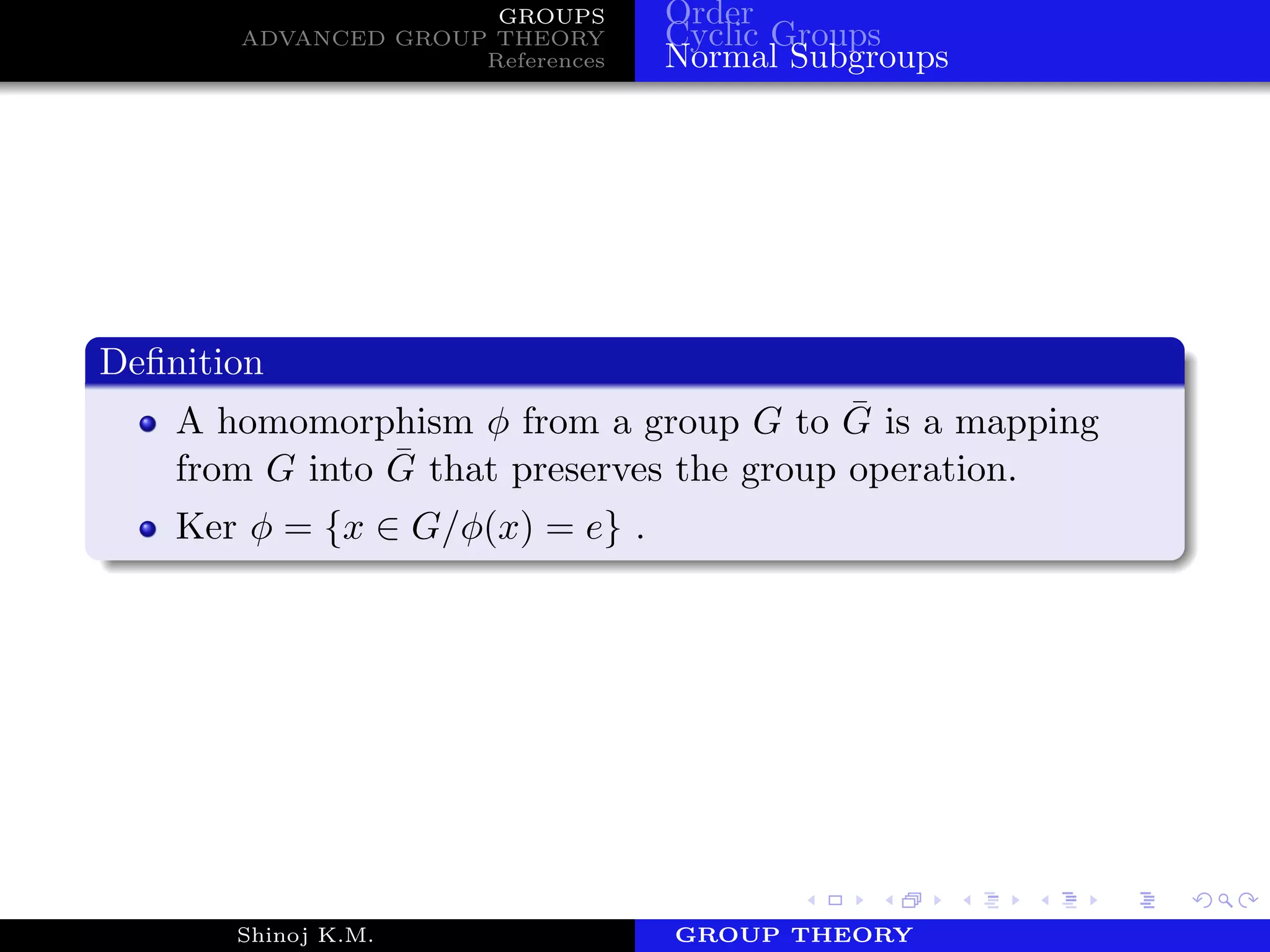
A homomorphism φ from a group G to ¯G is a mapping
from G into ¯G that preserves the group operation.
Ker φ = {x ∈ G/φ(x) = e} .
Shinoj K.M. Department of MathematicsGROUP THEORY
GROUPS
ADVANCED GROUP THEORY
References
Order
Cyclic Groups
Normal Subgroups
Theorem
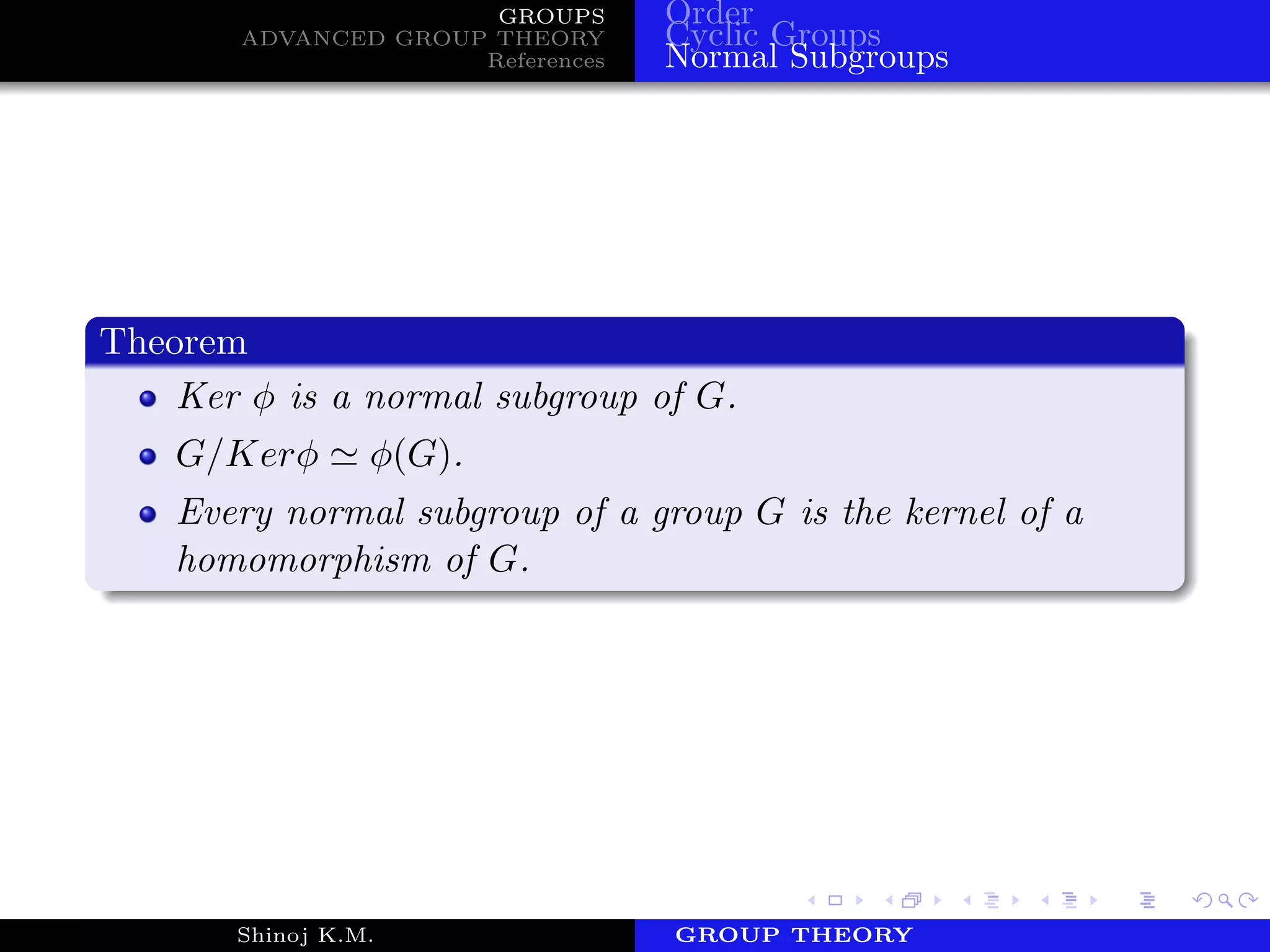
Ker φ is a normal subgroup of G.
G/Kerφ φ(G).
Every normal subgroup of a group G is the kernel of a
homomorphism of G.
Shinoj K.M. Department of MathematicsGROUP THEORY
GROUPS
ADVANCED GROUP THEORY
References
Order
Cyclic Groups
Normal Subgroups
Example
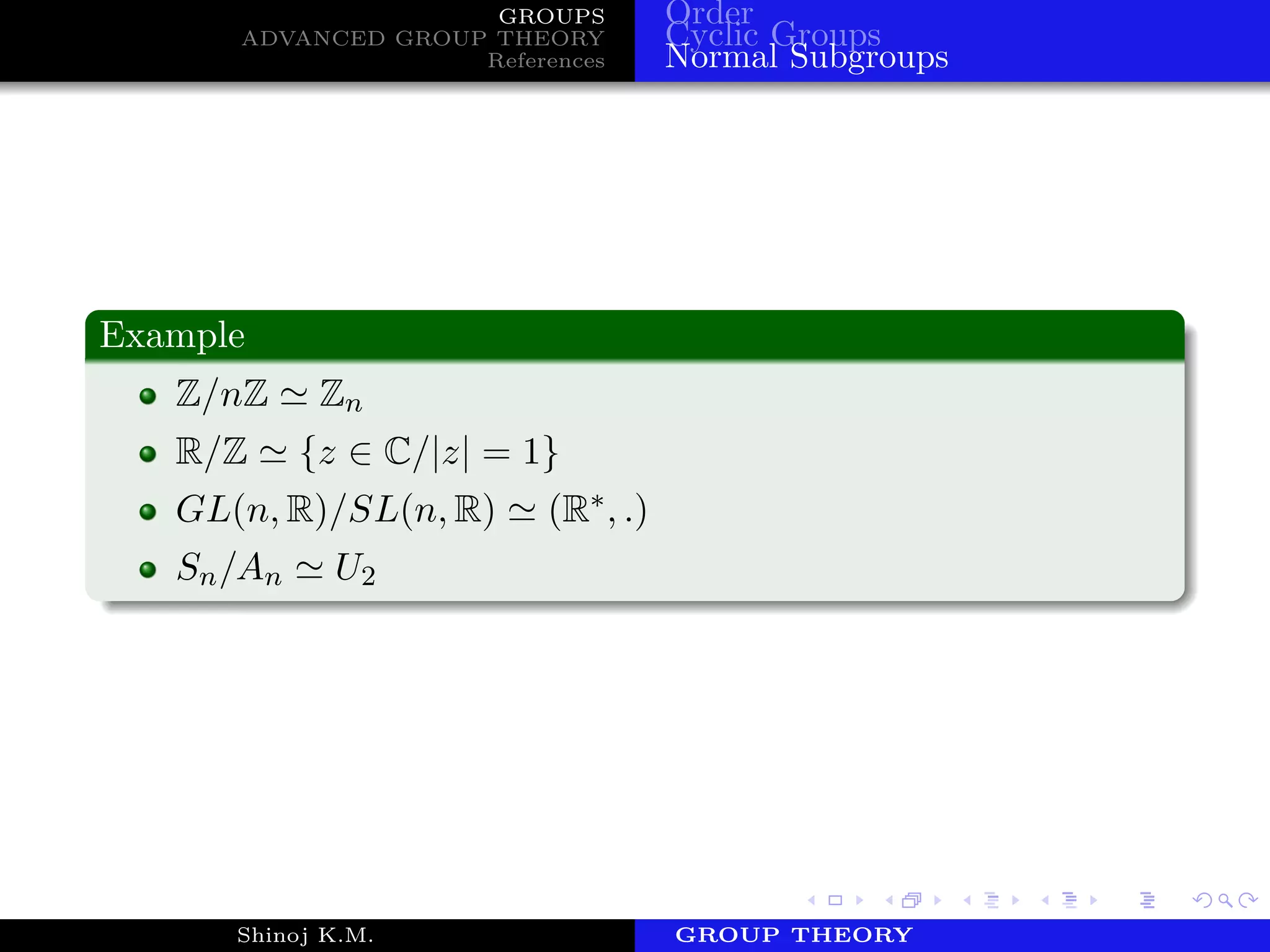
Z/nZ Zn
R/Z {z ∈ C/|z| = 1}
GL(n, R)/SL(n, R) (R∗, .)
Sn/An U2
Shinoj K.M. Department of MathematicsGROUP THEORY
GROUPS
ADVANCED GROUP THEORY
References
Order
Cyclic Groups
Normal Subgroups
Theorem
Let F be a finite field of q elements. GL(n, q) is the group
of all n × n invertible matrices with entries from F.Then
|GL(n, q)| = (qn − 1)(qn − q)(qn − q2). . .(qn − qn−1).
SL(n, q) is the group of all n × n matrices having
determinant 1,with entries from F.Then
|SL(n, q)| =
(qn − 1)(qn − q)(qn − q2). . .(qn − qn−1)
q − 1
.
Shinoj K.M. Department of MathematicsGROUP THEORY
GROUPS
ADVANCED GROUP THEORY
References
Direct product of groups
Fundamental Theorem of finite Abelian g
Classification of groups of order up to 10
Direct product of Groups
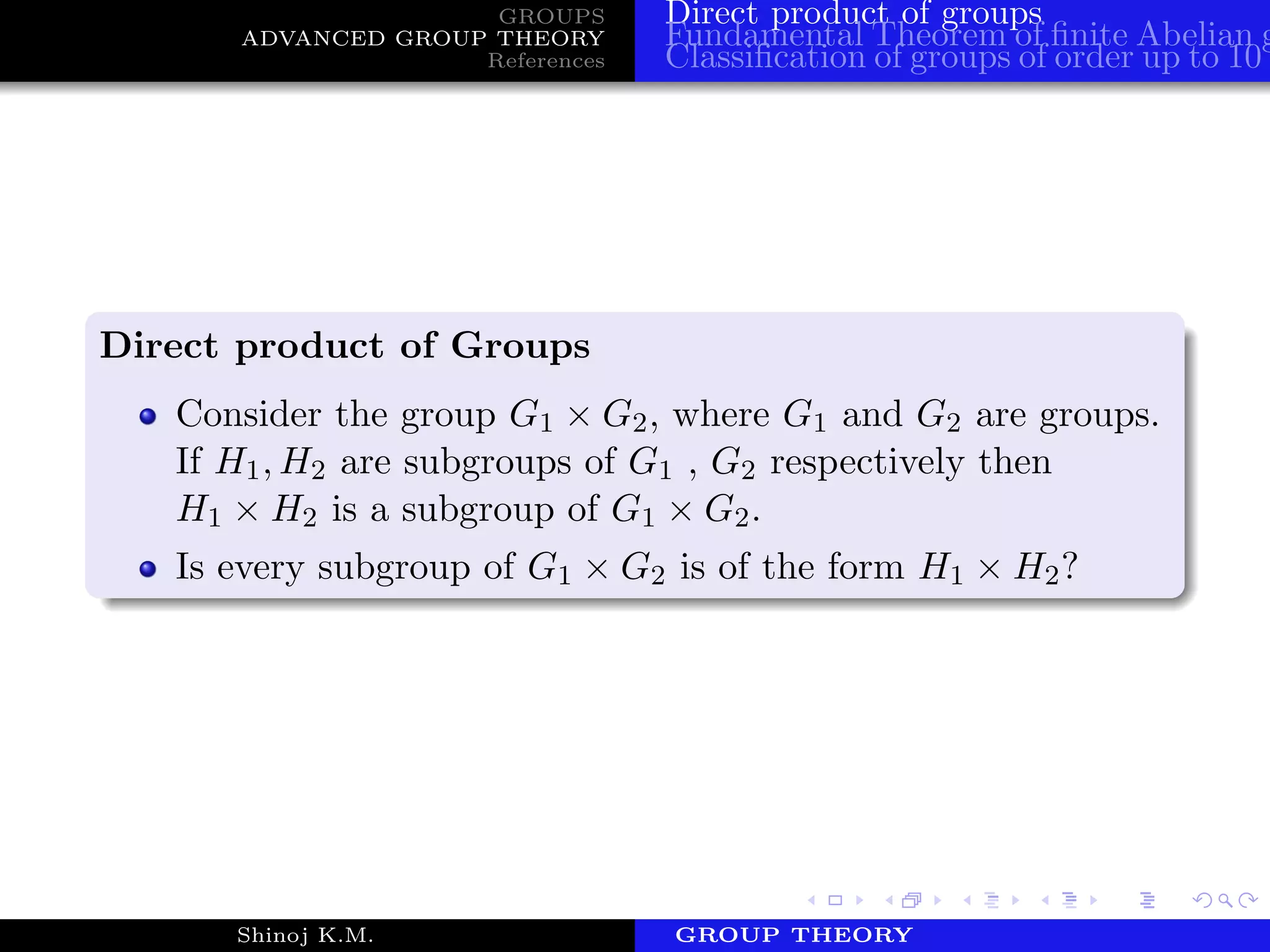
Consider the group G1 × G2, where G1 and G2 are groups.
If H1, H2 are subgroups of G1 , G2 respectively then
H1 × H2 is a subgroup of G1 × G2.
Is every subgroup of G1 × G2 is of the form H1 × H2?
Shinoj K.M. Department of MathematicsGROUP THEORY
GROUPS
ADVANCED GROUP THEORY
References
Direct product of groups
Fundamental Theorem of finite Abelian g
Classification of groups of order up to 10
Theorem
The group Zm × Zn is isomorphic to Zmn iff m and n are
relatively prime.
Shinoj K.M. Department of MathematicsGROUP THEORY
GROUPS
ADVANCED GROUP THEORY
References
Direct product of groups
Fundamental Theorem of finite Abelian g
Classification of groups of order up to 10
Theorem
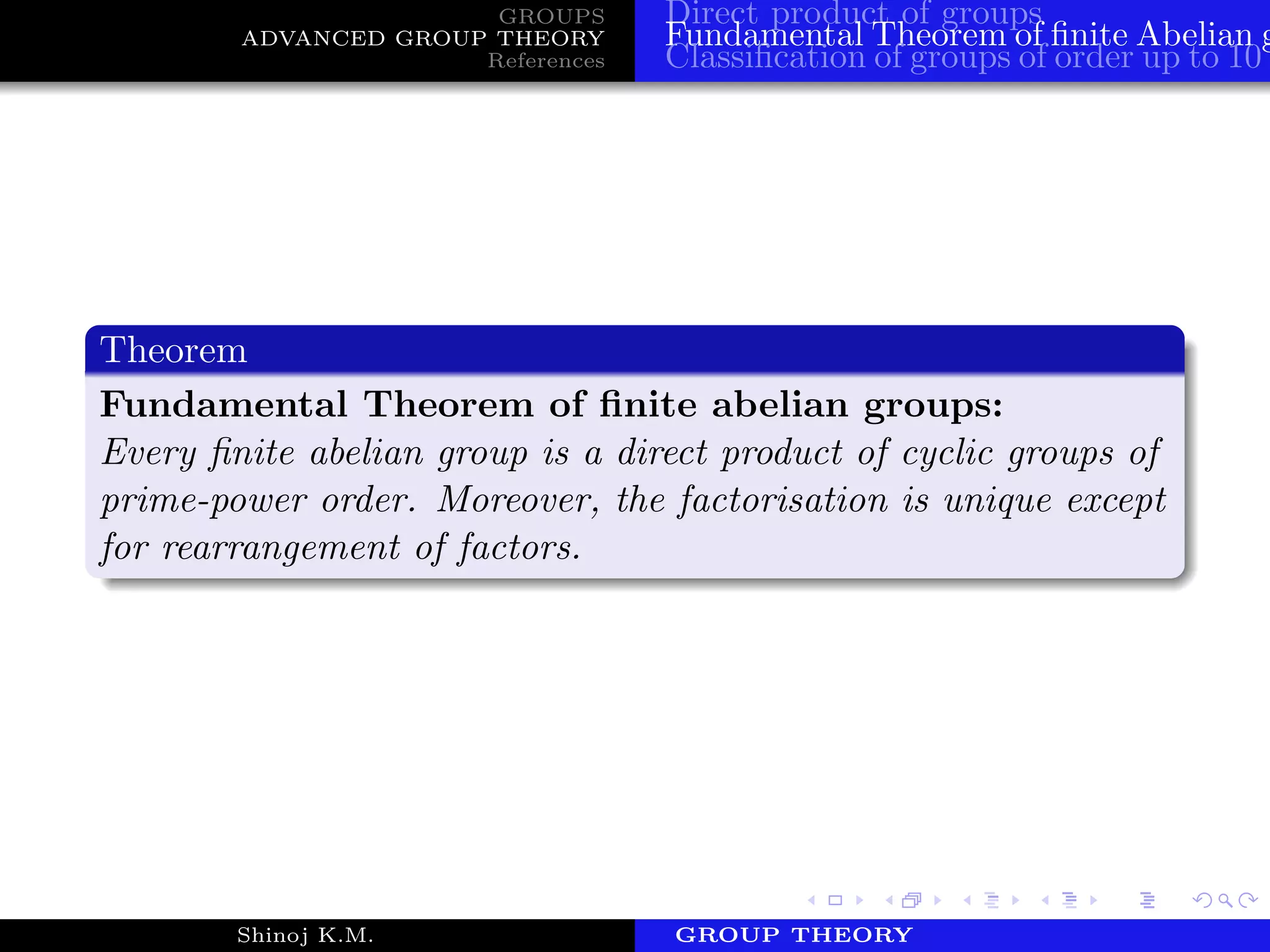
Fundamental Theorem of finite abelian groups:
Every finite abelian group is a direct product of cyclic groups of
prime-power order. Moreover, the factorisation is unique except
for rearrangement of factors.
Shinoj K.M. Department of MathematicsGROUP THEORY
GROUPS
ADVANCED GROUP THEORY
References
Direct product of groups
Fundamental Theorem of finite Abelian g
Classification of groups of order up to 10
Theorem
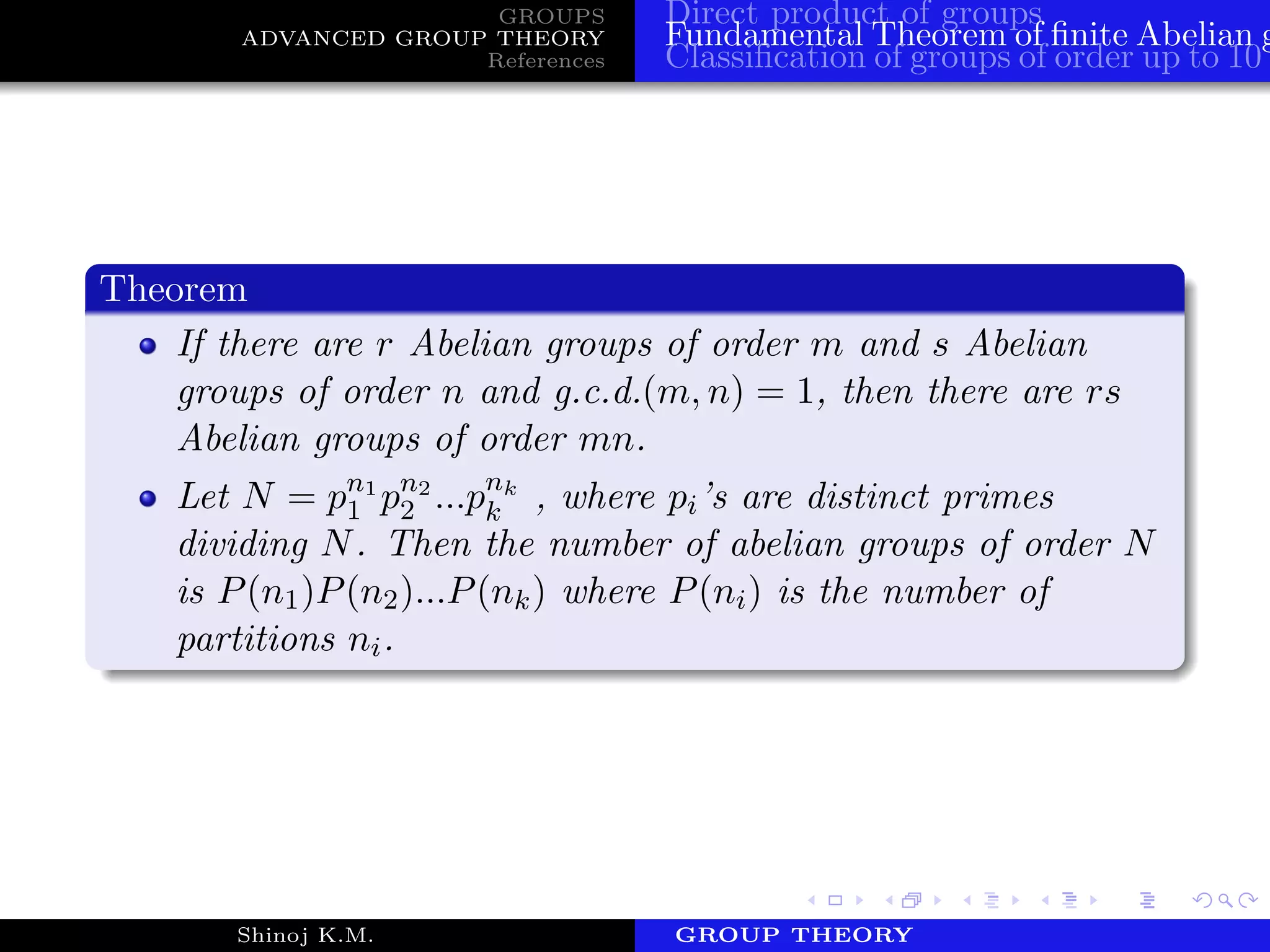
If there are r Abelian groups of order m and s Abelian
groups of order n and g.c.d.(m, n) = 1, then there are rs
Abelian groups of order mn.
Let N = pn1
1 pn2
2 ...pnk
k , where pi’s are distinct primes
dividing N. Then the number of abelian groups of order N
is P(n1)P(n2)...P(nk) where P(ni) is the number of
partitions ni.
Shinoj K.M. Department of MathematicsGROUP THEORY
GROUPS
ADVANCED GROUP THEORY
References
Direct product of groups
Fundamental Theorem of finite Abelian g
Classification of groups of order up to 10
How many abelian groups are there of order 4?
How many abelian groups are there of order 8?
How many abelian groups are there of order 100?
How many abelian groups are there of order 600?
How many abelian groups are there of order 1000?
How many abelian groups are there of order 105?
Shinoj K.M. Department of MathematicsGROUP THEORY
GROUPS
ADVANCED GROUP THEORY
References
Direct product of groups
Fundamental Theorem of finite Abelian g
Classification of groups of order up to 10
Theorem
For a prime p, every group of order p2 is abelian.
For an odd prime p, every group of order 2p is either Z2p
or the dihedral group Dp.
Shinoj K.M. Department of MathematicsGROUP THEORY
GROUPS
ADVANCED GROUP THEORY
References
Direct product of groups
Fundamental Theorem of finite Abelian g
Classification of groups of order up to 10
Theorem
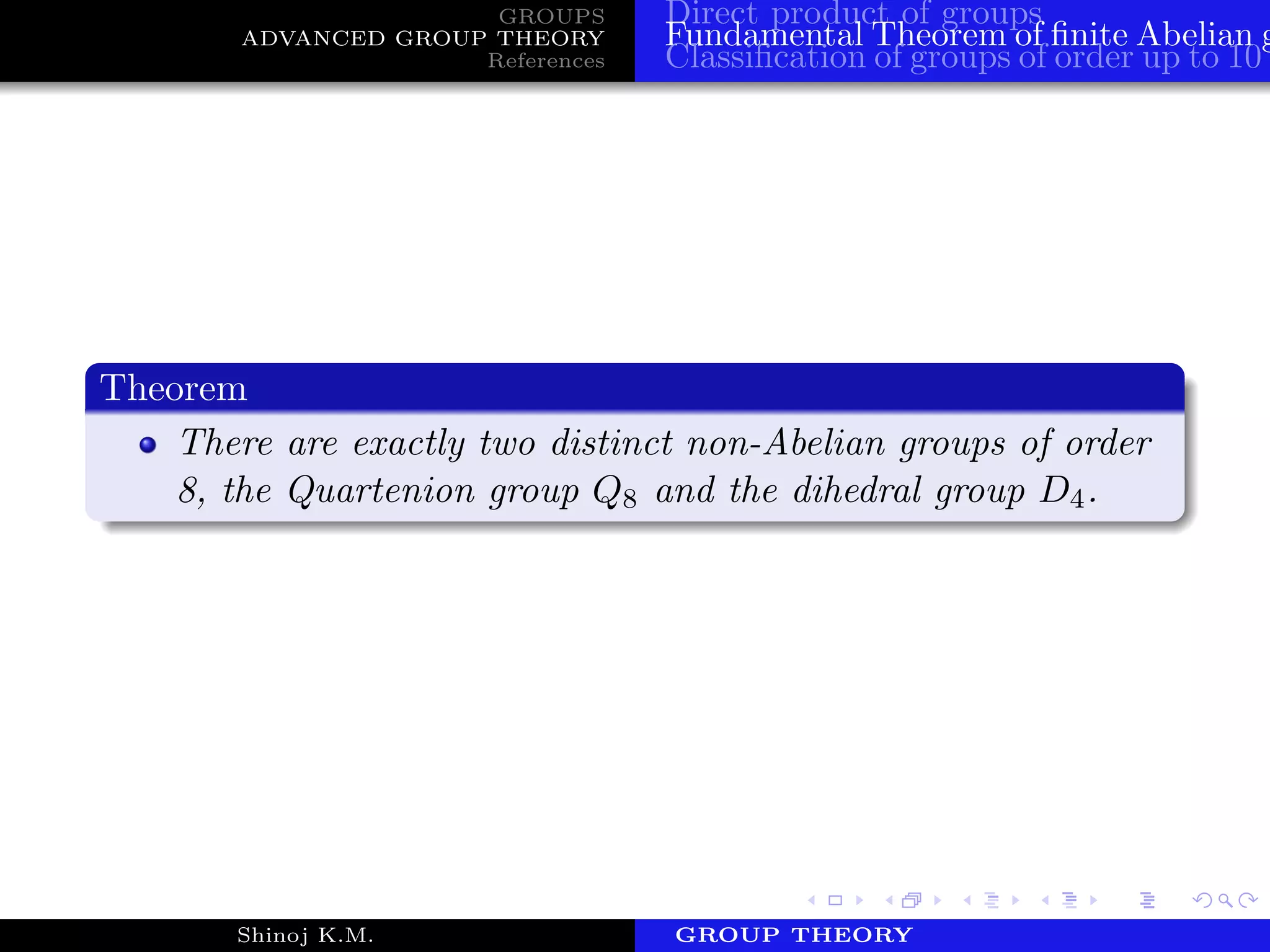
There are exactly two distinct non-Abelian groups of order
8, the Quartenion group Q8 and the dihedral group D4.
Shinoj K.M. Department of MathematicsGROUP THEORY
GROUPS
ADVANCED GROUP THEORY
References
Direct product of groups
Fundamental Theorem of finite Abelian g
Classification of groups of order up to 10
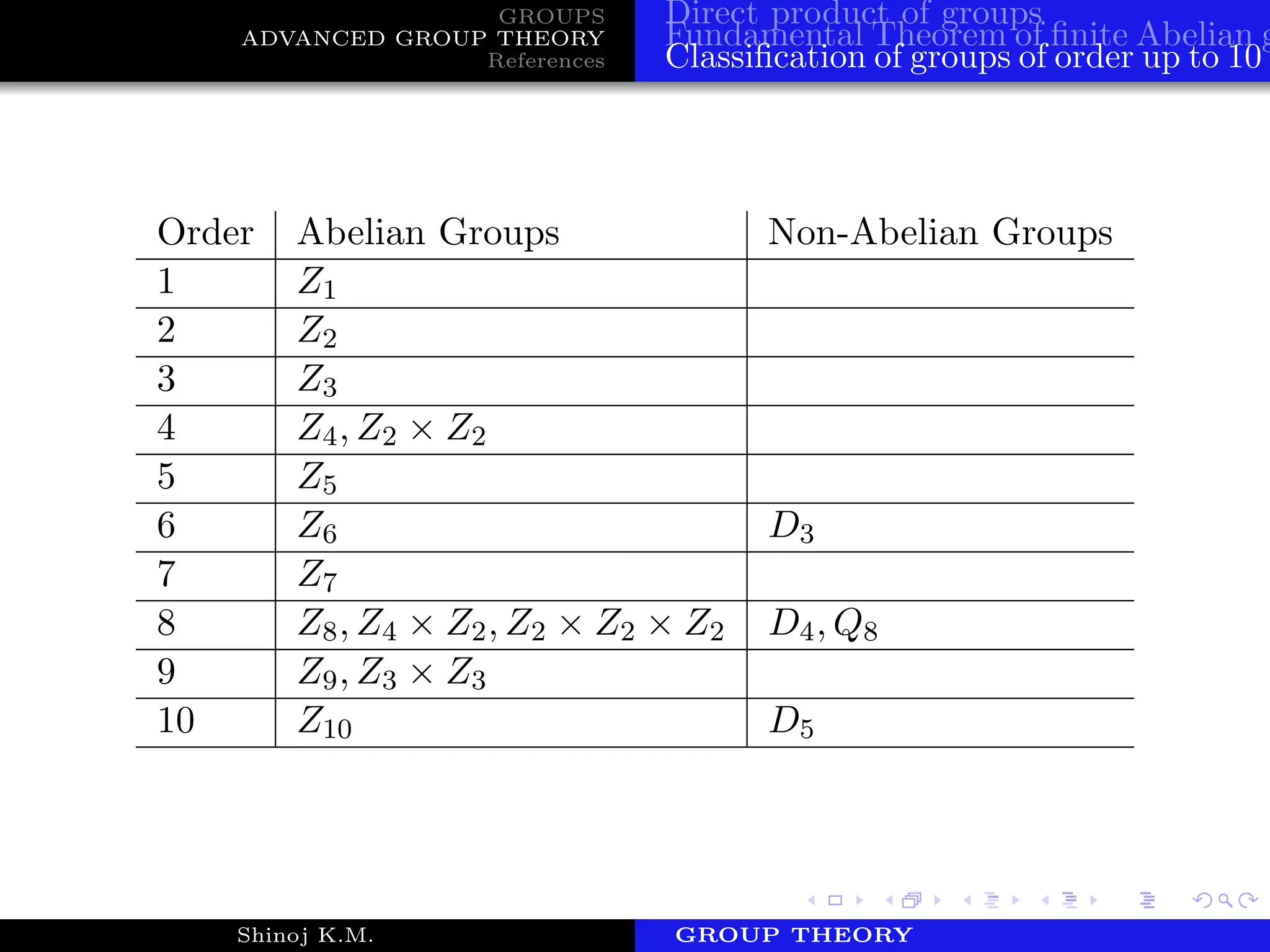
Order Abelian Groups Non-Abelian Groups
1 Z1
2 Z2
3 Z3
4 Z4, Z2 × Z2
5 Z5
6 Z6 D3
7 Z7
8 Z8, Z4 × Z2, Z2 × Z2 × Z2 D4, Q8
9 Z9, Z3 × Z3
10 Z10 D5
Shinoj K.M. Department of MathematicsGROUP THEORY
GROUPS
ADVANCED GROUP THEORY
References
REFERENCES
[1] Joseph A. Gallian ,”Contemporary Abstract Algebra” ,
Narosa Publishing House.
[2] John.B.Fraleigh, ”A First Course in Abstract Algebra”.
[3] Thomas V.Hungerford, ”Abstract Algebra”
Shinoj K.M. Department of MathematicsGROUP THEORY
GROUPS
ADVANCED GROUP THEORY
References
THANK YOU
Shinoj K.M. Department of MathematicsGROUP THEORY

Group Theory

  • 1.
    GROUPS ADVANCED GROUP THEORY References GROUPTHEORY Shinoj K.M. Department of Mathematics St.Joseph’s College,Devagiri Kozhikode-8 shinusaraswathy@gmail.com 8 December 2018 Shinoj K.M. Department of MathematicsGROUP THEORY
  • 2.
    GROUPS ADVANCED GROUP THEORY References Outline 1GROUPS Order Cyclic Groups Normal Subgroups 2 ADVANCED GROUP THEORY Direct product of groups Fundamental Theorem of finite Abelian groups Classification of groups of order up to 10 Shinoj K.M. Department of MathematicsGROUP THEORY
  • 3.
    GROUPS ADVANCED GROUP THEORY References Order CyclicGroups Normal Subgroups Definition A set G together with a binary operation ∗ is called a group if G is closed w.r.t. ∗ ∗ is associative there exists an identity element in G for each element in G there is an inverse in G If ∗ is commutative, then G is an Abelian group. If ∗ is not commutative, then G is called a non-Abelian group. Shinoj K.M. Department of MathematicsGROUP THEORY
  • 4.
    GROUPS ADVANCED GROUP THEORY References Order CyclicGroups Normal Subgroups Example (Z,+) is an Abelian group. (Zn, +n) is an Abelian group. The set of all nth roots of unity, Un, is an Abelian group w.r.t. multiplication. The set of all n × n invertible matrices with real entries, GL(n, R), called the general linear group, is a non-Abelian group , w.r.t. matrix multiplication. Shinoj K.M. Department of MathematicsGROUP THEORY
  • 5.
    GROUPS ADVANCED GROUP THEORY References Order CyclicGroups Normal Subgroups The symmetric group on n letters Sn , n ≥ 3 is a non- Abelian group. The group table of S3 * ρ0 ρ1 ρ2 µ1 µ2 µ3 ρ0 ρ0 ρ1 ρ2 µ1 µ2 µ3 ρ1 ρ1 ρ2 ρ0 µ3 µ1 µ2 ρ2 ρ2 ρ0 ρ1 µ2 µ3 µ1 µ1 µ1 µ2 µ3 ρ0 ρ1 ρ2 µ2 µ2 µ3 µ1 ρ2 ρ0 ρ1 µ3 µ3 µ1 µ2 ρ1 ρ2 ρ0 Shinoj K.M. Department of MathematicsGROUP THEORY
  • 6.
    GROUPS ADVANCED GROUP THEORY References Order CyclicGroups Normal Subgroups Fact The equation x2 = e has 4 solutions in Klein-4 group. The equation x2 = −1 has 6 solutions in Q8. So a polynomial equation of degree n can have more than n solutions in a group. Shinoj K.M. Department of MathematicsGROUP THEORY
  • 7.
    GROUPS ADVANCED GROUP THEORY References Order CyclicGroups Normal Subgroups Order Definition The order of an element a in a group is the smallest positive integer n such that an = e. The order of a group is the number of elements in the group. Shinoj K.M. Department of MathematicsGROUP THEORY
  • 8.
    GROUPS ADVANCED GROUP THEORY References Order CyclicGroups Normal Subgroups Fact If O(G) is even, then there is atleast one element in G of order 2. In a finite group, all elements are of finite order. There are infinite groups with all elements of finite order. Shinoj K.M. Department of MathematicsGROUP THEORY
  • 9.
    GROUPS ADVANCED GROUP THEORY References Order CyclicGroups Normal Subgroups Definition Let G be an abelian group. Then Gt = {u ∈ G/O(u) is finite }, is a subgroup of G, called the torsion subgroup of G. If Gt = {0}, then G is said to be torsion free. If Gt = G, then G is called a torsion group. Shinoj K.M. Department of MathematicsGROUP THEORY
  • 10.
    GROUPS ADVANCED GROUP THEORY References Order CyclicGroups Normal Subgroups Example Zn and all finite Abelian groups are torsion groups. Z and Z × Z are torsion free groups. Z × Z2 is neither torsion group nor torsion free group. Shinoj K.M. Department of MathematicsGROUP THEORY
  • 11.
    GROUPS ADVANCED GROUP THEORY References Order CyclicGroups Normal Subgroups If G is a non-abelian group, there can be two elements of finite order whose product is of infinite order. Shinoj K.M. Department of MathematicsGROUP THEORY
  • 12.
    GROUPS ADVANCED GROUP THEORY References Order CyclicGroups Normal Subgroups If G is a non-abelian group, there can be two elements of finite order whose product is of infinite order. Example(i): Consider the following two elements in GL(2, R). A = −1 0 0 1 and B = −1 −1 0 1 Example(ii): Consider the group G of all permutations on R, the set of all real numbers and f(x) = −x and g(x) = 1 − x. Shinoj K.M. Department of MathematicsGROUP THEORY
  • 13.
    GROUPS ADVANCED GROUP THEORY References Order CyclicGroups Normal Subgroups Theorem (Cauchy) Let G be a finite group and let p be a prime number dividing O(G). Then G has an element of order p and consequently G has a subgroup of order p. Shinoj K.M. Department of MathematicsGROUP THEORY
  • 14.
    GROUPS ADVANCED GROUP THEORY References Order CyclicGroups Normal Subgroups Let O(G) = n and d divides n. Does there always exist an element in G of order d ? Shinoj K.M. Department of MathematicsGROUP THEORY
  • 15.
    GROUPS ADVANCED GROUP THEORY References Order CyclicGroups Normal Subgroups Let O(G) = n and d divides n. Does there always exist an element in G of order d ? Need not!! Look at the following examples. Klein-4 group. S3 Z2 × Z4. Z2 × Z2 × Z2 Shinoj K.M. Department of MathematicsGROUP THEORY
  • 16.
    GROUPS ADVANCED GROUP THEORY References Order CyclicGroups Normal Subgroups Cyclic Groups Definition An infinite group is cyclic iff it is isomorphic to (Z,+). An infinite group is cyclic if and only if it is isomorphic to all its nontrivial subgroups. A finite group G is cyclic iff G has an element of order d, for each d dividing o(G). Shinoj K.M. Department of MathematicsGROUP THEORY
  • 17.
    GROUPS ADVANCED GROUP THEORY References Order CyclicGroups Normal Subgroups Fact (Zn, +n) and (Z, +) prototypes of cyclic groups. Every cyclic group is abelian. If m is a square free integer, then every Abelian group of order m is cyclic. The smallest possible order of a non cyclic group is 4. Shinoj K.M. Department of MathematicsGROUP THEORY
  • 18.
    GROUPS ADVANCED GROUP THEORY References Order CyclicGroups Normal Subgroups Theorem The number of subgroups of a cyclic group of order n is the number of divisors of n. The number of generators of (Zn, +n) is φ(n), the number of positive integers less than and relatively prime to n. A cyclic group with exactly one generator can have atmost 2 elements. Every group of prime order is cyclic. Shinoj K.M. Department of MathematicsGROUP THEORY
  • 19.
    GROUPS ADVANCED GROUP THEORY References Order CyclicGroups Normal Subgroups Fact Every group is the union of its cyclic subgroups. A group is finite if and only if it has only finitely many subgroups. Shinoj K.M. Department of MathematicsGROUP THEORY
  • 20.
    GROUPS ADVANCED GROUP THEORY References Order CyclicGroups Normal Subgroups Normal Subgroups Definition A subgroup H is a normal subgroup of G if ghg−1 ∈ H, ∀ g ∈ G and ∀ h ∈ H. A subgroup H of a group G is normal iff aH = Ha, ∀ a ∈ G. Shinoj K.M. Department of MathematicsGROUP THEORY
  • 21.
    GROUPS ADVANCED GROUP THEORY References Order CyclicGroups Normal Subgroups Example (2Z, +) is a normal subgroup of (Z, +) SL(n, R) is a normal subgroup of GL(n, R). An is a normal subgroup of Sn. Shinoj K.M. Department of MathematicsGROUP THEORY
  • 22.
    GROUPS ADVANCED GROUP THEORY References Order CyclicGroups Normal Subgroups Theorem Every subgroup of an abelian group is normal. Shinoj K.M. Department of MathematicsGROUP THEORY
  • 23.
    GROUPS ADVANCED GROUP THEORY References Order CyclicGroups Normal Subgroups Theorem Every subgroup of an abelian group is normal. Question:Let G be a group such that all its subgroups are normal. Can we conclude that G is abelian? Shinoj K.M. Department of MathematicsGROUP THEORY
  • 24.
    GROUPS ADVANCED GROUP THEORY References Order CyclicGroups Normal Subgroups Theorem Every subgroup of an abelian group is normal. Question:Let G be a group such that all its subgroups are normal. Can we conclude that G is abelian? Answer: NO Counter example : Q8 Shinoj K.M. Department of MathematicsGROUP THEORY
  • 25.
    GROUPS ADVANCED GROUP THEORY References Order CyclicGroups Normal Subgroups Theorem Lagrange’s Theorem: Let G be a finite group and H be a subgroup of G. Then O(H) divides O(G). The converse of Lagrange’s Theorem is true for Abelian groups. Shinoj K.M. Department of MathematicsGROUP THEORY
  • 26.
    GROUPS ADVANCED GROUP THEORY References Order CyclicGroups Normal Subgroups Question: Suppose G is a finite group and it has subgroups of order d for each d dividing n. Can we conclude that G is abelian? Shinoj K.M. Department of MathematicsGROUP THEORY
  • 27.
    GROUPS ADVANCED GROUP THEORY References Order CyclicGroups Normal Subgroups Question: Suppose G is a finite group and it has subgroups of order d for each d dividing n. Can we conclude that G is abelian? Answer : NO. Counter examples are S3 The Quartenion group, Q8 Shinoj K.M. Department of MathematicsGROUP THEORY
  • 28.
    GROUPS ADVANCED GROUP THEORY References Order CyclicGroups Normal Subgroups Theorem The converse of Lagrange’s Theorem is not generally true. A4 has no subgroup of order 6. Proof. Let H be a subgroup of order 6. Let a ∈ A4, be of order 3. Consider the cosets H, aH, a2H. Since o(H) = 6 atleast two of these cosets must be equal. H = aH⇒ a∈H aH = a2H ⇒ a2a−1 ∈ H ⇒ a ∈ H H = a2H ⇒ a2 ∈ H ⇒ a ∈ H Thus we get that all elements of order 3,must be in H,which is a contradiction.(Since there are 8 elements of order 3 in A4). So A4 cannot have a subgroup of order 6. Shinoj K.M. Department of MathematicsGROUP THEORY
  • 29.
    GROUPS ADVANCED GROUP THEORY References Order CyclicGroups Normal Subgroups Theorem If H is a normal subgroup of G Then the set G/H = {aH; a ∈ G} is a group, called factor group, under the operation (aH)(bH) = abH. Shinoj K.M. Department of MathematicsGROUP THEORY
  • 30.
    GROUPS ADVANCED GROUP THEORY References Order CyclicGroups Normal Subgroups Definition A homomorphism φ from a group G to ¯G is a mapping from G into ¯G that preserves the group operation. Ker φ = {x ∈ G/φ(x) = e} . Shinoj K.M. Department of MathematicsGROUP THEORY
  • 31.
    GROUPS ADVANCED GROUP THEORY References Order CyclicGroups Normal Subgroups Theorem Ker φ is a normal subgroup of G. G/Kerφ φ(G). Every normal subgroup of a group G is the kernel of a homomorphism of G. Shinoj K.M. Department of MathematicsGROUP THEORY
  • 32.
    GROUPS ADVANCED GROUP THEORY References Order CyclicGroups Normal Subgroups Example Z/nZ Zn R/Z {z ∈ C/|z| = 1} GL(n, R)/SL(n, R) (R∗, .) Sn/An U2 Shinoj K.M. Department of MathematicsGROUP THEORY
  • 33.
    GROUPS ADVANCED GROUP THEORY References Order CyclicGroups Normal Subgroups Theorem Let F be a finite field of q elements. GL(n, q) is the group of all n × n invertible matrices with entries from F.Then |GL(n, q)| = (qn − 1)(qn − q)(qn − q2). . .(qn − qn−1). SL(n, q) is the group of all n × n matrices having determinant 1,with entries from F.Then |SL(n, q)| = (qn − 1)(qn − q)(qn − q2). . .(qn − qn−1) q − 1 . Shinoj K.M. Department of MathematicsGROUP THEORY
  • 34.
    GROUPS ADVANCED GROUP THEORY References Directproduct of groups Fundamental Theorem of finite Abelian g Classification of groups of order up to 10 Direct product of Groups Consider the group G1 × G2, where G1 and G2 are groups. If H1, H2 are subgroups of G1 , G2 respectively then H1 × H2 is a subgroup of G1 × G2. Is every subgroup of G1 × G2 is of the form H1 × H2? Shinoj K.M. Department of MathematicsGROUP THEORY
  • 35.
    GROUPS ADVANCED GROUP THEORY References Directproduct of groups Fundamental Theorem of finite Abelian g Classification of groups of order up to 10 Theorem The group Zm × Zn is isomorphic to Zmn iff m and n are relatively prime. Shinoj K.M. Department of MathematicsGROUP THEORY
  • 36.
    GROUPS ADVANCED GROUP THEORY References Directproduct of groups Fundamental Theorem of finite Abelian g Classification of groups of order up to 10 Theorem Fundamental Theorem of finite abelian groups: Every finite abelian group is a direct product of cyclic groups of prime-power order. Moreover, the factorisation is unique except for rearrangement of factors. Shinoj K.M. Department of MathematicsGROUP THEORY
  • 37.
    GROUPS ADVANCED GROUP THEORY References Directproduct of groups Fundamental Theorem of finite Abelian g Classification of groups of order up to 10 Theorem If there are r Abelian groups of order m and s Abelian groups of order n and g.c.d.(m, n) = 1, then there are rs Abelian groups of order mn. Let N = pn1 1 pn2 2 ...pnk k , where pi’s are distinct primes dividing N. Then the number of abelian groups of order N is P(n1)P(n2)...P(nk) where P(ni) is the number of partitions ni. Shinoj K.M. Department of MathematicsGROUP THEORY
  • 38.
    GROUPS ADVANCED GROUP THEORY References Directproduct of groups Fundamental Theorem of finite Abelian g Classification of groups of order up to 10 How many abelian groups are there of order 4? How many abelian groups are there of order 8? How many abelian groups are there of order 100? How many abelian groups are there of order 600? How many abelian groups are there of order 1000? How many abelian groups are there of order 105? Shinoj K.M. Department of MathematicsGROUP THEORY
  • 39.
    GROUPS ADVANCED GROUP THEORY References Directproduct of groups Fundamental Theorem of finite Abelian g Classification of groups of order up to 10 Theorem For a prime p, every group of order p2 is abelian. For an odd prime p, every group of order 2p is either Z2p or the dihedral group Dp. Shinoj K.M. Department of MathematicsGROUP THEORY
  • 40.
    GROUPS ADVANCED GROUP THEORY References Directproduct of groups Fundamental Theorem of finite Abelian g Classification of groups of order up to 10 Theorem There are exactly two distinct non-Abelian groups of order 8, the Quartenion group Q8 and the dihedral group D4. Shinoj K.M. Department of MathematicsGROUP THEORY
  • 41.
    GROUPS ADVANCED GROUP THEORY References Directproduct of groups Fundamental Theorem of finite Abelian g Classification of groups of order up to 10 Order Abelian Groups Non-Abelian Groups 1 Z1 2 Z2 3 Z3 4 Z4, Z2 × Z2 5 Z5 6 Z6 D3 7 Z7 8 Z8, Z4 × Z2, Z2 × Z2 × Z2 D4, Q8 9 Z9, Z3 × Z3 10 Z10 D5 Shinoj K.M. Department of MathematicsGROUP THEORY
  • 42.
    GROUPS ADVANCED GROUP THEORY References REFERENCES [1]Joseph A. Gallian ,”Contemporary Abstract Algebra” , Narosa Publishing House. [2] John.B.Fraleigh, ”A First Course in Abstract Algebra”. [3] Thomas V.Hungerford, ”Abstract Algebra” Shinoj K.M. Department of MathematicsGROUP THEORY
  • 43.
    GROUPS ADVANCED GROUP THEORY References THANKYOU Shinoj K.M. Department of MathematicsGROUP THEORY