PRESENTED BY
MRS.D.RENUGA,M.SC.,M.PHIL.,M.ED.,
ASSISTANT PROFESSOR OF MATHEMATICS
SAC Women’s College,Cumbum.
E-mail: renugakannan238@gmail.com
 PRELIMINARIES
 FINITE SETS
 INFINITE SETS
 EQUIVALENT SETS
 COUNTABLE SETS
 COUNTABLY INFINITE SETS
 UNCOUNTABLE SETS
 DIFFERENCE BETWEEN CIS AND
UNCOUNTABLE SETS
 IMPORTANT RESULTS
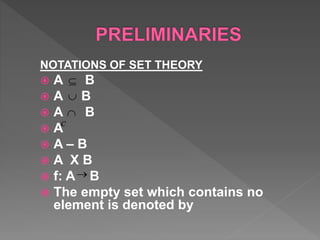
NOTATIONS OF SET THEORY
 A B
 A B
 A B
 A
 A – B
 A X B
 f: A B
 The empty set which contains no
element is denoted by



c

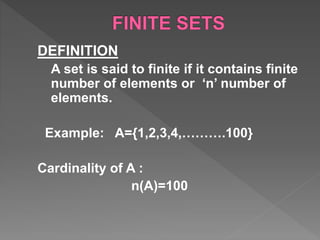
DEFINITION
A set is said to finite if it contains finite
number of elements or ‘n’ number of
elements.
Example: A={1,2,3,4,……….100}
Cardinality of A :
n(A)=100
DEFINITION
A set which is not a finite that
set is called infinite set. Or Set having
infinite number of elements.
Example:1.Real Numbers,intervals etc.
2.Set B = {1,2,3,4,……….}
Cardinality of B :
n(B) =
 
DEFINITION
Two sets A and B are said to be
equivalent if there exists a bijection f from A
to B
Example: Let A = N and B ={2,4,6….,2n,….}
Then f:A B defined by f(n)=2n is a
bijection.
Hence A is equivalent to B even though A
has actually ‘more’ elements than B.


DEFINITION
A set is countable if either the set is
finite or we are able to put elements of the
set in order just like natural numbers are in
order.
For example: 1.N,Q are countable.
2.Prime numbers less than 20
A={2,3,5,7,11,13,17,19}
N 1,2,3,4, 5, 6, 7, 8
Here set A is countable finite.
cardinality of A ,ie.,n(A)= 8

DEFINITION
A set is countably infinite if its
elements can be put in one to one
Correspondence with the set of Natural
Numbers(set ~ 1N)
Example: f: N Z
N
x
x
x
f 2
;
2
)
( 





N
N
x
x 2

1
;
2
1 








Now, in this example we get a function which is bijective
from 1N Z Z is countable set
(Countably Infinite set)





DEFINITION
Set which is not finite and neither
equivalent to the set of Natural Number.
For example:
R,Qc ,any interval etc.
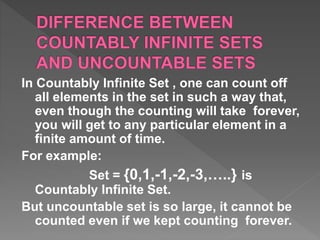
In Countably Infinite Set , one can count off
all elements in the set in such a way that,
even though the counting will take forever,
you will get to any particular element in a
finite amount of time.
For example:
Set = {0,1,-1,-2,-3,…..} is
Countably Infinite Set.
But uncountable set is so large, it cannot be
counted even if we kept counting forever.
 The set is a finite set,n( )=0
 The set primes less than 100 is finite
set P={2,3,5,…..97}
 The set of natural numbers is infinite
set.
 The set of all positive even numbers is
infinite set.
 Every finite set is countable.
 
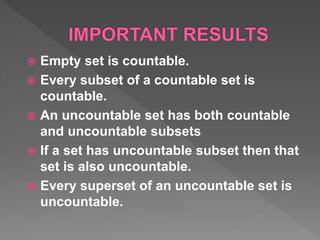
 Empty set is countable.
 Every subset of a countable set is
countable.
 An uncountable set has both countable
and uncountable subsets
 If a set has uncountable subset then that
set is also uncountable.
 Every superset of an uncountable set is
uncountable.
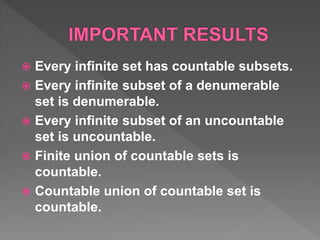
 Every infinite set has countable subsets.
 Every infinite subset of a denumerable
set is denumerable.
 Every infinite subset of an uncountable
set is uncountable.
 Finite union of countable sets is
countable.
 Countable union of countable set is
countable.
 Intersection of Countable set is
countable.
 Finite product of countable sets is
countable.
 The Cartesian product of two countable
sets is countable.
 N X N is countable.
 Every interval is an uncountable set.
 The set of all rational numbers in [0,1] is
countable.
 The set of all real numbers in [0,1] is
uncountable.
 The set of all polynomials of degree less
than or equal to n , whose coefficients
are integers is countable.
 Let A is
countable
 If f:A B is one – one and A is countable,
then B can be countable or
uncountable
 If f:A B is one – one and B is countable,
then A is countable.
 If f:A B is one – one and A is uncountable,
 tthen B is countable.
}
,
)
(
:
)
(
{ Q
i
a
i
x
i
a
x
P
x
P
A 




B
A
 B
A

B
A

B
A
 B
A

B
A


B
A
B
A
B
A
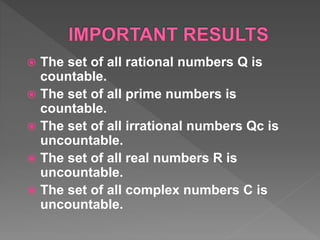
 The set of all rational numbers Q is
countable.
 The set of all prime numbers is
countable.
 The set of all irrational numbers Qc is
uncountable.
 The set of all real numbers R is
uncountable.
 The set of all complex numbers C is
uncountable.
REAL ANALYSIS -UNIT I Basic Concepts.pptx

REAL ANALYSIS -UNIT I Basic Concepts.pptx

  • 1.
    PRESENTED BY MRS.D.RENUGA,M.SC.,M.PHIL.,M.ED., ASSISTANT PROFESSOROF MATHEMATICS SAC Women’s College,Cumbum. E-mail: renugakannan238@gmail.com
  • 2.
     PRELIMINARIES  FINITESETS  INFINITE SETS  EQUIVALENT SETS  COUNTABLE SETS  COUNTABLY INFINITE SETS  UNCOUNTABLE SETS  DIFFERENCE BETWEEN CIS AND UNCOUNTABLE SETS  IMPORTANT RESULTS
  • 3.
    NOTATIONS OF SETTHEORY  A B  A B  A B  A  A – B  A X B  f: A B  The empty set which contains no element is denoted by    c 
  • 4.
    DEFINITION A set issaid to finite if it contains finite number of elements or ‘n’ number of elements. Example: A={1,2,3,4,……….100} Cardinality of A : n(A)=100
  • 5.
    DEFINITION A set whichis not a finite that set is called infinite set. Or Set having infinite number of elements. Example:1.Real Numbers,intervals etc. 2.Set B = {1,2,3,4,……….} Cardinality of B : n(B) =  
  • 6.
    DEFINITION Two sets Aand B are said to be equivalent if there exists a bijection f from A to B Example: Let A = N and B ={2,4,6….,2n,….} Then f:A B defined by f(n)=2n is a bijection. Hence A is equivalent to B even though A has actually ‘more’ elements than B.  
  • 7.
    DEFINITION A set iscountable if either the set is finite or we are able to put elements of the set in order just like natural numbers are in order. For example: 1.N,Q are countable. 2.Prime numbers less than 20 A={2,3,5,7,11,13,17,19} N 1,2,3,4, 5, 6, 7, 8 Here set A is countable finite. cardinality of A ,ie.,n(A)= 8 
  • 8.
    DEFINITION A set iscountably infinite if its elements can be put in one to one Correspondence with the set of Natural Numbers(set ~ 1N) Example: f: N Z N x x x f 2 ; 2 ) (       N N x x 2 1 ; 2 1          Now, in this example we get a function which is bijective from 1N Z Z is countable set (Countably Infinite set)     
  • 9.
    DEFINITION Set which isnot finite and neither equivalent to the set of Natural Number. For example: R,Qc ,any interval etc.
  • 10.
    In Countably InfiniteSet , one can count off all elements in the set in such a way that, even though the counting will take forever, you will get to any particular element in a finite amount of time. For example: Set = {0,1,-1,-2,-3,…..} is Countably Infinite Set. But uncountable set is so large, it cannot be counted even if we kept counting forever.
  • 11.
     The setis a finite set,n( )=0  The set primes less than 100 is finite set P={2,3,5,…..97}  The set of natural numbers is infinite set.  The set of all positive even numbers is infinite set.  Every finite set is countable.  
  • 12.
     Empty setis countable.  Every subset of a countable set is countable.  An uncountable set has both countable and uncountable subsets  If a set has uncountable subset then that set is also uncountable.  Every superset of an uncountable set is uncountable.
  • 13.
     Every infiniteset has countable subsets.  Every infinite subset of a denumerable set is denumerable.  Every infinite subset of an uncountable set is uncountable.  Finite union of countable sets is countable.  Countable union of countable set is countable.
  • 14.
     Intersection ofCountable set is countable.  Finite product of countable sets is countable.  The Cartesian product of two countable sets is countable.  N X N is countable.  Every interval is an uncountable set.
  • 15.
     The setof all rational numbers in [0,1] is countable.  The set of all real numbers in [0,1] is uncountable.  The set of all polynomials of degree less than or equal to n , whose coefficients are integers is countable.
  • 16.
     Let Ais countable  If f:A B is one – one and A is countable, then B can be countable or uncountable  If f:A B is one – one and B is countable, then A is countable.  If f:A B is one – one and A is uncountable,  tthen B is countable. } , ) ( : ) ( { Q i a i x i a x P x P A      B A  B A  B A  B A  B A  B A
  • 17.
  • 18.
     The setof all rational numbers Q is countable.  The set of all prime numbers is countable.  The set of all irrational numbers Qc is uncountable.  The set of all real numbers R is uncountable.  The set of all complex numbers C is uncountable.