READING SKILLS
Reading is one of the most important activities in your lives as students. Without
reading you would not be able to acquire knowledge that is fundamental to your
intellectual growth. Through reading you become experts in your fields. Reading
can be divided into two main sub-headings
i.e. Reading for pleasure and Reading for a specific purpose
Reading for pleasure
Reading for pleasure means that you choosewhat you want to read. Forexample
you chooseto read a magazine or a bookby your favorite author in your free time.
This does not however mean that you are not learning from this type of reading.
Reading in any form informs you about society and culture and the world in
general, whether it is through fiction (creative writing) or non-fiction (fact).
Reading for a specific purpose
This type of reading is more goal-orientated. In other words you are reading to
achieve a specific outcome, e.g. to pass a test or to research for an essay. This type
of reading is common in the life of any student. From the moment you attend your
first class you are inundated with reading upon reading. Sometimes you feel you
cannot copewith all the information contained in your prescribed readings. Not
having the skills to read effectively can determine whether or not you will be
successfulin completing your studies. It is therefore important to acquire effective
readings to secure success.
Reading skills will enable you to:
• Make meaning out of written language
• Interact and engage with the language
• Comprehend and analyses the language
WHAT ARE THE TYPES OF READING SKILLS?
1. Scanning
2. Skimming
3. Intensive and Extensive reading
4. Comprehension and Critical reading
5. Vocabulary or word attack skills
SCANNING
Scanning is used to find a particular piece of information. Run your eyes over the
text looking for the specific piece of information you need. Use scanning on
schedules, meeting plans, etc. in order to find the specific details you require. If
you see words or phrases that you don'tunderstand, don't worry when scanning.
What is specific information?
• Dates , Places, Names and Page numbers
This technique is used to assess the value and relevance of the reading.
SKIMMING
The technique you use when you're going through a newspaper or magazine: you
read quickly to get the main points, and skip over the detail. It's useful to skim:
to preview a passage before you read it in detail
to refresh your understanding of a passage after you've read it in detail.
Use skimming when you're trying to decide if a bookin the library or bookshop is
right for you
The Newspaper (quickly to get the general news of the day)
Magazines (quickly to discover which articles you would like to read in more
detail) and the Business and Travel Brochures (quickly to get informed)
EXTENSIVE READING
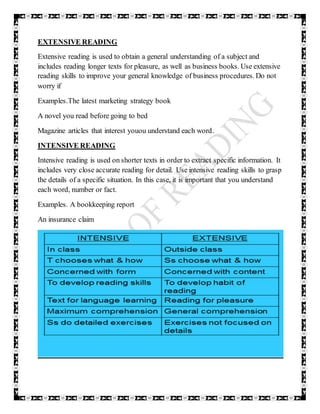
Extensive reading is used to obtain a general understanding of a subject and
includes reading longer texts for pleasure, as well as business books. Use extensive
reading skills to improve your general knowledge of business procedures. Do not
worry if
Examples.The latest marketing strategy book
A novel you read before going to bed
Magazine articles that interest youou understand each word.
INTENSIVE READING
Intensive reading is used on shorter texts in order to extract specific information. It
includes very close accurate reading for detail. Use intensive reading skills to grasp
the details of a specific situation. In this case, it is important that you understand
each word, number or fact.
Examples. A bookkeeping report
An insurance claim
COMPREHENSION
Means that you as a reader should predict what the author is about to say. Reading
extensively gives you this ability. By doing so your understanding of the text is
enhanced and you become familiar with the reading.
CRITICAL READING
Enables the reader to see the relationship of ideas and use these in reading with
meaning and fluency. Remember that writers often have specific aims in writing
texts- they often want to influence the way we think and see the world. In other
words texts are sometimes biased. Critical reading means questioning the opinions
of the writer. You have the right to agree or disagree with his/her opinions. This is
an important step in engaging with the text. Examples of questions you can ask
when doing a critical reading:
• Is the text based on fact or opinion
• Do I agree with the authors viewpoint
• Is the text subjective (opinion) or objective (facts)
• Is the text written in a specific time frame
VOCABULARY OR WORD ATTACK SKILLS
The more you read the more you become familiar with difficult words. In other
words by reading extensively you improve your vocabulary. Reading in context
(reading the sentence and understanding the way the word is used in that sentence)
is also a valuable reading skill.
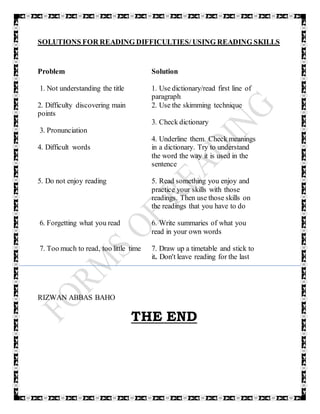
SOLUTIONS FOR READING DIFFICULTIES/ USING READING SKILLS
Problem
1. Not understanding the title
2. Difficulty discovering main
points
3. Pronunciation
4. Difficult words
5. Do not enjoy reading
6. Forgetting what you read
7. Too much to read, too little time
Solution
1. Use dictionary/read first line of
paragraph
2. Use the skimming technique
3. Check dictionary
4. Underline them. Check meanings
in a dictionary. Try to understand
the word the way it is used in the
sentence
5. Read something you enjoy and
practice your skills with those
readings. Then use those skills on
the readings that you have to do
6. Write summaries of what you
read in your own words
7. Draw up a timetable and stick to
it. Don't leave reading for the last
RIZWAN ABBAS BAHO
THE END

Reading skills.

  • 1.
    READING SKILLS Reading isone of the most important activities in your lives as students. Without reading you would not be able to acquire knowledge that is fundamental to your intellectual growth. Through reading you become experts in your fields. Reading can be divided into two main sub-headings i.e. Reading for pleasure and Reading for a specific purpose Reading for pleasure Reading for pleasure means that you choosewhat you want to read. Forexample you chooseto read a magazine or a bookby your favorite author in your free time. This does not however mean that you are not learning from this type of reading. Reading in any form informs you about society and culture and the world in general, whether it is through fiction (creative writing) or non-fiction (fact). Reading for a specific purpose This type of reading is more goal-orientated. In other words you are reading to achieve a specific outcome, e.g. to pass a test or to research for an essay. This type of reading is common in the life of any student. From the moment you attend your first class you are inundated with reading upon reading. Sometimes you feel you cannot copewith all the information contained in your prescribed readings. Not having the skills to read effectively can determine whether or not you will be successfulin completing your studies. It is therefore important to acquire effective readings to secure success. Reading skills will enable you to: • Make meaning out of written language • Interact and engage with the language • Comprehend and analyses the language
  • 2.
    WHAT ARE THETYPES OF READING SKILLS? 1. Scanning 2. Skimming 3. Intensive and Extensive reading 4. Comprehension and Critical reading 5. Vocabulary or word attack skills SCANNING Scanning is used to find a particular piece of information. Run your eyes over the text looking for the specific piece of information you need. Use scanning on schedules, meeting plans, etc. in order to find the specific details you require. If you see words or phrases that you don'tunderstand, don't worry when scanning. What is specific information? • Dates , Places, Names and Page numbers This technique is used to assess the value and relevance of the reading. SKIMMING The technique you use when you're going through a newspaper or magazine: you read quickly to get the main points, and skip over the detail. It's useful to skim: to preview a passage before you read it in detail to refresh your understanding of a passage after you've read it in detail. Use skimming when you're trying to decide if a bookin the library or bookshop is right for you The Newspaper (quickly to get the general news of the day) Magazines (quickly to discover which articles you would like to read in more detail) and the Business and Travel Brochures (quickly to get informed)
  • 3.
    EXTENSIVE READING Extensive readingis used to obtain a general understanding of a subject and includes reading longer texts for pleasure, as well as business books. Use extensive reading skills to improve your general knowledge of business procedures. Do not worry if Examples.The latest marketing strategy book A novel you read before going to bed Magazine articles that interest youou understand each word. INTENSIVE READING Intensive reading is used on shorter texts in order to extract specific information. It includes very close accurate reading for detail. Use intensive reading skills to grasp the details of a specific situation. In this case, it is important that you understand each word, number or fact. Examples. A bookkeeping report An insurance claim
  • 4.
    COMPREHENSION Means that youas a reader should predict what the author is about to say. Reading extensively gives you this ability. By doing so your understanding of the text is enhanced and you become familiar with the reading. CRITICAL READING Enables the reader to see the relationship of ideas and use these in reading with meaning and fluency. Remember that writers often have specific aims in writing texts- they often want to influence the way we think and see the world. In other words texts are sometimes biased. Critical reading means questioning the opinions of the writer. You have the right to agree or disagree with his/her opinions. This is an important step in engaging with the text. Examples of questions you can ask when doing a critical reading: • Is the text based on fact or opinion • Do I agree with the authors viewpoint • Is the text subjective (opinion) or objective (facts) • Is the text written in a specific time frame VOCABULARY OR WORD ATTACK SKILLS The more you read the more you become familiar with difficult words. In other words by reading extensively you improve your vocabulary. Reading in context (reading the sentence and understanding the way the word is used in that sentence) is also a valuable reading skill.
  • 5.
    SOLUTIONS FOR READINGDIFFICULTIES/ USING READING SKILLS Problem 1. Not understanding the title 2. Difficulty discovering main points 3. Pronunciation 4. Difficult words 5. Do not enjoy reading 6. Forgetting what you read 7. Too much to read, too little time Solution 1. Use dictionary/read first line of paragraph 2. Use the skimming technique 3. Check dictionary 4. Underline them. Check meanings in a dictionary. Try to understand the word the way it is used in the sentence 5. Read something you enjoy and practice your skills with those readings. Then use those skills on the readings that you have to do 6. Write summaries of what you read in your own words 7. Draw up a timetable and stick to it. Don't leave reading for the last RIZWAN ABBAS BAHO THE END