SPEAKING SKILLS
NEHA KAURAV
CLASS:
BCA 3rd SEM.
• Speaking is an act of making vocal
sounds. We can say that speaking
means to converse, or expressing
one's thoughts and feelings in
spoken language. To speak often
implies conveying information. It
may be from an informal remark
to a scholarly presentation to a
formal address.
• Speaking skills are the skills that give
us the ability to communicate
effectively.
• These skills allow the speaker, to
convey his message in a passionate,
thoughtful, and convincing manner.
• Speaking skills also help to assure
that one won't be misunderstood by
those who are listening.
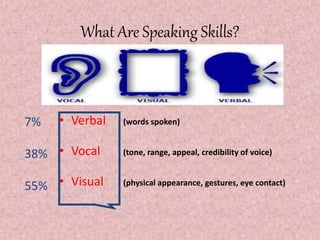
What Are Speaking Skills?
7%
38%
55%
• Verbal (words spoken)
• Vocal (tone, range, appeal, credibility of voice)
• Visual (physical appearance, gestures, eye contact)
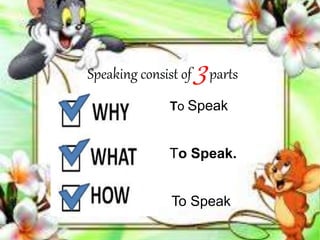
Speaking consist of 3parts
To Speak
To Speak.
To Speak
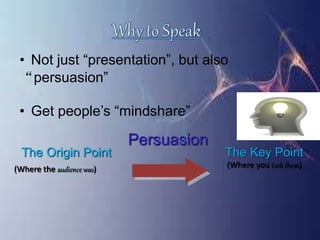
The Origin Point
(Where the audience was)
Persuasion
The Key Point
(Where you took them)
• Not just “presentation”, but also
“persuasion”
• Get people’s “mindshare”
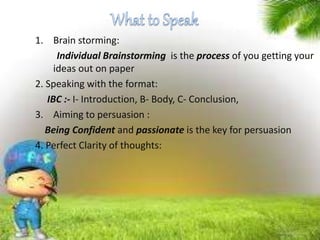
1. Brain storming:
Individual Brainstorming is the process of you getting your
ideas out on paper
2. Speaking with the format:
IBC :- I- Introduction, B- Body, C- Conclusion,
3. Aiming to persuasion :
Being Confident and passionate is the key for persuasion
4. Perfect Clarity of thoughts:
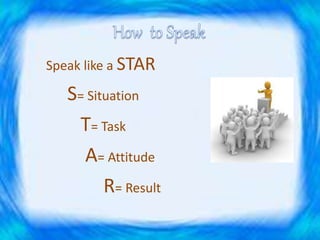
Speak like a STAR
S= Situation
T= Task
A= Attitude
R= Result
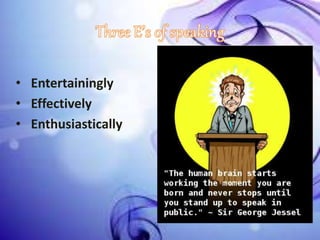
• Entertainingly
• Effectively
• Enthusiastically
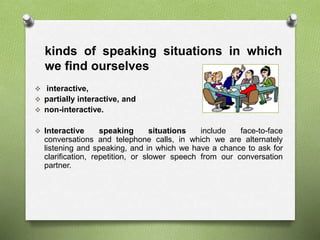
kinds of speaking situations in which
we find ourselves
 interactive,
 partially interactive, and
 non-interactive.
 Interactive speaking situations include face-to-face
conversations and telephone calls, in which we are alternately
listening and speaking, and in which we have a chance to ask for
clarification, repetition, or slower speech from our conversation
partner.
 Some speaking situations are partially interactive, such as
when giving a speech to a live audience, where the convention is
that the audience does not interrupt the speech. The speaker
nevertheless can see the audience and judge from the
expressions on their faces and body language whether or not he
or she is being understood.
 Some few speaking situations may be totally non-interactive,
such as when recording a speech for a radio broadcast.
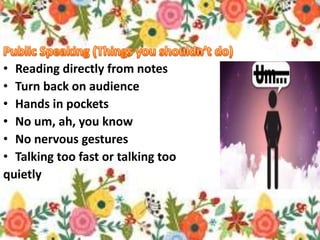
• Reading directly from notes
• Turn back on audience
• Hands in pockets
• No um, ah, you know
• No nervous gestures
• Talking too fast or talking too
quietly
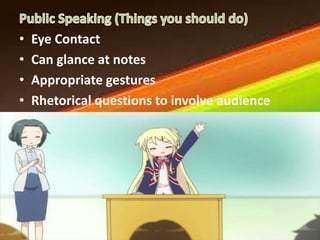
• Eye Contact
• Can glance at notes
• Appropriate gestures
• Rhetorical questions to involve audience
•The use of jargon. Over-complicated, unfamiliar and/or technical
terms.
•Emotional barriers and taboos. Some people may find it difficult to
express their emotions and some topics may be completely 'off-limits'
or taboo.
•Lack of attention, interest, distractions, or irrelevance to the receiver.
•Differences in perception and viewpoint.
•Physical disabilities such as hearing problems or speech difficulties.
•Physical barriers to non-verbal communication. Not being able to see
the non-verbal cues, gestures, posture and general body language can
make communication less effective.
•Language differences and the difficulty in understanding unfamiliar
accents.
•Expectations and prejudices which may lead to false assumptions or
stereotyping. People often hear what they expect to hear rather than
what is actually said and jump to incorrect conclusions.
•Cultural differences. The norms of social interaction vary greatly in
different cultures, as do the way in which emotions are expressed. For
example, the concept of personal space varies between cultures and
between different social settings.
Speaking Skills

Speaking Skills

  • 2.
  • 3.
    • Speaking isan act of making vocal sounds. We can say that speaking means to converse, or expressing one's thoughts and feelings in spoken language. To speak often implies conveying information. It may be from an informal remark to a scholarly presentation to a formal address.
  • 5.
    • Speaking skillsare the skills that give us the ability to communicate effectively. • These skills allow the speaker, to convey his message in a passionate, thoughtful, and convincing manner. • Speaking skills also help to assure that one won't be misunderstood by those who are listening.
  • 6.
    What Are SpeakingSkills? 7% 38% 55% • Verbal (words spoken) • Vocal (tone, range, appeal, credibility of voice) • Visual (physical appearance, gestures, eye contact)
  • 7.
    Speaking consist of3parts To Speak To Speak. To Speak
  • 8.
    The Origin Point (Wherethe audience was) Persuasion The Key Point (Where you took them) • Not just “presentation”, but also “persuasion” • Get people’s “mindshare”
  • 9.
    1. Brain storming: IndividualBrainstorming is the process of you getting your ideas out on paper 2. Speaking with the format: IBC :- I- Introduction, B- Body, C- Conclusion, 3. Aiming to persuasion : Being Confident and passionate is the key for persuasion 4. Perfect Clarity of thoughts:
  • 10.
    Speak like aSTAR S= Situation T= Task A= Attitude R= Result
  • 11.
  • 12.
    kinds of speakingsituations in which we find ourselves  interactive,  partially interactive, and  non-interactive.  Interactive speaking situations include face-to-face conversations and telephone calls, in which we are alternately listening and speaking, and in which we have a chance to ask for clarification, repetition, or slower speech from our conversation partner.
  • 13.
     Some speakingsituations are partially interactive, such as when giving a speech to a live audience, where the convention is that the audience does not interrupt the speech. The speaker nevertheless can see the audience and judge from the expressions on their faces and body language whether or not he or she is being understood.  Some few speaking situations may be totally non-interactive, such as when recording a speech for a radio broadcast.
  • 15.
    • Reading directlyfrom notes • Turn back on audience • Hands in pockets • No um, ah, you know • No nervous gestures • Talking too fast or talking too quietly
  • 16.
    • Eye Contact •Can glance at notes • Appropriate gestures • Rhetorical questions to involve audience
  • 19.
    •The use ofjargon. Over-complicated, unfamiliar and/or technical terms. •Emotional barriers and taboos. Some people may find it difficult to express their emotions and some topics may be completely 'off-limits' or taboo. •Lack of attention, interest, distractions, or irrelevance to the receiver. •Differences in perception and viewpoint. •Physical disabilities such as hearing problems or speech difficulties.
  • 20.
    •Physical barriers tonon-verbal communication. Not being able to see the non-verbal cues, gestures, posture and general body language can make communication less effective. •Language differences and the difficulty in understanding unfamiliar accents. •Expectations and prejudices which may lead to false assumptions or stereotyping. People often hear what they expect to hear rather than what is actually said and jump to incorrect conclusions. •Cultural differences. The norms of social interaction vary greatly in different cultures, as do the way in which emotions are expressed. For example, the concept of personal space varies between cultures and between different social settings.