Critical Reading
Qurat ul ain
Some books are to be tasted, others to
be swallowed, and some few to be
chewed and digested.
“ Francis Bacon
”
What is reading?
Presentation title 3
Reading is a set of skills that involves making sense and deriving meaning from the
from the printed word.
In order to read, we must be able to decode (sound out) the printed words and
and also comprehend what we read.
Decoding or phonemic awareness is the first skill you learn when you go to school.
to school. It is the ability to make out words, phrases, and sentences.
Differences Between
Active and Passive
Reading
4
Active Reading
• Aiming to find something out
• Reading slowly or quickly based on the given information or writing style
• Going over what you have read in your head and being willing to discuss it
with others
• Taking care to understand the text you’re reading thoroughly
• Skimming the text before reading it whole
Passive Reading
• Gaining little new knowledge from texts
• Leafing through the material regardless of the content
• Letting the ideas in the text slip away quickly upon finishing it
• Being unwilling to question your understanding of the text
• Going ahead with reading without any idea what the text is
about
Presentation title
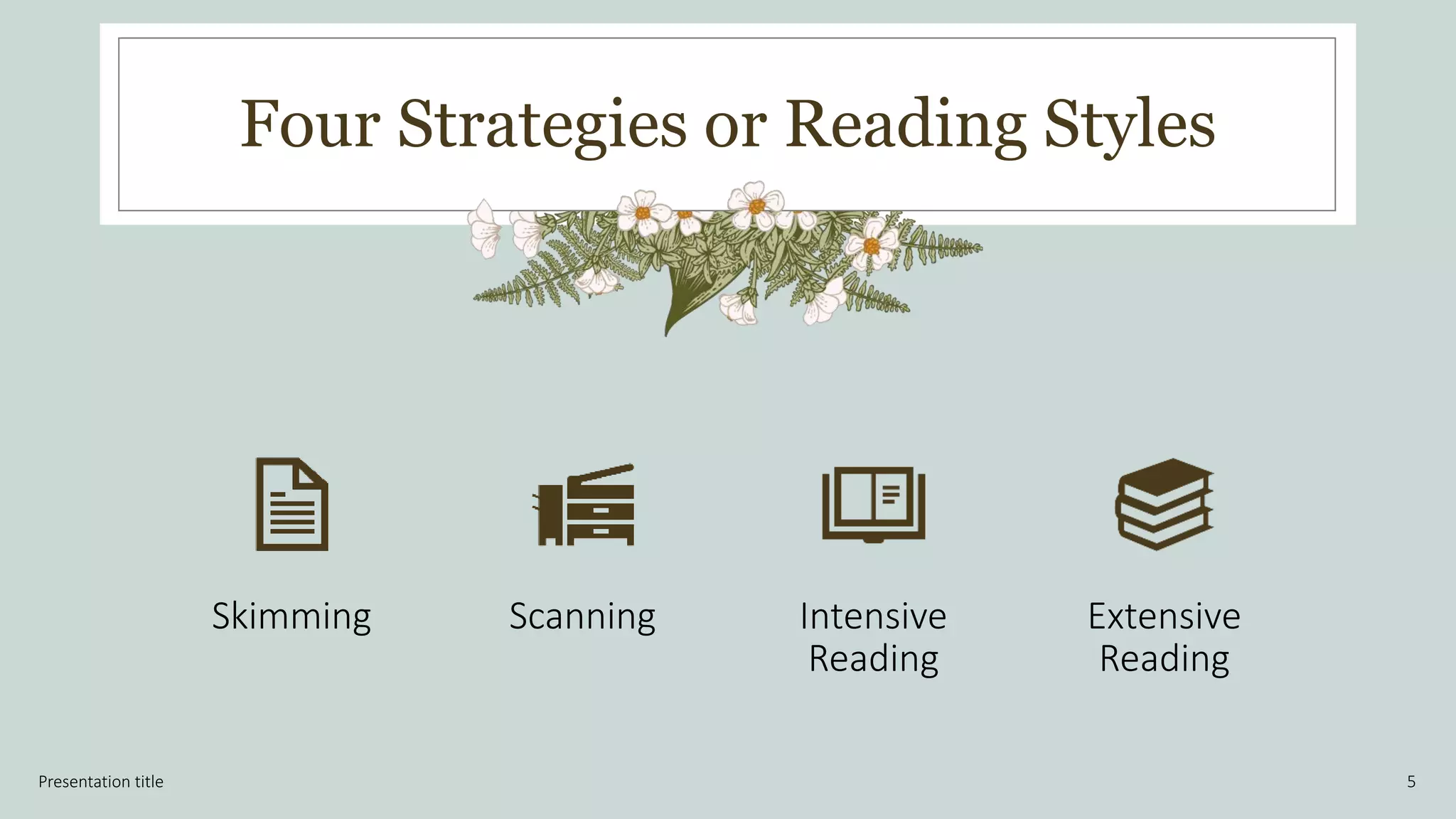
Four Strategies or Reading Styles
Presentation title 5
Skimming Scanning Intensive
Reading
Extensive
Reading
Skimming
Presentation title 6
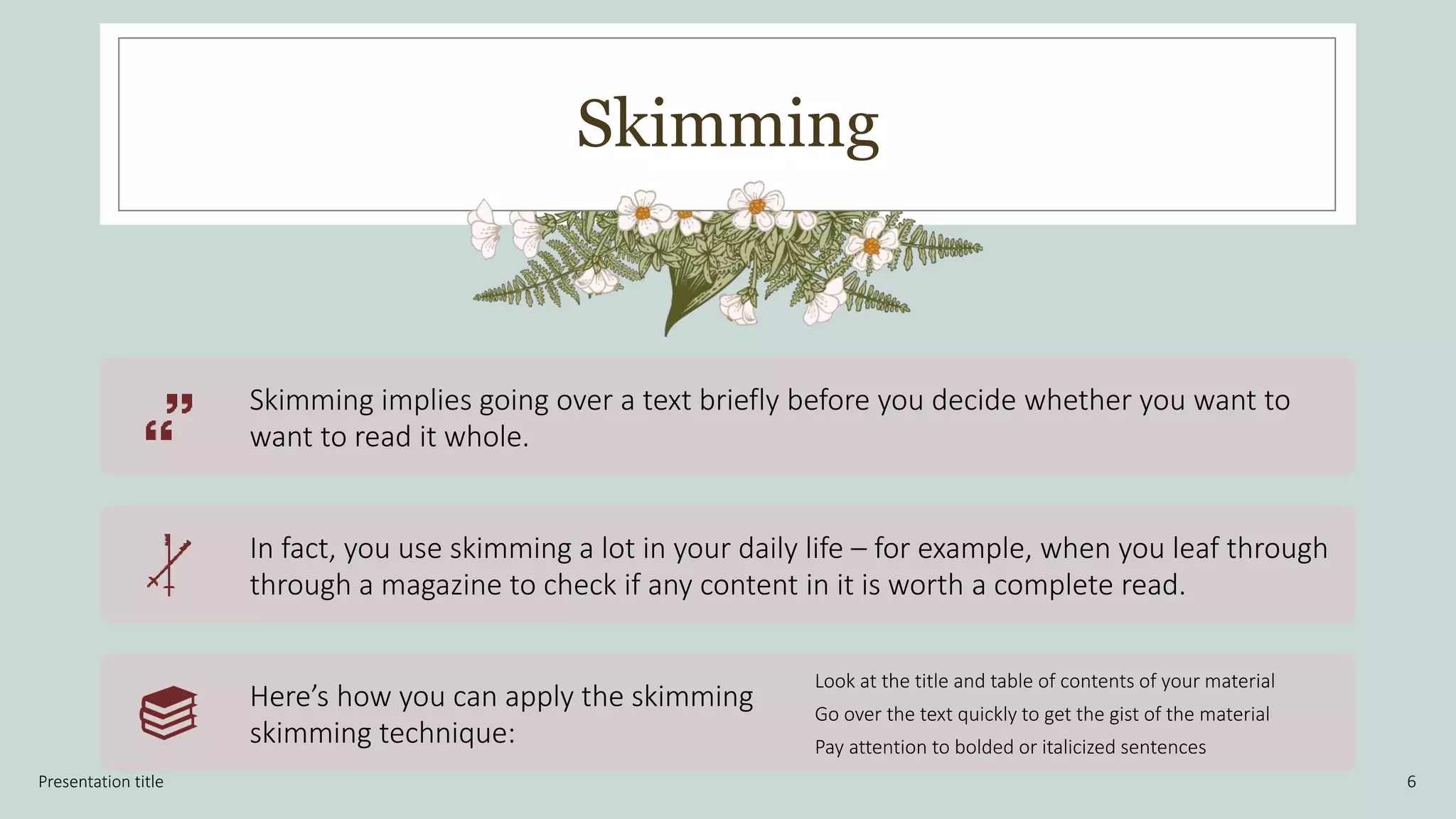
Skimming implies going over a text briefly before you decide whether you want to
want to read it whole.
In fact, you use skimming a lot in your daily life – for example, when you leaf through
through a magazine to check if any content in it is worth a complete read.
Here’s how you can apply the skimming
skimming technique:
Look at the title and table of contents of your material
Go over the text quickly to get the gist of the material
Pay attention to bolded or italicized sentences
Skimming: Finding the Thesis/Thesis
Statement
Presentation title 7
CHIEF POINT OR MAJOR CLAIM IT MAY GIVE YOU SOME SENSE OF HOW
HOW THE ARGUMENT FOR THAT THESIS
THESIS WILL BE CONDUCTED.
THESIS CAN ALSO BE CALLED THE MAIN
MAIN IDEA, THE POINT, OR EVEN THE
THE ARGUMENT
Scanning
Presentation title 8
Scanning is the technique you use to locate specific bits of information in texts.
texts.
To give you an example, imagine you want to check when the Wars of the Roses
Roses ended. You will open a page in your history textbook you know contains this
contains this information
Your eyes will fly over the text searching for numbers, and you will have your answer
answer quickly.
Intensive Reading
• Intensive reading implies you are diving deep into a given text.
• You want to analyze not only every idea expressed in it but also the
words and phrases the author has used.
• For this reason, intensive reading is usually regarded as an advanced
reading activity.
Presentation title 9
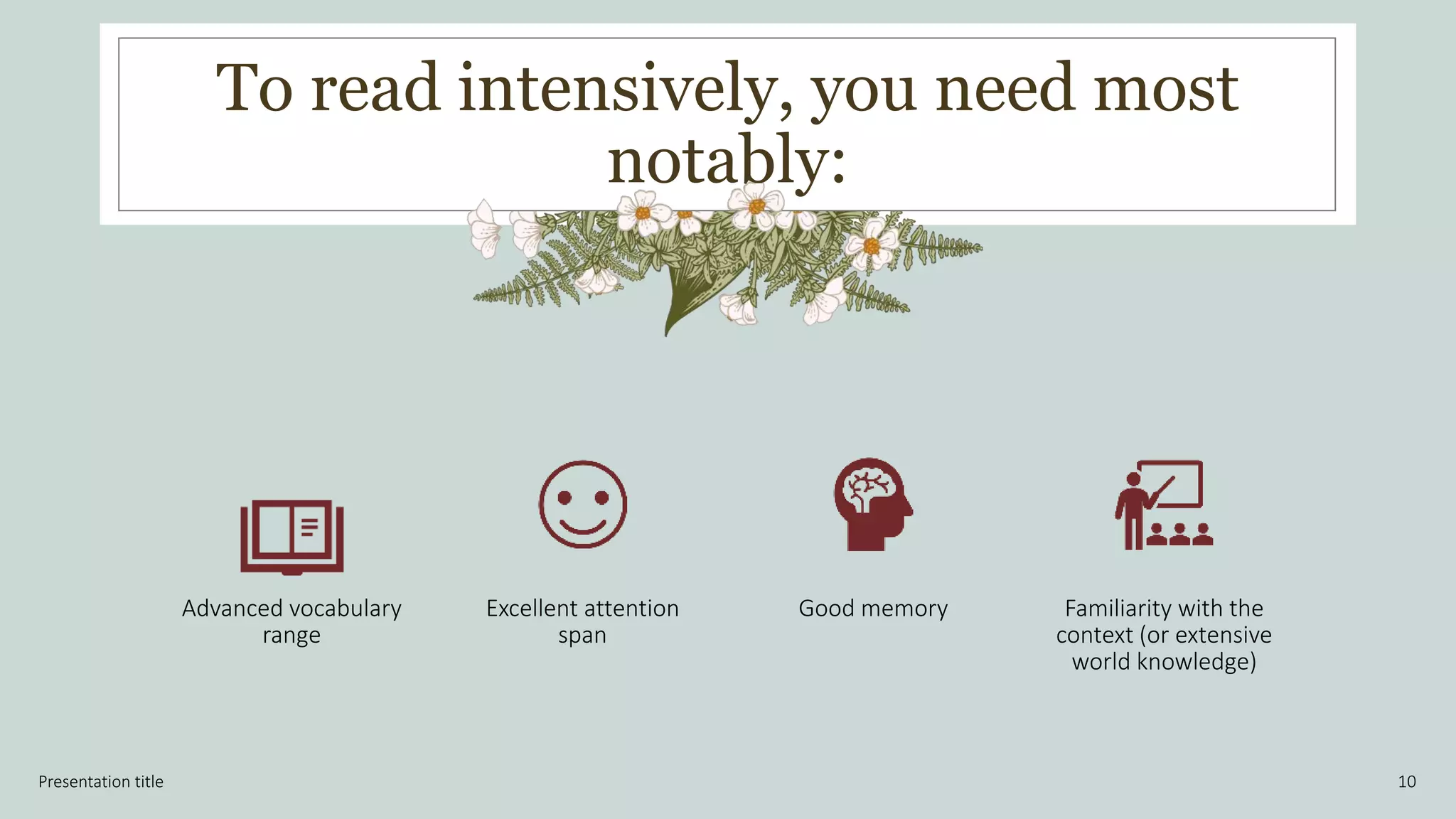
To read intensively, you need most
notably:
Presentation title 10
Advanced vocabulary
range
Excellent attention
span
Good memory Familiarity with the
context (or extensive
world knowledge)
Intensive reading helps you gain:
Presentation title 11
NEW VOCABULARY MAKES YOU A CRITICAL READER
READER
BROADENS YOUR ATTENTION
ATTENTION SPAN FURTHER.
FURTHER.
Extensive Reading
Presentation title 12
Reading extensively implies you are reading to get the bigger picture, enjoy the story, and pass the
pass the time.
Reading for pleasure.
You don’t have to analyze each part of the reading material or scratch your head anytime you’re not
you’re not sure what the author wanted to say.
Extensive reading should not be confused with passive reading.
While you are absorbing a certain material for pleasure, you still want to take in new knowledge and
knowledge and engross yourself in the story.
Regular extensive reading helps you:
Presentation title 13
Acquire new vocabulary too. It also builds a healthy habit of
reading for pleasure.
Ideal materials for extensive
reading are magazines, fiction
novels, and comic books.
Thank you
Qurat ul ain
quratulain@incollege.edu.pk
Presentation title 14

Critical Reading.pptx

  • 1.
  • 2.
    Some books areto be tasted, others to be swallowed, and some few to be chewed and digested. “ Francis Bacon ”
  • 3.
    What is reading? Presentationtitle 3 Reading is a set of skills that involves making sense and deriving meaning from the from the printed word. In order to read, we must be able to decode (sound out) the printed words and and also comprehend what we read. Decoding or phonemic awareness is the first skill you learn when you go to school. to school. It is the ability to make out words, phrases, and sentences.
  • 4.
    Differences Between Active andPassive Reading 4 Active Reading • Aiming to find something out • Reading slowly or quickly based on the given information or writing style • Going over what you have read in your head and being willing to discuss it with others • Taking care to understand the text you’re reading thoroughly • Skimming the text before reading it whole Passive Reading • Gaining little new knowledge from texts • Leafing through the material regardless of the content • Letting the ideas in the text slip away quickly upon finishing it • Being unwilling to question your understanding of the text • Going ahead with reading without any idea what the text is about Presentation title
  • 5.
    Four Strategies orReading Styles Presentation title 5 Skimming Scanning Intensive Reading Extensive Reading
  • 6.
    Skimming Presentation title 6 Skimmingimplies going over a text briefly before you decide whether you want to want to read it whole. In fact, you use skimming a lot in your daily life – for example, when you leaf through through a magazine to check if any content in it is worth a complete read. Here’s how you can apply the skimming skimming technique: Look at the title and table of contents of your material Go over the text quickly to get the gist of the material Pay attention to bolded or italicized sentences
  • 7.
    Skimming: Finding theThesis/Thesis Statement Presentation title 7 CHIEF POINT OR MAJOR CLAIM IT MAY GIVE YOU SOME SENSE OF HOW HOW THE ARGUMENT FOR THAT THESIS THESIS WILL BE CONDUCTED. THESIS CAN ALSO BE CALLED THE MAIN MAIN IDEA, THE POINT, OR EVEN THE THE ARGUMENT
  • 8.
    Scanning Presentation title 8 Scanningis the technique you use to locate specific bits of information in texts. texts. To give you an example, imagine you want to check when the Wars of the Roses Roses ended. You will open a page in your history textbook you know contains this contains this information Your eyes will fly over the text searching for numbers, and you will have your answer answer quickly.
  • 9.
    Intensive Reading • Intensivereading implies you are diving deep into a given text. • You want to analyze not only every idea expressed in it but also the words and phrases the author has used. • For this reason, intensive reading is usually regarded as an advanced reading activity. Presentation title 9
  • 10.
    To read intensively,you need most notably: Presentation title 10 Advanced vocabulary range Excellent attention span Good memory Familiarity with the context (or extensive world knowledge)
  • 11.
    Intensive reading helpsyou gain: Presentation title 11 NEW VOCABULARY MAKES YOU A CRITICAL READER READER BROADENS YOUR ATTENTION ATTENTION SPAN FURTHER. FURTHER.
  • 12.
    Extensive Reading Presentation title12 Reading extensively implies you are reading to get the bigger picture, enjoy the story, and pass the pass the time. Reading for pleasure. You don’t have to analyze each part of the reading material or scratch your head anytime you’re not you’re not sure what the author wanted to say. Extensive reading should not be confused with passive reading. While you are absorbing a certain material for pleasure, you still want to take in new knowledge and knowledge and engross yourself in the story.
  • 13.
    Regular extensive readinghelps you: Presentation title 13 Acquire new vocabulary too. It also builds a healthy habit of reading for pleasure. Ideal materials for extensive reading are magazines, fiction novels, and comic books.
  • 14.
    Thank you Qurat ulain quratulain@incollege.edu.pk Presentation title 14