Reading skills
A good reader lives a thousand lives before he dies
Reading
Speaking, Writing, and Listening skills, it is one among the four primary
language learning skills. So, it is looking at a collection of written symbols
and deriving meaning from them. When we read, our brains translate the
written symbols/letters, punctuation, and spaces that our eyes see into
words, sentences, and paragraphs that make sense to us. We can read aloud
or silently (in our heads). Reading is a talent that allows us to receive
information. But to enunciate the words we read; speaking is a necessary
component of the difficult reading process. Reading is useful in this way
since it allows us to both receive and sends information. Reading is also the
capacity to recognize words in print (a process known as word recognition)
and to infer meaning from them (a process called comprehension).
Purpose of reading
Reading has many purposes following them are:
❖Read for enjoyment.
❖For knowledge.
❖to educate.
❖To instruct.
❖As a pastime.
❖To examine.
❖To finish a task.
❖For understanding.
Obstacles in Effective Reading
Some of the important obstacles to effective reading are as follows:
➢Lack of Grammatical Competence
Many people struggle to read efficiently because they cannot decipher the
text's grammatical and lexical components. They are unable to distinguish
between and identify the words, sentences, and expressions utilized in the
text. It makes reading more difficult. If the reader cannot understand the text
grammatically, he may stop reading.
➢Lack of motivation
Motivation and discipline are needed to read for informationand knowledge.
Many people consider reading to be a tedious and time-consuming activity.
A barrier to reading may be created by a lack of sufficient motivation and
goals.
➢Less Concentration
When reading, if the reader is not focused, he will simply turn pages after
pages without much understanding. The psycholinguistic process of reading.
The reader must pay close attention.
➢Size of the Book
People typically like to read short articles and writings. The reader loses
interest in a book if it has a large number of pages.
➢Articulating the Words Loudly
Many readers have a habit of murmuring or articulating the text’s words
aloud. They buzz each word, which makes it difficult to read quickly.
➢Narrow Eye Span
Many readers read the text with independent word-to-word eye movements.
Their eyes have a small range. It not only slows down reading but also has
an impact on understanding. decreased speed and comprehension when the
attention span is less. For readers to increase their eye span, adequate
instruction and approaches are necessary.
Techniques of Effective Reading
Effective reading strategies include the following:
❖Highlighting Key Phrases
When you later reread the text, this can be a helpful technique to help you
remember what you thought was significant. It's crucial not to
overemphasize, though. Consider reading a paragraph at a time, for instance,
before underlining or highlighting. This will make it possible for you to pick
out its key points. As an alternative, you might discover that it is helpful to
read an entire chapter first to gain a sense of the key concepts before going
back and highlighting the details that support the argument.
❖Add Notations to the Margin
If you don't want to mark the book, you can use post-it notes instead. You
can do this with both physical copies and electronic books (for example, if it
is a library book). This method makes it easier for you to interact with the
material, which increases the recall of what you read.
❖Use the Signposts within the Text Itself
Watch out for words like "most importantly" and "critically." These
emphasize the themes that the author(s) thought were crucial.
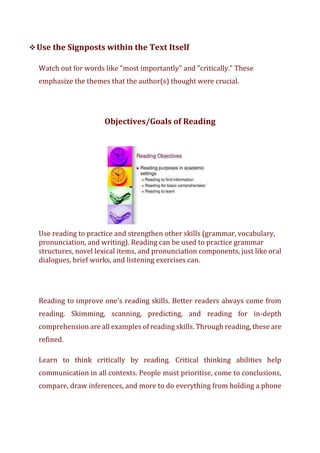
Objectives/Goals of Reading
Use reading to practice and strengthen other skills (grammar, vocabulary,
pronunciation, and writing). Reading can be used to practice grammar
structures, novel lexical items, and pronunciation components, just like oral
dialogues, brief works, and listening exercises can.
Reading to improve one's reading skills. Better readers always come from
reading. Skimming, scanning, predicting, and reading for in-depth
comprehension are all examples of reading skills. Through reading, these are
refined.
Learn to think critically by reading. Critical thinking abilities help
communication in all contexts. People must prioritise, come to conclusions,
compare, draw inferences, and more to do everything from holding a phone
conversation to developing a business plan. Reading can offer the
opportunity to put these talents to use and hone them.
Strategies of Reading
➢Using Prior Knowledge
Students use what they already know to assist them to grasp the literature
they are about to read when they preview it. This gives any new information
they read a framework.
➢Predicting
According to their prior knowledge of related subjects, students'
expectations are set when they form predictions about the material they are
about to read.
They might mentally amend their forecast as they read in light of new
information.
➢Summarization and recognizing the Main Idea
Students must decide what is important and then summarize it in their own
words to identify the primary theme. Attempting to comprehend the
author's motivation for creating the material is implicit in this process.
➢Questioning
Another tactic for getting pupils to concentrate on the text's significance is
asking and responding to questions about it. Teachers can assist by
demonstrating how to ask effective questions and how to use the text to
obtain the answers.
➢Making Inferences
Students must learn to draw from prior knowledge and spot cues in the text
itself to infer information that isn't expressed explicitly in the text.
➢Visualizing
According to studies, students who envision while reading retain
information better than those who do not (Pressley, 1977). When reading
the text without illustrations, readers can use the embedded illustrations or
conjure up their images or sketches in their minds.
Methods of Reading
This handy tactic improves reading comprehension and is particularly
beneficial for challenging textbook content. Do not feel that you must
follow every step because each one is valuable on its own. What works for
you, use.
❖Survey
Look over the content briefly before starting a new chapter to gain a sense
of the main points and concepts. The next procedure should take 5 to 10
minutes.
Go through the introduction.
Pay attention to the headings and subheadings.
Examine the images, graphs, and charts (anything visual).
Read the chapter synopsis.
Take a look at the chapter's conclusion study questions.
❖Questions
Your reading should be guided by questions.
Before reading the paragraphs in that part, make the first heading in the
chapter into a question. For example, read "What is a limited partnership?"
instead of "A Limited Partnership." Since you are now trying to find the
answer to the question, you have given reading a purpose.
❖Read
Look for the solutions to the questions you generated as you read. Use these
reading recommendations:
The key idea is typically stated in the opening sentence of each paragraph.
To make it easier for you to understand the author's point, look for
transitional terms like next, for instance, in contrast, and additionally.
As you read, make notes in the margins or on a notepad. primary points and
concepts; Do not just regurgitate data from the textbook.
Just draw attention to the most crucial details. Too much emphasis might
make distinguishing between the core idea and the supporting elements
challenging.
❖Recite
Examine the questions you came up with or those at the end of the chapter
when you've finished reading.
Can you respond to them? Unless you can, go back and review the
relevant portions while making notes.
Spend some time reciting or remembering what you can.
As soon as you are done reading, keep it in mind.
❖Review
For best comprehension and memory, it is crucial to revisit everything you
learned the day after you first learned it. If you don't study the material the
next day, you risk losing 80% of what you've learned.
Types of reading
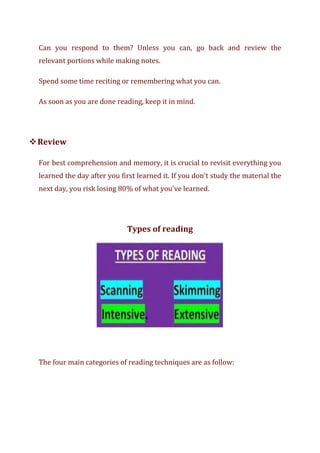
The four main categories of reading techniques are as follow:
➢Skimming
Skimming, also known as gist reading, is the process of reading a text quickly
to get the primary idea. Instead of pronouncing every word in this passage,
the reader concentrates on the fundamental idea or message of the text.
Reading periodicals or newspapers and looking up a name in a phone book
are two examples of skimming.
➢Scanning
Here, the reader skims through sentences to swiftly reach a certain piece of
information. When scanning, the unnecessary text is rejected or ignored to
focus on finding a specific piece of information.
➢Intensive Reading
Since it requires the reader to pay close attention to every detail, intensive
reading takes much longer than skimming and scanning. It involves close
reading to improve understanding. Every word must be understood by the
reader in this passage.
➢Extensive reading
A lot of reading places less emphasis on correctness and more on flow. It
typically involves leisure reading and is more of an extracurricular activity.
It is quite unusual that readers will read material they dislike extensively.
For More Articles Check This...

Reading skills

  • 1.
    Reading skills A goodreader lives a thousand lives before he dies Reading Speaking, Writing, and Listening skills, it is one among the four primary language learning skills. So, it is looking at a collection of written symbols and deriving meaning from them. When we read, our brains translate the written symbols/letters, punctuation, and spaces that our eyes see into words, sentences, and paragraphs that make sense to us. We can read aloud or silently (in our heads). Reading is a talent that allows us to receive information. But to enunciate the words we read; speaking is a necessary component of the difficult reading process. Reading is useful in this way since it allows us to both receive and sends information. Reading is also the capacity to recognize words in print (a process known as word recognition) and to infer meaning from them (a process called comprehension). Purpose of reading
  • 2.
    Reading has manypurposes following them are: ❖Read for enjoyment. ❖For knowledge. ❖to educate. ❖To instruct. ❖As a pastime. ❖To examine. ❖To finish a task. ❖For understanding. Obstacles in Effective Reading Some of the important obstacles to effective reading are as follows:
  • 3.
    ➢Lack of GrammaticalCompetence Many people struggle to read efficiently because they cannot decipher the text's grammatical and lexical components. They are unable to distinguish between and identify the words, sentences, and expressions utilized in the text. It makes reading more difficult. If the reader cannot understand the text grammatically, he may stop reading. ➢Lack of motivation Motivation and discipline are needed to read for informationand knowledge. Many people consider reading to be a tedious and time-consuming activity. A barrier to reading may be created by a lack of sufficient motivation and goals. ➢Less Concentration
  • 4.
    When reading, ifthe reader is not focused, he will simply turn pages after pages without much understanding. The psycholinguistic process of reading. The reader must pay close attention. ➢Size of the Book People typically like to read short articles and writings. The reader loses interest in a book if it has a large number of pages. ➢Articulating the Words Loudly Many readers have a habit of murmuring or articulating the text’s words aloud. They buzz each word, which makes it difficult to read quickly. ➢Narrow Eye Span Many readers read the text with independent word-to-word eye movements. Their eyes have a small range. It not only slows down reading but also has an impact on understanding. decreased speed and comprehension when the attention span is less. For readers to increase their eye span, adequate instruction and approaches are necessary. Techniques of Effective Reading Effective reading strategies include the following:
  • 5.
    ❖Highlighting Key Phrases Whenyou later reread the text, this can be a helpful technique to help you remember what you thought was significant. It's crucial not to overemphasize, though. Consider reading a paragraph at a time, for instance, before underlining or highlighting. This will make it possible for you to pick out its key points. As an alternative, you might discover that it is helpful to read an entire chapter first to gain a sense of the key concepts before going back and highlighting the details that support the argument. ❖Add Notations to the Margin If you don't want to mark the book, you can use post-it notes instead. You can do this with both physical copies and electronic books (for example, if it is a library book). This method makes it easier for you to interact with the material, which increases the recall of what you read.
  • 6.
    ❖Use the Signpostswithin the Text Itself Watch out for words like "most importantly" and "critically." These emphasize the themes that the author(s) thought were crucial. Objectives/Goals of Reading Use reading to practice and strengthen other skills (grammar, vocabulary, pronunciation, and writing). Reading can be used to practice grammar structures, novel lexical items, and pronunciation components, just like oral dialogues, brief works, and listening exercises can. Reading to improve one's reading skills. Better readers always come from reading. Skimming, scanning, predicting, and reading for in-depth comprehension are all examples of reading skills. Through reading, these are refined. Learn to think critically by reading. Critical thinking abilities help communication in all contexts. People must prioritise, come to conclusions, compare, draw inferences, and more to do everything from holding a phone
  • 7.
    conversation to developinga business plan. Reading can offer the opportunity to put these talents to use and hone them. Strategies of Reading ➢Using Prior Knowledge Students use what they already know to assist them to grasp the literature they are about to read when they preview it. This gives any new information they read a framework. ➢Predicting According to their prior knowledge of related subjects, students' expectations are set when they form predictions about the material they are about to read. They might mentally amend their forecast as they read in light of new information.
  • 8.
    ➢Summarization and recognizingthe Main Idea Students must decide what is important and then summarize it in their own words to identify the primary theme. Attempting to comprehend the author's motivation for creating the material is implicit in this process. ➢Questioning Another tactic for getting pupils to concentrate on the text's significance is asking and responding to questions about it. Teachers can assist by demonstrating how to ask effective questions and how to use the text to obtain the answers. ➢Making Inferences Students must learn to draw from prior knowledge and spot cues in the text itself to infer information that isn't expressed explicitly in the text. ➢Visualizing According to studies, students who envision while reading retain information better than those who do not (Pressley, 1977). When reading the text without illustrations, readers can use the embedded illustrations or conjure up their images or sketches in their minds.
  • 9.
    Methods of Reading Thishandy tactic improves reading comprehension and is particularly beneficial for challenging textbook content. Do not feel that you must follow every step because each one is valuable on its own. What works for you, use. ❖Survey Look over the content briefly before starting a new chapter to gain a sense of the main points and concepts. The next procedure should take 5 to 10 minutes. Go through the introduction. Pay attention to the headings and subheadings. Examine the images, graphs, and charts (anything visual). Read the chapter synopsis. Take a look at the chapter's conclusion study questions.
  • 10.
    ❖Questions Your reading shouldbe guided by questions. Before reading the paragraphs in that part, make the first heading in the chapter into a question. For example, read "What is a limited partnership?" instead of "A Limited Partnership." Since you are now trying to find the answer to the question, you have given reading a purpose. ❖Read Look for the solutions to the questions you generated as you read. Use these reading recommendations: The key idea is typically stated in the opening sentence of each paragraph. To make it easier for you to understand the author's point, look for transitional terms like next, for instance, in contrast, and additionally. As you read, make notes in the margins or on a notepad. primary points and concepts; Do not just regurgitate data from the textbook. Just draw attention to the most crucial details. Too much emphasis might make distinguishing between the core idea and the supporting elements challenging. ❖Recite Examine the questions you came up with or those at the end of the chapter when you've finished reading.
  • 11.
    Can you respondto them? Unless you can, go back and review the relevant portions while making notes. Spend some time reciting or remembering what you can. As soon as you are done reading, keep it in mind. ❖Review For best comprehension and memory, it is crucial to revisit everything you learned the day after you first learned it. If you don't study the material the next day, you risk losing 80% of what you've learned. Types of reading The four main categories of reading techniques are as follow:
  • 12.
    ➢Skimming Skimming, also knownas gist reading, is the process of reading a text quickly to get the primary idea. Instead of pronouncing every word in this passage, the reader concentrates on the fundamental idea or message of the text. Reading periodicals or newspapers and looking up a name in a phone book are two examples of skimming. ➢Scanning Here, the reader skims through sentences to swiftly reach a certain piece of information. When scanning, the unnecessary text is rejected or ignored to focus on finding a specific piece of information. ➢Intensive Reading Since it requires the reader to pay close attention to every detail, intensive reading takes much longer than skimming and scanning. It involves close reading to improve understanding. Every word must be understood by the reader in this passage. ➢Extensive reading A lot of reading places less emphasis on correctness and more on flow. It typically involves leisure reading and is more of an extracurricular activity. It is quite unusual that readers will read material they dislike extensively.
  • 13.
    For More ArticlesCheck This...