Reading and Vocabulary: Knowing, Guessing and Looking It UpSusan HolzmanETAIJuly, 2010
So, how do we “teach” reading?
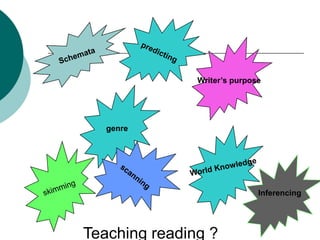
predictingSchemataWriter’s purposegenreWorld KnowledgescanningskimmingInferencingTeaching reading ?
Is L2 reading a reading problem or a language problem? (Alderson, 1984)
Should we teach reading (skills and strategies)???Should we teach language?
Swan (2008) says:The teaching of reading skills….commonly involves strategies which are of doubtful value…
Alderson (1984) saidBelow a certain level of language proficiency, reading is a languageproblem…..
KNOWINGFor the task of academic reading, the main knowledge type of interest is lexical. Word knowledge is the key ingredient in successful reading in L1 and L2. . ., contributing more to L2 reading than other types of linguistic knowledge including syntax…”[Cobb and Horst, 2001]
KNOWING. . .it has been consistently demonstrated that reading comprehension is strongly related to vocabulary knowledge, more strongly than to other components of reading”Syntactic complexity. . .was found not to affect the level of reading comprehension.			Laufer, 1997
Grabe (1997) The finer points of grammar were unnecessary…what was more crucial for comprehension was a continuous supply of new vocabularyKNOWING
CONCLUSION 1Teach vocabulary
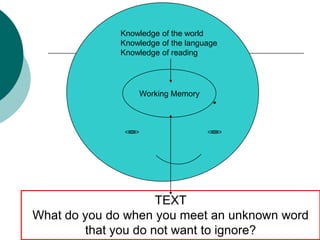
Knowledge of the worldKnowledge of the languageKnowledge of readingWorking MemoryTEXTWhat do you do when you meet an unknown word that you do not want to ignore?
What happens when we meet unfamiliar vocabulary?Option 1 - Guess in ContextOption 2 – Use a dictionary	English English Bilingual/Bilingiualized  Electronic Bilingual
Option 1Guess in ContextUse word families, use contextWhat happens to working memory?Does this strategy work?
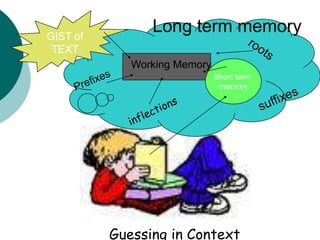
GIST ofTEXTLong term memoryrootsWorking MemoryShort term memoryPrefixessuffixesinflectionsGuessing in Context
GUESSINGBut there were two problems with the guessing theory. First there was little evidence for it and strong evidence against it….Second, the theory was harmless enough in L1 where children, whatever their teachers’ theories, made their guesses from a well-developed linguistic knowledge base.But if L2 readers were not taught vocabulary and syntax, then they were really guessing when they read, from whatever world knowledge they happened to possess.				Cobb and Horst, 2001
GUESSINGThe findings from the few reasonably well-conducted studies of guessing by non-native speakers have not shown large amounts of successful guessing and learning from guessing.Nation, 2001
GUESSINGSwan (2008)The teaching of reading skills….commonly involves strategies which are of doubtful value: this is especially the case for training in ‘guessing unknown words’
GUESSINGThe results of this study shed light on the efficacy of guessing strategy. It was found that the ability of learners to guess the meaning of unknown words is of limited value….Kaivanpanah and M Alavi, 2008
“He felt that high levels of frustration developed when a reader relies solely on guessing the meaning of unfamiliar lexical items: The reader has a need to know that certain meanings are correct so that they can continue to read with some level of confidence…” (Grabe, 1997, p. 112)GUESSING
CONCLUSION 2Guessing might be a nice classroom exercise..But it is NOT a useful strategy for real reading
Option 2: Use a dictionaryBook or electronic?English-EnglishBilingual/Bilingualized?Electronic?
LOOKING IT UPBill [Grabe] made reasonably good progress learning to read with the primary input being extensive reading and bilingual dictionary use…Grabe, 1997
LOOKING IT UP. . .the dictionary not only improved vocabulary learning, but also contributed to increased reading comprehensionGrabe, 1997
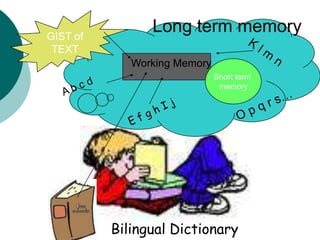
Since the amount of information that can be cognitively manipulated at one point by controlled processing is limited, focusing on slightly or completely unfamiliar words will take up some cognitive capacity that would  otherwise be used for higher level processing of text.      Laufer, 1997 LOOKING IT UP
GIST ofTEXTLong term memoryK l m n Working MemoryShort term memoryA b c dO p q r s…E f g h I j Bilingual Dictionary
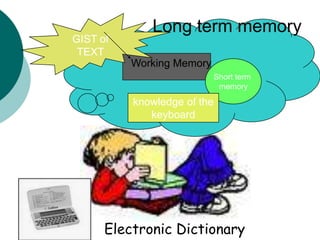
Long term memoryGIST ofTEXTWorking MemoryShort term memoryknowledge of the keyboardElectronic Dictionary
CONCLUSION 3For unknown vocabulary, students should :Use a dictionary
Readingand Vocabulary: Knowing,GuessingandLooking It UpCLASSROOM APPLICATIONS
Classroom Applications:KNOWINGbut the ultimate purpose of language teaching is to give students the language they need in order to read texts, not to teach them to manage as well as they can without that language. Research has shown that for efficient reading, skilled readers need to be able to recognize rapidly 95% or more of the words in a text (Grabe and Stoller 2002: 186). And in any case, if a student is seriously held up while reading by a difficult word, looking the word up beats guessing…(Swan,  2008)
Classroom Applications:KNOWING	Teach vocabularyBasic vocabularyAcademic vocabulary		Words with two meaningsWords that can be confusedLexical phrases
Classroom Applications:GUESSINGUse guessing in context as a classroom technique for teaching and reviewing vocabulary	Roots	Prefixes	Suffixes	Inflections
Classroom ApplicationsLOOKING IT UPActively teach dictionary useLooking for the base form of the wordFinding the right meaningFinding lexical phrases
Thank youSusan Holzmanholzms@zahav.net.ilARAB ACADEMIC INSTITUTE FOR TEACHER TRAINING AT BEIT BERL

Reading and Vocabulary: Knowing, Guessing and Looking It Up

  • 1.
    Reading and Vocabulary:Knowing, Guessing and Looking It UpSusan HolzmanETAIJuly, 2010
  • 2.
    So, how dowe “teach” reading?
  • 3.
  • 4.
    Is L2 readinga reading problem or a language problem? (Alderson, 1984)
  • 5.
    Should we teachreading (skills and strategies)???Should we teach language?
  • 6.
    Swan (2008) says:Theteaching of reading skills….commonly involves strategies which are of doubtful value…
  • 7.
    Alderson (1984) saidBelowa certain level of language proficiency, reading is a languageproblem…..
  • 8.
    KNOWINGFor the taskof academic reading, the main knowledge type of interest is lexical. Word knowledge is the key ingredient in successful reading in L1 and L2. . ., contributing more to L2 reading than other types of linguistic knowledge including syntax…”[Cobb and Horst, 2001]
  • 9.
    KNOWING. . .ithas been consistently demonstrated that reading comprehension is strongly related to vocabulary knowledge, more strongly than to other components of reading”Syntactic complexity. . .was found not to affect the level of reading comprehension. Laufer, 1997
  • 10.
    Grabe (1997) Thefiner points of grammar were unnecessary…what was more crucial for comprehension was a continuous supply of new vocabularyKNOWING
  • 11.
  • 12.
    Knowledge of theworldKnowledge of the languageKnowledge of readingWorking MemoryTEXTWhat do you do when you meet an unknown word that you do not want to ignore?
  • 13.
    What happens whenwe meet unfamiliar vocabulary?Option 1 - Guess in ContextOption 2 – Use a dictionary English English Bilingual/Bilingiualized Electronic Bilingual
  • 14.
    Option 1Guess inContextUse word families, use contextWhat happens to working memory?Does this strategy work?
  • 15.
    GIST ofTEXTLong termmemoryrootsWorking MemoryShort term memoryPrefixessuffixesinflectionsGuessing in Context
  • 16.
    GUESSINGBut there weretwo problems with the guessing theory. First there was little evidence for it and strong evidence against it….Second, the theory was harmless enough in L1 where children, whatever their teachers’ theories, made their guesses from a well-developed linguistic knowledge base.But if L2 readers were not taught vocabulary and syntax, then they were really guessing when they read, from whatever world knowledge they happened to possess. Cobb and Horst, 2001
  • 17.
    GUESSINGThe findings fromthe few reasonably well-conducted studies of guessing by non-native speakers have not shown large amounts of successful guessing and learning from guessing.Nation, 2001
  • 18.
    GUESSINGSwan (2008)The teachingof reading skills….commonly involves strategies which are of doubtful value: this is especially the case for training in ‘guessing unknown words’
  • 19.
    GUESSINGThe results ofthis study shed light on the efficacy of guessing strategy. It was found that the ability of learners to guess the meaning of unknown words is of limited value….Kaivanpanah and M Alavi, 2008
  • 20.
    “He felt thathigh levels of frustration developed when a reader relies solely on guessing the meaning of unfamiliar lexical items: The reader has a need to know that certain meanings are correct so that they can continue to read with some level of confidence…” (Grabe, 1997, p. 112)GUESSING
  • 21.
    CONCLUSION 2Guessing mightbe a nice classroom exercise..But it is NOT a useful strategy for real reading
  • 22.
    Option 2: Usea dictionaryBook or electronic?English-EnglishBilingual/Bilingualized?Electronic?
  • 23.
    LOOKING IT UPBill[Grabe] made reasonably good progress learning to read with the primary input being extensive reading and bilingual dictionary use…Grabe, 1997
  • 24.
    LOOKING IT UP.. .the dictionary not only improved vocabulary learning, but also contributed to increased reading comprehensionGrabe, 1997
  • 25.
    Since the amountof information that can be cognitively manipulated at one point by controlled processing is limited, focusing on slightly or completely unfamiliar words will take up some cognitive capacity that would otherwise be used for higher level processing of text. Laufer, 1997 LOOKING IT UP
  • 26.
    GIST ofTEXTLong termmemoryK l m n Working MemoryShort term memoryA b c dO p q r s…E f g h I j Bilingual Dictionary
  • 27.
    Long term memoryGISTofTEXTWorking MemoryShort term memoryknowledge of the keyboardElectronic Dictionary
  • 28.
    CONCLUSION 3For unknownvocabulary, students should :Use a dictionary
  • 29.
  • 30.
    Classroom Applications:KNOWINGbut theultimate purpose of language teaching is to give students the language they need in order to read texts, not to teach them to manage as well as they can without that language. Research has shown that for efficient reading, skilled readers need to be able to recognize rapidly 95% or more of the words in a text (Grabe and Stoller 2002: 186). And in any case, if a student is seriously held up while reading by a difficult word, looking the word up beats guessing…(Swan, 2008)
  • 31.
    Classroom Applications:KNOWING Teach vocabularyBasicvocabularyAcademic vocabulary Words with two meaningsWords that can be confusedLexical phrases
  • 32.
    Classroom Applications:GUESSINGUse guessingin context as a classroom technique for teaching and reviewing vocabulary Roots Prefixes Suffixes Inflections
  • 33.
    Classroom ApplicationsLOOKING ITUPActively teach dictionary useLooking for the base form of the wordFinding the right meaningFinding lexical phrases
  • 34.
    Thank youSusan Holzmanholzms@zahav.net.ilARABACADEMIC INSTITUTE FOR TEACHER TRAINING AT BEIT BERL