Language Skills

There are in general, four language skills.
               Listening
               Speaking
               Reading
                writing
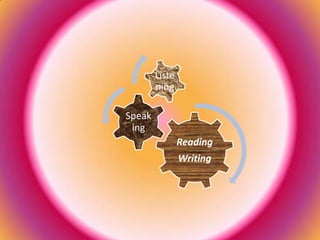
Liste
        ning

Speak
 ing
                Reading
                Writing
Listening Skill


Listening is the first of the four language
                    skills.
        Listening is the process of
  receiving, attending to, and assigning
   meaning to aural and visual stimuli
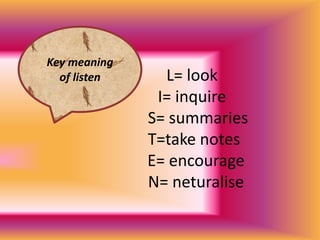
Key meaning
  of listen     L= look
               I= inquire
              S= summaries
              T=take notes
              E= encourage
              N= neturalise
Receiving language through ears
    Identifying the sound of speech
           Receive individual
sounds(letters, stress, rhythm, and pauses)
Importance of
              listening
It is essential for language teachers to help
 their students become effective listeners.
   It is an important skill for us to hone.
    We listen far more than we speak.
In most profession settings from 41 percent
to 60 percent or more of our communication
           time is spent listening.
 Students may receive as much as 90% of
their in-school information through listening
      to instructors and to one another.
 Focus and attention
          Work at harder
 Second language requires even great
               focus
Listening is like painting, like colour, in day to day
                    environment.
       Listening is important or face to face
 encounters, telephone messages, for enjoyment of
 radio and television programs, formal lectures, etc.
For practice we can listen recorded voices.
 The most important thing is to listen to a
   variety of voices as often as we can.
In our own language , listening is usually
  the first language skill that we learn.

    A good listener tried to understand
  throughly what the other person is saying.
“Listening looks easy, but it’s not simple.
         Every head is a world”

 “If speaking is silver, then listening is
                   gold”
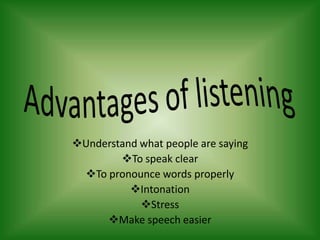
Understand what people are saying
        To speak clear
 To pronounce words properly
          Intonation
            Stress
     Make speech easier
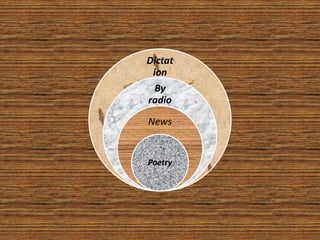
Dictat
 ion
  By
radio

News


Poetry
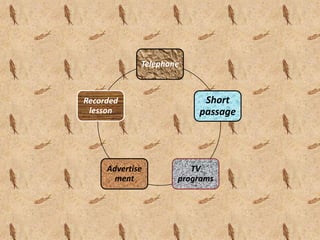
Telephone


Recorded                  Short
 lesson                  passage


     Advertise          TV
       ment          programs
(http:aei.uoregon.edu/iep/iep.htm)
    (http://www.esl-lab.com)
Language skills

Language skills

  • 2.
    Language Skills There arein general, four language skills. Listening Speaking Reading writing
  • 3.
    Liste ning Speak ing Reading Writing
  • 4.
    Listening Skill Listening isthe first of the four language skills. Listening is the process of receiving, attending to, and assigning meaning to aural and visual stimuli
  • 5.
    Key meaning of listen L= look I= inquire S= summaries T=take notes E= encourage N= neturalise
  • 6.
    Receiving language throughears Identifying the sound of speech Receive individual sounds(letters, stress, rhythm, and pauses)
  • 7.
    Importance of listening It is essential for language teachers to help their students become effective listeners. It is an important skill for us to hone. We listen far more than we speak.
  • 8.
    In most professionsettings from 41 percent to 60 percent or more of our communication time is spent listening. Students may receive as much as 90% of their in-school information through listening to instructors and to one another.
  • 9.
     Focus andattention  Work at harder  Second language requires even great focus
  • 10.
    Listening is likepainting, like colour, in day to day environment. Listening is important or face to face encounters, telephone messages, for enjoyment of radio and television programs, formal lectures, etc.
  • 11.
    For practice wecan listen recorded voices. The most important thing is to listen to a variety of voices as often as we can.
  • 12.
    In our ownlanguage , listening is usually the first language skill that we learn. A good listener tried to understand throughly what the other person is saying.
  • 13.
    “Listening looks easy,but it’s not simple. Every head is a world” “If speaking is silver, then listening is gold”
  • 14.
    Understand what peopleare saying To speak clear To pronounce words properly Intonation Stress Make speech easier
  • 16.
    Dictat ion By radio News Poetry
  • 17.
    Telephone Recorded Short lesson passage Advertise TV ment programs
  • 18.
    (http:aei.uoregon.edu/iep/iep.htm) (http://www.esl-lab.com)