Building Based Literacy Strategies Across the Content Areas SIS Professional Development  November 4, 2008 Provided by the SIS Literacy Team
The SIS Literacy Team Sue Albright, Math Michele Bonitatibus, Science Johanna Capria, Special Education Annine Crystal, Language Arts Supervisor Joan Fazo, Language Arts Lillian Hannon, UA Carolyn Ivanoff, Housemaster Terry McCabe, Media Specialist Sheila Persson, Social Studies Wendy Stowe, UA Dedicated to providing building based instructional literacy strategies to our teachers and students at SIS to improve student learning and performance.
Goal:   Closing the SIS Achievement Gap With Direct Vocabulary Instruction Techniques and Tools to Improve Reading Comprehension and Vocabulary Development Across the Content Areas
Workshop Objectives: Understand the research behind effective vocabulary instruction  Six Steps of effective vocabulary instruction Close the achievement gap by building background knowledge through direct vocabulary instruction Tools and Strategies for effective instruction and learning
And the researchers are… Robert J. Marzano  Building Background Knowledge for Academic Achievement  Building Academic Vocabulary Classroom Instruction that Works Debra J. Pickering Building Academic Vocabulary Classroom Instruction that Works Eric Jensen Brain Based Learning Jane K. Doty Teaching Reading in the Content Areas Belinda Williams Closing the Achievement Gap
Closing the gap with our low performing students The research is very clear that  students from lower socioeconomic backgrounds and others with limited academic background knowledge  are at a great disadvantage in our schools because they do not have the background knowledge required for successful learning and academic success. Analysis of SIS AYP gap reflects the need to support special needs sub-group, economically disadvantaged sub-group, and assist our ELL students in vocabulary acquisition.
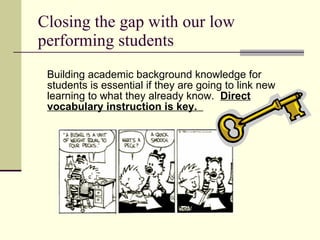
Closing the gap with our low performing students Building academic background knowledge for students is essential if they are going to link new learning to what they already know.  Direct vocabulary instruction is key.
The  Necessity  of Core Vocabulary Instruction – The Learning & Context Threshold If a student does not know enough of the words of what is being read they cannot learn from context. If a student a student does not know enough of the words of what is being read they cannot comprehend what they are reading. Students need a vocabulary of about 3000 words, or 95% coverage, before they can learn from context with simple text.  Liu Na & Nation, 1985
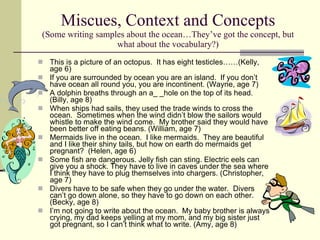
Miscues, Context and Concepts (Some writing samples about the ocean…They’ve got the concept, but what about the vocabulary?) This is a picture of an octopus.  It has eight testicles……(Kelly, age 6)  If you are surrounded by ocean you are an island.  If you don’t have ocean all round you, you are incontinent. (Wayne, age 7) A dolphin breaths through an a_ _hole on the top of its head. (Billy, age 8) When ships had sails, they used the trade winds to cross the ocean.  Sometimes when the wind didn’t blow the sailors would whistle to make the wind come.  My brother said they would have been better off eating beans. (William, age 7) Mermaids live in the ocean.  I like mermaids.  They are beautiful and I like their shiny tails, but how on earth do mermaids get pregnant?  (Helen, age 6) Some fish are dangerous. Jelly fish can sting. Electric eels can give you a shock. They have to live in caves under the sea where I think they have to plug themselves into chargers. (Christopher, age 7) Divers have to be safe when they go under the water.  Divers can’t go down alone, so they have to go down on each other. (Becky, age 8) I’m not going to write about the ocean.  My baby brother is always crying, my dad keeps yelling at my mom, and my big sister just got pregnant, so I can’t think what to write. (Amy, age 8)
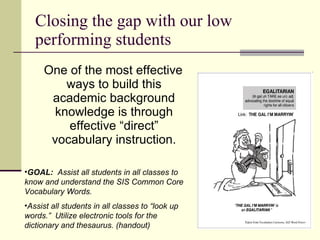
Closing the gap with our low performing students One of the most effective ways to build this academic background knowledge is through effective “direct” vocabulary instruction. GOAL:   Assist all students in all classes to know and understand the SIS Common Core Vocabulary Words. Assist all students in all classes to “look up words.”  Utilize electronic tools for the dictionary and thesaurus. (handout)
The Thesaurus for middle school students…. Encourage students to “look up” words they don’t know as they read.  Help them develop VERSATILE context clues for words that allows them to understand the word in the RIGHT context. Electronic thesaurus and dictionaries will provide meanings, synonyms, antonyms, and will “pronounce” words audibly.  They will also help kids look up words they may not be able to immediately spell. Check for understanding by giving students multiple opportunities to use words in the necessary context to successfully attain and demonstrate and embed vocabulary learning.
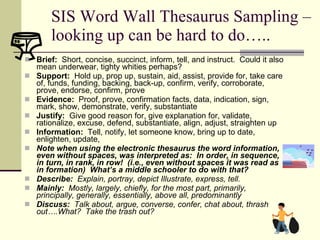
SIS Word Wall Thesaurus Sampling – looking up can be hard to do….. Brief:   Short, concise, succinct, inform, tell, and instruct.  Could it also mean underwear, tighty whities perhaps? Support:   Hold up, prop up, sustain, aid, assist, provide for, take care of, funds, funding, backing, back-up, confirm, verify, corroborate, prove, endorse, confirm, prove Evidence:  Proof, prove, confirmation facts, data, indication, sign, mark, show, demonstrate, verify, substantiate Justify:   Give good reason for, give explanation for, validate, rationalize, excuse, defend, substantiate, align, adjust, straighten up Information:   Tell, notify, let someone know, bring up to date, enlighten, update,  Note when using the electronic thesaurus the word information, even without spaces, was interpreted as:  In order, in sequence, in turn, in rank, in row!  (i.e., even without spaces it was read as in formation)  What’s a middle schooler to do with that? Describe:  Explain, portray, depict Illustrate, express, tell. Mainly:  Mostly, largely, chiefly, for the most part, primarily, principally, generally, essentially, above all, predominantly Discuss:  Talk about, argue, converse, confer, chat about, thrash out….What?  Take the trash out?
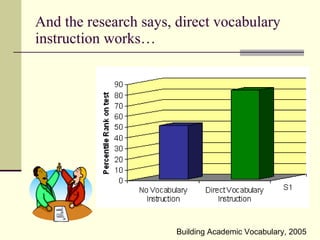
And the research says, direct vocabulary instruction works… Building Academic Vocabulary, 2005
What the Academic Research Says, “… one compelling fact: what students already know about the content is one of the strongest indicators of how well they will learn new information about the content.” Robert J. Marzano, Building Background Knowledge for Academic    Achievement
What the Brain Research Says Orstein found that prior exposure to information speeds up learning.  The brain looks for places to “compartmentalize” or “categorize” information… and Donchin found that the “greater amount of ‘priming’ stimulus, the more the brain extracted and ‘compartmentalized’ the information. Eric Jensen, Brain Based Learning
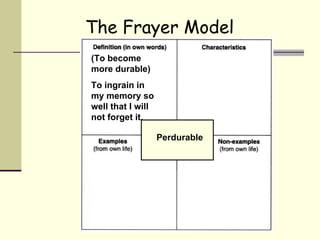
What the Brain Research Says Information is stored both linguistically and non-linguistically.  It is the combination of both of these that makes learning  perdurable. Eric Jensen, Brain Based Learning per·du·ra·ble   (p r-d r  -b l, -dy r -)   adj.  Extremely durable; permanent. Thesaurus :   Synonyms Related Words Antonyms Adj.1.perdurable  - very long lasting; "less durable rocks were gradually worn away to form valleys"; "the perdurable granite of the ancient Appalachian spine of the continent"  undestroyable ,  indestructible ,  durable imperishable  - not perishable
The Matthew Effect In research on reading and language disabilities. The "Matthew Effect" refers to the idea that in reading (as in other areas of life), the rich get richer and the poor get poorer.  When children fail at early reading and writing, they begin to dislike reading. They read less than their classmates who are stronger readers. And when children with disabilities do not receive adequate remediation, they read less – and learn less from reading - than non-disabled children.  As a consequence, they do not gain vocabulary,  background knowledge , and information about how reading material is structured. In short, the word-rich get richer, while the word-poor get poorer. This is called " The Matthew Effect ".
How important is vocabulary size? 5 to 6 year olds have a working vocabulary of 2,500 to 5,000 words.  (Beck & McKeown, 1991) Whether a child is near the bottom or top of that range depends on their literacy skills coming into first grade. (Graves, 1986; White, Graves & Slater, 1990) Therefore, by first grade, the vocabulary of the disadvantaged student is half that of the advantaged student and over time the gap widens.  ( The Matthew Effect )  The  average  student learns about 3,000 words per year in the early school years – that’s 8 words per day (Baumann & Kameenui, 1991) but vocabulary growth is considerably worse for disadvantaged students than it is for advantaged students (White,Graves & Slater, 1990)
Effect of Vocabulary Size Imagine how much harder learning would be if you didn’t understand half of the words you currently know.  Imagine if reading the front pages of a newspaper was like this:  “ While hortenting efrades the populace of the vanderbee class, most experts concur that a scrivant rarely endeavors to decry the ambitions and shifferings of the moulant class.  Deciding whether to oxant the blatantly malighed Secting party, most moulants will tolerate the subjugation of staits, savats, or tempets only so long as the scrivant pays tribute to the derivan, either through preem or exaltation.”
Direct Vocabulary Instruction Research shows the best approach to teaching vocabulary is to teach strategies for learning the meaning(s) of the words in context. Direct instruction involves talking about the definitions and contextual meanings of words, focusing on synonyms and antonyms  and providing examples and non-examples. (Kuhn & Stahl) Students also NEED to encounter words frequently in a variety of contexts at least 12 times to internalize them.  (McKeown, Beck, Omanson, and Pople)
Review For information to be stored in long term memory (background knowledge) it has to find a ‘compartment’ or category in the brain to reside.  (We often call these “concepts.”) Low achieving students generally lack these categories or compartments because they have not been exposed to enough stimuli (linguistic and non-linguistic)
So how does this work?    Let’s watch your brain at work. What categories do  you  use to store information? Do your students have the same ones? Rote does note mean the W was left off!
What do “your” categories tell you to do with this information? In the early 1860’s a R________issued the Emancipation ___________.  This order freed millions of s________. The C_______ had the authority to enforce this order. Emancipation alone did not give the former ________ a new life. Decades of e_________ hardship and unequal rights continued. A______________ Plan was supported by many R____________.
What do “your” categories tell you to do with information? In the early 1860’s a R ussian  issued the Emancipation  Manifesto .  This order freed millions of s erfs . The C zar  had the authority to enforce this order. Emancipation alone did not give the former s erfs  a new life. Decades of e conomic  hardship and unequal rights continued. A lexander’s  Plan was supported by many R ussians .
Let’s try another easy one… The questions that p______ face as they raise ch______ from in______to adult life are not easy to an______.  Both fa______ and m______ can become concerned when health problems such as co______ arise any time after the e______ stage to later life.  Experts recommend that young ch______ should have plenty of s______ and nutritious food for healthy growth.  B______ and g______ should not share the same b______ or even sleep in the same r______.  They may be afraid of the d______.
Well? The questions that p oultrymen  face as they raise ch ickens  from in cubation  to adult life are not easy to an swer .  Both fa rmer  and m erchants  can become concerned when health problems such as co ccidiosis  arise any time after the e gg  stage to later life.  Experts recommend that young chi cks  should have plenty of s unshine  and nutritious food for healthy growth.  B anties  and g eese  should not share the same b arnyard  or even sleep in the same r oost .  They may be afraid of the d ark . How did you do?
So, what can we do? We as teachers must make sure that our students are going to the  right   categories to make the  right  connections and create the  right  hooks to hang new knowledge.  We need to build these categories with good vocabulary instruction and stuff them full of good vocabulary terms.  VOCABULARY IS KEY!!
Our Goal – The Power of Words Build background knowledge through research based strategies that effectively help our students increase, and understand, categories to store new information. Utilize direct vocabulary instruction in  all classes for all students  to assist their ability to make connections in context and provide them with “Vocabulary Hangers and Hooks” to attach new concepts and knowledge.  Close the Matthew Effect. Teach our students to fish with words so they can feed/learn for themselves forever.
THE 2009 SIS BUILDING DUAL LITERACY CHALLENGE Every administrator, teacher, adult and student at SIS will participate in this challenge within the context of their subjects and classrooms. Everyone at SIS is a Literacy Leader. Every student at SIS will know their times tables.  http://www.mathsisfun.com/tables.html Every student at SIS will know and be able to use the SIS Common Core Vocabulary
Now, to the “How To”…
Five Statements from current research about Vocabulary . . . Students need to be exposed to a word a minimum of six times (twelve is best) in context before they have enough experience with the word to ascertain its meaning and make it perdurable. Even superficial instruction in new words enhances the probability that students will understand the words when they encounter them. One of the best ways to learn a new word is to associate a mental image or symbolic representation with it. Direct vocabulary instruction works.  Teaching new vocabulary directly increases student comprehension of new materials. Direct instruction on words that are  critical to new content  produces the most powerful learning. Selecting these words that are “critical”  is essential. Jane K. Doty, MCREL
Six Steps to Effective  Vocabulary Instruction Provide description, explanation or example of the new term Students restate the explanation of the new term in their own words Students create a nonlinguistic representation of the term Students periodically do activities that help them add to their knowledge of vocabulary terms (Comparing Terms, Classifying Terms, Generating Similes / Metaphor, Nonlinguistic Representations) Periodically ask students to discuss the terms with one another Periodically engage students in games that allow them to play with the terms Marzano, 2005
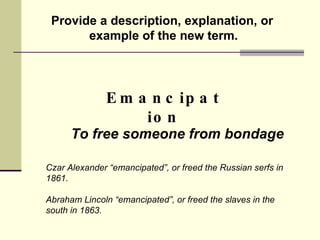
Provide a description, explanation, or example of the new term. Emancipation To free someone from bondage Czar Alexander “emancipated”, or freed the Russian serfs in 1861.  Abraham Lincoln “emancipated”, or freed the slaves in the south in 1863.
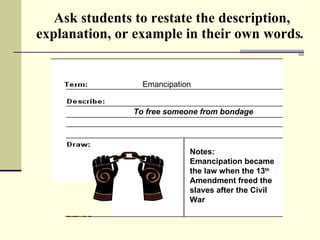
Ask students to restate the description, explanation, or example in their own words .   Emancipation To free someone from bondage Notes: Emancipation became the law when the 13 th  Amendment freed the slaves after the Civil War
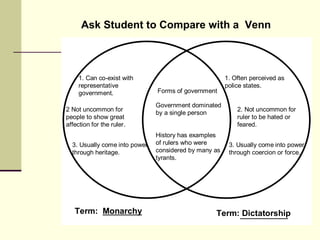
Ask Student to Compare with a  Venn
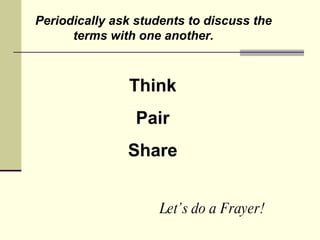
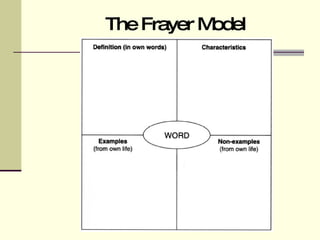
Periodically ask students to discuss the terms with one another. Think Pair Share Let’s do a Frayer!
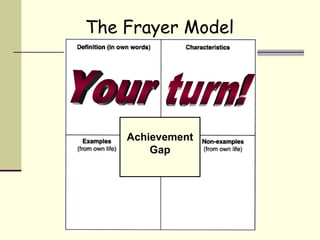
Think, Pair, Share with Frayer Think :   Provide a few minutes of quiet “think time” to allow students, individually, to review their own descriptions and images of the targeted terms in their notebooks.  Pair :   After students have had a chance to think about the targeted terms, organize them into pairs and ask them to discuss their descriptions and pictures of the terms with their partners. Share :   Invite students to share aloud with the whole class any new thoughts or understandings they have discussed in their pairs. Have students make additions and revisions to their Frayer’s. Monitor their work to ensure that their additions and revision are accurate.
The Frayer Model
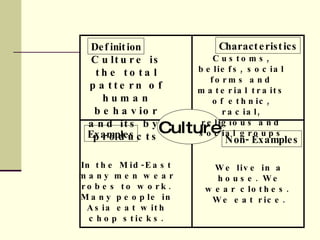
Definition Characteristics Examples Non-Examples Culture Culture is the total pattern of human behavior and its by-products Customs, beliefs, social forms and material traits of ethnic, racial, religious and social groups In the Mid-East many men wear robes to work. Many people in Asia eat with chop sticks. We live in a house. We wear clothes.  We eat rice.
The Frayer Model Achievement Gap Your turn!
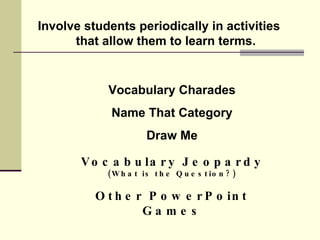
Involve students periodically in activities that allow them to learn terms. Vocabulary Charades Name That Category Draw Me Vocabulary Jeopardy (What is the Question?) Other PowerPoint Games
Vocabulary Jeopardy    and other  PowerPoint Games
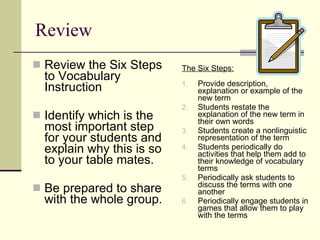
Review Review the Six Steps to Vocabulary Instruction  Identify which is the most important step for your students and explain why this is so to your table mates. Be prepared to share with the whole group. Provide description, explanation or example of the new term Students restate the explanation of the new term in their own words Students create a nonlinguistic representation of the term Students periodically do activities that help them add to their knowledge of vocabulary terms Periodically ask students to discuss the terms with one another Periodically engage students in games that allow them to play with the terms The Six Steps:
Building Essential Vocabulary Lists What have we done and where do we go from here?
School-wide, common core, interdisciplinary  words for CMT in word wall format Strategies in this presentation for direct vocabulary instruction  Departments developing relevant lists for their disciplines and curriculum What we have:
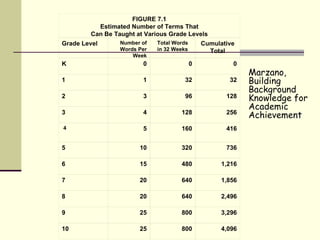
So how do we decide what to put on our list? How many words need to be identified as “critical” or “essential” for each grade level by subject? How many words are optimum for embedded learning?
Marzano,  Building Background Knowledge for Academic Achievement  FIGURE 7.1 Estimated Number of Terms That Can Be Taught at Various Grade Levels Grade Level Number of Words Per Week Total Words in 32 Weeks Cumulative Total K 0 0 0 1 1 32 32 2 3 96 128 3 4 128 256   4 5 160 416 5 10 320 736 6 15 480 1,216 7 20 640 1,856 8 20 640 2,496 9 25 800 3,296 10 25 800 4,096
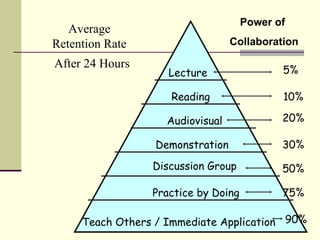
Lecture Reading Audiovisual Demonstration Discussion Group Practice by Doing Teach Others / Immediate Application 5% 10% 20% 30% 50% 75% 90% Average Retention Rate After 24 Hours Power of  Collaboration
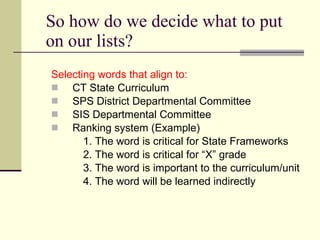
So how do we decide what to put on our lists? Selecting words that align to: CT State Curriculum SPS District Departmental Committee SIS Departmental Committee Ranking system (Example) 1. The word is critical for State Frameworks 2. The word is critical for “X” grade 3. The word is important to the curriculum/unit 4. The word will be learned indirectly
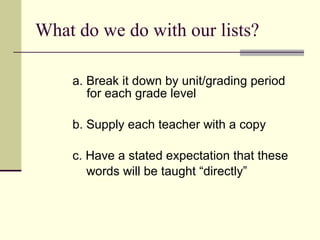
What do we do with our lists? a. Break it down by unit/grading period   for each grade level b. Supply each teacher with a copy c. Have a stated expectation that these   words will be taught “directly”
So how do we decide what to put on our list? Resources – a.  C-FB Online Vocabulary Lists b.  C-FB Curriculum Resource SS c.  MCREL Content Knowledge Site d.  Tennessee’s Academic Vocabulary Site e.  Texas Essential Knowledge and Skills Glossary
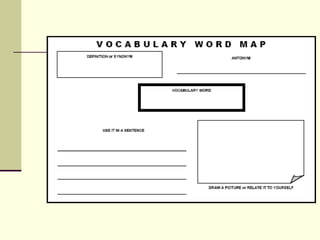
Other versions of Vocabulary Building Templates Where can I find these templates? Others  and  some more … Go to the SIS LMC Website / Teacher’s Toolkit
Review and Reaffirm Of the strategies that we just reviewed, which one(s) do you think you would like to try in your class? Explain to your group. Be prepared to share
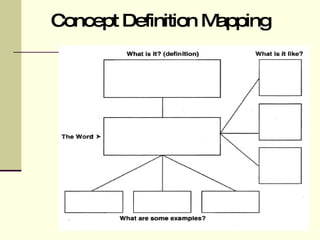
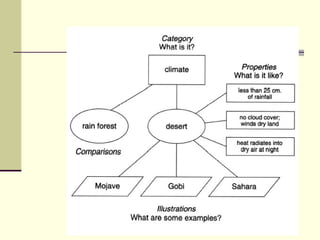
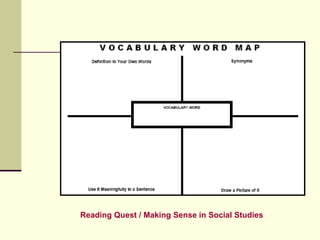
Concept Definition Mapping
 
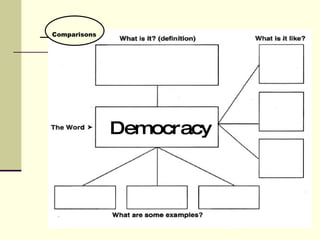
Democracy Comparisons
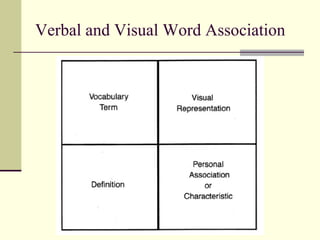
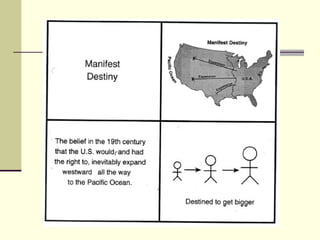
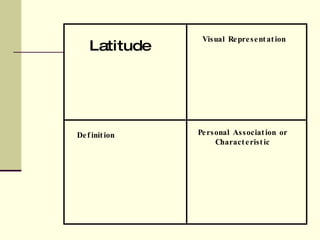
Verbal and Visual Word Association
 
Latitude Visual Representation Definition Personal Association or Characteristic
Reading Quest / Making Sense in Social Studies
 
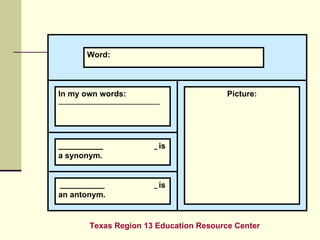
Texas Region 13 Education Resource Center Word: In my own words:   __________________________________ _______________ _   is a synonym. _______________ _   is an antonym. Picture:
The Frayer Model Perdurable (To become more durable) To ingrain in my memory so well that I will not forget it.
Application Activity Working with your group/department, discuss five other vocabulary activities you use that contribute to a rich, robust, interactive vocabulary environment in your classroom. Be prepared to share with the large group
 

Literacy in Every Classroom

  • 1.
    Building Based LiteracyStrategies Across the Content Areas SIS Professional Development November 4, 2008 Provided by the SIS Literacy Team
  • 2.
    The SIS LiteracyTeam Sue Albright, Math Michele Bonitatibus, Science Johanna Capria, Special Education Annine Crystal, Language Arts Supervisor Joan Fazo, Language Arts Lillian Hannon, UA Carolyn Ivanoff, Housemaster Terry McCabe, Media Specialist Sheila Persson, Social Studies Wendy Stowe, UA Dedicated to providing building based instructional literacy strategies to our teachers and students at SIS to improve student learning and performance.
  • 3.
    Goal: Closing the SIS Achievement Gap With Direct Vocabulary Instruction Techniques and Tools to Improve Reading Comprehension and Vocabulary Development Across the Content Areas
  • 4.
    Workshop Objectives: Understandthe research behind effective vocabulary instruction Six Steps of effective vocabulary instruction Close the achievement gap by building background knowledge through direct vocabulary instruction Tools and Strategies for effective instruction and learning
  • 5.
    And the researchersare… Robert J. Marzano Building Background Knowledge for Academic Achievement Building Academic Vocabulary Classroom Instruction that Works Debra J. Pickering Building Academic Vocabulary Classroom Instruction that Works Eric Jensen Brain Based Learning Jane K. Doty Teaching Reading in the Content Areas Belinda Williams Closing the Achievement Gap
  • 6.
    Closing the gapwith our low performing students The research is very clear that students from lower socioeconomic backgrounds and others with limited academic background knowledge are at a great disadvantage in our schools because they do not have the background knowledge required for successful learning and academic success. Analysis of SIS AYP gap reflects the need to support special needs sub-group, economically disadvantaged sub-group, and assist our ELL students in vocabulary acquisition.
  • 7.
    Closing the gapwith our low performing students Building academic background knowledge for students is essential if they are going to link new learning to what they already know. Direct vocabulary instruction is key.
  • 8.
    The Necessity of Core Vocabulary Instruction – The Learning & Context Threshold If a student does not know enough of the words of what is being read they cannot learn from context. If a student a student does not know enough of the words of what is being read they cannot comprehend what they are reading. Students need a vocabulary of about 3000 words, or 95% coverage, before they can learn from context with simple text. Liu Na & Nation, 1985
  • 9.
    Miscues, Context andConcepts (Some writing samples about the ocean…They’ve got the concept, but what about the vocabulary?) This is a picture of an octopus. It has eight testicles……(Kelly, age 6) If you are surrounded by ocean you are an island. If you don’t have ocean all round you, you are incontinent. (Wayne, age 7) A dolphin breaths through an a_ _hole on the top of its head. (Billy, age 8) When ships had sails, they used the trade winds to cross the ocean. Sometimes when the wind didn’t blow the sailors would whistle to make the wind come. My brother said they would have been better off eating beans. (William, age 7) Mermaids live in the ocean. I like mermaids. They are beautiful and I like their shiny tails, but how on earth do mermaids get pregnant? (Helen, age 6) Some fish are dangerous. Jelly fish can sting. Electric eels can give you a shock. They have to live in caves under the sea where I think they have to plug themselves into chargers. (Christopher, age 7) Divers have to be safe when they go under the water. Divers can’t go down alone, so they have to go down on each other. (Becky, age 8) I’m not going to write about the ocean. My baby brother is always crying, my dad keeps yelling at my mom, and my big sister just got pregnant, so I can’t think what to write. (Amy, age 8)
  • 10.
    Closing the gapwith our low performing students One of the most effective ways to build this academic background knowledge is through effective “direct” vocabulary instruction. GOAL: Assist all students in all classes to know and understand the SIS Common Core Vocabulary Words. Assist all students in all classes to “look up words.” Utilize electronic tools for the dictionary and thesaurus. (handout)
  • 11.
    The Thesaurus formiddle school students…. Encourage students to “look up” words they don’t know as they read. Help them develop VERSATILE context clues for words that allows them to understand the word in the RIGHT context. Electronic thesaurus and dictionaries will provide meanings, synonyms, antonyms, and will “pronounce” words audibly. They will also help kids look up words they may not be able to immediately spell. Check for understanding by giving students multiple opportunities to use words in the necessary context to successfully attain and demonstrate and embed vocabulary learning.
  • 12.
    SIS Word WallThesaurus Sampling – looking up can be hard to do….. Brief: Short, concise, succinct, inform, tell, and instruct. Could it also mean underwear, tighty whities perhaps? Support: Hold up, prop up, sustain, aid, assist, provide for, take care of, funds, funding, backing, back-up, confirm, verify, corroborate, prove, endorse, confirm, prove Evidence: Proof, prove, confirmation facts, data, indication, sign, mark, show, demonstrate, verify, substantiate Justify: Give good reason for, give explanation for, validate, rationalize, excuse, defend, substantiate, align, adjust, straighten up Information: Tell, notify, let someone know, bring up to date, enlighten, update, Note when using the electronic thesaurus the word information, even without spaces, was interpreted as: In order, in sequence, in turn, in rank, in row! (i.e., even without spaces it was read as in formation) What’s a middle schooler to do with that? Describe: Explain, portray, depict Illustrate, express, tell. Mainly: Mostly, largely, chiefly, for the most part, primarily, principally, generally, essentially, above all, predominantly Discuss: Talk about, argue, converse, confer, chat about, thrash out….What? Take the trash out?
  • 13.
    And the researchsays, direct vocabulary instruction works… Building Academic Vocabulary, 2005
  • 14.
    What the AcademicResearch Says, “… one compelling fact: what students already know about the content is one of the strongest indicators of how well they will learn new information about the content.” Robert J. Marzano, Building Background Knowledge for Academic Achievement
  • 15.
    What the BrainResearch Says Orstein found that prior exposure to information speeds up learning. The brain looks for places to “compartmentalize” or “categorize” information… and Donchin found that the “greater amount of ‘priming’ stimulus, the more the brain extracted and ‘compartmentalized’ the information. Eric Jensen, Brain Based Learning
  • 16.
    What the BrainResearch Says Information is stored both linguistically and non-linguistically. It is the combination of both of these that makes learning perdurable. Eric Jensen, Brain Based Learning per·du·ra·ble  (p r-d r -b l, -dy r -) adj. Extremely durable; permanent. Thesaurus :  Synonyms Related Words Antonyms Adj.1.perdurable - very long lasting; "less durable rocks were gradually worn away to form valleys"; "the perdurable granite of the ancient Appalachian spine of the continent" undestroyable , indestructible , durable imperishable - not perishable
  • 17.
    The Matthew EffectIn research on reading and language disabilities. The "Matthew Effect" refers to the idea that in reading (as in other areas of life), the rich get richer and the poor get poorer. When children fail at early reading and writing, they begin to dislike reading. They read less than their classmates who are stronger readers. And when children with disabilities do not receive adequate remediation, they read less – and learn less from reading - than non-disabled children. As a consequence, they do not gain vocabulary, background knowledge , and information about how reading material is structured. In short, the word-rich get richer, while the word-poor get poorer. This is called " The Matthew Effect ".
  • 18.
    How important isvocabulary size? 5 to 6 year olds have a working vocabulary of 2,500 to 5,000 words. (Beck & McKeown, 1991) Whether a child is near the bottom or top of that range depends on their literacy skills coming into first grade. (Graves, 1986; White, Graves & Slater, 1990) Therefore, by first grade, the vocabulary of the disadvantaged student is half that of the advantaged student and over time the gap widens. ( The Matthew Effect ) The average student learns about 3,000 words per year in the early school years – that’s 8 words per day (Baumann & Kameenui, 1991) but vocabulary growth is considerably worse for disadvantaged students than it is for advantaged students (White,Graves & Slater, 1990)
  • 19.
    Effect of VocabularySize Imagine how much harder learning would be if you didn’t understand half of the words you currently know. Imagine if reading the front pages of a newspaper was like this: “ While hortenting efrades the populace of the vanderbee class, most experts concur that a scrivant rarely endeavors to decry the ambitions and shifferings of the moulant class. Deciding whether to oxant the blatantly malighed Secting party, most moulants will tolerate the subjugation of staits, savats, or tempets only so long as the scrivant pays tribute to the derivan, either through preem or exaltation.”
  • 20.
    Direct Vocabulary InstructionResearch shows the best approach to teaching vocabulary is to teach strategies for learning the meaning(s) of the words in context. Direct instruction involves talking about the definitions and contextual meanings of words, focusing on synonyms and antonyms and providing examples and non-examples. (Kuhn & Stahl) Students also NEED to encounter words frequently in a variety of contexts at least 12 times to internalize them. (McKeown, Beck, Omanson, and Pople)
  • 21.
    Review For informationto be stored in long term memory (background knowledge) it has to find a ‘compartment’ or category in the brain to reside. (We often call these “concepts.”) Low achieving students generally lack these categories or compartments because they have not been exposed to enough stimuli (linguistic and non-linguistic)
  • 22.
    So how doesthis work? Let’s watch your brain at work. What categories do you use to store information? Do your students have the same ones? Rote does note mean the W was left off!
  • 23.
    What do “your”categories tell you to do with this information? In the early 1860’s a R________issued the Emancipation ___________. This order freed millions of s________. The C_______ had the authority to enforce this order. Emancipation alone did not give the former ________ a new life. Decades of e_________ hardship and unequal rights continued. A______________ Plan was supported by many R____________.
  • 24.
    What do “your”categories tell you to do with information? In the early 1860’s a R ussian issued the Emancipation Manifesto . This order freed millions of s erfs . The C zar had the authority to enforce this order. Emancipation alone did not give the former s erfs a new life. Decades of e conomic hardship and unequal rights continued. A lexander’s Plan was supported by many R ussians .
  • 25.
    Let’s try anothereasy one… The questions that p______ face as they raise ch______ from in______to adult life are not easy to an______. Both fa______ and m______ can become concerned when health problems such as co______ arise any time after the e______ stage to later life. Experts recommend that young ch______ should have plenty of s______ and nutritious food for healthy growth. B______ and g______ should not share the same b______ or even sleep in the same r______. They may be afraid of the d______.
  • 26.
    Well? The questionsthat p oultrymen face as they raise ch ickens from in cubation to adult life are not easy to an swer . Both fa rmer and m erchants can become concerned when health problems such as co ccidiosis arise any time after the e gg stage to later life. Experts recommend that young chi cks should have plenty of s unshine and nutritious food for healthy growth. B anties and g eese should not share the same b arnyard or even sleep in the same r oost . They may be afraid of the d ark . How did you do?
  • 27.
    So, what canwe do? We as teachers must make sure that our students are going to the right categories to make the right connections and create the right hooks to hang new knowledge. We need to build these categories with good vocabulary instruction and stuff them full of good vocabulary terms. VOCABULARY IS KEY!!
  • 28.
    Our Goal –The Power of Words Build background knowledge through research based strategies that effectively help our students increase, and understand, categories to store new information. Utilize direct vocabulary instruction in all classes for all students to assist their ability to make connections in context and provide them with “Vocabulary Hangers and Hooks” to attach new concepts and knowledge. Close the Matthew Effect. Teach our students to fish with words so they can feed/learn for themselves forever.
  • 29.
    THE 2009 SISBUILDING DUAL LITERACY CHALLENGE Every administrator, teacher, adult and student at SIS will participate in this challenge within the context of their subjects and classrooms. Everyone at SIS is a Literacy Leader. Every student at SIS will know their times tables. http://www.mathsisfun.com/tables.html Every student at SIS will know and be able to use the SIS Common Core Vocabulary
  • 30.
    Now, to the“How To”…
  • 31.
    Five Statements fromcurrent research about Vocabulary . . . Students need to be exposed to a word a minimum of six times (twelve is best) in context before they have enough experience with the word to ascertain its meaning and make it perdurable. Even superficial instruction in new words enhances the probability that students will understand the words when they encounter them. One of the best ways to learn a new word is to associate a mental image or symbolic representation with it. Direct vocabulary instruction works. Teaching new vocabulary directly increases student comprehension of new materials. Direct instruction on words that are critical to new content produces the most powerful learning. Selecting these words that are “critical” is essential. Jane K. Doty, MCREL
  • 32.
    Six Steps toEffective Vocabulary Instruction Provide description, explanation or example of the new term Students restate the explanation of the new term in their own words Students create a nonlinguistic representation of the term Students periodically do activities that help them add to their knowledge of vocabulary terms (Comparing Terms, Classifying Terms, Generating Similes / Metaphor, Nonlinguistic Representations) Periodically ask students to discuss the terms with one another Periodically engage students in games that allow them to play with the terms Marzano, 2005
  • 33.
    Provide a description,explanation, or example of the new term. Emancipation To free someone from bondage Czar Alexander “emancipated”, or freed the Russian serfs in 1861. Abraham Lincoln “emancipated”, or freed the slaves in the south in 1863.
  • 34.
    Ask students torestate the description, explanation, or example in their own words . Emancipation To free someone from bondage Notes: Emancipation became the law when the 13 th Amendment freed the slaves after the Civil War
  • 35.
    Ask Student toCompare with a Venn
  • 36.
    Periodically ask studentsto discuss the terms with one another. Think Pair Share Let’s do a Frayer!
  • 37.
    Think, Pair, Sharewith Frayer Think : Provide a few minutes of quiet “think time” to allow students, individually, to review their own descriptions and images of the targeted terms in their notebooks. Pair : After students have had a chance to think about the targeted terms, organize them into pairs and ask them to discuss their descriptions and pictures of the terms with their partners. Share : Invite students to share aloud with the whole class any new thoughts or understandings they have discussed in their pairs. Have students make additions and revisions to their Frayer’s. Monitor their work to ensure that their additions and revision are accurate.
  • 38.
  • 39.
    Definition Characteristics ExamplesNon-Examples Culture Culture is the total pattern of human behavior and its by-products Customs, beliefs, social forms and material traits of ethnic, racial, religious and social groups In the Mid-East many men wear robes to work. Many people in Asia eat with chop sticks. We live in a house. We wear clothes. We eat rice.
  • 40.
    The Frayer ModelAchievement Gap Your turn!
  • 41.
    Involve students periodicallyin activities that allow them to learn terms. Vocabulary Charades Name That Category Draw Me Vocabulary Jeopardy (What is the Question?) Other PowerPoint Games
  • 42.
    Vocabulary Jeopardy and other PowerPoint Games
  • 43.
    Review Review theSix Steps to Vocabulary Instruction Identify which is the most important step for your students and explain why this is so to your table mates. Be prepared to share with the whole group. Provide description, explanation or example of the new term Students restate the explanation of the new term in their own words Students create a nonlinguistic representation of the term Students periodically do activities that help them add to their knowledge of vocabulary terms Periodically ask students to discuss the terms with one another Periodically engage students in games that allow them to play with the terms The Six Steps:
  • 44.
    Building Essential VocabularyLists What have we done and where do we go from here?
  • 45.
    School-wide, common core,interdisciplinary words for CMT in word wall format Strategies in this presentation for direct vocabulary instruction Departments developing relevant lists for their disciplines and curriculum What we have:
  • 46.
    So how dowe decide what to put on our list? How many words need to be identified as “critical” or “essential” for each grade level by subject? How many words are optimum for embedded learning?
  • 47.
    Marzano, BuildingBackground Knowledge for Academic Achievement FIGURE 7.1 Estimated Number of Terms That Can Be Taught at Various Grade Levels Grade Level Number of Words Per Week Total Words in 32 Weeks Cumulative Total K 0 0 0 1 1 32 32 2 3 96 128 3 4 128 256   4 5 160 416 5 10 320 736 6 15 480 1,216 7 20 640 1,856 8 20 640 2,496 9 25 800 3,296 10 25 800 4,096
  • 48.
    Lecture Reading AudiovisualDemonstration Discussion Group Practice by Doing Teach Others / Immediate Application 5% 10% 20% 30% 50% 75% 90% Average Retention Rate After 24 Hours Power of Collaboration
  • 49.
    So how dowe decide what to put on our lists? Selecting words that align to: CT State Curriculum SPS District Departmental Committee SIS Departmental Committee Ranking system (Example) 1. The word is critical for State Frameworks 2. The word is critical for “X” grade 3. The word is important to the curriculum/unit 4. The word will be learned indirectly
  • 50.
    What do wedo with our lists? a. Break it down by unit/grading period for each grade level b. Supply each teacher with a copy c. Have a stated expectation that these words will be taught “directly”
  • 51.
    So how dowe decide what to put on our list? Resources – a. C-FB Online Vocabulary Lists b. C-FB Curriculum Resource SS c. MCREL Content Knowledge Site d. Tennessee’s Academic Vocabulary Site e. Texas Essential Knowledge and Skills Glossary
  • 52.
    Other versions ofVocabulary Building Templates Where can I find these templates? Others and some more … Go to the SIS LMC Website / Teacher’s Toolkit
  • 53.
    Review and ReaffirmOf the strategies that we just reviewed, which one(s) do you think you would like to try in your class? Explain to your group. Be prepared to share
  • 54.
  • 55.
  • 56.
  • 57.
    Verbal and VisualWord Association
  • 58.
  • 59.
    Latitude Visual RepresentationDefinition Personal Association or Characteristic
  • 60.
    Reading Quest /Making Sense in Social Studies
  • 61.
  • 62.
    Texas Region 13Education Resource Center Word: In my own words: __________________________________ _______________ _ is a synonym. _______________ _ is an antonym. Picture:
  • 63.
    The Frayer ModelPerdurable (To become more durable) To ingrain in my memory so well that I will not forget it.
  • 64.
    Application Activity Workingwith your group/department, discuss five other vocabulary activities you use that contribute to a rich, robust, interactive vocabulary environment in your classroom. Be prepared to share with the large group
  • 65.

Editor's Notes

  • #2 Carolyn greets and moderates first half of presentation to faculty.
  • #24 Table Leaders will distribute these for individuals to complete.
  • #26 Table Leaders will distribute these so individuals can complete.
  • #31 Transition to Terry
  • #35 Break for table exercise using department specific word examples.
  • #41 Have participants fill out Frayer handout for Achievement Gap; then have partners/tables do a “Think, Pair, Share”; then have tables do report out.
  • #43 Launch link to display variety of powerpoint game options.
  • #44 Brief table activity; pause slide advancement; Table Leaders distribute Six Steps handout for review activity; advance to right side of slide until after break. Encourage tables to share discussions.
  • #45 Solicit responses from participants.
  • #49 This graphic is used to show the power of collaboration. In order to help students retain information after a 24 hour period, it is important that they become personally involved with the information. Students will only retain 5% of what they hear in a lecture. As they move “down” the period, their retention rate grows at each additional step. Also as they move “down” the pyramid, their active involvement / participation increases in each activity. The greatest opportunity for retention of information occurs when students teach others and immediately apply the information.
  • #52 Launch links as time permits
  • #54 Have participants discuss at their tables, then tables do a “report out” on discussion.
  • #64 Have teachers fill out Frayer for “perdurable” as time permits
  • #65 Table activity as time permits
  • #66 End.